
Psalms 103:21

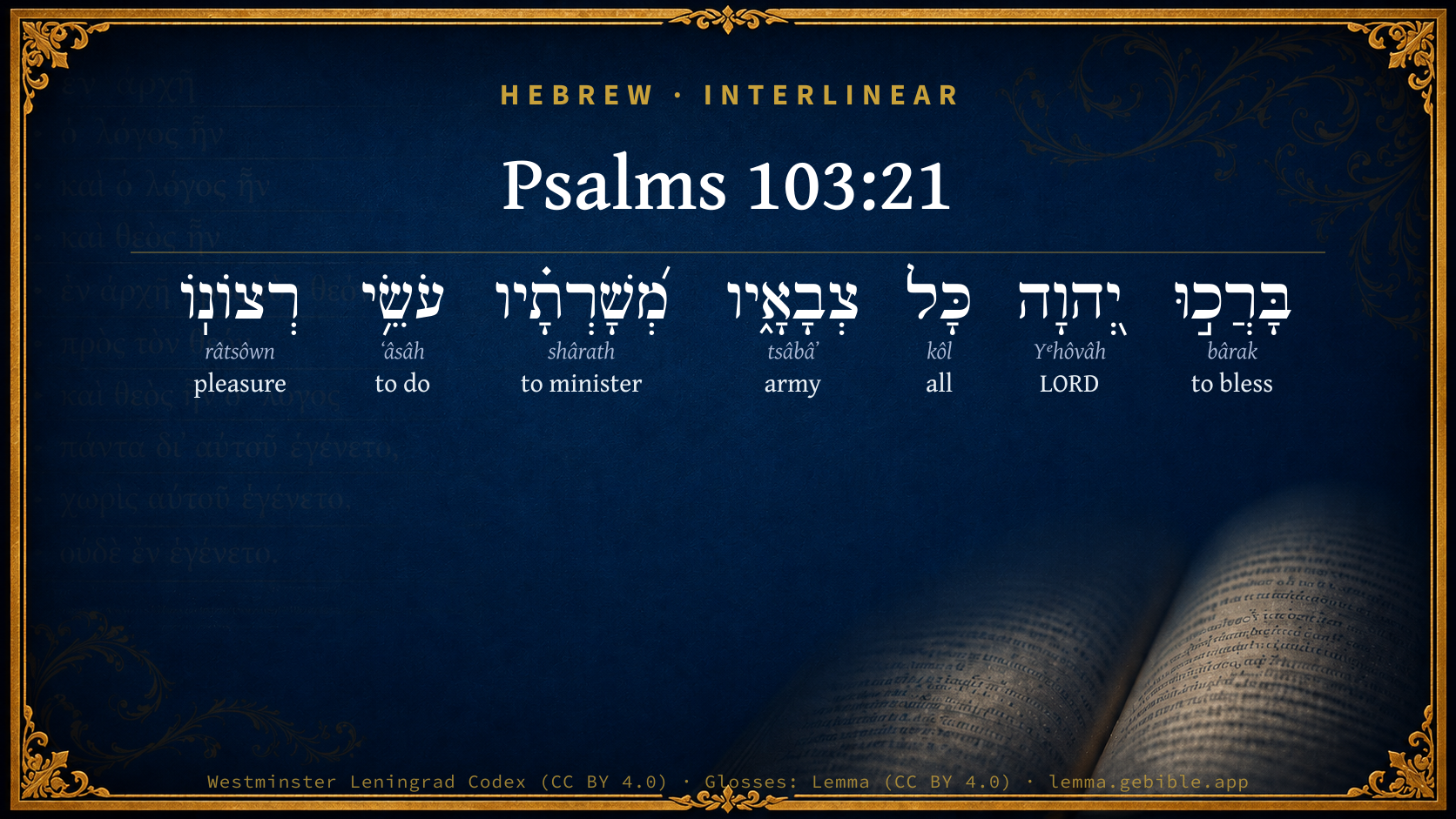
Hebrew (Westminster Leningrad Codex) Psalms 103:21 appears in the Hebrew Old Testament. The text above is from the Westminster Leningrad Codex. Each word links to its Strong’s number, a concise gloss, and parsing drawn from the Open Scriptures Hebrew Bible morphology. Click any word for its full Brown-Driver-Briggs (BDB) entry.
Download image
Cite this verse

Psalms 103:21 (World English Bible). Public Domain. Lemma interlinear Bible study tool, https://lemma.gebible.app/v/psalms/103/21.

Show BibTeX & RIS
BibTeX
RIS
English Translation
Praise Yahweh, all you hosts of his, You servants of his, who do his pleasure.
World English Bible · Public Domain
Download a study sheet

One document with this verse’s original text, its word-by-word gloss line, the meaning frame, cross-references with their text, attributed commentary, and full source and license credits — printable, and it pastes into notes with its structure intact.

This verse Autodidact and up

Study sheet (.html) Plain text (.txt)

A passage Seminary Student

Up to 50 verses in one chapter. A passage sheet keeps up to 6 commentary sources and 12 cross-references per verse, in the order this page ranks them, and says so on the sheet whenever that leaves anything out. Ask for a single verse and you get the Autodidact verse sheet above.

Everything on this page stays free to read, with no account — the sheet is a download of what is already on screen, not access to it.

Want to remove ads? Support Godless Engineer
Compare translations 3

The same verse in 3 English versions, stacked beneath the original-language interlinear above. Click any original word for its lexicon entry.

Each is an independent rendering of the whole verse — the interlinear is not word-aligned to these translations.

Highlighted words mark where these versions differ — a whole-verse word diff, not a word-by-word alignment.

  • World English Bible Public Domain
    Praise Yahweh, all you hosts of his, You servants of his, who do his pleasure.
  • King James Version Public Domain
    Bless ye the LORD, all ye his hosts; ye ministers of his, that do his pleasure.
  • unfoldingWord Literal Text CC BY-SA 4.0
    Bless Yahweh, all his hosts, ministering to him, doing his pleasure!

unfoldingWord Literal Text — © unfoldingWord, licensed CC BY-SA 4.0. Word-aligned USFM3 via Door43 (git.door43.org/unfoldingWord/en_ult).

Versions to compare (up to 4)

3 of 4 selected

Show all 18 translations

Every available English version of this verse, each an independent rendering of the whole verse.

  • World English Bible Public Domain
    Praise Yahweh, all you hosts of his, You servants of his, who do his pleasure.
  • Berean Standard Bible Public Domain
    Bless the LORD, all His hosts, you servants who do His will.
  • Majority Standard Bible Public Domain
    Bless the LORD, all His hosts, you servants who do His will.
  • King James Version Public Domain
    Bless ye the LORD, all ye his hosts; ye ministers of his, that do his pleasure.
  • American Standard Version (1901) Public Domain
    Bless Jehovah, all ye his hosts, Ye ministers of his, that do his pleasure.
  • Revised Version (1885) Public Domain
    Bless the LORD, all ye his hosts; ye ministers of his, that do his pleasure.
  • Geneva Bible (1599) Public Domain
    Prayse the Lord, all ye his hostes, ye his seruants that doe his pleasure.
  • Douay-Rheims (1899) Public Domain
    Bless the Lord, all ye his hosts: you ministers of his that do his will.
  • Young's Literal Translation Public Domain
    Bless Jehovah, all ye His hosts, His ministers -- doing His pleasure.
  • Literal Standard Version CC BY-SA 4.0
    Bless YHWH, all you His hosts, || His ministers—doing His pleasure.
  • Unlocked Literal Bible CC BY-SA 4.0
    Give praise to Yahweh, all his hosts, you are his servants who carry out his will.
  • unfoldingWord Literal Text CC BY-SA 4.0
    Bless Yahweh, all his hosts, ministering to him, doing his pleasure!
  • Darby Bible Public Domain
    Bless Jehovah, all ye his hosts; ye ministers of his that do his will.
  • World Messianic Bible Public Domain
    Praise the LORD, all you armies of his, you servants of his, who do his pleasure.
  • Webster's Bible Public Domain
    Bless ye the LORD, all ye his hosts; ye ministers of his, that do his pleasure.
  • Free Bible Version CC BY-SA 4.0
    Praise the Lord, you heavenly armies who serve him and carry out his will!
  • Bible in Basic English Public Domain
    Give praise to the Lord, all you his armies; and you his servants who do his pleasure.
  • JPS Tanakh (1917) Public Domain
    Bless the LORD, all ye His hosts; ye ministers of His, that do His pleasure.

Literal Standard Version (2020), Covenant Press — licensed CC BY-SA 4.0. Text via the HelloAO Bible API (eBible.org). Unlocked Literal Bible (unfoldingWord) — licensed CC BY-SA 4.0. Text via the HelloAO Bible API (eBible.org). unfoldingWord Literal Text — © unfoldingWord, licensed CC BY-SA 4.0. Word-aligned USFM3 via Door43 (git.door43.org/unfoldingWord/en_ult). Free Bible Version, Dr. Jonathan Gallagher — licensed CC BY-SA 4.0. Text via the HelloAO Bible API (eBible.org).

Word by word

More ways to search: Search by grammar → Find every occurrence → Compare this word →

Practice this passage: Drill this verse → Learn its vocabulary →

About this verse

These counts appear in no published source. They are computed here, from the morphology-tagged text and Lemma’s own curated glosses. What Lemma adds →

7
words
7
distinct lemmas
Wisdom
section

Shared distinctive vocabulary

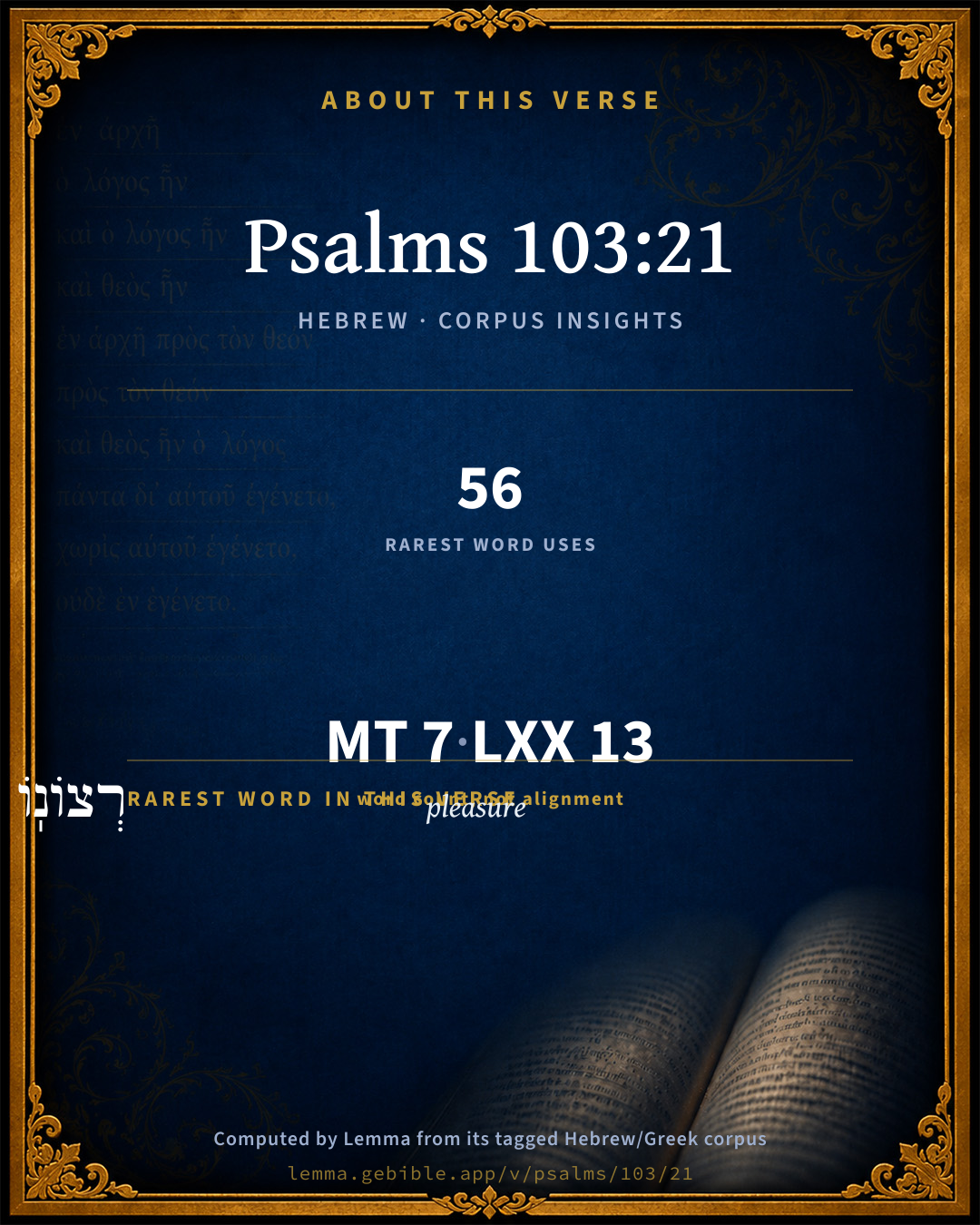
רְצוֹנֽוֹ pleasure H7522 occurs in 56 verses of the Hebrew Bible. Also found in:

Grammatical profile

  • 3 verbs
  • 4 nouns

Verb forms

  • בָּרֲכ֣וּ Piel · Imperative
  • מְ֝שָׁרְתָ֗יו Piel · Participle Active
  • עֹשֵׂ֥י Qal · Participle Active

Hebrew & Septuagint length

In English translation the verse runs 15 words from the Hebrew and 15 from the Septuagint (LXX English) — the same length.

A rough comparison of the two English renderings, which tokenize alike — not a word-level alignment.

Word counts can differ between the Hebrew and the Greek without any difference in meaning — e.g. the Hebrew direct-object marker אֵת has no separate Greek word, and Greek often adds the article ὁ.

In the original languages it is 7 Hebrew tokens and 13 Greek tokens — but the two are counted differently (Hebrew bundles its prefixes and suffixes into one token; the Greek is in lemma form), so that isn’t a like-for-like length.

Cross-references

16

Topical passages linked to Psalms 103:21 in the Treasury of Scripture Knowledge — connected by theme and wording, ordered by reader-vote popularity; previews shown in the World English Bible.

  • 1 Kings 22:19 [Micaiah] said, Therefore hear you the word of Yahweh: I saw Yahweh sitting on his throne, and all the host of heaven standing by him on his right hand and on his left.
  • Nehemiah 9:6 You are Yahweh, even you alone; you have made heaven, the heaven of heavens, with all their host, the earth and all things that are thereon, the seas and all that is in them, and you preserve them all; and the host of heaven worships you.
  • Luke 2:13 Suddenly, there was with the angel a multitude of the heavenly host praising God, and saying,
  • Psalms 104:4 He makes his messengers winds; His servants flames of fire.
  • Joshua 5:14 He said, No; but [as] prince of the host of Yahweh am I now come. Joshua fell on his face to the earth, and did worship, and said to him, What says my lord to his servant?
  • Hebrews 1:14 Aren't they all ministering spirits, sent out to do service for the sake of those who will inherit salvation?
  • Revelation 22:8–9 Now I, John, am the one who heard and saw these things. When I heard and saw, I fell down to worship before the feet of the angel who had shown me these things.
  • Genesis 32:2 When he saw them, Jacob said, "This is God's host." He called the name of that place Mahanaim.
  • 2 Chronicles 18:18 [Micaiah] said, Therefore hear you the word of Yahweh: I saw Yahweh sitting on his throne, and all the host of heaven standing on his right hand and on his left.
  • Psalms 33:6 By Yahweh's word the heavens were made; All their host by the breath of his mouth.
  • Psalms 68:17 The chariots of God are tens of thousands and thousands of thousands. The Lord is among them, from Sinai, into the sanctuary.
  • Daniel 7:9–10 I saw until thrones were placed, and one who was ancient of days sat: his clothing was white as snow, and the hair of his head like pure wool; his throne was fiery flames, [and] the wheels of it burning fire.
  • Matthew 13:41 The Son of Man will send out his angels, and they will gather out of his Kingdom all things that cause stumbling, and those who do iniquity,
  • Matthew 24:30–31 and then the sign of the Son of Man will appear in the sky. Then all the tribes of the earth will mourn, and they will see the Son of Man coming on the clouds of the sky with power and great glory.
  • 2 Thessalonians 1:7–8 and to give relief to you that are afflicted with us, when the Lord Jesus is revealed from heaven with his mighty angels in flaming fire,
  • Hebrews 1:6–7 Again, when he brings in the firstborn into the world he says, "Let all the angels of God worship him."

Cross-references courtesy of OpenBible.info (CC BY 4.0).

Hebrew and Greek witnesses Masoretic Hebrew ↔ Greek Septuagint

The same verse in the two great witnesses to the Old Testament, shown verse-for-verse.

You’re reading Greek Psalm 102 (Hebrew Psalm 103). The Septuagint counts the superscription, so verse numbers can differ from the Hebrew — chapter-level alignment, not verse-by-verse. Numbering follows Rahlfs.

These are two independent witnesses, not word-aligned to each other, and the Septuagint is shown in lemma (dictionary) form.

Hebrew Psalms 103:21 Masoretic · Westminster Leningrad Codex

בָּרֲכ֣וּ יְ֭הוָה כָּל צְבָאָ֑יו מְ֝שָׁרְתָ֗יו עֹשֵׂ֥י רְצוֹנֽוֹ

Praise Yahweh, all you hosts of his, You servants of his, who do his pleasure.

World English Bible · Public Domain

Greek LXX Greek Psalm 102:21 Septuagint · lemma form

εὐλογέω ὁ κύριος πᾶς ὁ δύναμις αὐτός λειτουργός αὐτός ποιέω ὁ θέλημα αὐτός

Bless the Lord, all you⌃ his hosts; you⌃ ministers of his that do his will.

LXX2012 (modern English Septuagint) · Public Domain

Hebrew: Westminster Leningrad Codex (CC BY 4.0). Greek: Septuagint (public domain); English from LXX2012 (modern English Septuagint) (Public Domain). How the Septuagint differs from the Hebrew →

Commentary

Notes on Psalms 103:21 from classic Christian and Jewish commentators (each source and its license shown beneath its notes). The classic Christian expositions comment on the surrounding passage and are grouped to its opening verse, so a note may address several verses; the Jewish commentaries on the Tanakh (Rashi and others) are per-verse, so they appear only where the commentator wrote on this verse.

Lemma curates 59 commentaries, every one of them public domain or Creative Commons licensed, each selected and text-cleaned for this edition rather than reprinted as found. About our sources →

Trapp's Complete Commentary

John Trapp

Psa 103:21 Bless ye the LORD, all [ye] his hosts; [ye] ministers of his, that do his pleasure.

Ver. 21. Bless ye the Lord, all ye his hosts] That is, all his creatures, which are fitly called God’s hosts, first, for their number; secondly, for their order; thirdly, for their obedience.

Ye ministers of his] Whether in State or Church. Kings are God’s ministers, Rom 13:4; Rom 13:6. So are angels, Heb 1:14, like as ministers are angels, Rev 2:1; they have exchanged names, their office is, angel-like, to wait upon God, to stand before him, to serve in his presence, and to bless his name.

John Trapp, A Commentary or Exposition upon All the Books of the Old and New Testament (1647–1656) — public domain. Text from a community e-Sword module.

J. A. Alexander on Psalms

Joseph Addison Alexander

21. (Psa 103:21) Bless Jehovah, ye his hosts, his ministers, the doers of his will. As the word hosts is applied both to the angels and the heavenly bodies (see above, on Psa 24:10), some interpreters, in order to relieve this verse of a tautology, suppose it to relate to the heavenly hosts in one sense, as the preceding verse does in another. In the same way they account for the change of expression in the last clause. Only intelligent creatures can be literally said to listen for God's word and to obey it; but even the inanimate creation may be said, without a metaphor, to execute his will. This last phrase occurs also in Psa 40:8.

Joseph Addison Alexander, The Psalms Translated and Explained (1850) — public domain. Text from a community e-Sword module.

Adam Clarke's Commentary

Verse 21. All ye his hosts; ye ministers of his] We know almost nothing of the economy of the heavenly host; and, therefore, cannot tell what is the difference between angels, mighty powers, hosts, and ministers who do his pleasure. All owe their being and all its blessings to God; all depend upon his bounty; and without him they can do nothing; therefore, all should praise him.

Adam Clarke's Commentary on the Bible (1810–1826) — public domain. Text from a community e-Sword/MySword module.

John Calvin's Commentaries

21 Bless Jehovah, all ye his hosts. By hosts is not to be understood the stars, as some explain it. The subject of the preceding verse is still continued. Nor is the repetition superfluous; for the word hosts teaches us that there are myriads of myriads who stand before the throne of God, ready to receive every intimation of his will. Again, they are called his ministers who do his pleasure, to intimate to us, that they are not there intent in idly beholding God’s glory, but that having been appointed as our ministers and guardians, they are always ready for their work. Instead of word, the term pleasure is here used, and both are employed with much propriety; for although the sun, the moon, and the stars, observe the laws which God has ordained for them, yet being without understanding, they cannot properly be said to obey his word and his voice. The term obey is indeed sometimes transferred to the mute and insensible parts of creation. It is, however, only in a metaphorical sense that they can be said to hearken to God’s voice, when by a secret instinct of nature they fulfill his purposes. But this in the proper sense is true of angels, who actively obey him upon their understanding from his sacred mouth what he would have them to do. The word pleasure expresses more plainly a joyful and cheerful obedience, implying that the angels not only obey God’s commandments, but also willingly and with the greatest delight receive the intimations of his will, that they may perform what he would have them to do. Such is the import of the Hebrew noun, as has been stated elsewhere.

John Calvin's Commentaries (1540-1563) — public domain. Text from the Calvin Translation Society English edition (1840s-50s) via the Christian Classics Ethereal Library (ccel.org). Calvin's coverage is partial (roughly two-thirds of the Bible); uncommented books and verses are honest gaps, never fabricated. The 19th-century editor's footnotes and remarks are omitted so the notes are faithfully Calvin's own voice.

Ellicott's Commentary for English Readers

(21) Hosts.—There are apparently in the psalmist’s thought three grades of beings in the hierarchy of praise:—

1. High angels around the throne.

2. Angelic powers, such as winds, lightnings, &c, specially commissioned to do God’s behests, as in Psa_104:4.

3. Creation generally. (Comp. Psalms 148)

A Bible Commentary for English Readers, edited by Charles John Ellicott (1878–1897) — public domain. Text from a community e-Sword module.

The Cambridge Bible for Schools and Colleges

gen. ed. J. J. S. Perowne

21. By Jehovah’s hosts and ministers may be meant the innumerable multitudes of celestial beings of lower rank, subordinated to the celestial hierarchy spoken of in Psa_103:20 (Dan_7:10; Heb_1:14); or perhaps “the host of heaven,” the stars, which are closely connected with angels in the O.T. (Job_38:7), and all the powers of Nature, which subserve Jehovah’s purposes (Psa_104:4; Psa_148:2-3).

The Cambridge Bible for Schools and Colleges (gen. ed. J. J. S. Perowne; Cambridge University Press, 1878–1918) — public domain. Text from a community e-Sword module.

Albert Barnes' Notes on the Bible

Bless ye the Lord, all ye his hosts - His armies; the vast multitudes of holy beings, arranged and marshalled as hosts for battle, in all parts of the universe. Compare the notes at Isa 1:9; notes at Eph 1:21.

Ye ministers of his - The same beings referred to by the word “hosts,” and all others who may be employed in executing his will. The “hosts” or armies of the Lord are thus marshalled that they may “do his pleasure,” or that they may execute his purposes.

That do his pleasure - What is agreeable to him; that is, who perform his will. Employed in his service, and appointed to execute his will, they are called on to bless his name. The fact of being employed in his service is a sufficient reason for praise. It is implied here that those “ministers of his” actually do his will. They are obedient to his commands; they regard themselves as employed for him.

Albert Barnes' Notes on the Bible (1834–1885) — public domain. Text from a community e-Sword/MySword module.

Matthew Poole's English Annotations

All ye his hosts; ye angels; to whom he still continues his address, and whom he more particularly describes by the name of hosts, a title oft given to the angels, as Gen 32:2; 1Ki 22:19; 2Ch 18:18; Luk 2:13; Rev 19:14, in regard of their vast numbers, mighty power, unanimous concurrence, and exquisite order. In the former verse the expression was indefinite and general, ye his angels, here it is universal and yet particular,

all ye his hosts. He seems to apply himself to the several orders of angels, of whom see Eph 3:10; Col 1:16, and to each individual angel.

Ye ministers: this Hebrew word is commonly used of the highest and most honourable sort of servants.

That do his pleasure; whose constant business and delight it is to execute the will and commands of God.

Matthew Poole's English Annotations on the Holy Bible (1683–1685) — public domain. Text from a community e-Sword/MySword module.

The Treasury of David

Charles H. Spurgeon

Ver. 21. Bless ye the Lord, all ye his hosts; to whatever race of creatures ye may belong, for ye are all his troops, and he is the Generallissimo of all your armies. The fowl of the air and the fish of the sea, and whatsoever passeth through the paths of the sea, should all unite in praising their Creator, after the best of their ability.

Ye ministers of his that do his pleasure; in whatever way ye serve him, bless him as ye serve. The Psalmist would have every servant in the Lord's palace unite with him, and all at once sing out the praises of the Lord. We have attached a new sense to the word "ministers" in these latter days, and so narrowed it down to those who serve in word and doctrine. Yet no true minister would wish to alter it, for we are above all men bound to be the Lord's servants, and we would, beyond all other ministering intelligences or forces, desire to bless the glorious Lord.

Ver. 21. Bless ye the LORD, all ye his hosts... that do his pleasure. The sun, moon, stars, and planets do "his pleasure" (Ps 19:1) unconsciously; the "angels" consciously and with instinctive love, "hearken unto the voice of his word" (Ps 103:20). Both together constitute the Lord's hosts. A. R. Fausset.

Ver. 21. Who are God's ministers? What is their business? To do his pleasure. What is their delight? To bless the Lord.

Ver. 21-22. Henry Melvill has a notable sermon upon "The Peril of the Spiritual Guide." The drift of it may be gathered from the extract which wc have placed as a note upon the passage.

Psalms 103:22*

Charles H. Spurgeon's The Treasury of David (1869–1885) — public domain. Psalms only. Text from a community e-Sword/MySword module.

Whedon's Commentary on the Bible

Daniel D. Whedon

21. Hosts—Not the heavenly bodies, (as in Deu_4:19; Deu_17:3; Psa_33:6,) but the collective whole of all orders of celestial beings, as 1Ki_22:19 and Psa_148:2. Compare Dan_7:10.

Ye ministers—Same as “hosts” in previous clause. Angels are called ministers, in Heb_1:14; Psa_104:4; Dan_7:10

Daniel D. Whedon (gen. ed.), Commentary on the Old and New Testaments (1874–1909) — public domain. Text from a community e-Sword module.

The Pulpit Commentary

Bless ye the Lord, all ye his hosts. Here the inferior angels seem to be meant that "multitude of the host of heaven" which appeared to the shepherds on Christ"s natal day, (Luk_2:13) and which is elsewhere often referred to in Holy Scripture. (see Psa_24:10 Psa_148:2 Isa_40:26 Mat_25:31 Mar_8:38 Luk_9:26 Heb_12:22 Jud_1:14) Ye ministers of his (comp. Psa_104:4) that do his pleasure. The inferior, no less than the superior, ranks of angels continually carry out the will of God, being "ministering spirits, sent forth to minister for them who shall be heirs of salvation". (Heb_1:14)

The Pulpit Commentary (1880–1919), ed. H.D.M. Spence-Jones & Joseph S. Exell — public domain. Text from a community e-Sword module.

John Wesley's Explanatory Notes

His hosts - A title often given to the angels, in regard of their vast numbers, mighty power, unanimous concurrence, and exquisite order. Ministers - This Hebrew word is commonly used of the highest and most honourable sort of servants,

John Wesley, Explanatory Notes Upon the Whole Bible (1754–1765) — public domain. Text via the GEBible commentary corpus.

Lesson kit

Teaching starters — assembled from the data on this page, not authored interpretation. Every prompt links to the verse data it draws on. Edit before teaching.

Psalms, in the Wisdom, opens this verse with 7 words (7 distinct Hebrew lemmas). Its most distinctive word is râtsôwn (“pleasure”). A historical commentator’s framing appears above. Read the whole chapter for the surrounding context.

Discussion questions

  1. How does “pleasure” (râtsôwn) shape what this verse is saying?
  2. How does Genesis 49:6, which shares the word «pleasure», read alongside this verse?
  3. The translations on this page render this verse differently — a whole-verse word diff, not a word-by-word alignment. What might account for the different wordings?
  4. «בָּרֲכ֣וּ» is a Piel Imperative verb. How does that grammatical form shape the action described?
  5. Compare how Trapp's Complete Commentary and J. A. Alexander on Psalms read this verse. Where do they agree or differ?

Things to notice

Reading settings

Reading text

Shown beneath each verse's original-language words.

Old Testament
Old Testament edition

Read the OT as the Masoretic Hebrew (MT) or the Greek Septuagint (LXX).

English shown for the Greek Septuagint (in the Hebrew ↔ Greek comparison).

Comparing translations? Open the Compare panel on any verse page to stack up to four side by side.