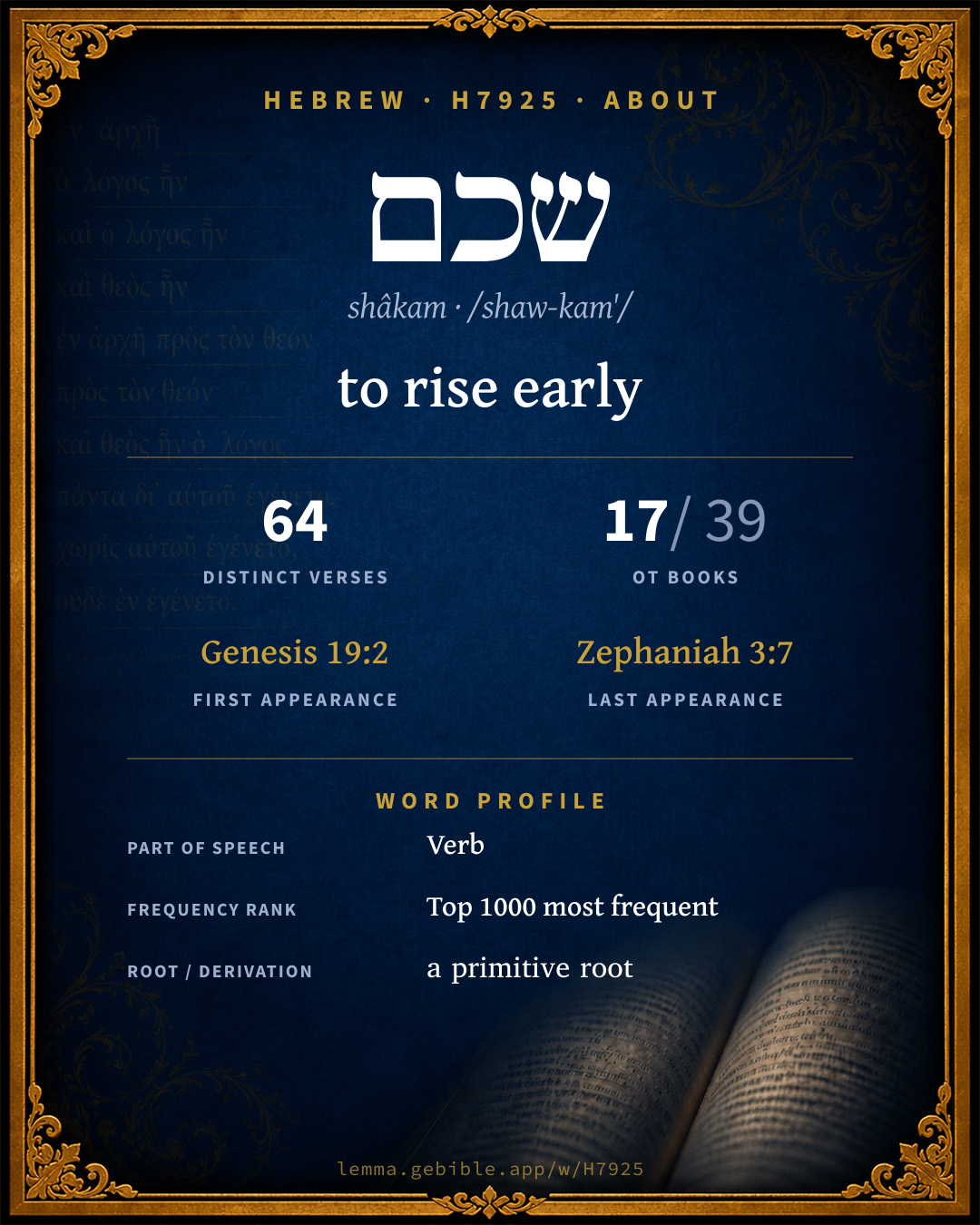
שָׁכַם
to rise early
‘to rise early’ is one of 3 main senses fuller range ↓
Full lexicon entry — Brown-Driver-Briggs (BDB)
From Brown-Driver-Briggs (BDB)
Where this word appears
Grammar key — what these labels mean
Part of speech
- Verb
- An action or state-of-being word.
Stem
- Hiphil
- The causative active stem (“he caused / brought about”).
Form
- Sequential Imperfect
- An imperfect with prefixed waw — the standard past-narrative form (waw-consecutive imperfect).
- Infinitive Absolute
- An unbound verbal noun, often intensifying or standing in for a finite verb.
- Imperative
- A direct command (“write!”).
- Sequential Perfect
- A perfect with prefixed waw continuing a preceding imperfect or command (waw-consecutive perfect).
- Participle Active
- A verbal adjective expressing ongoing or characteristic action (“writing / one who writes”).
- Perfect
- A completed action or state — Hebrew marks aspect (completeness) more than strict tense (“he wrote”).
- Cohortative
- A first-person volitional form expressing wish or resolve (“let me / let us write”).
- Imperfect
- An incomplete, ongoing, or future action (“he will / would write”).
State
- Construct
- A noun bound to a following noun in a possessive / “of” relationship (the construct chain).
- Absolute
- The independent form of a noun, not bound to a following word.
Person
- 3rd Person
- The one spoken about (“he / she / it / they”).
- 2nd Person
- The one addressed (“you”).
- 1st Person
- The speaker (“I / we”).
Gender
- Masculine
- Grammatically masculine.
- Common
- Either gender — not distinguished for this form.
Number
- Singular
- One.
- Plural
- More than one (in Hebrew, generally three or more).
Grammatical forms 13 distinct
- Verb, Hiphil, Sequential Imperfect, 3rd Person, Masculine, Singular 20 times (31%)
- Verb, Hiphil, Sequential Imperfect, 3rd Person, Masculine, Plural 16 times (25%)
- Verb, Hiphil, Infinitive Absolute 14 times (22%)
- Verb, Hiphil, Imperative, 2nd Person, Masculine, Singular 3 times (5%)
- Verb, Hiphil, Sequential Perfect, 2nd Person, Masculine, Plural 2 times (3%)
- Verb, Hiphil, Participle Active, Masculine, Plural, Construct 2 times (3%)
- Verb, Hiphil, Participle Active, Masculine, Singular, Absolute 2 times (3%)
- Verb, Hiphil, Perfect, 2nd Person, Masculine, Plural 1 time (2%)
+5 more forms (5 occurrences)
Parsed forms decoded from the imported morphology (morphhb / Westminster Leningrad Codex — WLC text public domain, morphhb tagging CC BY 4.0), counted across 65 parsed occurrences — not distinct verses.
Every verse where H7925 appears — 64 distinct verses across 17 books. Click any verse to open its interlinear word-by-word view. Verse text shown in the World English Bible for context — . Each verse’s Hebrew form is shown with its reference; the English is not keyword-highlighted, since the data carries no word-level English alignment. Use “Compare translations” on any verse to read it across multiple English versions. This concordance covers the Hebrew Bible; Septuagint (Greek Old Testament) occurrences are not indexed here.
Genesis 8 verses
- Genesis 19:2 וְ/הִשְׁכַּמְתֶּ֖ם conj + Hiphil pf 2mp and he said, "See now, my lords, please turn aside into your servant's house, stay all night, wash your feet, and you will rise up early, and go on your way." They said, "No, but we will stay in the street all night."
- Genesis 19:27 וַ/יַּשְׁכֵּ֥ם conj + Hiphil wimpf 3ms Abraham got up early in the morning to the place where he had stood before Yahweh.
- Genesis 20:8 וַ/יַּשְׁכֵּ֨ם conj + Hiphil wimpf 3ms Abimelech rose early in the morning, and called all his servants, and told all these things in their ear. The men were very scared.
- Genesis 21:14 וַ/יַּשְׁכֵּ֣ם conj + Hiphil wimpf 3ms Abraham rose up early in the morning, and took bread and a bottle of water, and gave it to Hagar, putting it on her shoulder, and gave her the child, and sent her away. She departed, and wandered in the wilderness of Beersheba.
- Genesis 22:3 וַ/יַּשְׁכֵּ֨ם conj + Hiphil wimpf 3ms Abraham rose early in the morning, and saddled his donkey, and took two of his young men with him, and Isaac his son. He split the wood for the burnt offering, and rose up, and went to the place of which God had told him.
- Genesis 26:31 וַ/יַּשְׁכִּ֣ימוּ conj + Hiphil wimpf 3mp They rose up some time in the morning, and swore one to another. Isaac sent them away, and they departed from him in peace.
- Genesis 28:18 וַ/יַּשְׁכֵּ֨ם conj + Hiphil wimpf 3ms Jacob rose up early in the morning, and took the stone that he had put under his head, and set it up for a pillar, and poured oil on the top of it.
- Genesis 31:55 וַ/יַּשְׁכֵּ֨ם conj + Hiphil wimpf 3ms Early in the morning, Laban rose up, and kissed his sons and his daughters, and blessed them. Laban departed and returned to his place.
Exodus 5 verses
- Exodus 8:20 הַשְׁכֵּ֤ם Hiphil impv 2ms Yahweh said to Moses, "Rise up early in the morning, and stand before Pharaoh; behold, he comes forth to the water; and tell him, 'This is what Yahweh says, "Let my people go, that they may serve me.
- Exodus 9:13 הַשְׁכֵּ֣ם Hiphil impv 2ms Yahweh said to Moses, "Rise up early in the morning, and stand before Pharaoh, and tell him, 'This is what Yahweh, the God of the Hebrews, says: "Let my people go, that they may serve me.
- Exodus 24:4 וַ/יַּשְׁכֵּ֣ם conj + Hiphil wimpf 3ms Moses wrote all the words of Yahweh, and rose up early in the morning, and built an altar under the mountain, and twelve pillars for the twelve tribes of Israel.
- Exodus 32:6 וַ/יַּשְׁכִּ֨ימוּ֙ conj + Hiphil wimpf 3mp They rose up early on the next day, and offered burnt offerings, and brought peace-offerings; and the people sat down to eat and to drink, and rose up to play.
- Exodus 34:4 וַ/יַּשְׁכֵּ֨ם conj + Hiphil wimpf 3ms He chiseled two tablets of stone like the first; and Moses rose up early in the morning, and went up to Mount Sinai, as Yahweh had commanded him, and took in his hand two stone tablets.
Numbers 1 verse
Joshua 6 verses
- Joshua 3:1 וַ/יַּשְׁכֵּם֩ conj + Hiphil wimpf 3ms Joshua rose up early in the morning; and they removed from Shittim, and came to the Jordan, he and all the children of Israel; and they lodged there before they passed over.
- Joshua 6:12 וַ/יַּשְׁכֵּ֥ם conj + Hiphil wimpf 3ms Joshua rose early in the morning, and the priests took up the ark of Yahweh.
- Joshua 6:15 וַ/יַּשְׁכִּ֨מוּ֙ conj + Hiphil wimpf 3mp It happened on the seventh day, that they rose early at the dawning of the day, and compassed the city after the same manner seven times: only on the day they compassed the city seven times.
- Joshua 7:16 וַ/יַּשְׁכֵּ֤ם conj + Hiphil wimpf 3ms So Joshua rose up early in the morning, and brought Israel near by their tribes; and the tribe of Judah was taken:
- Joshua 8:10 וַ/יַּשְׁכֵּ֤ם conj + Hiphil wimpf 3ms Joshua arose up early in the morning, and mustered the people, and went up, he and the elders of Israel, before the people to Ai.
- Joshua 8:14 וַ/יַּשְׁכִּ֡ימוּ conj + Hiphil wimpf 3mp It happened, when the king of Ai saw it, that they hurried and rose up early, and the men of the city went out against Israel to battle, he and all his people, at the time appointed, before the Arabah; but he didn't know that there was an ambush against him behind the city.
Judges 8 verses
- Judges 6:28 וַ/יַּשְׁכִּ֜ימוּ conj + Hiphil wimpf 3mp When the men of the city arose early in the morning, behold, the altar of Baal was broken down, and the Asherah was cut down that was by it, and the second bull was offered on the altar that was built.
- Judges 6:38 וַ/יַּשְׁכֵּם֙ conj + Hiphil wimpf 3ms It was so; for he rose up early on the next day, and pressed the fleece together, and wrung the dew out of the fleece, a bowl full of water.
- Judges 7:1 וַ/יַּשְׁכֵּ֨ם conj + Hiphil wimpf 3ms Then Jerubbaal, who is Gideon, and all the people who were with him, rose up early, and encamped beside the spring of Harod: and the camp of Midian was on the north side of them, by the hill of Moreh, in the valley.
- Judges 9:33 תַּשְׁכִּ֖ים Hiphil impf 2ms and it shall be, that in the morning, as soon as the sun is up, you shall rise early, and rush on the city; and, behold, when he and the people who are with him come out against you, then may you do to them as you shall find occasion.
- Judges 19:5 וַ/יַּשְׁכִּ֥ימוּ conj + Hiphil wimpf 3mp It happened on the fourth day, that they arose early in the morning, and he rose up to depart: and the young lady's father said to his son-in-law, Strengthen your heart with a morsel of bread, and afterward you shall go your way.
- Judges 19:8 וַ/יַּשְׁכֵּ֨ם conj + Hiphil wimpf 3ms He arose early in the morning on the fifth day to depart; and the young lady's father said, Please strengthen your heart and stay until the day declines; and they ate, both of them.
- Judges 19:9 וְ/הִשְׁכַּמְתֶּ֤ם conj + Hiphil wpf 2mp When the man rose up to depart, he, and his concubine, and his servant, his father-in-law, the young lady's father, said to him, Behold, now the day draws toward evening, please stay all night: behold, the day grows to an end, lodge here, that your heart may be merry; and tomorrow get you early on your way, that you may go home.
- Judges 21:4 וַ/יַּשְׁכִּ֣ימוּ conj + Hiphil wimpf 3mp It happened on the next day that the people rose early, and built there an altar, and offered burnt offerings and peace-offerings.
1 Samuel 9 verses
- 1 Samuel 1:19 וַ/יַּשְׁכִּ֣מוּ conj + Hiphil wimpf 3mp They rose up in the morning early, and worshiped before Yahweh, and returned, and came to their house to Ramah: and Elkanah knew Hannah his wife; and Yahweh remembered her.
- 1 Samuel 5:3 וַ/יַּשְׁכִּ֤מוּ conj + Hiphil wimpf 3mp When they of Ashdod arose early on the next day, behold, Dagon was fallen on his face to the ground before the ark of Yahweh. They took Dagon, and set him in his place again.
- 1 Samuel 5:4 וַ/יַּשְׁכִּ֣מוּ conj + Hiphil wimpf 3mp When they arose early on the next day morning, behold, Dagon was fallen on his face to the ground before the ark of Yahweh; and the head of Dagon and both the palms of his hands [lay] cut off on the threshold; only [the stump of] Dagon was left to him.
- 1 Samuel 9:26 וַ/יַּשְׁכִּ֗מוּ conj + Hiphil wimpf 3mp They arose early: and it happened about the spring of the day, that Samuel called to Saul on the housetop, saying, Up, that I may send you away. Saul arose, and they went out both of them, he and Samuel, abroad.
- 1 Samuel 15:12 וַ/יַּשְׁכֵּ֧ם conj + Hiphil wimpf 3ms Samuel rose early to meet Saul in the morning; and it was told Samuel, saying, Saul came to Carmel, and, behold, he set him up a monument, and turned, and passed on, and went down to Gilgal.
- 1 Samuel 17:16 הַשְׁכֵּ֣ם Hiphil inf.abs The Philistine drew near morning and evening, and presented himself forty days.
- 1 Samuel 17:20 וַ/יַּשְׁכֵּ֨ם conj + Hiphil wimpf 3ms David rose up early in the morning, and left the sheep with a keeper, and took, and went, as Jesse had commanded him; and he came to the place of the wagons, as the host which was going forth to the fight shouted for the battle.
- 1 Samuel 29:10 הַשְׁכֵּ֣ם וְ/הִשְׁכַּמְתֶּ֣ם Hiphil impv 2ms conj + Hiphil wpf 2mp Therefore now rise up early in the morning with the servants of your lord who have come with you; and as soon as you are up early in the morning, and have light, depart.
- 1 Samuel 29:11 וַ/יַּשְׁכֵּ֨ם conj + Hiphil wimpf 3ms So David rose up early, he and his men, to depart in the morning, to return into the land of the Philistines. The Philistines went up to Jezreel.
2 Samuel 1 verse
2 Kings 3 verses
- 2 Kings 3:22 וַ/יַּשְׁכִּ֣ימוּ conj + Hiphil wimpf 3mp They rose up early in the morning, and the sun shone on the water, and the Moabites saw the water over against them as red as blood:
- 2 Kings 6:15 וַ֠/יַּשְׁכֵּם conj + Hiphil wimpf 3ms When the servant of the man of God was risen early, and gone forth, behold, a host with horses and chariots was round about the city. His servant said to him, Alas, my master! how shall we do?
- 2 Kings 19:35 וַ/יַּשְׁכִּ֣ימוּ conj + Hiphil wimpf 3mp It happened that night, that the angel of Yahweh went forth, and struck in the camp of the Assyrians one hundred eighty-five thousand: and when men arose early in the morning, behold, these were all dead bodies.
2 Chronicles 3 verses
- 2 Chronicles 20:20 וַ/יַּשְׁכִּ֣ימוּ conj + Hiphil wimpf 3mp They rose early in the morning, and went forth into the wilderness of Tekoa: and as they went forth, Jehoshaphat stood and said, Hear me, Judah, and you inhabitants of Jerusalem: believe in Yahweh your God, so shall you be established; believe his prophets, so shall you prosper.
- 2 Chronicles 29:20 וַ/יַּשְׁכֵּם֙ conj + Hiphil wimpf 3ms Then Hezekiah the king arose early, and gathered the princes of the city, and went up to the house of Yahweh.
- 2 Chronicles 36:15 הַשְׁכֵּ֣ם Hiphil inf.abs Yahweh, the God of their fathers, sent to them by his messengers, rising up early and sending, because he had compassion on his people, and on his dwelling-place:
Job 1 verse
Psalms 1 verse
Proverbs 1 verse
Song of Solomon 1 verse
Isaiah 2 verses
- Isaiah 5:11 מַשְׁכִּימֵ֥י Hiphil ptcp.act mp cs Woe to those who rise up early in the morning, that they may follow strong drink; Who stay late into the night, until wine inflames them!
- Isaiah 37:36 וַ/יַּשְׁכִּ֣ימוּ conj + Hiphil wimpf 3mp The angel of Yahweh went forth, and struck in the camp of the Assyrians one hundred and eighty-five thousand; and when men arose early in the morning, behold, these were all dead bodies.
Jeremiah 11 verses
- Jeremiah 7:13 הַשְׁכֵּ֤ם Hiphil inf.abs Now, because you have done all these works, says Yahweh, and I spoke to you, rising up early and speaking, but you didn't hear; and I called you, but you didn't answer:
- Jeremiah 7:25 הַשְׁכֵּ֥ם Hiphil inf.abs Since the day that your fathers came forth out of the land of Egypt to this day, I have sent to you all my servants the prophets, daily rising up early and sending them:
- Jeremiah 11:7 הַשְׁכֵּ֥ם Hiphil inf.abs For I earnestly protested to your fathers in the day that I brought them up out of the land of Egypt, even to this day, rising early and protesting, saying, Obey my voice.
- Jeremiah 25:3 אַשְׁכֵּ֥ים Hiphil inf.abs From the thirteenth year of Josiah the son of Amon, king of Judah, even to this day, these twenty-three years, the word of Yahweh has come to me, and I have spoken to you, rising up early and speaking; but you have not listened.
- Jeremiah 25:4 הַשְׁכֵּ֥ם Hiphil inf.abs Yahweh has sent to you all his servants the prophets, rising up early and sending them, (but you have not listened, nor inclined your ear to hear),
- Jeremiah 26:5 וְ/הַשְׁכֵּ֥ם conj + Hiphil inf.abs to listen to the words of my servants the prophets, whom I send to you, even rising up early and sending them, but you have not listened;
- Jeremiah 29:19 הַשְׁכֵּ֣ם Hiphil inf.abs because they have not listened to my words, says Yahweh, with which I sent to them my servants the prophets, rising up early and sending them; but you would not hear, says Yahweh.
- Jeremiah 32:33 הַשְׁכֵּ֣ם Hiphil inf.abs They have turned to me the back, and not the face: and though I taught them, rising up early and teaching them, yet they have not listened to receive instruction.
- Jeremiah 35:14 הַשְׁכֵּ֣ם Hiphil inf.abs The words of Jonadab the son of Rechab, that he commanded his sons, not to drink wine, are performed; and to this day they drink none, for they obey their father's commandment: but I have spoken to you, rising up early and speaking; and you have not listened to me.
- Jeremiah 35:15 הַשְׁכֵּ֣ים Hiphil inf.abs I have sent also to you all my servants the prophets, rising up early and sending them, saying, Return you now every man from his evil way, and amend your doings, and don't go after other gods to serve them, and you shall dwell in the land which I have given to you and to your fathers: but you have not inclined your ear, nor listened to me.
- Jeremiah 44:4 הַשְׁכֵּ֥ים Hiphil inf.abs However I sent to you all my servants the prophets, rising up early and sending them, saying, Oh, don't do this abominable thing that I hate.
Hosea 2 verses
- Hosea 6:4 מַשְׁכִּ֥ים Hiphil ptcp.act ms "Ephraim, what shall I do to you? Judah, what shall I do to you? For your love is like a morning cloud, And like the dew that disappears early.
- Hosea 13:3 מַשְׁכִּ֣ים Hiphil ptcp.act ms Therefore they will be like the morning cloud, And like the dew that passes away early, Like the chaff that is driven with the whirlwind out of the threshing floor, And like the smoke out of the chimney.
Zephaniah 1 verse
About this entry
At a glance — auto-summarized from this page’s data, not written by a person. Every figure links to its source below. This summary describes the numbers; it doesn’t interpret them.
שכם — transliterated shâkam — is a Hebrew verb carrying the sense “to rise early.” Its English rendering has broadened — “rose up early” classically, “again and again” (Berean Standard Bible) and “and” (unfoldingWord Literal Text) in modern versions; see the renderings breakdown. The Hebrew Bible uses it across 64 verses — moderately common. It first appears in Genesis 19:2. Its lexical range runs to 3 senses. Each statement above links to its evidence; the full detail follows below.
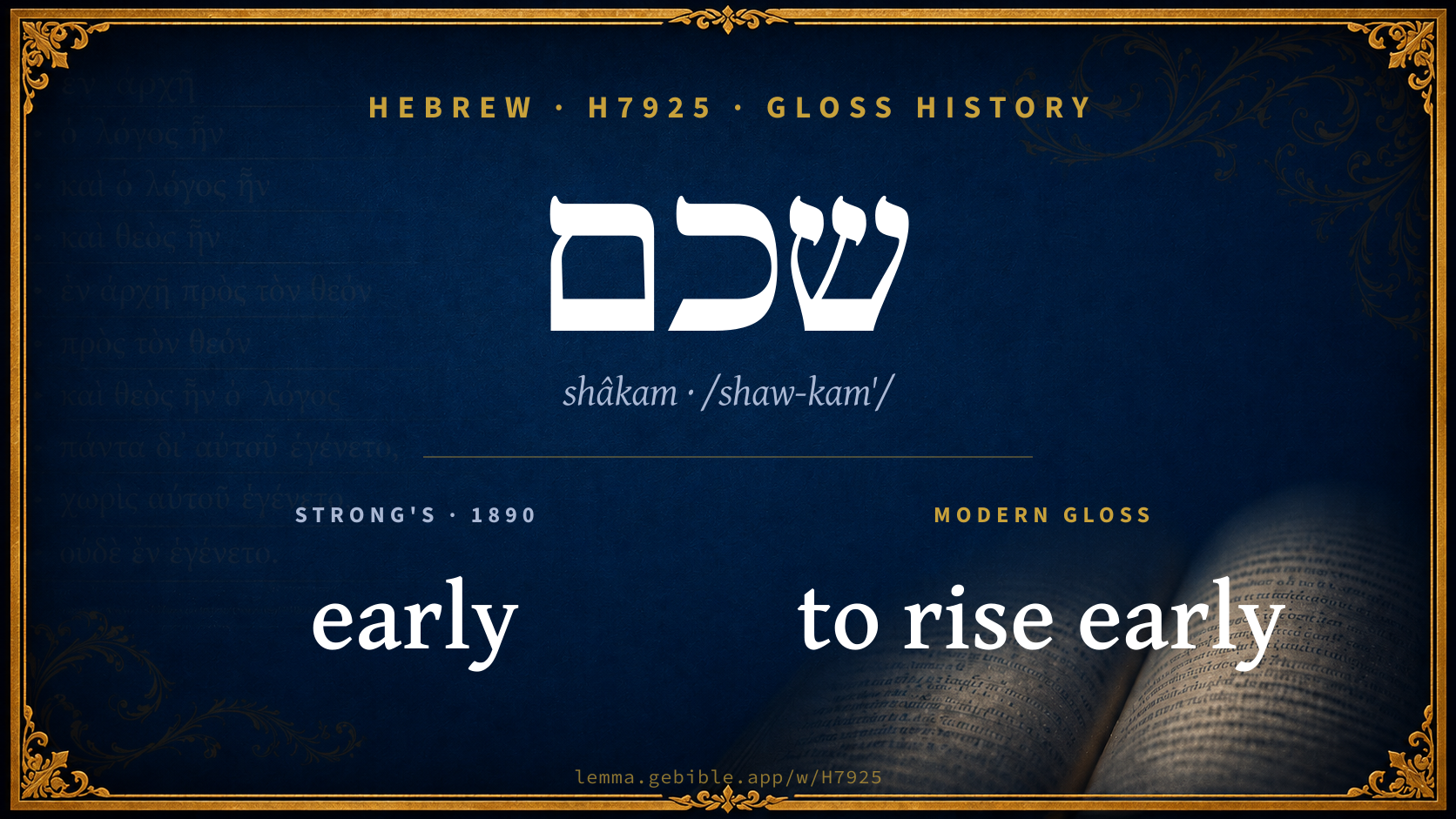
Gloss history
Strong's 1890 vs modern scholarship
About this word
Strong's H7925 catalogs a Hebrew word from the Hebrew Old Testament.
These counts are not copied from any lexicon or concordance. They are computed here, from the morphology-tagged Hebrew Old Testament. What Lemma adds →
- 64
- distinct verses
- The word appears in 64 distinct verses.
- 17 / 39
- OT books
- The word appears in 17 of 39 Old Testament books.
- #597
- by frequency
- Top 1000 most frequent Hebrew words (rank 597 of 8,640 Hebrew words by occurrence).
View all 64 occurrences in the concordance →
By section of the Old Testament
By traditional corpus
Conventional, traditional groupings — biblical authorship is debated, so this is a traditional corpus grouping, not an authorship claim. Each share is this word’s portion of its verses in that division of the Hebrew canon. Each figure is a share of the word’s 64 distinct verses.
- Prophets (Nevi'im) 43 verses · 67%
- Torah (Pentateuch) 14 verses · 22%
- Writings (Ketuvim) 7 verses · 11%
How translations render this word
Counts come from each version’s own published word-to-Strong’s tagging or interlinear alignment — an approximate guide to how each version renders this word, not a word-level alignment the data otherwise carries. Because each total is that version’s own tagged count, the per-version totals vary from one another and need not match the appearance or distinct-verse counts above. These counts may also differ from a printed concordance because Lemma counts each distinctly tagged rendering and does not collapse phrase taggings into a single head-word total. This is a fixed set of word-tagged versions (KJV, ASV, BSB, ULT) and does not change with the reading translation you choose elsewhere. Each version’s license is shown beside its name below (and on Sources).
- King James Version: Rose up early 12×, Early 6×, Rose early 6×
- American Standard Version: Rose up early 9×, Rising up early 6×, Rose early 5×
- Berean Standard Bible: Again and again 8×, Got up 7×, Got up early 7×
- unfoldingWord Literal Text: And 11×, Got up early 11×, Rising early 9×
King James Version Public Domain
Renders H7925 across 67 tagged occurrences — most commonly:
Plus 17 renderings that appear only once — usually multi-word phrases or single function words the recovered tagging swept in, not distinct renderings.
American Standard Version Public Domain
Renders H7925 across 67 tagged occurrences — most commonly:
Plus other, less common renderings. Plus 19 renderings that appear only once — usually multi-word phrases or single function words the recovered tagging swept in, not distinct renderings.
Berean Standard Bible Public Domain
Renders H7925 across 65 tagged occurrences — most commonly:
Plus 18 renderings that appear only once — usually multi-word phrases or single function words the recovered tagging swept in, not distinct renderings.
unfoldingWord Literal Text CC BY-SA 4.0
Renders H7925 across 80 tagged occurrences — most commonly:
Plus other, less common renderings. Plus 13 renderings that appear only once — usually multi-word phrases or single function words the recovered tagging swept in, not distinct renderings.
Senses in BDB
The 3 senses BDB distinguishes for this word, in lexicon order (not ranked by frequency or importance). The full entry — with sub-senses — is in the Lexicon Entry tab.
- to rise or start early
(Hiphil)
- to rise early, make an early start
- early (as adverb)
Word origin
[ שָׁכַם ] 65 vb. Hiph. denom. start, rise, early
— Brown-Driver-Briggs (Oxford 1906, public domain), digitized via Sefaria, supplemented by the OpenScriptures HebrewLexicon (CC BY 4.0). See Sources.
Origin: a primitive root
Jastrow Dictionary
A second Hebrew/Aramaic lexicon for comparison, covering Aramaic and post-biblical (Talmudic, Targumic, Midrashic) usage that the biblical-Hebrew BDB does not. Matched by lemma rather than by Strong’s number, so a lemma may carry more than one Jastrow headword (shown separately below), and the entries cover usage well beyond the Bible.
שָׂכַם
- , Hif. הִשְׂכִּים, v. סָכַם.
שָׁכַם
- , Hif. הִשְׁכִּים (b. h.; [to load, v. Ges. Thes. s. v.,] to rise early; to do a thing early. Ber. 30ᵃ ה׳ לצאת לדרך if one rises early (before sunrise) to go on the road; Tosef. ib. III, 19. Cant. R. to V, 11 (play on שחרות כעורב, ib.; cmp. שׁחַר) מַשְׁכִּים ומעריב (Lev. R. s. 19 משחיר), v. עָרַב II. B. Mets. VII, 1 if one hired working men, ואמר להן להַשְׁכִּים וכ׳ and told them that he expected them to come to their work earlier and go later (than the customary time). Ber. 47ᵇ לעולם יַשְׁכִּים אדם וכ׳ a man should always go early to the house of prayer, that he may succeed in being counted among the earliest ten &c. Ib. 16ᵇ; Y. ib. IV, 7ᵈ bot. ונַשְׁכִּים ונמצא וכ׳ that we may early (in life) obtain &c., v. יִחוּל. B. Kam. 92ᵇ הַשְׁכֵּם ואכול take an early breakfast. Gitt. 7ᵃ הַשְׁכֵּם והערב עליהן והם וכ׳ (omit לבה"מ) pray against them (the tormentors) early and late, and they shall cease of themselves; a. fr.—Bicc. III, 2 ולִמַשְׁכִּים היה וכ׳ and at rising time &c.
שְׁכֶם I
- (b. h.)
- 1. shoulder. Gen. R. s. 53 (ref. to Gen. XXI, 14) שכן דרך עבדים … על שִׁכְמָם for such is the manner of slaves, to carry their filled pitchers on their shoulder; a. e. e.g. Genesis 21:14
- 2. load; trnsf. (cmp. מַשָּׂא, סִבָּלוֹן) portion, share. Gen. R. s. 97, end (ref. to Gen. XLVIII, 22) ש׳ זו הבכורה by sh’khem is meant the share of the first-born; B. Bath. 123ᵃ; a. e. e.g. Genesis 48:22
- 3. mountain range, v. next w.
שְׁכֶם II
- (b. h.)
- 1. pr. n. m. Shechem, son of Hamor the Hivite. Macc. 11ᵃ, a. e., v. גְּזַר. Sot. 22ᵇ, v. שִׁיכְמִי; a. fr.
- 2. pr. n. pl. Shechem in Mount Ephraim. Gen. R. s. 97, end (ref. to Gen. XLVIII, 22, v. preced.) זו ש׳ ודאי it means Shechem in reality. Ib. (in a corrupt passage) לפיכך תהא הש׳ בחלקך therefore shall the district of Sh. (or the mountain range, v. preced.) be in thy share. Ib. בש׳ נפרצה וכ׳ in Sh. did unchastity break out, and thou didst fence it in (setting the example of chastity), therefore &c. Num. R. s. 23, v. נִיפּוֹלִין; a. fr. e.g. Genesis 48:22
A Dictionary of the Targumim, the Talmud Babli and Yerushalmi, and the Midrashic Literature (Marcus Jastrow; London, Luzac, 1903) — Public Domain. Digitized via Sefaria. Digitized via Sefaria. Full attribution on Sources.
Forms in the corpus
The 37 distinct written forms H7925 takes in the Hebrew Bible, most frequent first — each parse links to that stem’s occurrences in the concordance. Hebrew forms include their vowel points and cantillation, so a single lemma takes many written forms.
| Form | Parsing | Example | Uses |
|---|---|---|---|
| וַ/יַּשְׁכֵּ֨ם | Verb, Hiphil, Sequential Imperfect, 3rd Person, Masculine, Singular | Exodus 34:4 | 9 |
| הַשְׁכֵּ֣ם | Verb, Hiphil, Infinitive Absolute | 1 Samuel 17:16 | 7 |
| וַ/יַּשְׁכִּ֣ימוּ | Verb, Hiphil, Sequential Imperfect, 3rd Person, Masculine, Plural | Genesis 26:31 | 6 |
| הַשְׁכֵּ֥ם | Verb, Hiphil, Infinitive Absolute | Jeremiah 7:25 | 3 |
| וַ/יַּשְׁכִּ֣מוּ | Verb, Hiphil, Sequential Imperfect, 3rd Person, Masculine, Plural | 1 Samuel 1:19 | 3 |
| הַשְׁכֵּ֤ם | Verb, Hiphil, Infinitive Absolute | Jeremiah 7:13 | 2 |
| וַ/יַּשְׁכֵּ֣ם | Verb, Hiphil, Sequential Imperfect, 3rd Person, Masculine, Singular | Exodus 24:4 | 2 |
| וַ/יַּשְׁכֵּ֤ם | Verb, Hiphil, Sequential Imperfect, 3rd Person, Masculine, Singular | Joshua 7:16 | 2 |
| וַ/יַּשְׁכֵּ֥ם | Verb, Hiphil, Sequential Imperfect, 3rd Person, Masculine, Singular | Genesis 19:27 | 2 |
| וַ/יַּשְׁכֵּם֙ | Verb, Hiphil, Sequential Imperfect, 3rd Person, Masculine, Singular | 2 Chronicles 29:20 | 2 |
| אַשְׁכֵּ֥ים | Verb, Hiphil, Infinitive Absolute | Jeremiah 25:3 | 1 |
| הִשְׁכִּ֣ימוּ | Verb, Hiphil, Perfect, 3rd Person, Common, Plural | Zephaniah 3:7 | 1 |
| הַשְׁכֵּ֑ים | Verb, Hiphil, Infinitive Absolute | Proverbs 27:14 | 1 |
| הַשְׁכֵּ֣ים | Verb, Hiphil, Infinitive Absolute | Jeremiah 35:15 | 1 |
| הַשְׁכֵּ֥ים | Verb, Hiphil, Infinitive Absolute | Jeremiah 44:4 | 1 |
| וְ/הִשְׁכִּ֣ים | Verb, Hiphil, Perfect, 3rd Person, Masculine, Singular | Job 1:5 | 1 |
| וְ/הִשְׁכִּים֙ | Verb, Hiphil, Sequential Perfect, 3rd Person, Masculine, Singular | 2 Samuel 15:2 | 1 |
| וְ/הִשְׁכַּמְתֶּ֖ם | Verb, Hiphil, Perfect, 2nd Person, Masculine, Plural | Genesis 19:2 | 1 |
| וְ/הִשְׁכַּמְתֶּ֣ם | Verb, Hiphil, Sequential Perfect, 2nd Person, Masculine, Plural | 1 Samuel 29:10 | 1 |
| וְ/הִשְׁכַּמְתֶּ֤ם | Verb, Hiphil, Sequential Perfect, 2nd Person, Masculine, Plural | Judges 19:9 | 1 |
| וְ/הַשְׁכֵּ֥ם | Verb, Hiphil, Infinitive Absolute | Jeremiah 26:5 | 1 |
| וַ/יַּשְׁכִּ֗מוּ | Verb, Hiphil, Sequential Imperfect, 3rd Person, Masculine, Plural | 1 Samuel 9:26 | 1 |
| וַ/יַּשְׁכִּ֜ימוּ | Verb, Hiphil, Sequential Imperfect, 3rd Person, Masculine, Plural | Judges 6:28 | 1 |
| וַ/יַּשְׁכִּ֡ימוּ | Verb, Hiphil, Sequential Imperfect, 3rd Person, Masculine, Plural | Joshua 8:14 | 1 |
| וַ/יַּשְׁכִּ֤מוּ | Verb, Hiphil, Sequential Imperfect, 3rd Person, Masculine, Plural | 1 Samuel 5:3 | 1 |
| וַ/יַּשְׁכִּ֥ימוּ | Verb, Hiphil, Sequential Imperfect, 3rd Person, Masculine, Plural | Judges 19:5 | 1 |
| וַ/יַּשְׁכִּ֨ימוּ֙ | Verb, Hiphil, Sequential Imperfect, 3rd Person, Masculine, Plural | Exodus 32:6 | 1 |
| וַ/יַּשְׁכִּ֨מוּ֙ | Verb, Hiphil, Sequential Imperfect, 3rd Person, Masculine, Plural | Joshua 6:15 | 1 |
| וַ/יַּשְׁכֵּ֧ם | Verb, Hiphil, Sequential Imperfect, 3rd Person, Masculine, Singular | 1 Samuel 15:12 | 1 |
| וַ/יַּשְׁכֵּם֩ | Verb, Hiphil, Sequential Imperfect, 3rd Person, Masculine, Singular | Joshua 3:1 | 1 |
| וַ֠/יַּשְׁכֵּם | Verb, Hiphil, Sequential Imperfect, 3rd Person, Masculine, Singular | 2 Kings 6:15 | 1 |
| מַשְׁכִּ֣ים | Verb, Hiphil, Participle Active, Masculine, Singular, Absolute | Hosea 13:3 | 1 |
| מַשְׁכִּ֥ים | Verb, Hiphil, Participle Active, Masculine, Singular, Absolute | Hosea 6:4 | 1 |
| מַשְׁכִּ֪ימֵי | Verb, Hiphil, Participle Active, Masculine, Plural, Construct | Psalms 127:2 | 1 |
| מַשְׁכִּימֵ֥י | Verb, Hiphil, Participle Active, Masculine, Plural, Construct | Isaiah 5:11 | 1 |
| נַשְׁכִּ֨ימָה֙ | Verb, Hiphil, Cohortative, 1st Person, Common, Plural | Song of Solomon 7:12 | 1 |
| תַּשְׁכִּ֖ים | Verb, Hiphil, Imperfect, 2nd Person, Masculine, Singular | Judges 9:33 | 1 |
Same root — word family
Other BDB entries built from the same root as H7925, grouped by Strong’s listed origin. These share a root / origin per the lexicon — not necessarily a shared meaning. Each links to that word’s own entry.
Derived from this word
Compare all same-root words → They share a root, not necessarily a meaning.
Septuagint verse parallels
This word appears in 60 verses that also exist in the Greek Old Testament (Septuagint), out of the 64 Hebrew verses it occurs in. You can read those verses in Greek by switching the Old Testament edition to the Septuagint.
Read these verses in the Septuagint
- Genesis 19:2
- Exodus 8:20
- Numbers 14:40
- Joshua 3:1
- Judges 6:28
- 1 Samuel 1:19
- 2 Samuel 15:2
- 2 Kings 3:22
- 2 Chronicles 20:20
- Job 1:5
- Psalms 127:2
- Proverbs 27:14
This is a verse-level parallel only — the same verses exist in both the Hebrew and Greek Old Testaments. No word-level Hebrew↔Greek correspondence is claimed: the data carries no such alignment, so no Greek word is shown as this Hebrew word’s translation. Coverage is not total — the Septuagint omits the deuterocanon and renumbers the Psalms, so some Hebrew verses have no direct Greek parallel.