
Jeremiah 25:3

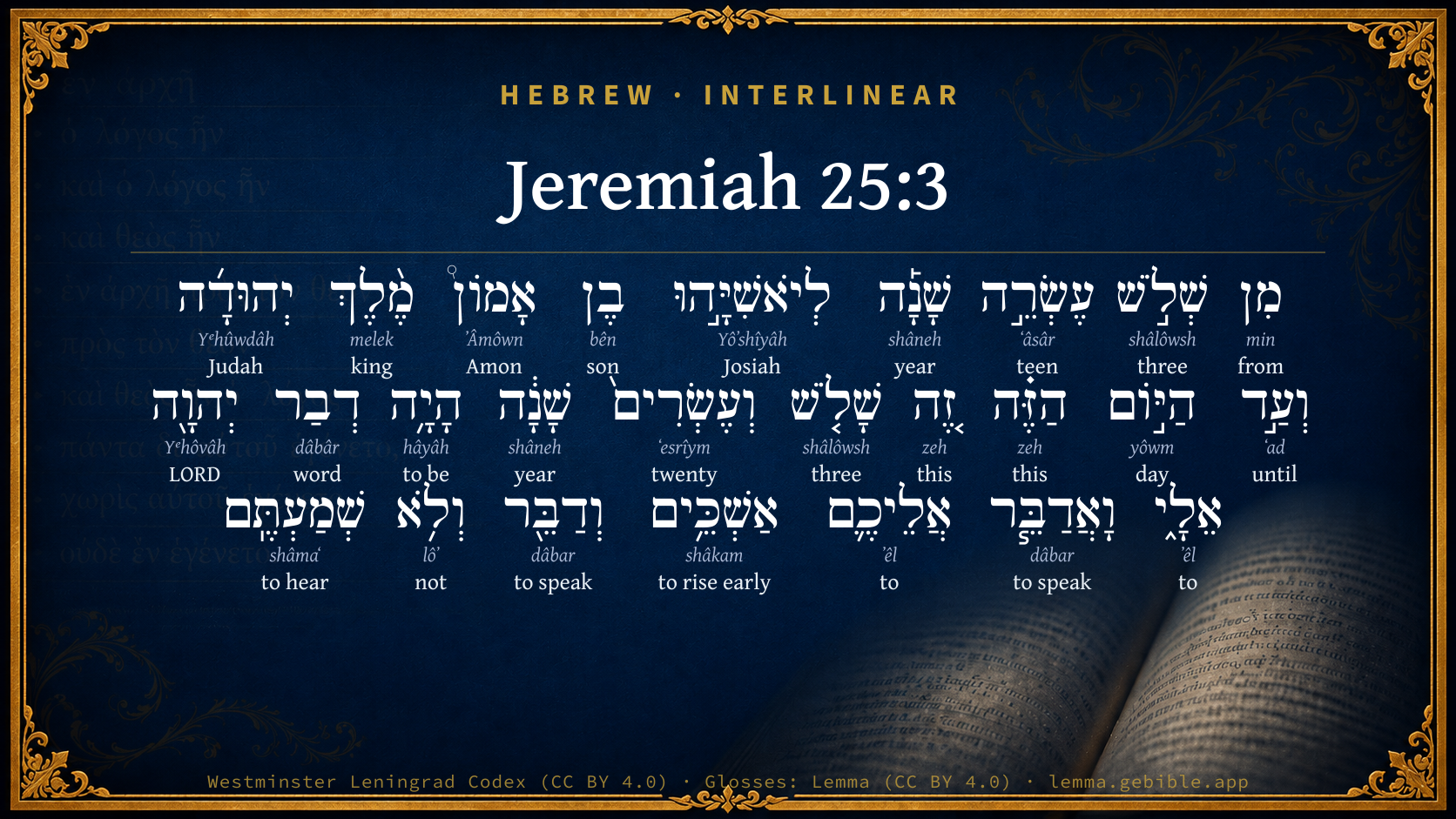
Hebrew (Westminster Leningrad Codex) Jeremiah 25:3 appears in the Hebrew Old Testament. The text above is from the Westminster Leningrad Codex. Each word links to its Strong’s number, a concise gloss, and parsing drawn from the Open Scriptures Hebrew Bible morphology. Click any word for its full Brown-Driver-Briggs (BDB) entry.
Download image
Cite this verse

Jeremiah 25:3 (World English Bible). Public Domain. Lemma interlinear Bible study tool, https://lemma.gebible.app/v/jeremiah/25/3.

Show BibTeX & RIS
BibTeX
RIS
English Translation
From the thirteenth year of Josiah the son of Amon, king of Judah, even to this day, these twenty-three years, the word of Yahweh has come to me, and I have spoken to you, rising up early and speaking; but you have not listened.
World English Bible · Public Domain
Download a study sheet

One document with this verse’s original text, its word-by-word gloss line, the meaning frame, cross-references with their text, attributed commentary, and full source and license credits — printable, and it pastes into notes with its structure intact.

This verse Autodidact and up

Study sheet (.html) Plain text (.txt)

A passage Seminary Student

Up to 50 verses in one chapter. A passage sheet keeps up to 6 commentary sources and 12 cross-references per verse, in the order this page ranks them, and says so on the sheet whenever that leaves anything out. Ask for a single verse and you get the Autodidact verse sheet above.

Everything on this page stays free to read, with no account — the sheet is a download of what is already on screen, not access to it.

Want to remove ads? Support Godless Engineer
Compare translations 3

The same verse in 3 English versions, stacked beneath the original-language interlinear above. Click any original word for its lexicon entry.

Each is an independent rendering of the whole verse — the interlinear is not word-aligned to these translations.

Highlighted words mark where these versions differ — a whole-verse word diff, not a word-by-word alignment.

  • World English Bible Public Domain
    From the thirteenth year of Josiah the son of Amon, king of Judah, even to this day, these twenty-three years, the word of Yahweh has come to me, and I have spoken to you, rising up early and speaking; but you have not listened.
  • King James Version Public Domain
    From the thirteenth year of Josiah the son of Amon king of Judah, even unto this day, that is the three and twentieth year, the word of the LORD hath come unto me, and I have spoken unto you, rising early and speaking; but ye have not hearkened.
  • unfoldingWord Literal Text CC BY-SA 4.0
    “From the thirteenth year of Josiah son of Amon, king of Judah, and until this day—this twenty-three years—the word of Yahweh has come to me, and I have spoken to you, rising early and speaking, but you have not listened.

unfoldingWord Literal Text — © unfoldingWord, licensed CC BY-SA 4.0. Word-aligned USFM3 via Door43 (git.door43.org/unfoldingWord/en_ult).

Versions to compare (up to 4)

3 of 4 selected

Show all 18 translations

Every available English version of this verse, each an independent rendering of the whole verse.

  • World English Bible Public Domain
    From the thirteenth year of Josiah the son of Amon, king of Judah, even to this day, these twenty-three years, the word of Yahweh has come to me, and I have spoken to you, rising up early and speaking; but you have not listened.
  • Berean Standard Bible Public Domain
    “From the thirteenth year of Josiah son of Amon king of Judah until this very day—twenty-three years—the word of the LORD has come to me, and I have spoken to you again and again, but you have not listened.
  • Majority Standard Bible Public Domain
    “From the thirteenth year of Josiah son of Amon king of Judah until this very day—twenty-three years—the word of the LORD has come to me, and I have spoken to you again and again, but you have not listened.
  • King James Version Public Domain
    From the thirteenth year of Josiah the son of Amon king of Judah, even unto this day, that is the three and twentieth year, the word of the LORD hath come unto me, and I have spoken unto you, rising early and speaking; but ye have not hearkened.
  • American Standard Version (1901) Public Domain
    From the thirteenth year of Josiah the son of Amon, king of Judah, even unto this day, these three and twenty years, the word of Jehovah hath come unto me, and I have spoken unto you, rising up early and speaking; but ye have not hearkened.
  • Revised Version (1885) Public Domain
    From the thirteenth year of Josiah the son of Amon, king of Judah, even unto this day, these three and twenty years, the word of the LORD hath come unto me, and I have spoken unto you, rising up early and speaking; but ye have not hearkened.
  • Geneva Bible (1599) Public Domain
    From the thirteenth yeere of Iosiah the sonne of Amon King of Iudah, euen vnto this day (that is the three and twentieth yeere) the word of the Lord hath come vnto mee, and I haue spoken vnto you rising earely and speaking, but ye woulde not heare.
  • Douay-Rheims (1899) Public Domain
    From the thirteenth year of Josias the son of Ammon king of Juda until this day: this is the three and twentieth year, the word of the Lord hath come to me, and I have spoken to you, rising before day, and speaking, and you have not hearkened.
  • Young's Literal Translation Public Domain
    `From the thirteenth year of Josiah son of Amon king of Judah, and unto this day -- this three and twentieth year -- hath the word of Jehovah been unto me, and I speak unto you, rising early and speaking, and ye have not hearkened;
  • Literal Standard Version CC BY-SA 4.0
    “From the thirteenth year of Josiah son of Amon king of Judah, and to this day—this twenty-third year—the word of YHWH has been to me, and I speak to you, rising early and speaking, and you have not listened;
  • Unlocked Literal Bible CC BY-SA 4.0
    He said, “For twenty-three years, from the thirteenth year of Josiah son of Amon, king of Judah until this day, Yahweh's words have been coming to me and I have spoken to you again and again, but you have not listened.
  • unfoldingWord Literal Text CC BY-SA 4.0
    “From the thirteenth year of Josiah son of Amon, king of Judah, and until this day—this twenty-three years—the word of Yahweh has come to me, and I have spoken to you, rising early and speaking, but you have not listened.
  • Darby Bible Public Domain
    From the thirteenth year of Josiah the son of Amon, the king of Judah, even unto this day, these three and twenty years, the word of Jehovah hath come unto me, and I have spoken unto you, rising early and speaking; but ye have not hearkened.
  • World Messianic Bible Public Domain
    From the thirteenth year of Josiah the son of Amon, king of Judah, even to this day, these twenty-three years, the LORD’s word has come to me, and I have spoken to you, rising up early and speaking; but you have not listened.
  • Webster's Bible Public Domain
    From the thirteenth year of Josiah the son of Amon king of Judah, even to this day, that is the three and twentieth year, the word of the LORD hath come to me, and I have spoken to you, rising early and speaking; but ye have not hearkened.
  • Free Bible Version CC BY-SA 4.0
    From the thirteenth year of the reign of Josiah, son of Amon, king of Judah until now, twenty-three years in total, messages from the Lord have come to me, and I have told you what he said time and again, but you have not listened.
  • Bible in Basic English Public Domain
    From the thirteenth year of Josiah, the son of Amon, king of Judah, even till this day, for twenty-three years, the word of the Lord has been coming to me, and I have given it to you, getting up early and talking to you; but you have not given ear.
  • JPS Tanakh (1917) Public Domain
    From the thirteenth year of Josiah the son of Amon, king of Judah, even unto this day, these three and twenty years, the word of the LORD hath come unto me, and I have spoken unto you, speaking betimes and often; but ye have not hearkened.

Literal Standard Version (2020), Covenant Press — licensed CC BY-SA 4.0. Text via the HelloAO Bible API (eBible.org). Unlocked Literal Bible (unfoldingWord) — licensed CC BY-SA 4.0. Text via the HelloAO Bible API (eBible.org). unfoldingWord Literal Text — © unfoldingWord, licensed CC BY-SA 4.0. Word-aligned USFM3 via Door43 (git.door43.org/unfoldingWord/en_ult). Free Bible Version, Dr. Jonathan Gallagher — licensed CC BY-SA 4.0. Text via the HelloAO Bible API (eBible.org).

Word by word

More ways to search: Search by grammar → Find every occurrence → Compare this word →

Practice this passage: Drill this verse → Learn its vocabulary →

אָמוֹן֩
ʼÂmôwn
H526
“Amon”
Noun, Proper
Part of Speech
Noun
Type
Proper
Full BDB Definition

Origin: the same as H525

TWOT: None

Amon = "skilled workman" or " master workman" - a king of Judah, son of Manasseh - a governor of Samaria - a descendant of a servant of Solomon
  1. מִן min H4480 “from” Preposition
  2. שְׁלֹ֣שׁ shâlôwsh H7969 “three” Adjective, Cardinal number, Feminine, Singular, Absolute
  3. עֶשְׂרֵ֣ה ʻâsâr H6240 “teen” Adjective, Cardinal number, Feminine, Singular, Absolute
  4. שָׁנָ֡ה shâneh H8141 “year” Noun, Common, Feminine, Singular, Absolute
  5. לְיֹאשִׁיָּ֣הוּ Yôʼshîyâh H2977 “to/for · Josiah” Preposition + Noun, Proper
  6. בֶן bên H1121 “son of” Noun, Common, Masculine, Singular, Construct
  7. מֶ֨לֶךְ melek H4428 “king of” Noun, Common, Masculine, Singular, Construct
  8. יְהוּדָ֜ה Yᵉhûwdâh H3063 “Judah” Noun, Proper
  9. וְעַ֣ד ʻad H5704 “and · until” Conjunction + Preposition
  10. הַיּ֣וֹם yôwm H3117 “the · day” Particle, Definite Article + Noun, Common, Masculine, Singular, Absolute
  11. הַזֶּ֗ה zeh H2088 “the · this” Particle, Definite Article + Pronoun, Demonstrative, Masculine, Singular
  12. זֶ֚ה zeh H2088 “this” Pronoun, Demonstrative, Masculine, Singular
  13. שָׁלֹ֤שׁ shâlôwsh H7969 “three” Adjective, Cardinal number, Feminine, Singular, Absolute
  14. וְעֶשְׂרִים֙ ʻesrîym H6242 “and · twenty” Conjunction + Adjective, Cardinal number, Both, Plural, Absolute
  15. שָׁנָ֔ה shâneh H8141 “year” Noun, Common, Feminine, Singular, Absolute
  16. הָיָ֥ה hâyâh H1961 “to be” Verb, Qal, Perfect, 3rd Person, Masculine, Singular
  17. דְבַר dâbâr H1697 “word of” Noun, Common, Masculine, Singular, Construct
  18. יְהוָ֖ה Yᵉhôvâh H3068 “LORD” Noun, Proper
  19. אֵלָ֑י ʼêl H413 “to · me” Preposition + Suffix, Personal, 1st Person, Common, Singular
  20. וָאֲדַבֵּ֧ר dâbar H1696 “and · to speak” Conjunction + Verb, Piel, Sequential Imperfect, 1st Person, Common, Singular
  21. אֲלֵיכֶ֛ם ʼêl H413 “to · you” Preposition + Suffix, Personal, 2nd Person, Masculine, Plural
  22. אַשְׁכֵּ֥ים shâkam H7925 “to rise early” Verb, Hiphil, Infinitive Absolute
  23. וְדַבֵּ֖ר dâbar H1696 “and · to speak” Conjunction + Verb, Piel, Infinitive Absolute
  24. וְלֹ֥א lôʼ H3808 “and · not” Conjunction + Particle, Negative
  25. שְׁמַעְתֶּֽם shâmaʻ H8085 “to hear” Verb, Qal, Perfect, 2nd Person, Masculine, Plural

About this verse

These counts appear in no published source. They are computed here, from the morphology-tagged text and Lemma’s own curated glosses. What Lemma adds →

26
words
21
distinct lemmas
Prophets
section

Notable vocabulary

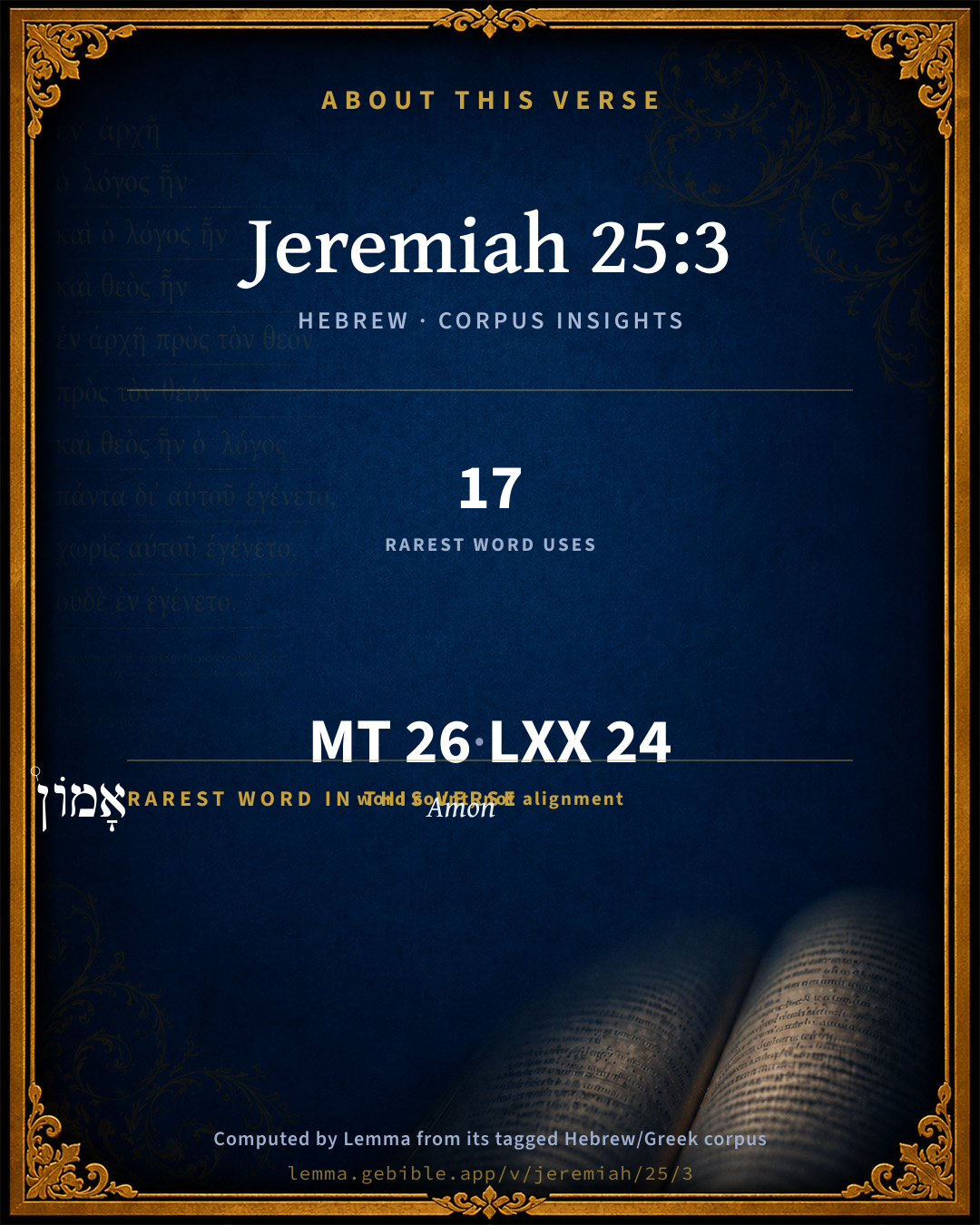
The rarest word here is אָמוֹן֩ Amon H526 — appearing just 17 times in the whole Hebrew Bible.

Shared distinctive vocabulary

אָמוֹן֩ Amon H526 occurs in 17 verses of the Hebrew Bible. Also found in:

Grammatical profile

  • 5 verbs
  • 10 nouns
  • 4 adjectives
  • 2 pronouns
  • 4 prepositions
  • 1 particle

Verb forms

  • הָיָ֥ה Qal · Perfect
  • וָאֲדַבֵּ֧ר Piel · Sequential Imperfect
  • אַשְׁכֵּ֥ים Hiphil · Infinitive Absolute
  • וְדַבֵּ֖ר Piel · Infinitive Absolute
  • שְׁמַעְתֶּֽם Qal · Perfect

Repetition

Words recur within this verse — often emphatic in Hebrew:

  • שְׁלֹ֣שׁ three H7969 ×2
  • שָׁנָ֡ה year H8141 ×2
  • וָאֲדַבֵּ֧ר to speak H1696 ×2
  • הַזֶּ֗ה this H2088 ×2
  • אֵלָ֑י to H413 ×2

Hebrew & Septuagint length

In the original languages it is 26 Hebrew tokens and 24 Greek tokens — but the two are counted differently (Hebrew bundles its prefixes and suffixes into one token; the Greek is in lemma form), so that isn’t a like-for-like length.

Cross-references

19

Topical passages linked to Jeremiah 25:3 in the Treasury of Scripture Knowledge — connected by theme and wording, ordered by reader-vote popularity; previews shown in the World English Bible.

  • Jeremiah 1:2 to whom the word of Yahweh came in the days of Josiah the son of Amon, king of Judah, in the thirteenth year of his reign.
  • Jeremiah 11:7 For I earnestly protested to your fathers in the day that I brought them up out of the land of Egypt, even to this day, rising early and protesting, saying, Obey my voice.
  • Jeremiah 26:5 to listen to the words of my servants the prophets, whom I send to you, even rising up early and sending them, but you have not listened;
  • Jeremiah 7:13 Now, because you have done all these works, says Yahweh, and I spoke to you, rising up early and speaking, but you didn't hear; and I called you, but you didn't answer:
  • 2 Chronicles 34:3 For in the eighth year of his reign, while he was yet young, he began to seek after the God of David his father; and in the twelfth year he began to purge Judah and Jerusalem from the high places, and the Asherim, and the engraved images, and the molten images.
  • 2 Chronicles 34:8 Now in the eighteenth year of his reign, when he had purged the land and the house, he sent Shaphan the son of Azaliah, and Maaseiah the governor of the city, and Joah the son of Joahaz the recorder, to repair the house of Yahweh his God.
  • Jeremiah 29:19 because they have not listened to my words, says Yahweh, with which I sent to them my servants the prophets, rising up early and sending them; but you would not hear, says Yahweh.
  • 2 Timothy 4:2 preach the word; be urgent in season and out of season; reprove, rebuke, and exhort, with all patience and teaching.
  • Genesis 22:3 Abraham rose early in the morning, and saddled his donkey, and took two of his young men with him, and Isaac his son. He split the wood for the burnt offering, and rose up, and went to the place of which God had told him.
  • Exodus 8:20 Yahweh said to Moses, "Rise up early in the morning, and stand before Pharaoh; behold, he comes forth to the water; and tell him, 'This is what Yahweh says, "Let my people go, that they may serve me.
  • 1 Kings 22:3 The king of Israel said to his servants, "You know that Ramoth-gilead is ours, and we are still, and don't take it out of the hand of the king of Syria?"
  • Psalms 81:13 Oh that my people would listen to me, That Israel would walk in my ways!
  • Isaiah 55:2 Why do you spend money for that which is not bread? and your labor for that which doesn't satisfy? listen diligently to me, and eat you that which is good, and let your soul delight itself in fatness.
  • Jeremiah 25:4 Yahweh has sent to you all his servants the prophets, rising up early and sending them, (but you have not listened, nor inclined your ear to hear),
  • Jeremiah 35:15 I have sent also to you all my servants the prophets, rising up early and sending them, saying, Return you now every man from his evil way, and amend your doings, and don't go after other gods to serve them, and you shall dwell in the land which I have given to you and to your fathers: but you have not inclined your ear, nor listened to me.
  • Jeremiah 44:4 However I sent to you all my servants the prophets, rising up early and sending them, saying, Oh, don't do this abominable thing that I hate.
  • Mark 1:35 Early in the night, he rose up and went out, and departed into a deserted place, and prayed there.
  • John 8:2 Now very early in the morning, he came again into the temple, and all the people came to him. He sat down, and taught them.
  • John 8:47 He who is of God hears the words of God. For this cause you don't hear, because you are not of God."

Cross-references courtesy of OpenBible.info (CC BY 4.0).

Hebrew and Greek witnesses Masoretic Hebrew ↔ Greek Septuagint

The same verse in the two great witnesses to the Old Testament, shown verse-for-verse.

These are two independent witnesses, not word-aligned to each other, and the Septuagint is shown in lemma (dictionary) form.

Hebrew Jeremiah 25:3 Masoretic · Westminster Leningrad Codex

מִן שְׁלֹ֣שׁ עֶשְׂרֵ֣ה שָׁנָ֡ה לְיֹאשִׁיָּ֣הוּ בֶן אָמוֹן֩ מֶ֨לֶךְ יְהוּדָ֜ה וְעַ֣ד הַיּ֣וֹם הַזֶּ֗ה זֶ֚ה שָׁלֹ֤שׁ וְעֶשְׂרִים֙ שָׁנָ֔ה הָיָ֥ה דְבַר יְהוָ֖ה אֵלָ֑י וָאֲדַבֵּ֧ר אֲלֵיכֶ֛ם אַשְׁכֵּ֥ים וְדַבֵּ֖ר וְלֹ֥א שְׁמַעְתֶּֽם

From the thirteenth year of Josiah the son of Amon, king of Judah, even to this day, these twenty-three years, the word of Yahweh has come to me, and I have spoken to you, rising up early and speaking; but you have not listened.

World English Bible · Public Domain

Greek LXX Structure differs

In the Septuagint, Jeremiah is about an eighth shorter than the Hebrew and arranges its material differently — the Oracles Against the Nations (Hebrew chapters 46–51) appear in the middle of the Greek book, after 25:13. Because the chapter and verse boundaries do not line up, a verse-for-verse comparison with the Hebrew is not shown.

A verse-for-verse comparison isn’t shown here because the chapters and verses don’t line up. Switch to the LXX edition with the MT / LXX toggle above to read the Greek directly.

On this verse, The Cambridge Bible for Schools and Colleges discusses the Septuagint’s reading. Read the note in Commentary ↓

Hebrew: Westminster Leningrad Codex (CC BY 4.0). Greek: Septuagint (public domain); English from a public-domain English Septuagint. How the Septuagint differs from the Hebrew →

Targum (Aramaic paraphrase)

1

The Targum is the ancient Jewish Aramaic paraphrase of the Hebrew Scriptures — an interpretive translation, not the Hebrew text itself. Onkelos (literal) and Pseudo-Jonathan (expansive) render the Torah, and Jonathan the Prophets. Coverage is partial: where no permissively-licensed English translation exists for a verse, only the Aramaic is shown. This is verse-level text, not a word-by-word alignment to the Hebrew.

  1. Targum Jonathan Prophets (Joshua–Malachi)
    מִן תְּלַת עַשְׂרֵי שְׁנִין לְיֹאשִׁיָה בַּר אָמוֹן מְלַךְ שִׁבְטָא דְבֵית יְהוּדָה וְעַד יוֹמָא הָדֵין דְנַן עַשְׂרִין וּתְלַת שְׁנִין הֲוָה פִּתְגַם נְבוּאָה מִן קֳדָם יְיָ עִמִי וּמַלְלֵית עִמְכוֹן מַקְדֵם וּמְמַלֵיל וְלָא קַבֵּילְתּוּן:

    (no public-domain English translation for this verse)

    Targum Jonathan — Aramaic: “Mikraot Gedolot” (public domain). English: “Sefaria Community Translation” (CC0 1.0 (public-domain dedication)); “London "Chaldee Paraphrase," 1871” (public domain). Text via Sefaria.

Commentary

Notes on Jeremiah 25:3 from classic Christian and Jewish commentators (each source and its license shown beneath its notes). The classic Christian expositions comment on the surrounding passage and are grouped to its opening verse, so a note may address several verses; the Jewish commentaries on the Tanakh (Rashi and others) are per-verse, so they appear only where the commentator wrote on this verse.

Lemma curates 59 commentaries, every one of them public domain or Creative Commons licensed, each selected and text-cleaned for this edition rather than reprinted as found. About our sources →

Trapp's Complete Commentary

John Trapp

Jer 25:3 From the thirteenth year of Josiah the son of Amon king of Judah, even unto this day, that [is] the three and twentieth year, the word of the LORD hath come unto me, and I have spoken unto you, rising early and speaking; but ye have not hearkened.

Ver. 3. Rising early and speaking.] A dilucula indesinenter: as good husbands use to do, taking the best times.

John Trapp, A Commentary or Exposition upon All the Books of the Old and New Testament (1647–1656) — public domain. Text from a community e-Sword module.

Albert Barnes' Notes on the Bible

The three and twentieth year - i. e., nineteen under Josiah, and four under Jehoiakim. This prophecy divides itself into three parts,

(1) the judgment of Judah Jer 25:3-11, and Babylon’s doom Jer 25:12-14;

(2) the wine-cup of fury Jer 25:15-29;

(3) the judgment of the world Jer 25:30-38.

Albert Barnes' Notes on the Bible (1834–1885) — public domain. Text from a community e-Sword/MySword module.

Keil & Delitzsch

C. F. Keil & F. Delitzsch

The seventy years' Chaldean bondage of Judah and the peoples. - Jer 25:3. "From the thirteenth year of Josiah, son of Amon king of Judah, unto this day, these three and twenty years, came the word of Jahveh to me, and I spake to you, from early morn onwards speaking, but ye hearkened not. Jer 25:4. And Jahveh sent to you all His servants, the prophets, from early morning on sending them, but ye hearkened not, and inclined not your ear to hear. Jer 25:5. They said: Turn ye now each from his evil way and from the evil of your doings, so shall ye abide in the land which Jahveh hath given to your fathers from everlasting to everlasting. Jer 25:6. And go not after other gods, to serve them and to worship them, that ye provoke me not with the work of your hands, and that I do you no evil. Jer 25:7. But ye hearkened not to me, to provoke me by the work of your hands, to your own hurt. Jer 25:8. Therefore thus hath said Jahveh of hosts: Because ye have not heard my words, Jer 25:9. Behold, I send and take all the families of the north, saith Jahveh, and to Nebuchadrezzar my servant (I send), and bring them upon this land, and upon its inhabitants, and upon all these peoples round about, and ban them, and make them an astonishment and a derision and everlasting desolations, Jer 25:10. And destroy from among them the voice of the bridegroom and the voice of the bride, the sound of the mill and the light of the lamp. Jer 25:11. And this land shall become a desert, a desolation, and these peoples shall serve the king of Babylon seventy years."

The very beginning of this discourse points to the great crisis in the fortunes of Judah. Jeremiah recalls into the memory of the people not merely the whole time of his own labours hitherto, but also the labours of many other prophets, who, like himself, have unremittingly preached repentance to the people, called on them to forsake idolatry and their evil ways, and to return to the God of their fathers - but in vain (Jer 25:3-7). The 23 years, from the 13th of Josiah till the 4th of Jehoiakim, are thus made up: 19 years of Josiah and 4 years of Jehoiakim, including the 3 months' reign of Jehoahaz. The form אשׁכּים might be an Aramaism; but it is more probably a clerical error, since we have השׁכּם everywhere else; cf. Jer 25:4, Jer 7:13; Jer 35:14, etc., and Olsh. Gramm. 191, g. For syntactical reasons it cannot be 1st pers. imperf., as Hitz. thinks it is. On the significance of this infin. abs. see on Jer 7:13. As to the thought of Jer 25:4 cf. Jer 7:25. and Jer 11:7. לאמר introduces the contents of the discourses of Jeremiah and the other prophets, though formally it is connected with ושׁלח, Jer 25:4. As to the fact, cf. Jer 35:15. וּשׁבוּ, so shall ye dwell, cf. Jer 7:7. - With Jer 25:6 cf. Jer 7:6; Jer 1:16, etc. (ארע, imperf. Hiph. from רעע). הכעסוּני cannot be the reading of its Chet., for the 3rd person will not do. The ו seems to have found its way in by an error in writing and the Keri to be the proper reading, since למען is construed with the infinitive.

Keil & Delitzsch — Biblical Commentary on the Old Testament (1861–1891) — public domain (CC PDM 1.0). Text via the HelloAO Bible API. (Old Testament only.)

Tyndale Open Study Notes

Tyndale Open Resources

25:3 Jeremiah’s ministry began in 627 BC.

Tyndale Open Study Notes — © Tyndale Open Resources, licensed CC BY-SA 4.0. Text via the HelloAO Bible API.

Geneva Bible (1599)

Geneva Bible translators

Which was the fifth year and the ninth month of Jehoiakim’s reign.

That is, I have spared no diligence or labor, Jer. 7:13.

Geneva Bible (1599) marginal notes — public domain. Text via Bolls.life.

Jamieson, Fausset & Brown

Robert Jamieson, A. R. Fausset & David Brown

From the thirteenth year of Josiah, in which Jeremiah began to prophesy (Jer 1:1), to the end of Josiah's reign, was nineteen years (Kg2 22:1) of Jehoahaz' reign, with the not quite complete four years of Jehoiakim (Jer 25:1), added to the nineteen years, make up twenty-three years in all.

Jamieson, Fausset & Brown — Commentary Critical and Explanatory on the Whole Bible (1871) — public domain (CC PDM 1.0). Text via the HelloAO Bible API.

John Calvin's Commentaries

Jeremiah now expostulates with the Jews, because they had not only perfidiously departed from the true worship of God, and despised the whole teaching of his Law, but because they had shaken off the yoke, and designedly and even obstinately rejected all warnings, being not moved by reproofs nor even by threatenings. He does not then simply charge them with impiety and ingratitude, but adds the sin of perverseness, that they were like untameable wild beasts, and could by no means be corrected.

He says, that from the thirteenth year of Josiah king of Judah, to that year, which was the twenty-third year, he had not ceased faithfully to perform the office committed to him, but had effected nothing. It hence appears how incorrigible was their wickedness. We have seen, at the beginning of the book, that he was called by God to be a Prophet in the thirteenth year of King Josiah; and he had now been engaged in his calling, as he declares, for twenty-three years.

He had spent his time in vain, he had consumed much labor without any fruit. It is then no wonder that he now accuses them of perverseness, and that in the name of God; for he pleads not his own cause, but shews what the Jews deserved, considering how much God had labored in reclaiming them, and that they had rejected all his warnings and refused all his remedies. Then from the thirteenth year of Josiah, he says, to this day; and afterwards in a parenthesis he adds, that he had already discharged his office for twenty-three years.

We learn that the Prophet spoke thus seventeen years before the destruction of the City and Temple; for he had accomplished forty years before the people were driven into exile, and before they who thought themselves safe, miserably perished. He continued to the death of Josiah; and afterwards about twenty-two transpired; for Jehoiakim reigned eleven years; and without reckoning the short time of Jeconiah, Mathaniah, called also Zedekiah, was in the eleventh year removed, and disgracefully and reproachfully put to death. Thus it appears that the Prophet constantly labored for forty years.

Hence, also, we learn how diabolical was the madness of that people in rejecting so many admonitions. And if we connect another thing, to which I lately referred, that they had been taught by many examples, it will appear still more evident that the disease of impiety as to that people was altogether incurable.

But this passage deserves special attention; for we here learn that we ought immediately to return to God when he invites us; for faith is known by its promptitude. As soon then as God speaks, it behoves us to be attentive, so that we may immediately follow him. But if God ceases not for a whole year to warn and exhort us, while at the same time his doctrine is despised, we become guilty of intolerable sin. Let us then remember that days are here in a manner mentioned as well as years, that the Jews might consider how many days are included in every year; and let us also know that years are mentioned by Jeremiah, that they might, understand that they had no excuse, inasmuch as God had for so long a time ceased not to promote their welfare, while in the meantime they persisted in their impiety, and continued obstinate to the last. This is the reason why the Prophet relates again when it was that he began to discharge his prophetic office, even from the thirteenth year of Josiah.

He then adds, that it was their own fault that they had not repented; spoken, he says, has Jehovah to me, and I to you. By saying that the word of God was deposited with him, he no doubt intended to assert his authority against the unbelievers, who clamored that he presumptuously pretended God’s name, and that he had not been sent by God. For we have elsewhere seen that the Church was then miserably torn, having intestine broils, and many were boasting that they were prophets; and we shall hereafter find the same thing in other places. Thus, then, Jeremiah was not received by the whole people, and his authority was disputed. Since then he had to contend with many ungodly men, he here testifies that he came not of himself, but that the prophetic office had been committed to him.

After having asserted the authority of his call, he adds, that he had faithfully promoted the welfare of the whole people; for he declares how faithful and diligent he had been when he says, that he had spoken and rose up early; for to rise up early means that he had been assiduous in his work. The Prophet then shews that he had not been tardy or idle, and that he had not spoken carelessly as many do, who seem to do what God commands, but display no fervid zeal and no sedulity. The Prophet then, after having declared that he had been sent from above, adds that he had exercised fidelity and diligence, that he had strenuously served God and his Church. I have spoken to you, he says, as the Lord had spoken to me, — how? rising up early

John Calvin's Commentaries (1540-1563) — public domain. Text from the Calvin Translation Society English edition (1840s-50s) via the Christian Classics Ethereal Library (ccel.org). Calvin's coverage is partial (roughly two-thirds of the Bible); uncommented books and verses are honest gaps, never fabricated. The 19th-century editor's footnotes and remarks are omitted so the notes are faithfully Calvin's own voice.

Ellicott's Commentary for English Readers

(3) The three and twentieth year (B.C. 603-4).—Thus there had been nineteen years of prophetic work under Josiah, and between three and four under Jehoiakim (Jer_1:2). Of the former period we have but scanty record. The year is noticeable as that which apparently witnessed the first collection of Jeremiah’s prophetic utterances (Jer_36:5-8).

Rising early and speaking.—See Note on Jer_7:13.

A Bible Commentary for English Readers, edited by Charles John Ellicott (1878–1897) — public domain. Text from a community e-Sword module.

The Cambridge Bible for Schools and Colleges

gen. ed. J. J. S. Perowne

3. these three and twenty years] Josiah reigned thirty-one years, and it was in the thirteenth year of that king (ch. Jer_1:2) that Jeremiah was called. He therefore prophesied for eighteen or nineteen years in that reign. To this we are to add the reign of Jehoahaz (three months), and more than three years of Jehoiakim.

but ye have not hearkened] Omit with LXX. See next note.

The Cambridge Bible for Schools and Colleges (gen. ed. J. J. S. Perowne; Cambridge University Press, 1878–1918) — public domain. Text from a community e-Sword module.

John Gill's Exposition

From the thirteenth year of Josiah the son of Amon king of Judah, even unto this day,.... The year in which Jeremiah began to prophesy, Jer 1:2;

(that is, the three and twentieth year); for Josiah reigned one and thirty years; so that Jeremiah prophesied nineteen years in his reign; and now it was the fourth of Jehoiakim's, which make twenty three years; so long the prophet had been prophesying to this people:

the word of the Lord hath come unto me; from time to time, during that space of twenty three years; and which he diligently, constantly, and faithfully delivered unto them; as follows:

and I have spoken unto you, rising early and speaking: as soon as ever he had a word from the Lord, he brought it to them, and took the most proper and seasonable time to inculcate it to them; in the morning, and after, he had had a vision or dream in the night from the Lord;

but ye have not hearkened; they took no notice of it; turned a deaf ear to it; however, did not obey or act as they were directed and exhorted to.

John Gill's Exposition of the Whole Bible (1746–1763) — public domain (CC PDM 1.0). Text via the HelloAO Bible API.

Haydock's Catholic Bible Commentary

Josias. He prophesied nineteen years under him, and three under his successors.

George Leo Haydock (1774–1849), Haydock's Catholic Family Bible and Commentary, 1859 edition — public domain. Excludes Psalms (Douay-Rheims chapter numbering differs from Protestant) and Deuterocanonical books (Catholic canon only).

Matthew Poole's English Annotations

We read, Jer 1:2, that Jeremiah began to prophesy in the thirteenth year of Josiah. Josiah reigned thirty-one years, 2Ki 22:1; so that taking in the thirteenth year, Jeremiah prophesied nineteen years during the life of Josiah, to which adding the four of Jehoiakim’s reign, it maketh twenty-three. These twenty-three years, saith the prophet, I have been a preacher to you, and I have not been negligent in my work; but like men that get up early in the morning to despatch their business, so have I been in the discharge of my prophetical office.

Matthew Poole's English Annotations on the Holy Bible (1683–1685) — public domain. Text from a community e-Sword/MySword module.

Whedon's Commentary on the Bible

Daniel D. Whedon

3. From the thirteenth year of Josiah, etc. — Appropriately marking the crisis, the prophet takes a retrospective glance. For twenty-three years he had patiently and persistently preached repentance to this unwilling and persecuting people; and hence they cannot now say that their calamities come without warning. These three and twenty years are made up of nineteen under Josiah and four of Jehoiakim, including the three months’ reign of Jehoahaz.

Daniel D. Whedon (gen. ed.), Commentary on the Old and New Testaments (1874–1909) — public domain. Text from a community e-Sword module.

The Pulpit Commentary

From the thirteenth year; etc.; alluding to the chronological statement in Jer_1:2. The three and twentieth year; counting nineteen years under Josiah and four under Jehoiachin, and including the three months of Jehoahaz.

The Pulpit Commentary (1880–1919), ed. H.D.M. Spence-Jones & Joseph S. Exell — public domain. Text from a community e-Sword module.

unfoldingWord translationNotes

Door43 World Missions Community

Amon

This is a man's name. (See: How to Translate Names)

translationWords

Yahweh

word of God

send

servant

unfoldingWord translationNotes — © Distant Shores Media and the Door43 World Missions Community, licensed CC BY-SA 4.0. Source: git.door43.org/Door43/en_tn.

Rashi

Rabbi Shlomo Yitzchaki (Rashi)

twenty-three years Josiah reigned thirty-one years (II Kings 22:1). Subtract twelve years from them (Jer. 1:2). This leaves nineteen, and four of his son amount to twenty-three.

arising early This is a present tense. I would arise early and speak constantly.

Rashi on the Tanakh — English translations: “The Judaica Press complete Tanach with Rashi, translated by A. J. Rosenberg” (CC BY 4.0); “Pentateuch with Rashi's commentary by M. Rosenbaum and A.M. Silbermann, 1929-1934” (public domain); “The Metsudah Tanach series, Lakewood, N.J” (CC BY 4.0); and “The Book of Joshua, Metsudah Publications, 1997” (CC BY 4.0). Text via Sefaria.

Lesson kit

Teaching starters — assembled from the data on this page, not authored interpretation. Every prompt links to the verse data it draws on. Edit before teaching.

Jeremiah, in the Prophets, opens this verse with 26 words (21 distinct Hebrew lemmas). Its most distinctive word is ʼÂmôwn (“Amon”). A historical commentator’s framing appears above. Read the whole chapter for the surrounding context.

Discussion questions

  1. The word ʼÂmôwn carries the sense “Amon.” How does it shape the verse?
  2. How does 1 Kings 22:26, which shares the word «Amon», read alongside this verse?
  3. What does the repetition of “three” (2× in this one verse) do in this verse?
  4. The translations on this page render this verse differently — a whole-verse word diff, not a word-by-word alignment. What might account for the different wordings?
  5. «הָיָ֥ה» is a Qal Perfect verb. How does that grammatical form shape the action described?
  6. Compare how Trapp's Complete Commentary and Albert Barnes' Notes on the Bible read this verse. Where do they agree or differ?

Things to notice

Reading settings

Reading text

Shown beneath each verse's original-language words.

Old Testament
Old Testament edition

Read the OT as the Masoretic Hebrew (MT) or the Greek Septuagint (LXX).

English shown for the Greek Septuagint (in the Hebrew ↔ Greek comparison).

Comparing translations? Open the Compare panel on any verse page to stack up to four side by side.