
Song of Solomon 7:12

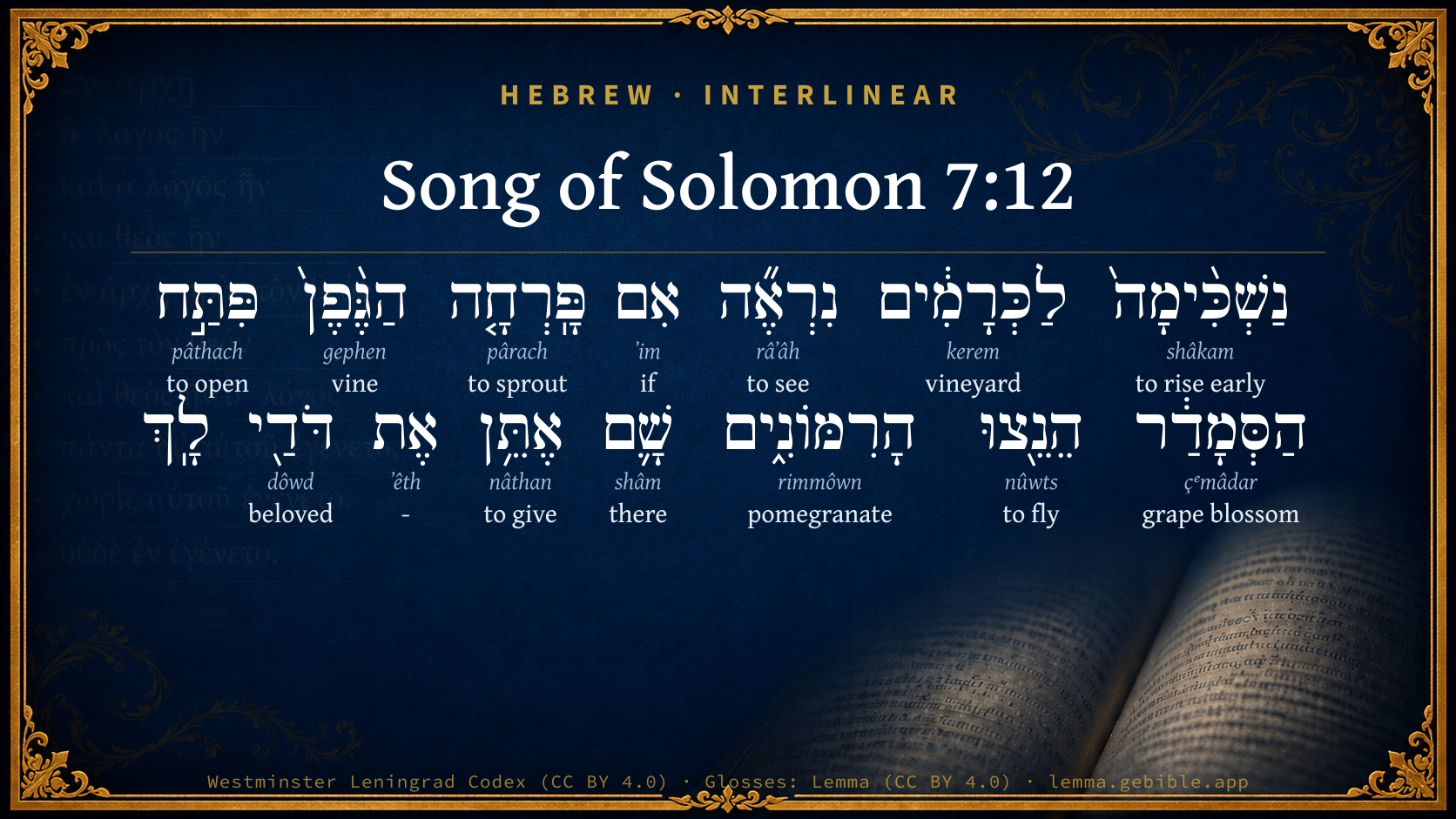
Hebrew (Westminster Leningrad Codex) Song of Solomon 7:12 appears in the Hebrew Old Testament. The text above is from the Westminster Leningrad Codex. Each word links to its Strong’s number, a concise gloss, and parsing drawn from the Open Scriptures Hebrew Bible morphology. Click any word for its full Brown-Driver-Briggs (BDB) entry.
Download image
Cite this verse

Song of Solomon 7:12 (World English Bible). Public Domain. Lemma interlinear Bible study tool, https://lemma.gebible.app/v/song-of-solomon/7/12.

Show BibTeX & RIS
BibTeX
RIS
English Translation
Let's go early up to the vineyards. Let's see whether the vine has budded, Its blossom is open, And the pomegranates are in flower. There I will give you my love.
World English Bible · Public Domain
Download a study sheet

One document with this verse’s original text, its word-by-word gloss line, the meaning frame, cross-references with their text, attributed commentary, and full source and license credits — printable, and it pastes into notes with its structure intact.

This verse Autodidact and up

Study sheet (.html) Plain text (.txt)

A passage Seminary Student

Up to 50 verses in one chapter. A passage sheet keeps up to 6 commentary sources and 12 cross-references per verse, in the order this page ranks them, and says so on the sheet whenever that leaves anything out. Ask for a single verse and you get the Autodidact verse sheet above.

Everything on this page stays free to read, with no account — the sheet is a download of what is already on screen, not access to it.

Want to remove ads? Support Godless Engineer
Compare translations 3

The same verse in 3 English versions, stacked beneath the original-language interlinear above. Click any original word for its lexicon entry.

Each is an independent rendering of the whole verse — the interlinear is not word-aligned to these translations.

Highlighted words mark where these versions differ — a whole-verse word diff, not a word-by-word alignment.

  • World English Bible Public Domain
    Let's go early up to the vineyards. Let's see whether the vine has budded, Its blossom is open, And the pomegranates are in flower. There I will give you my love.
  • King James Version Public Domain
    Let us get up early to the vineyards; let us see if the vine flourish, whether the tender grape appear, and the pomegranates bud forth: there will I give thee my loves.
  • unfoldingWord Literal Text CC BY-SA 4.0
    Let us go early to the vineyards; let us see if the vine has budded, the blossoms have opened, the pomegranates have bloomed. There I will give my love to you.

unfoldingWord Literal Text — © unfoldingWord, licensed CC BY-SA 4.0. Word-aligned USFM3 via Door43 (git.door43.org/unfoldingWord/en_ult).

Versions to compare (up to 4)

3 of 4 selected

Show all 18 translations

Every available English version of this verse, each an independent rendering of the whole verse.

  • World English Bible Public Domain
    Let's go early up to the vineyards. Let's see whether the vine has budded, Its blossom is open, And the pomegranates are in flower. There I will give you my love.
  • Berean Standard Bible Public Domain
    Let us go early to the vineyards to see if the vine has budded, if the blossom has opened, if the pomegranates are in bloom—there I will give you my love.
  • Majority Standard Bible Public Domain
    Let us go early to the vineyards to see if the vine has budded, if the blossom has opened, if the pomegranates are in bloom—there I will give you my love.
  • King James Version Public Domain
    Let us get up early to the vineyards; let us see if the vine flourish, whether the tender grape appear, and the pomegranates bud forth: there will I give thee my loves.
  • American Standard Version (1901) Public Domain
    Let us get up early to the vineyards; Let us see whether the vine hath budded, `And' its blossom is open, `And' the pomegranates are in flower: There will I give thee my love.
  • Revised Version (1885) Public Domain
    Let us get up early to the vineyards; let us see whether the vine hath budded, and its blossom be open, and the pomegranates be in flower: there will I give thee my love.
  • Geneva Bible (1599) Public Domain
    Let vs get vp early to the vines, let vs see if the vine florish, whether it hath budded the small grape, or whether the pomegranates florish: there will I giue thee my loue.
  • Douay-Rheims (1899) Public Domain
    Let us get up early to the vineyards, let us see if the vineyard flourish, if the flowers be ready to bring forth fruits, if the pomegranates flourish: there will I give thee my breasts.
  • Young's Literal Translation Public Domain
    We lodge in the villages, we go early to the vineyards, We see if the vine hath flourished, The sweet smelling-flower hath opened. The pomegranates have blossomed, There do I give to thee my loves;
  • Literal Standard Version CC BY-SA 4.0
    We lodge in the villages, we go early to the vineyards, || We see if the vine has flourished, || The sweet smelling-flower has opened. The pomegranates have blossomed, || There I give to you my loves;
  • Unlocked Literal Bible CC BY-SA 4.0
    Let us rise early to go to the vineyards; let us see whether the vines have budded, whether their blossoms have opened, and whether the pomegranates are in flower. There I will give you my love.
  • unfoldingWord Literal Text CC BY-SA 4.0
    Let us go early to the vineyards; let us see if the vine has budded, the blossoms have opened, the pomegranates have bloomed. There I will give my love to you.
  • Darby Bible Public Domain
    We will go up early to the vineyards, We will see if the vine hath budded, [If] the blossom is opening, And the pomegranates are in bloom: There will I give thee my loves.
  • World Messianic Bible Public Domain
    Let’s go early up to the vineyards. Let’s see whether the vine has budded, its blossom is open, and the pomegranates are in flower. There I will give you my love.
  • Webster's Bible Public Domain
    Let us get up early to the vineyards; let us see if the vine flourisheth, whether the tender grape appeareth, and the pomegranates bud forth: there will I give thee my loves.
  • Free Bible Version CC BY-SA 4.0
    Let's go early to the vineyards and see if the vines have budded and are in flower, and if the pomegranates are blossoming. There I will give my love to you.
  • Bible in Basic English Public Domain
    Let us go out early to the vine-gardens; let us see if the vine is in bud, if it has put out its young fruit, and the pomegranate is in flower. There I will give you my love.
  • JPS Tanakh (1917) Public Domain
    (7-13) Let us get up early to the vineyards; let us see whether the vine hath budded, whether the vine-blossom be opened, and the pomegranates be in flower; there will I give thee my love.

Literal Standard Version (2020), Covenant Press — licensed CC BY-SA 4.0. Text via the HelloAO Bible API (eBible.org). Unlocked Literal Bible (unfoldingWord) — licensed CC BY-SA 4.0. Text via the HelloAO Bible API (eBible.org). unfoldingWord Literal Text — © unfoldingWord, licensed CC BY-SA 4.0. Word-aligned USFM3 via Door43 (git.door43.org/unfoldingWord/en_ult). Free Bible Version, Dr. Jonathan Gallagher — licensed CC BY-SA 4.0. Text via the HelloAO Bible API (eBible.org).

Word by word

More ways to search: Search by grammar → Find every occurrence → Compare this word →

Practice this passage: Drill this verse → Learn its vocabulary →

הַסְּמָדַ֔ר
çᵉmâdar
H5563
“the · grape blossom”
Particle, Definite Article + Noun, Common, Masculine, Singular, Absolute
Part of Speech
Particle + Noun
Type
Common
Gender
Masculine
Number
Singular
State
Absolute
Full BDB Definition

Origin: of uncertain derivation

TWOT: 1513

grape blossom, grape bud
  1. נַשְׁכִּ֨ימָה֙ shâkam H7925 “to rise early” Verb, Hiphil, Cohortative, 1st Person, Common, Plural
  2. לַכְּרָמִ֔ים kerem H3754 “to/for the · vineyards” Preposition, Determined + Noun, Common, Both, Plural, Absolute
  3. נִרְאֶ֞ה râʼâh H7200 “to see” Verb, Qal, Cohortative, 1st Person, Common, Plural
  4. אִם ʼim H518 “if” Conjunction
  5. פָּֽרְחָ֤ה pârach H6524 “to sprout” Verb, Qal, Perfect, 3rd Person, Feminine, Singular
  6. הַגֶּ֨פֶן֙ gephen H1612 “the · vine” Particle, Definite Article + Noun, Common, Both, Singular, Absolute
  7. פִּתַּ֣ח pâthach H6605 “to open” Verb, Piel, Perfect, 3rd Person, Masculine, Singular
  8. הֵנֵ֖צוּ nûwts H5132 “to fly” Verb, Hiphil, Perfect, 3rd Person, Common, Plural
  9. הָרִמּוֹנִ֑ים rimmôwn H7416 “the · pomegranates” Particle, Definite Article + Noun, Common, Masculine, Plural, Absolute
  10. שָׁ֛ם shâm H8033 “there” Adverb
  11. אֶתֵּ֥ן nâthan H5414 “to give” Verb, Qal, Imperfect, 1st Person, Common, Singular
  12. אֶת ʼêth H853 “-” Particle, Direct Object
  13. דֹּדַ֖י dôwd H1730 “love · my” Noun, Common, Masculine, Plural, Construct + Suffix, Personal, 1st Person, Common, Singular

About this verse

These counts appear in no published source. They are computed here, from the morphology-tagged text and Lemma’s own curated glosses. What Lemma adds →

15
words
14
distinct lemmas
Wisdom
section

Notable vocabulary

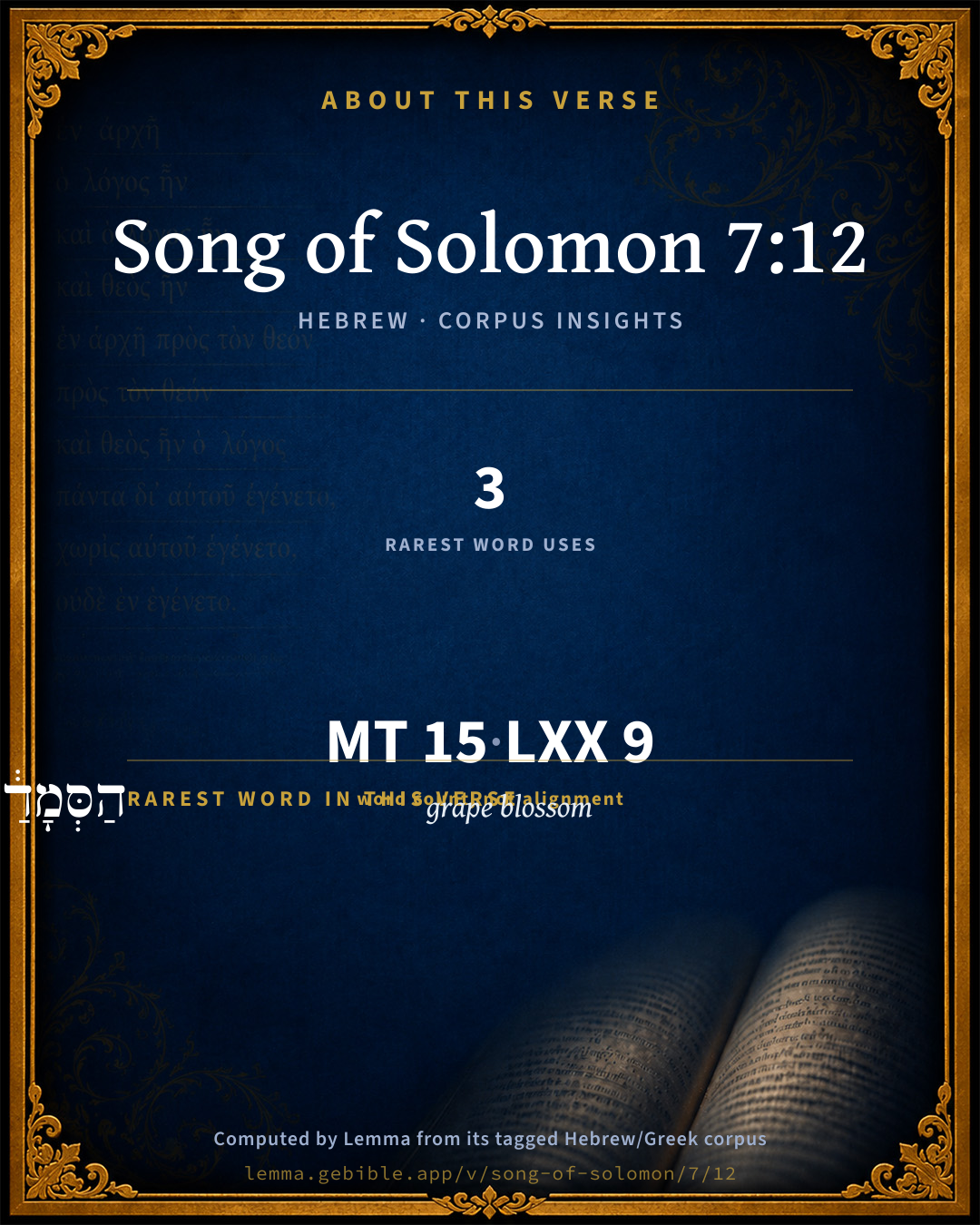
The rarest word here is הַסְּמָדַ֔ר grape blossom H5563 — appearing just 3 times in the whole Hebrew Bible.

Shared distinctive vocabulary

הַסְּמָדַ֔ר grape blossom H5563 occurs in 3 verses of the Hebrew Bible. Also found in:

Grammatical profile

  • 6 verbs
  • 5 nouns
  • 1 preposition
  • 1 conjunction
  • 1 adverb
  • 1 particle

Verb forms

  • נַשְׁכִּ֨ימָה֙ Hiphil · Cohortative
  • נִרְאֶ֞ה Qal · Cohortative
  • פָּֽרְחָ֤ה Qal · Perfect
  • פִּתַּ֣ח Piel · Perfect
  • הֵנֵ֖צוּ Hiphil · Perfect
  • אֶתֵּ֥ן Qal · Imperfect

Hebrew & Septuagint length

In English translation the verse runs 31 words from the Hebrew and 32 from the Septuagint (LXX English) — closely comparable.

A rough comparison of the two English renderings, which tokenize alike — not a word-level alignment.

Word counts can differ between the Hebrew and the Greek without any difference in meaning — e.g. the Hebrew direct-object marker אֵת has no separate Greek word, and Greek often adds the article ὁ.

In the original languages it is 15 Hebrew tokens and 9 Greek tokens — but the two are counted differently (Hebrew bundles its prefixes and suffixes into one token; the Greek is in lemma form), so that isn’t a like-for-like length.

Cross-references

25

Topical passages linked to Song of Solomon 7:12 in the Treasury of Scripture Knowledge — connected by theme and wording, ordered by reader-vote popularity; previews shown in the World English Bible.

  • Song of Solomon 6:11 I went down into the nut tree grove, To see the green plants of the valley, To see whether the vine budded, And the pomegranates were in flower.
  • Psalms 122:5 For there are set thrones for judgment, The thrones of David's house.
  • Song of Solomon 7:6 How beautiful and how pleasant are you, Love, for delights!
  • 2 Corinthians 13:5 Test your own selves, whether you are in the faith. Test your own selves. Or don't you know as to your own selves, that Jesus Christ is in you?--unless indeed you are disqualified.
  • Ephesians 6:24 Grace be with all those who love our Lord Jesus Christ with incorruptible love. Amen.
  • 1 Thessalonians 3:5–6 For this cause I also, when I couldn't stand it any longer, sent that I might know your faith, for fear that by any means the tempter had tempted you, and our labor would have been in vain.
  • Exodus 25:22 There I will meet with you, and I will tell you from above the mercy seat, from between the two cherubim which are on the ark of the testimony, all that I command you for the children of Israel.
  • Psalms 43:4 Then I will go to the altar of God, To God, my exceeding joy. I will praise you on the harp, God, my God.
  • Psalms 63:3–8 Because your loving kindness is better than life, My lips shall praise you.
  • Psalms 73:25 Who do I have in heaven? There is no one on earth who I desire besides you.
  • Proverbs 8:17 I love those who love me. Those who seek me diligently will find me.
  • Proverbs 24:30–31 I went by the field of the sluggard, By the vineyard of the man void of understanding;
  • Ecclesiastes 9:10 Whatever your hand finds to do, do it with your might; for there is no work, nor device, nor knowledge, nor wisdom, in Sheol, where you are going.
  • Song of Solomon 2:13 The fig tree ripens her green figs. The vines are in blossom; They give forth their fragrance. Arise, my love, my beautiful one, And come away. Lover
  • Song of Solomon 2:15 Catch for us the foxes, The little foxes that spoil the vineyards; For our vineyards are in blossom. Beloved
  • Song of Solomon 4:16 Awake, north wind; and come, you south; Blow on my garden, that its spices may flow out. Let my beloved come into his garden, And taste his precious fruits. Lover
  • Isaiah 18:5 For before the harvest, when the blossom is over, and the flower becomes a ripening grape, he will cut off the sprigs with pruning-hooks, and the spreading branches will he take away [and] cut down.
  • Ezekiel 20:40–41 For in my holy mountain, in the mountain of the height of Israel, says the Lord Yahweh, there shall all the house of Israel, all of them, serve me in the land: there will I accept them, and there will I require your offerings, and the first fruits of your offerings, with all your holy things.
  • Acts 15:36 After some days Paul said to Barnabas, "Let's return now and visit our brothers in every city in which we proclaimed the word of the Lord, to see how they are doing."
  • Romans 5:11 Not only so, but we also rejoice in God through our Lord Jesus Christ, through whom we have now received the reconciliation.
  • 2 Corinthians 5:14–15 For the love of Christ constrains us; because we judge thus, that one died for all, therefore all died.
  • Hebrews 2:13 Again, "I will put my trust in him." Again, "Behold, here am I and the children whom God has given me."
  • Hebrews 2:15 and might deliver all of them who through fear of death were all their lifetime subject to bondage.
  • Hebrews 4:16 Let us therefore draw near with boldness to the throne of grace, that we may receive mercy, and may find grace for help in time of need.
  • Hebrews 12:15 looking carefully lest there be any man who falls short of the grace of God; lest any root of bitterness springing up trouble you, and thereby the many be defiled;

Cross-references courtesy of OpenBible.info (CC BY 4.0).

Hebrew and Greek witnesses Masoretic Hebrew ↔ Greek Septuagint

The same verse in the two great witnesses to the Old Testament, shown verse-for-verse.

These are two independent witnesses, not word-aligned to each other, and the Septuagint is shown in lemma (dictionary) form.

Hebrew Song of Solomon 7:12 Masoretic · Westminster Leningrad Codex

נַשְׁכִּ֨ימָה֙ לַכְּרָמִ֔ים נִרְאֶ֞ה אִם פָּֽרְחָ֤ה הַגֶּ֨פֶן֙ פִּתַּ֣ח הַסְּמָדַ֔ר הֵנֵ֖צוּ הָרִמּוֹנִ֑ים שָׁ֛ם אֶתֵּ֥ן אֶת דֹּדַ֖י לָֽךְ

Let's go early up to the vineyards. Let's see whether the vine has budded, Its blossom is open, And the pomegranates are in flower. There I will give you my love.

World English Bible · Public Domain

Greek LXX Song of Solomon 7:12 Septuagint · lemma form

ἔρχομαι ἀδελφιδός ἐγώ ἐκἔρχομαι εἰς ἀγρός αὐλίζω ἐν κώμη

Let us go early into the vineyards; let us see if the vine has flowered, if the blossoms have appeared, if the pomegranates have blossomed; there will I give you my breasts.

LXX2012 (modern English Septuagint) · Public Domain

On this verse, Ellicott's Commentary for English Readers discusses the Septuagint’s reading. Read the note in Commentary ↓

Hebrew: Westminster Leningrad Codex (CC BY 4.0). Greek: Septuagint (public domain); English from LXX2012 (modern English Septuagint) (Public Domain). How the Septuagint differs from the Hebrew →

Commentary

Notes on Song of Solomon 7:12 from classic Christian and Jewish commentators (each source and its license shown beneath its notes). The classic Christian expositions comment on the surrounding passage and are grouped to its opening verse, so a note may address several verses; the Jewish commentaries on the Tanakh (Rashi and others) are per-verse, so they appear only where the commentator wrote on this verse.

Lemma curates 59 commentaries, every one of them public domain or Creative Commons licensed, each selected and text-cleaned for this edition rather than reprinted as found. About our sources →

Trapp's Complete Commentary

John Trapp

Son 7:12 Let us get up early to the vineyards; let us see if the vine flourish, [whether] the tender grape appear, [and] the pomegranates bud forth: there will I give thee my loves.

Ver. 12. Let us get up early to the vineyards.] Heb., Let us morning it. Manicemas (that is, Gellius’ {a} word), Let us be up early and at it. Here she promiseth not to be found henceforth unready, drowsy, sluggish, but night and day to watch and attend that hour, and to inquire and learn out all the signs and tokens when she may come to be perfectly knit to Christ. But it is worthy of our observation that she would neither go any way nor do anything without Christ’s company, for she had lately felt the grief of being without him, though but "for a small moment," as the prophet hath it. She had felt herself that while in the suburbs of hell as it were. She therefore holds him as fast as the restored cripple did Peter and John; {Act 3:11} she cleaves as close to him as Ruth did to Naomi; or Elisha did to his master Elijah, when now be knew he should be taken from his head. {2Ki 2:2} She seems here to speak to Christ as once Barak did to Deborah, "If thou wilt go with me, then I will go; but if thou wilt not go with me, I will not go." {Jdg 4:8} And whereas she seemeth, as the forwarder of the two, to excite and exhort Christ to "get up early to visit the vines," &c., we may not imagine any unwillingness in him to the performance of his office as "shepherd and bishop of our souls," {1Pe 2:25} or any need on his part to be quickened and counselled by her, as Manoah was by his wife, or Aquila by Priscilla, whence she is set before him, {Rom 16:3} for "who hath directed the Spirit of the Lord, or being his counsellor hath taught him?" {Isa 40:13} But the Church requesteth these things of Christ for her own encouragement and further benefit; that having his continual presence and fellowship, she may the more cheerfully and successfully go on with her duty. So when we press God with arguments in prayer, it is not so much to persuade him to help us, "for the Father himself loveth you," {Joh 16:27} saith Christ, and needs no arguments, σποι δοντα και αυτον οτσυνειν, {b} to incite or entice him to show us mercy, as to persuade our own hearts to more faith, love, humility, &c., that we may be in a capacity to receive that mercy that of his own accord he hath for us, and even waits to confer upon us. {Isa 30:18} Look how a man that would make a bladder capacious to hold sweet spices, blows it and rubs it, and blows it, and rubs it many times over to make it hold the more: so it is here. And as when a man that is in a ship plucks a rock, it seems as if he plucked the rock nearer the ship, whenas in very deed the ship is plucked nearer the rock: so when God’s people think they draw God to them with their arguments, in truth they draw themselves nearer to God, who sometimes ascribeth that to us which is his own work, that we may abound more and more. Certum est nos facere quod facimus, sed ille facit ut faciamus. {c} True it is that we do what we do, but it is he that giveth us to do what we do in his service. The bowls of the candlestick had no oil but that which dropped from the olive branches.

Whether the tender grape appear.] Heb., Open, and so prove itself to be a grape, which in the bud can hardly be discerned. True grace may be doubted about as long as it is small and feeble. Weak things are oft so obscured with their contraries that it remaineth uncertain whether they be or no. He that cried out, and that with tears, "I believe, Lord, help mine unbelief" {Mar 9:24} - that is, my weak faith - could not well tell whether he had any faith at all or not. Add growth to grace, and it will be out of question. Meanwhile that is a sweet promise, "I will pour my Spirit upon thy seed, and my blessing upon thy buds." {Isa 44:3} And again, "Thus saith the Lord, As the new wine is found in the cluster, and one saith, Destroy it not, for a blessing is in it, so will I do for my servants’ sake, that I may not destroy them all." {Isa 65:8}

And the pomegranates bud forth.] {See Trapp on "Son 4:13"}

There will I give thee my loves,] i.e., The fruition of my graces, and fruits of thy faith, thanks, good works, &c. And this is that which Christ requireth of us all - viz., that we bestow all our loves upon him, even the liveliest and warmest of our affections. Love him we must truly, that there be no halting, and totally, that there he no halving. Hold him we must "better, dearer to us than ten sons," &c., and communicate all our loves to him as best worthy. What he gives us back again we may bestow upon others; we may love other things, but no otherwise than as they convey love to us from Christ, and may be means of drawing our affections unto Christ. We must love all things else as they have a beam of Christ in them, and may lead us to him; accounting that we rightly love ourselves no further than we love the Lord Jesus Christ with a love of complacence.

{a} A. Gel. lib. iii., cap. 29.

{b} Homer.

{c} Augustine.

John Trapp, A Commentary or Exposition upon All the Books of the Old and New Testament (1647–1656) — public domain. Text from a community e-Sword module.

Joseph Benson's Commentary

Son 7:12. Let us get up early — The church having lost her beloved, by her former laziness, now doubles her diligence; to the vineyards — To particular congregations. Let us see if the vines, &c. — Let us inquire into the success of our labours, what souls are brought in and built up, and how they prosper and grow in grace. There will I give thee my loves — There I will discover the fervency of my affections to thee, and maintain communion with thee in thy holy ordinances.

Joseph Benson's Commentary on the Old and New Testaments (1811–1818) — public domain. Text from a community e-Sword module.

Geneva Bible (1599)

Geneva Bible translators

If the people that are called to Christ, bring forth any fruit.

Geneva Bible (1599) marginal notes — public domain. Text via Bolls.life.

Adam Clarke's Commentary

Verse 12. Let us get up early to the vineyards] When in the country, we shall have the better opportunity to contemplate the progress of the spring vegetation; and there she promises to be peculiarly affectionate to him.

Adam Clarke's Commentary on the Bible (1810–1826) — public domain. Text from a community e-Sword/MySword module.

Ellicott's Commentary for English Readers

(12) Tender grape appear.—Literally, vine blossome open. (See Note on Son_2:13.)

My loves—i.e., caresses. LXX., as before, read “breasts.”

A Bible Commentary for English Readers, edited by Charles John Ellicott (1878–1897) — public domain. Text from a community e-Sword module.

The Cambridge Bible for Schools and Colleges

gen. ed. J. J. S. Perowne

12. if the vine flourish] whether the vine hath budded, R.V. Cp. Son_6:11.

whether the tender grape appear] Rather, and its blossom be open, R.V. For the word semâdhar = ‘blossom,’ cp. ch. Son_2:13; Son_2:15. It is found nowhere else in the O.T.

there will I give thee] There, in contrast to here and now. As Oettli remarks, first freedom, then love.

The Cambridge Bible for Schools and Colleges (gen. ed. J. J. S. Perowne; Cambridge University Press, 1878–1918) — public domain. Text from a community e-Sword module.

Matthew Poole's English Annotations

Let us get up early: the church having offended and lost her Beloved by her former laziness, now doubles her diligence, and discovers how earnestly she was set upon the following work.

To the vineyards; to particular congregations. See Son 6:11; Isa 5:1.

Let us see if the vines flourish &c.; let us inquire into the success of our labours, what souls are brought in and built up, how they prosper and grow in grace, whether they abound in good works, &c.

There will I give thee my loves; there I will discover the sincerity and fervency of my affections to thee, and maintain communion with thee in thy holy ordinances.

Matthew Poole's English Annotations on the Holy Bible (1683–1685) — public domain. Text from a community e-Sword/MySword module.

Whedon's Commentary on the Bible

Daniel D. Whedon

12. Let us get up, etc. — Better, Early, will we stroll in the vineyards; we will see, etc.

My loves — My affections. She speaks as a queen.

“With a regal grace In her sun-kissed face,

And a light in her beaming eye.”

she assures him that he shall have what she refused to the King.

Daniel D. Whedon (gen. ed.), Commentary on the Old and New Testaments (1874–1909) — public domain. Text from a community e-Sword module.

John Wesley's Explanatory Notes

Early - The church having lost her beloved by her former laziness, now doubles her diligence. Vineyards - To particular congregations. Let us see - Let us inquire into the success of our labours, what souls are brought in and built up, and how they prosper and grow in grace. There - There I will discover the fervency of my affections to thee, and maintain communion with thee in thy holy ordinances.

John Wesley, Explanatory Notes Upon the Whole Bible (1754–1765) — public domain. Text via the GEBible commentary corpus.

unfoldingWord translationNotes

Door43 World Missions Community

General Information:

The woman continues to speak to the man.

rise early

"get up early" or "wake up early"

have budded

"have begun to bloom"

blossoms

flowers when they are open

are in flower

"have flowers open on the plant"

I will give you my love

"I will make love with you"

translationWords

vineyard

vine

pomegranate

love

unfoldingWord translationNotes — © Distant Shores Media and the Door43 World Missions Community, licensed CC BY-SA 4.0. Source: git.door43.org/Door43/en_tn.

Rashi

Rabbi Shlomo Yitzchaki (Rashi)

Come, my beloved, let us go out to the field Our Rabbis expounded in Eruvin (21b): The congregation of Israel said, “O Lord of the Universe, do not judge me like the inhabitants of large cities, where there is robbery and immorality, but like the inhabitants of villages, who are craftsmen, and engage in the Torah amidst hardship.

let us lodge in the villages Heb. בַּכְּפָרִִים. Let us lodge among the disbelievers (בַּכּוֹפְרִִים). Come and I will show You the sons of Esau, upon whom You bestowed plenty, but who do not believe in You.

Rashi on the Tanakh — English translations: “The Judaica Press complete Tanach with Rashi, translated by A. J. Rosenberg” (CC BY 4.0); “Pentateuch with Rashi's commentary by M. Rosenbaum and A.M. Silbermann, 1929-1934” (public domain); “The Metsudah Tanach series, Lakewood, N.J” (CC BY 4.0); and “The Book of Joshua, Metsudah Publications, 1997” (CC BY 4.0). Text via Sefaria.

Lesson kit

Teaching starters — assembled from the data on this page, not authored interpretation. Every prompt links to the verse data it draws on. Edit before teaching.

Song of Solomon, in the Wisdom, opens this verse with 15 words (14 distinct Hebrew lemmas). Its most distinctive word is çᵉmâdar (“grape blossom”). A historical commentator’s framing appears above. Read the whole chapter for the surrounding context.

Discussion questions

  1. How does “grape blossom” (çᵉmâdar) shape what this verse is saying?
  2. How does Song of Solomon 2:13, which shares the word «grape blossom», read alongside this verse?
  3. These translations render this verse differently. What is at stake in choosing one wording over another?
  4. «נַשְׁכִּ֨ימָה֙» is a Hiphil Cohortative verb. How does that grammatical form shape the action described?
  5. Compare how Trapp's Complete Commentary and Joseph Benson's Commentary read this verse. Where do they agree or differ?

Things to notice

Reading settings

Reading text

Shown beneath each verse's original-language words.

Old Testament
Old Testament edition

Read the OT as the Masoretic Hebrew (MT) or the Greek Septuagint (LXX).

English shown for the Greek Septuagint (in the Hebrew ↔ Greek comparison).

Comparing translations? Open the Compare panel on any verse page to stack up to four side by side.