Ezekiel 40:43

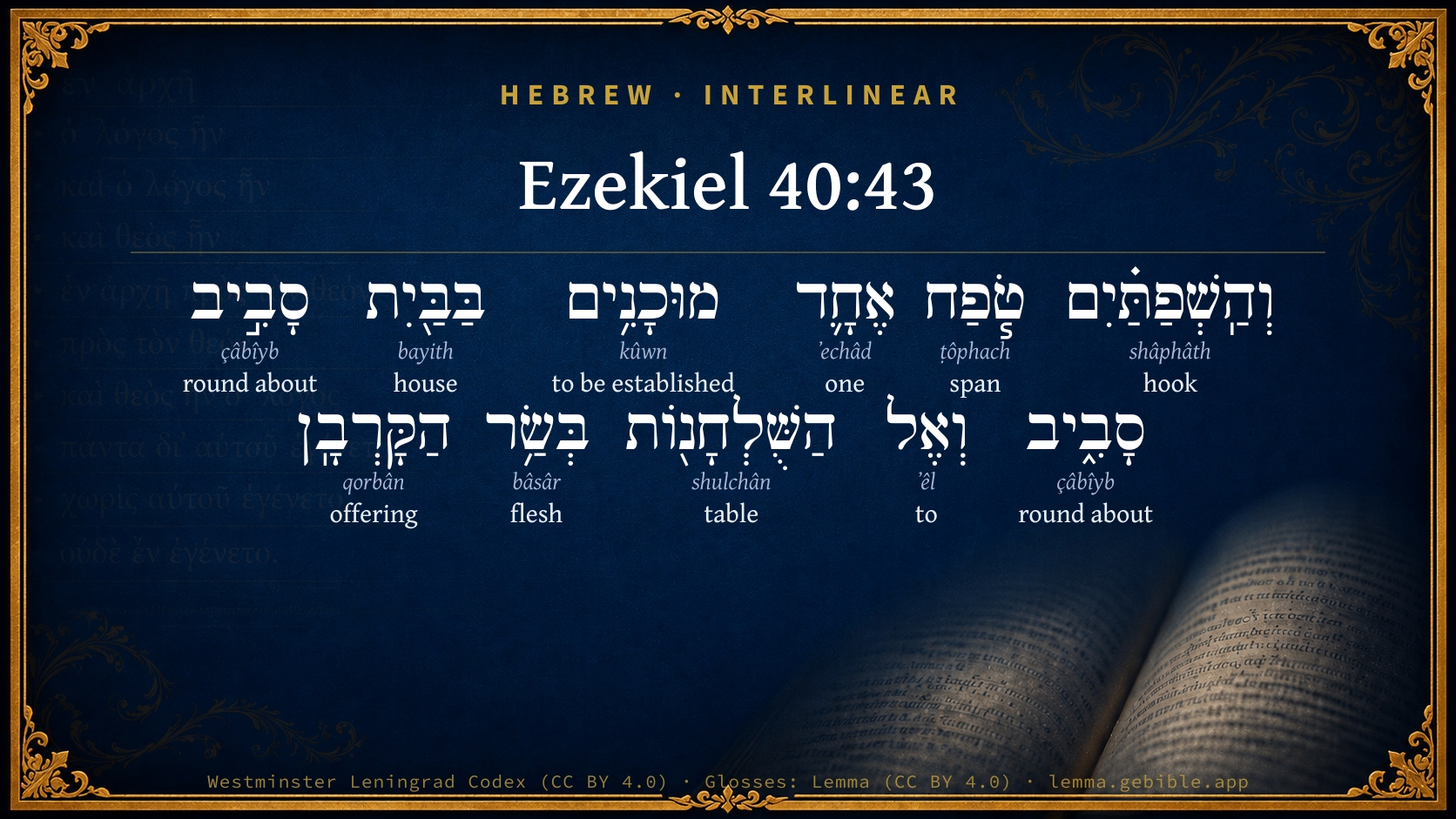
Hebrew (Westminster Leningrad Codex) Ezekiel 40:43 appears in the Hebrew Old Testament. The text above is from the Westminster Leningrad Codex. Each word links to its Strong’s number, a concise gloss, and parsing drawn from the Open Scriptures Hebrew Bible morphology. Click any word for its full Brown-Driver-Briggs (BDB) entry.
Download image
Cite this verse

Ezekiel 40:43 (World English Bible). Public Domain. Lemma interlinear Bible study tool, https://lemma.gebible.app/v/ezekiel/40/43.

Show BibTeX & RIS
BibTeX
RIS
English Translation
The hooks, a handbreadth long, were fastened within round about: and on the tables was the flesh of the offering.
World English Bible · Public Domain
Download a study sheet

One document with this verse’s original text, its word-by-word gloss line, the meaning frame, cross-references with their text, attributed commentary, and full source and license credits — printable, and it pastes into notes with its structure intact.

This verse Autodidact and up

Study sheet (.html) Plain text (.txt)

A passage Seminary Student

Up to 50 verses in one chapter. A passage sheet keeps up to 6 commentary sources and 12 cross-references per verse, in the order this page ranks them, and says so on the sheet whenever that leaves anything out. Ask for a single verse and you get the Autodidact verse sheet above.

Everything on this page stays free to read, with no account — the sheet is a download of what is already on screen, not access to it.

Want to remove ads? Support Godless Engineer
Compare translations 3

The same verse in 3 English versions, stacked beneath the original-language interlinear above. Click any original word for its lexicon entry.

Each is an independent rendering of the whole verse — the interlinear is not word-aligned to these translations.

Highlighted words mark where these versions differ — a whole-verse word diff, not a word-by-word alignment.

  • World English Bible Public Domain
    The hooks, a handbreadth long, were fastened within round about: and on the tables was the flesh of the offering.
  • King James Version Public Domain
    And within were hooks, an hand broad, fastened round about: and upon the tables was the flesh of the offering.
  • unfoldingWord Literal Text CC BY-SA 4.0
    Two-pronged hooks a handbreadth in length were fastened in the portico all around, and the flesh of the offerings would be put on the tables.

unfoldingWord Literal Text — © unfoldingWord, licensed CC BY-SA 4.0. Word-aligned USFM3 via Door43 (git.door43.org/unfoldingWord/en_ult).

Versions to compare (up to 4)

3 of 4 selected

Show all 18 translations

Every available English version of this verse, each an independent rendering of the whole verse.

  • World English Bible Public Domain
    The hooks, a handbreadth long, were fastened within round about: and on the tables was the flesh of the offering.
  • Berean Standard Bible Public Domain
    The double-pronged hooks, each a handbreadth long, were fastened all around the inside of the room, and the flesh of the offering was to be placed on the tables.
  • Majority Standard Bible Public Domain
    The double-pronged hooks, each a handbreadth long, were fastened all around the inside of the room, and the flesh of the offering was to be placed on the tables.
  • King James Version Public Domain
    And within were hooks, an hand broad, fastened round about: and upon the tables was the flesh of the offering.
  • American Standard Version (1901) Public Domain
    And the hooks, a handbreadth long, were fastened within round about: and upon the tables was the flesh of the oblation.
  • Revised Version (1885) Public Domain
    And the hooks, an handbreadth long, were fastened within round about: and upon the tables was the flesh of the oblation.
  • Geneva Bible (1599) Public Domain
    And within were borders an hand broade, fastened round about, and vpon the tables lay the flesh of the offring.
  • Douay-Rheims (1899) Public Domain
    And the borders of them were of one handbreadth, turned inwards round about: and upon the tables was the flesh of the offering.
  • Young's Literal Translation Public Domain
    And the boundaries `are' one handbreadth, prepared within all round about: and on the tables `is' the flesh of the offering.
  • Literal Standard Version CC BY-SA 4.0
    And the boundaries [are] one handbreadth, prepared within all around: and the flesh of the offering [is] on the tables.
  • Unlocked Literal Bible CC BY-SA 4.0
    Two-pronged hooks a handbreadth in length were fastened in the portico all around, and the flesh of the offerings would be put on the tables.
  • unfoldingWord Literal Text CC BY-SA 4.0
    Two-pronged hooks a handbreadth in length were fastened in the portico all around, and the flesh of the offerings would be put on the tables.
  • Darby Bible Public Domain
    And the double hooks of a hand breadth were fastened round about within; and upon the tables [they put] the flesh of the offering.
  • World Messianic Bible Public Domain
    The hooks, a hand width long, were fastened within all around. The meat of the offering was on the tables.
  • Webster's Bible Public Domain
    And within were hooks, a hand broad, fastened around: and upon the tables was the flesh of the offering.
  • Free Bible Version CC BY-SA 4.0
    Hooks measuring the width of a hand were attached to the walls inside the room. The meat of the offering was to be placed on the tables.
  • Bible in Basic English Public Domain
    And they had edges all round as wide as a man's hand: and on the tables was the flesh of the offerings.
  • JPS Tanakh (1917) Public Domain
    And the slabs, a handbreadth long, were fastened within round about; and upon the tables was to be the flesh of the offering.

Literal Standard Version (2020), Covenant Press — licensed CC BY-SA 4.0. Text via the HelloAO Bible API (eBible.org). Unlocked Literal Bible (unfoldingWord) — licensed CC BY-SA 4.0. Text via the HelloAO Bible API (eBible.org). unfoldingWord Literal Text — © unfoldingWord, licensed CC BY-SA 4.0. Word-aligned USFM3 via Door43 (git.door43.org/unfoldingWord/en_ult). Free Bible Version, Dr. Jonathan Gallagher — licensed CC BY-SA 4.0. Text via the HelloAO Bible API (eBible.org).

Word by word

More ways to search: Search by grammar → Find every occurrence → Compare this word →

Practice this passage: Drill this verse → Learn its vocabulary →

וְהַֽשְׁפַתַּ֗יִם
shâphâth
H8240
“and · the · hooks”
Conjunction + Particle, Definite Article + Noun, Common, Masculine, Dual, Absolute
Part of Speech
Conjunction + Particle + Noun
Type
Common
Gender
Masculine
Number
Dual
State
Absolute
Full BDB Definition

Origin: from H8239

TWOT: 2450

hook-shaped pegs, hooks, pots, fold - meaning doubtful
  1. טֹ֧פַח ṭôphach H2948 “span” Noun, Common, Masculine, Singular, Absolute
  2. אֶחָ֛ד ʼechâd H259 “one” Adjective, Cardinal number, Masculine, Singular, Absolute
  3. מוּכָנִ֥ים kûwn H3559 “established” Verb, Hophal, Participle Passive, Masculine, Plural, Absolute
  4. בַּבַּ֖יִת bayith H1004 “in/at the · house” Preposition, Determined + Noun, Common, Masculine, Singular, Absolute
  5. סָבִ֣יב çâbîyb H5439 “round about” Noun, Common, Both, Singular, Absolute
  6. סָבִ֑יב çâbîyb H5439 “round about” Noun, Common, Both, Singular, Absolute
  7. וְאֶל ʼêl H413 “and · to” Conjunction + Preposition
  8. הַשֻּׁלְחָנ֖וֹת shulchân H7979 “the · tables” Particle, Definite Article + Noun, Common, Masculine, Plural, Absolute
  9. בְּשַׂ֥ר bâsâr H1320 “flesh of” Noun, Common, Masculine, Singular, Construct
  10. הַקָּרְבָֽן qorbân H7133 “the · offering” Particle, Definite Article + Noun, Common, Masculine, Singular, Absolute

About this verse

These counts appear in no published source. They are computed here, from the morphology-tagged text and Lemma’s own curated glosses. What Lemma adds →

11
words
10
distinct lemmas
Prophets
section

Notable vocabulary

The rarest word here is וְהַֽשְׁפַתַּ֗יִם hook H8240 — appearing just 2 times in the whole Hebrew Bible.

Shared distinctive vocabulary

וְהַֽשְׁפַתַּ֗יִם hook H8240 occurs in 2 verses of the Hebrew Bible. Also found in:

Grammatical profile

  • 1 verb
  • 8 nouns
  • 1 adjective
  • 1 preposition

Verb forms

  • מוּכָנִ֥ים Hophal · Participle Passive

Repetition

A word recurs within this verse — often emphatic in Hebrew:

  • סָבִ֣יב round about H5439 ×2

Hebrew & Septuagint length

In English translation the verse runs 20 words from the Hebrew and 32 from the Septuagint (LXX English) — the Septuagint runs noticeably longer here. See the side-by-side →

A rough comparison of the two English renderings, which tokenize alike — not a word-level alignment.

Word counts can differ between the Hebrew and the Greek without any difference in meaning — e.g. the Hebrew direct-object marker אֵת has no separate Greek word, and Greek often adds the article ὁ.

Cross-references

3

Topical passages linked to Ezekiel 40:43 in the Treasury of Scripture Knowledge — connected by theme and wording, ordered by reader-vote popularity; previews shown in the World English Bible.

  • Leviticus 1:6 He shall flay the burnt offering, and cut it into pieces.
  • Leviticus 1:8 and Aaron's sons, the priests, shall lay the pieces, the head, and the fat in order on the wood that is on the fire which is on the altar;
  • Leviticus 8:20 He cut the ram into its pieces; and Moses burned the head, and the pieces, and the fat.

Cross-references courtesy of OpenBible.info (CC BY 4.0).

Hebrew and Greek witnesses Masoretic Hebrew ↔ Greek Septuagint

The same verse in the two great witnesses to the Old Testament, shown verse-for-verse.

Here the Septuagint runs noticeably longer than the Hebrew — LXX2012 (modern English Septuagint) 32 words vs World English Bible 20. A rough length comparison of the two English translations, not a word-level alignment — read both below.

These are two independent witnesses, not word-aligned to each other, and the Septuagint is shown in lemma (dictionary) form.

Hebrew Ezekiel 40:43 Masoretic · Westminster Leningrad Codex

וְהַֽשְׁפַתַּ֗יִם טֹ֧פַח אֶחָ֛ד מוּכָנִ֥ים בַּבַּ֖יִת סָבִ֣יב סָבִ֑יב וְאֶל הַשֻּׁלְחָנ֖וֹת בְּשַׂ֥ר הַקָּרְבָֽן

The hooks, a handbreadth long, were fastened within round about: and on the tables was the flesh of the offering.

World English Bible · Public Domain

Greek LXX Ezekiel 40:43 Septuagint · lemma form

καί παλαιστή ἔχω γεῖσος λαξεύω ἔσωθεν κύκλος καί ἐπί ὁ τράπεζα ἐπάνωθεν στέγη ὁ καλύπτω ἀπό ὁ ὑετός καί ἀπό ὁ ξηρασία

And they shall have within a border of hewn stone round about of a span broad, and over the tables above screens for covering them from the wet and from the heat.

LXX2012 (modern English Septuagint) · Public Domain

On this verse, The Cambridge Bible for Schools and Colleges discusses the Septuagint’s reading. Read the note in Commentary ↓

Hebrew: Westminster Leningrad Codex (CC BY 4.0). Greek: Septuagint (public domain); English from LXX2012 (modern English Septuagint) (Public Domain). How the Septuagint differs from the Hebrew →

Targum (Aramaic paraphrase)

1

The Targum is the ancient Jewish Aramaic paraphrase of the Hebrew Scriptures — an interpretive translation, not the Hebrew text itself. Onkelos (literal) and Pseudo-Jonathan (expansive) render the Torah, and Jonathan the Prophets. Coverage is partial: where no permissively-licensed English translation exists for a verse, only the Aramaic is shown. This is verse-level text, not a word-by-word alignment to the Hebrew.

  1. Targum Jonathan Prophets (Joshua–Malachi)
    וְעָנְקְלִין נַפְקִין פְּשַׁח חָד קְבִיעִין בְּעַמוּדֵי בֵּית מַטְבְּחַיָא מִגָיו לְאוּלַמַיָא סְחוֹר סְחוֹר וְעַל פָּתוֹרַיָא בְּשַׂר קוּרְבְּנַיָא:

    (no public-domain English translation for this verse)

    Targum Jonathan — Aramaic: “Mikraot Gedolot” (public domain). English: “Sefaria Community Translation” (CC0 1.0 (public-domain dedication)); “London "Chaldee Paraphrase," 1871” (public domain). Text via Sefaria.

Commentary

Notes on Ezekiel 40:43 from classic Christian and Jewish commentators (each source and its license shown beneath its notes). The classic Christian expositions comment on the surrounding passage and are grouped to its opening verse, so a note may address several verses; the Jewish commentaries on the Tanakh (Rashi and others) are per-verse, so they appear only where the commentator wrote on this verse.

Lemma curates 59 commentaries, every one of them public domain or Creative Commons licensed, each selected and text-cleaned for this edition rather than reprinted as found. About our sources →

Trapp's Complete Commentary

John Trapp

Eze 40:43 And within [were] hooks, an hand broad, fastened round about: and upon the tables [was] the flesh of the offering.

Ver. 43. And within were hooks.] Where hung the beasts when they were flayed, and afterwards the priests’ and offerers’ portions, till after the sacrifice they were shared out.

John Trapp, A Commentary or Exposition upon All the Books of the Old and New Testament (1647–1656) — public domain. Text from a community e-Sword module.

Joseph Benson's Commentary

Eze 40:43. Within were hooks, a hand broad, fastened round about — Within the gate, or entrance, on the north side of the inner court, were iron hooks, for the hanging up the beasts that were to be sacrificed, in order to the flaying off their skins. And upon the tables was the flesh, &c. — Or, they laid the flesh of the offering; upon the marble tables the priests laid the flesh of the slain beasts, which they cut in pieces, and fitted for the altar: see Lev 1:6.

Joseph Benson's Commentary on the Old and New Testaments (1811–1818) — public domain. Text from a community e-Sword module.

Tyndale Open Study Notes

Tyndale Open Resources

40:43 The hooks might be used to store the knives and implements mentioned in 40:42.

Tyndale Open Study Notes — © Tyndale Open Resources, licensed CC BY-SA 4.0. Text via the HelloAO Bible API.

Jamieson, Fausset & Brown

Robert Jamieson, A. R. Fausset & David Brown

hooks--cooking apparatus for cooking the flesh of the sacrifices that fell to the priests. The hooks were "fastened" in the walls within the apartment, to hang the meat from, so as to roast it. The Hebrew comes from a root "fixed" or "placed."

Jamieson, Fausset & Brown — Commentary Critical and Explanatory on the Whole Bible (1871) — public domain (CC PDM 1.0). Text via the HelloAO Bible API.

Ellicott's Commentary for English Readers

(43) Hooks.—This is a word of doubtful meaning, found elsewhere only in Psa_68:13, where it is translated pots. It certainly designates something “within” the porch, and therefore could not have been anything attached to the tables which were “without.” Our translators, following the ancient Chaldee paraphrast, have probably given the true sense, hooks, upon which the flesh of the victims was hung after it had been prepared upon the tables.

A Bible Commentary for English Readers, edited by Charles John Ellicott (1878–1897) — public domain. Text from a community e-Sword module.

The Cambridge Bible for Schools and Colleges

gen. ed. J. J. S. Perowne

43. within were hooks] The word rendered hooks occurs in the sense of cattlepens (Psa_68:14), a meaning precluded here by the dimension, a handbreadth. Such hooks fitted up “within,” i.e. in the porch, might be used for hanging the carcases upon in order to flay them (Targ.). The meaning “hooks” is not certain. LXX. assumes that the stone tables are still referred to and points differently, reading lip or border for “hooks:” “and they shall have a border of hewn stone inwards round about of a span broad.” Cf. Eze_43:13; Eze_43:17.

flesh of the offering] Except in a clause of Eze_20:28 (wanting in LXX.) the word “offering” is not used by Ezek. The present clause seems to say little. LXX. reads: “and over the tables above (they shall have) coverings, to protect them from the wet and from the heat”—which has a suspicious resemblance to Isa_4:6.

The Eze_40:38-43 are no doubt in some disorder. They suggest several questions not easily settled. Upon the whole it is improbable that slaughtering took place at more than one gate. The word “northwards” indeed (Eze_40:40) seems decisive of this point. Either the N. gate is intended, or the N. side of the E. gate, no other gate having a N. side. There are several things in favour of the N. gate:

(1) In Eze_40:35-37 the prophet was at the N. inner gate, and no intimation is given that he was transported to another gate in Eze_40:38. (2) In the Law slaughtering is ordered to be performed on the N. side of the altar in the case of the burnt, sin and trespass offerings (Lev_1:11; Lev_4:24; Lev_4:29; Lev_4:33; Lev_6:25; Lev_7:2; Lev_14:13); no injunction is given in the case of the peace-offering (Eze_3:2; Eze_3:8; Eze_3:13). It is probable that the prophet’s legislation and that of the Levitical books will be in harmony. (3) In ch. Eze_8:5 the “altar-gate” is certainly the N. gate. (4) The E. gate, both inner and outer, was to be kept shut except on sabbaths and new moons (Eze_46:1), or on other occasions when the prince wished to offer a freewill offering (Eze_46:12). In favour of the E. gate there is the supposed meaning of Eze_40:40; but the rendering, “on the N. of one going up to the entry,” is hardly tenable (Eze_40:40). Ew. indeed for “gates” Eze_40:38 would read “east gate”—a purely arbitrary amendment. And altogether unhappy is his proposal to read for without (michuçah), Eze_40:40, “runnel” (meruçah)—the verb to “run” being never used of the running of water or fluids.

The Cambridge Bible for Schools and Colleges (gen. ed. J. J. S. Perowne; Cambridge University Press, 1878–1918) — public domain. Text from a community e-Sword module.

John Gill's Exposition

And the chamber whose prospect is towards the north,.... The row of chambers on the side of the east gate; that side of it that was towards the north, and which the chambers in it faced:

is for the priests, the keepers of the charge of the altar; the ministers of the Gospel, that take care of the altar, of public worship; that preach the Gospel, and administer ordinances; and who are to be taken care of themselves, and live of the Gospel, and have everything provided for them that is necessary, Co1 9:13,

these are the sons of Zadok, among the sons of Levi; these Levites, or priests, were of the family of Zadok; who descended from Aaron, and was the eldest house of Aaron, to whom the priesthood belonged; though it had been usurped a long time by the family of Ithamar; but, in Solomon's time, Abiathar, of that family, was dispossessed of it, and Zadok was placed in his stead, whose name signifies "just", or righteous; and was a type of Christ, the holy and just One, whose spiritual children and offspring are here meant:

which come near to the Lord to minister unto him; both preachers and people, who have near access to God through Christ, and minister before him in holy things, in praying, preaching, administering ordinances, and attending on the same.

John Gill's Exposition of the Whole Bible (1746–1763) — public domain (CC PDM 1.0). Text via the HelloAO Bible API.

Albert Barnes' Notes on the Bible

Hooks - The alternative renderings given in the margin indicate the doubtfulness of the translation of the original word. The form is dual, and indicates that it is some object usually found in pairs. Some suggest that they were borders or ledges set, on either side of the tables, a handbreadth from the edges, to prevent the instruments placed on them from falling off. If the rendering “hooks” be adopted, it is to be explained thus: that these hooks were set on the wall “within,” that each hook was forked (hence, the “dual” form), and projected from the wall one span; and that on these hooks were hung the carcasses of the slain animals.

Albert Barnes' Notes on the Bible (1834–1885) — public domain. Text from a community e-Sword/MySword module.

Haydock's Catholic Bible Commentary

Borders, to prevent any thing falling. Chaldean, &c., have "hooks."

George Leo Haydock (1774–1849), Haydock's Catholic Family Bible and Commentary, 1859 edition — public domain. Excludes Psalms (Douay-Rheims chapter numbering differs from Protestant) and Deuterocanonical books (Catholic canon only).

Matthew Poole's English Annotations

Within the house, porch, or whatever the place be called where these tables stood.

Hooks; learned conjectures here, as in many other places, perplex more than explain. Hooks, on which the slaughtered sacrifice might be hanged. while they prepared it further, were needful, and the word imports such iron hooks. It is probable that there might be two hooks of iron fastened to or wrought out, where the plate was so broad, and therefore called hooks in the plural. Fastened to walls, no doubt, near these tables.

Upon the tables was the flesh of the offering; they were careful to keep the holy flesh from lying any where that might look like common ground. It is like that the sacrifice was fastened to these hooks, and rested on these stone tables, while the priests cut them into their pieces.

Matthew Poole's English Annotations on the Holy Bible (1683–1685) — public domain. Text from a community e-Sword/MySword module.

The Pulpit Commentary

The hooks. The word occurs again only in Psa_68:13, where it signifies "sheepfolds," or "stalls;" its older form ( appearing in Gen_49:14 and Jud_1:5:16. As this sense is unsuitable, recourse must be had to its derivation (from tp "to put, set, or fix"), which suggests as its import here either, as Ewald, Kliefoth, Hengstenberg, Havernick, and Smend, following the LXX and Vulgate, prefer, "ledges," or "border guards," on the edge of the tables, to keep the instruments or flesh from falling off; or, as Kimchi, Gesenius, Furst, Keil, Schroder, and Plumptre, after the Chaldean paraphrast, explain, "pegs" fastened in the wall for hanging the slaughtered caresses before they were flayed. In favor of the first meaning stand the facts that the second clause of this verse speaks of" tables," not of "walls," and that the measure of the shephataim is one of breadth rather than of length; against it are the considerations that the dual form, shephataim , fits better to a forked peg than to a double border, and that the shephataim are stated to have been fastened "in the house" (ba-baith), which again suits the idea of a peg fastened in the outer wall of the porch, rather than of a border fixed upon a table. The last clause of this verse is rendered by Ewald, after the LXX, "and over the tables" (obviously those standing outside of the porch) "were covers to protect them from rain and from drought;" and it is conceivable that coverings might have been advantageous for both the wooden tables and the officiating priests; only the Hebrew must be changed before it can yield this rendering.

The Pulpit Commentary (1880–1919), ed. H.D.M. Spence-Jones & Joseph S. Exell — public domain. Text from a community e-Sword module.

John Wesley's Explanatory Notes

Within - Within the porch, where these tables stood. Hooks - Hooks on which the slaughtered sacrifice might be hanged, while they prepared it farther. Fastened - To walls no doubt, near these tables.

John Wesley, Explanatory Notes Upon the Whole Bible (1754–1765) — public domain. Text via the GEBible commentary corpus.

Scofield Reference Notes

C. I. Scofield

hooks

Or, endirons, or, the two hearthstones.

The Scofield Reference Bible (1917 edition), notes by C. I. Scofield — public domain. Text from a community e-Sword module.

Rashi

Rabbi Shlomo Yitzchaki (Rashi)

And the hooks one handbreadth iron hooks attached to short pillars in the slaughtering area in the north upon which the hallowed animals were hung and flayed, as we learned in Pes. (5:9): Iron hooks were attached to the pillars and to the walls upon which they would hang and flay [the sacrifices]. Jonathan renders likewise: And hooks extending one handbreadth.

attached on the inside attached within the interior of the Court. בַּבַּיִת means inside.

Rashi on the Tanakh — English translations: “The Judaica Press complete Tanach with Rashi, translated by A. J. Rosenberg” (CC BY 4.0); “Pentateuch with Rashi's commentary by M. Rosenbaum and A.M. Silbermann, 1929-1934” (public domain); “The Metsudah Tanach series, Lakewood, N.J” (CC BY 4.0); and “The Book of Joshua, Metsudah Publications, 1997” (CC BY 4.0). Text via Sefaria.

Lesson kit

Teaching starters — assembled from the data on this page, not authored interpretation. Every prompt links to the verse data it draws on. Edit before teaching.

Ezekiel, in the Prophets, opens this verse with 11 words (10 distinct Hebrew lemmas). Its most distinctive word is shâphâth (“hook”). The Greek Septuagint runs longer here. A historical commentator’s framing appears above. Read the whole chapter for the surrounding context.

Discussion questions

  1. How does “hook” (shâphâth) shape what this verse is saying?
  2. Psalms 68:13 shares the word «hook» with this verse. How do the two illuminate each other?
  3. “round about” occurs 2× in this one verse. What is the effect of the repetition?
  4. Compared with the Hebrew, the Septuagint runs longer here. What questions does that raise?
  5. These translations render this verse differently. What is at stake in choosing one wording over another?
  6. The verb «מוּכָנִ֥ים» is Hophal Participle Passive. How does its form color the action?
  7. Reading how Trapp's Complete Commentary and Joseph Benson's Commentary read this verse, where do the two commentators agree and where do they part?

Things to notice

Reading settings

Reading text

Shown beneath each verse's original-language words.

Old Testament
Old Testament edition

Read the OT as the Masoretic Hebrew (MT) or the Greek Septuagint (LXX).

English shown for the Greek Septuagint (in the Hebrew ↔ Greek comparison).

Comparing translations? Open the Compare panel on any verse page to stack up to four side by side.