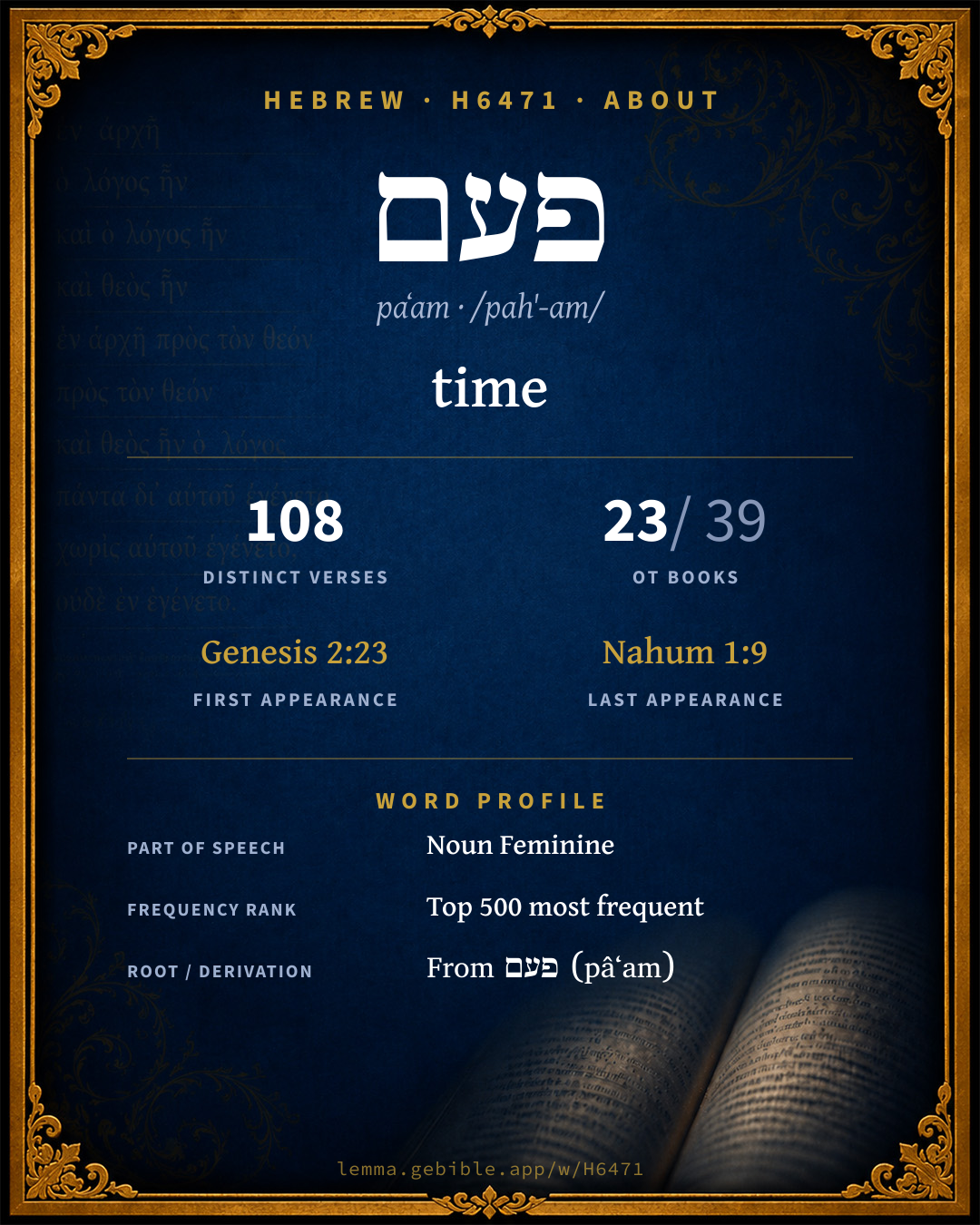
פַּ֫עַם
time
‘time’ is one of 4 main senses fuller range ↓
Full lexicon entry — Brown-Driver-Briggs (BDB)
From Brown-Driver-Briggs (BDB)
Where this word appears
See every Construct-state word in the Hebrew Bible →
Grammar key — what these labels mean
Part of speech
- Noun
- A naming word — a person, place, thing, or idea.
Noun type
- Common
- A common noun — a general class of person, place, or thing (“king,” “city,” “water”), not a specific name.
State
- Absolute
- The independent form of a noun, not bound to a following word.
- Construct
- A noun bound to a following noun in a possessive / “of” relationship (the construct chain).
Gender
- Feminine
- Grammatically feminine.
Number
- Plural
- More than one (in Hebrew, generally three or more).
- Singular
- One.
- Dual
- Exactly two — for natural pairs and some measures of time.
4 verses where H6471 appears in the Construct state in the Book of Joshua. Filtered view — show all forms. Click any verse to open its interlinear word-by-word view. Verse text shown in the World English Bible for context — . Each verse’s Hebrew form is shown with its reference; the English is not keyword-highlighted, since the data carries no word-level English alignment. Use “Compare translations” on any verse to read it across multiple English versions. This concordance covers the Hebrew Bible; Septuagint (Greek Old Testament) occurrences are not indexed here.
Joshua
- Joshua 6:3 פַּ֣עַם n c fs cs You shall compass the city, all the men of war, going about the city once. Thus shall you do six days.
- Joshua 6:11 פַּ֣עַם n c fs cs So he caused the ark of Yahweh to compass the city, going about it once: and they came into the camp, and lodged in the camp.
- Joshua 6:14 פַּ֣עַם n c fs cs The second day they compassed the city once, and returned into the camp: so they did six days.
- Joshua 10:42 פַּ֣עַם n c fs cs All these kings and their land did Joshua take at one time, because Yahweh, the God of Israel, fought for Israel.
About this entry
At a glance — auto-summarized from this page’s data, not written by a person. Every figure links to its source below. This summary describes the numbers; it doesn’t interpret them.
“time” is the headline sense of the Hebrew noun פעם (paʻam). Carrying more than one sense, it rewards its full sense range. With 108 verses in 23 books, it is a common word in the Hebrew Bible. Scripture first uses it in Genesis 2:23. From the same root come פעם and פעמן. The sections below give every sense, occurrence, and version rendering.
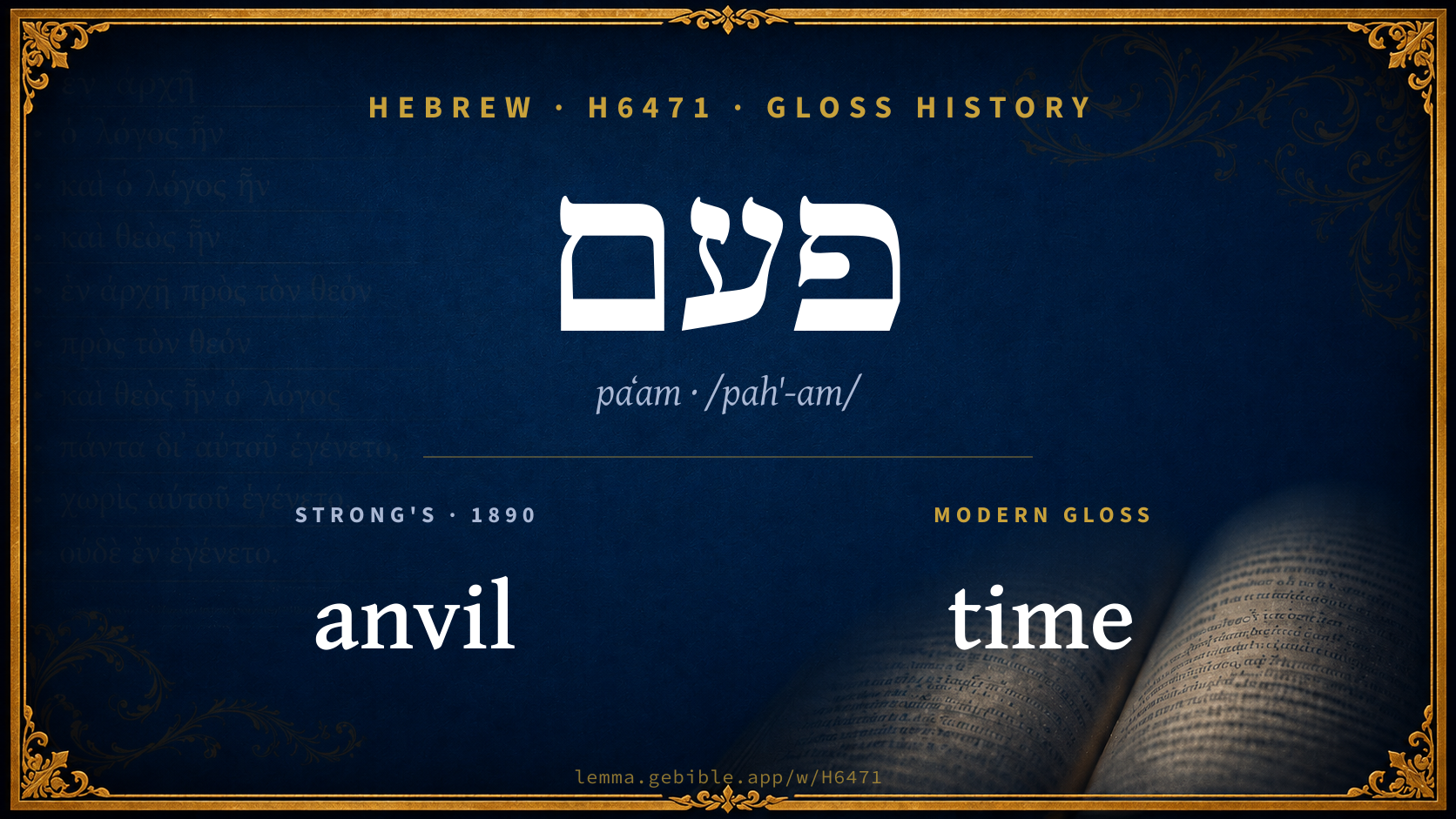
Gloss history
Strong's 1890 vs modern scholarship
About this word
Strong's H6471 catalogs a Hebrew word from the Hebrew Old Testament.
These counts are not copied from any lexicon or concordance. They are computed here, from the morphology-tagged Hebrew Old Testament. What Lemma adds →
- 108
- distinct verses
- The word appears in 108 distinct verses.
- 23 / 39
- OT books
- The word appears in 23 of 39 Old Testament books.
- #369
- by frequency
- Top 500 most frequent Hebrew words (rank 369 of 8,640 Hebrew words by occurrence).
View all 108 occurrences in the concordance →
By section of the Old Testament
By traditional corpus
Conventional, traditional groupings — biblical authorship is debated, so this is a traditional corpus grouping, not an authorship claim. Each share is this word’s portion of its verses in that division of the Hebrew canon. Each figure is a share of the word’s 108 distinct verses.
- Prophets (Nevi'im) 47 verses · 44%
- Torah (Pentateuch) 38 verses · 35%
- Writings (Ketuvim) 23 verses · 21%
How translations render this word
Counts come from each version’s own published word-to-Strong’s tagging or interlinear alignment — an approximate guide to how each version renders this word, not a word-level alignment the data otherwise carries. Because each total is that version’s own tagged count, the per-version totals vary from one another and need not match the appearance or distinct-verse counts above. These counts may also differ from a printed concordance because Lemma counts each distinctly tagged rendering and does not collapse phrase taggings into a single head-word total. This is a fixed set of word-tagged versions (KJV, ASV, BSB, ULT) and does not change with the reading translation you choose elsewhere. Each version’s license is shown beside its name below (and on Sources).
- King James Version: Times 36×, Once 10×, Time 10×
- American Standard Version: Times 35×, Time 9×, Feet 8×
- Berean Standard Bible: Times 41×, Time 15×, Feet 9×
- unfoldingWord Literal Text: Times 44×, Time 34×, At 7×
King James Version Public Domain
Renders H6471 across 109 tagged occurrences — most commonly:
Plus other, less common renderings. Plus 16 renderings that appear only once — usually multi-word phrases or single function words the recovered tagging swept in, not distinct renderings. Not rendered by a distinct English word in 3 further occurrences.
American Standard Version Public Domain
Renders H6471 across 109 tagged occurrences — most commonly:
Plus 25 renderings that appear only once — usually multi-word phrases or single function words the recovered tagging swept in, not distinct renderings.
Berean Standard Bible Public Domain
Renders H6471 across 105 tagged occurrences — most commonly:
Plus 17 renderings that appear only once — usually multi-word phrases or single function words the recovered tagging swept in, not distinct renderings. Not rendered by a distinct English word in 12 further occurrences.
unfoldingWord Literal Text CC BY-SA 4.0
Renders H6471 across 134 tagged occurrences — most commonly:
Plus 20 renderings that appear only once — usually multi-word phrases or single function words the recovered tagging swept in, not distinct renderings.
10 senses and sub-senses in the full BDB
What do BDB’s symbols mean?
BDB uses these scholarly abbreviations:
| Symbol | Meaning |
|---|---|
| 𝔊 | the Septuagint (the ancient Greek translation, LXX) |
| 𝔙 | the Vulgate (the Latin translation) |
| 𝔖 | the Syriac version (the Peshitta) |
| 𝔗 | the Targum (the Aramaic translation) |
| ψ | the Psalms |
| √ | root (the underlying root or stem) |
| ‖ | parallel passage (a synonymous or contrasted parallel) |
| † | the dagger: every passage where the word occurs is cited |
The 10 senses and sub-senses the full Brown-Driver-Briggs lexicon distinguishes for this word, in lexicon order (not ranked by frequency), with BDB’s own verbatim wording and sub-sense lettering. Shown in Hebrew script with BDB’s own scholarly abbreviations. The condensed entry is in the Lexicon Entry tab. See also the Forms in the corpus table below.
- 1.
- a. poet., hoof-beat Ju 5:28; late, of human footfall, footstep, fig. ψ 17:5 (‖ אֲשׁוּרַי), 119:133; וְיָשֵׂם לְדֶרֶךְ פְּעָמָיו 85:14. e.g. Judges 5:28
- b. foot, fig., 57:7; 58:11; 74:3; 140:5 Pr 29:5; lit. Is 26:6 (‖ רֶגֶל), Ct 7:2; בְּכַף פ׳ 2 K 19:24 = Is 37:25. e.g. Psalms 57:7
- c. foot, of ark Ex 25:12; 37:3 (P).—פַּעֲמֹתָיו 1 K 7:30 read פִּנּוֹתָיו (cf. v 34). e.g. Exodus 25:12
- 2. = anvil (struck by hammer) Is 41:7. e.g. Isaiah 41:7
- 3. occurrence (orig. stroke):
- a. הַפַּעַם now Ju 16:18; פ׳ אֶחָ֑ת [אַחַת] one time, once Jos 6:3, 11, 14 (JE), 10:42 (D) + 3 times + 2 S 23:8 Qr (> Kt אחד); פַּעֲמָ֑יִם twice Gn 41:32 + 6 times; פ׳ Na 1:9 second time; אַרְבַּע פ׳ Ne 6:4 four times; חָמֵשׁ אוֹ שֵׁשׁ פ׳ 2 K 13:19, cf. פ׳ חֲמִישִׁית Ne 6:5; also c. שָׁלשׁ, שֶׁבַע, q.v.; עֶשֶׂר פ׳ (זֶה) Nu 14:22 (JE) Ne 4:6; Jb 19:3, all indef. = over and over; indef. also פַּעַם וּשְׁתָּ֑יִם Ne 13:20 once and [i.e. or] twice; פַּעֲמַיִם שָׁלוֹשׁ Jb 33:29 twice (or) thrice; מֵאָה פְעָמִים 2 S 24:3 = 1 Ch 21:3, אֶלֶף פ׳ Dt 1:11; פ׳ רַבּוֹת ψ 106:43 Ec 7:22; עַד־כַּמֶּה פְעָמִים 1 K 22:16 = 2 Ch 18:15. e.g. Judges 16:18
- b. כְּפַעַם־בְּפַעַם as time on time, i.e. as formerly, as usual, Nu 24:1 (E) Ju 16:20; 20:30, 31; 1 S 3:10 (cf. Dr) 20:25. e.g. Numbers 24:1
- c. הַזֹּאת (גַּם) כַּפַּעַם at this repetition (this time) also Ex 8:28; 9:14 (J) + 3 times; גַּם בַּפּ׳ הַהִוא Dt 9:19; 10:10. e.g. Exodus 8:28
- d. הַפַּעַם (Hex only J): (1) = this once Gn 18:32, אַךְ הַפּ׳ Ex 10:17; Ju 6:39, רַק־הַפּ׳ v 39, אַךְ הַפּ׳ הַזֶּה 16:28 (הַזֶּה dub., v. supr.); (2) = now at length Gn 2:23; 29:34, 35; 30:20; 46:30; Ju 15:3; 16:18, cf. also Ex 9:27 now at length (it is clear that) I have sinned. e.g. Genesis 18:32
- e. פַּעַם … פָּ֑עַם Pr 7:12 now … now, at one time … at another. e.g. Proverbs 7:12
Senses from the full Brown-Driver-Briggs lexicon (Brown, Driver, Briggs; Oxford 1906 — public domain), digitized via Sefaria, supplemented by the OpenScriptures HebrewLexicon (CC BY 4.0). Full attribution on Sources.
Word origin
n.f. Ex 8:28 (masc. only Ju 16:23 [text suspicious, v. GFM AlbrZAW xvi (1896), 76 KöSynt. § 248 m], 2 S 23:8 [1 K 7:30 [crpt., v. infr.]) beat, foot, anvil, occurrence;—abs. פ׳ Gn 2:23 +; פָּ֑עַם 46:30 +; du. פַּעֲמַיִם Gn 27:36 +, etc.; pl. פְּעָמִים 33:3 +; also (concr.) cstr. פַּעֲמֵי Ju 5:28 +; sf. פְּעָמַי ψ 57:7; 119:133, etc.; פַּעֲמֹתָיו (only 1 c) Ex 25:12 + 2 times;—
— Brown-Driver-Briggs (Oxford 1906, public domain), digitized via Sefaria, supplemented by the OpenScriptures HebrewLexicon (CC BY 4.0). See Sources.
Derived from פעם (pâʻam) (H6470) — to impel.
Jastrow Dictionary
A second Hebrew/Aramaic lexicon for comparison, covering Aramaic and post-biblical (Talmudic, Targumic, Midrashic) usage that the biblical-Hebrew BDB does not. Matched by lemma rather than by Strong’s number, so a lemma may carry more than one Jastrow headword (shown separately below), and the entries cover usage well beyond the Bible.
פָּעַם
- (b. h.) to beat, knock.
- to beat, perturb. Gen. R. s. 18 (play on הפעם, Gen. II, 23) זו היא שהיתה מְפַעַמְתֵּנִי וכ׳ this is she who perturbed me the whole night; Yalk. ib. 24 (corr. acc.). e.g. Genesis 2:23
- to be perturbed, troubled. Gen. R. s. 89; Tanḥ. Miḳḳ. 2 (distinction between וַתִּפָּעֶם (Gen. XLI, 8) and וַתִּתְפָּעֶם (Dan. II, 1); Yalk. Dan. 1060; Yalk. Gen. 147. Midr. Till. to Ps. LXXVII מִתְפָּעֶמֶת אני והולכת I am constantly perturbed (sleepless); a. e. e.g. Genesis 41:8
פַּעַם
- c. (b. h.; preced.)
- 1. beat, step. — Pl. פַּעֲמוֹת, פְּעָמִים. Y. Sabb. XVI, 15ᶜ כיון שהרגיש בקול פַּעֲמוֹתָיו וכ׳ when he perceived the sound of R. Yishmael’s foosteps. Cant. R. to VII, 2 אינו מדבר אלא בפַעֲמֵי רגלים the verse speaks of the steps of the festive pilgrimages; ib. ומה היה יפיין לפְעָמַיִךְ וכ׳ and what was the beauty of ‘thy footsteps?’ That they locked the door for all troubles (no troubles arose in the homes of the pilgrims during their absence). Lam. R. introd. (R. Naḥm.) ולא היו עולין לפעמי רגלים they have not gone up on festive pilgrimages; Yalk. Is. 302; a. e.
- 2. time. Sabb. 12ᵇ פ׳ אחת קרא וכ׳ once it happened that he read &c. Pes. X, 4 (116ᵃ) שבכל הלילות אין אנו מטבילין אלא פ׳ אחת וכ׳ Ms. M. (v. Rabb. D. S. a. l. note) all other nights we dip (eatables) only once, and this night twice. Gen. R. s. 18 וחזר ובראה לו פ׳ שניה and he created her a second time; הדא היא דכתיב זאת הפ׳ זאת היא של אותו הפ׳ therefore it is written (Gen. II, 23) ‘this the time’, this is (the creation) of this time; a. v. fr.—Pl. פְּעָמִים. Pes. l. c. Yoma I, 6 פ׳ הרבה וכ׳ many a time I read to him from Daniel; a. fr.—פ׳ ש־ at times, sometimes. Men. 99ᵃ sq., v. בִּיטּוּל. Lev. R. s. 35, end פ׳ שעושה בזכות וכ׳ sometimes he makes (rain) for the sake of one man &c.; Y. Taan. III, 66ᶜ top. Cant. R. l. c. פעמים הללו פ׳ מכוסין פ׳ מגולין those steps (of the travellers) are at times covered, at times uncovered; a. fr.—Du. פַּעֲמַיִם twice. Sot. 42ᵃ פ׳ מדבר עמם וכ׳ he addresses them twice, once &c. Cant. R. to II, 16 ואני … בכל יום פ׳ וכ׳ and I declare the unity of his name twice every day (saying), Hear, O Israel, &c.; a. fr. e.g. Genesis 2:23
A Dictionary of the Targumim, the Talmud Babli and Yerushalmi, and the Midrashic Literature (Marcus Jastrow; London, Luzac, 1903) — Public Domain. Digitized via Sefaria. Digitized via Sefaria. Full attribution on Sources.
Forms in the corpus
The 54 distinct written forms H6471 takes in the Hebrew Bible, most frequent first — each parse links to that state’s occurrences in the concordance. Hebrew forms include their vowel points and cantillation, so a single lemma takes many written forms.
Same root — word family
Other BDB entries built from the same root as H6471, grouped by Strong’s listed origin. These share a root / origin per the lexicon — not necessarily a shared meaning. Each links to that word’s own entry.
Derives from
Derived from this word
Compare all same-root words → They share a root, not necessarily a meaning.
Septuagint verse parallels
This word appears in 100 verses that also exist in the Greek Old Testament (Septuagint), out of the 108 Hebrew verses it occurs in. You can read those verses in Greek by switching the Old Testament edition to the Septuagint.
Read these verses in the Septuagint
- Genesis 2:23
- Exodus 9:14
- Leviticus 4:6
- Numbers 14:22
- Deuteronomy 1:11
- Joshua 6:3
- Judges 5:28
- 1 Samuel 3:10
- 2 Samuel 17:7
- 1 Kings 7:4
- 2 Kings 4:35
- 1 Chronicles 11:11
This is a verse-level parallel only — the same verses exist in both the Hebrew and Greek Old Testaments. No word-level Hebrew↔Greek correspondence is claimed: the data carries no such alignment, so no Greek word is shown as this Hebrew word’s translation. Coverage is not total — the Septuagint omits the deuterocanon and renumbers the Psalms, so some Hebrew verses have no direct Greek parallel.