
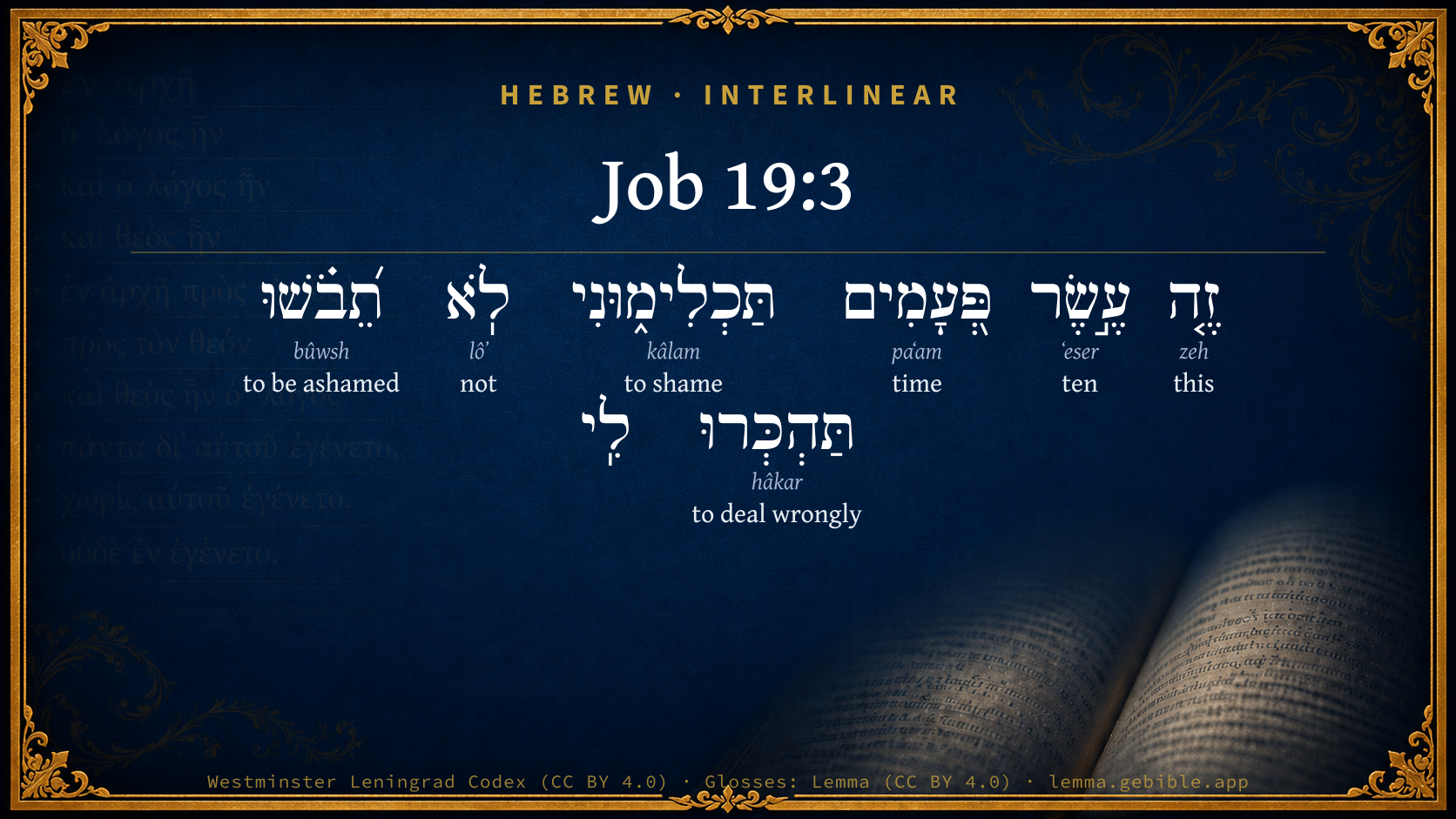
Job 19:3

Hebrew (Westminster Leningrad Codex) Job 19:3 appears in the Hebrew Old Testament. The text above is from the Westminster Leningrad Codex. Each word links to its Strong’s number, a concise gloss, and parsing drawn from the Open Scriptures Hebrew Bible morphology. Click any word for its full Brown-Driver-Briggs (BDB) entry.
Download image
Cite this verse

Job 19:3 (World English Bible). Public Domain. Lemma interlinear Bible study tool, https://lemma.gebible.app/v/job/19/3.

Show BibTeX & RIS
BibTeX
RIS
English Translation
You have reproached me ten times. You aren't ashamed that you attack me.
World English Bible · Public Domain
Highlights
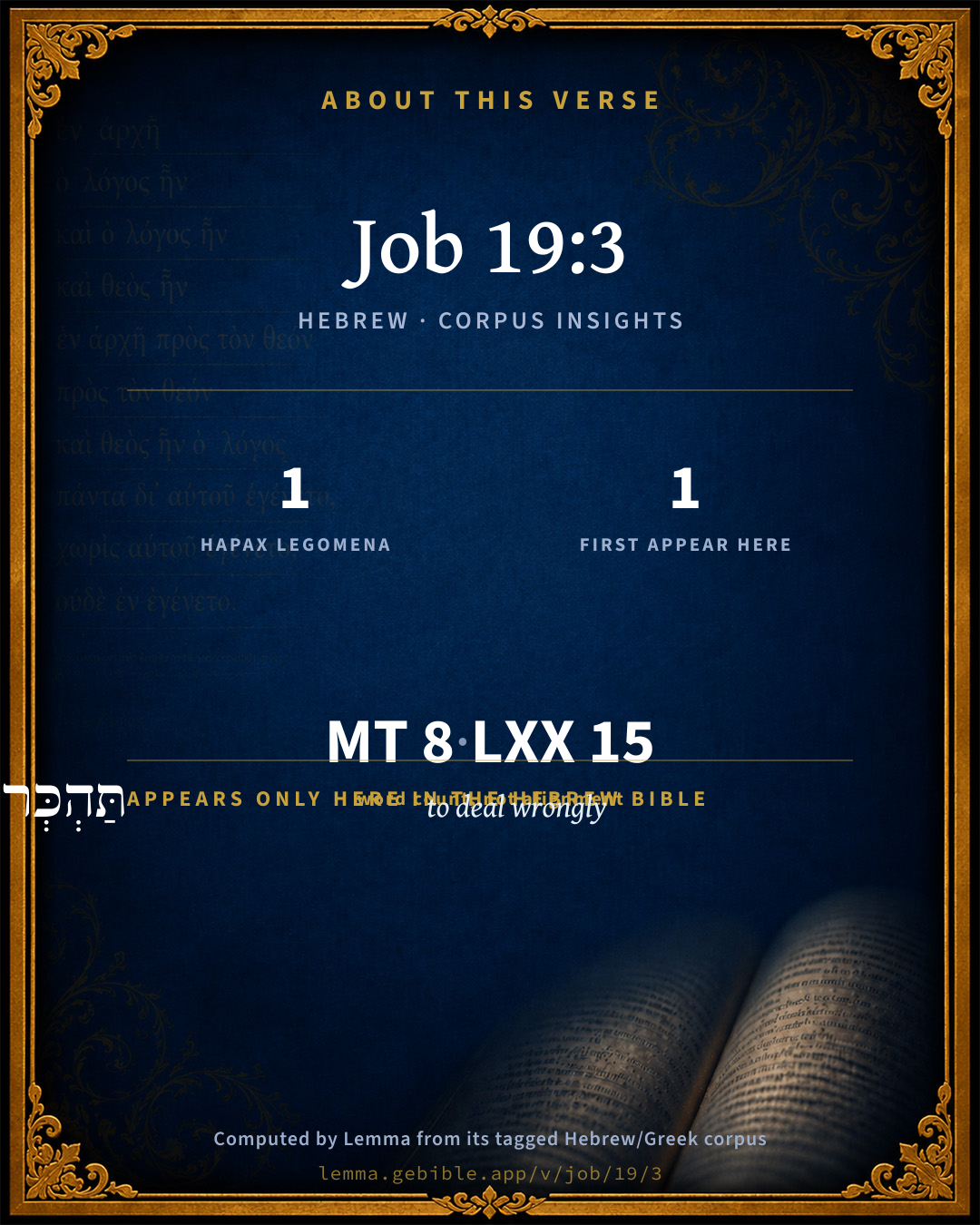
  • 1 hapax legomenon — only here in the Hebrew Bible
  • 1 first appearance in the Hebrew Bible
Full analysis ↓
Download a study sheet

One document with this verse’s original text, its word-by-word gloss line, the meaning frame, cross-references with their text, attributed commentary, and full source and license credits — printable, and it pastes into notes with its structure intact.

This verse Autodidact and up

Study sheet (.html) Plain text (.txt)

A passage Seminary Student

Up to 50 verses in one chapter. A passage sheet keeps up to 6 commentary sources and 12 cross-references per verse, in the order this page ranks them, and says so on the sheet whenever that leaves anything out. Ask for a single verse and you get the Autodidact verse sheet above.

Everything on this page stays free to read, with no account — the sheet is a download of what is already on screen, not access to it.

Want to remove ads? Support Godless Engineer
Compare translations 3

The same verse in 3 English versions, stacked beneath the original-language interlinear above. Click any original word for its lexicon entry.

Each is an independent rendering of the whole verse — the interlinear is not word-aligned to these translations.

Highlighted words mark where these versions differ — a whole-verse word diff, not a word-by-word alignment.

  • World English Bible Public Domain
    You have reproached me ten times. You aren't ashamed that you attack me.
  • King James Version Public Domain
    These ten times have ye reproached me: ye are not ashamed that ye make yourselves strange to me.
  • unfoldingWord Literal Text CC BY-SA 4.0
    These ten times you have reproached me; you are not ashamed, you mistreat me.

unfoldingWord Literal Text — © unfoldingWord, licensed CC BY-SA 4.0. Word-aligned USFM3 via Door43 (git.door43.org/unfoldingWord/en_ult).

Versions to compare (up to 4)

3 of 4 selected

Show all 18 translations

Every available English version of this verse, each an independent rendering of the whole verse.

  • World English Bible Public Domain
    You have reproached me ten times. You aren't ashamed that you attack me.
  • Berean Standard Bible Public Domain
    Ten times now you have reproached me; you shamelessly mistreat me.
  • Majority Standard Bible Public Domain
    Ten times now you have reproached me; you shamelessly mistreat me.
  • King James Version Public Domain
    These ten times have ye reproached me: ye are not ashamed that ye make yourselves strange to me.
  • American Standard Version (1901) Public Domain
    These ten times have ye reproached me: Ye are not ashamed that ye deal hardly with me.
  • Revised Version (1885) Public Domain
    These ten times have ye reproached me: ye are not ashamed that ye deal hardly with me.
  • Geneva Bible (1599) Public Domain
    Ye haue now ten times reproched me, and are not ashamed: ye are impudent toward mee.
  • Douay-Rheims (1899) Public Domain
    Behold, these ten times you confound me, and are not ashamed to oppress me.
  • Young's Literal Translation Public Domain
    These ten times ye put me to shame, ye blush not. Ye make yourselves strange to me --
  • Literal Standard Version CC BY-SA 4.0
    These ten times you put me to shame, you do not blush. You make yourselves strange to me—
  • Unlocked Literal Bible CC BY-SA 4.0
    These ten times you have reproached me; you are not ashamed that you have treated me harshly.
  • unfoldingWord Literal Text CC BY-SA 4.0
    These ten times you have reproached me; you are not ashamed, you mistreat me.
  • Darby Bible Public Domain
    These ten times have ye reproached me; ye are not ashamed to stupefy me.
  • World Messianic Bible Public Domain
    You have reproached me ten times. You aren’t ashamed that you attack me.
  • Webster's Bible Public Domain
    These ten times have ye reproached me: ye are not ashamed that ye make yourselves strange to me.
  • Free Bible Version CC BY-SA 4.0
    Ten times already you have humiliated me. Aren't you ashamed for treating me so badly?
  • Bible in Basic English Public Domain
    Ten times now you have made sport of me; it gives you no sense of shame to do me wrong.
  • JPS Tanakh (1917) Public Domain
    These ten times have ye reproached me; ye are not ashamed that ye deal harshly with me.

Literal Standard Version (2020), Covenant Press — licensed CC BY-SA 4.0. Text via the HelloAO Bible API (eBible.org). Unlocked Literal Bible (unfoldingWord) — licensed CC BY-SA 4.0. Text via the HelloAO Bible API (eBible.org). unfoldingWord Literal Text — © unfoldingWord, licensed CC BY-SA 4.0. Word-aligned USFM3 via Door43 (git.door43.org/unfoldingWord/en_ult). Free Bible Version, Dr. Jonathan Gallagher — licensed CC BY-SA 4.0. Text via the HelloAO Bible API (eBible.org).

Word by word

More ways to search: Search by grammar → Find every occurrence → Compare this word →

Practice this passage: Drill this verse → Learn its vocabulary →

About this verse

These counts appear in no published source. They are computed here, from the morphology-tagged text and Lemma’s own curated glosses. What Lemma adds →

8
words
7
distinct lemmas
Wisdom
section

Notable vocabulary

1 hapax legomenon — a word that appears only here in the entire Hebrew Bible:

  • תַּהְכְּרוּ to deal wrongly H1970

First appearance in Scripture

This word makes its first canonical appearance in the Hebrew Bible here:

  • תַּהְכְּרוּ to deal wrongly H1970

Shared distinctive vocabulary

תַּכְלִימ֑וּנִי to shame H3637 occurs in 38 verses of the Hebrew Bible. Also found in:

Grammatical profile

  • 3 verbs
  • 1 noun
  • 1 adjective
  • 1 pronoun
  • 1 preposition
  • 1 particle

Verb forms

  • תַּכְלִימ֑וּנִי Hiphil · Imperfect
  • תֵ֝בֹ֗שׁוּ Qal · Imperfect
  • תַּהְכְּרוּ Hiphil · Imperfect

Hebrew & Septuagint length

In English translation the verse runs 13 words from the Hebrew and 15 from the Septuagint (LXX English) — closely comparable.

A rough comparison of the two English renderings, which tokenize alike — not a word-level alignment.

Word counts can differ between the Hebrew and the Greek without any difference in meaning — e.g. the Hebrew direct-object marker אֵת has no separate Greek word, and Greek often adds the article ὁ.

In the original languages it is 8 Hebrew tokens and 15 Greek tokens — but the two are counted differently (Hebrew bundles its prefixes and suffixes into one token; the Greek is in lemma form), so that isn’t a like-for-like length.

Cross-references

16

Topical passages linked to Job 19:3 in the Treasury of Scripture Knowledge — connected by theme and wording, ordered by reader-vote popularity; previews shown in the World English Bible.

  • Genesis 31:7 Your father has deceived me, and changed my wages ten times, but God didn't allow him to hurt me.
  • Nehemiah 4:12 It happened that when the Jews who lived by them came, they said to us ten times from all places, You must return to us.
  • Job 15:4–6 Yes, you do away with fear, And hinder devotion before God.
  • Job 15:11–12 Are the consolations of God too small for you, Even the word that is gentle toward you?
  • Job 18:4–21 You who tear yourself in your anger, Shall the earth be forsaken for you? Or shall the rock be removed out of its place?
  • Job 19:17 My breath is offensive to my wife. I am loathsome to the children of my own mother.
  • Psalms 69:8 I have become a stranger to my brothers, An alien to my mother's children.
  • Daniel 1:20 In every matter of wisdom and understanding, concerning which the king inquired of them, he found them ten times better than all the magicians and enchanters who were in all his realm.
  • Genesis 42:7 Joseph saw his brothers, and he recognized them, but acted like a stranger to them, and spoke roughly with them. He said to them, "Where did you come from?" They said, "From the land of Canaan to buy food."
  • Numbers 14:22 because all those men who have seen my glory, and my signs, which I worked in Egypt and in the wilderness, yet have tempted me these ten times, and have not listened to my voice;
  • Job 4:6–11 Isn't your piety your confidence, The integrity of your ways your hope?
  • Job 5:3–4 I have seen the foolish taking root, But suddenly I cursed his habitation.
  • Job 8:4–6 If your children have sinned against him, He has delivered them into the hand of their disobedience;
  • Job 11:3 Should your boastings make men hold their peace? When you mock, shall no man make you ashamed?
  • Job 11:14 If iniquity is in your hand, put it far away, Don't let unrighteousness dwell in your tents.
  • Leviticus 26:26 When I break your staff of bread, ten women shall bake your bread in one oven, and they shall deliver your bread again by weight: and you shall eat, and not be satisfied.

Cross-references courtesy of OpenBible.info (CC BY 4.0).

Hebrew and Greek witnesses Masoretic Hebrew ↔ Greek Septuagint

The same verse in the two great witnesses to the Old Testament, shown verse-for-verse.

These are two independent witnesses, not word-aligned to each other, and the Septuagint is shown in lemma (dictionary) form.

Hebrew Job 19:3 Masoretic · Westminster Leningrad Codex

זֶ֤ה עֶ֣שֶׂר פְּ֭עָמִים תַּכְלִימ֑וּנִי לֹֽא תֵ֝בֹ֗שׁוּ תַּהְכְּרוּ לִֽי

You have reproached me ten times. You aren't ashamed that you attack me.

World English Bible · Public Domain

Greek LXX Job 19:3 Septuagint · lemma form

γιγνώσκω μόνον ὅτι ὁ κύριος ποιέω ἐγώ οὕτως καταλαλέω ἐγώ οὐ αἰσχύνω ἐγώ ἐπικεῖμαι ἐγώ

You⌃ speak against me; you⌃ do not feel for me, but bear hard upon me.

LXX2012 (modern English Septuagint) · Public Domain

On this verse, Albert Barnes' Notes on the Bible discusses the Septuagint’s reading. Read the note in Commentary ↓

Hebrew: Westminster Leningrad Codex (CC BY 4.0). Greek: Septuagint (public domain); English from LXX2012 (modern English Septuagint) (Public Domain). How the Septuagint differs from the Hebrew →

Commentary

Notes on Job 19:3 from classic Christian and Jewish commentators (each source and its license shown beneath its notes). The classic Christian expositions comment on the surrounding passage and are grouped to its opening verse, so a note may address several verses; the Jewish commentaries on the Tanakh (Rashi and others) are per-verse, so they appear only where the commentator wrote on this verse.

Lemma curates 59 commentaries, every one of them public domain or Creative Commons licensed, each selected and text-cleaned for this edition rather than reprinted as found. About our sources →

Trapp's Complete Commentary

John Trapp

Job 19:3 These ten times have ye reproached me: ye are not ashamed [that] ye make yourselves strange to me.

Ver. 3. These ten times have ye reproached me] i.e. Oftentimes. Herein Job endured a great fight of affliction, as the apostle styleth it, Heb 10:32-33; a manifold fight, as the word there signifieth. Cato was two and thirty times accused publicly, and as oft cleared and absolved. Basil was counted and called a heretic, even by those who, as it appeared afterwards, were of the same judgment with him, and whom he honoured as brethren. Dogs in a chase bark sometimes at their best friends, &c.

Ye are not ashamed that ye make yourselves strange to me] Or, Are you not ashamed that ye harden yourselves against me? or, that ye jeer and jest at my misery? or, that ye make merchandise of me, and take your penny worths out of me? Significat etiam emere, vel cauponari. Beza (agreeable to our translation) paraphraseth it thus, Ye take me up so short, as if ye dealt with a stranger and foreigner, and not with a friend. And so the word is taken, Gen 42:7.

John Trapp, A Commentary or Exposition upon All the Books of the Old and New Testament (1647–1656) — public domain. Text from a community e-Sword module.

Tyndale Open Study Notes

Tyndale Open Resources

19:3 The number ten did not represent a specific count but an indefinite large number (e.g., Gen 31:7; Lev 26:26; Num 14:22; Dan 1:20).

Tyndale Open Study Notes — © Tyndale Open Resources, licensed CC BY-SA 4.0. Text via the HelloAO Bible API.

Geneva Bible (1599)

Geneva Bible translators

That is, many times, as Neh. 4:12.

Geneva Bible (1599) marginal notes — public domain. Text via Bolls.life.

Jamieson, Fausset & Brown

Robert Jamieson, A. R. Fausset & David Brown

These--prefixed emphatically to numbers (Gen 27:36).

ten--that is, often (Gen 31:7).

make yourselves strange--rather, "stun me" [GESENIUS]. (See Margin for a different meaning [that is, "harden yourselves against me"]).

Jamieson, Fausset & Brown — Commentary Critical and Explanatory on the Whole Bible (1871) — public domain (CC PDM 1.0). Text via the HelloAO Bible API.

Adam Clarke's Commentary

Verse 3. These ten times] The exact arithmetical number is not to be regarded; ten times being put for many times, as we have already seen. See particularly Clarke's note on "Ge 31:7".

Ye make yourselves strange to me.] When I was in affluence and prosperity, ye were my intimates, and appeared to rejoice in my happiness; but now ye scarcely know me, or ye profess to consider me a wicked man because I am in adversity. Of this you had no suspicion when I was in prosperity! Circumstances change men's minds.

Adam Clarke's Commentary on the Bible (1810–1826) — public domain. Text from a community e-Sword/MySword module.

The Cambridge Bible for Schools and Colleges

gen. ed. J. J. S. Perowne

3. Job_19:23-27. Hopeless in the present he turns his eye to the future. He desires that his protest of innocence might find indelible record in the rock, that the generations to come might read it. Yet how small a thing that would be to him, whose chief sorrow lay in the alienation of God from his spirit. He shall have more. He knows that God shall yet appear to vindicate him, and that he shall see Him with his eyes—in peace.

Third, Job_19:28-29. Finally he adds a brief threat to his friends.

3. Ten times is a round number for often, Gen_31:7; Num_14:22.

make yourselves strange to me] An expression of uncertain meaning, as the word does not occur again, unless, as some suppose, it be found in Isa_3:9. The meaning may be, ye wrong me, the root having some resemblance to an Arabic verb rendered by Lane “to wrong,” also “to be persistent in contention.” Ew., ye are unfeeling towards me.

The Cambridge Bible for Schools and Colleges (gen. ed. J. J. S. Perowne; Cambridge University Press, 1878–1918) — public domain. Text from a community e-Sword module.

John Gill's Exposition

And be it indeed that I have erred,.... Which is a concession for argument's sake, but not an acknowledgment that he had erred; though it is possible he might have erred, and it is certain he did in some things, though not in that respect with which he was charged; "humanum est errare", all men are subject to mistakes, good men may err; they may err in judgment, or from the truth in some respect, and be carried away for a while and to some degree with the error the wicked, though they shall be turned from it again; they may err in practice, and wander from the way of God's commandments; and indeed their strayings and aberrations of this sort are so many, that David says, "who can understand his errors?" Psa 19:12; and they may err in words, or make a mistake in speech; but then no man should be made an offender for a word for he must be a perfect man that is free from mistakes of this kind: now Job argues that supposing this to be his case in any of the above instances; yet, says he,

mine error remaineth with myself; I only am chargeable with it, and answerable for it; it is nothing to you, and why should you trouble yourselves about it? it will not be imputed to you, nor will you suffer on account of it; or, admitting I have imbibed an error, I do not publish it abroad; I keep it to myself; it lies and lodges in my own breast, and nobody is the worse for it: or "let it remain", or "lodge with me" (k); Why should my mistakes be published abroad, and all the world be made acquainted with them? or else this expresses his resolution to abide by what his friends called an error; and then the so is, if this is an error which I have asserted, that God afflicts both good and bad men, and that afflictions are no argument of a man's being an hypocrite and a wicked man, I am determined to continue in it; I will not give it up, I will hold it fast; it shall remain with me as a principle never to be departed from; or it may be rather his meaning is, that this notion he had imbibed would remain with him, and was likely to do so, for anything they had said, or could say to the contrary.

(k) "mecum maneat", Beza; to the same sense Mercerus, Schmidt, Junius and Tremellius, Piscator, Michaelis, Schultens.

John Gill's Exposition of the Whole Bible (1746–1763) — public domain (CC PDM 1.0). Text via the HelloAO Bible API.

Albert Barnes' Notes on the Bible

These ten times - Many times; the word “ten” being used as we often say, “ten a dozen” or “twenty,” to denote many; see Gen 31:7, “And your father hath changed my wages “ten times.” Lev 26:26, “and when I have broken your staff of bread, “ten women” shall bake your bread, in one oven;” compare Num 14:22; Neh 4:6.

You are not ashamed that you make yourselves strange to me - Margin, “harden yourselves strange to me.” Margin, “harden yourselves against me.” Gesenius, and after him Noyes, renders this, “Shameless ye stun me.” Wemyss, “Are ye not ashamed to treat me thus cruelly? The word used here (הכר hâkar) occurs no no where else, and hence, it is difficult to determine its meaning. The Vulgate renders it, “oppressing me.” The Septuagint, “and you are not ashamed to press upon me.” - ἐπίκεισθέ υοι epikeisthe moi. Schultens has gone into an extended examination of its meaning, and supposes that the primary idea is that of being “stiff,” or “rigid.” The word in Arabic, he says, means to be “stupid with wonder.” It is applied, he supposes, to those who are “stiff or rigid” with stupor; and then to those who have a stony heart and an iron an iron fore-head - and who can look on the suffering without feeling or compassion. This sense accords well with the connection here. Gesenius, however, supposes that the primary idea is that of beating or pounding; and hence, of stunning by repeated blows. In either case the sense would be substantially the same - that of “stunning.” The idea given by our translators of making themselves “strange” was derived from the supposition that the word might be formed from נכר nâkar - to be strange, foreign; to estrange, alienate, etc. For a more full examination of the word, the reader may consult Schultens, or Rosenmuller “in loco.”

Albert Barnes' Notes on the Bible (1834–1885) — public domain. Text from a community e-Sword/MySword module.

Haydock's Catholic Bible Commentary

Ten times; very often. --- Oppress me. Hebrew word occurs no where else, and is variously translated. It may signify, "to dig a pit for me," chap vi. 27., and Psalm vi. 6. Job repeats nearly what he had said before, only with greater vehemence. He admits that Providence treats him in an unusual manner. Yet he still retains an assured hope, and arraigns his adversaries before the divine tribunal. (Calmet) --- Yet he rather hesitates; (ver. 4, 6.) and this species of ignorance is the folly of which he, at last, accuses himself, chap. xlii. 3. It was no real fault, chap. xlii. 8. (Haydock)

George Leo Haydock (1774–1849), Haydock's Catholic Family Bible and Commentary, 1859 edition — public domain. Excludes Psalms (Douay-Rheims chapter numbering differs from Protestant) and Deuterocanonical books (Catholic canon only).

Matthew Poole's English Annotations

These ten times, i.e. many times. A certain number for an uncertain. So this phrase is oft used, as Gen 31:7; Num 14:22, &c.

That ye make yourselves strange to me; that you carry yourselves like strangers to me, and are not concerned nor affected with my calamities, and condemn me as if you had never known my former piety and integrity.

Matthew Poole's English Annotations on the Holy Bible (1683–1685) — public domain. Text from a community e-Sword/MySword module.

Whedon's Commentary on the Bible

Daniel D. Whedon

3. Ten times — Used for many times. Thus Maimonides: “He who profaneth the name of God in the presence of ten Israelites, behold, he profaneth it in the presence of many.” Or it may stand as the number of human possibility, says Delitzsch, from its being the number of fingers on the two hands of man.

Make yourselves strange to me — Ill-treat me. (Dillmann.) Stun me. (Zockler.)

Daniel D. Whedon (gen. ed.), Commentary on the Old and New Testaments (1874–1909) — public domain. Text from a community e-Sword module.

The Pulpit Commentary

These ten times have ye reproached me. (For the use of the expression "ten times" for "many times." "frequently." see Gen_31:7, 41 Num_14:22 Neh_4:12 Dan_1:20, etc.) Ye are not ashamed that ye make yourselves strange to me; rather, that ye deal hardly with me (see the Revised Version). The verb used does not occur elsewhere, hut seems to have the meaning of "ill use" or "ill treat" (see Professor Lee"s "Commentary on the Book of Job" p. 328).

The Pulpit Commentary (1880–1919), ed. H.D.M. Spence-Jones & Joseph S. Exell — public domain. Text from a community e-Sword module.

John Wesley's Explanatory Notes

Ten - Many times. A certain number for an uncertain. Strange - That you carry yourselves like strangers to me, and condemn me as if you had never known my integrity.

John Wesley, Explanatory Notes Upon the Whole Bible (1754–1765) — public domain. Text via the GEBible commentary corpus.

unfoldingWord translationNotes

Door43 World Missions Community

General Information:

Job continues to speak to his three friends.

These ten times you have reproached me

The phrase "These ten times" refers to the way that the friends have completely rebuked Job. AT: "You have completely reproached me" or "You have reproached me many times" (See: Idiom)

you are not ashamed that you have treated me harshly

Job is rebuking them for this. This can be written in positive form. AT: "You should be ashamed that you have treated me so harshly"

have treated me harshly

"have despised me" or "have publicly ridiculed me"

have erred

"have sinned by accident" or "mistakenly sinned"

my error remains my own concern

Job implies that his friends are not responsible for continuing to rebuke him since he is the one who made the error. AT: "my error is my own responsibility, so you should not continue to rebuke me" or "my error did not hurt you, so you should not continue to rebuke me" (See: Assumed Knowledge and Implicit Information)

my error

"my sin" or "my mistake"

translationWords

reproach

shame

true

unfoldingWord translationNotes — © Distant Shores Media and the Door43 World Missions Community, licensed CC BY-SA 4.0. Source: git.door43.org/Door43/en_tn.

Rashi

Rabbi Shlomo Yitzchaki (Rashi)

ten times There are ten chapters until here.

Rashi on the Tanakh — English translations: “The Judaica Press complete Tanach with Rashi, translated by A. J. Rosenberg” (CC BY 4.0); “Pentateuch with Rashi's commentary by M. Rosenbaum and A.M. Silbermann, 1929-1934” (public domain); “The Metsudah Tanach series, Lakewood, N.J” (CC BY 4.0); and “The Book of Joshua, Metsudah Publications, 1997” (CC BY 4.0). Text via Sefaria.

Lesson kit

Teaching starters — assembled from the data on this page, not authored interpretation. Every prompt links to the verse data it draws on. Edit before teaching.

Job, in the Wisdom, opens this verse with 8 words (7 distinct Hebrew lemmas). Its most distinctive word is hâkar (“to deal wrongly”). A historical commentator’s framing appears above. Read the whole chapter for the surrounding context.

Discussion questions

  1. What does “to deal wrongly” (hâkar) contribute to the verse as a whole?
  2. This verse holds 1 word here found nowhere else in the Hebrew Bible. What might the rare word draw attention to?
  3. The word “to deal wrongly” first appears here in Scripture. What is being introduced at this debut?
  4. Numbers 12:14 shares the word «to shame» with this verse. How do the two illuminate each other?
  5. The translations on this page render this verse differently — a whole-verse word diff, not a word-by-word alignment. What might account for the different wordings?
  6. The verb «תַּכְלִימ֑וּנִי» is Hiphil Imperfect. How does its form color the action?
  7. Reading how Trapp's Complete Commentary and Tyndale Open Study Notes read this verse, where do the two commentators agree and where do they part?

Things to notice

Reading settings

Reading text

Shown beneath each verse's original-language words.

Old Testament
Old Testament edition

Read the OT as the Masoretic Hebrew (MT) or the Greek Septuagint (LXX).

English shown for the Greek Septuagint (in the Hebrew ↔ Greek comparison).

Comparing translations? Open the Compare panel on any verse page to stack up to four side by side.