
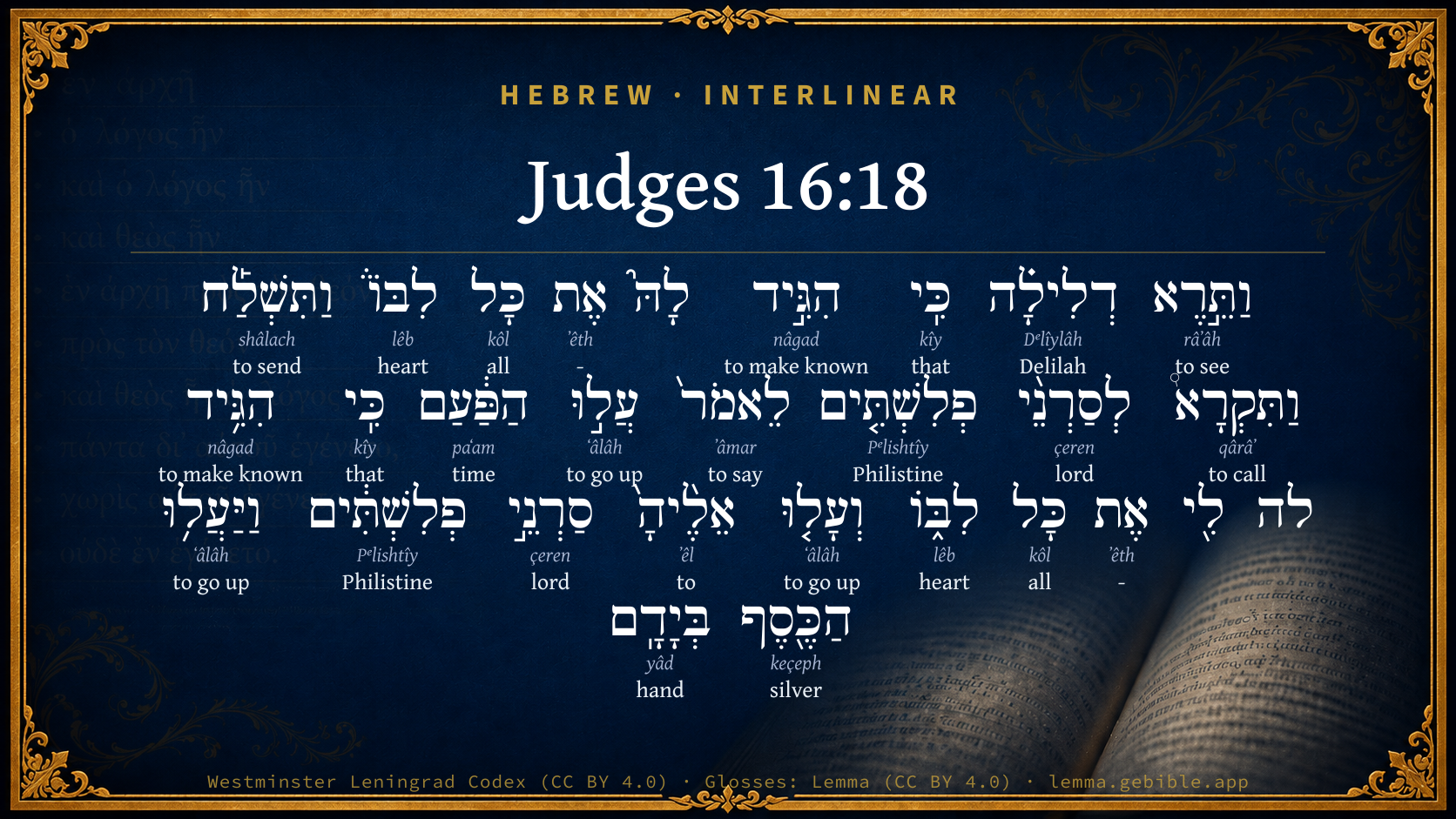
Judges 16:18

Hebrew (Westminster Leningrad Codex) Judges 16:18 appears in the Hebrew Old Testament. The text above is from the Westminster Leningrad Codex. Each word links to its Strong’s number, a concise gloss, and parsing drawn from the Open Scriptures Hebrew Bible morphology. Click any word for its full Brown-Driver-Briggs (BDB) entry.
Download image
Cite this verse

Judges 16:18 (World English Bible). Public Domain. Lemma interlinear Bible study tool, https://lemma.gebible.app/v/judges/16/18.

Show BibTeX & RIS
BibTeX
RIS
English Translation
When Delilah saw that he had told her all his heart, she sent and called for the lords of the Philistines, saying, Come up this once, for he has told me all his heart. Then the lords of the Philistines came up to her, and brought the money in their hand.
World English Bible · Public Domain
Download a study sheet

One document with this verse’s original text, its word-by-word gloss line, the meaning frame, cross-references with their text, attributed commentary, and full source and license credits — printable, and it pastes into notes with its structure intact.

This verse Autodidact and up

Study sheet (.html) Plain text (.txt)

A passage Seminary Student

Up to 50 verses in one chapter. A passage sheet keeps up to 6 commentary sources and 12 cross-references per verse, in the order this page ranks them, and says so on the sheet whenever that leaves anything out. Ask for a single verse and you get the Autodidact verse sheet above.

Everything on this page stays free to read, with no account — the sheet is a download of what is already on screen, not access to it.

Want to remove ads? Support Godless Engineer
Compare translations 3

The same verse in 3 English versions, stacked beneath the original-language interlinear above. Click any original word for its lexicon entry.

Each is an independent rendering of the whole verse — the interlinear is not word-aligned to these translations.

Highlighted words mark where these versions differ — a whole-verse word diff, not a word-by-word alignment.

  • World English Bible Public Domain
    When Delilah saw that he had told her all his heart, she sent and called for the lords of the Philistines, saying, Come up this once, for he has told me all his heart. Then the lords of the Philistines came up to her, and brought the money in their hand.
  • King James Version Public Domain
    And when Delilah saw that he had told her all his heart, she sent and called for the lords of the Philistines, saying, Come up this once, for he hath showed me all his heart. Then the lords of the Philistines came up unto her, and brought money in their hand.
  • unfoldingWord Literal Text CC BY-SA 4.0
    Then Delilah saw that he had declared to her all of his heart. So she sent and called for the lords of the Philistines, saying, “Come up one time, for he has declared to me all of his heart.” Then the lords of the Philistines came up to her, and they brought up the silver in their hand.

unfoldingWord Literal Text — © unfoldingWord, licensed CC BY-SA 4.0. Word-aligned USFM3 via Door43 (git.door43.org/unfoldingWord/en_ult).

Versions to compare (up to 4)

3 of 4 selected

Show all 18 translations

Every available English version of this verse, each an independent rendering of the whole verse.

  • World English Bible Public Domain
    When Delilah saw that he had told her all his heart, she sent and called for the lords of the Philistines, saying, Come up this once, for he has told me all his heart. Then the lords of the Philistines came up to her, and brought the money in their hand.
  • Berean Standard Bible Public Domain
    When Delilah realized that he had revealed to her all that was in his heart, she sent this message to the lords of the Philistines: “Come up once more, for he has revealed to me all that is in his heart.” Then the lords of the Philistines came to her, bringing the money in their hands.
  • Majority Standard Bible Public Domain
    When Delilah realized that he had revealed to her all that was in his heart, she sent this message to the lords of the Philistines: “Come up once more, for he has revealed to me all that is in his heart.” Then the lords of the Philistines came to her, bringing the money in their hands.
  • King James Version Public Domain
    And when Delilah saw that he had told her all his heart, she sent and called for the lords of the Philistines, saying, Come up this once, for he hath showed me all his heart. Then the lords of the Philistines came up unto her, and brought money in their hand.
  • American Standard Version (1901) Public Domain
    And when Delilah saw that he had told her all his heart, she sent and called for the lords of the Philistines, saying, Come up this once, for he hath told me all his heart. Then the lords of the Philistines came up unto her, and brought the money in their hand.
  • Revised Version (1885) Public Domain
    And when Delilah saw that he had told her all his heart, she sent and called for the lords of the Philistines, saying, Come up this once, for he hath told me all his heart. Then the lords of the Philistines came up unto her, and brought the money in their hand.
  • Geneva Bible (1599) Public Domain
    And when Delilah sawe that he had tolde her all his heart, she sent, and called for the Princes of ye Philistims, saying, Come vp once againe: for he hath shewed mee all his heart. Then the Princes of the Philistims came vp vnto her, and brought the money in their handes.
  • Douay-Rheims (1899) Public Domain
    Then seeing that be had discovered to her all his mind, she sent to the princes of the Philistines, saying: Come up this once more, for now he hath opened his heart to me. And they went up taking with them the money which they had promised.
  • Young's Literal Translation Public Domain
    And Delilah seeth that he hath declared to her all his heart, and she sendeth and calleth for the princes of the Philistines, saying, `Come up this time, for he hath declared to me all his heart;' and the princes of the Philistines have come up unto her, and bring up the money in their hand.
  • Literal Standard Version CC BY-SA 4.0
    And Delilah sees that he has declared all his heart to her, and she sends and calls for the princes of the Philistines, saying, “Come up this time, for he has declared all his heart to me”; and the princes of the Philistines have come up to her, and bring up the money in their hand.
  • Unlocked Literal Bible CC BY-SA 4.0
    When Delilah saw that he had told her the truth about everything, she sent and called for the rulers of the Philistines, saying, “Come up again, for he has told me everything.” Then the rulers of the Philistines went up to her, bringing the silver in their hands.
  • unfoldingWord Literal Text CC BY-SA 4.0
    Then Delilah saw that he had declared to her all of his heart. So she sent and called for the lords of the Philistines, saying, “Come up one time, for he has declared to me all of his heart.” Then the lords of the Philistines came up to her, and they brought up the silver in their hand.
  • Darby Bible Public Domain
    When Deli'lah saw that he had told her all his mind, she sent and called the lords of the Philistines, saying, "Come up this once, for he has told me all his mind." Then the lords of the Philistines came up to her, and brought the money in their hands.
  • World Messianic Bible Public Domain
    When Delilah saw that he had told her all his heart, she sent and called for the lords of the Philistines, saying, “Come up this once, for he has told me all his heart.” Then the lords of the Philistines came up to her and brought the money in their hand.
  • Webster's Bible Public Domain
    And when Delilah saw that he had told her all his heart, she sent and called for the lords of the Philistines, saying, Come up this once, for he hath disclosed to me all his heart. Then the lords of the Philistines came up to her and brought money in their hand.
  • Free Bible Version CC BY-SA 4.0
    Delilah realized that he had truly confided in her and shared everything, she sent a message to the Philistine leaders telling them, “Come back once more, because this time he's confided in me and told me everything.” So the Philistine leaders returned, bringing with them the money to give to her.
  • Bible in Basic English Public Domain
    And when Delilah saw that he had let her see into his heart, she sent word to the chiefs of the Philistines saying, Come up this time, for he has let out all his heart to me. Then the chiefs of the Philistines came to her, with the money in their hands.
  • JPS Tanakh (1917) Public Domain
    And when Delilah saw that he had told her all his heart, she sent and called for the lords of the Philistines, saying: 'Come up this once, for he hath told me all his heart.' Then the lords of the Philistines came up unto her, and brought the money in their hand.

Literal Standard Version (2020), Covenant Press — licensed CC BY-SA 4.0. Text via the HelloAO Bible API (eBible.org). Unlocked Literal Bible (unfoldingWord) — licensed CC BY-SA 4.0. Text via the HelloAO Bible API (eBible.org). unfoldingWord Literal Text — © unfoldingWord, licensed CC BY-SA 4.0. Word-aligned USFM3 via Door43 (git.door43.org/unfoldingWord/en_ult). Free Bible Version, Dr. Jonathan Gallagher — licensed CC BY-SA 4.0. Text via the HelloAO Bible API (eBible.org).

Word by word

More ways to search: Search by grammar → Find every occurrence → Compare this word →

Practice this passage: Drill this verse → Learn its vocabulary →

דְלִילָ֗ה
Dᵉlîylâh
H1807
“Delilah”
Noun, Proper
Part of Speech
Noun
Type
Proper
Full BDB Definition

Origin: from H1809

TWOT: None

Delilah = "feeble" - the Philistine mistress of Samson who betrayed the secret of his great strength, and by cutting his hair, enfeebled him and delivered him to the Philistines
  1. וַתֵּ֣רֶא râʼâh H7200 “and · to see” Conjunction + Verb, Qal, Sequential Imperfect, 3rd Person, Feminine, Singular
  2. כִּֽי kîy H3588 “that” Conjunction
  3. הִגִּ֣יד nâgad H5046 “to make known” Verb, Hiphil, Perfect, 3rd Person, Masculine, Singular
  4. אֶת ʼêth H853 “-” Particle, Direct Object
  5. כָּל kôl H3605 “all of” Noun, Common, Masculine, Singular, Construct
  6. לִבּוֹ֒ lêb H3820 “heart · his” Noun, Common, Masculine, Singular, Construct + Suffix, Personal, 3rd Person, Masculine, Singular
  7. וַתִּשְׁלַ֡ח shâlach H7971 “and · to send” Conjunction + Verb, Qal, Sequential Imperfect, 3rd Person, Feminine, Singular
  8. וַתִּקְרָא֩ qârâʼ H7121 “and · to call” Conjunction + Verb, Qal, Sequential Imperfect, 3rd Person, Feminine, Singular
  9. לְסַרְנֵ֨י çeren H5633 “to/for · lords of” Preposition + Noun, Common, Masculine, Plural, Construct
  10. פְלִשְׁתִּ֤ים Pᵉlishtîy H6430 “Philistines” Noun, Gentilic, Masculine, Plural, Absolute
  11. לֵאמֹר֙ ʼâmar H559 “to say” Preposition + Verb, Qal, Infinitive Construct
  12. עֲל֣וּ ʻâlâh H5927 “go up” Verb, Qal, Imperative, 2nd Person, Masculine, Plural
  13. הַפַּ֔עַם paʻam H6471 “the · time” Particle, Definite Article + Noun, Common, Feminine, Singular, Absolute
  14. כִּֽי kîy H3588 “that” Conjunction
  15. הִגִּ֥יד nâgad H5046 “to make known” Verb, Hiphil, Perfect, 3rd Person, Masculine, Singular
  16. אֶת ʼêth H853 “-” Particle, Direct Object
  17. כָּל kôl H3605 “all of” Noun, Common, Masculine, Singular, Construct
  18. לִבּ֑וֹ lêb H3820 “heart · his” Noun, Common, Masculine, Singular, Construct + Suffix, Personal, 3rd Person, Masculine, Singular
  19. וְעָל֤וּ ʻâlâh H5927 “and · to go up” Conjunction + Verb, Qal, Perfect, 3rd Person, Common, Plural
  20. אֵלֶ֨יהָ֙ ʼêl H413 “to · her” Preposition + Suffix, Personal, 3rd Person, Feminine, Singular
  21. סַרְנֵ֣י çeren H5633 “lords of” Noun, Common, Masculine, Plural, Construct
  22. פְלִשְׁתִּ֔ים Pᵉlishtîy H6430 “Philistines” Noun, Gentilic, Masculine, Plural, Absolute
  23. וַיַּעֲל֥וּ ʻâlâh H5927 “and · to go up” Conjunction + Verb, Hiphil, Sequential Imperfect, 3rd Person, Masculine, Plural
  24. הַכֶּ֖סֶף keçeph H3701 “the · silver” Particle, Definite Article + Noun, Common, Masculine, Singular, Absolute
  25. בְּיָדָֽם yâd H3027 “in/at · hand · their” Preposition + Noun, Common, Both, Singular, Construct + Suffix, Personal, 3rd Person, Masculine, Plural

About this verse

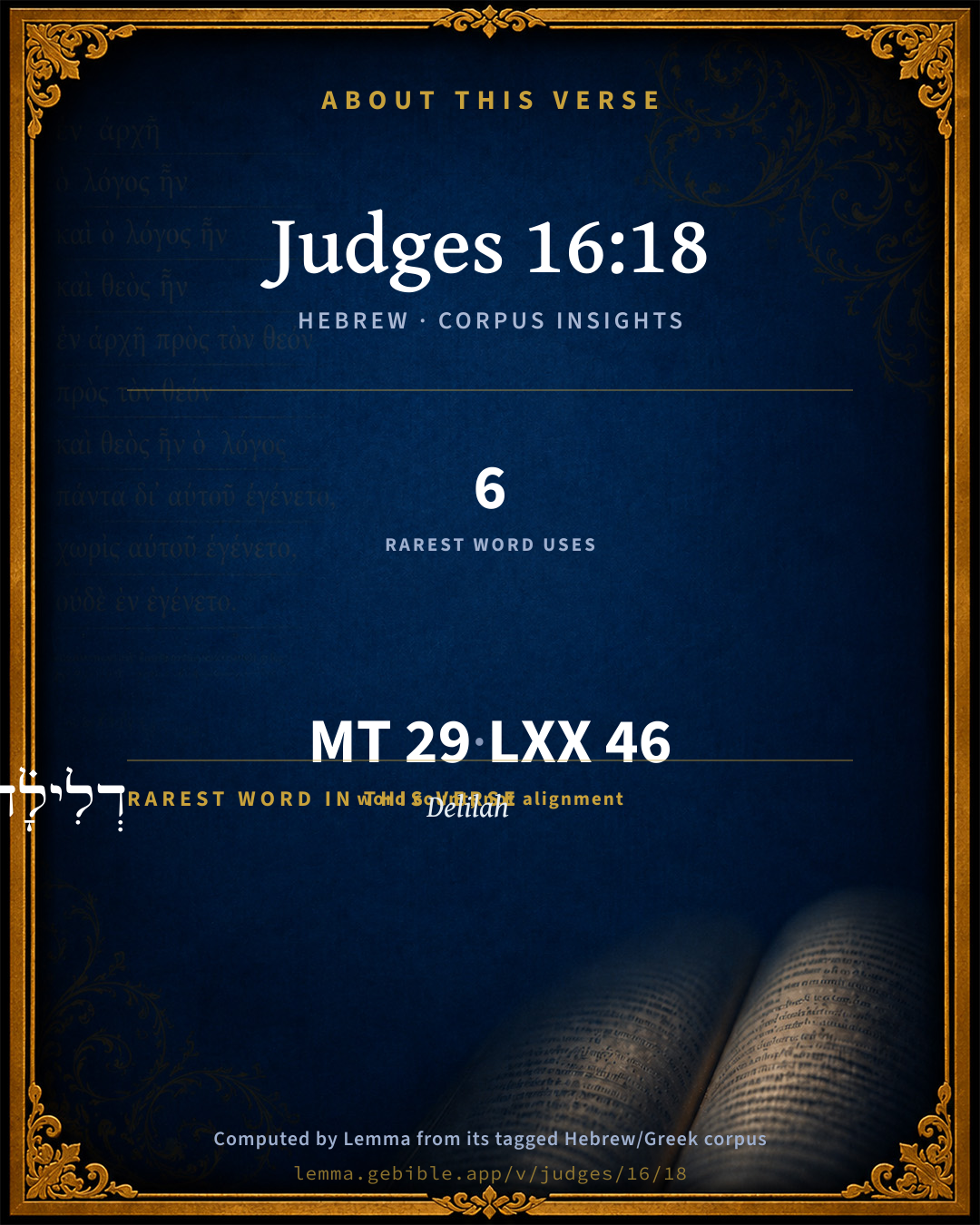
These counts appear in no published source. They are computed here, from the morphology-tagged text and Lemma’s own curated glosses. What Lemma adds →

29
words
17
distinct lemmas
Historical
section

Notable vocabulary

The rarest word here is דְלִילָ֗ה Delilah H1807 — appearing just 6 times in the whole Hebrew Bible.

Shared distinctive vocabulary

דְלִילָ֗ה Delilah H1807 occurs in 6 verses of the Hebrew Bible. Also found in:

Grammatical profile

  • 9 verbs
  • 12 nouns
  • 4 prepositions
  • 2 conjunctions
  • 2 particles

Verb forms

  • וַתֵּ֣רֶא Qal · Sequential Imperfect
  • הִגִּ֣יד Hiphil · Perfect
  • וַתִּשְׁלַ֡ח Qal · Sequential Imperfect
  • וַתִּקְרָא֩ Qal · Sequential Imperfect
  • לֵאמֹר֙ Qal · Infinitive Construct
  • עֲל֣וּ Qal · Imperative
  • הִגִּ֥יד Hiphil · Perfect
  • וְעָל֤וּ Qal · Perfect
  • וַיַּעֲל֥וּ Hiphil · Sequential Imperfect

Repetition

Words recur within this verse — often emphatic in Hebrew:

  • עֲל֣וּ to go up H5927 ×3
  • הִגִּ֣יד to make known H5046 ×2
  • כָּל all H3605 ×2
  • לִבּוֹ֒ heart H3820 ×2
  • לְסַרְנֵ֨י lord H5633 ×2
  • פְלִשְׁתִּ֤ים Philistine H6430 ×2
  • כִּֽי that H3588 ×2

Hebrew & Septuagint length

In English translation the verse runs 51 words from the Hebrew and 51 from the Septuagint (LXX English) — the same length.

A rough comparison of the two English renderings, which tokenize alike — not a word-level alignment.

Word counts can differ between the Hebrew and the Greek without any difference in meaning — e.g. the Hebrew direct-object marker אֵת has no separate Greek word, and Greek often adds the article ὁ.

In the original languages it is 29 Hebrew tokens and 46 Greek tokens — but the two are counted differently (Hebrew bundles its prefixes and suffixes into one token; the Greek is in lemma form), so that isn’t a like-for-like length.

Cross-references

9

Topical passages linked to Judges 16:18 in the Treasury of Scripture Knowledge — connected by theme and wording, ordered by reader-vote popularity; previews shown in the World English Bible.

  • Matthew 26:15 and said, "What are you willing to give me, that I should deliver him to you?" They weighed out for him thirty pieces of silver.
  • 1 Timothy 6:10 For the love of money is a root of all kinds of evil. Some have been led astray from the faith in their greed, and have pierced themselves through with many sorrows.
  • Judges 16:5 The lords of the Philistines came up to her, and said to her, Entice him, and see in which his great strength lies, and by what means we may prevail against him, that we may bind him to afflict him: and we will each give you of us eleven hundred [pieces] of silver.
  • Jeremiah 9:4–6 Take you heed everyone of his neighbor, and don't you trust in any brother; for every brother will utterly supplant, and every neighbor will go about with slanders.
  • Numbers 22:7 The elders of Moab and the elders of Midian departed with the rewards of divination in their hand; and they came to Balaam, and spoke to him the words of Balak.
  • 1 Kings 21:20 Ahab said to Elijah, Have you found me, my enemy? He answered, I have found you, because you have sold yourself to do that which is evil in the sight of Yahweh.
  • Psalms 62:9 Surely men of low degree are just a breath, And men of high degree are a lie. In the balances they will go up. They are together lighter than a breath.
  • Proverbs 18:8 The words of a gossip are like dainty morsels: They go down into a person's innermost parts.
  • Ephesians 5:5 Know this for sure, that no sexually immoral person, nor unclean person, nor covetous man, who is an idolater, has any inheritance in the Kingdom of Christ and God.

Cross-references courtesy of OpenBible.info (CC BY 4.0).

Hebrew and Greek witnesses Masoretic Hebrew ↔ Greek Septuagint

The same verse in the two great witnesses to the Old Testament, shown verse-for-verse.

These are two independent witnesses, not word-aligned to each other, and the Septuagint is shown in lemma (dictionary) form.

Hebrew Judges 16:18 Masoretic · Westminster Leningrad Codex

וַתֵּ֣רֶא דְלִילָ֗ה כִּֽי הִגִּ֣יד לָהּ֮ אֶת כָּל לִבּוֹ֒ וַתִּשְׁלַ֡ח וַתִּקְרָא֩ לְסַרְנֵ֨י פְלִשְׁתִּ֤ים לֵאמֹר֙ עֲל֣וּ הַפַּ֔עַם כִּֽי הִגִּ֥יד לה לִ֖י אֶת כָּל לִבּ֑וֹ וְעָל֤וּ אֵלֶ֨יהָ֙ סַרְנֵ֣י פְלִשְׁתִּ֔ים וַיַּעֲל֥וּ הַכֶּ֖סֶף בְּיָדָֽם

When Delilah saw that he had told her all his heart, she sent and called for the lords of the Philistines, saying, Come up this once, for he has told me all his heart. Then the lords of the Philistines came up to her, and brought the money in their hand.

World English Bible · Public Domain

Greek LXX Judges 16:18 Septuagint · lemma form

καί ὁράω δαλιδα ὅτι ἀποἀγγέλλω αὐτός πᾶς ὁ καρδία αὐτός καί ἀποστέλλω καί καλέω ὁ ἄρχων ὁ ἀλλόφυλος λέγω ἀναβαίνω ἔτι ὁ ἅπαξ οὗτος ὅτι ἀποἀγγέλλω ἐγώ ὁ πᾶς καρδία αὐτός καί ἀναβαίνω πρός αὐτός ὁ ἄρχων ὁ ἀλλόφυλος καί ἀναφέρω ὁ ἀργύριον ἐν χείρ αὐτός

And Dalida saw that he told her all his heart, and she sent and called the princes of the Philistines, saying, Come up yet this once; for he has told me all his heart. And the chiefs of the Philistines went up to her, and brought the money in their hands.

LXX2012 (modern English Septuagint) · Public Domain

Hebrew: Westminster Leningrad Codex (CC BY 4.0). Greek: Septuagint (public domain); English from LXX2012 (modern English Septuagint) (Public Domain). How the Septuagint differs from the Hebrew →

Targum (Aramaic paraphrase)

1

The Targum is the ancient Jewish Aramaic paraphrase of the Hebrew Scriptures — an interpretive translation, not the Hebrew text itself. Onkelos (literal) and Pseudo-Jonathan (expansive) render the Torah, and Jonathan the Prophets. Coverage is partial: where no permissively-licensed English translation exists for a verse, only the Aramaic is shown. This is verse-level text, not a word-by-word alignment to the Hebrew.

  1. Targum Jonathan Prophets (Joshua–Malachi)
    וַחֲזַת דְלִילָה אֲרֵי חַוֵי לָהּ יַת כָּל לִבֵּיהּ וּשְׁלָחַת וּקְרַת לְטוּרְנֵי פְּלִשְׁתָּאֵי לְמֵימָר סַקוּ בְּרַם זִמְנָא הָדָא אֲרֵי חֲוֵי לִי יַת כָּל לִבֵּיהּ וּסְלִיקוּ לְוָתָהּ טוּרְנֵי פְּלִשְׁתָּאֵי וְאַסִיקוּ כַסְפָּא בִּידֵיהוֹן:

    (no public-domain English translation for this verse)

    Targum Jonathan — Aramaic: “Mikraot Gedolot” (public domain). English: “Sefaria Community Translation” (CC0 1.0 (public-domain dedication)); “London "Chaldee Paraphrase," 1871” (public domain). Text via Sefaria.

Commentary

Notes on Judges 16:18 from classic Christian and Jewish commentators (each source and its license shown beneath its notes). The classic Christian expositions comment on the surrounding passage and are grouped to its opening verse, so a note may address several verses; the Jewish commentaries on the Tanakh (Rashi and others) are per-verse, so they appear only where the commentator wrote on this verse.

Lemma curates 59 commentaries, every one of them public domain or Creative Commons licensed, each selected and text-cleaned for this edition rather than reprinted as found. About our sources →

Matthew Henry's Commentary

We have here the fatal consequences of Samson's folly in betraying his own strength; he soon paid dearly for it. A whore is a deep ditch; he that is abhorred of the Lord shall fall therein. In that pit Samson sinks. Observe, 1. What care Delilah took to make sure of the money for herself. She now perceived, by the manner of his speaking, that he had told her all his heart, and the lords of the Philistines that hired her to do this base thing are sent for; but they must be sure to bring the money in their hands, Jdg 16:18. The wages of unrighteousness are accordingly produced, unknown to Samson. It would have grieved one's heart to have seen one of the bravest men then in the world sold and bought, as a sheep for the slaughter; how does this instance sully all the glory of man, and forbid the strong man ever to boast of his strength! 2. What course she took to deliver him up to them according to the bargain. Many in the world would, for the hundredth part of what was here given Delilah, sell those that they pretend the greatest respect for. Trust not in a friend then, put no confidence in a guide. See what a treacherous method she took (Jdg 16:19): She made him sleep upon her knees. Josephus says, She gave him some intoxicating liquor, which laid him to sleep. What opiates she might steal into his cup we know not, but we cannot suppose that he knowingly drank wine or strong drink, for that would have been a forfeiture of his Nazariteship as much as the cutting off of his hair. She pretended the greatest kindness even when she designed the greatest mischief, which yet she could not have compassed if she had not made him sleep. See the fatal consequences of security. Satan ruins men by rocking them asleep, flattering them into a good opinion of their own safety, and so bringing them to mind nothing and fear nothing, and then he robs them of their strength and honour and leads them captive at his will. When we sleep our spiritual enemies do not. When he was asleep she had a person ready to cut off his hair, which he did so silently and so quickly that it did not awake him, but plainly afflicted him; even in his sleep, his spirit manifestly sunk upon it. I think we may suppose that if this ill turn had been done to him in his sleep by some spiteful body, without his being himself accessory to it, as he was here, it would not have had this strange effect upon him; but it was his own wickedness that corrected him. It was his iniquity, else it would not have been so much his infelicity. 3. What little concern he himself was in at it, Jdg 16:20. He could not but miss his hair as soon as he awoke, and yet said, "I will shake myself as at other times after sleep," or, "as at other times when the Philistines were upon me, to make my part good against them." Perhaps he thought to shake himself the more easily, and that his head would feel the lighter, now that his hair was cut, little thinking how much heavier the burden of guilt was than that of hair. He soon found in himself some change, we have reason to think so, and yet wist not that the Lord had departed from him: he did not consider that this was the reason of the change. Note, Many have lost the favourable presence of God and are not aware of it; they have provoked God to withdraw from them, but are not sensible of their loss, nor ever complain of it. Their souls languish and grow weak, their gifts wither, every thing goes cross with them; and yet they impute not this to the right cause: they are not aware that God has departed from them, nor are they in any care to reconcile themselves to him or to recover his favour. When God has departed we cannot do as at other times. 4. What improvement the Philistines soon made of their advantages against him, Jdg 16:21. The Philistines took him when God had departed from him. Those that have thrown themselves out of God's protection become an easy prey to their enemies. If we sleep in the lap of our lusts, we shall certainly wake in the hands of the Philistines. It is probable they had promised Delilah not to kill him, but they took an effectual course to disable him. The first thing they did, when they had him in their hands and found they could manage him, was to put out his eyes, by applying fire to them, says the Arabic version. They considered that his eyes would never come again, as perhaps his hair might, and that the strongest arms could do little without eyes to guide the, and therefore, if now they blind him, they for ever blind him. His eyes were the inlets of his sin: he saw the harlot at Gaza, and went in unto her (Jdg 16:1), and now his punishment began there. Now that the Philistines had blinded him he had time to remember how his own lust had blinded him. The best preservative of the eyes is to turn them away from beholding vanity. They brought him down to Gaza, that there he might appear in weakness where he had lately given such proofs of his strength (Jdg 16:3), and be a jest to those to whom he had been a terror. They bound him with fetters of brass who had before been held in the cords of his own iniquity, and he did grind in the prison, work in their bridewell, either for their profit or his punishment, or for both. The devil does thus by sinners, blinds the minds of those who believe not, and so enslaves them, and secures them in his interests. Poor Samson, how hast thou fallen! How is thy honour laid in the dust! How has the glory and defence of Israel become the drudge and triumph of the Philistines! The crown has fallen from his head; woe unto him, for he hath sinned. Let all take warning by his fall carefully to preserve their purity, and to watch against all fleshly lusts; for all our glory has gone, and our defence departed form us, when the covenant of our separation to God, as spiritual Nazarites, is profaned.

Matthew Henry's Commentary on the Whole Bible (1708–1710) — public domain (CC PDM 1.0). Text via the HelloAO Bible API.

Trapp's Complete Commentary

John Trapp

Jdg 16:18 And when Delilah saw that he had told her all his heart, she sent and called for the lords of the Philistines, saying, Come up this once, for he hath shewed me all his heart. Then the lords of the Philistines came up unto her, and brought money in their hand.

Ver. 18. And when Delilah saw that he had told her all his heart.] Whoredom indeed had "taken away his heart," {Hos 4:11} had infatuated and besotted him, as it is the nature of these sensual sins to do; these "lusts of the flesh that war against the soul." {1Pe 2:12}

And brought money in their hand.] Money they knew to be the monarch of this world, and to bear the mastery; but especially with such Poscinummiae, et Crumenimulgae as Delilah was.

John Trapp, A Commentary or Exposition upon All the Books of the Old and New Testament (1647–1656) — public domain. Text from a community e-Sword module.

Joseph Benson's Commentary

Jdg 16:18. When Delilah saw that he had told her all his heart — From the seriousness and solemnity with which he spoke, she concluded that she was at length mistress of the important secret. The lords of the Philistines brought money in their hands — See one of the bravest men then in the world bought and sold as a sheep for the slaughter! How does this instance sully all the glory of man, and forbid the strong man ever to boast of his strength!

Joseph Benson's Commentary on the Old and New Testaments (1811–1818) — public domain. Text from a community e-Sword module.

Ellicott's Commentary for English Readers

(18) Saw that he had told her all his heart.—She could not mistake the accent of truthfulness, nor was Samson so far gone as to be able to reveal the great secret without some sense of awe and shame.

Money.—Rather, the silver (Jdg_16:5).

A Bible Commentary for English Readers, edited by Charles John Ellicott (1878–1897) — public domain. Text from a community e-Sword module.

The Cambridge Bible for Schools and Colleges

gen. ed. J. J. S. Perowne

18. he hath told me] So the Hebr. marg. (Ḳerç); this is to be preferred to the Hebr. text (Kethîbh) which = RVm.

and brought] The verb is probably an insertion; read simply and, i.e. with. The previous verb came up requires a slight, alteration in the Hebr.

The Cambridge Bible for Schools and Colleges (gen. ed. J. J. S. Perowne; Cambridge University Press, 1878–1918) — public domain. Text from a community e-Sword module.

John Gill's Exposition

And when Delilah saw that he had told her all his heart,.... Which she perceived by his countenance, and the serious manner in which he expressed himself; and Abarbinel conjectures that he might swear to her that what he said was truth; and who observes from their Rabbins, as does also Kimchi, that she concluded he had told her the truth, by his making mention of the name of God, saying he was a Nazarite unto God, whose name she knew he would not take in vain; and with the account he gave agreed the long hair he wore:

she sent and called for the lords of the Philistines, saying, come up this once; for it seems as they were returned home, finding that she could do nothing with him, and was not able to get the secret out of him; but now, believing she had it, sends to them, and entreats them to come once more, being very desirous of having the money they had offered her:

for he hath showed me all his heart; there is a double reading of this clause; the Keri or marginal reading, which our version follows, is, "hath showed me", as being the words of Delilah to the lords of the Philistines; but the Cetib or textual reading is, "he hath showed her", as being the words of the messengers to them:

then the lords of the Philistines came up unto her; that is, from their own country; for it can hardly be understood of their coming up into her room, or chamber; and especially since it follows:

and brought money in their hand; 1100 shekels of silver apiece, the sum they first proposed to give her; and now being pretty well assured of success, brought it along with them to pay her for the service done.

John Gill's Exposition of the Whole Bible (1746–1763) — public domain (CC PDM 1.0). Text via the HelloAO Bible API.

Haydock's Catholic Bible Commentary

To me. Hebrew, "to her." Lah instead of li, perhaps in all the printed editions except the Complutensian, which has corrected the mistake, and is authorized by some manuscripts. (Kennicott)

George Leo Haydock (1774–1849), Haydock's Catholic Family Bible and Commentary, 1859 edition — public domain. Excludes Psalms (Douay-Rheims chapter numbering differs from Protestant) and Deuterocanonical books (Catholic canon only).

Matthew Poole's English Annotations

It was not hard for her to discover that he had told her all his heart by the change of his countenance, and the matter of his discourse, and the whole carriage of the business.

Matthew Poole's English Annotations on the Holy Bible (1683–1685) — public domain. Text from a community e-Sword/MySword module.

Whedon's Commentary on the Bible

Daniel D. Whedon

18. Delilah saw — She perceived from the character of what he said, and his solemn behaviour, and perhaps agitation, that now he had told her the fatal secret.

Daniel D. Whedon (gen. ed.), Commentary on the Old and New Testaments (1874–1909) — public domain. Text from a community e-Sword module.

The Pulpit Commentary

He hath showed me. So the Keri; but the written text has her instead of me, which is favoured by the tense of the verb came up. If her is the true reading, these words would be the addition of the messenger, explaining why she told them to come up once more, or of the narrator, for the same purpose. Brought money. It should be the money, the stipulated bribe (ver. 5).

The Pulpit Commentary (1880–1919), ed. H.D.M. Spence-Jones & Joseph S. Exell — public domain. Text from a community e-Sword module.

John Wesley's Explanatory Notes

And brought money in their hand - See one of the bravest men then in the world bought and sold, as a sheep for the slaughter. How does this instance sully all the glory of man, and forbid the strong man ever to boast of his strength!

John Wesley, Explanatory Notes Upon the Whole Bible (1754–1765) — public domain. Text via the GEBible commentary corpus.

unfoldingWord translationNotes

Door43 World Missions Community

Delilah saw

Here the word "saw" is a idiom that means to realize something. AT: "Delilah realized" or "Delilah learned" (See: Idiom)

the truth about everything

Here the word "everything" refers to everything about why Samson was strong. AT: "the truth about why he is strong" (See: Assumed Knowledge and Implicit Information)

Come up again

Delilah is telling the rulers to come again to where she lives. Her home is likely at a higher elevation than where the rulers would be travelling from.

bringing the silver in their hands

This means that they brought to her the silver that they had promised to give her if she helped them capture Samson. AT: "bringing the silver that they had promised to give her" (See: Assumed Knowledge and Implicit Information)

She had him fall asleep

"She caused him to fall asleep"

in her lap

This means that he slept with his head on her lap. This can be stated clearly. AT: "with his head on her lap" (See: Assumed Knowledge and Implicit Information)

lap

The lap is the level area of the upper legs when a person is sitting down.

the seven locks of his head

Samson had seven locks of hair on his head. Locks are small bunches of hair. Here his locks of hair are described as "belonging" to his head. AT: "the seven locks of hair on his head" (See: Possession)

subdue him

"control him"

his strength had left him

Here Samson's strength is described as if it were a person who could leave him. AT: "his strength was gone" or "he was no longer strong" (See: Personification)

translationWords

Delilah

true

rule

Philistines

silver

unfoldingWord translationNotes — © Distant Shores Media and the Door43 World Missions Community, licensed CC BY-SA 4.0. Source: git.door43.org/Door43/en_tn.

Rashi

Rabbi Shlomo Yitzchaki (Rashi)

Delilah saw that he had confided to her. One instinctively recognizes the truth.

Rashi on the Tanakh — English translations: “The Judaica Press complete Tanach with Rashi, translated by A. J. Rosenberg” (CC BY 4.0); “Pentateuch with Rashi's commentary by M. Rosenbaum and A.M. Silbermann, 1929-1934” (public domain); “The Metsudah Tanach series, Lakewood, N.J” (CC BY 4.0); and “The Book of Joshua, Metsudah Publications, 1997” (CC BY 4.0). Text via Sefaria.

Lesson kit

Teaching starters — assembled from the data on this page, not authored interpretation. Every prompt links to the verse data it draws on. Edit before teaching.

Judges, in the Historical, opens this verse with 29 words (17 distinct Hebrew lemmas). Its most distinctive word is Dᵉlîylâh (“Delilah”). A historical commentator’s framing appears above. Read the whole chapter for the surrounding context.

Discussion questions

  1. How does “Delilah” (Dᵉlîylâh) shape what this verse is saying?
  2. Judges 16:4 shares the word «Delilah» with this verse. How do the two illuminate each other?
  3. “to go up” occurs 3× in this one verse. What is the effect of the repetition?
  4. These translations render this verse differently; the difference is in the English rendering, not the original. What questions does that raise?
  5. The verb «וַתֵּ֣רֶא» is Qal Sequential Imperfect. How does its form color the action?
  6. Reading how Matthew Henry's Commentary and Trapp's Complete Commentary read this verse, where do the two commentators agree and where do they part?

Things to notice

Reading settings

Reading text

Shown beneath each verse's original-language words.

Old Testament
Old Testament edition

Read the OT as the Masoretic Hebrew (MT) or the Greek Septuagint (LXX).

English shown for the Greek Septuagint (in the Hebrew ↔ Greek comparison).

Comparing translations? Open the Compare panel on any verse page to stack up to four side by side.