Jeremiah 25:32

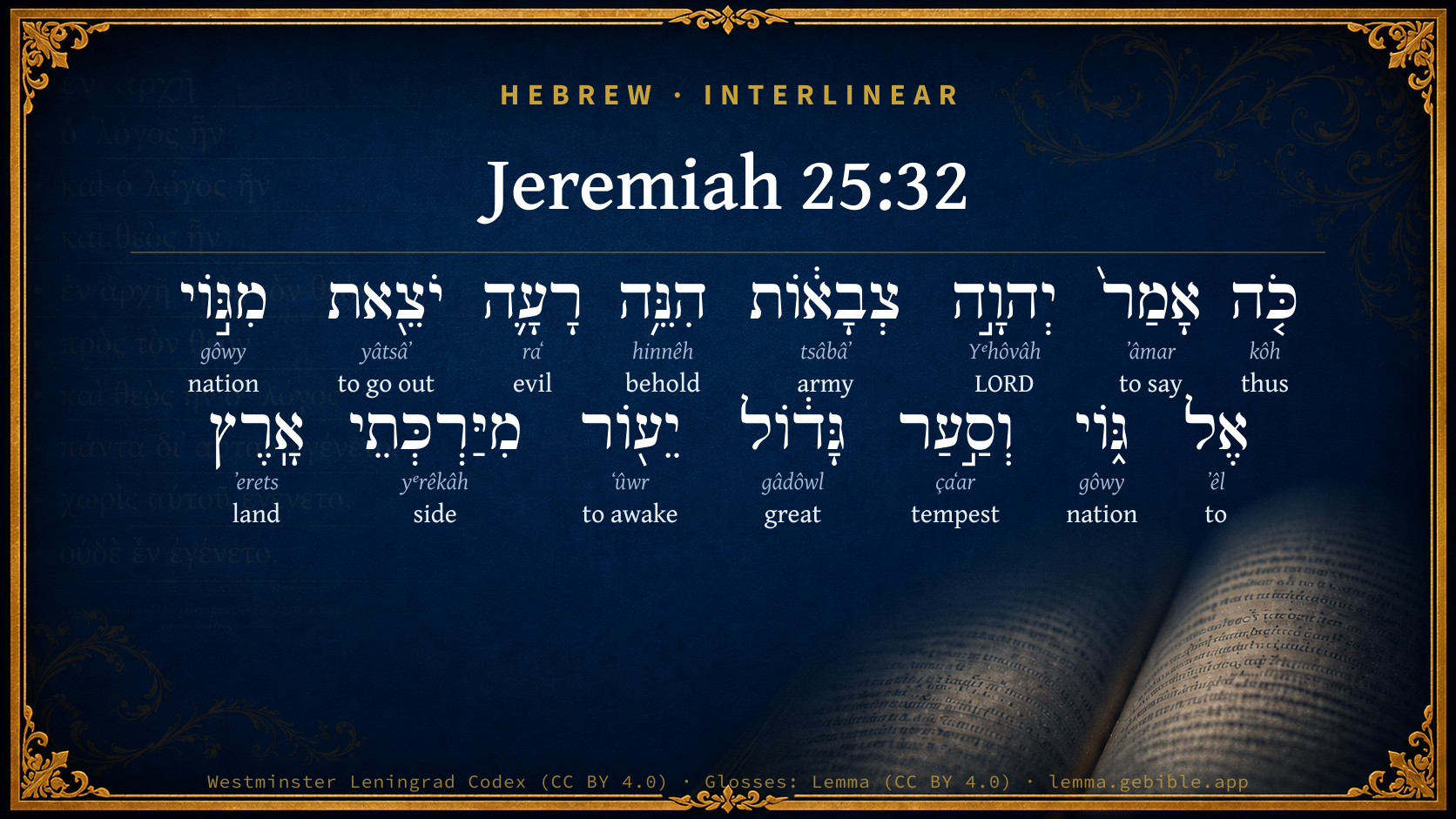
Hebrew (Westminster Leningrad Codex) Jeremiah 25:32 appears in the Hebrew Old Testament. The text above is from the Westminster Leningrad Codex. Each word links to its Strong’s number, a concise gloss, and parsing drawn from the Open Scriptures Hebrew Bible morphology. Click any word for its full Brown-Driver-Briggs (BDB) entry.
Download image
Cite this verse

Jeremiah 25:32 (World English Bible). Public Domain. Lemma interlinear Bible study tool, https://lemma.gebible.app/v/jeremiah/25/32.

Show BibTeX & RIS
BibTeX
RIS
English Translation
Thus says Yahweh of hosts, Behold, evil shall go forth from nation to nation, and a great tempest shall be raised up from the uttermost parts of the earth.
World English Bible · Public Domain
Download a study sheet

One document with this verse’s original text, its word-by-word gloss line, the meaning frame, cross-references with their text, attributed commentary, and full source and license credits — printable, and it pastes into notes with its structure intact.

This verse Autodidact and up

Study sheet (.html) Plain text (.txt)

A passage Seminary Student

Up to 50 verses in one chapter. A passage sheet keeps up to 6 commentary sources and 12 cross-references per verse, in the order this page ranks them, and says so on the sheet whenever that leaves anything out. Ask for a single verse and you get the Autodidact verse sheet above.

Everything on this page stays free to read, with no account — the sheet is a download of what is already on screen, not access to it.

Want to remove ads? Support Godless Engineer
Compare translations 3

The same verse in 3 English versions, stacked beneath the original-language interlinear above. Click any original word for its lexicon entry.

Each is an independent rendering of the whole verse — the interlinear is not word-aligned to these translations.

Highlighted words mark where these versions differ — a whole-verse word diff, not a word-by-word alignment.

  • World English Bible Public Domain
    Thus says Yahweh of hosts, Behold, evil shall go forth from nation to nation, and a great tempest shall be raised up from the uttermost parts of the earth.
  • King James Version Public Domain
    Thus saith the LORD of hosts, Behold, evil shall go forth from nation to nation, and a great whirlwind shall be raised up from the coasts of the earth.
  • unfoldingWord Literal Text CC BY-SA 4.0
    Thus says Yahweh of Armies, “Behold, disaster is going out from nation to nation, and a great storm will be stirred up from the farthest parts of the earth.

unfoldingWord Literal Text — © unfoldingWord, licensed CC BY-SA 4.0. Word-aligned USFM3 via Door43 (git.door43.org/unfoldingWord/en_ult).

Versions to compare (up to 4)

3 of 4 selected

Show all 18 translations

Every available English version of this verse, each an independent rendering of the whole verse.

  • World English Bible Public Domain
    Thus says Yahweh of hosts, Behold, evil shall go forth from nation to nation, and a great tempest shall be raised up from the uttermost parts of the earth.
  • Berean Standard Bible Public Domain
    This is what the LORD of Hosts says: “Behold! Disaster is spreading from nation to nation; a mighty storm is rising from the ends of the earth.”
  • Majority Standard Bible Public Domain
    This is what the LORD of Hosts says: “Behold! Disaster is spreading from nation to nation; a mighty storm is rising from the ends of the earth.”
  • King James Version Public Domain
    Thus saith the LORD of hosts, Behold, evil shall go forth from nation to nation, and a great whirlwind shall be raised up from the coasts of the earth.
  • American Standard Version (1901) Public Domain
    Thus saith Jehovah of hosts, Behold, evil shall go forth from nation to nation, and a great tempest shall be raised up from the uttermost parts of the earth.
  • Revised Version (1885) Public Domain
    Thus saith the LORD of hosts, Behold, evil shall go forth from nation to nation, and a great tempest shall be raised up from the uttermost parts of the earth.
  • Geneva Bible (1599) Public Domain
    Thus saith the Lord of hostes, Behold, a plague shall goe foorth from nation to nation, and a great whirlewinde shalbe raised vp from the coastes of the earth,
  • Douay-Rheims (1899) Public Domain
    Thus saith the Lord of hosts: Behold evil shall go forth from nation to nation: and a great whirlwind shall go forth from the ends of the earth.
  • Young's Literal Translation Public Domain
    Thus said Jehovah of Hosts: Lo, evil is going out from nation to nation, And a great whirlwind is stirred up from the sides of the earth.
  • Literal Standard Version CC BY-SA 4.0
    Thus said YHWH of Hosts: “Behold, evil is going out from nation to nation, || And a great whirlwind is stirred up from the sides of the earth.
  • Unlocked Literal Bible CC BY-SA 4.0
    Yahweh of hosts says this, 'See, disaster is going out from nation to nation, and a great storm is beginning from the farthest parts of the earth.
  • unfoldingWord Literal Text CC BY-SA 4.0
    Thus says Yahweh of Armies, “Behold, disaster is going out from nation to nation, and a great storm will be stirred up from the farthest parts of the earth.
  • Darby Bible Public Domain
    Thus saith Jehovah of hosts: Behold, evil shall go forth from nation to nation, and a great storm shall be raised up from the uttermost parts of the earth.
  • World Messianic Bible Public Domain
    The LORD of Hosts says, “Behold, evil will go out from nation to nation, and a great storm will be raised up from the uttermost parts of the earth.”
  • Webster's Bible Public Domain
    Thus saith the LORD of hosts, Behold, evil shall go forth from nation to nation, and a great whirlwind shall be raised from the borders of the earth.
  • Free Bible Version CC BY-SA 4.0
    This is what the Lord Almighty says: Watch out! Disaster is falling on one nation after another; an immense storm is building up in the far distance.
  • Bible in Basic English Public Domain
    This is what the Lord of armies has said: See, evil is going out from nation to nation, and a great storm will come up from the inmost parts of the earth.
  • JPS Tanakh (1917) Public Domain
    Thus saith the LORD of hosts: Behold, evil shall go forth from nation to nation, and a great storm shall be raised up from the uttermost parts of the earth.

Literal Standard Version (2020), Covenant Press — licensed CC BY-SA 4.0. Text via the HelloAO Bible API (eBible.org). Unlocked Literal Bible (unfoldingWord) — licensed CC BY-SA 4.0. Text via the HelloAO Bible API (eBible.org). unfoldingWord Literal Text — © unfoldingWord, licensed CC BY-SA 4.0. Word-aligned USFM3 via Door43 (git.door43.org/unfoldingWord/en_ult). Free Bible Version, Dr. Jonathan Gallagher — licensed CC BY-SA 4.0. Text via the HelloAO Bible API (eBible.org).

Word by word

More ways to search: Search by grammar → Find every occurrence → Compare this word →

Practice this passage: Drill this verse → Learn its vocabulary →

וְסַ֣עַר
çaʻar
H5591
“and · tempest”
Conjunction + Noun, Common, Masculine, Singular, Absolute
Part of Speech
Conjunction + Noun
Type
Common
Gender
Masculine
Number
Singular
State
Absolute
Full BDB Definition

Origin: from H5590

TWOT: 1528

tempest, storm, whirlwind - tempest
  1. כֹּ֤ה kôh H3541 “thus” Adverb
  2. אָמַר֙ ʼâmar H559 “to say” Verb, Qal, Perfect, 3rd Person, Masculine, Singular
  3. יְהוָ֣ה Yᵉhôvâh H3068 “LORD” Noun, Proper
  4. צְבָא֔וֹת tsâbâʼ H6635 “armies” Noun, Common, Both, Plural, Absolute
  5. הִנֵּ֥ה hinnêh H2009 “behold” Particle, Demonstrative
  6. רָעָ֛ה raʻ H7451 “evil” Noun, Common, Feminine, Singular, Absolute
  7. יֹצֵ֖את yâtsâʼ H3318 “going out” Verb, Qal, Participle Active, Feminine, Singular, Absolute
  8. מִגּ֣וֹי gôwy H1471 “from · nation” Preposition + Noun, Common, Masculine, Singular, Absolute
  9. אֶל ʼêl H413 “to” Preposition
  10. גּ֑וֹי gôwy H1471 “nation” Noun, Common, Masculine, Singular, Absolute
  11. גָּד֔וֹל gâdôwl H1419 “great” Adjective, Adjective, Masculine, Singular, Absolute
  12. יֵע֖וֹר ʻûwr H5782 “to awake” Verb, Niphal, Imperfect, 3rd Person, Masculine, Singular
  13. מִיַּרְכְּתֵי yᵉrêkâh H3411 “from · sides of” Preposition + Noun, Common, Feminine, Dual, Construct
  14. אָֽרֶץ ʼerets H776 “land” Noun, Common, Both, Singular, Absolute

About this verse

These counts appear in no published source. They are computed here, from the morphology-tagged text and Lemma’s own curated glosses. What Lemma adds →

15
words
14
distinct lemmas
Prophets
section

Shared distinctive vocabulary

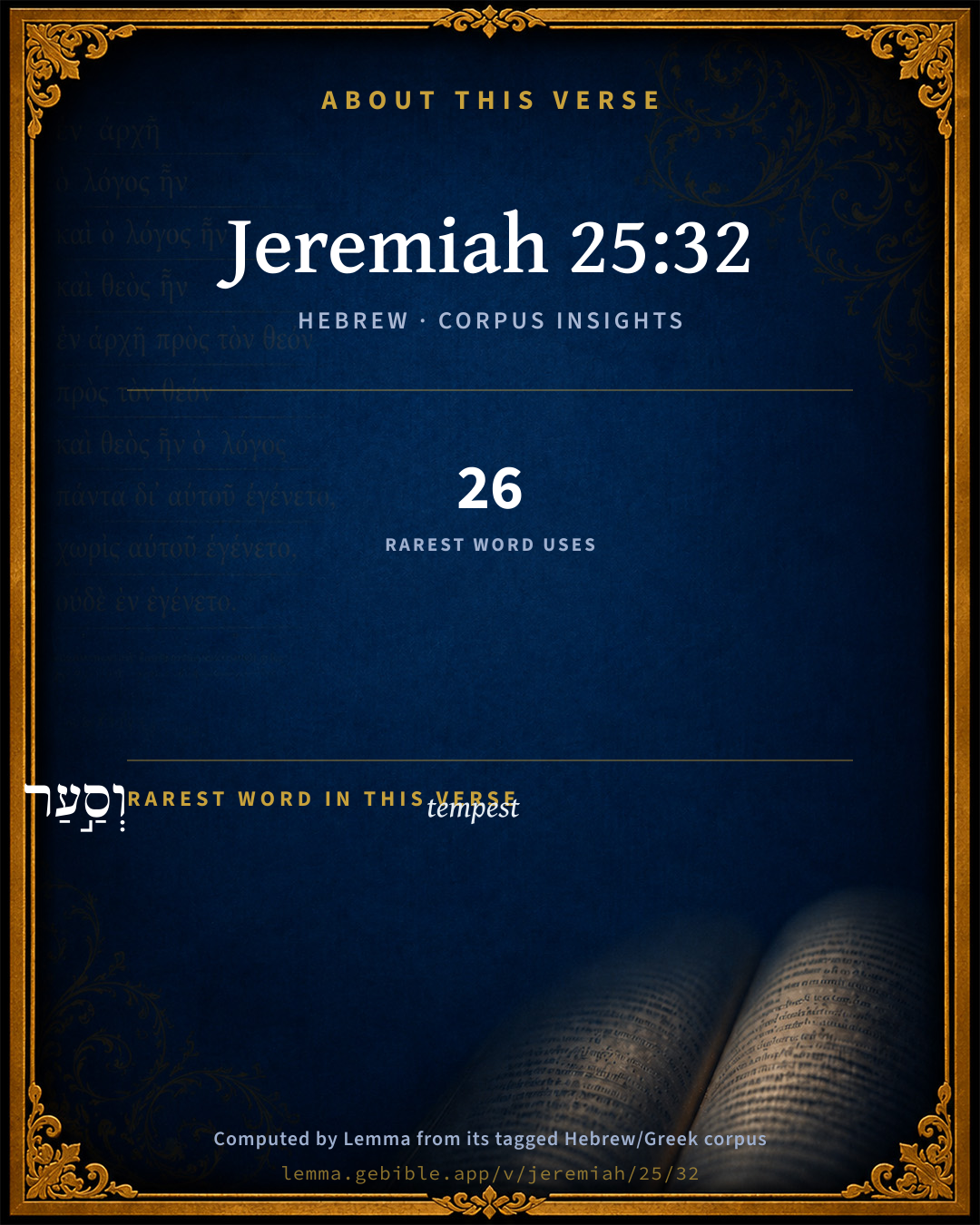
וְסַ֣עַר tempest H5591 occurs in 22 verses of the Hebrew Bible. Also found in:

Grammatical profile

  • 3 verbs
  • 8 nouns
  • 1 adjective
  • 1 preposition
  • 1 adverb
  • 1 particle

Verb forms

  • אָמַר֙ Qal · Perfect
  • יֹצֵ֖את Qal · Participle Active
  • יֵע֖וֹר Niphal · Imperfect

Repetition

A word recurs within this verse — often emphatic in Hebrew:

  • מִגּ֣וֹי nation H1471 ×2

Cross-references

10

Topical passages linked to Jeremiah 25:32 in the Treasury of Scripture Knowledge — connected by theme and wording, ordered by reader-vote popularity; previews shown in the World English Bible.

  • Isaiah 34:2 For Yahweh has indignation against all the nations, and wrath against all their host: he has utterly destroyed them, he has delivered them to the slaughter.
  • Jeremiah 23:19 Behold, the tempest of Yahweh, [even his] wrath, is gone forth, yes, a whirling tempest: it shall burst on the head of the wicked.
  • 2 Chronicles 15:6 They were broken in pieces, nation against nation, and city against city; for God did vex them with all adversity.
  • Isaiah 30:30 Yahweh will cause his glorious voice to be heard, and will show the lighting down of his arm, with the indignation of [his] anger, and the flame of a devouring fire, with a blast, and tempest, and hailstones.
  • Jeremiah 30:23 Behold, the tempest of Yahweh, [even his] wrath, is gone forth, a sweeping tempest: it shall burst on the head of the wicked.
  • Isaiah 5:28 Whose arrows are sharp, And all their bows bent. Their horses' hoofs will be like flint, And their wheels like a whirlwind.
  • Isaiah 66:18 For I [know] their works and their thoughts: [the time] comes, that I will gather all nations and languages; and they shall come, and shall see my glory.
  • Zephaniah 3:8 "Therefore wait for me," says Yahweh, "until the day that I rise up to the prey, for my determination is to gather the nations, that I may assemble the kingdoms, to pour on them my indignation, even all my fierce anger, for all the earth will be devoured with the fire of my jealousy.
  • Luke 21:10 Then he said to them, "Nation will rise against nation, and kingdom against kingdom.
  • Luke 21:25 There will be signs in the sun, moon, and stars; and on the earth anxiety of nations, in perplexity for the roaring of the sea and the waves;

Cross-references courtesy of OpenBible.info (CC BY 4.0).

Hebrew and Greek witnesses Masoretic Hebrew ↔ Greek Septuagint

The same verse in the two great witnesses to the Old Testament, shown verse-for-verse.

These are two independent witnesses, not word-aligned to each other, and the Septuagint is shown in lemma (dictionary) form.

Hebrew Jeremiah 25:32 Masoretic · Westminster Leningrad Codex

כֹּ֤ה אָמַר֙ יְהוָ֣ה צְבָא֔וֹת הִנֵּ֥ה רָעָ֛ה יֹצֵ֖את מִגּ֣וֹי אֶל גּ֑וֹי וְסַ֣עַר גָּד֔וֹל יֵע֖וֹר מִיַּרְכְּתֵי אָֽרֶץ

Thus says Yahweh of hosts, Behold, evil shall go forth from nation to nation, and a great tempest shall be raised up from the uttermost parts of the earth.

World English Bible · Public Domain

Greek LXX Structure differs

In the Septuagint, Jeremiah is about an eighth shorter than the Hebrew and arranges its material differently — the Oracles Against the Nations (Hebrew chapters 46–51) appear in the middle of the Greek book, after 25:13. Because the chapter and verse boundaries do not line up, a verse-for-verse comparison with the Hebrew is not shown.

A verse-for-verse comparison isn’t shown here because the chapters and verses don’t line up. Switch to the LXX edition with the MT / LXX toggle above to read the Greek directly.

Hebrew: Westminster Leningrad Codex (CC BY 4.0). Greek: Septuagint (public domain); English from a public-domain English Septuagint. How the Septuagint differs from the Hebrew →

Targum (Aramaic paraphrase)

1

The Targum is the ancient Jewish Aramaic paraphrase of the Hebrew Scriptures — an interpretive translation, not the Hebrew text itself. Onkelos (literal) and Pseudo-Jonathan (expansive) render the Torah, and Jonathan the Prophets. Coverage is partial: where no permissively-licensed English translation exists for a verse, only the Aramaic is shown. This is verse-level text, not a word-by-word alignment to the Hebrew.

  1. Targum Jonathan Prophets (Joshua–Malachi)
    כִּדְנַן אֲמַר יְיָ צְבָאוֹת הָא בִּישְׁתָא נַפְקָא מֵעַם לְעַם וְעַמְמִין רַבְרְבִין יֵיתוּן בִּגְלֵי מִסְיָפֵי אַרְעָא:

    (no public-domain English translation for this verse)

    Targum Jonathan — Aramaic: “Mikraot Gedolot” (public domain). English: “Sefaria Community Translation” (CC0 1.0 (public-domain dedication)); “London "Chaldee Paraphrase," 1871” (public domain). Text via Sefaria.

Commentary

Notes on Jeremiah 25:32 from classic Christian and Jewish commentators (each source and its license shown beneath its notes). The classic Christian expositions comment on the surrounding passage and are grouped to its opening verse, so a note may address several verses; the Jewish commentaries on the Tanakh (Rashi and others) are per-verse, so they appear only where the commentator wrote on this verse.

Lemma curates 59 commentaries, every one of them public domain or Creative Commons licensed, each selected and text-cleaned for this edition rather than reprinted as found. About our sources →

Trapp's Complete Commentary

John Trapp

Jer 25:32 Thus saith the LORD of hosts, Behold, evil shall go forth from nation to nation, and a great whirlwind shall be raised up from the coasts of the earth.

Ver. 32. Behold, evil shall go forth from nation to nation.] See on Jer 25:16.

John Trapp, A Commentary or Exposition upon All the Books of the Old and New Testament (1647–1656) — public domain. Text from a community e-Sword module.

Tyndale Open Study Notes

Tyndale Open Resources

25:32-33 Disaster . . . great whirlwind of fury: These words emphasize the awful nature of the wars that tore many nations apart during the 500s BC.

Tyndale Open Study Notes — © Tyndale Open Resources, licensed CC BY-SA 4.0. Text via the HelloAO Bible API.

Jamieson, Fausset & Brown

Robert Jamieson, A. R. Fausset & David Brown

from the coasts--rather, "from the uttermost regions." Like a storm which arises in one region and then diffuses itself far and wide, so God's judgments shall pass "from nation to nation," till all has been fulfilled; no distance shall prevent the fulfilment.

not be lamented-- (Jer 16:4, Jer 16:6).

neither gathered--to their fathers, in their ancestral tombs (Jer 8:2).

dung-- (Psa 83:10).

Jamieson, Fausset & Brown — Commentary Critical and Explanatory on the Whole Bible (1871) — public domain (CC PDM 1.0). Text via the HelloAO Bible API.

Adam Clarke's Commentary

Verse 32. Evil shall go forth from nation to nation] One nation after another shall fall before the Chaldeans.

Adam Clarke's Commentary on the Bible (1810–1826) — public domain. Text from a community e-Sword/MySword module.

John Calvin's Commentaries

Jeremiah goes on with the subject which we began to explain in the last Lecture. He had before prophesied of God’s judgments, which were nigh many nations, and which referred to almost all the countries near and known to the Jews, and to some that were afar off. The substance of what has been said is, — that God, who had long spared the wickedness of men, would now become an avenger, so that it might openly appear, that though he had deferred punishment, he would not allow the ungodly to escape, for they would in proper time and season be called to give an account.

To the same purpose is what he adds here, go forth shall evil from nation to nation The explanation by some is, that one nation would make war on another, and that thus they would destroy themselves by mutual conflicts; and this meaning may be admitted. It seems, however, to me that the Prophet meant another thing, even that God’s vengeance would advance like a contagion through all lands. And according to this view he adds a metaphor, or the simile of a storm, or a tempest, or a whirlwind; for when a tempest arises, it confines not itself to one region, but spreads itself far and wide. So the Prophet now shews, that though God would not at one time punish all the nations, he would yet be eventually the judge of all, for he would pass far and wide like a storm. Thus, then, I interpret the passage, not that the nations would make war with one another, but that when God had executed his judgment on one nation, he would afterwards advance to another, so that he would make no end until he had completed what Jeremiah had foretold.

And this view appears still more evident from the second clause of the verse, for this cannot be explained of intestine wars, raised shall be a tempest from the sides of the earth We hence see that the meaning is, that God would not be wearied after having begun to summon men to judgment, but would include the most remote, who thought themselves beyond the reach of danger. As when a tempest rises, it seems only to threaten a small portion of the country, but it soon spreads itself and covers the whole heavens; so also God says, that his vengeance would come from the sides of the earth, that is, from the remotest places, so that no distance would prevent the completion of what he had foretold by his servant.

But this may also be accommodated to our case; for whenever we see that this or that nation is afflicted by any calamity, we ought to remember this truth, that God seasonably warns us, that we may not abuse his patience, but anticipate him before his scourge passes from some side of the earth to us. In short, as soon as God manifests any sign of his wrath, it ought instantly to occur to us, that it may spread in a moment through all the extremities of the earth, so that no corner would be exempted. For if he makes known his power in the whirlwind or the storm, how will it be, when he makes a fuller and a nearer manifestation of his judgment, by stretching forth his hand as it were in a visible manner? This, then, is the import of this verse. It afterwards follows, —

John Calvin's Commentaries (1540-1563) — public domain. Text from the Calvin Translation Society English edition (1840s-50s) via the Christian Classics Ethereal Library (ccel.org). Calvin's coverage is partial (roughly two-thirds of the Bible); uncommented books and verses are honest gaps, never fabricated. The 19th-century editor's footnotes and remarks are omitted so the notes are faithfully Calvin's own voice.

Ellicott's Commentary for English Readers

(32) Whirlwind.—The word, as in Jer_23:19, is more generic, a tempest. The storm is seen as it were rising from the “coasts”—i.e., the sides or horizon of the earth, as in Jer_6:22—and spreading over all the nations.

A Bible Commentary for English Readers, edited by Charles John Ellicott (1878–1897) — public domain. Text from a community e-Sword module.

John Gill's Exposition

And the slain of the Lord,.... Slain by his permission, yea, by his orders, according to his will, in his wrath and sore displeasure, and to glorify his vindictive justice:

shall be at that day from one end of the earth even unto the other end of the earth; not that this should be at one and the same time; for there never was such a time, that there was such a general slaughter in the world, that the slain should reach from one end to the other; but that within the dispensation, in which the cup should go round to all nations, meant by "that day", the slain of the Lord would be in all parts of the world; or that, according to his will, there would be a great slaughter everywhere, as the cup went round, or the sword was sent, first ravaging one country, and then another;

they shall not be lamented; having no pity from their enemies; and as for their friends, they will share the same rite with them; so that there will be none to mourn over them:

neither gathered; taken up from the field of battle where they fall; but, where they should fall, there they should lie; none gathering up their bodies or bones, in order for interment:

nor buried; in the sepulchres of their fathers, nor indeed in any place, or in any manner; as not in any grand and magnificent manner, so not so much as in a common way;

they shall be dung upon the ground; spread upon it, and lie above it, as dung, to manure the earth.

John Gill's Exposition of the Whole Bible (1746–1763) — public domain (CC PDM 1.0). Text via the HelloAO Bible API.

Albert Barnes' Notes on the Bible

A great whirlwind - Or, storm.

The coasts of the earth - See Jer 6:22 note. The thunderstorm seen first on the edge of the horizon overspreads the heaven, and travels from nation to nation in its destructive course.

Albert Barnes' Notes on the Bible (1834–1885) — public domain. Text from a community e-Sword/MySword module.

Haydock's Catholic Bible Commentary

To nation. Jerusalem, Tyre, Syria, desert Arabia, Ammon, Idumea, and Egypt, shall fall one after another. Thus Cyrus will attack the Medes, Asia, and Babylon.

George Leo Haydock (1774–1849), Haydock's Catholic Family Bible and Commentary, 1859 edition — public domain. Excludes Psalms (Douay-Rheims chapter numbering differs from Protestant) and Deuterocanonical books (Catholic canon only).

Matthew Poole's English Annotations

It is much the same thing which was said before, only repeated for the greater terror in a variety of expressions. He tells them that the judgment should be like a contagion, going from one nation to another, or like a fire catching hold of another house before the first is burned down, like a

whirlwind that blows from all sides, cometh suddenly, and devoureth dreadfully.

Matthew Poole's English Annotations on the Holy Bible (1683–1685) — public domain. Text from a community e-Sword/MySword module.

Whedon's Commentary on the Bible

Daniel D. Whedon

32. Evil shall go forth — As a fierce and destructive storm travels on from nation to nation.

Daniel D. Whedon (gen. ed.), Commentary on the Old and New Testaments (1874–1909) — public domain. Text from a community e-Sword module.

The Pulpit Commentary

A great whirlwind; rather, a great storm. (as Jer_23:19) The coasts of the earth; rather, the furthest parts of the earth. The storm, as it appears on the horizon, comes as it were from the ends of the earth; perhaps, too, there is an allusion to the distant abode of the foe. (Jer_6:22)

The Pulpit Commentary (1880–1919), ed. H.D.M. Spence-Jones & Joseph S. Exell — public domain. Text from a community e-Sword module.

unfoldingWord translationNotes

Door43 World Missions Community

Yahweh of hosts says this

Jeremiah often uses these words to introduce an important message from Yahweh. See how you translated this in Jeremiah 6:6.

See

"Look" or "Listen" or "Pay attention to what I am about to tell you"

disaster is going out from nation to nation

Yahweh speaks of great disasters happening in each nation as if "disaster" were a person who goes from nation to nation. AT: "great disasters are going to happen in one nation after another" (See: Personification)

a great storm is beginning from the farthest parts of the earth

Possible meanings for this metaphor are 1) Yahweh speaks of Babylonian army and the destruction that it will cause as if it were a great storm or 2) Yahweh speaks of his great anger as if it were a great storm that causes much destruction. (See: Metaphor)

those killed by Yahweh

This can be stated in active form. AT: "those whom Yahweh killed" (See: Active or Passive)

will on that day extend from one end of the earth to the other

By mentioning both ends of the earth, this phrase represents everywhere in between those ends. AT: "will on that day cover the entire earth" (See: Merism)

they will not be mourned, gathered, or buried

This can be stated in active form. AT: "no one will mourn them, gather them, or bury them" (See: Active or Passive)

They will be like dung on the ground

The bodies are compared to dung on the ground to emphasize that they will be disgusting and that no one will bury them. See how you translated a similar phrase in Jeremiah 16:4. (See: Simile)

translationWords

nation

mourn

bury

dung

unfoldingWord translationNotes — © Distant Shores Media and the Door43 World Missions Community, licensed CC BY-SA 4.0. Source: git.door43.org/Door43/en_tn.

Rashi

Rabbi Shlomo Yitzchaki (Rashi)

from nation to nation whom I incite against one another.

from the ends as the Targum renders it: מִסְיָפֵי, from the ends of.

Rashi on the Tanakh — English translations: “The Judaica Press complete Tanach with Rashi, translated by A. J. Rosenberg” (CC BY 4.0); “Pentateuch with Rashi's commentary by M. Rosenbaum and A.M. Silbermann, 1929-1934” (public domain); “The Metsudah Tanach series, Lakewood, N.J” (CC BY 4.0); and “The Book of Joshua, Metsudah Publications, 1997” (CC BY 4.0). Text via Sefaria.

Lesson kit

Teaching starters — assembled from the data on this page, not authored interpretation. Every prompt links to the verse data it draws on. Edit before teaching.

Jeremiah, in the Prophets, opens this verse with 15 words (14 distinct Hebrew lemmas). Its most distinctive word is çaʻar (“tempest”). A historical commentator’s framing appears above. Read the whole chapter for the surrounding context.

Discussion questions

  1. How does “tempest” (çaʻar) shape what this verse is saying?
  2. How does 2 Kings 2:1, which shares the word «tempest», read alongside this verse?
  3. What does the repetition of “nation” (2× in this one verse) do in this verse?
  4. The translations on this page render this verse differently — a whole-verse word diff, not a word-by-word alignment. What might account for the different wordings?
  5. «אָמַר֙» is a Qal Perfect verb. How does that grammatical form shape the action described?
  6. Compare how Trapp's Complete Commentary and Tyndale Open Study Notes read this verse. Where do they agree or differ?

Things to notice

Reading settings

Reading text

Shown beneath each verse's original-language words.

Old Testament
Old Testament edition

Read the OT as the Masoretic Hebrew (MT) or the Greek Septuagint (LXX).

English shown for the Greek Septuagint (in the Hebrew ↔ Greek comparison).

Comparing translations? Open the Compare panel on any verse page to stack up to four side by side.