
Job 41:10

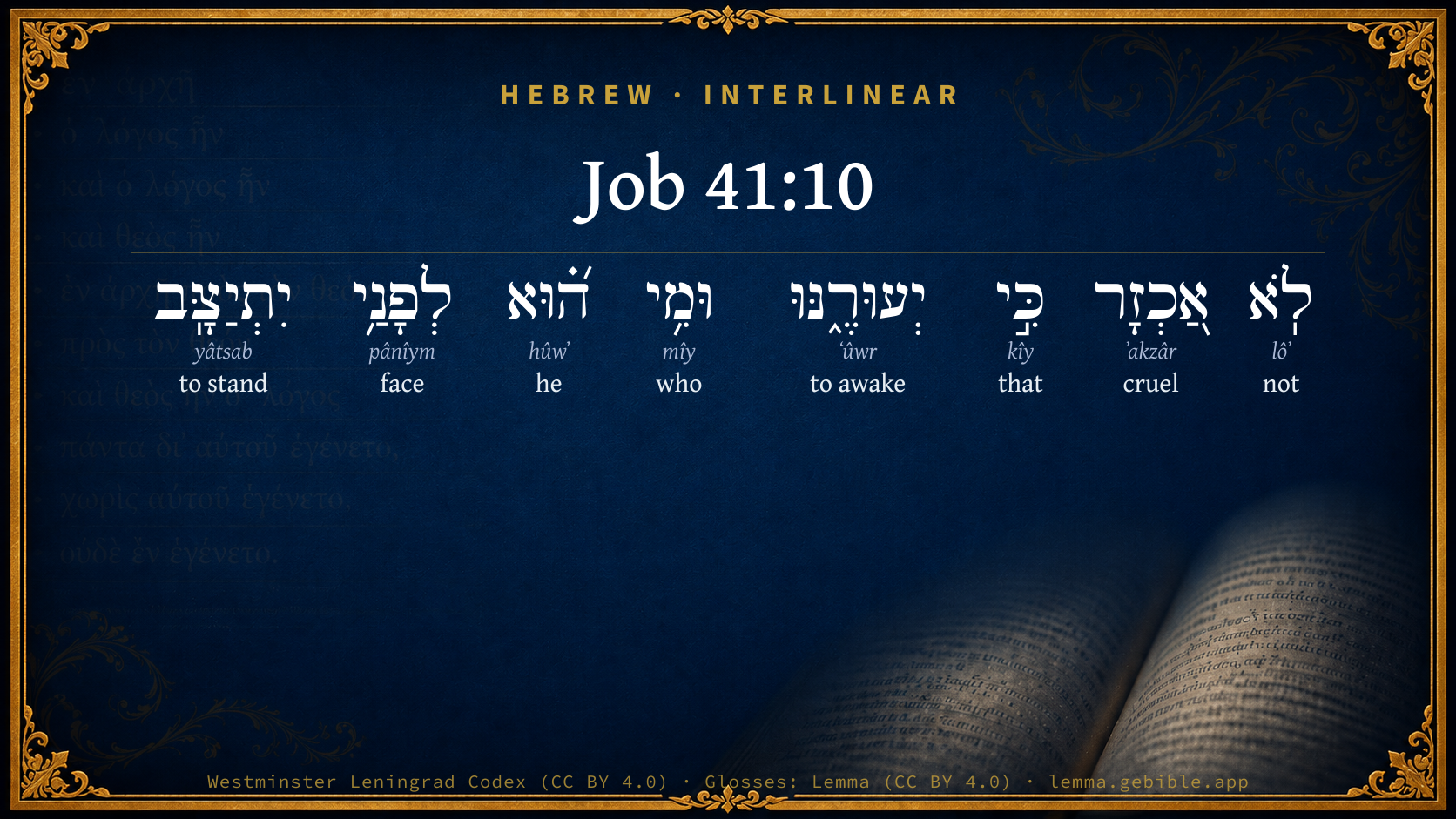
Hebrew (Westminster Leningrad Codex) Job 41:10 appears in the Hebrew Old Testament. The text above is from the Westminster Leningrad Codex. Each word links to its Strong’s number, a concise gloss, and parsing drawn from the Open Scriptures Hebrew Bible morphology. Click any word for its full Brown-Driver-Briggs (BDB) entry.
Download image
Cite this verse

Job 41:10 (World English Bible). Public Domain. Lemma interlinear Bible study tool, https://lemma.gebible.app/v/job/41/10.

Show BibTeX & RIS
BibTeX
RIS
English Translation
None is so fierce that he dare stir him up. Who then is he who can stand before me?
World English Bible · Public Domain
Download a study sheet

One document with this verse’s original text, its word-by-word gloss line, the meaning frame, cross-references with their text, attributed commentary, and full source and license credits — printable, and it pastes into notes with its structure intact.

This verse Autodidact and up

Study sheet (.html) Plain text (.txt)

A passage Seminary Student

Up to 50 verses in one chapter. A passage sheet keeps up to 6 commentary sources and 12 cross-references per verse, in the order this page ranks them, and says so on the sheet whenever that leaves anything out. Ask for a single verse and you get the Autodidact verse sheet above.

Everything on this page stays free to read, with no account — the sheet is a download of what is already on screen, not access to it.

Want to remove ads? Support Godless Engineer
Compare translations 3

The same verse in 3 English versions, stacked beneath the original-language interlinear above. Click any original word for its lexicon entry.

Each is an independent rendering of the whole verse — the interlinear is not word-aligned to these translations.

Highlighted words mark where these versions differ — a whole-verse word diff, not a word-by-word alignment.

  • World English Bible Public Domain
    None is so fierce that he dare stir him up. Who then is he who can stand before me?
  • King James Version Public Domain
    None is so fierce that dare stir him up: who then is able to stand before me?
  • unfoldingWord Literal Text CC BY-SA 4.0
    not fierce, that he will awaken it. Then who he will stand to my face?

unfoldingWord Literal Text — © unfoldingWord, licensed CC BY-SA 4.0. Word-aligned USFM3 via Door43 (git.door43.org/unfoldingWord/en_ult).

Versions to compare (up to 4)

3 of 4 selected

Show all 18 translations

Every available English version of this verse, each an independent rendering of the whole verse.

  • World English Bible Public Domain
    None is so fierce that he dare stir him up. Who then is he who can stand before me?
  • Berean Standard Bible Public Domain
    No one is so fierce as to rouse Leviathan. Then who is able to stand against Me?
  • Majority Standard Bible Public Domain
    No one is so fierce as to rouse Leviathan. Then who is able to stand against Me?
  • King James Version Public Domain
    None is so fierce that dare stir him up: who then is able to stand before me?
  • American Standard Version (1901) Public Domain
    None is so fierce that he dare stir him up; Who then is he that can stand before me?
  • Revised Version (1885) Public Domain
    None is so fierce that he dare stir him up: who then is he that can stand before me?
  • Geneva Bible (1599) Public Domain
    Out of his mouth go lampes, and sparkes of fire leape out.
  • Douay-Rheims (1899) Public Domain
    Out of his mouth go forth lamps, like torches of lighted fire.
  • Young's Literal Translation Public Domain
    None so fierce that he doth awake him, And who `is' he before Me stationeth himself?
  • Literal Standard Version CC BY-SA 4.0
    None so fierce that he awakes him, || And who [is] he [who] stations himself before Me?
  • Unlocked Literal Bible CC BY-SA 4.0
    None is so fierce that he dare stir Leviathan up; who, then, is he who can stand before me?
  • unfoldingWord Literal Text CC BY-SA 4.0
    not fierce, that he will awaken it. Then who he will stand to my face?
  • Darby Bible Public Domain
    None is so bold as to stir him up; and who is he that will stand before me?
  • World Messianic Bible Public Domain
    None is so fierce that he dare stir him up. Who then is he who can stand before me?
  • Webster's Bible Public Domain
    \\41:19\\Out of his mouth go burning lamps, and sparks of fire dart forth.
  • Free Bible Version CC BY-SA 4.0
    Since no one has the courage to provoke Leviathan, who would dare to stand up against me?
  • Bible in Basic English Public Domain
    Out of his mouth go burning lights, and flames of fire are jumping up.
  • JPS Tanakh (1917) Public Domain
    (41-2) None is so fierce that dare stir him up; who then is able to stand before Me?

Literal Standard Version (2020), Covenant Press — licensed CC BY-SA 4.0. Text via the HelloAO Bible API (eBible.org). Unlocked Literal Bible (unfoldingWord) — licensed CC BY-SA 4.0. Text via the HelloAO Bible API (eBible.org). unfoldingWord Literal Text — © unfoldingWord, licensed CC BY-SA 4.0. Word-aligned USFM3 via Door43 (git.door43.org/unfoldingWord/en_ult). Free Bible Version, Dr. Jonathan Gallagher — licensed CC BY-SA 4.0. Text via the HelloAO Bible API (eBible.org).

Word by word

More ways to search: Search by grammar → Find every occurrence → Compare this word →

Practice this passage: Drill this verse → Learn its vocabulary →

About this verse

These counts appear in no published source. They are computed here, from the morphology-tagged text and Lemma’s own curated glosses. What Lemma adds →

8
words
8
distinct lemmas
Wisdom
section

Notable vocabulary

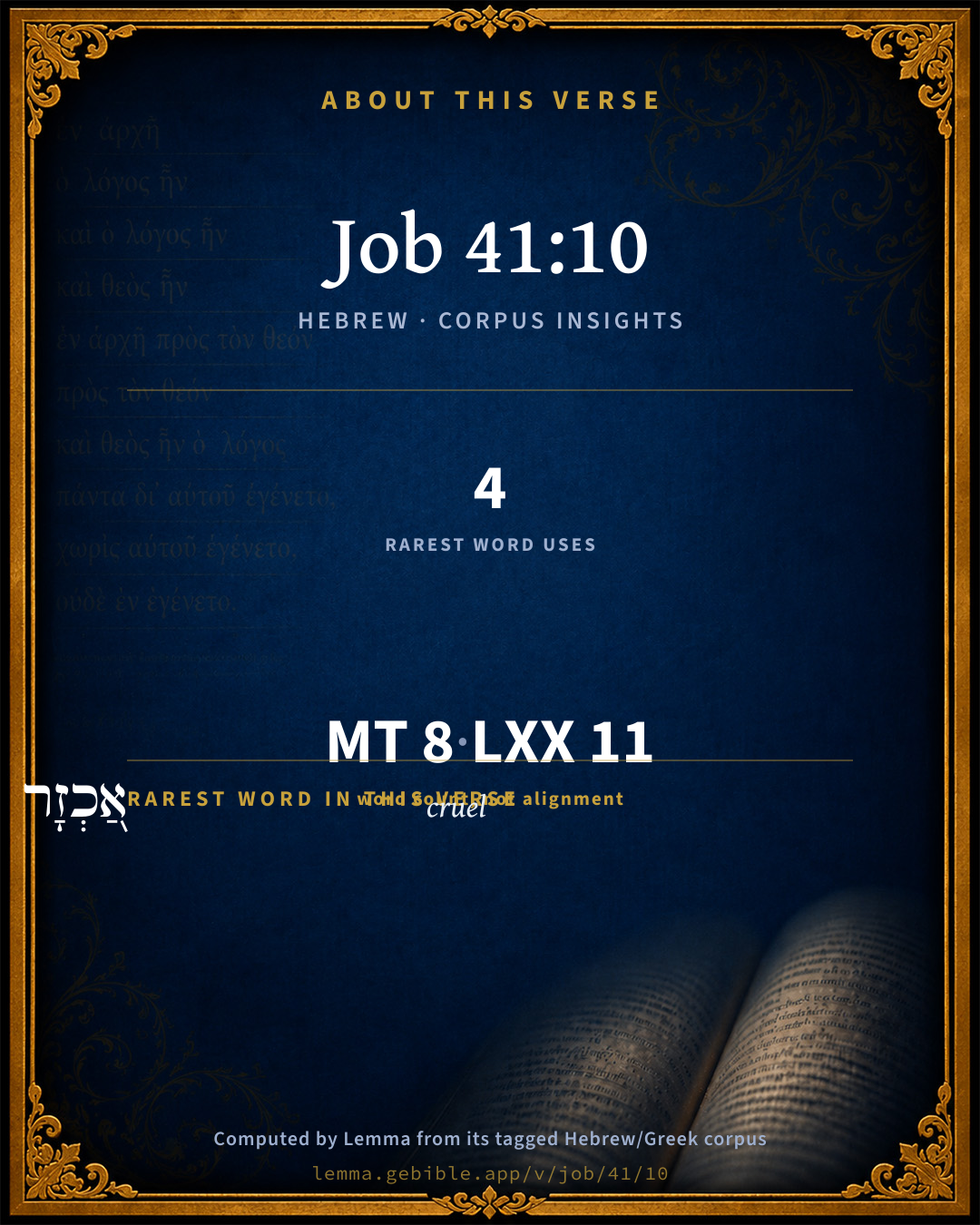
The rarest word here is אַ֭כְזָר cruel H393 — appearing just 4 times in the whole Hebrew Bible.

Shared distinctive vocabulary

אַ֭כְזָר cruel H393 occurs in 4 verses of the Hebrew Bible. Also found in:

Grammatical profile

  • 2 verbs
  • 1 noun
  • 1 adjective
  • 1 pronoun
  • 1 conjunction
  • 2 particles

Verb forms

  • יְעוּרֶ֑נּוּ Qal · Imperfect
  • יִתְיַצָּֽב Hithpael · Imperfect

Hebrew & Septuagint length

In English translation the verse runs 19 words from the Hebrew and 20 from the Septuagint (LXX English) — closely comparable.

A rough comparison of the two English renderings, which tokenize alike — not a word-level alignment.

Word counts can differ between the Hebrew and the Greek without any difference in meaning — e.g. the Hebrew direct-object marker אֵת has no separate Greek word, and Greek often adds the article ὁ.

In the original languages it is 8 Hebrew tokens and 11 Greek tokens — but the two are counted differently (Hebrew bundles its prefixes and suffixes into one token; the Greek is in lemma form), so that isn’t a like-for-like length.

Cross-references

9

Topical passages linked to Job 41:10 in the Treasury of Scripture Knowledge — connected by theme and wording, ordered by reader-vote popularity; previews shown in the World English Bible.

  • Job 9:4 God who is wise in heart, and mighty in strength: Who has hardened himself against him, and prospered?
  • Genesis 49:9 Judah is a lion's cub. From the prey, my son, you have gone up. He stooped down, he crouched as a lion, As a lioness. Who will rouse him up?
  • Numbers 24:9 He couched, he lay down as a lion, As a lioness; who shall rouse him up? Blessed be everyone who blesses you, Cursed be everyone who curses you.
  • Job 3:8 Let them curse it who curse the day, Who are ready to rouse up leviathan.
  • Job 40:9 Or have you an arm like God? Can you thunder with a voice like him?
  • Psalms 2:11–12 Serve Yahweh with fear, And rejoice with trembling.
  • Jeremiah 12:5 If you have run with the footmen, and they have wearied you, then how can you contend with horses? and though in a land of peace you are secure, yet how will you do in the pride of the Jordan?
  • 1 Corinthians 10:22 Or do we provoke the Lord to jealousy? Are we stronger than he?
  • Ezekiel 8:17–18 Then he said to me, Have you seen [this], son of man? Is it a light thing to the house of Judah that they commit the abominations which they commit here? for they have filled the land with violence, and have turned again to provoke me to anger: and, behold, they put the branch to their nose.

Cross-references courtesy of OpenBible.info (CC BY 4.0).

Hebrew and Greek witnesses Masoretic Hebrew ↔ Greek Septuagint

The same verse in the two great witnesses to the Old Testament, shown verse-for-verse.

These are two independent witnesses, not word-aligned to each other, and the Septuagint is shown in lemma (dictionary) form.

Hebrew Job 41:10 Masoretic · Westminster Leningrad Codex

לֹֽא אַ֭כְזָר כִּ֣י יְעוּרֶ֑נּוּ וּמִ֥י ה֝֗וּא לְפָנַ֥י יִתְיַצָּֽב

None is so fierce that he dare stir him up. Who then is he who can stand before me?

World English Bible · Public Domain

Greek LXX Job 41:10 Septuagint · lemma form

ἐν πταρμός αὐτός ἐπιφαύσκω φέγγος ὁ δέ ὀφθαλμός αὐτός εἶδος ἑωσφόρος

Out of his mouth proceed as it were burning lamps, and as it were hearths of fire are cast abroad.

LXX2012 (modern English Septuagint) · Public Domain

Hebrew: Westminster Leningrad Codex (CC BY 4.0). Greek: Septuagint (public domain); English from LXX2012 (modern English Septuagint) (Public Domain). How the Septuagint differs from the Hebrew →

Commentary

Notes on Job 41:10 from classic Christian and Jewish commentators (each source and its license shown beneath its notes). The classic Christian expositions comment on the surrounding passage and are grouped to its opening verse, so a note may address several verses; the Jewish commentaries on the Tanakh (Rashi and others) are per-verse, so they appear only where the commentator wrote on this verse.

Lemma curates 59 commentaries, every one of them public domain or Creative Commons licensed, each selected and text-cleaned for this edition rather than reprinted as found. About our sources →

Trapp's Complete Commentary

John Trapp

Job 41:10 None [is so] fierce that dare stir him up: who then is able to stand before me?

Ver. 10. None is so fierce that dare stir him up] Unless he be ambitious of his own destruction; cruel (so the word here signifieth) to his own life, which hereby he desperately casteth away. Aristotle telleth us that fishes do sleep: and perhaps these greater fishes take more sleep. Now who dare awake them sleeping, or encounter them waking, and rolling in the waters? None surely but a mad man.

Who then is able to stand before me?] Et est qui coram me stet? No more surely than a man before a whale, or a glass bottle before a cannon shot. Here then we have the accommodation and application of the former discourse, which we must not look upon as cunningly devised fables, 2Pe 1:6, or read as we do the old stories of foreign businesses, but as that wherein ourselves are nearly interested and concerned, that we may give God the glory of his power (as here, far beyond that of the whale or any other creature) and of his justice, as Job 41:11-12.

John Trapp, A Commentary or Exposition upon All the Books of the Old and New Testament (1647–1656) — public domain. Text from a community e-Sword module.

Keil & Delitzsch

C. F. Keil & F. Delitzsch

10 None is so foolhardy that he dare excite him!

And who is it who could stand before Me?

11 Who hath given Me anything first of all, that I must requite it?

Whatsoever is under the whole heaven is Mine.

One sees from these concluding inferences, thus applied, what is the design, in the connection of this second speech of Jehovah, of the reference to behmoth and leviathan, which somewhat abruptly began in Job 40:15. If even the strength of one of God's creatures admits no thought of being able to attack it, how much more should the greatness of the Creator deter man from all resistance! For no one has any claim on God, so that he should have the right of appearing before Him with a rude challenge. Every creature under heaven is God's; man, therefore, possesses nothing that was not God's property and gift, and he must humbly yield, whether God gives or takes away. לא, Job 41:10, is not directly equivalent to אין, but the clause is exclamatory. יעורנו Chethb, יעירנו Ker, is the Palestine reading, the reverse the Babylonian; the authorized text (chiefly without a Ker) is יעוּרנּוּ from עוּר in a transitive signification (ἐγείρειν), as שׁוּב, Job 39:12, comp. Job 42:10. The meaning of הקדּימני is determined according to ואשׁלּם: to anticipate, viz., by gifts presented as a person is approaching the giver (Arab. aqdama). הוּא, Job 41:11, is neutral, as Job 13:16; Job 15:9; Job 31:11, Job 31:28. תּחת is virtually a subj.: that which is under ... . After these apparently epiphonematic verses (2 and 3), one might now look for Job's answer. But the description of the leviathan is again taken up, and in fact hitherto it was only the invincibility of the animal that was spoken of; and yet it is not so described that this picture might form the exact pendent of the preceding.

Keil & Delitzsch — Biblical Commentary on the Old Testament (1861–1891) — public domain (CC PDM 1.0). Text via the HelloAO Bible API. (Old Testament only.)

Jamieson, Fausset & Brown

Robert Jamieson, A. R. Fausset & David Brown

fierce--courageous. If a man dare attack one of My creatures (Gen 49:9; Num 24:9), who will dare (as Job has wished) oppose himself (Psa 2:2) to Me, the Creator? This is the main drift of the description of leviathan.

Jamieson, Fausset & Brown — Commentary Critical and Explanatory on the Whole Bible (1871) — public domain (CC PDM 1.0). Text via the HelloAO Bible API.

Adam Clarke's Commentary

Verse 10. None is so fierce that dare stir him up] The most courageous of men dare not provoke the crocodile to fight, or even attempt to rouse him, when, sated with fish, he takes his repose among the reeds. The strongest of men cannot match him.

Who then is able] If thou canst not stand against the crocodile, one of the creatures of my hand, how canst thou resist me, who am his Maker? This is the use which God makes of the formidable description which he has thus far given of this terrible animal.

Adam Clarke's Commentary on the Bible (1810–1826) — public domain. Text from a community e-Sword/MySword module.

Ellicott's Commentary for English Readers

(10) None is so fierce that dare stir him up.—“If, therefore, the creatures of My hand strike so much terror, how far more terrible must I be? If thou canst not save thyself from them, how much less canst thou be saved without Me?” (See Job_40:14.) The first clause may be understood thus: “He is not so cruel (the common meaning of the word rendered fierce)—i.e., to himself—that he should venture to rouse him up.”

A Bible Commentary for English Readers, edited by Charles John Ellicott (1878–1897) — public domain. Text from a community e-Sword module.

The Cambridge Bible for Schools and Colleges

gen. ed. J. J. S. Perowne

10, 11. In these verses the speaker turns aside from describing the invincibility of Leviathan to impress the moral which he intends to teach by introducing the monster. If none dare stir up this creature, which God has made, who will stand before God who created him, or venture to contend with Him?

The Cambridge Bible for Schools and Colleges (gen. ed. J. J. S. Perowne; Cambridge University Press, 1878–1918) — public domain. Text from a community e-Sword module.

John Gill's Exposition

None is so fierce that dare stir him up,.... This seems best to agree with the crocodile, who frequently lies down and sleeps on the ground (q), and in the water by night (r); see Eze 29:3; when it is very dangerous to arouse him; and few, if any so daring, have courage enough to do it: though whales have been seen lying near shore asleep, and looked like rocks, even forty of them together (s);

who then is able to stand before me? This is the inference the Lord draws from hence, or the use he makes of it; that if this creature is so formidable and terrible, that it is dangerous to arouse and provoke him, and there is no standing before him or against him; then how should anyone be able to stand before the Lord, who made this creature, whenever he is angry? see Psa 76:7.

(q) Plin. l. 8. c. 25. Solin. c. 45. (r) Ammian. Marcellin. l. 22. (s) See the North-West Fox, p. 205.

John Gill's Exposition of the Whole Bible (1746–1763) — public domain (CC PDM 1.0). Text via the HelloAO Bible API.

Albert Barnes' Notes on the Bible

None is so fierce that dare stir him up - No one has courage to rouse and provoke him.

Who then is able to stand before me? - The meaning of this is plain. It is, “If one of my creatures is so formidable that man dare not attack it, how can he contend with the great Creator? This may perhaps be designed as a reproof of Job. He had expressed a desire to carry his cause before God, and to urge argument before him in vindication of himself. God here shows him how hopeless must be a contest with the Almighty. Man trembles and is disarmed of his courage by even the sight of one of the creatures of God. Overpowered with fear, he retires from the contemplated contest, and flees away. How then could he presume to contend with God? What hope could he have in a contest with him?

Albert Barnes' Notes on the Bible (1834–1885) — public domain. Text from a community e-Sword/MySword module.

Haydock's Catholic Bible Commentary

Fire, when they spout water, (Menochius) or pursue their prey open mouthed. This description is extremely poetical, like that of anger, 2 Kings xxii. 9. (Calmet)

George Leo Haydock (1774–1849), Haydock's Catholic Family Bible and Commentary, 1859 edition — public domain. Excludes Psalms (Douay-Rheims chapter numbering differs from Protestant) and Deuterocanonical books (Catholic canon only).

Matthew Poole's English Annotations

That dare stir him up, when he sleepeth or is quiet. None dare provoke him to the battle.

To stand before me; to contend with me his Creator, as thou, Job, dost, when one of my creatures is too hard for him.

Matthew Poole's English Annotations on the Holy Bible (1683–1685) — public domain. Text from a community e-Sword/MySword module.

Whedon's Commentary on the Bible

Daniel D. Whedon

10. Fierce — Zockler renders “foolhardy,” which is not to be preferred to the text, since the same word akzar, fierce, is in Job_30:21 applied by Job to God.

Dare stir him up — The same Hebrew word עור, “stir up,” is used in Job_3:8, of “raising up” leviathan, where it is implied that the only conceivable mode of dealing with him was by incantations — possibly spells of Satan, certainly by power supposed to be derived from the invisible world. See note on Job_3:8. The coincidence between the two passages should be noted, and is among many similar ones scattered through the Jehovistic section, which point to its integral oneness with the rest of the book. See Excursus VIII, page 281. In an inscription on a tablet at Karnak, Amun Ra thus addresses Thothmes III.: “I have made them behold thy majesty like unto a crocodile: he is the terrible master of the waters: no one ventures to approach him.”

Daniel D. Whedon (gen. ed.), Commentary on the Old and New Testaments (1874–1909) — public domain. Text from a community e-Sword module.

The Pulpit Commentary

None is so fierce that dare stir him up. The crocodile is often seen asleep, or nearly asleep, upon sand-banks washed by the Nile. He would be a bold man who should creep near, and stir him up. Who then is able to stand before me? Here we reach the point whereto the whole argument has been working up. If man cannot cope with creatures, which are the work of God"s hands, how much leas can he presume to cope with him who is their Maker!

The Pulpit Commentary (1880–1919), ed. H.D.M. Spence-Jones & Joseph S. Exell — public domain. Text from a community e-Sword module.

John Wesley's Explanatory Notes

Stand - To the battle. Me - To contend with me who created him?

John Wesley, Explanatory Notes Upon the Whole Bible (1754–1765) — public domain. Text via the GEBible commentary corpus.

unfoldingWord translationNotes

Door43 World Missions Community

Connecting Statement:

Yahweh continues to rebuke Job by asking him rhetorical questions. He uses rhetorical questions to remind Job that Yahweh is much more powerful than both Leviathan and Job.

None is so fierce that he dare stir Leviathan up; who, then, is he who can stand before me?

It would be easier to stir up Leviathan than to stand before Yahweh. This question can be translated as a statement. AT: "Since you know that no person is so fierce that he dare stir Leviathan up, you should certainly know that no one can stand before me." (See: Rhetorical Question)

Who has first given anything to me in order that I should repay him?

This question can be translated as a statement. AT: "You know that no one has first given anything to me, so there is no one whom I need to repay." (See: Rhetorical Question)

he ... him

The words "he" and "him" refer to a person.

I will not keep silent concerning ... nor about ... nor about

This can be translated in positive form. AT: "I will certainly speak about ... and about ... and about" (See: Litotes)

concerning Leviathan's legs, nor about the matter of his strength, nor about his graceful form

These are three things about which God will not keep silent.

his

The word "his" refers to Leviathan.

translationWords

heaven

grace

unfoldingWord translationNotes — © Distant Shores Media and the Door43 World Missions Community, licensed CC BY-SA 4.0. Source: git.door43.org/Door43/en_tn.

Rashi

Rabbi Shlomo Yitzchaki (Rashi)

His sneezes flash forth light With every sneeze that he sneezes, light flashes forth and shines.

flash forth as in (above 29:3), “when He lit (בהלו) His candle.”

and his eyes are like the rays of dawn His eyes shine and illuminate like the redness of the sun, like the time of morning when the sun becomes red.

Rashi on the Tanakh — English translations: “The Judaica Press complete Tanach with Rashi, translated by A. J. Rosenberg” (CC BY 4.0); “Pentateuch with Rashi's commentary by M. Rosenbaum and A.M. Silbermann, 1929-1934” (public domain); “The Metsudah Tanach series, Lakewood, N.J” (CC BY 4.0); and “The Book of Joshua, Metsudah Publications, 1997” (CC BY 4.0). Text via Sefaria.

Lesson kit

Teaching starters — assembled from the data on this page, not authored interpretation. Every prompt links to the verse data it draws on. Edit before teaching.

Job, in the Wisdom, opens this verse with 8 words (8 distinct Hebrew lemmas). Its most distinctive word is ʼakzâr (“cruel”). A historical commentator’s framing appears above. Read the whole chapter for the surrounding context.

Discussion questions

  1. How does “cruel” (ʼakzâr) shape what this verse is saying?
  2. How does Deuteronomy 32:33, which shares the word «cruel», read alongside this verse?
  3. These translations render this verse differently. What is at stake in choosing one wording over another?
  4. «יְעוּרֶ֑נּוּ» is a Qal Imperfect verb. How does that grammatical form shape the action described?
  5. Compare how Trapp's Complete Commentary and Keil & Delitzsch read this verse. Where do they agree or differ?

Things to notice

Reading settings

Reading text

Shown beneath each verse's original-language words.

Old Testament
Old Testament edition

Read the OT as the Masoretic Hebrew (MT) or the Greek Septuagint (LXX).

English shown for the Greek Septuagint (in the Hebrew ↔ Greek comparison).

Comparing translations? Open the Compare panel on any verse page to stack up to four side by side.