Jeremiah 6:22

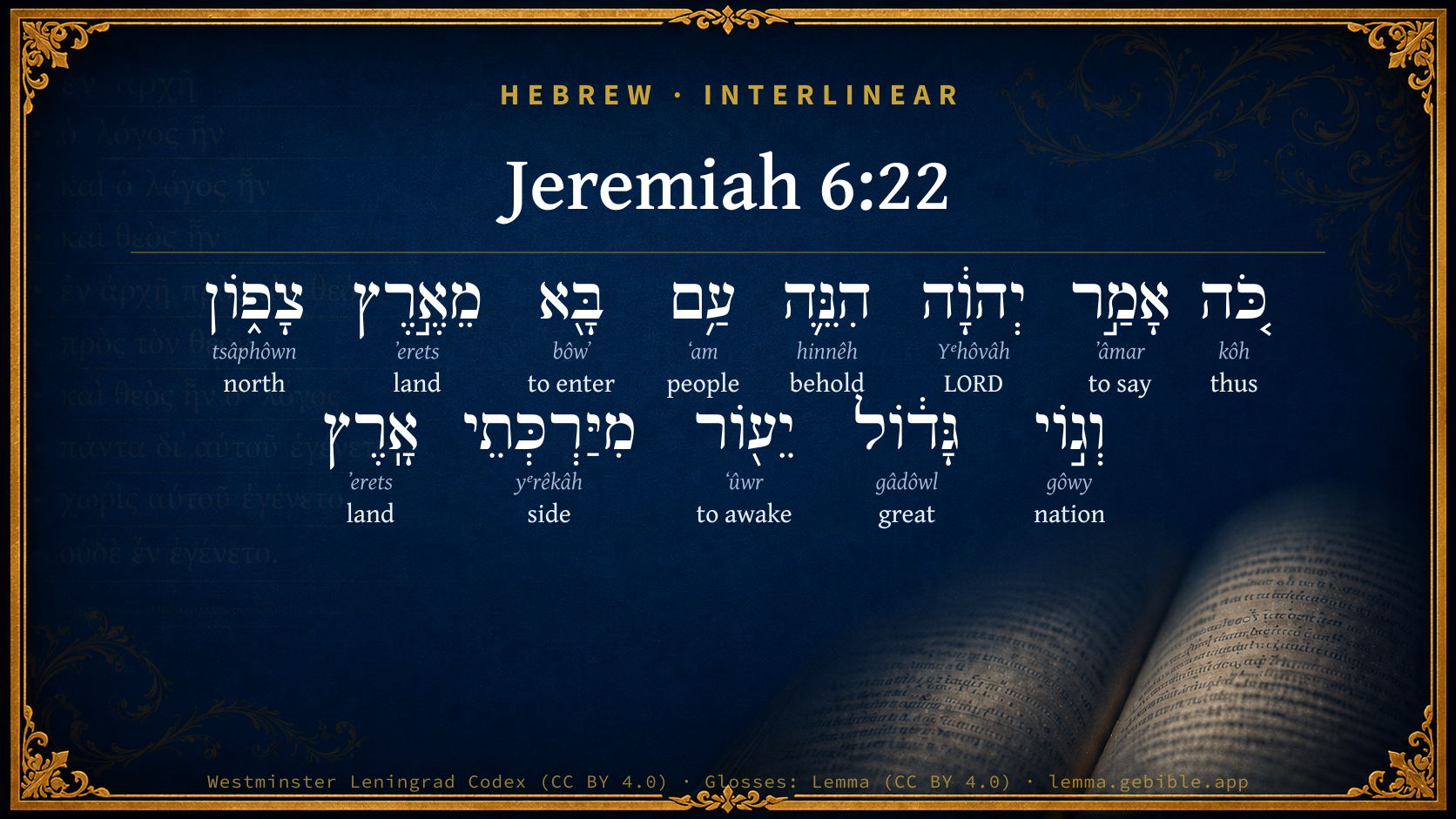
Hebrew (Westminster Leningrad Codex) Jeremiah 6:22 appears in the Hebrew Old Testament. The text above is from the Westminster Leningrad Codex. Each word links to its Strong’s number, a concise gloss, and parsing drawn from the Open Scriptures Hebrew Bible morphology. Click any word for its full Brown-Driver-Briggs (BDB) entry.
Download image
Cite this verse

Jeremiah 6:22 (World English Bible). Public Domain. Lemma interlinear Bible study tool, https://lemma.gebible.app/v/jeremiah/6/22.

Show BibTeX & RIS
BibTeX
RIS
English Translation
Thus says Yahweh, Behold, a people comes from the north country; and a great nation shall be stirred up from the uttermost parts of the earth.
World English Bible · Public Domain
Download a study sheet

One document with this verse’s original text, its word-by-word gloss line, the meaning frame, cross-references with their text, attributed commentary, and full source and license credits — printable, and it pastes into notes with its structure intact.

This verse Autodidact and up

Study sheet (.html) Plain text (.txt)

A passage Seminary Student

Up to 50 verses in one chapter. A passage sheet keeps up to 6 commentary sources and 12 cross-references per verse, in the order this page ranks them, and says so on the sheet whenever that leaves anything out. Ask for a single verse and you get the Autodidact verse sheet above.

Everything on this page stays free to read, with no account — the sheet is a download of what is already on screen, not access to it.

Want to remove ads? Support Godless Engineer
Compare translations 3

The same verse in 3 English versions, stacked beneath the original-language interlinear above. Click any original word for its lexicon entry.

Each is an independent rendering of the whole verse — the interlinear is not word-aligned to these translations.

Highlighted words mark where these versions differ — a whole-verse word diff, not a word-by-word alignment.

  • World English Bible Public Domain
    Thus says Yahweh, Behold, a people comes from the north country; and a great nation shall be stirred up from the uttermost parts of the earth.
  • King James Version Public Domain
    Thus saith the LORD, Behold, a people cometh from the north country, and a great nation shall be raised from the sides of the earth.
  • unfoldingWord Literal Text CC BY-SA 4.0
    Thus says Yahweh, ‘Behold, a people is coming from the land of the north, and a great nation is being woken up from the farthest parts of the earth.

unfoldingWord Literal Text — © unfoldingWord, licensed CC BY-SA 4.0. Word-aligned USFM3 via Door43 (git.door43.org/unfoldingWord/en_ult).

Versions to compare (up to 4)

3 of 4 selected

Show all 18 translations

Every available English version of this verse, each an independent rendering of the whole verse.

  • World English Bible Public Domain
    Thus says Yahweh, Behold, a people comes from the north country; and a great nation shall be stirred up from the uttermost parts of the earth.
  • Berean Standard Bible Public Domain
    This is what the LORD says: “Behold, an army is coming from the land of the north; a great nation is stirred up from the ends of the earth.
  • Majority Standard Bible Public Domain
    This is what the LORD says: “Behold, an army is coming from the land of the north; a great nation is stirred up from the ends of the earth.
  • King James Version Public Domain
    Thus saith the LORD, Behold, a people cometh from the north country, and a great nation shall be raised from the sides of the earth.
  • American Standard Version (1901) Public Domain
    Thus saith Jehovah, Behold, a people cometh from the north country; and a great nation shall be stirred up from the uttermost parts of the earth.
  • Revised Version (1885) Public Domain
    Thus saith the LORD, Behold, a people cometh from the north country; and a great nation shall be stirred up from the uttermost parts of the earth.
  • Geneva Bible (1599) Public Domain
    Thus sayeth the Lord, Beholde, a people commeth from the North countrey, and a great nation shall arise from the sides of the earth.
  • Douay-Rheims (1899) Public Domain
    Thus saith the Lord: Behold a people cometh from the land of the north, and a great nation shall rise up from the ends of the earth.
  • Young's Literal Translation Public Domain
    Thus said Jehovah: Lo, a people hath come from a north country, And a great nation is stirred up from the sides of the earth.
  • Literal Standard Version CC BY-SA 4.0
    Thus said YHWH: “Behold, a people has come from a north country, || And a great nation is stirred up from the sides of the earth.
  • Unlocked Literal Bible CC BY-SA 4.0
    Yahweh says this, 'See, a people is coming from the land of the north, a great nation is being stirred up from the farthest parts of the earth.
  • unfoldingWord Literal Text CC BY-SA 4.0
    Thus says Yahweh, ‘Behold, a people is coming from the land of the north, and a great nation is being woken up from the farthest parts of the earth.
  • Darby Bible Public Domain
    Thus saith Jehovah: Behold, a people cometh from the north country, and a great nation is stirred up from the uttermost parts of the earth.
  • World Messianic Bible Public Domain
    The LORD says, “Behold, a people comes from the north country. A great nation will be stirred up from the uttermost parts of the earth.
  • Webster's Bible Public Domain
    Thus saith the LORD, Behold, a people cometh from the north country, and a great nation shall be raised from the sides of the earth.
  • Free Bible Version CC BY-SA 4.0
    This is what the Lord says: Look! An army is invading from the north; a powerful nation is getting ready to attack all the way from the ends of the earth.
  • Bible in Basic English Public Domain
    The Lord has said, See, a people is coming from the north country, a great nation will be put in motion from the inmost parts of the earth.
  • JPS Tanakh (1917) Public Domain
    Thus saith the LORD: Behold, a people cometh from the north country, and a great nation shall be roused from the uttermost parts of the earth.

Literal Standard Version (2020), Covenant Press — licensed CC BY-SA 4.0. Text via the HelloAO Bible API (eBible.org). Unlocked Literal Bible (unfoldingWord) — licensed CC BY-SA 4.0. Text via the HelloAO Bible API (eBible.org). unfoldingWord Literal Text — © unfoldingWord, licensed CC BY-SA 4.0. Word-aligned USFM3 via Door43 (git.door43.org/unfoldingWord/en_ult). Free Bible Version, Dr. Jonathan Gallagher — licensed CC BY-SA 4.0. Text via the HelloAO Bible API (eBible.org).

Word by word

More ways to search: Search by grammar → Find every occurrence → Compare this word →

Practice this passage: Drill this verse → Learn its vocabulary →

מִיַּרְכְּתֵי
yᵉrêkâh
H3411
“from · sides of”
Preposition + Noun, Common, Feminine, Dual, Construct
Part of Speech
Preposition + Noun
Type
Common
Gender
Feminine
Number
Dual
State
Construct
Full BDB Definition

Origin: from H3409

TWOT: 916b

flank, side, extreme parts, recesses - side - sides, recesses (dual)
  1. כֹּ֚ה kôh H3541 “thus” Adverb
  2. אָמַ֣ר ʼâmar H559 “to say” Verb, Qal, Perfect, 3rd Person, Masculine, Singular
  3. יְהוָ֔ה Yᵉhôvâh H3068 “LORD” Noun, Proper
  4. הִנֵּ֛ה hinnêh H2009 “behold” Particle, Demonstrative
  5. עַ֥ם ʻam H5971 “people” Noun, Common, Masculine, Singular, Absolute
  6. בָּ֖א bôwʼ H935 “to enter” Verb, Qal, Perfect, 3rd Person, Masculine, Singular
  7. מֵאֶ֣רֶץ ʼerets H776 “from · land of” Preposition + Noun, Common, Both, Singular, Construct
  8. צָפ֑וֹן tsâphôwn H6828 “north” Noun, Common, Feminine, Singular, Absolute
  9. וְג֣וֹי gôwy H1471 “and · nation” Conjunction + Noun, Common, Masculine, Singular, Absolute
  10. גָּד֔וֹל gâdôwl H1419 “great” Adjective, Adjective, Masculine, Singular, Absolute
  11. יֵע֖וֹר ʻûwr H5782 “to awake” Verb, Niphal, Imperfect, 3rd Person, Masculine, Singular
  12. אָֽרֶץ ʼerets H776 “land” Noun, Common, Both, Singular, Absolute

About this verse

These counts appear in no published source. They are computed here, from the morphology-tagged text and Lemma’s own curated glosses. What Lemma adds →

13
words
12
distinct lemmas
Prophets
section

Shared distinctive vocabulary

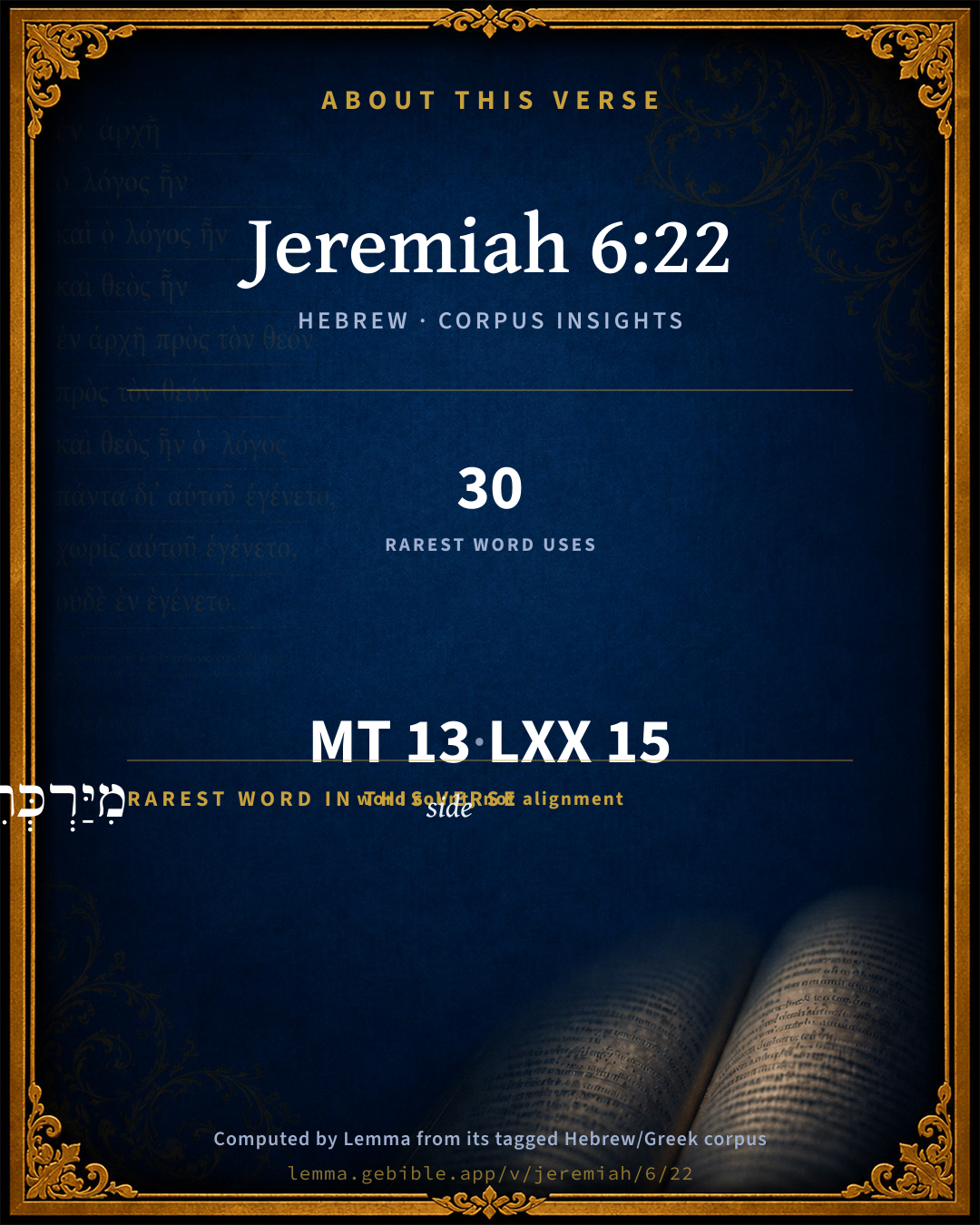
מִיַּרְכְּתֵי side H3411 occurs in 28 verses of the Hebrew Bible. Also found in:

Grammatical profile

  • 3 verbs
  • 7 nouns
  • 1 adjective
  • 1 adverb
  • 1 particle

Verb forms

  • אָמַ֣ר Qal · Perfect
  • בָּ֖א Qal · Perfect
  • יֵע֖וֹר Niphal · Imperfect

Repetition

A word recurs within this verse — often emphatic in Hebrew:

  • מֵאֶ֣רֶץ land H776 ×2

Hebrew & Septuagint length

In the original languages it is 13 Hebrew tokens and 15 Greek tokens — but the two are counted differently (Hebrew bundles its prefixes and suffixes into one token; the Greek is in lemma form), so that isn’t a like-for-like length.

Cross-references

6

Topical passages linked to Jeremiah 6:22 in the Treasury of Scripture Knowledge — connected by theme and wording, ordered by reader-vote popularity; previews shown in the World English Bible.

  • Jeremiah 10:22 The voice of news, behold, it comes, and a great commotion out of the north country, to make the cities of Judah a desolation, a dwelling-place of jackals.
  • Jeremiah 50:41–43 Behold, a people comes from the north; and a great nation and many kings shall be stirred up from the uttermost parts of the earth.
  • Jeremiah 1:14–15 Then Yahweh said to me, Out of the north evil shall break forth on all the inhabitants of the land.
  • Jeremiah 5:15 Behold, I will bring a nation on you from far, house of Israel, says Yahweh: it is a mighty nation, it is an ancient nation, a nation whose language you don't know, neither understand what they say.
  • Jeremiah 6:1 Flee for safety, you children of Benjamin, out of the midst of Jerusalem, and blow the trumpet in Tekoa, and raise up a signal on Beth Haccherem; for evil looks forth from the north, and a great destruction.
  • Jeremiah 25:9 behold, I will send and take all the families of the north, says Yahweh, and [I will send] to Nebuchadrezzar the king of Babylon, my servant, and will bring them against this land, and against the inhabitants of it, and against all these nations round about; and I will utterly destroy them, and make them an astonishment, and a hissing, and perpetual desolations.

Cross-references courtesy of OpenBible.info (CC BY 4.0).

Hebrew and Greek witnesses Masoretic Hebrew ↔ Greek Septuagint

The same verse in the two great witnesses to the Old Testament, shown verse-for-verse.

These are two independent witnesses, not word-aligned to each other, and the Septuagint is shown in lemma (dictionary) form.

Hebrew Jeremiah 6:22 Masoretic · Westminster Leningrad Codex

כֹּ֚ה אָמַ֣ר יְהוָ֔ה הִנֵּ֛ה עַ֥ם בָּ֖א מֵאֶ֣רֶץ צָפ֑וֹן וְג֣וֹי גָּד֔וֹל יֵע֖וֹר מִיַּרְכְּתֵי אָֽרֶץ

Thus says Yahweh, Behold, a people comes from the north country; and a great nation shall be stirred up from the uttermost parts of the earth.

World English Bible · Public Domain

Greek LXX Structure differs

In the Septuagint, Jeremiah is about an eighth shorter than the Hebrew and arranges its material differently — the Oracles Against the Nations (Hebrew chapters 46–51) appear in the middle of the Greek book, after 25:13. Because the chapter and verse boundaries do not line up, a verse-for-verse comparison with the Hebrew is not shown.

A verse-for-verse comparison isn’t shown here because the chapters and verses don’t line up. Switch to the LXX edition with the MT / LXX toggle above to read the Greek directly.

Hebrew: Westminster Leningrad Codex (CC BY 4.0). Greek: Septuagint (public domain); English from a public-domain English Septuagint. How the Septuagint differs from the Hebrew →

Targum (Aramaic paraphrase)

1

The Targum is the ancient Jewish Aramaic paraphrase of the Hebrew Scriptures — an interpretive translation, not the Hebrew text itself. Onkelos (literal) and Pseudo-Jonathan (expansive) render the Torah, and Jonathan the Prophets. Coverage is partial: where no permissively-licensed English translation exists for a verse, only the Aramaic is shown. This is verse-level text, not a word-by-word alignment to the Hebrew.

  1. Targum Jonathan Prophets (Joshua–Malachi)
    כִּדְנַן אֲמַר יְיָ הָא עַמָא אָתֵי מִצִפּוּנָא וְעַמְמִין רַבְרְבִין יֵיתוּן בִּגְלֵי מִסְיָפֵי אַרְעָא:

    (no public-domain English translation for this verse)

    Targum Jonathan — Aramaic: “Mikraot Gedolot” (public domain). English: “Sefaria Community Translation” (CC0 1.0 (public-domain dedication)); “London "Chaldee Paraphrase," 1871” (public domain). Text via Sefaria.

Commentary

Notes on Jeremiah 6:22 from classic Christian and Jewish commentators (each source and its license shown beneath its notes). The classic Christian expositions comment on the surrounding passage and are grouped to its opening verse, so a note may address several verses; the Jewish commentaries on the Tanakh (Rashi and others) are per-verse, so they appear only where the commentator wrote on this verse.

Lemma curates 59 commentaries, every one of them public domain or Creative Commons licensed, each selected and text-cleaned for this edition rather than reprinted as found. About our sources →

Trapp's Complete Commentary

John Trapp

Jer 6:22 Thus saith the LORD, Behold, a people cometh from the north country, and a great nation shall be raised from the sides of the earth.

Ver. 22. Thus saith the Lord.] It is not in vain that this is so oft prefaced to the ensuing prophecies. Dictum Iehovae The word the Lord is very emphatic and authoritative.

Behold, a people cometh from the north.] This the prophet had oft foretold for forty years together; sed surdis fabulam, but he could not be believed.

John Trapp, A Commentary or Exposition upon All the Books of the Old and New Testament (1647–1656) — public domain. Text from a community e-Sword module.

Whedon's Commentary on the Bible

Daniel D. Whedon

GREATNESS OF THE CALAMITY, Jer_6:22-30.

22. The north country — Babylonia.

Sides of the earth — Rather, ends; most distant regions. As the enemy comes from these, so the captivity will be to these. (Jer_31:8.)

Daniel D. Whedon (gen. ed.), Commentary on the Old and New Testaments (1874–1909) — public domain. Text from a community e-Sword module.

Keil & Delitzsch

C. F. Keil & F. Delitzsch

A distant, cruel people will execute the judgment, since Judah, under the trial, has proved to be worthless metal. - Jer 6:22. "Thus hath Jahveh said: Behold, a people cometh from the land of the north, and a great nation raises itself from the furthermost sides of the earth. Jer 6:23. Bows and javelins they bear; cruel it is, and they have no mercy; their voice roareth like the sea; and on horses they ride, equipped as a man for the war against thee, daughter of Zion. Jer 6:24. We heard the rumour thereof: weak are our hands: anguish hath taken hold of us, and pain, as of a woman in travail. Jer 6:25. Go not forth into the field, and in the way walk not; for a sword hath the enemy, fear is all around. Jer 6:26. O daughter of my people, gird thee with sackcloth, and besprinkle thee with ashes; make mourning for an only son, butter lamentation: for suddenly shall the spoiler come upon us. Jer 6:27. For a trier have I set thee among my people as a strong tower, that thou mightest know and try their way. Jer 6:28. They are all revolters of revolters; go about as slanderers; brass and iron; they are all dealing corruptingly. Jer 6:29. Burned are the bellows by the fire, at an end is the lead; in vain they melt and melt; and wicked ones are not separated. Jer 6:30. Rejected silver they call them, for Jahveh hath rejected them."

In Jer 6:22 the stumbling-blocks of Jer 6:21 are explained. At the end of this discourse yet again the invasion of the enemy from the far north is announced, cf. Jer 4:13 and Jer 5:15, and its terribleness is portrayed with new colours. The farther the land is from which the enemy comes, the more strange and terrible he appears to the imagination. The farthest (hindmost) sides of the earth (cf. Jer 25:32) is only a heightening of the idea: land of the north, or of the far distance (Jer 5:15); in other words, the far uttermost north (cf. Isa 14:13). In this notice of their home, Hitz. finds a proof that the enemies were the Scythians, not the Chaldeans; since, acc. to Eze 38:6, Eze 38:15, and Eze 39:2, Gog, i.e., The Scythians, come "from the sides of the north." But "sides of the earth" is not a geographical term for any particular northern country, but only for very remote lands; and that the Chaldeans were reckoned as falling within this term, is shown by the passage Jer 31:8, according to which Israel is to be gathered again from the land of the north and from the sides of the earth. Here any connection with Scythia in "sides of the earth" is not to be thought of, since prophecy knows nothing of a captivity of Israel in Scythia, but regards Assur and Babylon alone as the lands of the exile of Israelites and Jews. As weapons of the enemy then are mentioned bows (cf. Jer 4:29; Jer 5:16), and the javelin or lance (כּידון, not shield; see on Sa1 17:6). It is cruel, knows no pity, and is so numerous and powerful, that its voice, i.e., the tumult of its approach, is like the roaring of the sea; cf. Isa 5:30; Isa 17:12. On horses they ride; cf. Jer 4:13; Jer 8:16; Hab 1:8. ערוּך in the singular, answering to "cruel it is," points back to גּוי or כּאישׁ . is not for כּאישׁ אחד (Ros.), but for כּאישׁ מלחמה, cf. Sa1 17:33; Isa 42:13; and the genitive is omitted only because of the למלחמה coming immediately after (Graf). "Against thee" is dependent on ערוּך: equipped as a warrior is equipped for the war, against the daughter of Zion. In Jer 6:24-26 are set forth the terrors and the suspense which the appearance of the foe will spread abroad. In Jer 6:24 the prophet, as a member of the people, gives utterance to its feelings. As to the sense, the clauses are to be connected thus: As soon as we hear the rumour of the people, i.e., of its approach, our hands become feeble through dread, all power to resist vanishes: cf. Isa 13:7; and for the metaphor of travail, Isa 13:8; Mic 4:9, etc. In v. 28 the inhabitants of Jerusalem, personified as the daughter of Zion, are warned not to go forth of the city into the field or about the country, lest they fall into the enemies' hands and be put to death. מגור מסּביב, often used by Jeremiah, cf. Jer 20:3, Jer 20:10; Jer 46:5; Jer 49:29, and, as Jer 20:10 shows, taken from Psa 31:14. Fear or terrors around, i.e., on all sides danger and destruction threaten.

Keil & Delitzsch — Biblical Commentary on the Old Testament (1861–1891) — public domain (CC PDM 1.0). Text via the HelloAO Bible API. (Old Testament only.)

Tyndale Open Study Notes

Tyndale Open Resources

6:22-30 This dialogue between Jeremiah and the Lord probably took place at the beginning of the Babylonian invasion in 605 BC. In these three poems, Jeremiah declares the Lord’s message (6:22-23), identifies with his people’s fear, and urges them to repent quickly (6:24-26). He then receives a heart-to-heart message from the Lord (6:27-30).

6:22-23 The Lord reminded the people that the impending invasion was not fictitious; the soldiers had real bows and spears (Isa 13:18). • sound like a roaring sea: The sound of tens of thousands of soldiers with cavalry and chariots must have been terrifying (Isa 5:27-30).

Tyndale Open Study Notes — © Tyndale Open Resources, licensed CC BY-SA 4.0. Text via the HelloAO Bible API.

Geneva Bible (1599)

Geneva Bible translators

From Babylon by Dan, which was North from Jerusalem.

Geneva Bible (1599) marginal notes — public domain. Text via Bolls.life.

Jamieson, Fausset & Brown

Robert Jamieson, A. R. Fausset & David Brown

north . . . sides of the earth--The ancients were little acquainted with the north; therefore it is called the remotest regions (as the Hebrew for "sides" ought to be translated, see on Isa 14:13) of the earth. The Chaldees are meant (Jer 1:15; Jer 5:15). It is striking that the very same calamities which the Chaldeans had inflicted on Zion are threatened as the retribution to be dealt in turn to themselves by Jehovah (Jer 50:41-43).

Jamieson, Fausset & Brown — Commentary Critical and Explanatory on the Whole Bible (1871) — public domain (CC PDM 1.0). Text via the HelloAO Bible API.

John Calvin's Commentaries

It was no useless repetition when the Prophet said so often that God said. He might have said only, “Behold, a nation shall come from the north;” but he premises by saying that he derived this message from God, and not only so, but he introduces God as the speaker, that his message might be more impressive. In the former verse he had also said, Thus saith Jehovah, and elsewhere: but he now repeats the same words, that the holy name of God might more powerfully rouse their minds.

Behold, he says, a people shall come from the land of the north For forty years Jeremiah ceased not to proclaim war against the Jews, and also openly to name their enemies: we yet see that so much preaching was without fruit. This was dreadful indeed: but we may thus see, as it were in a mirror, how great is our hardness and stupor, and how great is our fury and madness against God. He then designates here the Chaldeans as a northern nation, and says that it was a great nation: and yet he shews, that the Chaldeans would not of themselves come; it shall be roused, he says. This act is to be applied to God; for though ambition and avarice impelled the Chaldeans to lay waste nations and lands far and wide, yet that war was carried on under the guidance of God himself: he armed and impelled the Chaldeans, and used them as the scourges of his wrath. We may learn this from the verb יעור, iour, “shall be roused;” and he says, from the sides of the earth, for they came from a distant country. But the Prophet means, that there would be nothing to hinder the Chaldeans from entering Judea, and from destroying and putting to flight the people, and from demolishing the city and the temple.

John Calvin's Commentaries (1540-1563) — public domain. Text from the Calvin Translation Society English edition (1840s-50s) via the Christian Classics Ethereal Library (ccel.org). Calvin's coverage is partial (roughly two-thirds of the Bible); uncommented books and verses are honest gaps, never fabricated. The 19th-century editor's footnotes and remarks are omitted so the notes are faithfully Calvin's own voice.

Ellicott's Commentary for English Readers

(22) From the north country . . .—The words point, as in Jer_1:13-15, to the Chaldæan, perhaps, also, to the Scythian, invasion. So the “north quarters” are used in Eze_38:6; Eze_38:15; Eze_39:2 of the home of Gog as the representative of the Scythian tribes.

Shall be raised.—Literally, shall be roused, or awakened.

The sides of the earth.—sc., its ends, or far-off regions.

A Bible Commentary for English Readers, edited by Charles John Ellicott (1878–1897) — public domain. Text from a community e-Sword module.

The Cambridge Bible for Schools and Colleges

gen. ed. J. J. S. Perowne

22. from the north country] The reference, originally at any rate, was to the Scythians. See on Jer_1:14.

22–30. The last of the four divisions. See introd. note to the ch.

The Cambridge Bible for Schools and Colleges (gen. ed. J. J. S. Perowne; Cambridge University Press, 1878–1918) — public domain. Text from a community e-Sword module.

John Gill's Exposition

Thus saith the Lord, behold, a people cometh from the north country,.... The Assyrians from Babylon, which lay north of Judea, as in Jer 1:14,

and a great nation shall be raised; that is, by the Lord, who would stir them up to this undertaking. The Targum is,

"many people shall come openly:''

from the sides of the earth; afar off, as Babylon was, Jer 5:15.

John Gill's Exposition of the Whole Bible (1746–1763) — public domain (CC PDM 1.0). Text via the HelloAO Bible API.

Albert Barnes' Notes on the Bible

Raised - Or, awakened, to undertake distant expeditions.

The sides of the earth - Or ends, the most distant regions (see Jer 25:32).

Albert Barnes' Notes on the Bible (1834–1885) — public domain. Text from a community e-Sword/MySword module.

Haydock's Catholic Bible Commentary

North. As Babylon lay with respect to Jerusalem, (Worthington) or rather to the east. (Haydock)

George Leo Haydock (1774–1849), Haydock's Catholic Family Bible and Commentary, 1859 edition — public domain. Excludes Psalms (Douay-Rheims chapter numbering differs from Protestant) and Deuterocanonical books (Catholic canon only).

Matthew Poole's English Annotations

Now the prophet is showing what these destructive stumbling-blocks shall be, of which he had prophesied forty years already, and yet they would not be warned. The north country: see Jer 6:1.

A great nation shall be raised; God shall stir up the Chaldeans like a great storm or tempest, Jer 1:15; 25:32. See Eze 23:22.

From the sides of the earth; the remote and uttermost parts of the Babylonian territories, though at the greatest distance, yet God will bring them: which may note the greatness of God’s displeasure against Judah, this circumstance being noted among the curses, Deu 28:49. See Isa 5:25,26, &c.; Jer 5:15.

Matthew Poole's English Annotations on the Holy Bible (1683–1685) — public domain. Text from a community e-Sword/MySword module.

The Pulpit Commentary

Vers. 22-30. The enemy described; the terror consequent on his arrival; a rumored declaration of the moral cause of the judgment.

From the north country. (so Jer_1:14 (see note) Jer_4:6) Shall be raised; rather, shall be aroused. The sides of the earth; rather, "the recesses (i.e. furthest parts) of the earth". (so Isa_14:13)

The Pulpit Commentary (1880–1919), ed. H.D.M. Spence-Jones & Joseph S. Exell — public domain. Text from a community e-Sword module.

John Wesley's Explanatory Notes

Behold - God shall stir up the Chaldeans like a great storm. The sides - The uttermost parts of the Babylonian territories.

John Wesley, Explanatory Notes Upon the Whole Bible (1754–1765) — public domain. Text via the GEBible commentary corpus.

Lesson kit

Teaching starters — assembled from the data on this page, not authored interpretation. Every prompt links to the verse data it draws on. Edit before teaching.

Jeremiah, in the Prophets, opens this verse with 13 words (12 distinct Hebrew lemmas). Its most distinctive word is yᵉrêkâh (“side”). A historical commentator’s framing appears above. Read the whole chapter for the surrounding context.

Discussion questions

  1. What does “side” (yᵉrêkâh) contribute to the verse as a whole?
  2. How does Genesis 49:13, which shares the word «side», read alongside this verse?
  3. What does the repetition of “land” (2× in this one verse) do in this verse?
  4. The translations on this page render this verse differently — a whole-verse word diff, not a word-by-word alignment. What might account for the different wordings?
  5. «אָמַ֣ר» is a Qal Perfect verb. How does that grammatical form shape the action described?
  6. Compare how Trapp's Complete Commentary and Whedon's Commentary on the Bible read this verse. Where do they agree or differ?

Things to notice

Reading settings

Reading text

Shown beneath each verse's original-language words.

Old Testament
Old Testament edition

Read the OT as the Masoretic Hebrew (MT) or the Greek Septuagint (LXX).

English shown for the Greek Septuagint (in the Hebrew ↔ Greek comparison).

Comparing translations? Open the Compare panel on any verse page to stack up to four side by side.