
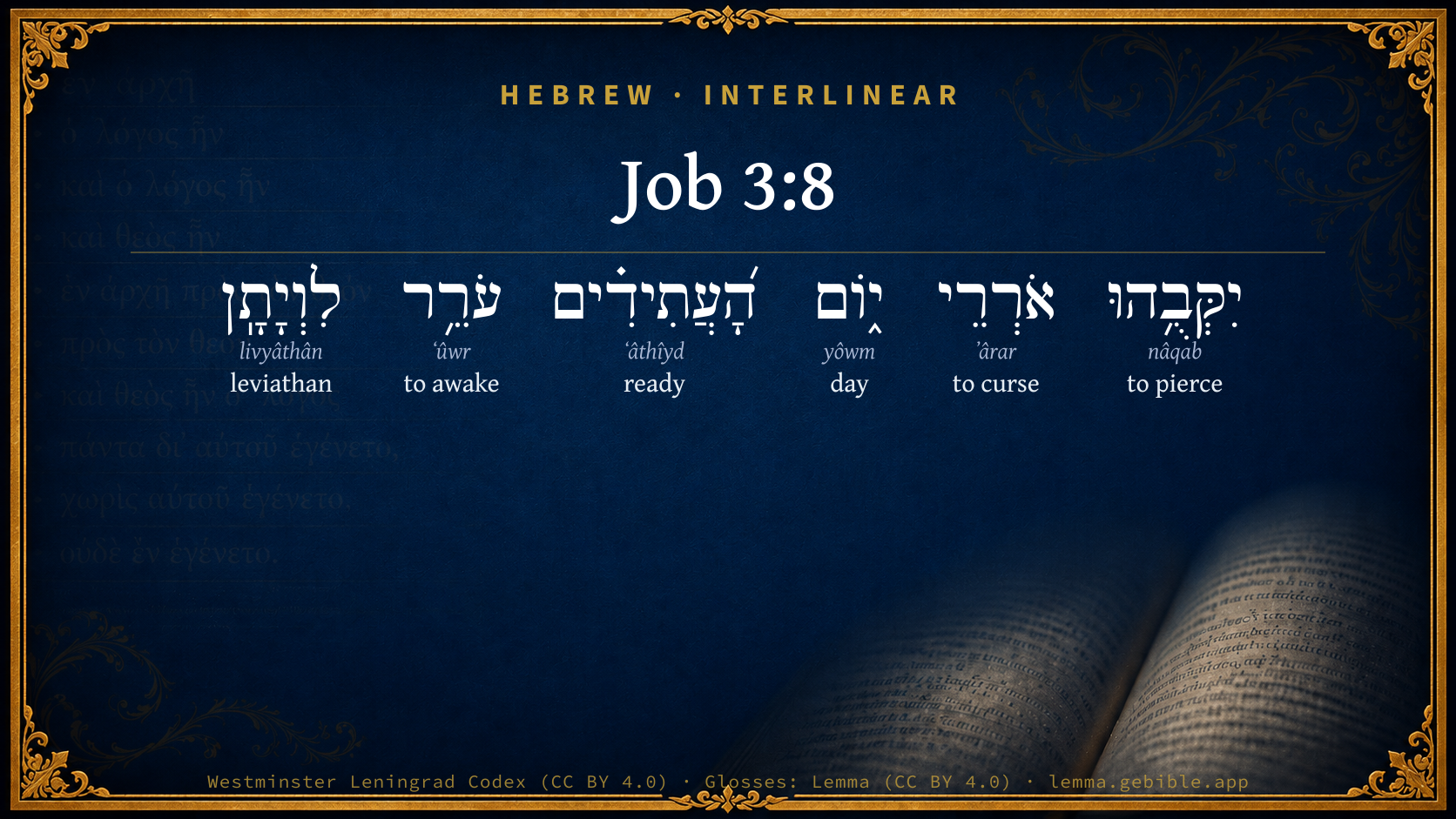
Job 3:8

Hebrew (Westminster Leningrad Codex) Job 3:8 appears in the Hebrew Old Testament. The text above is from the Westminster Leningrad Codex. Each word links to its Strong’s number, a concise gloss, and parsing drawn from the Open Scriptures Hebrew Bible morphology. Click any word for its full Brown-Driver-Briggs (BDB) entry.
Download image
Cite this verse

Job 3:8 (World English Bible). Public Domain. Lemma interlinear Bible study tool, https://lemma.gebible.app/v/job/3/8.

Show BibTeX & RIS
BibTeX
RIS
English Translation
Let them curse it who curse the day, Who are ready to rouse up leviathan.
World English Bible · Public Domain
Highlights
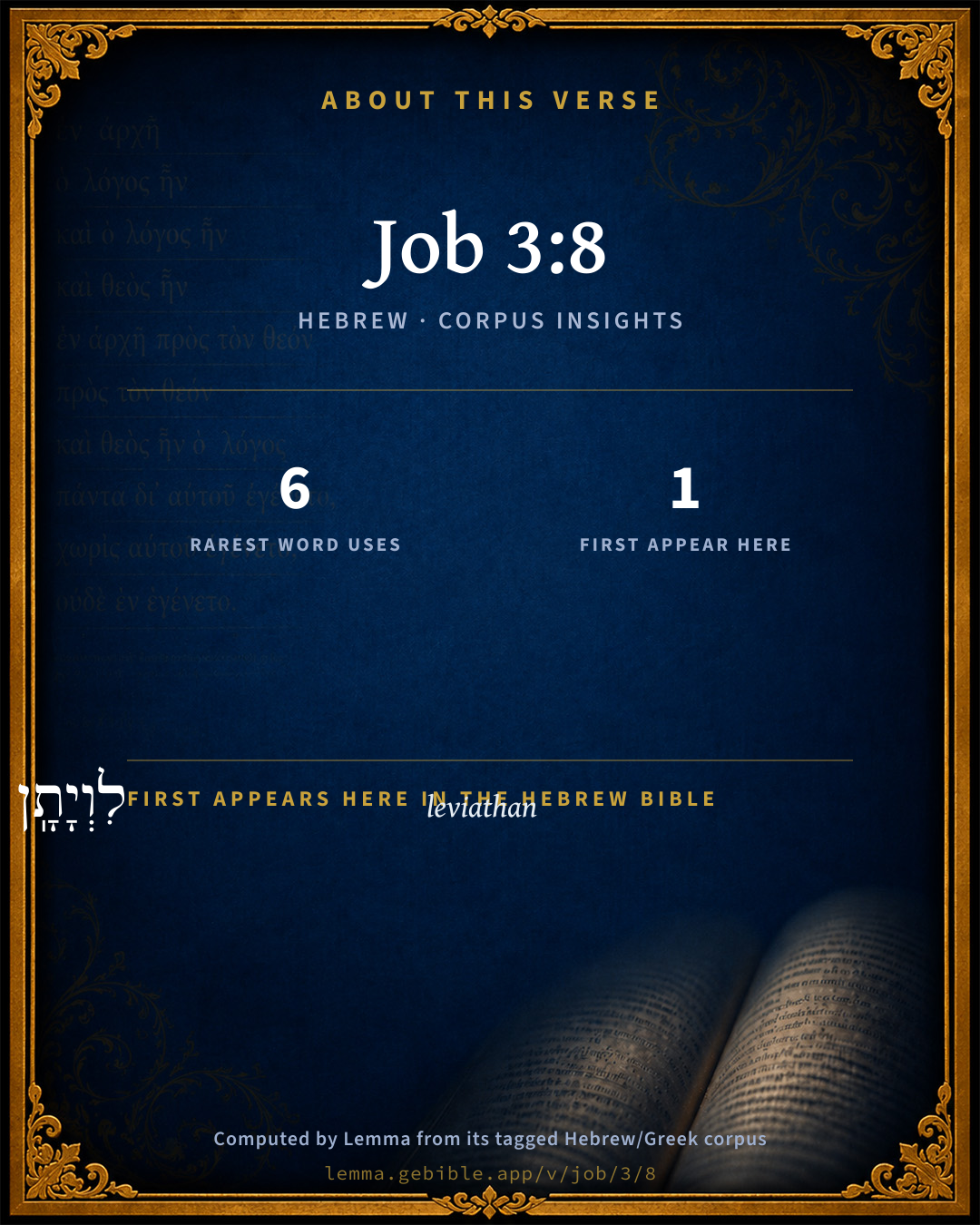
  • 1 first appearance in the Hebrew Bible
Full analysis ↓
Download a study sheet

One document with this verse’s original text, its word-by-word gloss line, the meaning frame, cross-references with their text, attributed commentary, and full source and license credits — printable, and it pastes into notes with its structure intact.

This verse Autodidact and up

Study sheet (.html) Plain text (.txt)

A passage Seminary Student

Up to 50 verses in one chapter. A passage sheet keeps up to 6 commentary sources and 12 cross-references per verse, in the order this page ranks them, and says so on the sheet whenever that leaves anything out. Ask for a single verse and you get the Autodidact verse sheet above.

Everything on this page stays free to read, with no account — the sheet is a download of what is already on screen, not access to it.

Want to remove ads? Support Godless Engineer
Compare translations 3

The same verse in 3 English versions, stacked beneath the original-language interlinear above. Click any original word for its lexicon entry.

Each is an independent rendering of the whole verse — the interlinear is not word-aligned to these translations.

Highlighted words mark where these versions differ — a whole-verse word diff, not a word-by-word alignment.

  • World English Bible Public Domain
    Let them curse it who curse the day, Who are ready to rouse up leviathan.
  • King James Version Public Domain
    Let them curse it that curse the day, who are ready to raise up their mourning.
  • unfoldingWord Literal Text CC BY-SA 4.0
    May the ones cursing a day curse it, the ones skillful to awaken Leviathan.

unfoldingWord Literal Text — © unfoldingWord, licensed CC BY-SA 4.0. Word-aligned USFM3 via Door43 (git.door43.org/unfoldingWord/en_ult).

Versions to compare (up to 4)

3 of 4 selected

Show all 18 translations

Every available English version of this verse, each an independent rendering of the whole verse.

  • World English Bible Public Domain
    Let them curse it who curse the day, Who are ready to rouse up leviathan.
  • Berean Standard Bible Public Domain
    May it be cursed by those who curse the day—those prepared to rouse Leviathan.
  • Majority Standard Bible Public Domain
    May it be cursed by those who curse the day—those prepared to rouse Leviathan.
  • King James Version Public Domain
    Let them curse it that curse the day, who are ready to raise up their mourning.
  • American Standard Version (1901) Public Domain
    Let them curse it that curse the day, Who are ready to rouse up leviathan.
  • Revised Version (1885) Public Domain
    Let them curse it that curse the day, who are ready to rouse up leviathan.
  • Geneva Bible (1599) Public Domain
    Let them that curse the day, (being readie to renue their mourning) curse it.
  • Douay-Rheims (1899) Public Domain
    Let them curse it who curse the day. who are ready to raise up a leviathan:
  • Young's Literal Translation Public Domain
    Let the cursers of day mark it, Who are ready to wake up Leviathan.
  • Literal Standard Version CC BY-SA 4.0
    Let the cursers of day mark it, || Who are ready to wake up Leviathan.
  • Unlocked Literal Bible CC BY-SA 4.0
    May they curse that day, those who know how to wake up Leviathan.
  • unfoldingWord Literal Text CC BY-SA 4.0
    May the ones cursing a day curse it, the ones skillful to awaken Leviathan.
  • Darby Bible Public Domain
    Let them curse it that curse the day, who are ready to rouse Leviathan;
  • World Messianic Bible Public Domain
    Let them curse it who curse the day, who are ready to rouse up leviathan.
  • Webster's Bible Public Domain
    Let them curse it that curse the day, who are ready to raise up their mourning.
  • Free Bible Version CC BY-SA 4.0
    Those who place curses on certain days should curse it, those who have the power to raise Leviathan.
  • Bible in Basic English Public Domain
    Let it be cursed by those who put a curse on the day; who are ready to make Leviathan awake.
  • JPS Tanakh (1917) Public Domain
    Let them curse it that curse the day, who are ready to rouse up leviathan.

Literal Standard Version (2020), Covenant Press — licensed CC BY-SA 4.0. Text via the HelloAO Bible API (eBible.org). Unlocked Literal Bible (unfoldingWord) — licensed CC BY-SA 4.0. Text via the HelloAO Bible API (eBible.org). unfoldingWord Literal Text — © unfoldingWord, licensed CC BY-SA 4.0. Word-aligned USFM3 via Door43 (git.door43.org/unfoldingWord/en_ult). Free Bible Version, Dr. Jonathan Gallagher — licensed CC BY-SA 4.0. Text via the HelloAO Bible API (eBible.org).

Word by word

More ways to search: Search by grammar → Find every occurrence → Compare this word →

Practice this passage: Drill this verse → Learn its vocabulary →

About this verse

These counts appear in no published source. They are computed here, from the morphology-tagged text and Lemma’s own curated glosses. What Lemma adds →

6
words
6
distinct lemmas
Wisdom
section

Notable vocabulary

The rarest word here is לִוְיָתָֽן leviathan H3882 — appearing just 6 times in the whole Hebrew Bible.

First appearance in Scripture

This word makes its first canonical appearance in the Hebrew Bible here:

  • לִוְיָתָֽן leviathan H3882

Shared distinctive vocabulary

לִוְיָתָֽן leviathan H3882 occurs in 5 verses of the Hebrew Bible. Also found in:

Grammatical profile

  • 3 verbs
  • 2 nouns
  • 1 adjective

Verb forms

  • יִקְּבֻ֥הוּ Qal · Imperfect
  • אֹרְרֵי Qal · Participle Active
  • עֹרֵ֥ר Polel · Infinitive Construct

Hebrew & Septuagint length

In English translation the verse runs 15 words from the Hebrew and 19 from the Septuagint (LXX English) — closely comparable.

A rough comparison of the two English renderings, which tokenize alike — not a word-level alignment.

Word counts can differ between the Hebrew and the Greek without any difference in meaning — e.g. the Hebrew direct-object marker אֵת has no separate Greek word, and Greek often adds the article ὁ.

Cross-references

8

Topical passages linked to Job 3:8 in the Treasury of Scripture Knowledge — connected by theme and wording, ordered by reader-vote popularity; previews shown in the World English Bible.

  • Job 41:1 "Can you draw out Leviathan with a fishhook? Or press down his tongue with a cord?
  • Job 41:10 None is so fierce that he dare stir him up. Who then is he who can stand before me?
  • 2 Chronicles 35:25 Jeremiah lamented for Josiah: and all the singing men and singing women spoke of Josiah in their lamentations to this day; and they made them an ordinance in Israel: and, behold, they are written in the lamentations.
  • Job 41:25 When he raises himself up, the mighty are afraid. They retreat before his thrashing.
  • Jeremiah 9:17–18 Thus says Yahweh of Hosts, Consider you, and call for the mourning women, that they may come; and send for the skillful women, that they may come:
  • Amos 5:16 Therefore thus says Yahweh, the God of hosts, the Lord: "Wailing will be in all the broad ways; And they will say in all the streets, 'Alas! Alas!' And they will call the farmer to mourning, And those who are skillful in lamentation to wailing.
  • Matthew 11:17 and say, 'We played the flute for you, and you didn't dance. We mourned for you, and you didn't lament.'
  • Mark 5:38 He came to the synagogue ruler's house, and he saw an uproar, weeping, and great wailing.

Cross-references courtesy of OpenBible.info (CC BY 4.0).

Hebrew and Greek witnesses Masoretic Hebrew ↔ Greek Septuagint

The same verse in the two great witnesses to the Old Testament, shown verse-for-verse.

These are two independent witnesses, not word-aligned to each other, and the Septuagint is shown in lemma (dictionary) form.

Hebrew Job 3:8 Masoretic · Westminster Leningrad Codex

יִקְּבֻ֥הוּ אֹרְרֵי י֑וֹם הָ֝עֲתִידִ֗ים עֹרֵ֥ר לִוְיָתָֽן

Let them curse it who curse the day, Who are ready to rouse up leviathan.

World English Bible · Public Domain

Greek LXX Job 3:8 Septuagint · lemma form

ἀλλά καταἀράομαι αὐτός ὁ καταράομαι ὁ ἡμέρα ἐκεῖνος ὁ μέλλω ὁ μέγας κῆτος χειρόομαι

But let him that curses that day curse it, even he that is ready to attack the great whale.

LXX2012 (modern English Septuagint) · Public Domain

On this verse, Haydock's Catholic Bible Commentary discusses the Septuagint’s reading. Read the note in Commentary ↓

Hebrew: Westminster Leningrad Codex (CC BY 4.0). Greek: Septuagint (public domain); English from LXX2012 (modern English Septuagint) (Public Domain). How the Septuagint differs from the Hebrew →

Commentary

Notes on Job 3:8 from classic Christian and Jewish commentators (each source and its license shown beneath its notes). The classic Christian expositions comment on the surrounding passage and are grouped to its opening verse, so a note may address several verses; the Jewish commentaries on the Tanakh (Rashi and others) are per-verse, so they appear only where the commentator wrote on this verse.

Lemma curates 59 commentaries, every one of them public domain or Creative Commons licensed, each selected and text-cleaned for this edition rather than reprinted as found. About our sources →

Trapp's Complete Commentary

John Trapp

Job 3:8 Let them curse it that curse the day, who are ready to raise up their mourning.

Ver. 8. Let them curse it, that curse the day] As those atri et tetri Atlantes (before spoken of) curse the rising sun for scorching them, Non tam cute, quam corde Not so much skin as heart, (Aethiopici); as despairing persons, and malefactors led to execution, use to curse the time that ever they were born. The help of all such Job here calleth in against the harmless night he banneth with so much bitterness. Like as that desperate wretch mentioned by Mr Bolton, who being upon his death bed, albeit he swore as fast and as furiously as he could, yet desired he the bystandersy to help him with oaths, and to swear for him. Tremellius here thinks that Job calls to the stars and winds to help him curse, See his translation of the text, and his notes thereon.

Who are ready to raise up their mourning] Whether they be those mercenary mourners mentioned elsewhere, which, for hire, are wont at funerals with doleful execrations to lament the day of their benefactor’s death, Jer 9:17-18; Jer 9:20; crying out, Oh the day! alas for the day! oh that ever such a day came! See Eze 30:2 2Ch 35:25 Amo 5:16. Or else those that really mourn for their deceased friends; and yearly, as oft as the day returneth, they renew their mourning. These are called upon by Job, totes saccos deplere, to pour out their utmost lamentations and execrations upon this his night. Concerning the word Leviathan, here rendered mourning, whether it be taken for the sea dragon, or the devil, and what it is to raise him up, and why they cursed him that are ready to do so, with a prepared and meditated active readiness, if I should go about to show the reader, with the several opinions of interpreters, I should not only tire him out, but also danger doing as that vicar of Augsburgh did, mentioned by Johannes Manlius. This doctor of divinity (for so he was) having read at Tubinga certain lectures upon Job, at the end of his last lecture said, that both Job and himself were very glad to be rid of one another; for as he understood little or nothing of Job’s meaning, so Job seemed to him to be more tormented with his narrations than ever he had been with all his own ulcers. Let them that have a mind consult the commentators here.

John Trapp, A Commentary or Exposition upon All the Books of the Old and New Testament (1647–1656) — public domain. Text from a community e-Sword module.

Joseph Benson's Commentary

Job 3:8. Let them curse it that curse the day — That is, their birth-day: when their afflictions move them to curse their own birth-day, let them remember mine also, and bestow some curses upon it; who are ready to raise up their mourning — Who are full of sorrow, and always ready to pour out their cries, and tears, and complaints. A late writer paraphrases this verse as follows: “So little am I concerned to have my birth-night celebrated by any public demonstrations of joy, by any solemn blessing or giving of thanks, that I would rather choose to hire a set of those men, whose business it is to curse the days that are esteemed inauspicious, and who are always ready on such occasions. Let them be produced, and let them apply all their skill in raising their mournful voices to the highest pitch: and let them study to find out proper expressions to load it with the highest and heaviest imprecations.” If the reader will consult Poole and Dodd on the passage, he will find some reasons adduced which go to justify this exposition; but for which we have not room here.

Joseph Benson's Commentary on the Old and New Testaments (1811–1818) — public domain. Text from a community e-Sword module.

Tyndale Open Study Notes

Tyndale Open Resources

3:8 The expression experts at cursing refers to professional cursers such as Balaam (Num 22–24).

Tyndale Open Study Notes — © Tyndale Open Resources, licensed CC BY-SA 4.0. Text via the HelloAO Bible API.

Geneva Bible (1599)

Geneva Bible translators

Which curse the day of their birth, let them lay that curse upon this night.

Geneva Bible (1599) marginal notes — public domain. Text via Bolls.life.

Jamieson, Fausset & Brown

Robert Jamieson, A. R. Fausset & David Brown

them . . . curse the day--If "mourning" be the right rendering in the latter clause of this verse, these words refer to the hired mourners of the dead (Jer 9:17). But the Hebrew for "mourning" elsewhere always denotes an animal, whether it be the crocodile or some huge serpent (Isa 27:1), such as is meant by "leviathan." Therefore, the expression, "cursers of day," refers to magicians, who were believed to be able by charms to make a day one of evil omen. (So Balaam, Num 22:5). This accords with UMBREIT'S view (Job 3:7); or to the Ethiopians and Atlantes, who "used to curse the sun at his rising for burning up them and their country" [HERODOTUS]. Necromancers claimed power to control or rouse wild beasts at will, as do the Indian serpent-charmers of our day (Psa 58:5). Job does not say they had the power they claimed; but, supposing they had, may they curse the day. SCHUTTENS renders it by supplying words as follows:--Let those that are ready for anything, call it (the day) the raiser up of leviathan, that is, of a host of evils.

Jamieson, Fausset & Brown — Commentary Critical and Explanatory on the Whole Bible (1871) — public domain (CC PDM 1.0). Text via the HelloAO Bible API.

Adam Clarke's Commentary

Verse 8. Let them curse it that curse the day] This translation is scarcely intelligible. I have waded through a multitude of interpretations, without being able to collect from them such a notion of the verse as could appear to me probable. Schultens, Rosenmuller, and after them Mr. Good, have laboured much to make it plain. They think the custom of sorcerers who had execrations for peoples, places, things, days, c., is here referred to such as Balaam, Elymas, and many others were: but I cannot think that a man who knew the Divine Being and his sole government of the world so well as Job did, would make such an allusion, who must have known that such persons and their pretensions were impostors and execrable vanities. I shall give as near a translation as I can of the words, and subjoin a short paraphrase: יקבהו אררי יום העתידימערר לויתן yikkebuhu orerey yom haathidim orer livyathan; "Let them curse it who detest the day; them who are ready to raise up the leviathan." That is, Let them curse my birthday who hate daylight, such as adulterers, murderers, thieves, and banditti, for whose practices the night is more convenient; and let them curse it who, being like me weary of life, are desperate enough to provoke the leviathan, the crocodile, to tear them to pieces. This version is nearly the same as that given by Coverdale. Let them that curse the daye give it their curse also, then those that be ready to rayse up leviathan. By leviathan some understand the greatest and most imminent dangers; and others, the devil, whom the enchanters are desperate enough to attempt to raise by their incantations.

Calmet understands the whole to be spoken of the Atlantes, a people of Ethiopia, who curse the sun because it parches their fields and their bodies; and who fearlessly attack, kill, and eat the crocodile. This seems a good sense.

Adam Clarke's Commentary on the Bible (1810–1826) — public domain. Text from a community e-Sword/MySword module.

Ellicott's Commentary for English Readers

(8) That curse the day—i.e., Let those who proclaim days unlucky or accursed curse that day as pre-eminently so; or let them recollect that day as a standard or sample of cursing. “Let it be as cursed as Job’s birth day.”

These people are further described as being ready to arouse leviathan (Authorised Version, “raise up their mourning”), or the crocodile—persons as mad and desperate as that. Let the most hopeless and reckless of mankind select that day as the one which they would choose to curse. This seems to be Job’s meaning.

A Bible Commentary for English Readers, edited by Charles John Ellicott (1878–1897) — public domain. Text from a community e-Sword module.

The Cambridge Bible for Schools and Colleges

gen. ed. J. J. S. Perowne

8. The most probable sense of this verse is,

Let them that curse days curse it,

Them that are skilled to rouse up the Dragon.

They that curse days or the day are enchanters and magicians, who were believed to have power to cast their spells upon a day and overwhelm it with darkness and misfortune. Perhaps, however, the first half of the verse is explained by the second, and only one species of enchantment referred to, namely, rousing up the Dragon. The Heb. word is leviathan. This name is given in ch. 41 to a sea or river monster, probably, the crocodile, but it is difficult to find any logical connexion between rousing up the crocodile and cursing days. The word leviathan means twisted or having folds, and is an epithet for a serpent. In Isa_27:1 we read: In that day Jehovah with his sore and great and strong sword shall visit leviathan the fleeing serpent, and leviathan the serpent with coils. The key to the meaning of the verse, however, is found in Job_26:13, which rightly rendered means,

By His breath the heavens become bright,

His hand pierceth the fleeing serpent.

Here piercing the fleeing serpent and making the heavens clear are parallel acts. The fleeing serpent, therefore, was the cause of the darkness. In both passages in Job there is an allusion to the popular mythology, according to which the darkening or eclipse of the sun and moon was caused by the serpent throwing its folds around them, or swallowing them up. In its origin this mythology is probably nothing more than a stroke of the poetic imagination, which turned the dark cloud or eclipsing shadow into a huge Dragon. Enchanters were supposed to have power to set this Dragon in motion, and cause the lights of day or night to be swallowed up.

The Cambridge Bible for Schools and Colleges (gen. ed. J. J. S. Perowne; Cambridge University Press, 1878–1918) — public domain. Text from a community e-Sword module.

John Gill's Exposition

Let them curse it that curse the day,.... Their own day, either their birthday, or any day on which evil befalls them; and now such as are used to this, Job would have them, while they were cursing their own day, to throw some curses upon his; or that curse the daylight in general, as adulterers and murderers, who are said to rebel against the light, see Job 24:13; and as some Ethiopians, who lived near Arabia, and so known to Job, who supposed there was no God, and used to curse the sun when it rose and set, as various writers relate (g), called by others (h) Atlantes; or it may design such persons who were hired at funerals, to mourn for the dead, and who, in their doleful ditties and dirges, used to curse the day on which the person was born whom they lamented; or it may be rather the day on which he died; hence it follows:

who are ready to raise up their mourning; who were expert at the business, and who could raise up a howl, as the Irish now do, or make a lamentation for the dead when they pleased; such were the mourning women in Jer 9:17; and those that were skilful of lamentation, Amo 5:16; some render the words, "who are ready to raise up Leviathan" (i), and interpret it either of the whale, which, when raised up by the fishermen, they are in danger of their vessels being overturned, and their lives lost, and then they curse the day that ever they entered into such service, and exposed themselves to such danger; or of fish in general, and of fishermen cursing and swearing when they are unsuccessful: some understand this of astrologers, magicians, and enchanters, raising spirits, and particularly the devil, who they think is meant by Leviathan; but it seems best with a little alteration from Gussetius, and Schultens after him, to render the words thus,"let the cursers of the day fix a name upon it; let those that are ready "to anything, call it" the raiser up of Leviathan;''that is, let such who either of themselves are used to curse days, or are employed by others to do it, brand this night with some mark of infamy; let them ascribe all dreadful calamities and dismal things unto it, as the source and spring of them; which may be signified by Leviathan, that being a creature most formidable and terrible, of which an account is given in the latter part of this book; but many Jewish writers (k) render it "mourning", as we do.

(g) Diodor. Sic. l. 3. p. 148. Strabo, Geograph. l. 17. P. 565. (h) Herodot. Melpomene, sive, l. 4. c. 184. Mela de Situ Orbis, l. 1. c. 8. Solin. Polyhistor, c. 44. Plin. Nat. Hist. l. 5. c. 8. (i) "Leviathanem", Schmidt, Michaelis. Mr. Broughton renders the words, "who hunt Leviathan." (k) Vid. Aben Ezram & Gersom in loc. R. Sol. Urbin. Ohel Moed, fol. 1. 1. Aruch in voce So the word is used, T. Hieros. Moed Katon, fol. 80. 4.

John Gill's Exposition of the Whole Bible (1746–1763) — public domain (CC PDM 1.0). Text via the HelloAO Bible API.

Albert Barnes' Notes on the Bible

Let them curse it who curse the day - This entire verse is exceedingly difficult, and many different expositions have been given of it. It seems evident that it refers to some well-known class of persons, who were accustomed to utter imprecations, and were supposed to have the power to render a day propitious or unpropitious - persons who had the power of divination or enchantment. A belief in such a power existed early in the world, and has prevailed in all savage and semi-barbarous nations, and even in nations considerably advanced in civilization. The origin of this was a desire to look into futurity; and in order to accomplish this, a league was supposed to be made with the spirits of the dead, who were acquainted with the events of the invisible world, and who could be prevailed on to impart their knowledge to favored mortals. It was supposed, also, that by such union there might be a power exerted which would appear to be miraculous.

Such persons also claimed to be the favorites of heaven, and to be endowed with control over the elements, and over the destiny of men; to have the power to bless and to curse, to render propitious or calamitous. Balsaam was believed to be endowed with this power, and hence, he was sent for by Balak, king of Moab, to curse the Israelites; Num 22:5-6; see the notes at Isa 8:19. The practice of cursing the day, or cursing the sun, is said by Herodotus to have prevailed among a people of Africa, whom he calls the Atlantes, living in the vicinity of Mount Atlas. “Of all mankind,” says he, “of whom we have any knowledge, the Atlantes alone have no distinction of names; the body of the people are termed Atlantes, but their individuals have no appropriate appellation. When the sun is at the highest they heap on it reproaches and execrations, because their country and themselves are parched by its rays; book iv. 184. The same account of them is found in Pliny, Nat. His. v. 8: Solem orientem occidentemque dira imprecatione contuentur, ut exitialem ipsis agrisque. See also Strabo, Lib. xvii. p. 780. Some have supposed, also, that there may be an allusion here to a custom which seems early to have prevailed of hiring people to mourn for the dead, and who probably in their official lamentation bewailed or cursed the day of their calamity; compare Jer 9:17; 2Ch 35:25. But the correct interpretation is doubtless that which refers it to pretended prophets, priests, or diviners - who were supposed to have power to render a day one of ill omen. Such a power Job wished exerted over that unhappy night when he was born. He desired that the curses of those who had power to render a day unpropitious or unlucky, should rest upon it.

Who are ready to raise up their mourning - This is not very intelligible, and it is evident that our translators were embarrassed by the passage. They seem to have supposed that there was an allusion here to the practice of employing professional mourners, and that the idea is, that Job wished that they might be employed to howl over the day as inauspicious, or as a day of ill omen. The margin is, as in the Hebrew, “a leviathan.” The word rendered “ready” עתידים ‛âthı̂ydı̂ym, means properly ready, prepared; and then practiced or skillful. This is the idea here, that they were practiced or skillful in calling up the “leviathan;” see Schultens “in loc.” The word rendered in the text “mourning,” and in the margin “leviathan” לויתן lı̂vyâthân, in all other parts of the sacred Scriptures denotes an animal; see it explained in the notes at Isa 27:1, and more fully in the notes at Job 41: It usually denotes the crocodile, or some huge sea monster.

Here it is evidently used to represent the most fierce, powerful and frightful of all the animals known, and the allusion is to some power claimed by necromancers to call forth the most terrific monsters at their will from distant places, from the “vasty deep,” from morasses and impenetrable forests. The general claim was, that they had control over all nature; that they could curse the day, and make it of ill omen, and that the most mighty and terrible of land or sea monsters were entirely under their control. If they had such a power, Job wished that they would exercise it to curse the night in which he was born. On what pretensions they founded this claim is unknown. The power, however, of taming serpents, is practiced in India at this day; and jugglers bear around with them the most deadly of the serpent race, having extracted their fangs, and creating among the credulous the belief that they have control over the most noxious animals. Probably some such art was claimed by the ancients. and to some such pretension Job alludes here.

Albert Barnes' Notes on the Bible (1834–1885) — public domain. Text from a community e-Sword/MySword module.

Haydock's Catholic Bible Commentary

Day. The nations of Ethiopia, under the line, curse the sun as their greatest enemy. (Strabo xvii.) (Pliny, [Natural History?] v. 8.) --- They also brave the fury of the leviathan or crocodile, chap. xl. 27., and xli. 1., and Psalm lxxiii. 14. The natives of Tentyra, upon the Nile, were supposed to be a terror to that monster, or they were very courageous in entangling and pursuing it. (Seneca, q. 4. 2.) (Pliny viii. 25.) --- Leviathan. Protestants, "their mourning." De Dieu rejects this interpretation, substituting "and thou, leviathan, rouse up," &c. The fathers generally understand the devil to be thus designated. Septuagint, "he who is about to seize the great whale," (Haydock) or fish, which they also explain of the conflict of Satan with Jesus Christ." (Origen, &c.)

George Leo Haydock (1774–1849), Haydock's Catholic Family Bible and Commentary, 1859 edition — public domain. Excludes Psalms (Douay-Rheims chapter numbering differs from Protestant) and Deuterocanonical books (Catholic canon only).

Matthew Poole's English Annotations

That curse the day, i.e. their day, to wit, their birthday; for the pronoun is here omitted for the metre’s sake; for this and the following chapters are written in verse, as all grant. So the sense is, when their afflictions move them to curse their own birthday, let them remember mine also, and bestow some curses upon it. Or the day of their distress and trouble, which sometimes is called simply the day, as Oba 1:12. Or the day of the birth or death of that person, whose funerals are celebrated by the hired mourners, who in their solemn lamentations used to curse the day that gave them such a person, whom they should so suddenly lose; and therefore it had been better never to have enjoyed him, and to curse the day in which he died as an unlucky and execrable day. Or, the day, i.e. the daylight; which to some persons is a hateful thing, and the object of their curses, namely, to lewd persons and thieves, to whom the morning light is even as the shadow of death, Job 24:17; as also to persons oppressed with deep melancholy, as it is here implied, Job 3:20. So the sense is this, They who use to curse the day only, but generally love and bless the night, yet let this night be as abominable and execrable to them as the day-time generally is.

Who are ready to raise up their mourning; who are brimful of sorrow, and always ready to pour out their cries, and tears, and complaints, and with them curses, as men in great passions frequently do; or, such mourning men, or mourning women, whose common employment it was, and who were hired to mourn, and therefore were always ready to do so upon funeral occasions; of which see 2Ch 35:25; Jer 9:17,18,20; Eze 30:2; Joe 1:15; Amo 5:16; Mat 9:23. And this sense suits with the use of the last word in Hebrew writers, of which a plain and pertinent instance is given by the learned Mercer. But because that word is commonly used in another sense for the leviathan, both in this book and elsewhere in Scripture, as Psa 74:14; 104:26; Isa 27:1, and because this very phrase of raising the leviathan is used afterward, Job 41:25, others render the words thus, who are prepared or ready to raise the leviathan. It is evident that the leviathan was a great and dreadful fish, or sea monster, though there be some disagreement about its kind or quality, and that the raising of or endeavouring to catch the leviathan was a dangerous and terrible work, as is plain from Job 41. And therefore those seamen who have been generally noted for great swearers and cursers, especially when their passions of rage or fear are raised, being now labouring to catch this sea monster, and finding themselves and their vessel in great danger from him, they fall to their old trade of swearing and cursing, and curse the day wherein they were born, and the day in which they ventured upon this most hazardous and terrible work. Others understand this leviathan mystically, as it is used Isa 27:1, for the great enemy of God’s church and people, called there also the dragon, to wit, the devil, whom the magicians both now do, and formerly did, use to raise with fearful curses and imprecations. Not as if Job did justify this practice, but only it is a rash and passionate wish, that they who pour forth so many curses undeservedly, would bestow their deserved curses upon this day.

Matthew Poole's English Annotations on the Holy Bible (1683–1685) — public domain. Text from a community e-Sword/MySword module.

Whedon's Commentary on the Bible

Daniel D. Whedon

8. That curse the day — Cursers of the day. Pliny says of the Atlantes, (Herodotus calls them Atarantes,) that as they look upon the rising and the setting sun they give utterance to direful imprecations against it as being deadly to themselves and their lands. (Nat. Hist., book v, chap. 8.) Job does not refer to such, but to professional cursers, who imprecate evil on particular days. Superstition in the earliest times had its sorcerers, who were believed to possess the power, through incantations, of working injury to others. Balaam was summoned from his distant home to curse the people of Israel. Job invites those skilled in the art of cursing to join him in cursing that night.

Raise up their mourning — Our version yields no intelligible meaning. The Septuagint renders the passage, “he that is ready to attack the great whale,” (or monster,) which is quite as meaningless.

The original reads, skilled to rouse up the dragon, (Leviathan.) This word, לויתן, has been a stumbling-block to all translators. The Complutensian editors (of the first polyglott, 1517) left it without attempting to translate it. Our own version, “their mourning,” together with that of Piscator and Tyndal, probably followed the Chaldee paraphrase, which may have been suggested by the ancient association of the profession of sorcery with professional mourning. They inferred that as the first clause of the verse meant sorcery, the second must mean “mourning.” 1. Furst, in common with modern lexicographers, gives the ground-form of the word as that which wreathes, or gathers itself into folds. Hence one meaning of the word is serpent, since it moves itself forward by folds. Umbreit and Vaihinger understand by the word a very large serpent. The art of charming serpents is common through the East. The serpent, too, fills a large place in all mythologies. In the last Indian Avatar, as well as in the Eddas, the world is to be destroyed by a serpent vomiting flames. 2.

According to Bochartus, Clericus, Carey, etc., the word should be rendered crocodile. This animal was regarded by the ancient Egyptians as the emblem of Typhon, the dark genius of their mythology. As it was in the shape of a crocodile that Typhon eluded the pursuit of Horus, they set apart a particular day for the hunt of this animal. They killed as many of them as they could, and afterwards threw their dead bodies before the temple of their god. The following translation of a papyrus found at Thebes gives us a form of the invocation of Typhon: “I invoke thee who livest in empty space: wind, or terrible invisible, all powerful, god of gods: maker of destruction: and maker of desolation: thou who hatest a flourishing family, since thou hast been expelled from Egypt and out of foreign countries.

Thou hast been named the all destroyer, and the invincible. I invoke thee Typhon Set: I perform thy magical rites. Because I invoke thee by thy genuine name, by virtue of which thou canst not refuse to hear… come to me entire, and walk, and throw down that man — or that woman — by cold and heat. He has wronged me,” etc. Herodotus (ii, 32, 33) relates of the travels of the Nasamonians in Africa, that they came to a great river which flowed by a town of dwarfs, and which abounded in crocodiles. In this connexion he strangely informs us that they were a nation of sorcerers. 3. Others, (Hirtzel, Furst, Schlottmann, Ewald, etc.,) who cite Van Bohlen, think that the expression refers to the dragon in the heavens, a constellation which, according to eastern mythology, followed the sun and moon like a relentless enemy, sometimes surrounding them with his mighty folds, and so bringing on darkness. Throughout the East the ancients believed that their magicians could work upon this monster. A similar belief with respect to a monster called Rahu prevails among the Hindus to the present time. In times of eclipse the natives (as do the Chinese) raise a great din to compel the dragon to release his prey. Job’s wish, according to this view, was, that these day-cursers might rouse up this dragon, and thus effect a complete obscuration of the night. 4. The fathers looked upon the passage from a spiritual standpoint, and regarded it as referring to a spiritual encounter with Leviathan. They saw in it a prophecy of the incarnated One who should overcome the great serpent, which is hostile not only to the light, but to the God of light. (See extended citations in Wordsworth, who favours this view.) Such an interpretation, however, is unnatural and forced.

Daniel D. Whedon (gen. ed.), Commentary on the Old and New Testaments (1874–1909) — public domain. Text from a community e-Sword module.

The Pulpit Commentary

Let them curse it that curse the day. Very different explanations are given of this passage. Some suppose it to mean, "Let those desperate men curse it who are in the habit of cursing their day," like Job himself (Job_3:1) and Jeremiah. (Jer_20:14) Others suggest a reference to such as claimed power to curse days, and to divide them into the lucky and the unlucky. In this case Job would mean, "Let the sorcerers who curse days curse especially this day," and would thus seem, if not to sanction the practice, at any rate to express a certain amount of belief in the sorcerers" power. The second clause has also a double interpretation, which adapts it to either of these two suggested meanings (vide infra). Who are ready to raise up their mourning. This is an impossible rendering. Translate (with the Revised Version), who are ready to rouse up leviathan. "Rousing leviathan" may be understood in two ways. It may be regarded as spoken in the literal sense of those who are rash enough and desperate enough to stir up the fury of the crocodile, (see the comment on Job_41:1) or in a metaphorical sense of such as stir up to action by their sorceries the great power of evil, symbolized in Oriental mythologies by a huge serpent, or dragon, or crocodile. On the whole, the second and deeper sense seems preferable; and we may conceive of Job as believing in the power of sorcery, and wishing it used against the night which he so much dislikes.

The Pulpit Commentary (1880–1919), ed. H.D.M. Spence-Jones & Joseph S. Exell — public domain. Text from a community e-Sword module.

John Wesley's Explanatory Notes

The day - Their birth-day: when their afflictions move them to curse their own birth-day, let them remember mine also, and bestow some curses upon it. Mourning - Who are full of sorrow, and always ready to pour out their cries, and tears, and complaints.

John Wesley, Explanatory Notes Upon the Whole Bible (1754–1765) — public domain. Text via the GEBible commentary corpus.

unfoldingWord translationNotes

Door43 World Missions Community

those who know how to wake up Leviathan

Job is probably referring here to sorcerers and magicians, who he believes might be able to even provoke Leviathan in spreading chaos. Leviathan was an animal well known in Ancient Near Eastern mythology, which was thought to be responsible for all kinds of destruction, disorder, and chaos.

May the stars of that day's dawn be dark

This refers to the planets that are often visible just before dawn. AT: "May the stars that appear before that day's first light be dark"

May that day look for light, but find none

The day of Job's birth is spoken of as if it were a person looking for something. AT: "May that day hope for light, but have none" (See: Personification)

neither may it see the eyelids of the dawn

The dawn is spoken of as if it had eyelids as a person has. AT: "nor see the first light of the dawn" (See: Personification)

because it did not shut up the doors of my mother's womb

A woman's womb is spoken of as if it were a container with doors. AT: "because that day did not close my mother's womb" (See: Metaphor)

because it did not hide trouble from my eyes

The day of Job's birth is spoken of here as if it were a person who could hide something. (See: Personification)

from my eyes

Here "eyes" represents the person who sees with them. AT: "from me" (See: Metonymy)

translationWords

curse

Leviathan

light

womb

unfoldingWord translationNotes — © Distant Shores Media and the Door43 World Missions Community, licensed CC BY-SA 4.0. Source: git.door43.org/Door43/en_tn.

Rashi

Rabbi Shlomo Yitzchaki (Rashi)

curse it Heb. יקבהו, curse it, as in (Num. 22:17), “curse (קבה) for me.”

those who curse the day Those who curse their days, since they intend to pronounce a curse because of their anguish.

those destined to be childless in their union Heb. ערר לויתן, to be childless (ערירים) in their union; to join their mate in the union of man and wife, without children. And I saw in the Jerusalem Talmud (Moed Katan 1:5) that עֹרֵר means, to lament their mate when he dies, as in (Moed Katan 1:6): A person may not inspire lamentations (יערער) for his dead relative.

Rashi on the Tanakh — English translations: “The Judaica Press complete Tanach with Rashi, translated by A. J. Rosenberg” (CC BY 4.0); “Pentateuch with Rashi's commentary by M. Rosenbaum and A.M. Silbermann, 1929-1934” (public domain); “The Metsudah Tanach series, Lakewood, N.J” (CC BY 4.0); and “The Book of Joshua, Metsudah Publications, 1997” (CC BY 4.0). Text via Sefaria.

Lesson kit

Teaching starters — assembled from the data on this page, not authored interpretation. Every prompt links to the verse data it draws on. Edit before teaching.

Job, in the Wisdom, opens this verse with 6 words (6 distinct Hebrew lemmas). Its most distinctive word is livyâthân (“leviathan”). A historical commentator’s framing appears above. Read the whole chapter for the surrounding context.

Discussion questions

  1. What does “leviathan” (livyâthân) contribute to the verse as a whole?
  2. The word “leviathan” first appears here in Scripture. What is being introduced at this debut?
  3. Job 41:1 shares the word «leviathan» with this verse. How do the two illuminate each other?
  4. The translations on this page render this verse differently — a whole-verse word diff, not a word-by-word alignment. What might account for the different wordings?
  5. The verb «יִקְּבֻ֥הוּ» is Qal Imperfect. How does its form color the action?
  6. Reading how Trapp's Complete Commentary and Joseph Benson's Commentary read this verse, where do the two commentators agree and where do they part?

Things to notice

Reading settings

Reading text

Shown beneath each verse's original-language words.

Old Testament
Old Testament edition

Read the OT as the Masoretic Hebrew (MT) or the Greek Septuagint (LXX).

English shown for the Greek Septuagint (in the Hebrew ↔ Greek comparison).

Comparing translations? Open the Compare panel on any verse page to stack up to four side by side.