
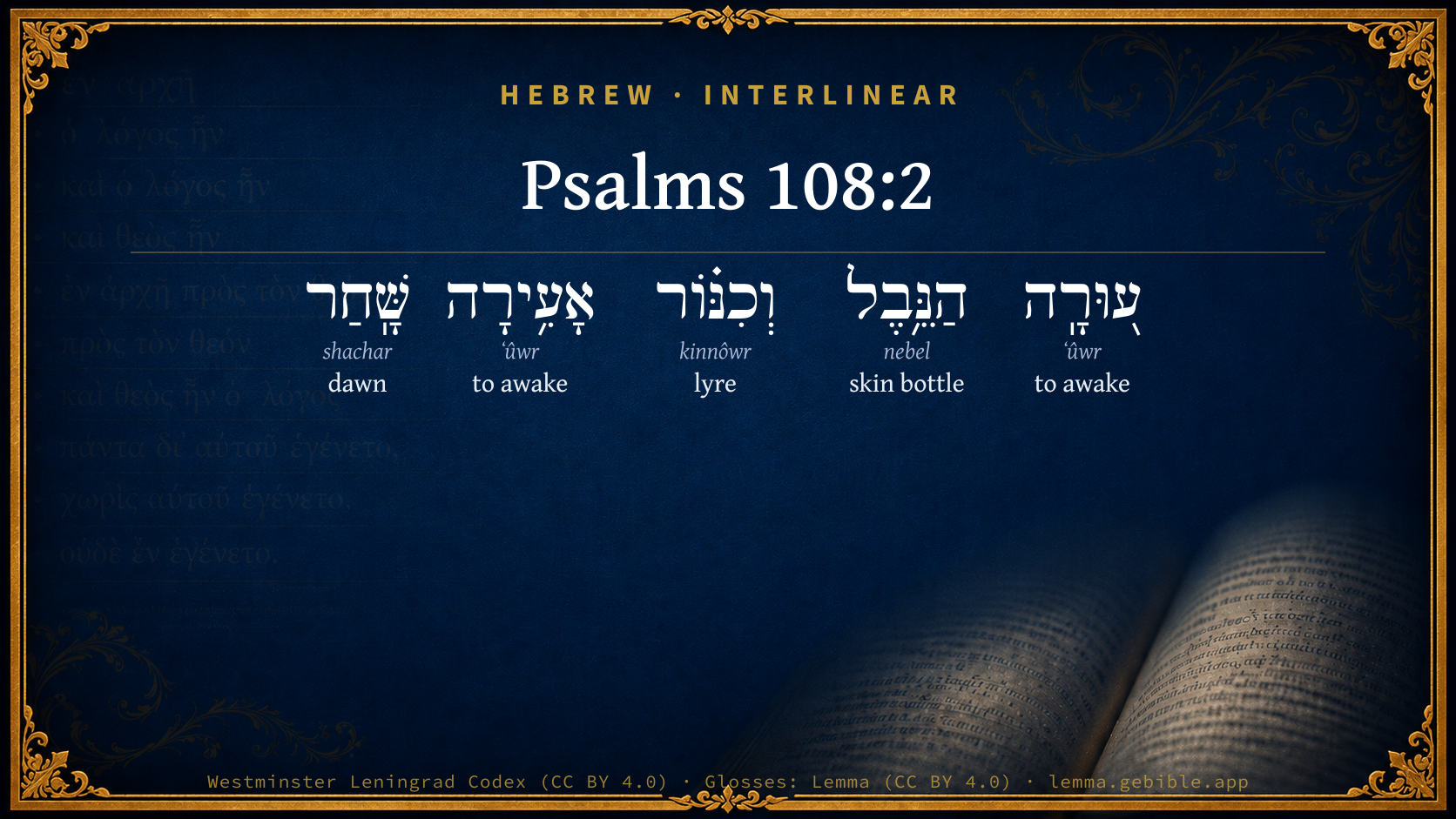
Psalms 108:2

Hebrew (Westminster Leningrad Codex) Psalms 108:2 appears in the Hebrew Old Testament. The text above is from the Westminster Leningrad Codex. Each word links to its Strong’s number, a concise gloss, and parsing drawn from the Open Scriptures Hebrew Bible morphology. Click any word for its full Brown-Driver-Briggs (BDB) entry.
Download image
Cite this verse

Psalms 108:2 (World English Bible). Public Domain. Lemma interlinear Bible study tool, https://lemma.gebible.app/v/psalms/108/2.

Show BibTeX & RIS
BibTeX
RIS
English Translation
Wake up, harp and lyre! I will wake up the dawn.
World English Bible · Public Domain
Download a study sheet

One document with this verse’s original text, its word-by-word gloss line, the meaning frame, cross-references with their text, attributed commentary, and full source and license credits — printable, and it pastes into notes with its structure intact.

This verse Autodidact and up

Study sheet (.html) Plain text (.txt)

A passage Seminary Student

Up to 50 verses in one chapter. A passage sheet keeps up to 6 commentary sources and 12 cross-references per verse, in the order this page ranks them, and says so on the sheet whenever that leaves anything out. Ask for a single verse and you get the Autodidact verse sheet above.

Everything on this page stays free to read, with no account — the sheet is a download of what is already on screen, not access to it.

Want to remove ads? Support Godless Engineer
Compare translations 3

The same verse in 3 English versions, stacked beneath the original-language interlinear above. Click any original word for its lexicon entry.

Each is an independent rendering of the whole verse — the interlinear is not word-aligned to these translations.

Highlighted words mark where these versions differ — a whole-verse word diff, not a word-by-word alignment.

  • World English Bible Public Domain
    Wake up, harp and lyre! I will wake up the dawn.
  • King James Version Public Domain
    Awake, psaltery and harp: I myself will awake early.
  • unfoldingWord Literal Text CC BY-SA 4.0
    Awaken, lyre and harp; I will awaken the dawn.

unfoldingWord Literal Text — © unfoldingWord, licensed CC BY-SA 4.0. Word-aligned USFM3 via Door43 (git.door43.org/unfoldingWord/en_ult).

Versions to compare (up to 4)

3 of 4 selected

Show all 18 translations

Every available English version of this verse, each an independent rendering of the whole verse.

  • World English Bible Public Domain
    Wake up, harp and lyre! I will wake up the dawn.
  • Berean Standard Bible Public Domain
    Awake, O harp and lyre! I will awaken the dawn.
  • Majority Standard Bible Public Domain
    Awake, O harp and lyre! I will awaken the dawn.
  • King James Version Public Domain
    Awake, psaltery and harp: I myself will awake early.
  • American Standard Version (1901) Public Domain
    Awake, psaltery and harp: I myself will awake right early.
  • Revised Version (1885) Public Domain
    Awake, psaltery and harp: I myself will awake right early.
  • Geneva Bible (1599) Public Domain
    Awake viole and harpe: I will awake early.
  • Douay-Rheims (1899) Public Domain
    My heart is ready, O God, my heart is ready: I will sing, and will give praise, with my glory.
  • Young's Literal Translation Public Domain
    Awake, psaltery and harp, I awake the dawn.
  • Literal Standard Version CC BY-SA 4.0
    Awake, stringed instrument and harp, || I awake the dawn.
  • Unlocked Literal Bible CC BY-SA 4.0
    Wake up, lute and harp; I will wake up the dawn.
  • unfoldingWord Literal Text CC BY-SA 4.0
    Awaken, lyre and harp; I will awaken the dawn.
  • Darby Bible Public Domain
    Awake, lute and harp: I will wake the dawn.
  • World Messianic Bible Public Domain
    Wake up, harp and lyre! I will wake up the dawn.
  • Webster's Bible Public Domain
    \\108:1\\A Song or Psalm of David. O God, my heart is fixed; I will sing and give praise, even with my glory.
  • Free Bible Version CC BY-SA 4.0
    Wake up, harp and lyre! I will wake up the dawn!
  • Bible in Basic English Public Domain
    Give out your sounds, O corded instruments: the dawn will be awaking with my song.
  • JPS Tanakh (1917) Public Domain
    (108-3) Awake, psaltery and harp; I will awake the dawn.

Literal Standard Version (2020), Covenant Press — licensed CC BY-SA 4.0. Text via the HelloAO Bible API (eBible.org). Unlocked Literal Bible (unfoldingWord) — licensed CC BY-SA 4.0. Text via the HelloAO Bible API (eBible.org). unfoldingWord Literal Text — © unfoldingWord, licensed CC BY-SA 4.0. Word-aligned USFM3 via Door43 (git.door43.org/unfoldingWord/en_ult). Free Bible Version, Dr. Jonathan Gallagher — licensed CC BY-SA 4.0. Text via the HelloAO Bible API (eBible.org).

Word by word

More ways to search: Search by grammar → Find every occurrence → Compare this word →

Practice this passage: Drill this verse → Learn its vocabulary →

About this verse

These counts appear in no published source. They are computed here, from the morphology-tagged text and Lemma’s own curated glosses. What Lemma adds →

5
words
4
distinct lemmas
Wisdom
section

Notable vocabulary

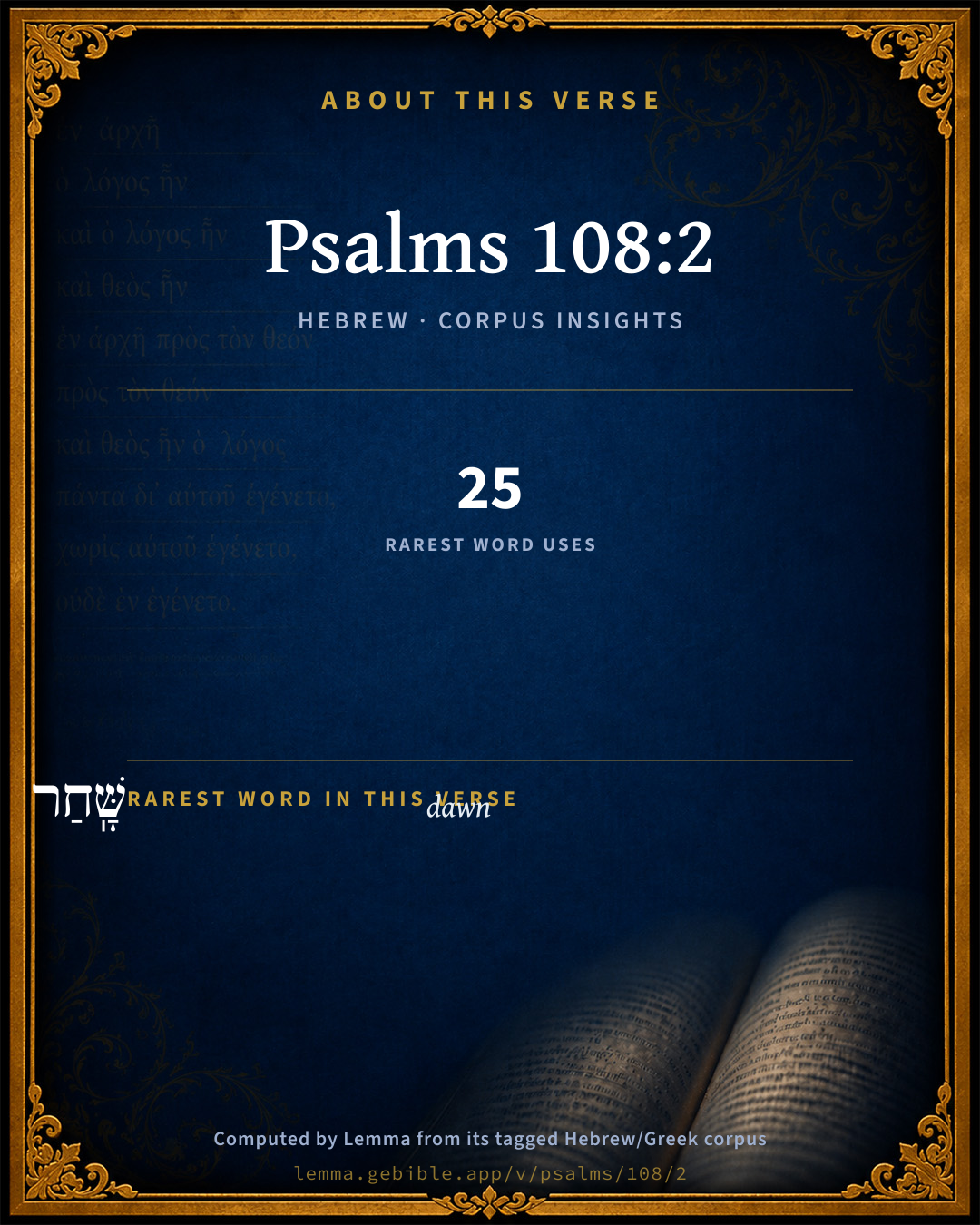
The rarest word here is שָּֽׁחַר dawn H7837 — appearing just 25 times in the whole Hebrew Bible.

Shared distinctive vocabulary

שָּֽׁחַר dawn H7837 occurs in 24 verses of the Hebrew Bible. Also found in:

Grammatical profile

  • 2 verbs
  • 3 nouns

Verb forms

  • ע֭וּרָֽה Qal · Imperative
  • אָעִ֥ירָה Hiphil · Cohortative

Repetition

A word recurs within this verse — often emphatic in Hebrew:

  • ע֭וּרָֽה to awake H5782 ×2

Hebrew & Septuagint length

In English translation the verse runs 11 words from the Hebrew and 8 from the Septuagint (LXX English) — closely comparable.

A rough comparison of the two English renderings, which tokenize alike — not a word-level alignment.

Word counts can differ between the Hebrew and the Greek without any difference in meaning — e.g. the Hebrew direct-object marker אֵת has no separate Greek word, and Greek often adds the article ὁ.

Cross-references

7

Topical passages linked to Psalms 108:2 in the Treasury of Scripture Knowledge — connected by theme and wording, ordered by reader-vote popularity; previews shown in the World English Bible.

  • Psalms 69:30 I will praise the name of God with a song, And will magnify him with thanksgiving.
  • Psalms 81:2 Raise a song, and bring here the tambourine, The pleasant lyre with the harp.
  • Psalms 33:2 Give thanks to Yahweh with the lyre. Sing praises to him with the harp of ten strings.
  • Psalms 57:8 Wake up, my glory! Wake up, psaltery and harp! I will wake up the dawn.
  • Psalms 92:1–4 It is a good thing to give thanks to Yahweh, To sing praises to your name, Most High;
  • Psalms 103:22 Praise Yahweh, all you works of his, In all places of his dominion. Praise Yahweh, my soul.
  • Judges 5:12 Awake, awake, Deborah; Awake, awake, utter a song: Arise, Barak, and lead away your captives, you son of Abinoam.

Cross-references courtesy of OpenBible.info (CC BY 4.0).

Hebrew and Greek witnesses Masoretic Hebrew ↔ Greek Septuagint

The same verse in the two great witnesses to the Old Testament, shown verse-for-verse.

You’re reading Greek Psalm 107 (Hebrew Psalm 108). The Septuagint counts the superscription, so verse numbers can differ from the Hebrew — chapter-level alignment, not verse-by-verse. Numbering follows Rahlfs.

These are two independent witnesses, not word-aligned to each other, and the Septuagint is shown in lemma (dictionary) form.

Hebrew Psalms 108:2 Masoretic · Westminster Leningrad Codex

ע֭וּרָֽה הַנֵּ֥בֶל וְכִנּ֗וֹר אָעִ֥ירָה שָּֽׁחַר

Wake up, harp and lyre! I will wake up the dawn.

World English Bible · Public Domain

Greek LXX Greek Psalm 107:2 Septuagint · lemma form

ἕτοιμος ὁ καρδία ἐγώ ὁ θεός ἕτοιμος ὁ καρδία ἐγώ ᾄδω καί ψάλλω ἐν ὁ δόξα ἐγώ

Awake, lute and harp; I will awake early.

LXX2012 (modern English Septuagint) · Public Domain

Hebrew: Westminster Leningrad Codex (CC BY 4.0). Greek: Septuagint (public domain); English from LXX2012 (modern English Septuagint) (Public Domain). How the Septuagint differs from the Hebrew →

Commentary

Notes on Psalms 108:2 from classic Christian and Jewish commentators (each source and its license shown beneath its notes). The classic Christian expositions comment on the surrounding passage and are grouped to its opening verse, so a note may address several verses; the Jewish commentaries on the Tanakh (Rashi and others) are per-verse, so they appear only where the commentator wrote on this verse.

Lemma curates 59 commentaries, every one of them public domain or Creative Commons licensed, each selected and text-cleaned for this edition rather than reprinted as found. About our sources →

The Treasury of David

Charles H. Spurgeon

Ver. 2. Awake, psaltery and harp. As if he could not be content with voice alone, but must use the well tuned strings, and communicate to them something of his own liveliness. Strings are wonderful things when some men play upon them, they seem to become sympathetic and incorporated with the minstrel as if his very soul were imparted to them and thrilled through them. Only when a thoroughly enraptured soul speaks in the instrument can music be acceptable with God: as mere musical sound the Lord can have no pleasure therein, he is only pleased with the thought and feeling which are thus expressed. When a man has musical gift, he should regard it as too lovely a power to be enlisted in the cause of sin. Well did Charles Wesley say:

"If well I know the tuneful art

To captivate a human heart,

The glory, Lord, be thine.

A servant of thy blessed will,

I here devote my utmost skill

To sound the praise divine."

"Thine own musician, Lord, inspire,

And let my consecrated lyre

Repeat the Psalmist's part.

His Son and Thine reveal in me,

And fill with sacred melody

The fibres of my heart."

I myself will awake early. I will call up the dawn. The best and brightest hours of the day shall find me heartily aroused to bless my God. Some singers had need to awake, for they sing in drawling tones, as if they were half asleep; the tune drags wearily along, there is no feeling or sentiment in the singing, but the listener hears only a dull mechanical sound, as if the choir ground out the notes from a worn out barrel organ. Oh, choristers, wake up, for this is not a work for dreamers, but such as requires your best powers in their liveliest condition. In all worship this should be the personal resolve of each worshipper: "I myself will awake."

Ver. 2. With reference to this passage the Talmud says, "A cithern used to hang above David's bed; and when midnight came the north wind blew among the strings, so that they sounded of themselves; and forthwith he arose and busied himself with the Torah until the pillar of the dawn ascended." Rashi observes, "The dawn awakes the other kings; but I, said David, will awake the dawn." Franz Delitzsch

Ver. 2. When the Hebrew captives were sitting in sorrow "by the waters of Babylon", they wept, and hung their harps on the willows, and could not be prevailed upon by the conquerors to sing "the songs of Zion in that land" (Ps 137:1, 4). But when "the Lord turned again the captivity of Zion, then was their mouth filled with laughter and their tongue with singing" (Ps 126:1-2). Then the psaltery and harp of former generations awoke (Ps 108:2). The old songs revived on their lips, and the melodies of David acquired new charms for them. Christopher Wordsworth.

Ver. 2. Awake early.

"Yet never sleep the sun up; prayer should

Dawn with the day, there are set awful hours

Between heaven and us; the manna was not good

After sun rising, for day sullies flowers." Henry Vaughan, 1621-1695.

Ver. 2. The benefit of early rising. The sweetness of the Sabbath morning early prayer meeting.

Psalms 108:3*

Charles H. Spurgeon's The Treasury of David (1869–1885) — public domain. Psalms only. Text from a community e-Sword/MySword module.

J. A. Alexander on Psalms

Joseph Addison Alexander

3. (Psa 108:2) Awake lute and harp! I will awaken the dawn (or morning). See above, on Psa 57:8. The only variation is the one already mentioned, the omission here of the words awake my glory, for which the last clause of Psa 108:1 is a substitute.

Joseph Addison Alexander, The Psalms Translated and Explained (1850) — public domain. Text from a community e-Sword module.

The Cambridge Bible for Schools and Colleges

gen. ed. J. J. S. Perowne

2. Awake, psaltery and harp] There is a special fitness in the call, if this Psalm was compiled at a time when the harp of Israel had long been mute in the Exile (Psa_137:2).

I myself will awake early] Better, as R.V. marg., I will awake the dawn. A bold and beautiful poetical figure. The dawn is often personified (Job_41:18; Psa_139:9). Usually it is the dawn that awakes men; the Psalmist will awake the dawn by his praises before daybreak.

The Cambridge Bible for Schools and Colleges (gen. ed. J. J. S. Perowne; Cambridge University Press, 1878–1918) — public domain. Text from a community e-Sword module.

Albert Barnes' Notes on the Bible

Awake, psaltery and harp ... - This is copied without change from Psa 57:8.

Albert Barnes' Notes on the Bible (1834–1885) — public domain. Text from a community e-Sword/MySword module.

The Pulpit Commentary

Awake, psaltery and harp: I myself will awake early. Ps 57 has, "Awake, my glory; awake, psaltery and harp," which is intelligible and forcible.

Morning religion.

"I myself will awake right early" (Revised Version). The idea seems to be, that the anxiety to be praising God is so strong in the psalmist that it actually wakes. A man wakes early when he has a mind burdened with business or family cares; the psalmist wakes early because his mind is burdened with its sense of indebtedness to God. Perhaps but few of us can say that we shorten our self-indulgent sleep for the sake of praise and prayer. Our Lord lived a crowded, bustled life; but as he must have, for sold-refreshing, daily communion with his Father, he was wont to "rise a great while before day." According to the Eastern use of the figure, waking early to do a thing was the sign of being thoroughly in earnest in the doing. A man has his heart in the thing which he gets up early to accomplish.

I MORNING RELIGION IS REFRESHING TO THE SOUL. Because then thought is free and emotion lively, and there is a bright and cheerful tone on all that is said and done. When wearied with the day and its toils and care, religious meditation easily becomes gloomy, the fatigued body flinging its shadows over all the expressions of the spirit. Give the freshness of morning thoughts to God, and that service will surely come back on you as refreshing.

II MORNING RELIGION IS ACCEPTABLE TO GOD. Because it shows him that we are in earnest in his service, and hold our very best as the fitting gift to offer to him. "The flower that"s offered in the bud is the best sacrifice." That is as true of the day as of the life. And God may be expected to estimate our gifts in the light of what they cost us to present to him. That is our way of appraising the gifts which we receive, and we may be sure that it is God"s way. What, then, is God"s estimate of our daily praise and thanksgiving? Does it really cost us much? It does if, for it, we awake early; preventing the day lest we should lose our holy opportunity, or be beneath our best and freshest in our communions.

III MORNING RELIGION IS INFLUENTIAL ON OTHERS. It is one of the most effective and impressive examples; and it has a special influence on the young, helping them to form good life-habits. Many of us can gratefully remember the influence of the early morning devotions of our parents. Let us gain the power on others which they have gained on us. R.T.

The Pulpit Commentary (1880–1919), ed. H.D.M. Spence-Jones & Joseph S. Exell — public domain. Text from a community e-Sword module.

Rashi

Rabbi Shlomo Yitzchaki (Rashi)

My heart is steadfast faithful with You.

even my glory Even my glory is what I sing to You. Another explanation: Even my glory Even according to my honor, I shall not hesitate to sing to Him, and I shall not take glory for myself.

Rashi on the Tanakh — English translations: “The Judaica Press complete Tanach with Rashi, translated by A. J. Rosenberg” (CC BY 4.0); “Pentateuch with Rashi's commentary by M. Rosenbaum and A.M. Silbermann, 1929-1934” (public domain); “The Metsudah Tanach series, Lakewood, N.J” (CC BY 4.0); and “The Book of Joshua, Metsudah Publications, 1997” (CC BY 4.0). Text via Sefaria.

Lesson kit

Teaching starters — assembled from the data on this page, not authored interpretation. Every prompt links to the verse data it draws on. Edit before teaching.

Psalms, in the Wisdom, opens this verse with 5 words (4 distinct Hebrew lemmas). Its most distinctive word is shachar (“dawn”). A historical commentator’s framing appears above. Read the whole chapter for the surrounding context.

Discussion questions

  1. What does “dawn” (shachar) contribute to the verse as a whole?
  2. How does Genesis 19:15, which shares the word «dawn», read alongside this verse?
  3. What does the repetition of “to awake” (2× in this one verse) do in this verse?
  4. The translations on this page render this verse differently — a whole-verse word diff, not a word-by-word alignment. What might account for the different wordings?
  5. «ע֭וּרָֽה» is a Qal Imperative verb. How does that grammatical form shape the action described?
  6. Compare how The Treasury of David and J. A. Alexander on Psalms read this verse. Where do they agree or differ?

Things to notice

  • These translations choose different wording for 9 words in this verse.
  • “to awake” occurs 2× in this single verse.
  • 4 distinct Hebrew lemmas span 5 words in this verse.

Reading settings

Reading text

Shown beneath each verse's original-language words.

Old Testament
Old Testament edition

Read the OT as the Masoretic Hebrew (MT) or the Greek Septuagint (LXX).

English shown for the Greek Septuagint (in the Hebrew ↔ Greek comparison).

Comparing translations? Open the Compare panel on any verse page to stack up to four side by side.