Jeremiah 50:41

Hebrew (Westminster Leningrad Codex) Jeremiah 50:41 appears in the Hebrew Old Testament. The text above is from the Westminster Leningrad Codex. Each word links to its Strong’s number, a concise gloss, and parsing drawn from the Open Scriptures Hebrew Bible morphology. Click any word for its full Brown-Driver-Briggs (BDB) entry.
Download image
Cite this verse

Jeremiah 50:41 (World English Bible). Public Domain. Lemma interlinear Bible study tool, https://lemma.gebible.app/v/jeremiah/50/41.

Show BibTeX & RIS
BibTeX
RIS
English Translation
Behold, a people comes from the north; and a great nation and many kings shall be stirred up from the uttermost parts of the earth.
World English Bible · Public Domain
Download a study sheet

One document with this verse’s original text, its word-by-word gloss line, the meaning frame, cross-references with their text, attributed commentary, and full source and license credits — printable, and it pastes into notes with its structure intact.

This verse Autodidact and up

Study sheet (.html) Plain text (.txt)

A passage Seminary Student

Up to 50 verses in one chapter. A passage sheet keeps up to 6 commentary sources and 12 cross-references per verse, in the order this page ranks them, and says so on the sheet whenever that leaves anything out. Ask for a single verse and you get the Autodidact verse sheet above.

Everything on this page stays free to read, with no account — the sheet is a download of what is already on screen, not access to it.

Want to remove ads? Support Godless Engineer
Compare translations 3

The same verse in 3 English versions, stacked beneath the original-language interlinear above. Click any original word for its lexicon entry.

Each is an independent rendering of the whole verse — the interlinear is not word-aligned to these translations.

Highlighted words mark where these versions differ — a whole-verse word diff, not a word-by-word alignment.

  • World English Bible Public Domain
    Behold, a people comes from the north; and a great nation and many kings shall be stirred up from the uttermost parts of the earth.
  • King James Version Public Domain
    Behold, a people shall come from the north, and a great nation, and many kings shall be raised up from the coasts of the earth.
  • unfoldingWord Literal Text CC BY-SA 4.0
    “See, a people is coming from the north; a great nation and many kings are being stirred up from the farthest parts of the earth.

unfoldingWord Literal Text — © unfoldingWord, licensed CC BY-SA 4.0. Word-aligned USFM3 via Door43 (git.door43.org/unfoldingWord/en_ult).

Versions to compare (up to 4)

3 of 4 selected

Show all 18 translations

Every available English version of this verse, each an independent rendering of the whole verse.

  • World English Bible Public Domain
    Behold, a people comes from the north; and a great nation and many kings shall be stirred up from the uttermost parts of the earth.
  • Berean Standard Bible Public Domain
    Behold, an army is coming from the north; a great nation and many kings are stirred up from the ends of the earth.
  • Majority Standard Bible Public Domain
    Behold, an army is coming from the north; a great nation and many kings are stirred up from the ends of the earth.
  • King James Version Public Domain
    Behold, a people shall come from the north, and a great nation, and many kings shall be raised up from the coasts of the earth.
  • American Standard Version (1901) Public Domain
    Behold, a people cometh from the north; and a great nation and many kings shall be stirred up from the uttermost parts of the earth.
  • Revised Version (1885) Public Domain
    Behold, a people cometh from the north; and a great nation, and many kings shall be stirred up from the uttermost parts of the earth.
  • Geneva Bible (1599) Public Domain
    Beholde, a people shall come from the North, and a great nation, and many Kings shall be raised vp from the coastes of the earth.
  • Douay-Rheims (1899) Public Domain
    Behold a people cometh from the north, and a great nation, and many kings shall rise from the ends of the earth.
  • Young's Literal Translation Public Domain
    Lo, a people hath come from the north, Even a great nation, And many kings are stirred up from the sides of the earth.
  • Literal Standard Version CC BY-SA 4.0
    Behold, a people has come from the north, || Even a great nation, || And many kings are stirred up from the sides of the earth.
  • Unlocked Literal Bible CC BY-SA 4.0
    “See, a people is coming from the north; a great nation and many kings are being stirred up from the farthest parts of the earth.
  • unfoldingWord Literal Text CC BY-SA 4.0
    “See, a people is coming from the north; a great nation and many kings are being stirred up from the farthest parts of the earth.
  • Darby Bible Public Domain
    Behold, a people cometh from the north, and a great nation. And many kings shall arise from the uttermost parts of the earth.
  • World Messianic Bible Public Domain
    “Behold, a people comes from the north. A great nation and many kings will be stirred up from the uttermost parts of the earth.
  • Webster's Bible Public Domain
    Behold, a people shall come from the north, and a great nation, and many kings shall be raised up from the borders of the earth.
  • Free Bible Version CC BY-SA 4.0
    Look! An army is advancing from the north. A great nation and many kings are coming against you from the distant lands.
  • Bible in Basic English Public Domain
    See, a people is coming from the north; a great nation and a number of kings will be put in motion from the inmost parts of the earth.
  • JPS Tanakh (1917) Public Domain
    Behold, a people cometh from the north, and a great nation, and many kings shall be roused from the uttermost parts of the earth.

Literal Standard Version (2020), Covenant Press — licensed CC BY-SA 4.0. Text via the HelloAO Bible API (eBible.org). Unlocked Literal Bible (unfoldingWord) — licensed CC BY-SA 4.0. Text via the HelloAO Bible API (eBible.org). unfoldingWord Literal Text — © unfoldingWord, licensed CC BY-SA 4.0. Word-aligned USFM3 via Door43 (git.door43.org/unfoldingWord/en_ult). Free Bible Version, Dr. Jonathan Gallagher — licensed CC BY-SA 4.0. Text via the HelloAO Bible API (eBible.org).

Word by word

More ways to search: Search by grammar → Find every occurrence → Compare this word →

Practice this passage: Drill this verse → Learn its vocabulary →

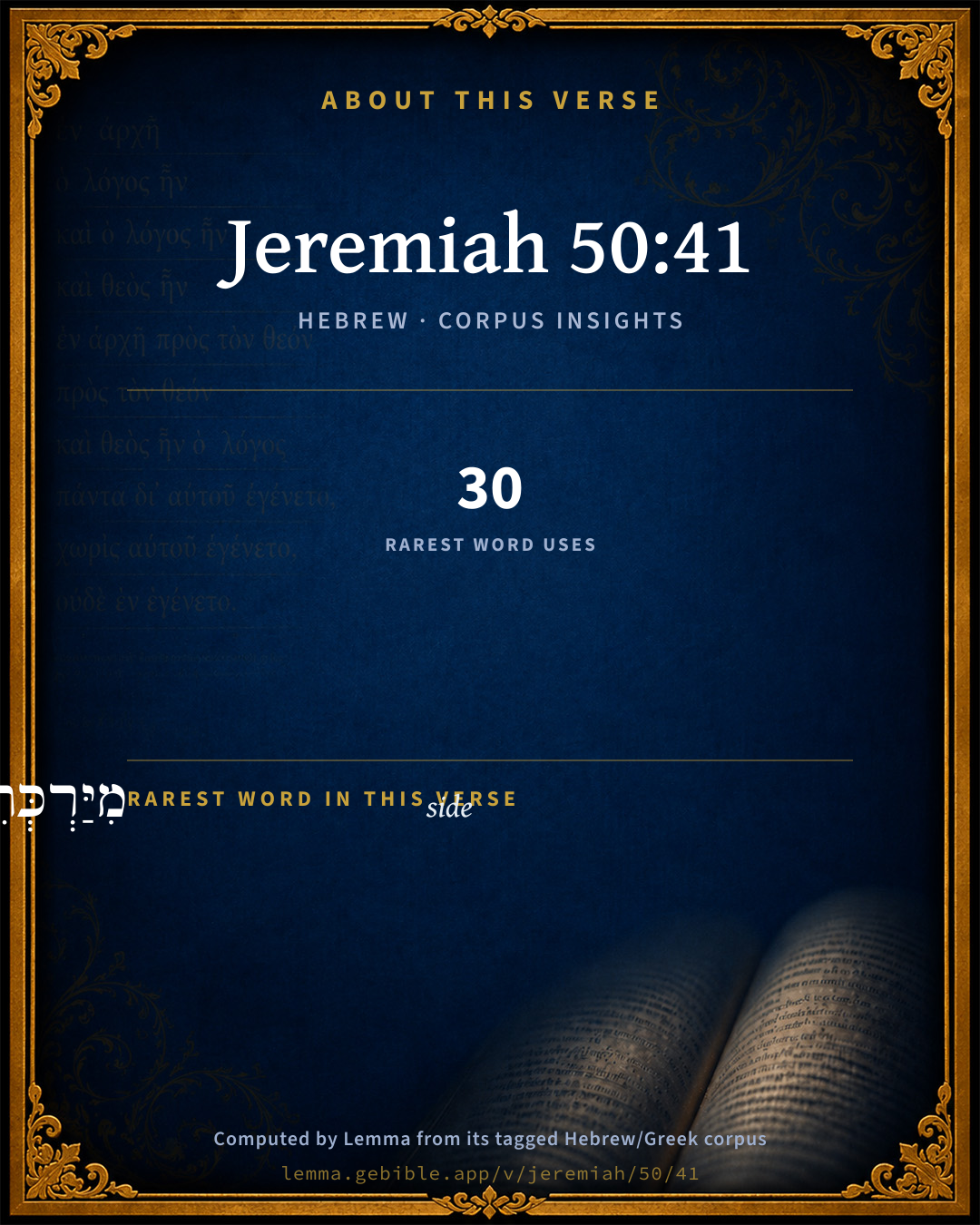
מִיַּרְכְּתֵי
yᵉrêkâh
H3411
“from · sides of”
Preposition + Noun, Common, Feminine, Dual, Construct
Part of Speech
Preposition + Noun
Type
Common
Gender
Feminine
Number
Dual
State
Construct
Full BDB Definition

Origin: from H3409

TWOT: 916b

flank, side, extreme parts, recesses - side - sides, recesses (dual)
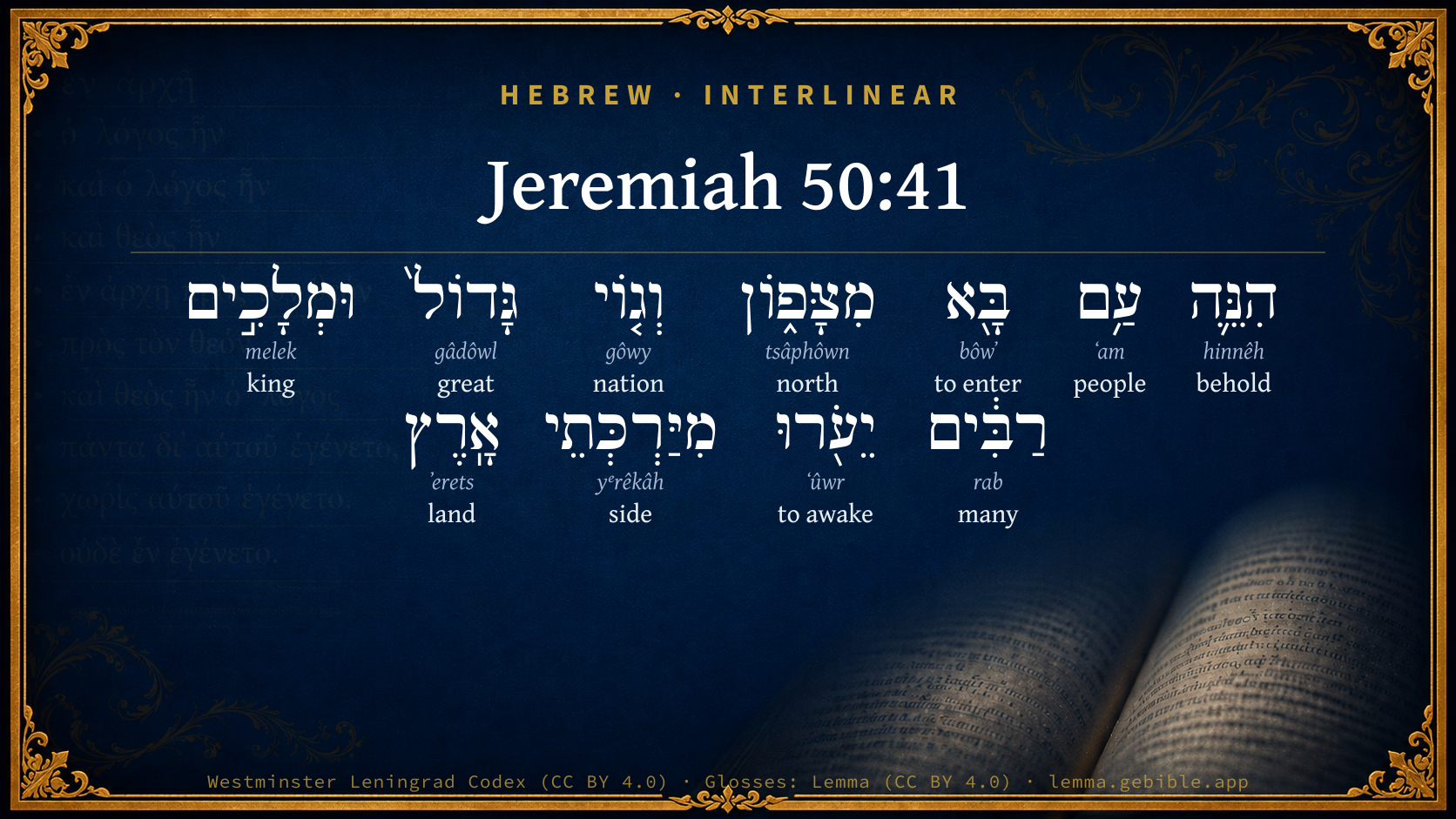
  1. הִנֵּ֛ה hinnêh H2009 “behold” Particle, Demonstrative
  2. עַ֥ם ʻam H5971 “people” Noun, Common, Masculine, Singular, Absolute
  3. בָּ֖א bôwʼ H935 “to enter” Verb, Qal, Perfect, 3rd Person, Masculine, Singular
  4. מִצָּפ֑וֹן tsâphôwn H6828 “from · north” Preposition + Noun, Common, Feminine, Singular, Absolute
  5. וְג֤וֹי gôwy H1471 “and · nation” Conjunction + Noun, Common, Masculine, Singular, Absolute
  6. גָּדוֹל֙ gâdôwl H1419 “great” Adjective, Adjective, Masculine, Singular, Absolute
  7. וּמְלָכִ֣ים melek H4428 “and · kings” Conjunction + Noun, Common, Masculine, Plural, Absolute
  8. רַבִּ֔ים rab H7227 “many” Adjective, Adjective, Masculine, Plural, Absolute
  9. יֵעֹ֖רוּ ʻûwr H5782 “to awake” Verb, Niphal, Imperfect, 3rd Person, Masculine, Plural
  10. אָֽרֶץ ʼerets H776 “land” Noun, Common, Both, Singular, Absolute

About this verse

These counts appear in no published source. They are computed here, from the morphology-tagged text and Lemma’s own curated glosses. What Lemma adds →

11
words
11
distinct lemmas
Prophets
section

Shared distinctive vocabulary

מִיַּרְכְּתֵי side H3411 occurs in 28 verses of the Hebrew Bible. Also found in:

Grammatical profile

  • 2 verbs
  • 6 nouns
  • 2 adjectives
  • 1 particle

Verb forms

  • בָּ֖א Qal · Perfect
  • יֵעֹ֖רוּ Niphal · Imperfect

Cross-references

10

Topical passages linked to Jeremiah 50:41 in the Treasury of Scripture Knowledge — connected by theme and wording, ordered by reader-vote popularity; previews shown in the World English Bible.

  • Jeremiah 51:27–28 Set up a standard in the land, blow the trumpet among the nations, prepare the nations against her, call together against her the kingdoms of Ararat, Minni, and Ashkenaz: appoint a marshal against her; cause the horses to come up as the rough canker-worm.
  • Isaiah 13:2–5 Set up an ensign on the bare mountain, lift up the voice to them, wave the hand, that they may go into the gates of the nobles.
  • Jeremiah 6:22–23 Thus says Yahweh, Behold, a people comes from the north country; and a great nation shall be stirred up from the uttermost parts of the earth.
  • Jeremiah 50:9 For, behold, I will stir up and cause to come up against Babylon a company of great nations from the north country; and they shall set themselves in array against her; from there she shall be taken: their arrows shall be as of an expert mighty man; none shall return in vain.
  • Isaiah 13:17–18 Behold, I will stir up the Medes against them, who shall not regard silver, and as for gold, they shall not delight in it.
  • Jeremiah 25:14 For many nations and great kings shall make bondservants of them, even of them; and I will recompense them according to their deeds, and according to the work of their hands.
  • Jeremiah 50:2–3 Declare you among the nations and publish, and set up a standard; publish, and don't conceal: say, Babylon is taken, Bel is disappointed, Merodach is dismayed; her images are disappointed, her idols are dismayed.
  • Jeremiah 51:1–2 Thus says Yahweh: Behold, I will raise up against Babylon, and against those who dwell in Lebkamai, a destroying wind.
  • Jeremiah 51:11 Make sharp the arrows; hold firm the shields: Yahweh has stirred up the spirit of the kings of the Medes; because his purpose is against Babylon, to destroy it: for it is the vengeance of Yahweh, the vengeance of his temple.
  • Revelation 17:16 The ten horns which you saw, and the beast, these will hate the prostitute, and will make her desolate, and will make her naked, and will eat her flesh, and will burn her utterly with fire.

Cross-references courtesy of OpenBible.info (CC BY 4.0).

Hebrew and Greek witnesses Masoretic Hebrew ↔ Greek Septuagint

The same verse in the two great witnesses to the Old Testament, shown verse-for-verse.

These are two independent witnesses, not word-aligned to each other, and the Septuagint is shown in lemma (dictionary) form.

Hebrew Jeremiah 50:41 Masoretic · Westminster Leningrad Codex

הִנֵּ֛ה עַ֥ם בָּ֖א מִצָּפ֑וֹן וְג֤וֹי גָּדוֹל֙ וּמְלָכִ֣ים רַבִּ֔ים יֵעֹ֖רוּ מִיַּרְכְּתֵי אָֽרֶץ

Behold, a people comes from the north; and a great nation and many kings shall be stirred up from the uttermost parts of the earth.

World English Bible · Public Domain

Greek LXX Structure differs

In the Septuagint, Jeremiah is about an eighth shorter than the Hebrew and arranges its material differently — the Oracles Against the Nations (Hebrew chapters 46–51) appear in the middle of the Greek book, after 25:13. Because the chapter and verse boundaries do not line up, a verse-for-verse comparison with the Hebrew is not shown.

A verse-for-verse comparison isn’t shown here because the chapters and verses don’t line up. Switch to the LXX edition with the MT / LXX toggle above to read the Greek directly.

On this verse, Keil & Delitzsch discusses the Septuagint’s reading. Read the note in Commentary ↓

Hebrew: Westminster Leningrad Codex (CC BY 4.0). Greek: Septuagint (public domain); English from a public-domain English Septuagint. How the Septuagint differs from the Hebrew →

Targum (Aramaic paraphrase)

1

The Targum is the ancient Jewish Aramaic paraphrase of the Hebrew Scriptures — an interpretive translation, not the Hebrew text itself. Onkelos (literal) and Pseudo-Jonathan (expansive) render the Torah, and Jonathan the Prophets. Coverage is partial: where no permissively-licensed English translation exists for a verse, only the Aramaic is shown. This is verse-level text, not a word-by-word alignment to the Hebrew.

  1. Targum Jonathan Prophets (Joshua–Malachi)
    הָא עַמָא אֲתָא מִצִפּוּנָא וְעַמְמִין רַבְרְבִין וּמַלְכִין סַגִיאִין יֵיתוּן בִּגְלֵי מִסְיָפֵי אַרְעָא:

    (no public-domain English translation for this verse)

    Targum Jonathan — Aramaic: “Mikraot Gedolot” (public domain). English: “Sefaria Community Translation” (CC0 1.0 (public-domain dedication)); “London "Chaldee Paraphrase," 1871” (public domain). Text via Sefaria.

Commentary

Notes on Jeremiah 50:41 from classic Christian and Jewish commentators (each source and its license shown beneath its notes). The classic Christian expositions comment on the surrounding passage and are grouped to its opening verse, so a note may address several verses; the Jewish commentaries on the Tanakh (Rashi and others) are per-verse, so they appear only where the commentator wrote on this verse.

Lemma curates 59 commentaries, every one of them public domain or Creative Commons licensed, each selected and text-cleaned for this edition rather than reprinted as found. About our sources →

Trapp's Complete Commentary

John Trapp

Jer 50:41 Behold, a people shall come from the north, and a great nation, and many kings shall be raised up from the coasts of the earth.

Ver. 41. Behold, a people shall come from the north.] As Jer 50:3; Jer 50:9; Jer 6:22.

John Trapp, A Commentary or Exposition upon All the Books of the Old and New Testament (1647–1656) — public domain. Text from a community e-Sword module.

Albert Barnes' Notes on the Bible

An application to Babylon of the doom against Jerusalem Jer 6:22-24.

Jer 50:41

The coasts of the earth - See the Jer 6:22 note.

Albert Barnes' Notes on the Bible (1834–1885) — public domain. Text from a community e-Sword/MySword module.

Joseph Benson's Commentary

Jer 50:41-46. Behold, a people shall come from the north — Namely, the Medes; and a great nation — That is, who are a great nation; for this is no more than an explicative of the foregoing sentence. And many kings — Namely, the kings of the Persians, Armenians, Hyrcanians, Cadusians, and others who fought under Cyrus’s banner, as allies or friends to him. Their voice shall roar like the sea — The noise of an army is fitly compared to the roaring of the sea when it rages and is tempestuous. Every one put in array — In exact and firm order, as if the whole host were but one man. The king of Babylon hath heard, &c. — Belshazzar was of himself a weak and dissolute prince, and was soon routed in the field; and so dismayed that he shut himself up in Babylon. Behold, he shall come up like a lion — See notes on Jer 49:19-21, where we have applied unto Edom what is here spoken against Babylon. At the noise of the taking of Babylon the earth is moved, and the cry is heard, &c. — These words are intended to express the greatness of the destruction of Babylon, which should be such as should make all that part of the world to shake and tremble; and the nations, whether near or far remote, should be astonished at the downfall of so great a city and potent an empire.

Joseph Benson's Commentary on the Old and New Testaments (1811–1818) — public domain. Text from a community e-Sword module.

Whedon's Commentary on the Bible

Daniel D. Whedon

THE AGENTS OF THIS DESTRUCTION, Jer_50:41-46.

41-46. A people shall come from the north, etc. — A more particular description of the agents of Babylon’s overthrow, consisting, however, almost exclusively of the materials found in previous passages.

Daniel D. Whedon (gen. ed.), Commentary on the Old and New Testaments (1874–1909) — public domain. Text from a community e-Sword module.

Keil & Delitzsch

C. F. Keil & F. Delitzsch

The agents who execute the judgment. - Jer 50:41. "Behold, a people shall come from the north, and a great nation, and many kings shall be raised up from the most distant sides of the earth. Jer 50:42. Bow and javelin shall they seize: they are cruel, and will not pity; their voice shall sound like the sea, and they shall ride upon horses, [each one] arrayed like a man for the battle, against thee, O daughter of Babylon. Jer 50:43. The king of Babylon hath heard the report concerning them, and his hands have fallen down: distress hath seized him, writing pain, like [that of] the woman in childbirth. Jer 50:44. Behold, he shall come up like a lion from the glory of Jordan to a habitation of rock; but in a moment will I make them run away from her, and will set over her him who is chosen: for who is like me, and who will appoint me a time [to plead my defence]? and what shepherd [is there] that will stand before me? Jer 50:45. Therefore hear ye the counsel of Jahveh which He hath taken against Babylon, and His purposes which He hath purposed against the land of the Chaldeans: Assuredly they shall drag them away, the smallest of the flock; assuredly [their] habitation shall be astonished at them. Jer 50:46. At the cry, 'Babylon is taken,' the earth is shaken, and a cry [for help] is heard among the nations.

Jeremiah 51

Jer 51:1-4

"Thus saith Jahveh: Behold, I will stir up against Babylon, and against the inhabitants of [as it were] the heart of mine opponents, the spirit of a destroyer. Jer 51:2. And I will send against Babylon strangers, and they shall winnow her, and empty her land, because they are against her round about in a day of evil. Jer 51:3. Against [him who] bends let the bender bend his bow, and against [him who] lifts up himself in his coat of mail: and do not spare her young men; devote to destruction all her host, Jer 51:4. That slain ones may fall in the land of the Chaldeans, and those that are pierced through in her streets."

The greater portion of this strophe consists of quotations from former utterances. Jer 51:41-43 are taken from Jer 6:22-24, and Jer 51:44-46 from Jer 49:19-21; here they are applied to Babylon. What is said in Jer 6:22-24 concerning the enemy out of the north who will devastate Judah, is here transferred to the enemy that is to destroy Babylon. For this purpose, after the words "and a great nation," are added "and many kings," in order to set forth the hostile army advancing against Babylon as one composed of many nations; and in consequence of this extension of the subject, the verb יערוּ is used in the plural, and אכזרי is changed into אכזרי המּה. Moreover, the mention of the "daughter of Babylon" instead of the "daughter of Zion" is attended by a change from the directly communicative form of address in the first person ("We have heard," etc., Jer 51:43) into the third person ("The king of Babylon hath heard," etc.). In applying the expression used in Jer 49:19-21 regarding the instrument chosen for the destruction of Edom, to the instrument selected against Babylon (Jer 51:44-46), the names "Babylon" and "and land of the Chaldeans" are substituted for "Edom" and "the inhabitants of Teman" (Jer 49:20); but beyond this, only the last verse is changed, in accordance with the change of circumstances. The thought that, in consequence of the fall of Edom, the earth trembles, and Edom's cry of anguish is heard on the Red Sea, is intensified thus: by the sound or cry, "Babylon is taken," the earth is shaken, and a cry is heard among the nations. The conquest of Babylon, the mistress of the world, puts the whole world in anxiety and fear, while the effects of Edom's fall extend only to the Red Sea. The Kethib ארוצם, Jer 51:44, seems to come from the verb רצץ, in the sense of pushing, so that it is not a mere error in transcription for אריצם. Moreover, such changes made on former utterances, when they are repeated and applied to Babylon, show that these verses are not glosses which a reader has written on the margin, and a later copyist inserted into the text, but that Jeremiah himself has applied these earlier words in his address against Babylon. The two passages are not merely quite appropriately arranged beside one another, but even present in their connection a thought which has not hitherto been met with in the address against Babylon, and which does not recur afterwards. The enemy that is to conquer Babylon is certainly pointed out, so early as v. 9, as an assemblage of great nations out of the north, but not more particularly characterized there; but the nations that are to constitute the hostile army are not further designated till Jer 51:11 and Jer 51:27. The second quotation, Jer 51:44-46, adds the new thought that the appearance of this enemy against Babylon is owing to a decree of the Lord, the execution of which no man can prevent, because there is none like Jahveh. The figurative description of the enemy as a lion coming up out of the thicket of reeds at the Jordan, frightening the herd feeding on their pasture-ground, and carrying off the weakly sheep, is appropriate both to Nebuchadnezzar's expedition against Edom, and to the invasion of Babylonia by the Medes and their allies, for the purpose of laying waste the country of the Chaldeans, smiting the inhabitants of Babylon, and conquering it. Even the expression נוה permits of being applied to Babylonia, which was protected by its canal system and the strong walls of its capital.

Jer 51:1-2

In Jer 51:1-4, the terrible character of the hostile nation is further described. Against Babylon and the inhabitants of Chaldea, God stirs up the "spirit of a destroyer," viz., a savage nation that will massacre the Chaldeans without pity. לב , lit., "the heart of mine adversaries," is the word כּשׂדּים, changed, according to the canon Atbash (see on Jer 25:26), for the purpose of obtaining the important meaning that Chaldea is the centre of God's enemies. This explanation of the name involves the thought that all enmity against God the Lord culminates in Babylon; on the basis of this representation Babylon is called, Rev 17:5, "the mother of harlots and abominations of the earth." רוּח משׁחית does not mean καύσωνα διαφθείροντα (lxx), ventum pestilentem (Vulgate), "a sharp wind" (Luther), nor, as it is usually translated, "a destroying wind;" for העיר רוּח is nowhere used of the rousing of a wind, but everywhere means "to rouse the spirit of any one," to stir him up to an undertaking; cf. Hag 1:14; Ch1 5:26; Ch2 21:16, and Ch2 36:22. Jeremiah also employs it thus in Jer 51:11, and this meaning is quite suitable here also. משׁחית is a substantive, as in Jer 4:7 : "the spirit of a destroyer." The figure of winnowing, which follows in Jer 51:2, does not by any means necessarily require the meaning "wind," because the figure contained in the word זרוּה was first called forth by the employment of זרים, "strangers" = barbarians. The sending of the זרים to Babylon has no connection with the figure of the wind, and it even remains a question whether זרוּה really means here to winnow, because the word is often used of the scattering of a nation, without any reference to the figure of winnowing; cf. Lev 26:33; Eze 5:10; Eze 12:15, etc., also Jer 49:32, Jer 49:36. However, this thought is suggested by what follows, "they empty her hand," although the clause which assigns the reason, "because they are against her round about" (cf. Jer 4:17), does not correspond with this figure, but merely declares that the enemies which attack Babylon on every side disperse its inhabitants and empty the land.

Jer 51:3-4

These strangers shall kill, without sparing, every warrior of Babylon, and annihilate its whole military forces. In the first half of the verse the reading is doubtful, since the Masoretes would have the second ידרד (Qeri) expunged, probably because (as Bttcher, N. Aehrenl. ii. S. 166, supposes) they considered it merely a repetition. The meaning is not thereby changed. According to the Qeri, we would require to translate, "against him who bends the bow, may there be, or come, one who bends his bow;" according to the Kethib, "against him who bends the bow, may he who bends his bow bend it." As to אל־ידרך with אשׁר omitted, cf. Ch1 15:12; Ch2 1:4, and Ewald, 333, b. יתעל בּס' stands in apposition to אל־ידרך ; יתעל is the Hithpael from עלה, and means to raise oneself: it is to be taken as the shortened form of the imperfect passive; cf. Gesenius, 128, Rem. 2. Certainly, the Hithpael of עלה occurs nowhere else, but it is quite appropriate here; so that it is unnecessary, with Hitzig, to adduce, for explanation, the Arabic tl', to stretch the head out of anything, or, with Ewald, to derive the form from the Aramaic עלל, Arabic gl, to thrust in. Neither is there any foundation for the remark, that the abbreviated form of the imperfect would be admissible only if אל were found instead of אל. Indeed, the Syriac, Targum, and Vulgate have actually read and rendered from אל, which several codices also present, "Let him not bend his bow, nor stretch himself in his coat of mail." But by this reading the first half of the verse is put in contradiction to the second; and this contradiction is not removed by the supposition of J. D. Michaelis and Hitzig, who refer these clauses to the Chaldeans, and find the thought expressed in them, that the Chaldeans, through loss of courage, cannot set themselves for defence. For, in that case, we would be obliged, with Hitzig, to explain as spurious the words that follow, "and spare ye not her young men;" but for this there is no valid reason. As to החרימוּ, cf. Jer 50:21, Jer 50:26. On Jer 51:4, cf. Jer 50:30 and Jer 49:26. The suffix in "her streets" refers to Babylon.

Keil & Delitzsch — Biblical Commentary on the Old Testament (1861–1891) — public domain (CC PDM 1.0). Text via the HelloAO Bible API. (Old Testament only.)

Lange's Commentary on the Holy Scriptures

10. NON TU, SED TIBI

Jer_50:41-46

41          Behold, a people cometh from the north,

And a great host and many kings break up from the ends of the earth.

42     Bow and lance they bear,

Cruel are they33 and without compassion.

Their sound roareth like the sea,

And on horses they ride equipped like a man for the battle

Against thee, thou daughter of Babylon.

43     The king of Babylon hath heard the report of them,

And his hands are feeble;

Anguish hath seized him, trembling as a parturient.

44     Behold, like a lion he ascends

From the pride of Jordan to the evergreen pasturage,

For in a twinkling I drive her34 from thence,

And—who is chosen? Him I set over her.

For who is like me, and who will order me?

And who is the shepherd who may stand before me?

45     Therefore hear the counsel of Jehovah that he hath counselled against Babylon,

And his thoughts which he hath thought against the land of the Chaldeans:

Yea, they will be dragged away, the weak little sheep,

Yea, the pasturage will be amazed concerning them.

46     With the cry, “Babylon is taken,” the earth trembles,

And a crying is heard35 among the nations.

EXEGETICAL AND CRITICAL

This entire passage consists of quotations, Jer_50:41-43 being taken from Jer_6:22-24, Jer_50:44-46 from Jer_49:19-21. As the prophet has already repeatedly designated the enemy as one coming from the north, it was natural to apply the former prophecy of the enemy threatening Judah from the north to Babylon, and it must also be admitted that the prophet would find it appropriate to transfer the prophecy of the chosen instrument for the destruction of Edom (Jer_49:19-21) to the similarly chosen instrument of the destruction of Babylon. Although thus the quotations here are accumulated to a degree greater than heretofore, I am yet convinced (contrary to my former view in Der proph. Jer. u. Bab., S. 128 ff.) that the passage is genuine and original. The idea of the unity of God’s judgments and of just recompense was to be represented here. This would receive no detriment, even if every single feature of the former prophecies did not seem adapted to be applied to Babylon. This, however, is not the case, for we find in the text such modifications as the application to Babylon required; daughter of Babylon, Jer_50:42; King of Babylon, Jer_50:43; against Babylon and the land of the Chaldeans, Jer_50:45; Babylon is taken, Jer_50:46; among the nations, for, in the Red Sea, Jer_50:46. What is not altered is not then opposed, according to the author’s judgment, to its application to Babylon. The figure in Jer_50:44 a is therefore not inappropriate. The pride of Jordan and evergreen pasturage belong to the picture. The lion, which, from the reed-thickets on the Jordan, falls upon the flocks feeding near the bank (comp. rems. on Jer_49:19), is a figure which may be applied to any case of overpowering hostile attack. Likewise the description of the northern people (Jer_6:23) is by no means so special that it may not be applied to any people advancing with warlike impetuosity. Moreover, Jeremiah, when he wrote Jer_6:22-24, neither had the Chaldeans specially in view, nor are they so very different from their neighbors, the Medes.

The addition and many kings in Jer_50:41 is thus explained, that in the conception of the prophet the picture was present of a host of enemies, composed of many different elements (comp. Jer_51:27-28).

Footnotes:

[33]Jer_50:42.—אכזרי המה. Comp. Naegelsb. Gr., §105, 4, b, 2.

[34]Jer_50:44.—ארוצם is probably only a mistake, and is therefore to be read with the Keri אֲרִיצֵמ (comp. אֲרִיצֶנּוּ Jer_49:19).

[35]Jer_50:46.—נשׁמע is occasioned by Jer_49:21, and moreover comp. Naegelsb. Gr., § 60, 4.

Lange's Commentary on the Holy Scriptures (Critical, Doctrinal, and Homiletical), ed. John Peter Lange, English translation edited by Philip Schaff (1864–1880) — public domain. Text from a community e-Sword module.

Geneva Bible (1599)

Geneva Bible translators

Meaning, that the Persians should gather their army of many nations.

Geneva Bible (1599) marginal notes — public domain. Text via Bolls.life.

Jamieson, Fausset & Brown

Robert Jamieson, A. R. Fausset & David Brown

(Compare Jer 6:22-24). The very language used to describe the calamities which Babylon inflicted on Zion is that here employed to describe Babylon's own calamity inflicted by the Medes. Retribution in kind.

kinds--the allies and satraps of the various provinces of the Medo-Persian empire: Armenia, Hyrcania, Lydia, &c.

coasts--the remote parts.

Jamieson, Fausset & Brown — Commentary Critical and Explanatory on the Whole Bible (1871) — public domain (CC PDM 1.0). Text via the HelloAO Bible API.

Adam Clarke's Commentary

Verse 41. Behold, a people shall come from the north] This and the two following verses are nearly the same with Jer 6:22-24. But here, destroyers against Babylon are intended; there, destroyers against Jerusalem.

Adam Clarke's Commentary on the Bible (1810–1826) — public domain. Text from a community e-Sword/MySword module.

John Calvin's Commentaries

The Prophet again shows whence destruction was to come on the Babylonians. He does not indeed mention Cyrus, as Isaiah does (Isaiah 44:28; 45:1), nor does he mention the Persians; but he evidently points out the Medes, when he says that a people would come from the north He adds, a great nation and many or powerful kings; and lastly, from the sides of the earth. It is indeed certain that the war was carried on under the banner and command of Cyrus and Darius. Cyrus was the chief, but Darius, on account of his age, was deemed the king. To whom then does Jeremiah refer, when he says many kings, if we so render the words? even to the satraps or princes, of whom a great number Darius brought with him; for Cyrus came from remote mountains, and from a barbarous nation; but the kingdom of Darius was very wide. There is then no doubt but that he brought with him many kings, who yet obeyed his authority. But we may take רבים, rebim, in the sense of being strong. However this may be, the Prophet means that the Chaldeans would have to carry on war, not with one nation or one king, but with many nations and with many kings, or certainly with mighty kings. Hence he mentions the sides of the earth, by which phrase he reminds us that the army would come, not from one country but from remote parts; and though the distance might be great, yet the Prophet says, that they would all come together to attack the Chaldeans.

We now see that what afterwards happened is represented as in a picture, in order that the event itself might confirm the Jews, not only in the truth announced by Jeremiah, but also in the whole law and worship of God; for this prophecy was ratified to the faithful when they found that Jeremiah, a faithful interpreter of the law, had thus spoken. And then his doctrine availed also for another purpose, even that the people might know that they rebelled against God when they obstinately resisted the holy Prophet; for we know that they were extremely disobedient. They were then proved, by what happened, to have been guilty of having contended with God in their pertinacious wickedness and contempt. There was afterwards given them a sure ground of hope; for as Jeremiah had spoken of the destruction of Babylon, so, on the other hand, he had promised a return to the Jews. They had then reason to look for restoration, when they saw fulfilled what Jeremiah had spoken.

By the word raised, he expresses something more than by the word come: he says that people would come, and adds, that they would be raised up or roused; he intimates that they would not come of themselves, but by the hidden influence of God, because this war was not carried on merely by men. Cyrus indeed, led by insatiable avarice and ambition, was guided by his own inclination to undertake this war; and he made no end of his cruelty, until he at length miserably died, for he never ceased to shed innocent blood everywhere. But yet the Lord made use of these kings and nations to destroy Babylon: they were in reality the scourges of God, and accordingly he says, that they were roused from the sides of the earth, that is, from the most distant places.

John Calvin's Commentaries (1540-1563) — public domain. Text from the Calvin Translation Society English edition (1840s-50s) via the Christian Classics Ethereal Library (ccel.org). Calvin's coverage is partial (roughly two-thirds of the Bible); uncommented books and verses are honest gaps, never fabricated. The 19th-century editor's footnotes and remarks are omitted so the notes are faithfully Calvin's own voice.

The Cambridge Bible for Schools and Colleges

gen. ed. J. J. S. Perowne

41. a people] the Persians. See reference in mg.

from the north] Cp. Jer_50:9.

41–43. A repetition, with the necessary changes, of Jer_6:22-24, where Jerusalem is the object of the threat. See notes there.

The Cambridge Bible for Schools and Colleges (gen. ed. J. J. S. Perowne; Cambridge University Press, 1878–1918) — public domain. Text from a community e-Sword module.

John Gill's Exposition

Behold, a people shall come from the north, and a great nation,.... The Modes and Persians, whose country lay north of Babylon: See Gill on Jer 50:9;

and many kings shall be raised up from the coasts of the earth; the kings of Ararat, Minni, and Ashchenaz, Jer 51:27; and of the Armenians and other nations that Cyrus had subdued and brought with him in his army against Babylon, as Xenophon (s) relates. Ten kings shall be raised up against mystical Babylon, and hate her, and burn her with fire, Rev 17:12.

(s) Cyropaedia, l. 5. c. 15.

John Gill's Exposition of the Whole Bible (1746–1763) — public domain (CC PDM 1.0). Text via the HelloAO Bible API.

Matthew Poole's English Annotations

The Medes and Persians with their armies, who shall also have many other kings who, from the several parts of the earth, shall join with them and help them.

Matthew Poole's English Annotations on the Holy Bible (1683–1685) — public domain. Text from a community e-Sword/MySword module.

The Pulpit Commentary

Jer_51:4. The instruments of the judgment. The section is partly a cento from other prophecies. Thus vers. 41-43 are a repetition of Jer_6:22-24, except that what is there said of Jerusalem is here applied to Babylon; and vers. 44-46 of Jer_49:19-21, the reference, however, being in the latter passage to Edom. In ver. 46 At the noise of the taking of Babylon would be more literally rendered, At the cry, Babylon is taken.

The Pulpit Commentary (1880–1919), ed. H.D.M. Spence-Jones & Joseph S. Exell — public domain. Text from a community e-Sword module.

unfoldingWord translationNotes

Door43 World Missions Community

General Information:

These verses are almost identical to Jeremiah 6:22 and Jeremiah 6:23. See how you translated those verses.

See, a people is coming

Yahweh speaks to the people of Babylon. This can be made clear. AT: "See, people of Babylon, a people is coming" (See: Assumed Knowledge and Implicit Information)

See, a people

"Pay attention, because what I am about to say is both true and important: a people"

a great nation and many kings

This phrase refers to the time when the Medes and Persians conquered Babylon in 539 BC. Here "nation" represents their armies. AT: "the armies of a great nation and many kings" (See: Synecdoche)

are being stirred up from the farthest parts of the earth

Being "stirred up" represents being urged to take action. AT: "are preparing to come from the most distant places on earth" (See: Metaphor and Active or Passive)

They will pick up bows and spears

"The soldiers will carry bows and spears"

Their sound is like the sea roar

The loud noise that the soldiers make is compared to the loud noise of the sea. AT: "The sound that they make is very loud, like the sound of the sea" (See: Simile)

they are riding on horses, set out in order as men for battle

The phrase "set out in order" means that they have organized themselves and are riding in rows. The phrase "as men for battle" indicates that they are ready to fight. AT: "they are riding on horses in their assigned rows, and they are ready to fight"

daughter of Babylon

This phrase refers to the Babylonian people. (See: Metonymy)

translationWords

nation

king

bow and arrow

spear

compassion

unfoldingWord translationNotes — © Distant Shores Media and the Door43 World Missions Community, licensed CC BY-SA 4.0. Source: git.door43.org/Door43/en_tn.

Lesson kit

Teaching starters — assembled from the data on this page, not authored interpretation. Every prompt links to the verse data it draws on. Edit before teaching.

Jeremiah, in the Prophets, opens this verse with 11 words (11 distinct Hebrew lemmas). Its most distinctive word is yᵉrêkâh (“side”). A historical commentator’s framing appears above. Read the whole chapter for the surrounding context.

Discussion questions

  1. How does “side” (yᵉrêkâh) shape what this verse is saying?
  2. How does Genesis 49:13, which shares the word «side», read alongside this verse?
  3. These translations render this verse differently; the difference is in the English rendering, not the original. What questions does that raise?
  4. «בָּ֖א» is a Qal Perfect verb. How does that grammatical form shape the action described?
  5. Compare how Trapp's Complete Commentary and Albert Barnes' Notes on the Bible read this verse. Where do they agree or differ?

Things to notice

Reading settings

Reading text

Shown beneath each verse's original-language words.

Old Testament
Old Testament edition

Read the OT as the Masoretic Hebrew (MT) or the Greek Septuagint (LXX).

English shown for the Greek Septuagint (in the Hebrew ↔ Greek comparison).

Comparing translations? Open the Compare panel on any verse page to stack up to four side by side.