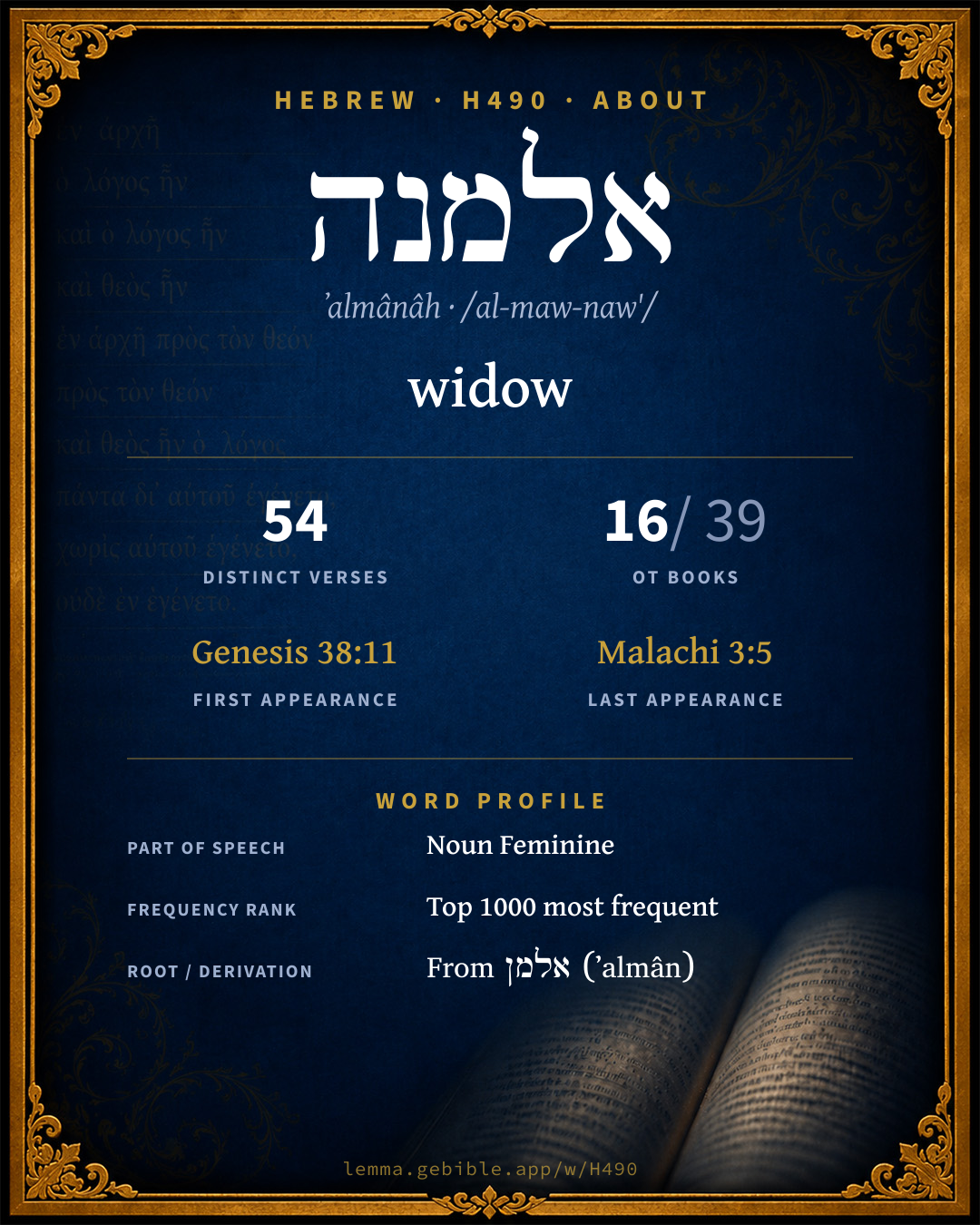
אַלְמָנָה
widow
Full lexicon entry — Brown-Driver-Briggs (BDB)
From Brown-Driver-Briggs (BDB)
Where this word appears
See every Absolute-state word in the Hebrew Bible →
Grammar key — what these labels mean
Part of speech
- Noun
- A naming word — a person, place, thing, or idea.
Noun type
- Common
- A common noun — a general class of person, place, or thing (“king,” “city,” “water”), not a specific name.
State
- Absolute
- The independent form of a noun, not bound to a following word.
- Construct
- A noun bound to a following noun in a possessive / “of” relationship (the construct chain).
Gender
- Feminine
- Grammatically feminine.
Number
- Singular
- One.
- Plural
- More than one (in Hebrew, generally three or more).
Grammatical forms
- Noun, Common, Feminine, Singular, Absolute 42 times (75%)
- Noun, Common, Feminine, Plural, Construct 8 times (14%)
- Noun, Common, Feminine, Plural, Absolute 6 times (11%)
Parsed forms decoded from the imported morphology (morphhb / Westminster Leningrad Codex — WLC text public domain, morphhb tagging CC BY 4.0), counted across 56 parsed occurrences — not distinct verses.
Every verse where H490 appears — 54 distinct verses across 16 books. Click any verse to open its interlinear word-by-word view. Verse text shown in the World English Bible for context — . Each verse’s Hebrew form is shown with its reference; the English is not keyword-highlighted, since the data carries no word-level English alignment. Use “Compare translations” on any verse to read it across multiple English versions. This concordance covers the Hebrew Bible; Septuagint (Greek Old Testament) occurrences are not indexed here.
Genesis 1 verse
Exodus 2 verses
Leviticus 2 verses
- Leviticus 21:14 אַלְמָנָ֤ה n c fs A widow, or one divorced, or a woman who has been defiled, or a prostitute, these he shall not marry: but a virgin of his own people shall he take as a wife.
- Leviticus 22:13 אַלְמָנָ֣ה n c fs But if a priest's daughter is a widow, or divorced, and has no child, and has returned to her father's house, as in her youth, she may eat of her father's bread: but no stranger shall eat any of it.
Numbers 1 verse
Deuteronomy 11 verses
- Deuteronomy 10:18 וְ/אַלְמָנָ֑ה conj + n c fs He does execute justice for the fatherless and widow, and loves the foreigner, in giving him food and clothing.
- Deuteronomy 14:29 וְ/הָֽ/אַלְמָנָה֙ conj + ptcl def.art + n c fs and the Levite, because he has no portion nor inheritance with you, and the foreigner living among you, and the fatherless, and the widow, who are within your gates, shall come, and shall eat and be satisfied; that Yahweh your God may bless you in all the work of your hand which you do.
- Deuteronomy 16:11 וְ/הָ/אַלְמָנָ֖ה conj + ptcl def.art + n c fs and you shall rejoice before Yahweh your God, you, and your son, and your daughter, and your man-servant, and your maid-servant, and the Levite who is within your gates, and the foreigner, and the fatherless, and the widow, who are in the midst of you, in the place which Yahweh your God shall choose, to cause his name to dwell there.
- Deuteronomy 16:14 וְ/הָ/אַלְמָנָ֖ה conj + ptcl def.art + n c fs and you shall rejoice in your feast, you, and your son, and your daughter, and your man-servant, and your maid-servant, and the Levite, and the foreigner, and the fatherless, and the widow, who are within your gates.
- Deuteronomy 24:17 אַלְמָנָֽה n c fs You shall not wrest the justice [due] to the foreigner, [or] to the fatherless, nor take the widow's clothing to pledge;
- Deuteronomy 24:19 וְ/לָ/אַלְמָנָ֖ה conj + prep det + n c fs When you reap your harvest in your field, and have forgot a sheaf in the field, you shall not go again to get it: it shall be for the foreigner, for the fatherless, and for the widow; that Yahweh your God may bless you in all the work of your hands.
- Deuteronomy 24:20 וְ/לָ/אַלְמָנָ֖ה conj + prep det + n c fs When you beat your olive tree, you shall not go over the boughs again: it shall be for the foreigner, for the fatherless, and for the widow.
- Deuteronomy 24:21 וְ/לָ/אַלְמָנָ֖ה conj + prep det + n c fs When you gather [the grapes of] your vineyard, you shall not glean it after you: it shall be for the foreigner, for the fatherless, and for the widow.
- Deuteronomy 26:12 וְ/לָֽ/אַלְמָנָ֔ה conj + prep det + n c fs When you have made an end of tithing all the tithe of your increase in the third year, which is the year of tithing, then you shall give it to the Levite, to the foreigner, to the fatherless, and to the widow, that they may eat within your gates, and be filled.
- Deuteronomy 26:13 וְ/לָ/אַלְמָנָ֔ה conj + prep det + n c fs You shall say before Yahweh your God, I have put away the holy things out of my house, and also have given them to the Levite, and to the foreigner, to the fatherless, and to the widow, according to all your commandment which you have commanded me: I have not transgressed any of your commandments, neither have I forgotten them:
- Deuteronomy 27:19 וְ/אַלְמָנָ֑ה conj + n c fs Cursed be he who wrests the justice [due] to the foreigner, fatherless, and widow. All the people shall say, Amen.
2 Samuel 1 verse
1 Kings 5 verses
- 1 Kings 7:14 אַלְמָנָ֨ה n c fs He was the son of a widow of the tribe of Naphtali, and his father was a man of Tyre, a worker in brass; and he was filled with wisdom and understanding and skill, to work all works in brass. He came to king Solomon, and performed all his work.
- 1 Kings 11:26 אַלְמָנָ֔ה n c fs Jeroboam the son of Nebat, an Ephraimite of Zeredah, a servant of Solomon, whose mother's name was Zeruah, a widow, he also lifted up his hand against the king.
- 1 Kings 17:9 אַלְמָנָ֖ה n c fs Arise, get you to Zarephath, which belongs to Sidon, and dwell there: behold, I have commanded a widow there to sustain you.
- 1 Kings 17:10 אַלְמָנָ֖ה n c fs So he arose and went to Zarephath; and when he came to the gate of the city, behold, a widow was there gathering sticks: and he called to her, and said, Please get me a little water in a vessel, that I may drink.
- 1 Kings 17:20 הָ/אַלְמָנָ֞ה ptcl def.art + n c fs He cried to Yahweh, and said, Yahweh my God, have you also brought evil on the widow with whom I sojourn, by killing her son?
Job 6 verses
- Job 22:9 אַ֭לְמָנוֹת n c fp You have sent widows away empty, And the arms of the fatherless have been broken.
- Job 24:3 אַלְמָנָֽה n c fs They drive away the donkey of the fatherless, And they take the widow's ox for a pledge.
- Job 24:21 וְ֝/אַלְמָנָ֗ה conj + n c fs He devours the barren who don't bear. He shows no kindness to the widow.
- Job 27:15 וְ֝/אַלְמְנֹתָ֗י/ו conj + n c fp cs + sfx pers 3ms Those who remain of him shall be buried in death. His widows shall make no lamentation.
- Job 29:13 אַלְמָנָ֣ה n c fs The blessing of him who was ready to perish came on me, And I caused the widow's heart to sing for joy.
- Job 31:16 אַלְמָנָ֣ה n c fs "If I have withheld the poor from their desire, Or have caused the eyes of the widow to fail,
Psalms 5 verses
- Psalms 68:5 אַלְמָנ֑וֹת n c fp A father of the fatherless, and a defender of the widows, Is God in his holy habitation.
- Psalms 78:64 וְ֝/אַלְמְנֹתָ֗י/ו conj + n c fp cs + sfx pers 3ms Their priests fell by the sword, And their widows couldn't weep.
- Psalms 94:6 אַ֭לְמָנָה n c fs They kill the widow and the alien, And murder the fatherless.
- Psalms 109:9 אַלְמָנָֽה n c fs Let his children be fatherless, And his wife a widow.
- Psalms 146:9 וְ/אַלְמָנָ֣ה conj + n c fs Yahweh preserves the foreigners. He upholds the fatherless and widow, But the way of the wicked he turns upside down.
Proverbs 1 verse
Isaiah 6 verses
- Isaiah 1:17 אַלְמָנָֽה n c fs Learn to do well. Seek justice, Relieve the oppressed, Judge the fatherless, Plead for the widow."
- Isaiah 1:23 אַלְמָנָ֖ה n c fs Your princes are rebellious, and companions of thieves. Everyone loves bribes, and follows after rewards. They don't judge the fatherless, Neither does the cause of the widow come to them.
- Isaiah 9:17 אַלְמְנֹתָי/ו֙ n c fp cs + sfx pers 3ms Therefore the Lord will not rejoice over their young men, neither will he have compassion on their fatherless and widows; for everyone is profane and an evil-doer, and every mouth speaks folly. For all this his anger is not turned away, but his hand is stretched out still.
- Isaiah 10:2 אַלְמָנוֹת֙ n c fp to turn aside the needy from justice, and to rob the poor of my people of their right, that widows may be their spoil, and that they may make the fatherless their prey!
- Isaiah 13:22 בְּ/אַלְמנוֹתָ֔י/ו prep + n c fp cs + sfx pers 3ms Wolves shall cry in their castles, and jackals in the pleasant palaces: and her time is near to come, and her days shall not be prolonged.
- Isaiah 47:8 אַלְמָנָ֔ה n c fs Now therefore hear this, you who are given to pleasures, who sit securely, who say in your heart, I am, and there is none else besides me; I shall not sit as a widow, neither shall I know the loss of children:
Jeremiah 5 verses
- Jeremiah 7:6 וְ/אַלְמָנָה֙ conj + n c fs if you don't oppress the foreigner, the fatherless, and the widow, and don't shed innocent blood in this place, neither walk after other gods to your own hurt:
- Jeremiah 15:8 אַלְמְנֹתָ/ו֙ n c fp cs + sfx pers 3ms Their widows are increased to me above the sand of the seas; I have brought on them against the mother of the young men a destroyer at noonday: I have caused anguish and terrors to fall on her suddenly.
- Jeremiah 18:21 וְ/אַלְמָנ֔וֹת conj + n c fp Therefore deliver up their children to the famine, and give them over to the power of the sword; and let their wives become childless, and widows; and let their men be slain of death, [and] their young men struck of the sword in battle.
- Jeremiah 22:3 וְ/אַלְמָנָ֤ה conj + n c fs Thus says Yahweh: Execute you justice and righteousness, and deliver him who is robbed out of the hand of the oppressor: and do no wrong, do no violence, to the foreigner, the fatherless, nor the widow; neither shed innocent blood in this place.
- Jeremiah 49:11 וְ/אַלְמְנֹתֶ֖י/ךָ conj + n c fp cs + sfx pers 2ms Leave your fatherless children, I will preserve them alive; and let your widows trust in me.
Lamentations 2 verses
- Lamentations 1:1 כְּ/אַלְמָנָ֑ה prep + n c fs How does the city sit solitary, that was full of people! She has become as a widow, who was great among the nations! She who was a princess among the provinces is become tributary!
- Lamentations 5:3 כְּ/אַלְמָנֽוֹת prep + n c fp We are orphans and fatherless; Our mothers are as widows.
Ezekiel 4 verses
- Ezekiel 19:7 אַלְמְנוֹתָ֔י/ו n c fp cs + sfx pers 3ms He knew their palaces, and laid waste their cities; and the land was desolate, and the fullness of it, because of the noise of his roaring.
- Ezekiel 22:7 וְ/אַלְמָנָ֖ה conj + n c fs In you have they set light by father and mother; in the midst of you have they dealt by oppression with the foreigner; in you have they wronged the fatherless and the widow.
- Ezekiel 22:25 אַלְמְנוֹתֶ֖י/הָ n c fp cs + sfx pers 3fs There is a conspiracy of her prophets in the midst of it, like a roaring lion ravening the prey: they have devoured souls; they take treasure and precious things; they have made her widows many in the midst of it.
- Ezekiel 44:22 וְ/אַלְמָנָה֙ וְ/הָֽ/אַלְמָנָה֙ אַלְמָנָ֔ה conj + n c fs conj + ptcl def.art + n c fs n c fs Neither shall they take for their wives a widow, nor her who is put away; but they shall take virgins of the seed of the house of Israel, or a widow who is the widow of a priest.
Zechariah 1 verse
Malachi 1 verse
About this entry
At a glance — auto-summarized from this page’s data, not written by a person. Every figure links to its source below. This summary describes the numbers; it doesn’t interpret them.
The Hebrew noun אלמנה centers on the idea of “widow.” Its earliest occurrence is Genesis 38:11. Spanning 54 verses in 16 books, it ranks among the moderately common words of the Hebrew Bible. Related forms include אלמן and אלמנות. Dig into 54-verse concordance and the renderings breakdown below.
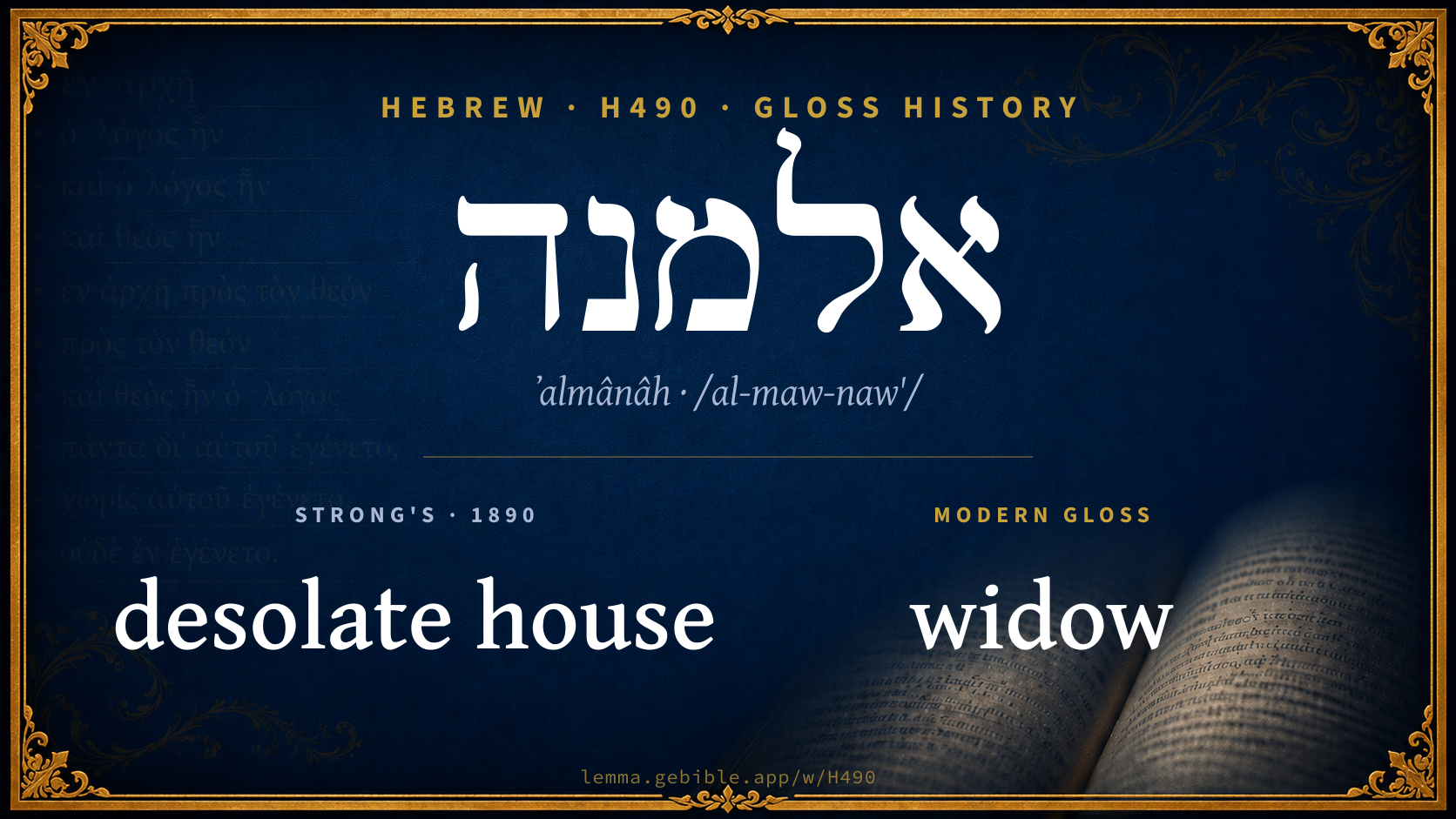
Gloss history
Strong's 1890 vs modern scholarship
About this word
Strong's H490 catalogs a Hebrew word from the Hebrew Old Testament.
These counts are not copied from any lexicon or concordance. They are computed here, from the morphology-tagged Hebrew Old Testament. What Lemma adds →
- 54
- distinct verses
- The word appears in 54 distinct verses.
- 16 / 39
- OT books
- The word appears in 16 of 39 Old Testament books.
- #678
- by frequency
- Top 1000 most frequent Hebrew words (rank 678 of 8,640 Hebrew words by occurrence).
View all 54 occurrences in the concordance →
Most concentrated in
- Deuteronomy 11 verses 20%
- Job 6 verses 11%
- Isaiah 6 verses 11%
By section of the Old Testament
By traditional corpus
Conventional, traditional groupings — biblical authorship is debated, so this is a traditional corpus grouping, not an authorship claim. Each share is this word’s portion of its verses in that division of the Hebrew canon. Each figure is a share of the word’s 54 distinct verses.
- Prophets (Nevi'im) 23 verses · 43%
- Torah (Pentateuch) 17 verses · 31%
- Writings (Ketuvim) 14 verses · 26%
How translations render this word
Counts come from each version’s own published word-to-Strong’s tagging or interlinear alignment — an approximate guide to how each version renders this word, not a word-level alignment the data otherwise carries. Because each total is that version’s own tagged count, the per-version totals vary from one another and need not match the appearance or distinct-verse counts above. These counts may also differ from a printed concordance because Lemma counts each distinctly tagged rendering and does not collapse phrase taggings into a single head-word total. This is a fixed set of word-tagged versions (KJV, ASV, BSB, ULT) and does not change with the reading translation you choose elsewhere. Each version’s license is shown beside its name below (and on Sources).
- King James Version: Widow 32×, Widows 8×, Widow's 2×
- American Standard Version: Widow 30×, Widows 8×
- Berean Standard Bible: Widow 28×, Widows 9×, Widowed 3×
- unfoldingWord Literal Text: Widow 32×, Widows 12×, Or for the widow 3×
King James Version Public Domain
Renders H490 across 54 tagged occurrences — most commonly:
Plus 12 renderings that appear only once — usually multi-word phrases or single function words the recovered tagging swept in, not distinct renderings. Not rendered by a distinct English word in 1 further occurrence.
American Standard Version Public Domain
Renders H490 across 53 tagged occurrences — most commonly:
Plus 15 renderings that appear only once — usually multi-word phrases or single function words the recovered tagging swept in, not distinct renderings.
Berean Standard Bible Public Domain
Renders H490 across 55 tagged occurrences — most commonly:
Plus 13 renderings that appear only once — usually multi-word phrases or single function words the recovered tagging swept in, not distinct renderings. Not rendered by a distinct English word in 1 further occurrence.
unfoldingWord Literal Text CC BY-SA 4.0
Renders H490 across 58 tagged occurrences — most commonly:
Plus 5 renderings that appear only once — usually multi-word phrases or single function words the recovered tagging swept in, not distinct renderings.
Senses in BDB
The 1 sense BDB distinguishes for this word, in lexicon order (not ranked by frequency or importance). The full entry — with sub-senses — is in the Lexicon Entry tab.
- widow
Word origin
n.f. widow (Mish. id., Assyrian almattu Dl in ZimBP 114)—א׳ Gn 38:11 +; no cstr.; pl. אַלְמָנוֹת Ex 22:23 +; pl. sf. אַלְמְנֹתָיו Jb 27:15, etc.—widow 1 K 17:20; אִשָּׁה אַ׳ 2 S 14:5 (‖ וַיָּ֫מָת אִישִׁי) 1 K 7:14; 11:26; 17:9, 10; Gn 38:11 (J; living in father’s house) cf. Lv 22:13 (H; ‖ גְּרוּשָׁה); 21:14 (H), where widow forbidden as wife of h. p., like גְּרוּשָׁה, חֲלָלָה, זֹנָה cf. Ez 44:22(×3) (id. of all priests, except widow of priest); Nu 30:10 (P; of widow’s vow, ‖ גְּרוּשָׁה); נְשֵׁיכֶם אַלְמָנוֹת = ye shall be slain Ex 22:23 (‖ בְּנֵיכֶם יְתֹמִים) cf. ψ 109:9 Je 15:8; 18:21 Ez 22:25, also La 5:3 (sim.); of those snatched away by pestilence אַלְמְנוֹתָיו לֹא תִבְכֶּינָה Jb 27:15; by sword, id., ψ 78:64; 𝔊 We read אַלְמָנוֹת חַיּוֹת 2 S 20:3 (v. אַלְמָנוּת infr.) of imprisoned concubines; fig. of Jerusalem La 1:1; Babylon Is 47:8; especially widow as helpless, exposed to oppression & harsh treatment (often ‖ יָתוֹם, & גֵּר); Is 1:23; 10:2 Jb 22:9; 24:3; 31:16 ψ 94:6 Mal 3:5; harshness forbidden, & care for them enjoined Ex 22:21 (E) Dt 14:29; 16:11, 14; 24:17, 19, 20, 21; 26:12, 13; 27:19 Is 1:17 Je 7:6; 22:3 Zc 7:10, cf. Jb 29:13; under especially care of God Dt 10:18 Je 49:11 Pr 15:25 ψ 68:6; 146:9; once of severity of judgment in not sparing widow Is 9:16. (אַל׳ Is 13:22 vid. sub אַרְמוֹן; Ez 19:7 vid. ib.)
— Brown-Driver-Briggs (Oxford 1906, public domain), digitized via Sefaria, supplemented by the OpenScriptures HebrewLexicon (CC BY 4.0). See Sources.
Derived from אלמן (ʼalmân) (H488) — widowed.
Jastrow Dictionary
A second Hebrew/Aramaic lexicon for comparison, covering Aramaic and post-biblical (Talmudic, Targumic, Midrashic) usage that the biblical-Hebrew BDB does not. Matched by lemma rather than by Strong’s number, so a lemma may carry more than one Jastrow headword (shown separately below), and the entries cover usage well beyond the Bible.
אַלְמָנָה
- v. אַלְמוֹן) widow. Keth. I, 1; 2, v. אֵרוּסִין. Kidd. 75ᵃ אַלְמָנַת עיסה the widow of one of spurious descent; v. עִיסָה; a. fr. Trnsf. דלת א׳ a frameless door (or made of one piece). Erub. 101ᵃ; v. גַּשְׁמָה.—Denom.
A Dictionary of the Targumim, the Talmud Babli and Yerushalmi, and the Midrashic Literature (Marcus Jastrow; London, Luzac, 1903) — Public Domain. Digitized via Sefaria. Digitized via Sefaria. Full attribution on Sources.
Forms in the corpus
The 35 distinct written forms H490 takes in the Hebrew Bible, most frequent first — each parse links to that state’s occurrences in the concordance. Hebrew forms include their vowel points and cantillation, so a single lemma takes many written forms.
Same root — word family
Other BDB entries built from the same root as H490, grouped by Strong’s listed origin. These share a root / origin per the lexicon — not necessarily a shared meaning. Each links to that word’s own entry.
Derives from
Shares the same root
Compare all same-root words → They share a root, not necessarily a meaning.
Septuagint verse parallels
This word appears in 52 verses that also exist in the Greek Old Testament (Septuagint), out of the 54 Hebrew verses it occurs in. You can read those verses in Greek by switching the Old Testament edition to the Septuagint.
Read these verses in the Septuagint
- Genesis 38:11
- Exodus 22:22
- Leviticus 21:14
- Numbers 30:9
- Deuteronomy 10:18
- 2 Samuel 14:5
- 1 Kings 7:14
- Job 22:9
- Psalms 68:5
- Proverbs 15:25
- Isaiah 1:17
- Jeremiah 7:6
This is a verse-level parallel only — the same verses exist in both the Hebrew and Greek Old Testaments. No word-level Hebrew↔Greek correspondence is claimed: the data carries no such alignment, so no Greek word is shown as this Hebrew word’s translation. Coverage is not total — the Septuagint omits the deuterocanon and renumbers the Psalms, so some Hebrew verses have no direct Greek parallel.