
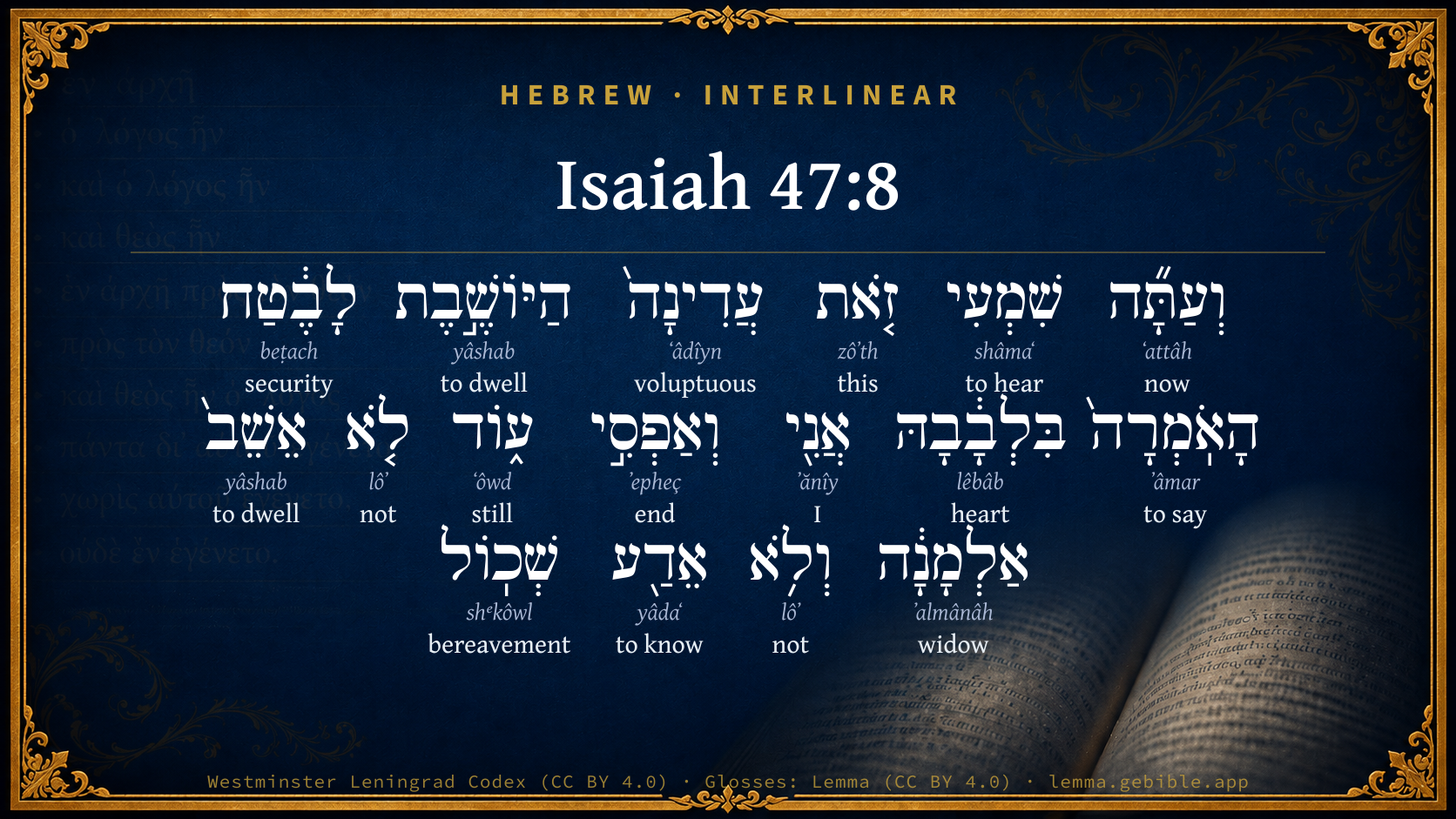
Isaiah 47:8

Hebrew (Westminster Leningrad Codex) Isaiah 47:8 appears in the Hebrew Old Testament. The text above is from the Westminster Leningrad Codex. Each word links to its Strong’s number, a concise gloss, and parsing drawn from the Open Scriptures Hebrew Bible morphology. Click any word for its full Brown-Driver-Briggs (BDB) entry.
Download image
Cite this verse

Isaiah 47:8 (World English Bible). Public Domain. Lemma interlinear Bible study tool, https://lemma.gebible.app/v/isaiah/47/8.

Show BibTeX & RIS
BibTeX
RIS
English Translation
Now therefore hear this, you who are given to pleasures, who sit securely, who say in your heart, I am, and there is none else besides me; I shall not sit as a widow, neither shall I know the loss of children:
World English Bible · Public Domain
Highlights
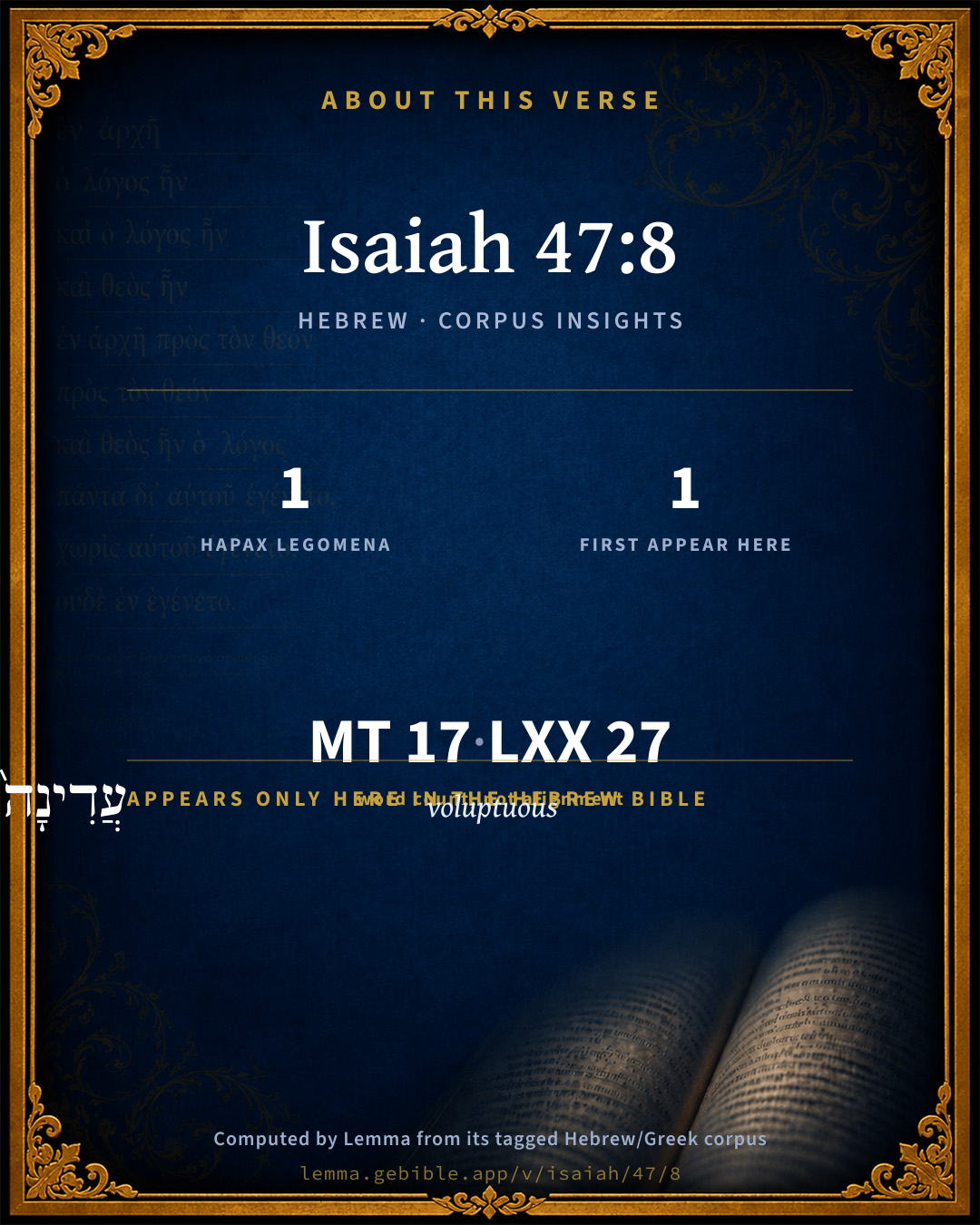
  • 1 hapax legomenon — only here in the Hebrew Bible
  • 1 first appearance in the Hebrew Bible
Full analysis ↓
Download a study sheet

One document with this verse’s original text, its word-by-word gloss line, the meaning frame, cross-references with their text, attributed commentary, and full source and license credits — printable, and it pastes into notes with its structure intact.

This verse Autodidact and up

Study sheet (.html) Plain text (.txt)

A passage Seminary Student

Up to 50 verses in one chapter. A passage sheet keeps up to 6 commentary sources and 12 cross-references per verse, in the order this page ranks them, and says so on the sheet whenever that leaves anything out. Ask for a single verse and you get the Autodidact verse sheet above.

Everything on this page stays free to read, with no account — the sheet is a download of what is already on screen, not access to it.

Want to remove ads? Support Godless Engineer
Compare translations 3

The same verse in 3 English versions, stacked beneath the original-language interlinear above. Click any original word for its lexicon entry.

Each is an independent rendering of the whole verse — the interlinear is not word-aligned to these translations.

Highlighted words mark where these versions differ — a whole-verse word diff, not a word-by-word alignment.

  • World English Bible Public Domain
    Now therefore hear this, you who are given to pleasures, who sit securely, who say in your heart, I am, and there is none else besides me; I shall not sit as a widow, neither shall I know the loss of children:
  • King James Version Public Domain
    Therefore hear now this, thou that art given to pleasures, that dwellest carelessly, that sayest in thine heart, I am, and none else beside me; I shall not sit as a widow, neither shall I know the loss of children:
  • unfoldingWord Literal Text CC BY-SA 4.0
    And now, hear this, luxuriant, dweller in security, the one saying in her heart, ‘I, and besides me none; I will not sit a widow, and I will not know bereavement.’

unfoldingWord Literal Text — © unfoldingWord, licensed CC BY-SA 4.0. Word-aligned USFM3 via Door43 (git.door43.org/unfoldingWord/en_ult).

Versions to compare (up to 4)

3 of 4 selected

Show all 18 translations

Every available English version of this verse, each an independent rendering of the whole verse.

  • World English Bible Public Domain
    Now therefore hear this, you who are given to pleasures, who sit securely, who say in your heart, I am, and there is none else besides me; I shall not sit as a widow, neither shall I know the loss of children:
  • Berean Standard Bible Public Domain
    So now hear this, O lover of luxury who sits securely, who says to herself, ‘I am, and there is none besides me. I will never be a widow or know the loss of children.’
  • Majority Standard Bible Public Domain
    So now hear this, O lover of luxury who sits securely, who says to herself, ‘I am, and there is none besides me. I will never be a widow or know the loss of children.’
  • King James Version Public Domain
    Therefore hear now this, thou that art given to pleasures, that dwellest carelessly, that sayest in thine heart, I am, and none else beside me; I shall not sit as a widow, neither shall I know the loss of children:
  • American Standard Version (1901) Public Domain
    Now therefore hear this, thou that art given to pleasures, that sittest securely, that sayest in thy heart, I am, and there is none else besides me; I shall not sit as a widow, neither shall I know the loss of children:
  • Revised Version (1885) Public Domain
    Now therefore hear this, thou that art given to pleasures, that dwellest carelessly, that sayest in thine heart, I am, and there is none else beside me; I shall not sit as a widow, neither shall I know the loss of children:
  • Geneva Bible (1599) Public Domain
    Therefore nowe heare, thou that art giuen to pleasures, and dwellest carelesse, Shee sayeth in her heart, I am and none els: I shall not sit as a widowe, neither shall knowe the losse of children.
  • Douay-Rheims (1899) Public Domain
    And now hear these things, thou that art delicate, and dwellest confidently, that sayest in thy heart: I am, and there is none else besides me: I shall not sit as a widow, and I shall not know barrenness.
  • Young's Literal Translation Public Domain
    And now, hear this, O luxurious one, Who is sitting confidently -- Who is saying in her heart, `I `am', and none else, I sit not a widow, nor know bereavement.'
  • Literal Standard Version CC BY-SA 4.0
    And now, hear this, O luxurious one, || Who is sitting confidently—Who is saying in her heart, I [am], and none else, || I do not sit [as] a widow, nor know bereavement.
  • Unlocked Literal Bible CC BY-SA 4.0
    So now hear this, you who love pleasure and sit securely; you who say in your heart, “I exist, and there is no one else like me; I will never sit as a widow, nor will I ever experience loss of children.”
  • unfoldingWord Literal Text CC BY-SA 4.0
    And now, hear this, luxuriant, dweller in security, the one saying in her heart, ‘I, and besides me none; I will not sit a widow, and I will not know bereavement.’
  • Darby Bible Public Domain
    And now hear this, thou voluptuous one, that dwellest carelessly, that sayest in thy heart, It is I, and there is none but me; I shall not sit as a widow, neither shall I know loss of children:
  • World Messianic Bible Public Domain
    “Now therefore hear this, you who are given to pleasures, who sit securely, who say in your heart, ‘I am, and there is no one else besides me. I won’t sit as a widow, neither will I know the loss of children.’
  • Webster's Bible Public Domain
    Therefore hear now this, thou that art given to pleasures, that dwellest carelessly, that sayest in thy heart, I am, and none else besides me; I shall not sit as a widow, neither shall I know the loss of children:
  • Free Bible Version CC BY-SA 4.0
    Now listen to this, you sensual woman, sitting there so sure of yourself, saying to yourself, “I am supreme —there's nobody besides me. I shall never be a widow or experience the loss of my children.”
  • Bible in Basic English Public Domain
    So now take note of this, you who are given up to pleasure, living without fear of evil, saying in your heart, I am, and there is no one like me; I will never be a widow, or have my children taken from me.
  • JPS Tanakh (1917) Public Domain
    Now therefore hear this, thou that art given to pleasures, that sittest securely, that sayest in thy heart: 'I am, and there is none else beside me; I shall not sit as a widow, neither shall I know the loss of children';

Literal Standard Version (2020), Covenant Press — licensed CC BY-SA 4.0. Text via the HelloAO Bible API (eBible.org). Unlocked Literal Bible (unfoldingWord) — licensed CC BY-SA 4.0. Text via the HelloAO Bible API (eBible.org). unfoldingWord Literal Text — © unfoldingWord, licensed CC BY-SA 4.0. Word-aligned USFM3 via Door43 (git.door43.org/unfoldingWord/en_ult). Free Bible Version, Dr. Jonathan Gallagher — licensed CC BY-SA 4.0. Text via the HelloAO Bible API (eBible.org).

Word by word

More ways to search: Search by grammar → Find every occurrence → Compare this word →

Practice this passage: Drill this verse → Learn its vocabulary →

עֲדִינָה֙
ʻâdîyn
H5719
“voluptuous”
Adjective, Adjective, Feminine, Singular, Absolute
Part of Speech
Adjective
Type
Adjective
Gender
Feminine
Number
Singular
State
Absolute
Full BDB Definition

Origin: from H5727

TWOT: 1567c

voluptuous
  1. וְעַתָּ֞ה ʻattâh H6258 “and · now” Conjunction + Adverb
  2. שִׁמְעִי shâmaʻ H8085 “hear” Verb, Qal, Imperative, 2nd Person, Feminine, Singular
  3. זֹ֤את zôʼth H2063 “this” Pronoun, Demonstrative, Feminine, Singular
  4. הַיּוֹשֶׁ֣בֶת yâshab H3427 “the · dwelling” Particle, Definite Article + Verb, Qal, Participle Active, Feminine, Singular, Absolute
  5. לָבֶ֔טַח beṭach H983 “to/for · security” Preposition + Noun, Common, Masculine, Singular, Absolute
  6. הָאֹֽמְרָה֙ ʼâmar H559 “the · saying” Particle, Definite Article + Verb, Qal, Participle Active, Feminine, Singular, Absolute
  7. בִּלְבָ֔בָהּ lêbâb H3824 “in/at · heart · her” Preposition + Noun, Common, Masculine, Singular, Construct + Suffix, Personal, 3rd Person, Feminine, Singular
  8. אֲנִ֖י ʼănîy H589 “I” Pronoun, Personal, 1st Person, Common, Singular
  9. וְאַפְסִ֣י ʼepheç H657 “and · end · my” Conjunction + Noun, Common, Masculine, Singular, Construct + Suffix, Personal, 1st Person, Common, Singular
  10. ע֑וֹד ʻôwd H5750 “still” Adverb
  11. לֹ֤א lôʼ H3808 “not” Particle, Negative
  12. אֵשֵׁב֙ yâshab H3427 “to dwell” Verb, Qal, Imperfect, 1st Person, Common, Singular
  13. אַלְמָנָ֔ה ʼalmânâh H490 “widow” Noun, Common, Feminine, Singular, Absolute
  14. וְלֹ֥א lôʼ H3808 “and · not” Conjunction + Particle, Negative
  15. אֵדַ֖ע yâdaʻ H3045 “to know” Verb, Qal, Imperfect, 1st Person, Common, Singular
  16. שְׁכֽוֹל shᵉkôwl H7908 “bereavement” Noun, Common, Masculine, Singular, Absolute

About this verse

These counts appear in no published source. They are computed here, from the morphology-tagged text and Lemma’s own curated glosses. What Lemma adds →

17
words
15
distinct lemmas
Prophets
section

Notable vocabulary

1 hapax legomenon — a word that appears only here in the entire Hebrew Bible:

  • עֲדִינָה֙ voluptuous H5719

First appearance in Scripture

This word makes its first canonical appearance in the Hebrew Bible here:

  • עֲדִינָה֙ voluptuous H5719

Shared distinctive vocabulary

שְׁכֽוֹל bereavement H7908 occurs in 3 verses of the Hebrew Bible. Also found in:

Grammatical profile

  • 5 verbs
  • 5 nouns
  • 1 adjective
  • 2 pronouns
  • 2 adverbs
  • 2 particles

Verb forms

  • שִׁמְעִי Qal · Imperative
  • הַיּוֹשֶׁ֣בֶת Qal · Participle Active
  • הָאֹֽמְרָה֙ Qal · Participle Active
  • אֵשֵׁב֙ Qal · Imperfect
  • אֵדַ֖ע Qal · Imperfect

Repetition

Words recur within this verse — often emphatic in Hebrew:

  • הַיּוֹשֶׁ֣בֶת to dwell H3427 ×2
  • לֹ֤א not H3808 ×2

Hebrew & Septuagint length

In English translation the verse runs 42 words from the Hebrew and 42 from the Septuagint (LXX English) — the same length.

A rough comparison of the two English renderings, which tokenize alike — not a word-level alignment.

Word counts can differ between the Hebrew and the Greek without any difference in meaning — e.g. the Hebrew direct-object marker אֵת has no separate Greek word, and Greek often adds the article ὁ.

In the original languages it is 17 Hebrew tokens and 27 Greek tokens — but the two are counted differently (Hebrew bundles its prefixes and suffixes into one token; the Greek is in lemma form), so that isn’t a like-for-like length.

Cross-references

25

Topical passages linked to Isaiah 47:8 in the Treasury of Scripture Knowledge — connected by theme and wording, ordered by reader-vote popularity; previews shown in the World English Bible.

  • Zephaniah 2:15 This is the joyous city that lived carelessly, that said in her heart, "I am, and there is none besides me." How she has become a desolation, a place for animals to lie down in! Everyone who passes by her will hiss, and shake their fists.
  • Isaiah 32:9 Rise up, you women who are at ease, [and] hear my voice; you careless daughters, give ear to my speech.
  • Isaiah 45:6 that they may know from the rising of the sun, and from the west, that there is none besides me: I am Yahweh, and there is no one else.
  • Isaiah 47:10 For you have trusted in your wickedness; you have said, None sees me; your wisdom and your knowledge, it has perverted you, and you have said in your heart, I am, and there is none else besides me.
  • Jeremiah 50:11 Because you are glad, because you rejoice, O you who plunder my heritage, because you are wanton as a heifer that treads out [the grain], and neigh as strong horses;
  • Revelation 18:3–8 For all the nations have drunk of the wine of the wrath of her sexual immorality, the kings of the earth committed sexual immorality with her, and the merchants of the earth grew rich from the abundance of her luxury."
  • Judges 18:7 Then the five men departed, and came to Laish, and saw the people who were therein, how they lived in security, after the manner of the Sidonians, quiet and secure; for there was none in the land, possessing authority, that might put [them] to shame in anything, and they were far from the Sidonians, and had no dealings with any man.
  • Judges 18:27 They took that which Micah had made, and the priest whom he had, and came to Laish, to a people quiet and secure, and struck them with the edge of the sword; and they burnt the city with fire.
  • Psalms 10:5–6 His ways are prosperous at all times; He is haughty, and your laws are far from his sight: As for all his adversaries, he sneers at them.
  • Isaiah 21:4–5 My heart flutters, horror has frightened me; the twilight that I desired has been turned into trembling to me.
  • Isaiah 22:12–13 In that day did the Lord, Yahweh of Hosts, call to weeping, and to mourning, and to baldness, and to girding with sackcloth:
  • Isaiah 45:18 For thus says Yahweh who created the heavens, the God who formed the earth and made it, who established it and didn't create it a waste, who formed it to be inhabited: I am Yahweh; and there is no one else.
  • Jeremiah 50:31–32 Behold, I am against you, you proud one, says the Lord, Yahweh of Hosts; for your day is come, the time that I will visit you.
  • Jeremiah 51:53 Though Babylon should mount up to the sky, and though she should fortify the height of her strength, yet from me shall destroyers come to her, says Yahweh.
  • Daniel 4:22 it is you, O king, that are grown and become strong; for your greatness is grown, and reaches to the sky, and your dominion to the end of the earth.
  • Daniel 4:30 The king spoke and said, Is not this great Babylon, which I have built for the royal dwelling-place, by the might of my power and for the glory of my majesty?
  • Daniel 5:1–4 Belshazzar the king made a great feast to a thousand of his lords, and drank wine before the thousand.
  • Daniel 5:23 but have lifted up yourself against the Lord of heaven; and they have brought the vessels of his house before you, and you and your lords, your wives and your concubines, have drunk wine from them; and you have praised the gods of silver and gold, of brass, iron, wood, and stone, which don't see, nor hear, nor know; and the God in whose hand your breath is, and whose are all your ways, you have not glorified.
  • Daniel 5:30 In that night Belshazzar the Chaldean King was slain.
  • Daniel 11:36 The king shall do according to his will; and he shall exalt himself, and magnify himself above every god, and shall speak marvelous things against the God of gods; and he shall prosper until the indignation be accomplished; for that which is determined shall be done.
  • Nahum 1:10 For entangled like thorns, and drunken as with their drink, they are consumed utterly like dry stubble.
  • Habakkuk 2:5–8 Yes, moreover, wine is treacherous. A haughty man who doesn't stay at home, who enlarges his desire as Sheol, and he is like death, and can't be satisfied, but gathers to himself all nations, and heaps to himself all peoples.
  • Luke 12:18–20 He said, 'This is what I will do. I will pull down my barns, and build bigger ones, and there I will store all my grain and my goods.
  • 2 Thessalonians 2:4 he who opposes and exalts himself against all that is called God or that is worshiped; so that he sits as God in the temple of God, setting himself up as God.
  • Luke 17:27–29 They ate, they drank, they married, they were given in marriage, until the day that Noah entered into the ark, and the flood came, and destroyed them all.

Cross-references courtesy of OpenBible.info (CC BY 4.0).

Hebrew and Greek witnesses Masoretic Hebrew ↔ Greek Septuagint

The same verse in the two great witnesses to the Old Testament, shown verse-for-verse.

These are two independent witnesses, not word-aligned to each other, and the Septuagint is shown in lemma (dictionary) form.

Hebrew Isaiah 47:8 Masoretic · Westminster Leningrad Codex

וְעַתָּ֞ה שִׁמְעִי זֹ֤את עֲדִינָה֙ הַיּוֹשֶׁ֣בֶת לָבֶ֔טַח הָאֹֽמְרָה֙ בִּלְבָ֔בָהּ אֲנִ֖י וְאַפְסִ֣י ע֑וֹד לֹ֤א אֵשֵׁב֙ אַלְמָנָ֔ה וְלֹ֥א אֵדַ֖ע שְׁכֽוֹל

Now therefore hear this, you who are given to pleasures, who sit securely, who say in your heart, I am, and there is none else besides me; I shall not sit as a widow, neither shall I know the loss of children:

World English Bible · Public Domain

Greek LXX Isaiah 47:8 Septuagint · lemma form

νῦν δέ ἀκούω οὗτος ὁ τρυφερός ὁ καταἧμαι πείθω ὁ λέγω ἐν ὁ καρδία αὐτός ἐγώ εἰμί καί οὐ εἰμί ἕτερος οὐ καταἵζω χήρα οὐδέ γιγνώσκω ὀρφανία

But now hear these words, you luxurious one, who are the one that sits at ease, that is secure, that says in her heart, I am, and there is not another; I shall not sit a widow, neither shall I know bereavement.

LXX2012 (modern English Septuagint) · Public Domain

On this verse, Keil & Delitzsch discusses the Septuagint’s reading. Read the note in Commentary ↓

Hebrew: Westminster Leningrad Codex (CC BY 4.0). Greek: Septuagint (public domain); English from LXX2012 (modern English Septuagint) (Public Domain). How the Septuagint differs from the Hebrew →

Targum (Aramaic paraphrase)

1

The Targum is the ancient Jewish Aramaic paraphrase of the Hebrew Scriptures — an interpretive translation, not the Hebrew text itself. Onkelos (literal) and Pseudo-Jonathan (expansive) render the Torah, and Jonathan the Prophets. Coverage is partial: where no permissively-licensed English translation exists for a verse, only the Aramaic is shown. This is verse-level text, not a word-by-word alignment to the Hebrew.

  1. Targum Jonathan Prophets (Joshua–Malachi)
    וּכְעַן שְׁמַעִי דָא מְפַנֶקְתָּא דְיָתְבָא לְרָחֲצָן דְאָמְרָא בְּלִבָּהּ אֲנָא וְלֵית בַּר מִינִי עוֹד לָא אֵיתֵיב אַרְמְלוּ וְלָא אֵדַע תִּיכְלוּ:

    Therefore, hear now this, O voluptuous one, that dwellest in security, that saith in her heart, I am, and there is none else besides me; I shall not sit a widow, neither shall I know the loss of children:

    Targum Jonathan — Aramaic: “Mikraot Gedolot” (public domain). English: “Sefaria Community Translation” (CC0 1.0 (public-domain dedication)); “London "Chaldee Paraphrase," 1871” (public domain). Text via Sefaria.

Commentary

Notes on Isaiah 47:8 from classic Christian and Jewish commentators (each source and its license shown beneath its notes). The classic Christian expositions comment on the surrounding passage and are grouped to its opening verse, so a note may address several verses; the Jewish commentaries on the Tanakh (Rashi and others) are per-verse, so they appear only where the commentator wrote on this verse.

Lemma curates 59 commentaries, every one of them public domain or Creative Commons licensed, each selected and text-cleaned for this edition rather than reprinted as found. About our sources →

Trapp's Complete Commentary

John Trapp

Isa 47:8 Therefore hear now this, [thou that art] given to pleasures, that dwellest carelessly, that sayest in thine heart, I [am], and none else beside me; I shall not sit [as] a widow, neither shall I know the loss of children:

Ver. 8. Thou that art given to pleasure.] Delisatula; It is not good to take pleasure in pleasure; no, not to go as far here as we may. Verecunda sunt omnia initia peecati, Sin seemeth modest at first, &c.

Thou sayest in thine heart, I am,] sc., The lady of the world. Heathen Rome was called by the heathens, Terrarum dea gentiumque. Rome Papal saith as much. {Rev 17:4}

And none else besides me,] i.e., None worth speaking of. The Jesuits brag in like sort of their transcendent learning, and profess skill beyond the periphery of possible knowledge.

I shall not sit as a widow,] i.e., Be bereft of my monarchy, which is, as it were, my husband.

Neither shall I know the loss of children.] I shall not cease to subdue countries and kingdoms, which are added unto me as so many children.

John Trapp, A Commentary or Exposition upon All the Books of the Old and New Testament (1647–1656) — public domain. Text from a community e-Sword module.

Tyndale Open Study Notes

Tyndale Open Resources

47:8 I am the only one, and there is no other: This was a claim to divinity (cp. 45:5; 47:10). Only the Lord can make such a claim. For any created thing, including a nation, to utter this is the height of hubris. • To be a widow or to lose one’s children was a disgrace.

Tyndale Open Study Notes — © Tyndale Open Resources, licensed CC BY-SA 4.0. Text via the HelloAO Bible API.

Jamieson, Fausset & Brown

Robert Jamieson, A. R. Fausset & David Brown

given to pleasures--(See on Isa 47:1). In no city were there so many incentives to licentiousness.

I am . . . none . . . beside me-- (Isa 47:10). Language of arrogance in man's mouth; fitting for God alone (Isa 45:6). See Isa 5:8, latter part.

widow . . . loss of children--A state, represented as a female, when it has fallen is called a widow, because its king is no more; and childless, because it has no inhabitants; they having been carried off as captives (Isa 23:4; Isa 54:1, Isa 54:4-5; Rev 18:7-8).

Jamieson, Fausset & Brown — Commentary Critical and Explanatory on the Whole Bible (1871) — public domain (CC PDM 1.0). Text via the HelloAO Bible API.

Ellicott's Commentary for English Readers

(8) I am, and none else beside me . . .—The boasts of Babylon are purposely embodied by the prophet in praises that recall Jehovah’s assertion of His own eternity. She practically deified herself. So a like boast is put into the mouth of Nineveh in Zep_2:15, and was repeated almost verbally by the poets of Rome: Terrarum dea gentiumque Roma, cui par est nihil, et nihil secundum (Martial).

A Bible Commentary for English Readers, edited by Charles John Ellicott (1878–1897) — public domain. Text from a community e-Sword module.

John Gill's Exposition

Therefore hear now this, thou that art given to pleasures,.... To carnal lusts and pleasures; gratifying her sensual appetite; indulging herself in everything that was agreeable to the senses; abounding in delicacies, and living deliciously; as is said of mystical Babylon, Rev 18:4, particularly given to venereal pleasures. Curtius says (g),

"no city was more corrupt in its manners, or furnished to irritate or allure to immoderate pleasures. Parents and husbands suffered their children and wives to prostitute themselves to strangers, so that they had but a price.''

Yea, every woman was obliged by a law to do this once in life, and that in a public manner, in the temple of Venus; the impurities of which are at large described by Herodotus (h) and Strabo (i):

that dwelleth carelessly; in great confidence and security, being fearless of danger, and insensible of any:

that sayest in thine heart, I am, and none else besides me: sole monarch of the world, empress of the whole universe; no competitor with me, none that can rival me. These words are sometimes used by the eternal and unchangeable Jehovah of himself, and indeed they suit with none but him; and it is the height of insolence and blasphemy in a creature to use them of itself; they fitly express that sovereignty, supremacy, infallibility, and even deity, which mystical Babylon assumes and ascribes to her head:

I shall not sit as a widow, neither shall I know the loss of children; not be without a head, king, or monarch, which is as a husband to the state; nor without numerous subjects, which are as children. The like mystical Babylon says, "I sit a queen, and am no widow", Rev 18:7.

(g) Hist. l. 5. c. 1. sect. 1. (h) Clio, sive l. 1. c. 199. (i) Geograph. l. 16. p. 513.

John Gill's Exposition of the Whole Bible (1746–1763) — public domain (CC PDM 1.0). Text via the HelloAO Bible API.

Albert Barnes' Notes on the Bible

Therefore hear now this - The prophet proceeds, in this verse and the following, to detail more particularly the sins of Babylon, and to state the certainty of the punishment which would come upon her. In the previous verses, the denunciation of punishment had been figurative. It had been represented under the image of a lady delicately trained and nurtured, doomed to the lowest condition of life, and compelled to stoop to the most menial offices. Here the prophet uses language without figure, and states directly her crimes, and her doom.

That art given to pleasures - Devoted to dissipation, and to the effeminate pleasures which luxury engenders (see the notes at Isa 47:1). Curtius, in his History of Babylon as it was in the times of Alexander (v. 5. 36), Herodotus (i. 198), and Strabo Georg. xvi.), have given a description of it, all representing it as corrupt, licentious, and dissipated in the extreme. Curtius, in the passage quoted on Isa 47:1, says, among other things, that no city was more corrupt in its morals; nowhere were there so many excitements to licentious and guilty pleasures.

That dwellest carelessly - In vain security; without any consciousness of danger, and without alarm (compare Zep 2:15).

I am, and none else besides me - The language of pride. She regarded herself as the principal city of the world, and all others as unworthy to be named in comparison with her (compare the note at Isa 45:6). Language remarkably similar to this occurs in Martial’s description of Rome (xii. 8):

Terrarum dea gentiumque, Roma,

Cui par est nihil, et nihil secundum -

Rome, goddess of the earth and of nations, to whom nothing is equal, nothing second.’

I shall not sit as a widow - On the word ‘sit,’ see the note at Isa 47:1. The sense is, that she would never be lonely, sad, and afflicted, like a wife deprived of her husband, and a mother of her children. The figure is changed from Isa 47:1, where she is represented as a virgin; but the same idea is presented under another form (compare the note at Isa 23:4).

Albert Barnes' Notes on the Bible (1834–1885) — public domain. Text from a community e-Sword/MySword module.

Matthew Poole's English Annotations

I am; I am independent, and self-sufficient, and unchangeable, as that phrase implies, which therefore is appropriated to God, Isa 41:4; 43:10, and elsewhere. The prophet doth not here use the very phrase which the Babylonians used, but expresseth their sense in a Scripture phrase.

None else beside me; which is not either subject to me, or far inferior to me in power and glory; so that in comparison of me it may be said not to be, because it disappears like stars at the presence of the sun.

I shall not sit as a widow, neither shall I know the loss of children; I shall never want either a king or people to defend me from all dangers.

Matthew Poole's English Annotations on the Holy Bible (1683–1685) — public domain. Text from a community e-Sword/MySword module.

Whedon's Commentary on the Bible

Daniel D. Whedon

8. Carelessly — In no anxiety about efforts of Cyrus to take the city. According to Xenophon, the princes and whole court at Babylon looked with contempt on Cyrus. She said,

I am, and none else besides me — Literally, I am, and the absence of me there is none. Profanely she parodies the divine saying, “I am Jehovah, and besides me there is none else.” This strain of defiance and of self-security continues to Isa_47:11.

Daniel D. Whedon (gen. ed.), Commentary on the Old and New Testaments (1874–1909) — public domain. Text from a community e-Sword module.

The Pulpit Commentary

Therefore; rather, and now. The third strophe begins here, but with a single, instead of a double, imperative. So also the fourth strophe in ver. 12. Thou that art given to pleasures (see the comment on ver. 1, sub fin.). That dwellest carelessly; or, that sittest securely; i.e. in an imagined security. Herodotus says that, when Cyrus invested the city, the inhabitants "made light of his siege" (1:190), and occupied themselves "in dancing and revelry" (1:191). The Nabonidus Tablet seems to show that very slight and insufficient preparations for defence were made.! am, and none else Beside me. This is not self-deification, but only a boast of superiority to all other earthly powers. Zephaniah expresses in exactly similar terms the pride and arrogance of Assyria. (Zep_2:15) I shall not sit as a widow; i.e. in solitude and desolation, (Lam_1:1) deserted by the crowds who had sought her marts and delighted in her luxury. This result, which now impended, had never been anticipated by the "careless" one, who had expected to be for ever "the lady of kingdoms." The loss of children; i.e. diminution of population.

The Pulpit Commentary (1880–1919), ed. H.D.M. Spence-Jones & Joseph S. Exell — public domain. Text from a community e-Sword module.

John Wesley's Explanatory Notes

I am - Independent, and self-sufficient. None - Which is not either subject to me, or far inferior to me in power and glory. Shall not sit - I shall never want either a king or people to defend me.

John Wesley, Explanatory Notes Upon the Whole Bible (1754–1765) — public domain. Text via the GEBible commentary corpus.

Keil & Delitzsch

C. F. Keil & F. Delitzsch

A third strophe of this proclamation of punishment is opened here with ועתה, on the ground of the conduct censured. "And now hear this, thou voluptuous one, she who sitteth so securely, who sayeth in her heart, I am it, and none else: I shall not sit a widow, nor experience bereavement of children. And these two will come upon thee suddenly in one day: bereavement of children and widowhood; they come upon thee in fullest measure, in spite of the multitude of thy sorceries, in spite of the great abundance of thy witchcrafts. Thou trustedst in thy wickedness, saidst, No one seeth me. Thy wisdom and thy knowledge, they led thee astray; so that thou saidst in thy heart, I am it, and none else. And misfortune cometh upon thee, which thou dost not understand how to charm away: and destruction will fall upon thee, which thou canst not atone for; there will come suddenly upon thee ruin which thou suspectest not." In the surnames given to Babylon here, a new reason is assigned for the judgment - namely, extravagance, security, and self-exaltation. עדין is an intensive from of עדן (lxx τρυφερά). The i of אפסי is regarded by Hahn as the same as we meet with in אתּי = אתּ; but this is impossible here with the first person. Rosenmller, Ewald, Gesenius, and others, take it as chirek compaginis, and equivalent to עוד אין, which would only occur in this particular formula. Hitzig supposes it to be the suffix of the word, which is meant as a preposition in the sense of et praeter me ultra (nemo); but this nemo would be omitted, which is improbable. The more probable explanation is, that אפס signifies absolute non-existence, and when used as an adverb, "exclusively, nothing but," e.g., קצהוּ אפס, nothing, the utmost extremity thereof, i.e., only the utmost extremity of it (Num 23:13; cf., Num 22:35). But it is mostly used with a verbal force, like אין (אין), (utique) non est (see Isa 45:14); hence אפסי, like איני, (utique) non sum. The form in which the presumption of Babylon expresses itself, viz., "I (am it), and I am absolutely nothing further," sounds like self-deification, by the side of similar self-assertion on the part of Jehovah (Isa 45:5-6; Isa 14:21, Isa 14:22 and Isa 46:9). Nineveh speaks in just the same way in Zep 2:15; compare Martial: "Terrarum Dea gentiumque Roma cui par est nihil et nihil secundum." Babylon also says still further (like the Babylon of the last days in Rev 18:7): "I shall not sit as a widow (viz., mourning thus in solitude, Lam 1:1; Lam 3:28; and secluded from the world, Gen 38:11), nor experience the loss of children" (orbitatem). She would become a widow, if she should lose the different nations, and "the kings of the earth who committed fornication with her" (Rev 18:9); for her relation to her own king cannot possibly be thought of, inasmuch as the relation in which a nation stands to its temporal king is never thought of as marriage, like that of Jehovah to Israel. She would also be a mother bereaved of her children, if war and captivity robbed her of her population. But both of these would happen to her suddenly in one day, so that she would succumb to the weight of the double sorrow. Both of them would come upon her kethummâm (secundum integritatem eorum), i.e., so that she would come to learn what the loss of men and the loss of children signified in all its extent and in all its depth, and that in spite of (בּ, with, equivalent to "notwithstanding," as in Isa 5:25; not "through = on account of," since this tone is adopted for the first time in Isa 47:10) the multitude of its incantations, and the very great mass (‛ŏtsmâh, an inf. noun, as in Isa 30:19; Isa 55:2, used here, not as in Isa 40:29, in an intensive sense, but, like ‛âtsūm, as a parallel word to rabh in a numerical sense) of its witchcrafts (chebher, binding by means of incantations, κατάδεσμος). Babylonia was the birth-place of astrology, from which sprang the twelve-fold division of the day, the horoscope and sun-dial (Herod. ii. 109); but it was also the home of magic, which pretended to bind the course of events, and even the power of the gods, and to direct them in whatever way it pleased (Diodorus, ii. 29). Thus had Babylon trusted in her wickedness (Isa 13:11), viz., in the tyranny and cunning by which she hoped to ensure perpetual duration, with the notion that she was exalted above the reach of any earthly calamity.

She thought, "None seeth me" (non est videns me), thus suppressing the voice of conscience, and practically denying the omnipotence and omnipresence of God. ראני (with a verbal suffix, videns me, whereas ראי saere in Gen 16:3 signifies videns mei = meus), also written ראני, is a pausal form in half pause for ראני (Isa 29:15). Tzere passes in pause both into pathach (e.g., Isa 42:22), and also, apart from such hithpael forms as Isa 41:16, into kametz, as in קימנוּ (Job 22:20, which see). By the "wisdom and knowledge" of Babylon, which had turned her aside from the right way, we are to understand her policy, strategy, and more especially her magical arts, i.e., the mysteries of the Chaldeans, their ἐπιχώριοι φιλόσοφοι (Strabo, xxi. 1, 6). On hōvâh (used here and in Eze 7:26, written havvâh elsewhere), according to its primary meaning, "yawning," χαῖνον, then a yawning depth, χάσμα, utter destruction, see at Job 37:6. שׁאה signifies primarily a desert, or desolate place, here destruction; and hence the derivative meaning, waste noise, a dull groan. The perfect consec. of the first clause precedes its predicate רעה in the radical form בא (Ges., 147, a). With the parallelism of כּפּרהּ, it is not probable that שׁחרהּ, which rhymes with it, is a substantive, in the sense of "from which thou wilt experience no morning dawn" (i.e., after the night of calamity), as Umbreit supposes. The suffix also causes some difficulty (hence the Vulgate rendering, ortum ejus, sc. mali); and instead of תדעי, we should expect תראי. In any case, shachrâh is a verb, and Hitzig renders it, "which thou wilt not know how to unblacken;" but this privative use of shichēr as a word of colour would be without example. It would be better to translate it, "which thou wilt not know how to spy out" (as in Isa 26:9), but better still, "which thou wilt not know how to conjure away" (shichēr = Arab. sḥḥr, as it were incantitare, and here incantando averruncare). The last relative clause affirms what shachrâh would state, if understood according to Isa 26:9 : destruction which thou wilt not know, i.e., which will come suddenly and unexpectedly.

Keil & Delitzsch — Biblical Commentary on the Old Testament (1861–1891) — public domain (CC PDM 1.0). Text via the HelloAO Bible API. (Old Testament only.)

J. A. Alexander on Isaiah

Joseph Addison Alexander

“And now,” a common form of logical resumption and conclusion, very nearly corresponding to our phrases, ‘this being so,’ or, ‘such being the case’. “Hear this,” (i.e., what I have just said, or am just about to say, or both). “Oh voluptuous one!” The common version, ‘thou that art given to pleasures,’ is substantially correct, but in form too paraphrastical. The translation ‘delicate’, which some give, is inadequate, at least upon the common supposition that this term is not intended, like the kindred ones in v. 1, to contrast the two conditions of prosperity and downfall, but to bring against the Babylonians the specific charge of gross licentiousness. This corruption of morals, as in other like cases, is supposed to have been aggravated by the wealth of Babylon, its teeming population, and the vast concourse of foreign visitors and residents. After all, however, as this charge is not repeated or insisted on, it may be doubted whether the epithet in question was intended to express more than the fact of her abundant prosperity about to be exchanged for desolation and disgrace. “The (one) sitting in security.” The common version, ‘dwellest’ is much too vague. Sitting seems rather to be mentioned as a posture of security and ease. “The (one) saying’ in her heart (or to herself), I (am) and none besides, (i.e., none like or equal to me). I shall not sit (as) a widow.” The figure of a virgin is now exchanged for that of a wife, a strong proof that the sign was, in the writer’s view, of less importance than the thing signified. The same comparison is used by Jeremiah of Jerusalem (Lam 1:1. Compare Isa 51:18-20; Isa 54:1; Isa 54:4-5). Many interpreters understand widowhood as a specific figure for the loss of a king; but others apply the whole clause to the loss of allies, or of all friendly intercourse with foreign nations. And I shall not know (by experience) the loss of children. This paraphrastical expression is the nearest approach that we can make in English to the pregnant Hebrew word. Bereavement and childlessness may seem at first sight more exact, but the first is not exclusively appropriate to the loss of children, and the last does not suggest the idea of loss at all.

Joseph Addison Alexander, The Prophecies of Isaiah (1846–1847; New York: Scribner, 1870–1878) — public domain. Text from a community e-Sword module.

Kretzmann's Popular Commentary

Paul E. Kretzmann

Babylon’s Vain Attempt to Avert the Threatened Destruction

v. 8. Therefore hear now this, thou that art given to pleasures, living in wantonness, luxury, and licentiousness, that dwellest carelessly, the feeling of false security being characteristic of the people of Babylon in that day, that sayest in thine heart, I am, and none else beside me, an expression of unbounded haughtiness; I shall not sit as a widow, believing that the Babylonian men, the soldiers of its army, could never be overcome, neither shall I know the loss of children, by being bereaved of her inhabitants in the war;

v. 9. but these two things shall come to thee in a moment in one day, with frightful suddenness, the loss of children and widowhood, a total bereavement; they, these two great trials, shall come upon thee in their perfection, in full measure, for the multitude of thy sorceries and for the great abundance of thine enchantments, witchcraft in its various forms being one of the outstanding features in many of the ancient nations, as recent excavations also show, for magicians and astrologers are frequently mentioned, and formulas of magic were in general use.

v. 10. For thou hast trusted in thy wickedness, deeming herself secure in spite of her cruelty and tyranny; thou hast said, None seeth me. Thy wisdom, particularly that of various magical arts, and thy knowledge, especially the science of mathematics, which was pretty well developed in Babylon, it hath perverted thee, turned the heads of the Chaldeans; and thou hast said in thine heart, I am, and none else beside me, imagining herself the mistress of the earth, indulging in self-deification.

v. 11. Therefore shall evil come upon thee, in the Lord’s punishment, thou shalt not know from whence it riseth, not being able to banish it; and mischief, misfortune, destruction, shall fall upon thee, thou shalt not be able to put it off, to lay down ransom-money to be delivered from it; and desolation shall come upon thee suddenly, as when a destructive storm comes rushing headlong, which thou shalt not know, against which all Babylon’s might and wisdom would be powerless.

v. 12. Stand now with thine enchantments, the various magical formulas employed, and with the multitude of thy sorceries, wherein thou hast labored from thy youth, this having ever been a characteristic of Babylon, as far as its history goes back; if so be thou shalt be able to profit, if so be thou mayest prevail! It is a bitterly sarcastic challenge: Apply all your magical arts; maybe they will help, they may even instill fear and terror in the heart of Jehovah!

v. 13. Thou art wearied in the multitude of thy counsels, driven to despair by the fruitless quest for means and methods to meet the threatened punishment and to avert it. Let now the astrologers, those versed in astronomy, but connecting with their activity that of fortune-telling, the star-gazers, the professional observers of the movements of the sidereal bodies, the monthly prognosticators, men who determined the time of the new moon and gave advice concerning lucky days, stand up and save thee from these things that shall come upon thee, rather, those who at new moons make known, by means of them, the things that shall come upon thee. The challenge is held in an even more sarcastic vein than in the foregoing verse.

v. 14. Behold, they, all the wizards and necromancers and astrologers, shall be as stubble, the fire shall burn them, so that they will be totally destroyed; they shall not deliver themselves from the power of the flame, as the wrath of God comes upon them to their destruction; there shall not be a coal to warm at, the stubble burning down to dead ashes, nor fire to sit before it, total destruction having come upon Babylon.

v. 15. Thus shall they, these men upon whom the Babylonians depended, be unto thee with whom thou hast labored, even thy merchants, from thy youth, for the astrologers and wizards and magicians did a flourishing business at the expense of the citizens of Babylonia; they shall wander every one to his quarter, reeling to and fro in the effort to save his life, if possible; none shall save thee. Such would be the fate of proud Babylon, as it usually is the fate of all those who place their trust in witchcraft and necromancy in its various forms. The warning may be fitly appended also here: "Be not deceived, God is not mocked; for whatsoever a man soweth, that shall he also reap. "

Paul E. Kretzmann, Popular Commentary of the Bible (1921–1924) — public domain. Text from a community e-Sword module.

unfoldingWord translationNotes

Door43 World Missions Community

Connecting Statement:

Yahweh continues to speak to Babylon about her downfall as if she were a queen who is humiliated. (See: Metaphor and Personification)

you who love pleasure

"you luxurious one." This refers to the many luxuries that Babylon enjoyed.

sit securely

This refers to Babylon's false sense of security in thinking that she will never lose her position of wealth and honor. AT: "who think you are safe" (See: Idiom)

I will never sit as a widow ... loss of children

Babylon believing that other nations will never be able to conquer her is spoken of as if she will never become a widow or never have children die. (See: Metaphor)

I will never sit as a widow

"I will never become a widow"

in a moment in one day

"suddenly at the same time"

translationWords

heart

children

sorcerer

unfoldingWord translationNotes — © Distant Shores Media and the Door43 World Missions Community, licensed CC BY-SA 4.0. Source: git.door43.org/Door43/en_tn.

Rashi

Rabbi Shlomo Yitzchaki (Rashi)

delicate one Heb. עֲדִינָה. Jonathan renders: מְפַנֶּקְתָּא, delicate.

and there is none besides me Heb. וְאַפְסִי. And there is none outside of me. Like אֵין זוּלָתִי.

Rashi on the Tanakh — English translations: “The Judaica Press complete Tanach with Rashi, translated by A. J. Rosenberg” (CC BY 4.0); “Pentateuch with Rashi's commentary by M. Rosenbaum and A.M. Silbermann, 1929-1934” (public domain); “The Metsudah Tanach series, Lakewood, N.J” (CC BY 4.0); and “The Book of Joshua, Metsudah Publications, 1997” (CC BY 4.0). Text via Sefaria.

Ibn Ezra

Rabbi Abraham ibn Ezra

עדינה Given to pleasures. It is an adjective; עדנה pleasure (Gen. 18:12) is of the same root.

אפס═אפסי None, The י is paragogic; comp. מן═מני from (Judg. 5:14).

A widow. The king of the country is metaphorically called the husband.

שכל The loss of children. It is a noun similar in form to כפר hoar-frost (Ex. 16:14); שפט judgment (2 Chr. 20:9)

Ibn Ezra on the Tanakh — English translations: “Sefaria Community Translation” (CC0 1.0 (public-domain dedication)); “Yalkut, Sifsei Chachomim Chumash, Metsudah Publications, 2009” (CC BY 4.0); and “Commentary of Ibn Ezra on Isaiah - trans. by M. Friedlander, 1873” (public domain). Text via Sefaria.

Lesson kit

Teaching starters — assembled from the data on this page, not authored interpretation. Every prompt links to the verse data it draws on. Edit before teaching.

Isaiah, in the Prophets, opens this verse with 17 words (15 distinct Hebrew lemmas). Its most distinctive word is ʻâdîyn (“voluptuous”). A historical commentator’s framing appears above. Read the whole chapter for the surrounding context.

Discussion questions

  1. The word ʻâdîyn carries the sense “voluptuous.” How does it shape the verse?
  2. This verse holds 1 word here found nowhere else in the Hebrew Bible. What might the rare word draw attention to?
  3. The word “voluptuous” first appears here in Scripture. What is being introduced at this debut?
  4. Psalms 35:12 shares the word «bereavement» with this verse. How do the two illuminate each other?
  5. “to dwell” occurs 2× in this one verse. What is the effect of the repetition?
  6. These translations render this verse differently; the difference is in the English rendering, not the original. What questions does that raise?
  7. The verb «שִׁמְעִי» is Qal Imperative. How does its form color the action?
  8. Reading how Trapp's Complete Commentary and Tyndale Open Study Notes read this verse, where do the two commentators agree and where do they part?

Things to notice

  • 1 word in this verse appears nowhere else in the Hebrew Bible.
  • 1 word makes its first canonical appearance in Scripture here.
  • This verse counts 17 Hebrew ↔ 27 Greek words.
  • These translations choose different wording for 26 words in this verse.
  • “to dwell” occurs 2× in this single verse.

Reading settings

Reading text

Shown beneath each verse's original-language words.

Old Testament
Old Testament edition

Read the OT as the Masoretic Hebrew (MT) or the Greek Septuagint (LXX).

English shown for the Greek Septuagint (in the Hebrew ↔ Greek comparison).

Comparing translations? Open the Compare panel on any verse page to stack up to four side by side.