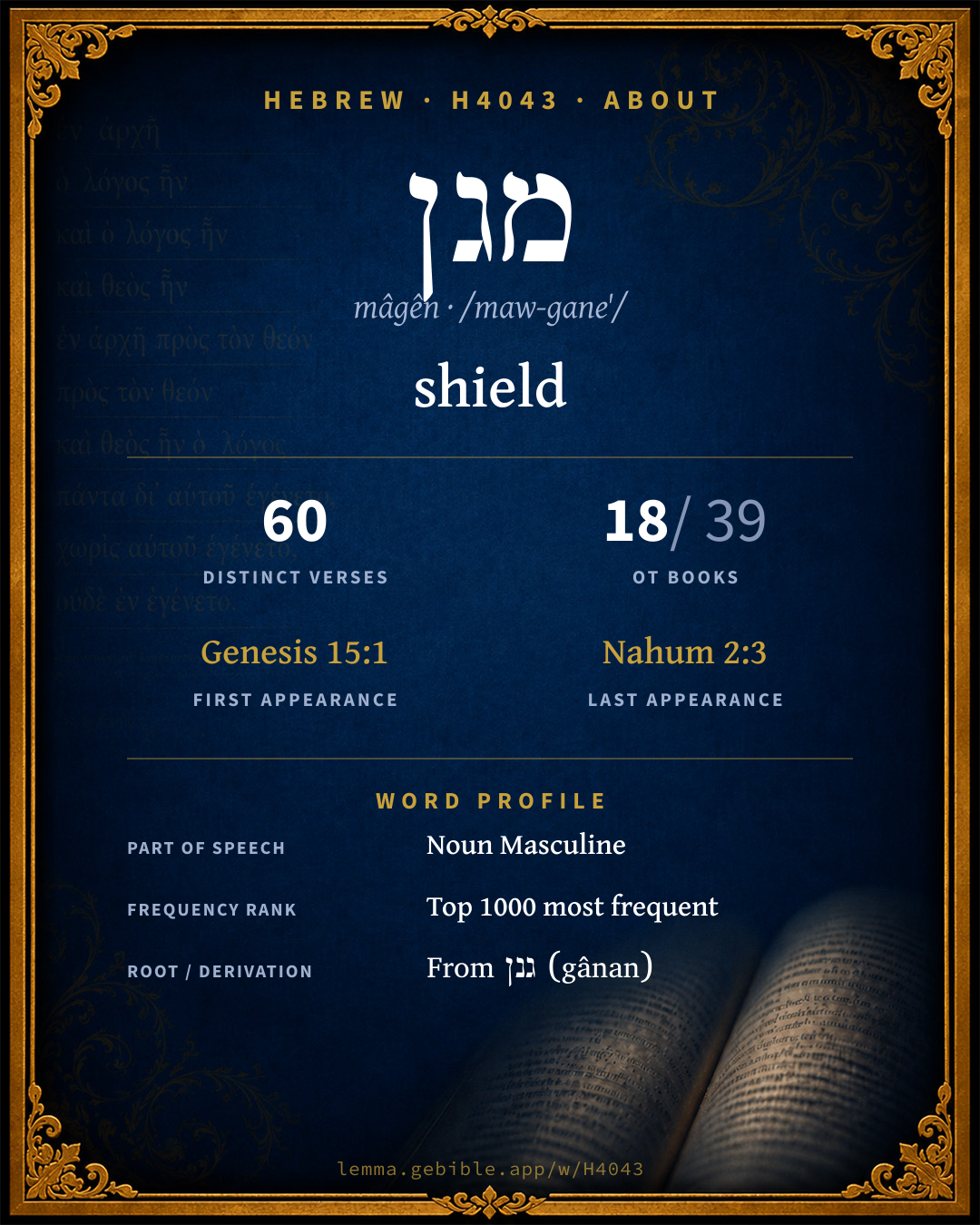
מָגֵן
shield
Full lexicon entry — Brown-Driver-Briggs (BDB)
From Brown-Driver-Briggs (BDB)
Where this word appears
See every Absolute-state word in the Hebrew Bible →
Grammar key — what these labels mean
Part of speech
- Noun
- A naming word — a person, place, thing, or idea.
Noun type
- Common
- A common noun — a general class of person, place, or thing (“king,” “city,” “water”), not a specific name.
State
- Absolute
- The independent form of a noun, not bound to a following word.
- Construct
- A noun bound to a following noun in a possessive / “of” relationship (the construct chain).
Gender
- Both
- Attested as both masculine and feminine.
Number
- Singular
- One.
- Plural
- More than one (in Hebrew, generally three or more).
Grammatical forms
- Noun, Common, Both, Singular, Absolute 29 times (46%)
- Noun, Common, Both, Singular, Construct 19 times (30%)
- Noun, Common, Both, Plural, Absolute 8 times (13%)
- Noun, Common, Both, Plural, Construct 7 times (11%)
Parsed forms decoded from the imported morphology (morphhb / Westminster Leningrad Codex — WLC text public domain, morphhb tagging CC BY 4.0), counted across 63 parsed occurrences — not distinct verses.
Every verse where H4043 appears — 60 distinct verses across 18 books. Click any verse to open its interlinear word-by-word view. Verse text shown in the World English Bible for context — . Each verse’s Hebrew form is shown with its reference; the English is not keyword-highlighted, since the data carries no word-level English alignment. Use “Compare translations” on any verse to read it across multiple English versions. This concordance covers the Hebrew Bible; Septuagint (Greek Old Testament) occurrences are not indexed here.
Genesis 1 verse
Deuteronomy 1 verse
Judges 1 verse
2 Samuel 4 verses
- 2 Samuel 1:21 מָגֵ֣ן מָגֵ֣ן n c bs cs n c bs cs You mountains of Gilboa, Let there be no dew nor rain on you, neither fields of offerings: For there the shield of the mighty was vilely cast away, The shield of Saul, not anointed with oil.
- 2 Samuel 22:3 מָגִנִּ֞/י n c bs cs + sfx pers 1cs God, my rock, in him will I take refuge; My shield, and the horn of my salvation, my high tower, and my refuge; My savior, you save me from violence.
- 2 Samuel 22:31 מָגֵ֣ן n c bs As for God, his way is perfect: The word of Yahweh is tried; He is a shield to all those who take refuge in him.
- 2 Samuel 22:36 מָגֵ֣ן n c bs cs You have also given me the shield of your salvation; Your gentleness has made me great.
1 Kings 3 verses
- 1 Kings 10:17 מָֽגִנִּים֙ הַ/מָּגֵ֣ן n c bp ptcl def.art + n c bs [he made] three hundred shields of beaten gold; three minas of gold went to one shield: and the king put them in the house of the forest of Lebanon.
- 1 Kings 14:26 מָגִנֵּ֣י n c bp cs and he took away the treasures of the house of Yahweh, and the treasures of the king's house; he even took away all: and he took away all the shields of gold which Solomon had made.
- 1 Kings 14:27 מָגִנֵּ֖י n c bp cs King Rehoboam made in their place shields of brass, and committed them to the hands of the captains of the guard, who kept the door of the king's house.
2 Kings 1 verse
1 Chronicles 1 verse
2 Chronicles 9 verses
- 2 Chronicles 9:16 מָֽגִנִּים֙ הַ/מָּגֵ֣ן n c bp ptcl def.art + n c bs [he made] three hundred shields of beaten gold; three hundred [shekels] of gold went to one shield: and the king put them in the house of the forest of Lebanon.
- 2 Chronicles 12:9 מָגִנֵּ֣י n c bp cs So Shishak king of Egypt came up against Jerusalem, and took away the treasures of the house of Yahweh, and the treasures of the king's house: he took all away: he took away also the shields of gold which Solomon had made.
- 2 Chronicles 12:10 מָגִנֵּ֖י n c bp cs King Rehoboam made in their place shields of brass, and committed them to the hands of the captains of the guard, who kept the door of the king's house.
- 2 Chronicles 14:8 מָגֵן֙ n c bs Asa had an army that bore bucklers and spears, out of Judah three hundred thousand; and out of Benjamin, that bore shields and drew bows, two hundred eighty thousand: all these were mighty men of valor.
- 2 Chronicles 17:17 וּ/מָגֵ֖ן conj + n c bs Of Benjamin: Eliada a mighty man of valor, and with him two hundred thousand armed with bow and shield;
- 2 Chronicles 23:9 הַ/מָּגִנּוֹת֙ ptcl def.art + n c bp Jehoiada the priest delivered to the captains of hundreds the spears, and bucklers, and shields, that had been king David's, which were in the house of God.
- 2 Chronicles 26:14 מָגִנִּ֤ים n c bp Uzziah prepared for them, even for all the host, shields, and spears, and helmets, and coats of mail, and bows, and stones for slinging.
- 2 Chronicles 32:5 וּ/מָגִנִּֽים conj + n c bp He took courage, and built up all the wall that was broken down, and raised [it] up to the towers, and the other wall outside, and strengthened Millo [in] the city of David, and made weapons and shields in abundance.
- 2 Chronicles 32:27 וּ/לְ/מָ֣גִנִּ֔ים conj + prep + n c bp Hezekiah had exceeding much riches and honor: and he provided him treasuries for silver, and for gold, and for precious stones, and for spices, and for shields, and for all manner of goodly vessels;
Nehemiah 1 verse
Job 2 verses
Psalms 19 verses
- Psalms 3:3 מָגֵ֣ן n c bs But you, Yahweh, are a shield around me, My glory, and the one who lifts up my head.
- Psalms 7:10 מָֽגִנִּ֥/י n c bs cs + sfx pers 1cs My shield is with God, Who saves the upright in heart.
- Psalms 18:2 מָֽגִנִּ֥/י n c bs cs + sfx pers 1cs Yahweh is my rock, my fortress, and my deliverer; My God, my rock, in whom I take refuge; My shield, and the horn of my salvation, my high tower.
- Psalms 18:30 מָגֵ֥ן n c bs As for God, his way is perfect. The word of Yahweh is tried. He is a shield to all those who take refuge in him.
- Psalms 18:35 מָגֵ֪ן n c bs cs You have also given me the shield of your salvation. Your right hand sustains me. Your gentleness has made me great.
- Psalms 28:7 וּ/מָגִנִּ/י֮ conj + n c bs cs + sfx pers 1cs Yahweh is my strength and my shield. My heart has trusted in him, and I am helped. Therefore my heart greatly rejoices. With my song I will thank him.
- Psalms 33:20 וּ/מָגִנֵּ֣/נוּ conj + n c bs cs + sfx pers 1cp Our soul has waited for Yahweh. He is our help and our shield.
- Psalms 35:2 מָגֵ֣ן n c bs Take hold of shield and buckler, And stand up for my help.
- Psalms 47:9 מָֽגִנֵּי n c bp cs The princes of the peoples are gathered together, The people of the God of Abraham. For the shields of the earth belong to God. He is greatly exalted!
- Psalms 59:11 מָֽגִנֵּ֣/נוּ n c bs cs + sfx pers 1cp Don't kill them, or my people may forget. Scatter them by your power, and bring them down, Lord our shield.
- Psalms 76:3 מָגֵ֬ן n c bs There he broke the flaming arrows of the bow, The shield, and the sword, and the weapons of war. Selah.
- Psalms 84:9 מָ֭גִנֵּ/נוּ n c bs cs + sfx pers 1cp Behold, God our shield, Look at the face of your anointed.
- Psalms 84:11 וּ/מָגֵן֮ conj + n c bs For Yahweh God is a sun and a shield. Yahweh will give grace and glory. He withholds no good thing from those who walk blamelessly.
- Psalms 89:18 מָֽגִנֵּ֑/נוּ n c bs cs + sfx pers 1cp For our shield belongs to Yahweh; Our king to the Holy One of Israel.
- Psalms 115:9 וּ/מָגִנָּ֣/ם conj + n c bs cs + sfx pers 3mp Israel, trust in Yahweh! He is their help and their shield.
- Psalms 115:10 וּ/מָגִנָּ֣/ם conj + n c bs cs + sfx pers 3mp House of Aaron, trust in Yahweh! He is their help and their shield.
- Psalms 115:11 וּ/מָגִנָּ֣/ם conj + n c bs cs + sfx pers 3mp You who fear Yahweh, trust in Yahweh! He is their help and their shield.
- Psalms 119:114 וּ/מָגִנִּ֣/י conj + n c bs cs + sfx pers 1cs You are my hiding place and my shield. I hope in your word.
- Psalms 144:2 מָ֭גִנִּ/י n c bs cs + sfx pers 1cs My loving kindness, my fortress, My high tower, my deliverer, My shield, and he in whom I take refuge; Who subdues my people under me.
Proverbs 4 verses
- Proverbs 2:7 מָ֝גֵ֗ן n c bs He lays up sound wisdom for the upright. He is a shield to those who walk in integrity;
- Proverbs 6:11 מָגֵֽן n c bs So your poverty will come as a robber, And your scarcity as an armed man.
- Proverbs 24:34 מָגֵֽן n c bs So shall your poverty come as a robber, And your want as an armed man.
- Proverbs 30:5 מָגֵ֥ן n c bs "Every word of God is flawless. He is a shield to those who take refuge in him.
Song of Solomon 1 verse
Isaiah 3 verses
- Isaiah 21:5 מָגֵֽן n c bs They prepare the table, they set the watch, they eat, they drink: rise up, you princes, anoint the shield.
- Isaiah 22:6 מָגֵֽן n c bs Elam bore the quiver, with chariots of men [and] horsemen; and Kir uncovered the shield.
- Isaiah 37:33 מָגֵ֔ן n c bs Therefore thus says Yahweh concerning the king of Assyria, He shall not come to this city, nor shoot an arrow there, neither shall he come before it with shield, nor cast up a mound against it.
Jeremiah 2 verses
Ezekiel 5 verses
- Ezekiel 23:24 וּ/מָגֵן֙ conj + n c bs They shall come against you with weapons, chariots, and wagons, and with a company of peoples; they shall set themselves against you with buckler and shield and helmet round about; and I will commit the judgment to them, and they shall judge you according to their judgments.
- Ezekiel 27:10 מָגֵ֤ן n c bs Persia and Lud and Put were in your army, your men of war: they hanged the shield and helmet in you; they set forth your comeliness.
- Ezekiel 38:4 וּ/מָגֵ֔ן conj + n c bs and I will turn you about, and put hooks into your jaws, and I will bring you forth, and all your army, horses and horsemen, all of them clothed in full armor, a great company with buckler and shield, all of them handling swords;
- Ezekiel 38:5 מָגֵ֥ן n c bs Persia, Cush, and Put with them, all of them with shield and helmet;
- Ezekiel 39:9 וּ/מָגֵ֤ן conj + n c bs Those who dwell in the cities of Israel shall go forth, and shall make fires of the weapons and burn them, both the shields and the bucklers, the bows and the arrows, and the war clubs, and the spears, and they shall make fires of them seven years;
Hosea 1 verse
Nahum 1 verse
About this entry
At a glance — auto-summarized from this page’s data, not written by a person. Every figure links to its source below. This summary describes the numbers; it doesn’t interpret them.
מגן — transliterated mâgên — is a Hebrew noun carrying the sense “shield.” It first appears in Genesis 15:1. The Hebrew Bible uses it across 60 verses — moderately common. More than a quarter of its appearances fall in Psalms. Related forms include גנן, גן and מגן. Each statement above links to its evidence; the full detail follows below.
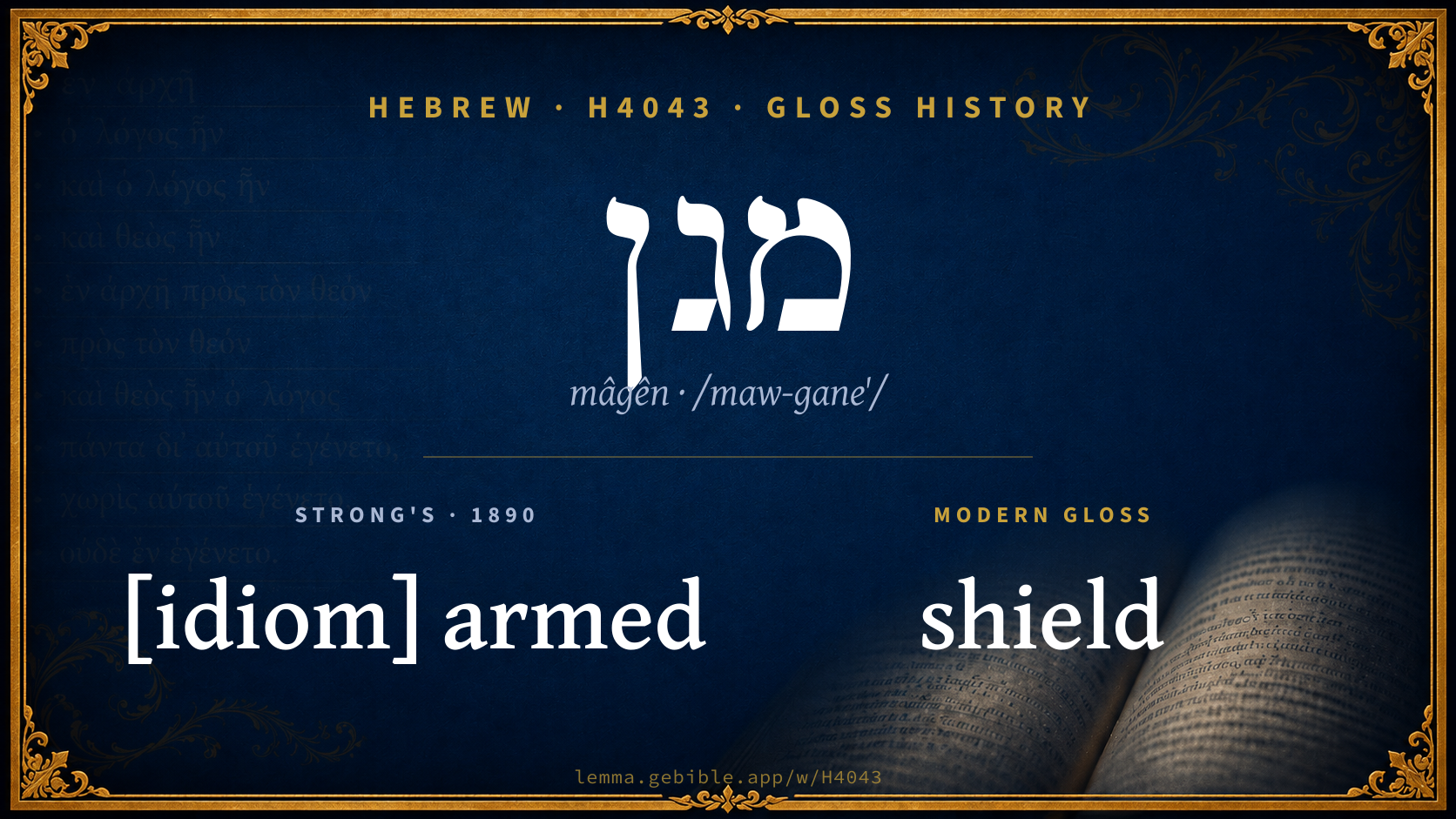
Gloss history
Strong's 1890 vs modern scholarship
About this word
Strong's H4043 catalogs a Hebrew word from the Hebrew Old Testament.
These counts are not copied from any lexicon or concordance. They are computed here, from the morphology-tagged Hebrew Old Testament. What Lemma adds →
- 60
- distinct verses
- The word appears in 60 distinct verses.
- 18 / 39
- OT books
- The word appears in 18 of 39 Old Testament books.
- #611
- by frequency
- Top 1000 most frequent Hebrew words (rank 611 of 8,640 Hebrew words by occurrence).
View all 60 occurrences in the concordance →
Most concentrated in
- Psalms 19 verses 32%
- 2 Chronicles 9 verses 15%
- Ezekiel 5 verses 8%
By section of the Old Testament
By traditional corpus
Conventional, traditional groupings — biblical authorship is debated, so this is a traditional corpus grouping, not an authorship claim. Each share is this word’s portion of its verses in that division of the Hebrew canon. Each figure is a share of the word’s 60 distinct verses.
- Writings (Ketuvim) 37 verses · 62%
- Prophets (Nevi'im) 21 verses · 35%
- Torah (Pentateuch) 2 verses · 3%
How translations render this word
Counts come from each version’s own published word-to-Strong’s tagging or interlinear alignment — an approximate guide to how each version renders this word, not a word-level alignment the data otherwise carries. Because each total is that version’s own tagged count, the per-version totals vary from one another and need not match the appearance or distinct-verse counts above. These counts may also differ from a printed concordance because Lemma counts each distinctly tagged rendering and does not collapse phrase taggings into a single head-word total. This is a fixed set of word-tagged versions (KJV, ASV, BSB, ULT) and does not change with the reading translation you choose elsewhere. Each version’s license is shown beside its name below (and on Sources).
- King James Version: Shield 27×, Shields 13×, Bucklers 3×
- American Standard Version: Shield 31×, Shields 7×, He is a shield 4×
- Berean Standard Bible: Shield 29×, Shields 16×, Is a shield 3×
- unfoldingWord Literal Text: Shield 30×, Shields 11×, Shields of 6×
King James Version Public Domain
Renders H4043 across 63 tagged occurrences — most commonly:
Plus 13 renderings that appear only once — usually multi-word phrases or single function words the recovered tagging swept in, not distinct renderings.
American Standard Version Public Domain
Renders H4043 across 63 tagged occurrences — most commonly:
Plus 10 renderings that appear only once — usually multi-word phrases or single function words the recovered tagging swept in, not distinct renderings.
Berean Standard Bible Public Domain
Renders H4043 across 61 tagged occurrences — most commonly:
Plus 8 renderings that appear only once — usually multi-word phrases or single function words the recovered tagging swept in, not distinct renderings. Not rendered by a distinct English word in 2 further occurrences.
unfoldingWord Literal Text CC BY-SA 4.0
Renders H4043 across 61 tagged occurrences — most commonly:
Plus 3 renderings that appear only once — usually multi-word phrases or single function words the recovered tagging swept in, not distinct renderings.
Senses in BDB
The 1 sense BDB distinguishes for this word, in lexicon order (not ranked by frequency or importance). The full entry — with sub-senses — is in the Lexicon Entry tab.
- shield, buckler
Word origin
n.m. 1 K 14:27, & f. 1 K 10:17, shield (Arabic مِجَنٌّ, Aramaic מְגִנָּא, ܡܓܶܢܳܐ )—מָגֵן Gn 15:1 + 33 times (also cstr. Dt 33:29 Na 2:4); sf. מָגִנִּי ψ 7:11 + 5 times; מָגִנֵּנוּ ψ 33:20 + 3 times; מָגִנָּם ψ 115:9, 10, 11; pl. מָגִנִּים 1 K 10:17 + 6 times; מָגִנּוֹת 2 Ch 23:9; cstr. מָגִנֵּי 1 K 14:26 + 4 times; sf. מָגִנָּיו Jb 15:26; מָגִנֶּיהָ Ho 4:18;—shield, buckler, carried by warrior for defence Ju 5:8 2 S 1:21(×2) 2 K 19:32 = Is 37:33, 1 Ch 5:18; 2 Ch 14:7; 17:17; 23:9; 26:14; 32:5 Ne 4:10 ψ 76:4 Je 46:3, 9 Ez 23:24; 38:4, 5; 39:9 Na 2:4 Is 22:6 cf. 21:5 (anoint the shield, to make it slippery), so also ψ 35:2 (where י׳ fig. as warrior); אִישׁ מָגֵן = armed man Pr 6:11; 24:34; laid up for show, or as treasure 1 K 10:17(×2); 14:26, 27 (= 2 Ch 9:16(×2); 12:9, 10) 2 Ch 32:27 cf. Ct 4:4 Ez 27:10; of scales of crocodile (leviathan) אֲפִיקֵי מָגִנִּים Jb 41:7; fig. of wicked’s defence against judgments of י׳, עֲבִי גַבֵּי מָגִנָּיו Jb 15:26; fig. of king ψ 89:19 (cf. Che); fig. of rulers of Ephraim Ho 4:18; fig. of rulers of earth ψ 47:10; fig. (very often) of י׳, as defence of his servants, ψ 3:4; 7:11 (read מָגִנִּי עָלַי אל׳ cf. Che crit. note) 18:3, 31, 36 (= 2 S 22:3, 31, 36) 28:7; 33:20; 59:12; 84:10, 12; 115:9, 10, 11; 119:114; 144:2 Pr 2:7; 30:5, and v. especially Gn 15:1 (E).
— Brown-Driver-Briggs (Oxford 1906, public domain), digitized via Sefaria, supplemented by the OpenScriptures HebrewLexicon (CC BY 4.0). See Sources.
Derived from גנן (gânan) (H1598) — to defend.
Jastrow Dictionary
A second Hebrew/Aramaic lexicon for comparison, covering Aramaic and post-biblical (Talmudic, Targumic, Midrashic) usage that the biblical-Hebrew BDB does not. Matched by lemma rather than by Strong’s number, so a lemma may carry more than one Jastrow headword (shown separately below), and the entries cover usage well beyond the Bible.
מָגֵן
- shield, defense. Pesik. Haʿomer, p. 70ᵃ; 70ᵇ (ref. to ואל מצנים, Job V, 5) לא בזיין ולא במ׳ not with weapon or with shield (will he prevail); Lev. R. s. 28; Pesik. R. s. 18; Yalk. Job 898.—Cant. R. to IV, 4 end (ref. to אלף המגן, ib.) אלף דור … אותו המ׳ I folded together (skipped over) a thousand generations and brought unto them that shield (the Torah).—Midr. Till. to Ps. I, 5, v. גּוּן; a. fr.—Pl. מָגִנִּים, מָגִינִּים. Lam. R. introd. (R. Joḥ. 1) (ref. to Is. XXII, 5) שהיו מקרקרים … עושין אותן מ׳ they broke down the walls of their houses and made of them defenses. Cant. R. l. c. לבניך אני נעשה מ׳ הרבה unto thy children I shall be many defenses. Gen. R. s. 44 מ׳ של צדיקים shields of the righteous (protectors of their generation by dint of their righteousness); a. e.—Esp. Magen, the first section of the Prayer of Benedictions closing with מָגֵן אַבְרָהָם (usu. called אָבוֹת, v. אָב). Deut. R. s. 11, beg. חוזר לתחלת מ׳ (Ber. 34ᵃ לראש) he must go back to the beginning of the first section. Erub. 65ᵃ, v. פּוּק h.—בֵּית הַמָּגִינִּין, Tosef. Kil. IV, 7, v. מְגִינָּא. e.g. Job 5:5
מְגָן
- v. מַגִּין
מַגָּן
- (גְּנַן; cmp. חִנָּם fr. חָנַן) grace, undeserved gift; (adv. with or without prepos.) for nothing, in vain. Targ. Prov. XV, 27.—Targ. Gen. XXIX, 15. Targ. Ex. XX, 7; Targ. Deut. V, 11; a. e.—Y. Bicc. III, 65ᶜ bot. לא מ׳ מאריך ימים it is not for nothing that he has been allowed a long life. B. Kam. 85ᵃ אסיא דמ׳ a physician (that will cure thee) without pay; אסיא דמ׳ כמ׳ שוי Ms. M. a. oth. (ed. incorr., v. Rabb. D. S. a. l. note) a physician without pay is worth as much as unpaid service can be expected to be, i.e. an unpaid physician is likely to be careless. Y. Snh. X, 29ᵃ bot. אפי׳ על מ׳ even if the curse has been pronounced gratuitously (without cause), cmp. קללת חנם s. v. חִנָּם.
A Dictionary of the Targumim, the Talmud Babli and Yerushalmi, and the Midrashic Literature (Marcus Jastrow; London, Luzac, 1903) — Public Domain. Digitized via Sefaria. Digitized via Sefaria. Full attribution on Sources.
Forms in the corpus
The 39 distinct written forms H4043 takes in the Hebrew Bible, most frequent first — each parse links to that state’s occurrences in the concordance. Hebrew forms include their vowel points and cantillation, so a single lemma takes many written forms.
Same root — word family
Other BDB entries built from the same root as H4043, grouped by Strong’s listed origin. These share a root / origin per the lexicon — not necessarily a shared meaning. Each links to that word’s own entry.
Derives from
Shares the same root
Derived from this word
Proper names from this root
People and places named from this root — a name, not an additional meaning of the word.
Compare all same-root words → Showing 4 of 6 — not the complete family. 2 of the same-root words are proper names (people or places). They share a root, not necessarily a meaning.
Septuagint verse parallels
This word appears in 51 verses that also exist in the Greek Old Testament (Septuagint), out of the 60 Hebrew verses it occurs in. You can read those verses in Greek by switching the Old Testament edition to the Septuagint.
Read these verses in the Septuagint
- Genesis 15:1
- Deuteronomy 33:29
- Judges 5:8
- 2 Samuel 1:21
- 1 Kings 10:17
- 2 Kings 19:32
- 1 Chronicles 5:18
- 2 Chronicles 9:16
- Job 15:26
- Psalms 3:3
- Proverbs 2:7
- Song of Solomon 4:4
This is a verse-level parallel only — the same verses exist in both the Hebrew and Greek Old Testaments. No word-level Hebrew↔Greek correspondence is claimed: the data carries no such alignment, so no Greek word is shown as this Hebrew word’s translation. Coverage is not total — the Septuagint omits the deuterocanon and renumbers the Psalms, so some Hebrew verses have no direct Greek parallel.