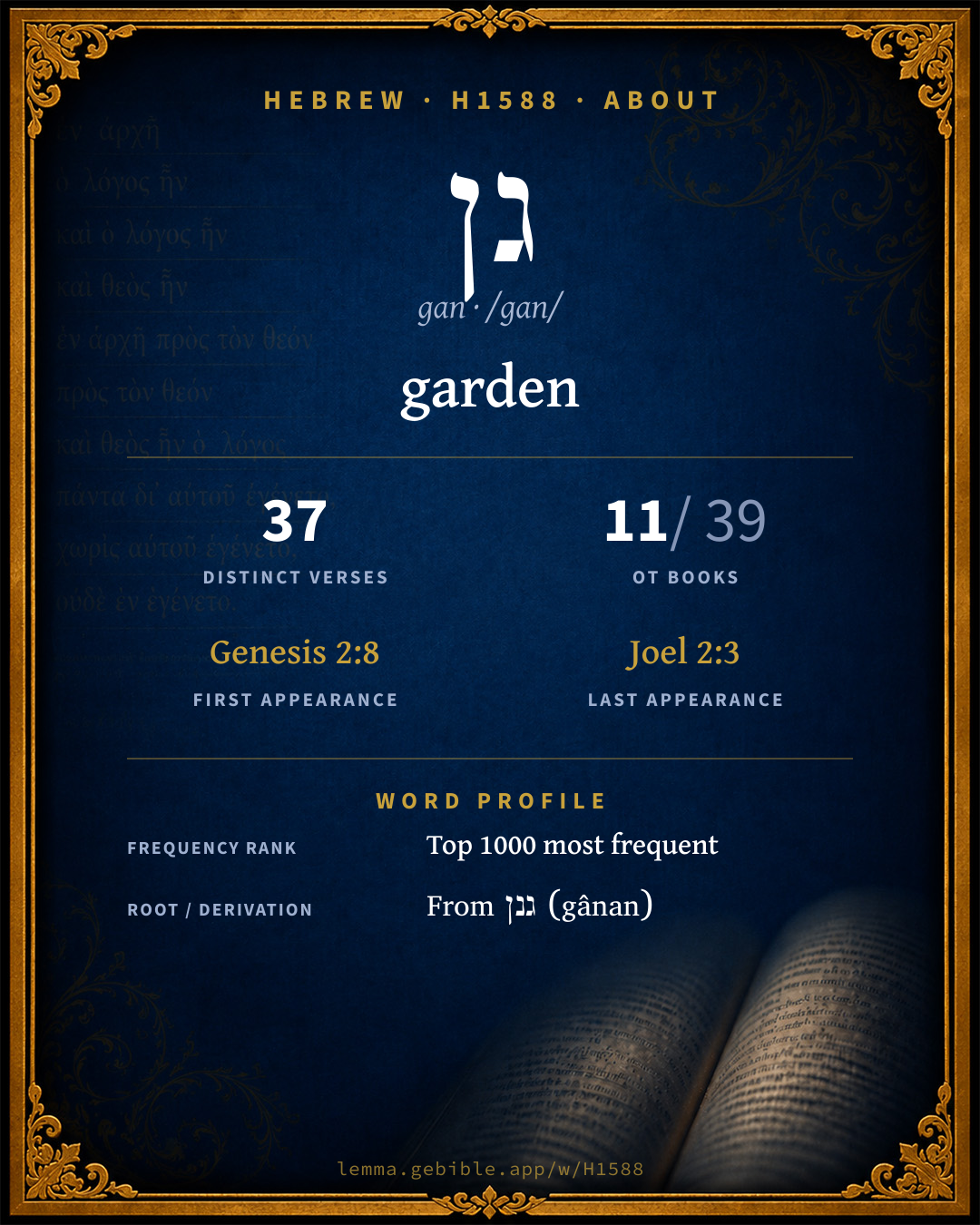
גַּן
garden
‘garden’ is one of 4 main senses fuller range ↓
Full lexicon entry — Brown-Driver-Briggs (BDB)
From Brown-Driver-Briggs (BDB)
Where this word appears
See every Construct-state word in the Hebrew Bible →
Grammar key — what these labels mean
Part of speech
- Noun
- A naming word — a person, place, thing, or idea.
Noun type
- Common
- A common noun — a general class of person, place, or thing (“king,” “city,” “water”), not a specific name.
- Proper
- A name of a specific person, place, or people (e.g. Abraham, Zion, Israel).
State
- Construct
- A noun bound to a following noun in a possessive / “of” relationship (the construct chain).
- Absolute
- The independent form of a noun, not bound to a following word.
Gender
- Both
- Attested as both masculine and feminine.
Number
- Singular
- One.
- Plural
- More than one (in Hebrew, generally three or more).
Grammatical forms
- Noun, Common, Both, Singular, Construct 24 times (57%)
- Noun, Common, Both, Singular, Absolute 14 times (33%)
- Noun, Common, Both, Plural, Absolute 3 times (7%)
- Noun, Proper 1 time (2%)
Parsed forms decoded from the imported morphology (morphhb / Westminster Leningrad Codex — WLC text public domain, morphhb tagging CC BY 4.0), counted across 42 parsed occurrences — not distinct verses.
Every verse where H1588 appears — 37 distinct verses across 11 books. Click any verse to open its interlinear word-by-word view. Verse text shown in the World English Bible for context — . Each verse’s Hebrew form is shown with its reference; the English is not keyword-highlighted, since the data carries no word-level English alignment. Use “Compare translations” on any verse to read it across multiple English versions. This concordance covers the Hebrew Bible; Septuagint (Greek Old Testament) occurrences are not indexed here.
Genesis 13 verses
- Genesis 2:8 גַּן n c bs Yahweh God planted a garden eastward, in Eden, and there he put the man whom he had formed.
- Genesis 2:9 הַ/גָּ֔ן ptcl def.art + n c bs Out of the ground Yahweh God made every tree to grow that is pleasant to the sight, and good for food; the tree of life also in the midst of the garden, and the tree of the knowledge of good and evil.
- Genesis 2:10 הַ/גָּ֑ן ptcl def.art + n c bs A river went out of Eden to water the garden; and from there it was parted, and became four heads.
- Genesis 2:15 בְ/גַן prep + n c bs cs Yahweh God took the man, and put him into the garden of Eden to dress it and to keep it.
- Genesis 2:16 הַ/גָּ֖ן ptcl def.art + n c bs Yahweh God commanded the man, saying, "Of every tree of the garden you may freely eat:
- Genesis 3:1 הַ/גָּֽן ptcl def.art + n c bs Now the serpent was more subtle than any animal of the field which Yahweh God had made. He said to the woman, "Yes, has God said, 'You shall not eat of any tree of the garden?'"
- Genesis 3:2 הַ/גָּ֖ן ptcl def.art + n c bs The woman said to the serpent, "Of the fruit of the trees of the garden we may eat,
- Genesis 3:3 הַ/גָּן֒ ptcl def.art + n c bs but of the fruit of the tree which is in the midst of the garden, God has said, 'You shall not eat of it, neither shall you touch it, lest you die.'"
- Genesis 3:8 בַּ/גָּ֖ן הַ/גָּֽן prep det + n c bs ptcl def.art + n c bs They heard the voice of Yahweh God walking in the garden in the cool of the day, and the man and his wife hid themselves from the presence of Yahweh God among the trees of the garden.
- Genesis 3:10 בַּ/גָּ֑ן prep det + n c bs The man said, "I heard your voice in the garden, and I was afraid, because I was naked; and I hid myself."
- Genesis 3:23 מִ/גַּן prep + n c bs cs Therefore Yahweh God sent him forth from the garden of Eden, to till the ground from whence he was taken.
- Genesis 3:24 לְ/גַן prep + n c bs cs So he drove out the man; and he placed Cherubs at the east of the garden of Eden, and the flame of a sword which turned every way, to guard the way to the tree of life.
- Genesis 13:10 כְּ/גַן prep + n c bs cs Lot lifted up his eyes, and saw all the plain of the Jordan, that it was well watered every where, before Yahweh destroyed Sodom and Gomorrah, like the garden of Yahweh, like the land of Egypt, as you go to Zoar.
Deuteronomy 1 verse
1 Kings 1 verse
2 Kings 4 verses
- 2 Kings 9:27 הַגָּ֑ן n Proper But when Ahaziah the king of Judah saw this, he fled by the way of the garden-house. Jehu followed after him, and said, Smite him also in the chariot: [and they struck him] at the ascent of Gur, which is by Ibleam. He fled to Megiddo, and died there.
- 2 Kings 21:18 בְּ/גַן בְּ/גַן prep + n c bs cs prep + n c bs cs Manasseh slept with his fathers, and was buried in the garden of his own house, in the garden of Uzza: and Amon his son reigned in his place.
- 2 Kings 21:26 בְּ/גַן prep + n c bs cs He was buried in his tomb in the garden of Uzza: and Josiah his son reigned in his place.
- 2 Kings 25:4 גַּ֣ן n c bs cs Then a breach was made in the city, and all the men of war [fled] by night by the way of the gate between the two walls, which was by the king's garden (now the Chaldeans were against the city round about); and [the king] went by the way of the Arabah.
Nehemiah 1 verse
Song of Solomon 6 verses
- Song of Solomon 4:12 גַּ֥ן n c bs A locked up garden is my sister, my bride; A locked up spring, A sealed fountain.
- Song of Solomon 4:15 גַּנִּ֔ים n c bp A fountain of gardens, A well of living waters, Flowing streams from Lebanon. Beloved
- Song of Solomon 4:16 גַנִּ֖/י לְ/גַנּ֔/וֹ n c bs cs + sfx pers 1cs prep + n c bs cs + sfx pers 3ms Awake, north wind; and come, you south; Blow on my garden, that its spices may flow out. Let my beloved come into his garden, And taste his precious fruits. Lover
- Song of Solomon 5:1 לְ/גַנִּ/י֮ prep + n c bs cs + sfx pers 1cs I have come into my garden, my sister, my bride. I have gathered my myrrh with my spice; I have eaten my honeycomb with my honey; I have drunk my wine with my milk. Friends Eat, friends! Drink, yes, drink abundantly, beloved. Beloved
- Song of Solomon 6:2 לְ/גַנּ֔/וֹ בַּ/גַּנִּ֔ים prep + n c bs cs + sfx pers 3ms prep det + n c bp My beloved has gone down to his garden, To the beds of spices, To feed in the gardens, and to gather lilies.
- Song of Solomon 8:13 בַּ/גַּנִּ֗ים prep det + n c bp You who dwell in the gardens, with friends in attendance, Let me hear your voice! Beloved
Isaiah 2 verses
- Isaiah 51:3 כְּ/גַן prep + n c bs cs For Yahweh has comforted Zion; he has comforted all her waste places, and has made her wilderness like Eden, and her desert like the garden of Yahweh; joy and gladness shall be found therein, thanksgiving, and the voice of melody.
- Isaiah 58:11 כְּ/גַ֣ן prep + n c bs and Yahweh will guide you continually, and satisfy your soul in dry places, and make strong your bones; and you shall be like a watered garden, and like a spring of water, whose waters don't fail.
Jeremiah 3 verses
- Jeremiah 31:12 כְּ/גַ֣ן prep + n c bs They shall come and sing in the height of Zion, and shall flow to the goodness of Yahweh, to the grain, and to the new wine, and to the oil, and to the young of the flock and of the herd: and their soul shall be as a watered garden; and they shall not sorrow any more at all.
- Jeremiah 39:4 גַּ֣ן n c bs cs It happened that, when Zedekiah the king of Judah and all the men of war saw them, then they fled, and went forth out of the city by night, by the way of the king's garden, through the gate between the two walls; and he went out toward the Arabah.
- Jeremiah 52:7 גַּ֣ן n c bs cs Then a breach was made in the city, and all the men of war fled, and went forth out of the city by night by the way of the gate between the two walls, which was by the king's garden; (now the Chaldeans were against the city round about;) and they went toward the Arabah.
Lamentations 1 verse
Ezekiel 4 verses
- Ezekiel 28:13 גַּן n c bs cs You were in Eden, the garden of God; every precious stone adorned you: ruby, topaz, emerald, chrysolite, onx, jasper, sapphire, turquoise, and beryl. Gold work of tambourines and of pipes was in you. In the day that you were created they were prepared.
- Ezekiel 31:8 בְּ/גַן בְּ/גַן prep + n c bs cs prep + n c bs cs The cedars in the garden of God could not hide it; the fir trees were not like its boughs, and the plane trees were not as its branches; nor was any tree in the garden of God like it in its beauty.
- Ezekiel 31:9 בְּ/גַ֥ן prep + n c bs cs I made it beautiful by the multitude of its branches, so that all the trees of Eden, that were in the garden of God, envied it.
- Ezekiel 36:35 כְּ/גַן prep + n c bs cs They shall say, This land that was desolate is become like the garden of Eden; and the waste and desolate and ruined cities are fortified and inhabited.
Joel 1 verse
About this entry
At a glance — auto-summarized from this page’s data, not written by a person. Every figure links to its source below. This summary describes the numbers; it doesn’t interpret them.
The Hebrew word גן centers on the idea of “garden.” Lexicons map it across 4 senses. It turns up in 37 verses across 11 books, a moderately common footprint. The word gravitates to Genesis (35%), then Song of Solomon and 2 Kings. First canonically at Genesis 2:8, it enters the text early. For the data behind this summary, explore the sense tree and the renderings breakdown below.
Gloss history
Strong's 1890 vs modern scholarship
About this word
Strong's H1588 catalogs a Hebrew word from the Hebrew Old Testament.
These counts are not copied from any lexicon or concordance. They are computed here, from the morphology-tagged Hebrew Old Testament. What Lemma adds →
- 37
- distinct verses
- The word appears in 37 distinct verses.
- 11 / 39
- OT books
- The word appears in 11 of 39 Old Testament books.
- #864
- by frequency
- Top 1000 most frequent Hebrew words (rank 864 of 8,640 Hebrew words by occurrence).
View all 37 occurrences in the concordance →
Most concentrated in
- Genesis 13 verses 35%
- Song of Solomon 6 verses 16%
- 2 Kings 4 verses 11%
By section of the Old Testament
By traditional corpus
Conventional, traditional groupings — biblical authorship is debated, so this is a traditional corpus grouping, not an authorship claim. Each share is this word’s portion of its verses in that division of the Hebrew canon. Each figure is a share of the word’s 37 distinct verses.
- Prophets (Nevi'im) 15 verses · 41%
- Torah (Pentateuch) 14 verses · 38%
- Writings (Ketuvim) 8 verses · 22%
How translations render this word
Counts come from each version’s own published word-to-Strong’s tagging or interlinear alignment — an approximate guide to how each version renders this word, not a word-level alignment the data otherwise carries. Because each total is that version’s own tagged count, the per-version totals vary from one another and need not match the appearance or distinct-verse counts above. These counts may also differ from a printed concordance because Lemma counts each distinctly tagged rendering and does not collapse phrase taggings into a single head-word total. This is a fixed set of word-tagged versions (KJV, ASV, BSB, ULT) and does not change with the reading translation you choose elsewhere. Each version’s license is shown beside its name below (and on Sources).
BDB lists this Strong’s number as 3 distinct words (homographs). Each count above pools all of them and is not split by sense — see the Senses section below. A low-frequency rendering may belong to a different one of those words, not the primary meaning.
- King James Version†: Garden 33×, Gardens 3×
- American Standard Version†: Garden 28×, 's garden 4×, Gardens 3×
- Berean Standard Bible†: Garden 32×, Like the garden 3×, Gardens 2×
- unfoldingWord Literal Text†: Garden 22×, Garden of 10×, Gardens 3×
King James Version Public Domain
Renders H1588 across 42† tagged occurrences — most commonly:
Plus 6 renderings that appear only once — usually multi-word phrases or single function words the recovered tagging swept in, not distinct renderings.
American Standard Version Public Domain
Renders H1588 across 42† tagged occurrences — most commonly:
Plus 5 renderings that appear only once — usually multi-word phrases or single function words the recovered tagging swept in, not distinct renderings.
Berean Standard Bible Public Domain
Renders H1588 across 42† tagged occurrences — most commonly:
Plus 5 renderings that appear only once — usually multi-word phrases or single function words the recovered tagging swept in, not distinct renderings.
unfoldingWord Literal Text CC BY-SA 4.0
Renders H1588 across 46† tagged occurrences — most commonly:
Plus 9 renderings that appear only once — usually multi-word phrases or single function words the recovered tagging swept in, not distinct renderings.
Senses in BDB
The 4 senses BDB distinguishes for this word, in lexicon order (not ranked by frequency or importance). The full entry — with sub-senses — is in the Lexicon Entry tab.
- garden, enclosure (noun masculine or feminine)
- enclosed garden
(figuratively of a bride)
- garden (of plants)
- Garden of Eden (noun proper locative)
Word origin
I. n.pr.loc.? 𝔊 Βαιθαν (Βαιατγαν), 𝔊L Βαιθωρων, 2 K 9:27; mod. Jenîn? v. גַּן, sub גנן, and עֵין גַּנִּים; cf. StaGesch. i. 542.
II. n.m. Ct 4:12 & (Gn 2:15) f. enclosure, garden (NH id., גַּנָּה, Arabic جَنَّةٌ, Ethiopic ገnነት Assyrian gannu or gannatu word of unc. meaning; Aramaic גִּנָּא, גִּנְתָּא, ܓܰܢܬܳܐ; Ph. פר אגנן אם צץ[צ] CISi, 165, 11 & p. 232 f. birds of enclosure (domestic fowls) or of wing)—abs. גַּן Gn 2:8 + 3 times; cstr. id. Gn 2:15 + 19 times; c. art. הַגָּן Gn 2:9 + 9 times, but כַּגַּן La 2:6; sf. גַּנִּי Ct 4:16; 5:1, גַּנּוֹ Ct 4:16; 6:2; Pl. גַּנִּים Ct 4:15 + 2 times—garden as enclosure La 2:6 (simile); הַיּוֹשֶׁבֶת בַּגַּנִּים Ct 8:13; cf. Ct 4:12 (fig. of bride גַּן נָעוּל); g. of herbs (יָרָק) Dt 11:10 1 K 21:2; fig. of bride, g. of plants, fruits, and spices Ct 4:16(×2); 5:1; 6:2(×2) cf. מַעְיַן גנים Ct 4:15; g. of (king’s) house 2 K 21:18 = גַּן־עֻזָּא 2 K 21:18, 26; גַּן הַמֶּלֶךְ 2 K 25:4 Je 39:4; 52:7 Ne 3:15, cf. בֵּית הַגָּן 2 K 9:27 (at Jezreel? but this perhaps n.pr.loc. v. sub בית p. 111); most often of garden (orchard?) in Eden (Hex only Gn & only J) Gn 2:8, 9, 10, 16; 3:1, 2, 3, 8(×2), 10, called גַּן־עֵדֶן Gn 2:15; 3:23, 24 Ez 36:35 Jo 2:3, cf. גן־י׳ Gn 13:10 Is 51:3 (both in simile); גן־אלהים Ez 28:13 (עֵדֶן גן־אל׳), 31:8(×2), 9 (‖ עֵדֶן); in last three the trees of the garden are comp. with Assyrian under fig. of cedar of Lebanon.
— Brown-Driver-Briggs (Oxford 1906, public domain), digitized via Sefaria, supplemented by the OpenScriptures HebrewLexicon (CC BY 4.0). See Sources.
Derived from גנן (gânan) (H1598) — to defend.
Jastrow Dictionary
A second Hebrew/Aramaic lexicon for comparison, covering Aramaic and post-biblical (Talmudic, Targumic, Midrashic) usage that the biblical-Hebrew BDB does not. Matched by lemma rather than by Strong’s number, so a lemma may carry more than one Jastrow headword (shown separately below), and the entries cover usage well beyond the Bible.
גַּן
- a fenced-in place, garden.—גַּן עֵדֶן paradise, place of future reward, opp. גֵּיהִינָּם. Pes. 54ᵃ; Ned. 39ᵇ; a. fr.—Gen. R. s. 15 beg. גן גדול מעדן the garden was larger than Eden (Eden was a portion of the garden, ref. to Ez. XXXI, 9). Taan. 10ᵃ וגן אחד וכ׳ and the garden was one sixtieth portion of Eden.—Gen. R. l. c. כפיגי שהיא נתונה בגי׳ like a spring in a garden. Kil. II, 2 זרעוני גנה garden plants. Ex. R. s. 31 גלגל שבגי׳ the wheel works of the well in the garden; a. fr.—Trnsf. (cmp. hortulus a. κῆπος) woman. Pirké d’R. El. ch. XXI אין גן אלא האשה וכ׳ gan (Gen. III, 3) means woman who is compared to a garden (ref. to Cant. IV, 12), מה הגנה זו וכ׳ as a garden &c. Cant. R. to IV, 12 גַּנָּתִי נעולה והיא מתגניא my consort (Israel) is closed (chaste), and yet defamed.—Pl. גַּנּוֹת. Lev. R. s. 3, beg. better off is he who owns גינה one garden and &c. ממי שנוטל ג׳ של וכ׳ than he who takes other people’s gardens on half-shares; a. fr.—Gen. R. s. 85 חורש בגנות (euphem. for sexual intercourse). e.g. Ezekiel 31:9
A Dictionary of the Targumim, the Talmud Babli and Yerushalmi, and the Midrashic Literature (Marcus Jastrow; London, Luzac, 1903) — Public Domain. Digitized via Sefaria. Digitized via Sefaria. Full attribution on Sources.
Forms in the corpus
The 26 distinct written forms H1588 takes in the Hebrew Bible, most frequent first — each parse links to that state’s occurrences in the concordance. Hebrew forms include their vowel points and cantillation, so a single lemma takes many written forms.
Same root — word family
Other BDB entries built from the same root as H1588, grouped by Strong’s listed origin. These share a root / origin per the lexicon — not necessarily a shared meaning. Each links to that word’s own entry.
Derives from
Shares the same root
Derived from this word
Proper names from this root
People and places named from this root — a name, not an additional meaning of the word.
Compare all same-root words → Showing 4 of 6 — not the complete family. 2 of the same-root words are proper names (people or places). They share a root, not necessarily a meaning.
Septuagint verse parallels
This word appears in 36 verses that also exist in the Greek Old Testament (Septuagint), out of the 37 Hebrew verses it occurs in. You can read those verses in Greek by switching the Old Testament edition to the Septuagint.
Read these verses in the Septuagint
- Genesis 2:8
- Deuteronomy 11:10
- 1 Kings 21:2
- 2 Kings 9:27
- Song of Solomon 4:12
- Isaiah 51:3
- Jeremiah 31:12
- Lamentations 2:6
- Ezekiel 28:13
- Joel 2:3
This is a verse-level parallel only — the same verses exist in both the Hebrew and Greek Old Testaments. No word-level Hebrew↔Greek correspondence is claimed: the data carries no such alignment, so no Greek word is shown as this Hebrew word’s translation. Coverage is not total — the Septuagint omits the deuterocanon and renumbers the Psalms, so some Hebrew verses have no direct Greek parallel.