
Psalms 33:20

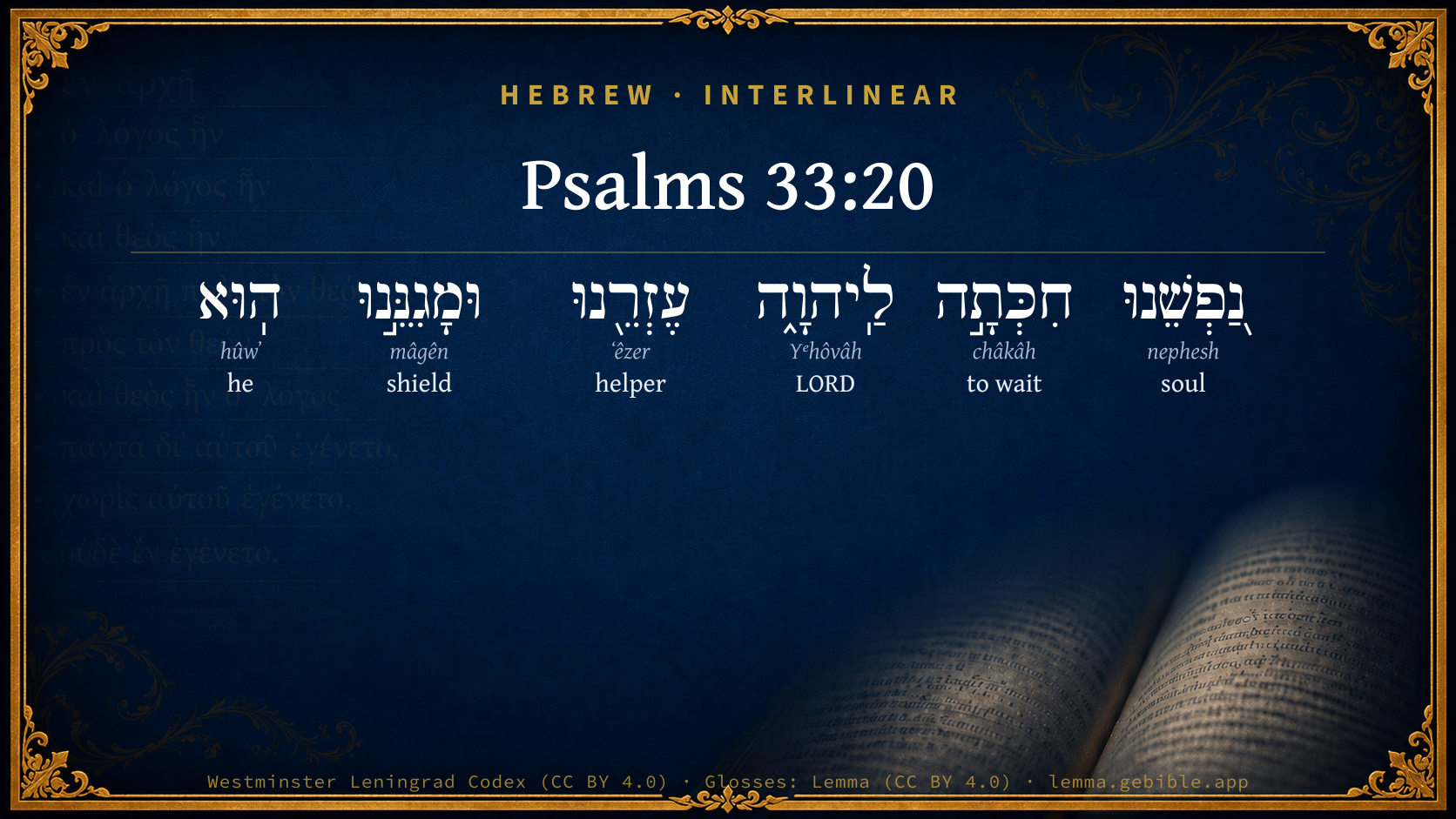
Hebrew (Westminster Leningrad Codex) Psalms 33:20 appears in the Hebrew Old Testament. The text above is from the Westminster Leningrad Codex. Each word links to its Strong’s number, a concise gloss, and parsing drawn from the Open Scriptures Hebrew Bible morphology. Click any word for its full Brown-Driver-Briggs (BDB) entry.
Download image
Cite this verse

Psalms 33:20 (World English Bible). Public Domain. Lemma interlinear Bible study tool, https://lemma.gebible.app/v/psalms/33/20.

Show BibTeX & RIS
BibTeX
RIS
English Translation
Our soul has waited for Yahweh. He is our help and our shield.
World English Bible · Public Domain
Download a study sheet

One document with this verse’s original text, its word-by-word gloss line, the meaning frame, cross-references with their text, attributed commentary, and full source and license credits — printable, and it pastes into notes with its structure intact.

This verse Autodidact and up

Study sheet (.html) Plain text (.txt)

A passage Seminary Student

Up to 50 verses in one chapter. A passage sheet keeps up to 6 commentary sources and 12 cross-references per verse, in the order this page ranks them, and says so on the sheet whenever that leaves anything out. Ask for a single verse and you get the Autodidact verse sheet above.

Everything on this page stays free to read, with no account — the sheet is a download of what is already on screen, not access to it.

Want to remove ads? Support Godless Engineer
Compare translations 3

The same verse in 3 English versions, stacked beneath the original-language interlinear above. Click any original word for its lexicon entry.

Each is an independent rendering of the whole verse — the interlinear is not word-aligned to these translations.

Highlighted words mark where these versions differ — a whole-verse word diff, not a word-by-word alignment.

  • World English Bible Public Domain
    Our soul has waited for Yahweh. He is our help and our shield.
  • King James Version Public Domain
    Our soul waiteth for the LORD: he is our help and our shield.
  • unfoldingWord Literal Text CC BY-SA 4.0
    Our soul waits for Yahweh; he our help and our shield.

unfoldingWord Literal Text — © unfoldingWord, licensed CC BY-SA 4.0. Word-aligned USFM3 via Door43 (git.door43.org/unfoldingWord/en_ult).

Versions to compare (up to 4)

3 of 4 selected

Show all 18 translations

Every available English version of this verse, each an independent rendering of the whole verse.

  • World English Bible Public Domain
    Our soul has waited for Yahweh. He is our help and our shield.
  • Berean Standard Bible Public Domain
    Our soul waits for the LORD; He is our help and our shield.
  • Majority Standard Bible Public Domain
    Our soul waits for the LORD; He is our help and our shield.
  • King James Version Public Domain
    Our soul waiteth for the LORD: he is our help and our shield.
  • American Standard Version (1901) Public Domain
    Our soul hath waited for Jehovah: He is our help and our shield.
  • Revised Version (1885) Public Domain
    Our soul hath waited for the LORD: he is our help and our shield.
  • Geneva Bible (1599) Public Domain
    Our soule waiteth for the Lord: for he is our helpe and our shielde.
  • Douay-Rheims (1899) Public Domain
    Our soul waiteth for the Lord: for he is our helper and protector.
  • Young's Literal Translation Public Domain
    Our soul hath waited for Jehovah, Our help and our shield `is' He,
  • Literal Standard Version CC BY-SA 4.0
    Our soul has waited for YHWH, || He [is] our help and our shield,
  • Unlocked Literal Bible CC BY-SA 4.0
    We wait for Yahweh; he is our help and our shield.
  • unfoldingWord Literal Text CC BY-SA 4.0
    Our soul waits for Yahweh; he our help and our shield.
  • Darby Bible Public Domain
    Our soul waiteth for Jehovah: he is our help and our shield.
  • World Messianic Bible Public Domain
    Our soul has waited for the LORD. He is our help and our shield.
  • Webster's Bible Public Domain
    Our soul waiteth for the LORD: he is our help and our shield.
  • Free Bible Version CC BY-SA 4.0
    We place our confidence in the Lord; he is our help and our defender.
  • Bible in Basic English Public Domain
    Our souls are waiting for the Lord; he is our help and our salvation.
  • JPS Tanakh (1917) Public Domain
    Our soul hath waited for the LORD; He is our help and our shield.

Literal Standard Version (2020), Covenant Press — licensed CC BY-SA 4.0. Text via the HelloAO Bible API (eBible.org). Unlocked Literal Bible (unfoldingWord) — licensed CC BY-SA 4.0. Text via the HelloAO Bible API (eBible.org). unfoldingWord Literal Text — © unfoldingWord, licensed CC BY-SA 4.0. Word-aligned USFM3 via Door43 (git.door43.org/unfoldingWord/en_ult). Free Bible Version, Dr. Jonathan Gallagher — licensed CC BY-SA 4.0. Text via the HelloAO Bible API (eBible.org).

Word by word

More ways to search: Search by grammar → Find every occurrence → Compare this word →

Practice this passage: Drill this verse → Learn its vocabulary →

About this verse

These counts appear in no published source. They are computed here, from the morphology-tagged text and Lemma’s own curated glosses. What Lemma adds →

6
words
6
distinct lemmas
Wisdom
section

Notable vocabulary

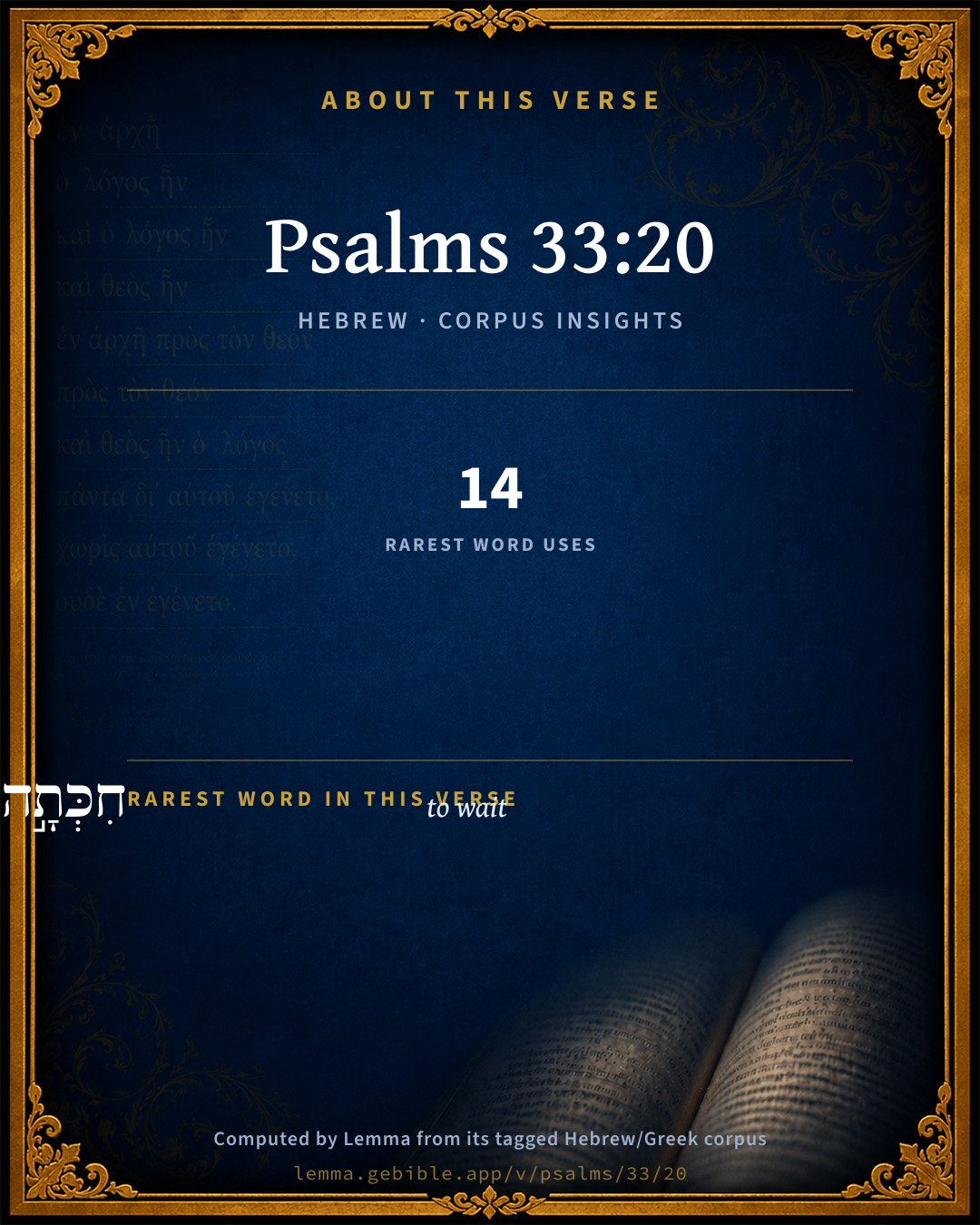
The rarest word here is חִכְּתָ֣ה to wait H2442 — appearing just 14 times in the whole Hebrew Bible.

Shared distinctive vocabulary

חִכְּתָ֣ה to wait H2442 occurs in 13 verses of the Hebrew Bible. Also found in:

Grammatical profile

  • 1 verb
  • 4 nouns
  • 1 pronoun

Verb forms

  • חִכְּתָ֣ה Piel · Perfect

Hebrew & Septuagint length

In English translation the verse runs 13 words from the Hebrew and 13 from the Septuagint (LXX English) — the same length.

A rough comparison of the two English renderings, which tokenize alike — not a word-level alignment.

Word counts can differ between the Hebrew and the Greek without any difference in meaning — e.g. the Hebrew direct-object marker אֵת has no separate Greek word, and Greek often adds the article ὁ.

Cross-references

9

Topical passages linked to Psalms 33:20 in the Treasury of Scripture Knowledge — connected by theme and wording, ordered by reader-vote popularity; previews shown in the World English Bible.

  • Isaiah 40:31 but those who wait for Yahweh shall renew their strength; they shall mount up with wings as eagles; they shall run, and not be weary; they shall walk, and not faint.
  • Psalms 27:14 Wait for Yahweh. Be strong, and let your heart take courage. Yes, wait for Yahweh.
  • Psalms 130:5–6 I wait for Yahweh. My soul waits. I hope in his word.
  • Psalms 115:9–12 Israel, trust in Yahweh! He is their help and their shield.
  • 1 Chronicles 5:20 They were helped against them, and the Hagrites were delivered into their hand, and all who were with them; for they cried to God in the battle, and he was entreated of them, because they put their trust in him.
  • Psalms 62:5–6 My soul, wait in silence for God alone, For my expectation is from him.
  • Psalms 144:1–2 Blessed be Yahweh, my rock, Who teaches my hands to war, And my fingers to battle:
  • Isaiah 8:17 I will wait for Yahweh, who hides his face from the house of Jacob, and I will look for him.

Cross-references courtesy of OpenBible.info (CC BY 4.0).

Hebrew and Greek witnesses Masoretic Hebrew ↔ Greek Septuagint

The same verse in the two great witnesses to the Old Testament, shown verse-for-verse.

You’re reading Greek Psalm 32 (Hebrew Psalm 33). The Septuagint counts the superscription, so verse numbers can differ from the Hebrew — chapter-level alignment, not verse-by-verse. Numbering follows Rahlfs.

These are two independent witnesses, not word-aligned to each other, and the Septuagint is shown in lemma (dictionary) form.

Hebrew Psalms 33:20 Masoretic · Westminster Leningrad Codex

נַ֭פְשֵׁנוּ חִכְּתָ֣ה לַֽיהוָ֑ה עֶזְרֵ֖נוּ וּמָגִנֵּ֣נוּ הֽוּא

Our soul has waited for Yahweh. He is our help and our shield.

World English Bible · Public Domain

Greek LXX Greek Psalm 32:20 Septuagint · lemma form

ὁ ψυχή ἐγώ ὑπομένω ὁ κύριος ὅτι βοηθός καί ὑπερασπιστής ἐγώ εἰμί

Our soul waits on the Lord; for he is our helper and defender.

LXX2012 (modern English Septuagint) · Public Domain

Hebrew: Westminster Leningrad Codex (CC BY 4.0). Greek: Septuagint (public domain); English from LXX2012 (modern English Septuagint) (Public Domain). How the Septuagint differs from the Hebrew →

Commentary

Notes on Psalms 33:20 from classic Christian and Jewish commentators (each source and its license shown beneath its notes). The classic Christian expositions comment on the surrounding passage and are grouped to its opening verse, so a note may address several verses; the Jewish commentaries on the Tanakh (Rashi and others) are per-verse, so they appear only where the commentator wrote on this verse.

Lemma curates 59 commentaries, every one of them public domain or Creative Commons licensed, each selected and text-cleaned for this edition rather than reprinted as found. About our sources →

Trapp's Complete Commentary

John Trapp

Psa 33:20 Our soul waiteth for the LORD: he [is] our help and our shield.

Ver. 20. Our soul waiteth for the Lord] i.e. Patiently tarrieth the Lord’s leisure. We can both wait and want for a need.

John Trapp, A Commentary or Exposition upon All the Books of the Old and New Testament (1647–1656) — public domain. Text from a community e-Sword module.

The Biblical Illustrator

Joseph S. Exell

Psa_33:20-22

Our soul waiteth for the Lord: He is our help and our shield.

Waiting for the Lord

I. the subject of the exercise--our soul. Not our souls, but our soul. Believers are said to be of one soul. Drops of water brought into contact will run into one. So with the souls of Gods people.

II. the exercise itself--waiting for the Lord. It includes conviction, desire, hope, patience.

III. the encouragement given--He is our help and our shield.

1. Their help. They need aid, and know their need.

2. Their shield, to defend from all the power of the adversary both from without and within. (W. Jay.)

A description of true worship

I. waiting on the Lord for a good reason (Psa_33:20).

1. Waiting upon Him implies faith--faith in His existence; desire, a craving after some good; patience, biding His own good time. But how are you to wait on Him?

(1) Wholly. He must be waited upon in every event, purpose, action, and place. True worship is an all-pervading spirit, not an occasional feeling or service.

(2) Lovingly. It cannot be done perfunctorily or formally.

(3) Constantly. It is spirit running through the life, giving unity, meaning, and worth to existence.

2. Such is the waiting but what is the good reason? He is our help and our shield. A shield. If He be for us, who can be against us? God is our refuge and strength. A help. Lifes labours are arduous, lifes trials are heavy: He is the only effective helper in both. We will wait, therefore, on Him.

II. rejoicing in the lord for a good reason (Psa_33:21).

1. True worship is joy--the only satisfactory and lasting joy of a moral intelligence. It is a rejoicing in His--

(1) Works.

(2) Government.

(3) Character.

(4) Fatherhood.

(5) Promises.

What is the good reason for rejoicing? Because we have trusted in His holy name. All joy is the fruit of that tree that is rooted in an unbounded confidence in God. All the streams that make glad the city of our God rise out of a settled faith in Him.

III. praying to the Lord for a good reason (Psa_33:22).

1. Were we innocent sufferers, we should pray for justice, not mercy; but we are sinful, and mercy is what we require: mercy to pardon, to cleanse, and to qualify us for the high service and fellowship of the Holy One.

2. What is the good reason for this prayer? According as we hope in Thee. We pray because our confidence is in Thee, and our expectation is from Thee. Men would never pray without this hope in God, and the compass of the prayer is measured by the expanse of this hope. We ask for little because our faith and hope are feeble. (Homilist.)

.

Psa_34:1-22

The Biblical Illustrator, edited by Joseph S. Exell (c. 1880s–1900s) — public domain. Text from a community e-Sword module.

Joseph Benson's Commentary

Psa 33:20-22. He is our help — The help of his true Israel, to whom he hath made many promises and glorious discoveries of his goodness. For our heart shall rejoice in him — Or, therefore it shall rejoice, for this seems to have been an inference, either from the foregoing or following sentence.

Joseph Benson's Commentary on the Old and New Testaments (1811–1818) — public domain. Text from a community e-Sword module.

Keil & Delitzsch

C. F. Keil & F. Delitzsch

Accordingly, in this closing hexastich, the church acknowledges Him as its help, its shield, and its source of joy. Besides the passage before us, חכּה occurs in only one other instance in the Psalter, viz., Psa 106:13. This word, which belongs to the group of words signifying hoping and waiting, is perhaps from the root חך (Arab. ḥk', ḥkâ, firmiter constringere sc. nodum), to be firm, compact, like קוּה from קוה, to pull tight or fast, cf. the German harren (to wait) and hart (hard, compact). In Psa 33:20 we still hear the echo of the primary passage Deu 33:29 (cf. Deu 33:26). The emphasis, as in Psa 115:9-11, rests upon הוּא, into which בּו, in Psa 33:21, puts this thought, viz., He is the unlimited sphere, the inexhaustible matter, the perennial spring of our joy. The second כּי confirms this subjectively. His holy Name is His church's ground of faith, of love, and of hope; for from thence comes its salvation. It can boldly pray that the mercy of the Lord may be upon it, for it waits upon Him, and man's waiting or hoping and God's giving are reciprocally conditioned. This is the meaning of the כּאשׁר. God is true to His word. The Te Deum laudamus of Ambrose closes in the same way.

Keil & Delitzsch — Biblical Commentary on the Old Testament (1861–1891) — public domain (CC PDM 1.0). Text via the HelloAO Bible API. (Old Testament only.)

J. A. Alexander on Psalms

Joseph Addison Alexander

20. (Psa 33:20) Our soul has hoped (or waited) for Jehovah; our help and our shield (is) He. In the remainder of the psalm, the people of God express their trust in him, and pray that he will deal with them according to their faith. The preterite expresses a habit already formed and fixed, and therefore really including a description of the present. In the terms of this verse, there appears to be a reference to the language of the Pentateuch in several places. See Gen 15:1; Gen 49:18, Deu 33:29. The figure of a shield occurs above, in Psa 3:4 (3), Psa 18:3; Psa 18:31; Psa 18:36 (2, 30, 35). The position of the pronoun is emphatic and significant. Our safety and protection are in him, and him alone.

Joseph Addison Alexander, The Psalms Translated and Explained (1850) — public domain. Text from a community e-Sword module.

Tyndale Open Study Notes

Tyndale Open Resources

33:20-22 The godly respond to this magnificent vision of God’s power in creation and in the affairs of the world with an affirmation of trust, commitment, joy, and hope as they pray and wait for God’s rescue.

Tyndale Open Study Notes — © Tyndale Open Resources, licensed CC BY-SA 4.0. Text via the HelloAO Bible API.

Geneva Bible (1599)

Geneva Bible translators

Thus he speaketh in the name of the whole Church, which only depend on God’s providence.

Geneva Bible (1599) marginal notes — public domain. Text via Bolls.life.

Jamieson, Fausset & Brown

Robert Jamieson, A. R. Fausset & David Brown

waiteth--in earnest expectation.

Jamieson, Fausset & Brown — Commentary Critical and Explanatory on the Whole Bible (1871) — public domain (CC PDM 1.0). Text via the HelloAO Bible API.

Adam Clarke's Commentary

Verse 20. Our soul waiteth] Our whole life is employed in this blessed work; we trust in nothing but him; neither in multitudes of armed men, nor in natural strength, nor in the fleetest animals, nor in any thing human: we trust in Him alone "who is our help and our shield."

Adam Clarke's Commentary on the Bible (1810–1826) — public domain. Text from a community e-Sword/MySword module.

John Calvin's Commentaries

20. Our soul waiteth upon Jehovah. What the Psalmist has hitherto spoken concerning God’s providence, and particularly concerning that faithful guardianship by which he protects his people, he has spoken not so much from himself as from the mouth of the Holy Spirit. He now, therefore, in the name of the whole Church, raises his song to declare that there is nothing better than to commit our welfare to God. Thus we see that the fruit of the preceding doctrine is set forth to all true believers, that they may unhesitatingly cast themselves with confidence, and with a cheerful heart, upon the paternal care of God. In this matter, the Psalmist declares nothing concerning himself in particular, but unites the whole of the godly with him in the acknowledgement of the same faith. There is an emphasis in the word soul which should be attended to; for, although this is a common mode of speech among the Hebrews, yet it expresses earnest affection; as if believers should say, We sincerely rely upon God with our whole heart, accounting him our shield and help.

John Calvin's Commentaries (1540-1563) — public domain. Text from the Calvin Translation Society English edition (1840s-50s) via the Christian Classics Ethereal Library (ccel.org). Calvin's coverage is partial (roughly two-thirds of the Bible); uncommented books and verses are honest gaps, never fabricated. The 19th-century editor's footnotes and remarks are omitted so the notes are faithfully Calvin's own voice.

Ellicott's Commentary for English Readers

(20-22) Hope—wait—trust.—The Hebrew language was naturally rich in words expressive of that attitude of expectancy which was characteristic of a nation whose golden age was not in the past, but in the future—a nation for which its great ancestor left in his dying words so suitable a motto—

“I have waited for thy salvation, O Lord,”

and which, while itself held back outside the promised land of the hope of immortality, was to be the birth-race of the great and consoling doctrine that alone could satisfy the natural craving expressed by the moralist in the well-known line—

“Man never is, but always to be, blest;”

and by the Christian apostle—

“For here we have no continuing city, but we seek one to come.”

A Bible Commentary for English Readers, edited by Charles John Ellicott (1878–1897) — public domain. Text from a community e-Sword module.

The Cambridge Bible for Schools and Colleges

gen. ed. J. J. S. Perowne

20. waiteth] R.V. hath waited; a different word from that in Psa_33:18; Psa_33:22; found in the Psalter again only in Psa_106:13; but used in Isa_8:17; Isa_30:18; Isa_64:4; &c.

our help and our shield] Cp. again Deu_33:29, “the shield of thy help”; Psa_3:3; Psa_28:7; and Psa_115:9-11.

20–22. The people’s concluding profession of patient trust and hope, corresponding to the introductory invitation of Psa_33:1-3, and springing naturally out of the consideration of Jehovah’s character in Psa_33:12-19.

The Cambridge Bible for Schools and Colleges (gen. ed. J. J. S. Perowne; Cambridge University Press, 1878–1918) — public domain. Text from a community e-Sword module.

John Gill's Exposition

Our soul waiteth for the Lord,.... This, and what follows, are the words of the church, expressing her expectation, faith, and joy, by reason of what is suggested in the preceding verses. She signifies her expectation of good by waiting for the Lord; either for his coming in the flesh, and salvation by him; for which the patriarchs, prophets, and all the Old Testament saints, waited, Gen 49:18; and so the Targum paraphrases it, "our soul waiteth for the redemption of the Lord"; or for his spiritual coming, his appearance to them, and gracious presence with them, he having been for some time absent; and it is right and good so to do, and in the issue proves advantageous, Isa 8:17; and this being soul waiting, it denotes the heartiness, sincerity, and earnestness of it;

he is our help and our shield; the Lord is the help of his people in time of trouble, when none else is or can be; and he is a present one, and helps right early, and at the best season: and he is their shield, who encompasses them about with his love and favour, and keeps them by his power in the greatest safety; all which encourages their waiting upon him, and expectation of good things from him.

John Gill's Exposition of the Whole Bible (1746–1763) — public domain (CC PDM 1.0). Text via the HelloAO Bible API.

Albert Barnes' Notes on the Bible

Our soul waiteth for the Lord - This and the subsequent verses to the end of the psalm refer to the people of God, expressing their faith in him in view of the considerations suggested in the former part of the psalm. The language is expressive of the general character of piety. True piety leads people to wait on the Lord; to depend on Him; to look to His interposition in danger, sickness, poverty, want; to rely upon Him for all that is hoped for in this life, and for salvation in the life to come. Compare Psa 62:1; Psa 25:3.

He is our help - Our aid; our helper. Compare Psa 10:14; Psa 22:11; Psa 30:10.

And our shield - See the notes at Psa 5:12. That is, He will defend us from our enemies, as if He threw His shield between us and them.

Albert Barnes' Notes on the Bible (1834–1885) — public domain. Text from a community e-Sword/MySword module.

Matthew Poole's English Annotations

The help of us Israelites, to whom he hath made many promises and glorious discoveries of his goodness.

Matthew Poole's English Annotations on the Holy Bible (1683–1685) — public domain. Text from a community e-Sword/MySword module.

The Treasury of David

Charles H. Spurgeon

Ver. 20. Our soul waits for the Lord. Here the godly avow their reliance upon him whom the Psalm extols. To wait is a great lesson. To be quiet in expectation, patient in hope, single in confidence, is one of the bright attainments of a Christian. Our soul, our life, must hang upon God; we are not to trust him with a few gewgaws, but with all we have and are. He is our help and our shield. Our help in labour, our shield in danger. The Lord answereth all things to his people. He is their all in all. Note the three "ours" in the text. These holdfast words are precious. Personal possession makes the Christian man; all else is mere talk.

Ver. 20. Our soul waiteth for the Lord. There is an emphasis on the word soul which should be attended to; for although this is a common mode of speech among the Hebrews, yet it expresses earnest affection; as if believers should say, We sincerely rely upon God with our whole heart, accounting him our shield and help. John Calvin.

Ver. 20. Our soul. Not our souls, but our soul, as if they all had only one. And what is the language of God by the prophet? "I will give them one heart and one way." And thus the two disciples going to Emmaus exclaimed, upon their discovery and surprise, "Did not our heart burn within us?" And thus in the beginning of the gospel it was said, "The multitude of them that believed were of one heart, and of one soul." We have seen several drops of water on the table, by being brought to touch, running into one. If Christians were better acquainted with each other, they would easily unite. William Jay.

Ver. 20. He is our help. Antigonus, king of Syria, being ready to give battle near the Isle of Andreos, sent out a squadron to watch the motions of his enemies, and to descry their strength: return was made that they had more ships, and better manned than he was. "How?" says Antigonus, "that cannot be; quam multis meipsum opponis (for how many dost thou reckon me?)" intimating that the dignity of a general weighed down many others, especially when poised with valour and experience. And where is valour, where is experience to be found, if not in God? He is the Lord of hosts; with him alone is strength and power to deliver Israel our of all her troubles. He may do it, he can do it, he will do it; he is wise in heart and mighty in strength; besides him there is no Saviour, no deliverer; he is a shield to the righteous, strength to the weak, a refuge to the oppressed. He is instar omnium (all in all), and who is like unto him in all the world? John Spencer.

Ver. 20. There is an excellent story of a young man, that was at sea in a mighty raging tempest; and when all the passengers were at their wits' end for fear, he only was merry; and when he was asked the reason of his mirth, he answered, "That the pilot of the ship was his father, and he knew his father would have a care of him." The great and wise God, who is our Father, hath from all eternity decreed what shall be the issue of all wars, what the event of all troubles; he is our pilot, he sits at the stern; and though the ship of the church or state be in a sinking condition, yet be of good comfort, our Pilot will have a care of us. There is nothing done in the lower house of Parliament on earth, but what is first decreed in the higher house in heaven. All the lesser wheels are ordered and overruled by the upper. Are not five sparrows, saith Christ, sold for a farthing? One sparrow is not worth half a farthing. And there's no man shall have half a farthing's worth of harm more than God hath decreed from all eternity. Edmund Calamy.

Ver. 20. Waiting for the Lord, includes:

1. Conviction --a persuasion that the Lord is the supreme good.

2. Desire --it is expressed by hungering and thirsting after righteousness.

3. Hope.

4. Patience --God is never slack concerning his promise.

William Jay.

Ver. 20. (first clause). The believer's hourly position.

Psalms 33:21*

Charles H. Spurgeon's The Treasury of David (1869–1885) — public domain. Psalms only. Text from a community e-Sword/MySword module.

Whedon's Commentary on the Bible

Daniel D. Whedon

20-22. From the retrospections already given the psalmist renews the national profession of trust in Jehovah as their only protector, and of joyful fealty to his holy name. The last verse may be taken either as a petition, or a declaration that mercy shall abide upon Israel because of their trust in God.

Daniel D. Whedon (gen. ed.), Commentary on the Old and New Testaments (1874–1909) — public domain. Text from a community e-Sword module.

The Pulpit Commentary

Vers. 20-22. A brief address of the people to God, arising out of what has been declared concerning his goodness (vers. 4, 5, 12-19) and his power (vers. 6-11), which constitute a call upon them for praise and adoration.

Our soul waiteth for the Lord. (comp. Psa_25:21 Psa_62:1, 5 130:5, 6, etc.) Confident in God"s good will, and in his power to help us, we wait patiently and cheerfully for him to manifest himself in his own good time. He is our Help and our Shield. We trust in no one and nothing but him not in armies (ver. 16), not in horses (ver. 17), not in our own strength (ver. 16). He alone is our dependence. (For the use of the metaphor "shield" for defence, see Psa_5:12 Psa_18:2 Psa_28:7 Psa_91:4 Psa_119:114, etc.)

The Pulpit Commentary (1880–1919), ed. H.D.M. Spence-Jones & Joseph S. Exell — public domain. Text from a community e-Sword module.

unfoldingWord translationNotes

Door43 World Missions Community

We wait for Yahweh

Here "wait" is an idiom that refers to trust. AT: "We trust in Yahweh" or "We hope in Yahweh" (See: Idiom)

he is our help and our shield

Here Yahweh is spoken of as if he is a shield that protects soldiers in battle. AT: "he is our helper and protects us like a shield" (See: Metaphor)

Our hearts rejoice

Here "hearts" refer to the people. AT: "We rejoice" (See: Synecdoche)

in his holy name

Here "holy name" refers to Yahweh's holy character. AT: "in his holy character" or "in him because he is holy" (See: Metonymy)

translationWords

shield

heart

joy

trust

holy

name

unfoldingWord translationNotes — © Distant Shores Media and the Door43 World Missions Community, licensed CC BY-SA 4.0. Source: git.door43.org/Door43/en_tn.

Lesson kit

Teaching starters — assembled from the data on this page, not authored interpretation. Every prompt links to the verse data it draws on. Edit before teaching.

Psalms, in the Wisdom, opens this verse with 6 words (6 distinct Hebrew lemmas). Its most distinctive word is châkâh (“to wait”). A historical commentator’s framing appears above. Read the whole chapter for the surrounding context.

Discussion questions

  1. What does “to wait” (châkâh) contribute to the verse as a whole?
  2. 2 Kings 7:9 shares the word «to wait» with this verse. How do the two illuminate each other?
  3. These translations render this verse differently. What is at stake in choosing one wording over another?
  4. The verb «חִכְּתָ֣ה» is Piel Perfect. How does its form color the action?
  5. Reading how Trapp's Complete Commentary and The Biblical Illustrator read this verse, where do the two commentators agree and where do they part?

Things to notice

Reading settings

Reading text

Shown beneath each verse's original-language words.

Old Testament
Old Testament edition

Read the OT as the Masoretic Hebrew (MT) or the Greek Septuagint (LXX).

English shown for the Greek Septuagint (in the Hebrew ↔ Greek comparison).

Comparing translations? Open the Compare panel on any verse page to stack up to four side by side.