
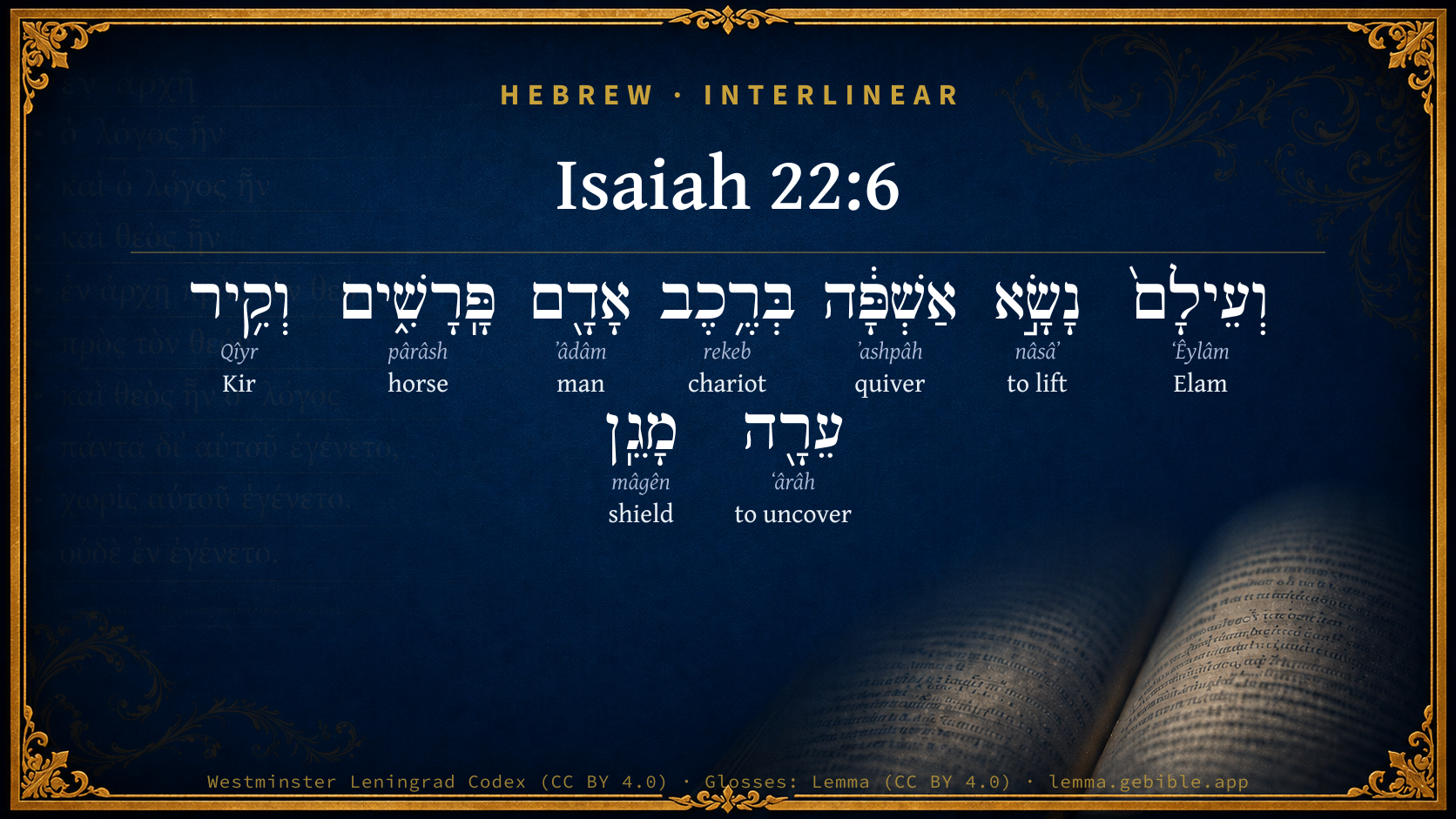
Isaiah 22:6

Hebrew (Westminster Leningrad Codex) Isaiah 22:6 appears in the Hebrew Old Testament. The text above is from the Westminster Leningrad Codex. Each word links to its Strong’s number, a concise gloss, and parsing drawn from the Open Scriptures Hebrew Bible morphology. Click any word for its full Brown-Driver-Briggs (BDB) entry.
Download image
Cite this verse

Isaiah 22:6 (World English Bible). Public Domain. Lemma interlinear Bible study tool, https://lemma.gebible.app/v/isaiah/22/6.

Show BibTeX & RIS
BibTeX
RIS
English Translation
Elam bore the quiver, with chariots of men [and] horsemen; and Kir uncovered the shield.
World English Bible · Public Domain
Download a study sheet

One document with this verse’s original text, its word-by-word gloss line, the meaning frame, cross-references with their text, attributed commentary, and full source and license credits — printable, and it pastes into notes with its structure intact.

This verse Autodidact and up

Study sheet (.html) Plain text (.txt)

A passage Seminary Student

Up to 50 verses in one chapter. A passage sheet keeps up to 6 commentary sources and 12 cross-references per verse, in the order this page ranks them, and says so on the sheet whenever that leaves anything out. Ask for a single verse and you get the Autodidact verse sheet above.

Everything on this page stays free to read, with no account — the sheet is a download of what is already on screen, not access to it.

Want to remove ads? Support Godless Engineer
Compare translations 3

The same verse in 3 English versions, stacked beneath the original-language interlinear above. Click any original word for its lexicon entry.

Each is an independent rendering of the whole verse — the interlinear is not word-aligned to these translations.

Highlighted words mark where these versions differ — a whole-verse word diff, not a word-by-word alignment.

  • World English Bible Public Domain
    Elam bore the quiver, with chariots of men [and] horsemen; and Kir uncovered the shield.
  • King James Version Public Domain
    And Elam bare the quiver with chariots of men and horsemen, and Kir uncovered the shield.
  • unfoldingWord Literal Text CC BY-SA 4.0
    And Elam lifted up the quiver, with chariots of men horsemen, and Kir uncovered the shield.

unfoldingWord Literal Text — © unfoldingWord, licensed CC BY-SA 4.0. Word-aligned USFM3 via Door43 (git.door43.org/unfoldingWord/en_ult).

Versions to compare (up to 4)

3 of 4 selected

Show all 18 translations

Every available English version of this verse, each an independent rendering of the whole verse.

  • World English Bible Public Domain
    Elam bore the quiver, with chariots of men [and] horsemen; and Kir uncovered the shield.
  • Berean Standard Bible Public Domain
    Elam takes up a quiver, with chariots and horsemen, and Kir uncovers the shield.
  • Majority Standard Bible Public Domain
    Elam takes up a quiver, with chariots and horsemen, and Kir uncovers the shield.
  • King James Version Public Domain
    And Elam bare the quiver with chariots of men and horsemen, and Kir uncovered the shield.
  • American Standard Version (1901) Public Domain
    And Elam bare the quiver, with chariots of men `and' horsemen; and Kir uncovered the shield.
  • Revised Version (1885) Public Domain
    And Elam bare the quiver, with chariots of men and horsemen; and Kir uncovered the shield.
  • Geneva Bible (1599) Public Domain
    And Elam bare the quiuer in a mans charet with horsemen, and Kir vncouered the shield.
  • Douay-Rheims (1899) Public Domain
    And Elam took the quiver, the chariot of the horseman, and the shield was taken down from the wall.
  • Young's Literal Translation Public Domain
    And Elam hath borne a quiver, In a chariot of men -- horsemen, And Kir hath exposed a shield.
  • Literal Standard Version CC BY-SA 4.0
    And Elam has carried a quiver, || In a chariot of men—horsemen, || And Kir has exposed a shield.
  • Unlocked Literal Bible CC BY-SA 4.0
    Elam takes up the quiver, with chariots of men and horsemen, and Kir lays the shield bare.
  • unfoldingWord Literal Text CC BY-SA 4.0
    And Elam lifted up the quiver, with chariots of men horsemen, and Kir uncovered the shield.
  • Darby Bible Public Domain
    -- Elam beareth the quiver with chariots of men [and] horsemen; and Kir uncovereth the shield.
  • World Messianic Bible Public Domain
    Elam carried his quiver, with chariots of men and horsemen; and Kir uncovered the shield.
  • Webster's Bible Public Domain
    And Elam bore the quiver with chariots of men and horsemen, and Kir uncovered the shield.
  • Free Bible Version CC BY-SA 4.0
    The Elamites pick up their quivers full of arrows, and prepare their chariots and horsemen, while the people of Kir uncover their shields ready for battle.
  • Bible in Basic English Public Domain
    And Elam was armed with arrows, and Aram came on horseback; and the breastplate of Kir was uncovered.
  • JPS Tanakh (1917) Public Domain
    And Elam bore the quiver, with troops of men, even horsemen; and Kir uncovered the shield.

Literal Standard Version (2020), Covenant Press — licensed CC BY-SA 4.0. Text via the HelloAO Bible API (eBible.org). Unlocked Literal Bible (unfoldingWord) — licensed CC BY-SA 4.0. Text via the HelloAO Bible API (eBible.org). unfoldingWord Literal Text — © unfoldingWord, licensed CC BY-SA 4.0. Word-aligned USFM3 via Door43 (git.door43.org/unfoldingWord/en_ult). Free Bible Version, Dr. Jonathan Gallagher — licensed CC BY-SA 4.0. Text via the HelloAO Bible API (eBible.org).

Word by word

More ways to search: Search by grammar → Find every occurrence → Compare this word →

Practice this passage: Drill this verse → Learn its vocabulary →

About this verse

These counts appear in no published source. They are computed here, from the morphology-tagged text and Lemma’s own curated glosses. What Lemma adds →

9
words
9
distinct lemmas
Prophets
section

Notable vocabulary

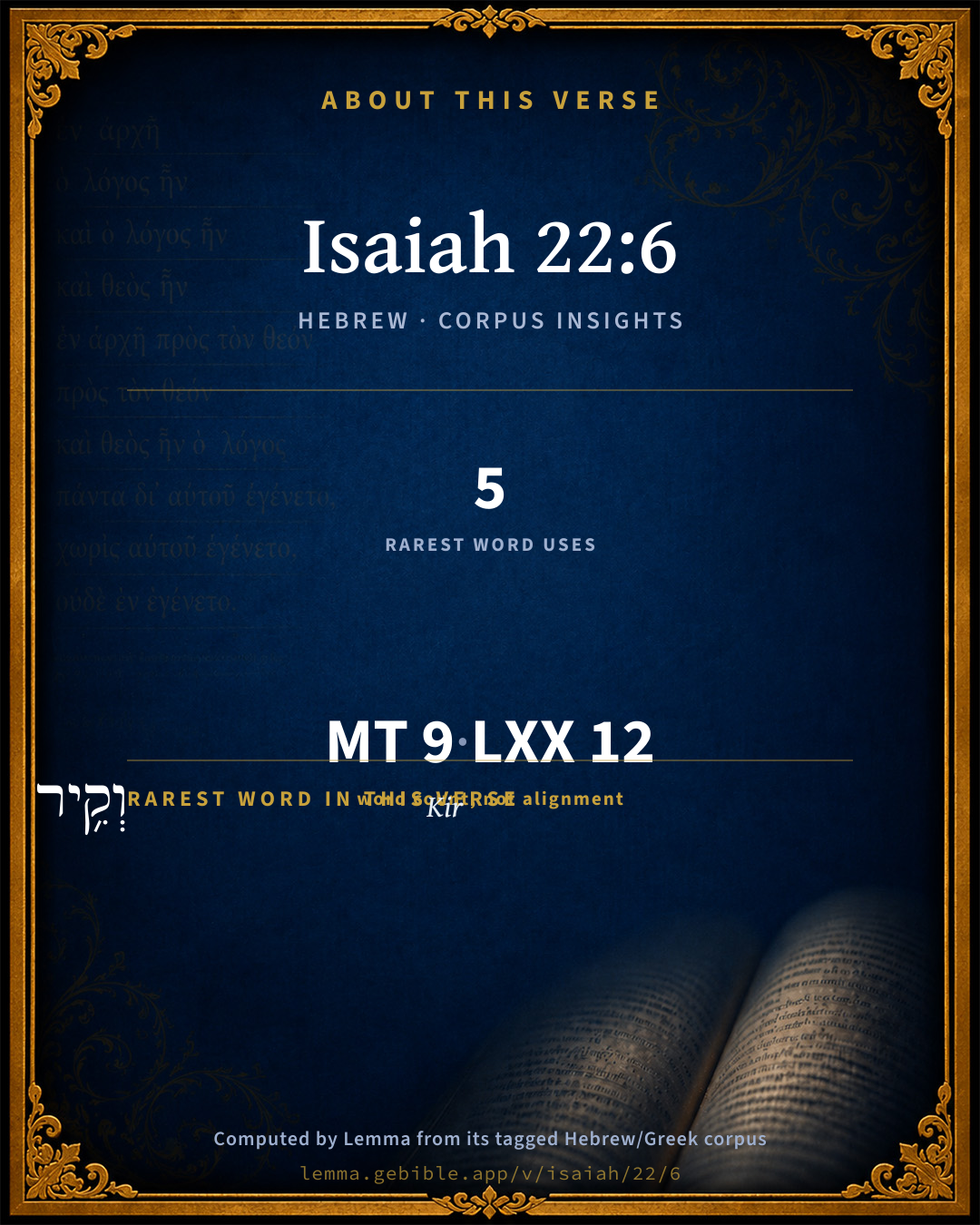
The rarest word here is וְקִ֥יר Kir H7024 — appearing just 5 times in the whole Hebrew Bible.

Shared distinctive vocabulary

וְקִ֥יר Kir H7024 occurs in 5 verses of the Hebrew Bible. Also found in:

Grammatical profile

  • 2 verbs
  • 7 nouns

Verb forms

  • נָשָׂ֣א Qal · Perfect
  • עֵרָ֖ה Piel · Perfect

Hebrew & Septuagint length

In English translation the verse runs 15 words from the Hebrew and 20 from the Septuagint (LXX English) — closely comparable.

A rough comparison of the two English renderings, which tokenize alike — not a word-level alignment.

Word counts can differ between the Hebrew and the Greek without any difference in meaning — e.g. the Hebrew direct-object marker אֵת has no separate Greek word, and Greek often adds the article ὁ.

In the original languages it is 9 Hebrew tokens and 12 Greek tokens — but the two are counted differently (Hebrew bundles its prefixes and suffixes into one token; the Greek is in lemma form), so that isn’t a like-for-like length.

Cross-references

7

Topical passages linked to Isaiah 22:6 in the Treasury of Scripture Knowledge — connected by theme and wording, ordered by reader-vote popularity; previews shown in the World English Bible.

  • 2 Kings 16:9 The king of Assyria listened to him; and the king of Assyria went up against Damascus, and took it, and carried [the people of] it captive to Kir, and killed Rezin.
  • Isaiah 21:2 A grievous vision is declared to me; the treacherous man deals treacherously, and the destroyer destroys. Go up, Elam; besiege, Media; all the sighing of it have I made to cease.
  • Amos 1:5 I will break the bar of Damascus, And cut off the inhabitant from the valley of Aven, And him who holds the scepter from the house of Eden; And the people of Syria shall go into captivity to Kir," says Yahweh.
  • Amos 9:7 Are you not like the children of the Ethiopians to me, children of Israel?" says Yahweh. "Haven't I brought up Israel out of the land of Egypt, and the Philistines from Caphtor, and the Syrians from Kir?
  • Genesis 10:22 The sons of Shem: Elam, Asshur, Arpachshad, Lud, and Aram.
  • Isaiah 15:1 The burden of Moab. For in a night Ar of Moab is laid waste, [and] brought to nothing; for in a night Kir of Moab is laid waste, [and] brought to nothing.
  • Jeremiah 49:35–39 Thus says Yahweh of Hosts: Behold, I will break the bow of Elam, the chief of their might.

Cross-references courtesy of OpenBible.info (CC BY 4.0).

Hebrew and Greek witnesses Masoretic Hebrew ↔ Greek Septuagint

The same verse in the two great witnesses to the Old Testament, shown verse-for-verse.

These are two independent witnesses, not word-aligned to each other, and the Septuagint is shown in lemma (dictionary) form.

Hebrew Isaiah 22:6 Masoretic · Westminster Leningrad Codex

וְעֵילָם֙ נָשָׂ֣א אַשְׁפָּ֔ה בְּרֶ֥כֶב אָדָ֖ם פָּֽרָשִׁ֑ים וְקִ֥יר עֵרָ֖ה מָגֵֽן

Elam bore the quiver, with chariots of men [and] horsemen; and Kir uncovered the shield.

World English Bible · Public Domain

Greek LXX Isaiah 22:6 Septuagint · lemma form

ὁ δέ αιλαμίτης λαμβάνω φαρέτρα ἀναβάτης ἄνθρωπος ἐπί ἵππος καί συναγωγή παράταξις

And the Elamites took their quivers, and there were men mounted on horses, and there was a gathering for battle.

LXX2012 (modern English Septuagint) · Public Domain

On this verse, John Gill's Exposition discusses the Septuagint’s reading. Read the note in Commentary ↓

Hebrew: Westminster Leningrad Codex (CC BY 4.0). Greek: Septuagint (public domain); English from LXX2012 (modern English Septuagint) (Public Domain). How the Septuagint differs from the Hebrew →

Targum (Aramaic paraphrase)

1

The Targum is the ancient Jewish Aramaic paraphrase of the Hebrew Scriptures — an interpretive translation, not the Hebrew text itself. Onkelos (literal) and Pseudo-Jonathan (expansive) render the Torah, and Jonathan the Prophets. Coverage is partial: where no permissively-licensed English translation exists for a verse, only the Aramaic is shown. This is verse-level text, not a word-by-word alignment to the Hebrew.

  1. Targum Jonathan Prophets (Joshua–Malachi)
    וְעֵילֵמָאֵי נְטָלוּ זְיָן בִּרְתָךְ אֱנָשׁ וְעִמֵהּ זוֹג פָּרָשִׁין וְעַל שׁוּר דְבַקוּ תְרֵיסִין:

    And the Elamites have taken arms in the chariot of a man, and with him are a couple of horsemen, and on the wall they hang the shields.

    Targum Jonathan — Aramaic: “Mikraot Gedolot” (public domain). English: “Sefaria Community Translation” (CC0 1.0 (public-domain dedication)); “London "Chaldee Paraphrase," 1871” (public domain). Text via Sefaria.

Commentary

Notes on Isaiah 22:6 from classic Christian and Jewish commentators (each source and its license shown beneath its notes). The classic Christian expositions comment on the surrounding passage and are grouped to its opening verse, so a note may address several verses; the Jewish commentaries on the Tanakh (Rashi and others) are per-verse, so they appear only where the commentator wrote on this verse.

Lemma curates 59 commentaries, every one of them public domain or Creative Commons licensed, each selected and text-cleaned for this edition rather than reprinted as found. About our sources →

Trapp's Complete Commentary

John Trapp

Isa 22:6 And Elam bare the quiver with chariots of men [and] horsemen, and Kir uncovered the shield.

Ver. 6. And Elam,] i.e., The Persians (great archers, as Corabo testifieth, lib. xvi.), as Kir standeth here for the Medians, {2Ki 16:9} good at sword and buckler; called also Syromedians.

Uncovered the shield.] Kept covered till then for fear of rusting. These were desperate fellows, bloodily bent, skilful to destroy.

John Trapp, A Commentary or Exposition upon All the Books of the Old and New Testament (1647–1656) — public domain. Text from a community e-Sword module.

Joseph Benson's Commentary

Isa 22:6-7. And Elam bare the quiver — This second member of the first part of this prophecy, which begins here, seems evidently to refer to the Assyrian invasion; for the Medes and Elamites, or Persians, were united with the Assyrians in the time of Sennacherib, but not of Nebuchadnezzar. The Persians were expert bowmen, as appears from Jer 49:35, and from Strabo’s testimony. With chariots of men and horsemen — As some of them fought on foot, so others from chariots and horses. And Kir — That is, the Medes, so called, from an eminent city and region of that name in Media, 2Ki 16:9; Amo 1:5; uncovered the shield — Prepared their defensive and offensive weapons, and themselves, for the battle; for in times of peace arms were wrapped up and covered, to preserve them clean and fit for use. Thy choicest valleys shall be full of chariots — Valleys were the most proper places for the use of chariots; and the horsemen at the gate — To assist and defend the footmen, while they made the assault, and to prevent those who endeavoured to escape.

Joseph Benson's Commentary on the Old and New Testaments (1811–1818) — public domain. Text from a community e-Sword module.

Keil & Delitzsch

C. F. Keil & F. Delitzsch

The advance of the besiegers, which leads to the destruction of the walls, is first described in Isa 22:6, Isa 22:7. "And Elam has taken the quiver, together with chariots with men, horsemen; and Kir has drawn out the shield. And then it comes to pass, that thy choicest valleys are filled with chariots, and the horsemen plant a firm foot towards the gate." Of the nations composing the Assyrian army, the two mentioned are Elam, the Semitic nation of Susiana (Chuzistan), whose original settlements were the row of valleys between the Zagros chain and the chain of advanced mountains bounding the Assyrian plains on the east, and who were greatly dreaded as bowmen (Eze 32:24; Jer 49:35), and Kir, the inhabitants of the country of the Cyrus river, which was an Assyrian province, according to Kg2 16:9 and Amo 1:5, and still retained its dependent position even in the time of the Achaemenides, when Armenia, at any rate, is expressly described in the arrowheaded writings as a Persian province, though a rebellious one. The readiness for battle of this people of Kur, who represent, in combination with Elam, the whole extent of the Assyrian empire from south to north,

(Note: The name Gurgistan (= Georgia) has nothing to do with the river Kur; and it is a suspicious fact that Kir has k at the commencement, and i in the middle, whereas the name of the river which joins the Araxes, and flows into the Caspian sea, is pronounced Kur, and is written in Persian with k (answering to the Armenian and old Persian, in which Kuru is equivalent to Κῦρος). Wetzstein considers Kir a portion of Mesopotamia.)

is attested by their "drawing out the shield" (‛ērâh mâgēn), which Caesar calls scutis tegimenta detrahere (bell. gall. ii. 21); for the Talmudic meaning applicare cannot be thought of for a moment (Buxtorf, lex. col. 1664). These nations that fought on foot were accompanied (Beth, as in Kg1 10:2) by chariots filled with men (receb 'âdâm), i.e., war-chariots (as distinguished from ‛agâloth), and, as is added ἀσυνδέτως, by pârâshim, riders (i.e., horsemen trained to arms). The historical tense is introduced with ויהי in Isa 22:7, but in a purely future sense. It is only for the sake of the favourite arrangement of the words that the passage does not proceed with Vav relat. וּמלאוּ. "Thy valleys" (‛amâkaik) are the valleys by which Jerusalem was encircled on the east, the west, and the south, viz., the valley of Kidron on the east; the valley of Gihon on the west; the valley of Rephaim, stretching away from the road to Bethlehem, on the south-west (Isa 17:5); the valley of Hinnom, which joins the Tyropaeum, and then runs on into a south-eastern angle; and possibly also the valley of Jehoshaphat, which ran on the north-east of the city above the valley of Kidron. These valleys, more especially the finest of them towards the south, are now cut up by the wheels and hoofs of the enemies' chariots and horses; and the enemies' horsemen have already taken a firm position gatewards, ready to ride full speed against the gates at a given signal, and force their way into the city (shı̄th with a shoth to strengthen it, as in Psa 3:7; also sı̄m in Kg1 20:12, compare Sa1 15:2).

Keil & Delitzsch — Biblical Commentary on the Old Testament (1861–1891) — public domain (CC PDM 1.0). Text via the HelloAO Bible API. (Old Testament only.)

Tyndale Open Study Notes

Tyndale Open Resources

22:6 Elamites: Elam was to the east of Babylon and would later play a role in Babylon’s defeat (see 21:2; also Jer 49:34-39). • The actual location of Kir is unknown (see also Amos 1:5).

Tyndale Open Study Notes — © Tyndale Open Resources, licensed CC BY-SA 4.0. Text via the HelloAO Bible API.

Geneva Bible (1599)

Geneva Bible translators

He putteth them in mind how God delivered them once from Sennacherib, who brought the Persians and Cyrenians with him, that they might by returning to God avoid that great plague which they should else suffer by Nebuchadnezzar.

Geneva Bible (1599) marginal notes — public domain. Text via Bolls.life.

Jamieson, Fausset & Brown

Robert Jamieson, A. R. Fausset & David Brown

Elam--the country stretching east from the Lower Tigris, answering to what was afterwards called Persia (see on Isa 21:2). Later, Elam was a province of Persia (Ezr 4:9). In Sennacherib's time, Elam was subject to Assyria (Kg2 18:11), and so furnished a contingent to its invading armies. Famed for the bow (Isa 13:18; Jer 49:35), in which the Ethiopians alone excelled them.

with chariots of men and horsemen--that is, they used the bow both in chariots and on horseback. "Chariots of men," that is, chariots in which men are borne, war chariots (compare see on Isa 21:7; Isa 21:9).

Kir--another people subject to Assyria (Kg2 16:9); the region about the river Kur, between the Caspian and Black Seas.

uncovered--took off for the battle the leather covering of the shield, intended to protect the embossed figures on it from dust or injury during the march. "The quiver" and "the shield" express two classes--light and heavy armed troops.

Jamieson, Fausset & Brown — Commentary Critical and Explanatory on the Whole Bible (1871) — public domain (CC PDM 1.0). Text via the HelloAO Bible API.

Adam Clarke's Commentary

Verse 6. Chariots of men - "The Syriac"] It is not easy to say what רכב אדם recheb adam, a chariot of men, can mean. It seems by the form of the sentence, which consists of three members, the first and the third mentioning a particular people, that the second should do so likewise. Thus ברכב ארם ופרשים berecheb aram uparashim, "with chariots the Syrian, and with horsemen:" the similitude of the letters ד daleth and ר resh is so great, and the mistakes arising from it are so frequent, that I readily adopt the correction of Houbigant, ארם aram, Syria, instead of אדם adam, man; which seems to me extremely probable. The conjunction ו vau, and, prefixed to פרשים parashim, horsemen, seems necessary in whatever way the sentence may be taken; and it is confirmed by five MSS., (one ancient,) four of De Rossi's, and two ancient of my own; one by correction of Dr. Kennicott's, and three editions. Kir was a city belonging to the Medes. The Medes were subject to the Assyrians in Hezekiah's time, (see 2Kg 16:9; 2Kg 17:6;) and so perhaps might Elam (the Persians) likewise be, or auxiliaries to them.

Adam Clarke's Commentary on the Bible (1810–1826) — public domain. Text from a community e-Sword/MySword module.

Ellicott's Commentary for English Readers

(6) Elam . . . Kir . . .—The two nations are named as the chief elements of the Assyrian army then invading Judæa. Elam, previously named as the destroyer of Babylon (Isa_21:2), was at this time, as the inscriptions of Sargon show, subject to Assyria (Records of the Past, vii. 29). As in later history (Herod. i. 73, iii. 21; Jer_49:35), it was conspicuous chiefly for its archers. “Kir,” named in 2Ki_16:11 as the region to which Tiglath-pileser carried off the people of Damascus, has been identified with the region near the river Kyros, the modern Georgia. There are, however, both linguistic and historical grounds against this identification, and we must be content to look on it as an otherwise unknown region of Mesopotamia. To “uncover the shield” was to draw it out of its leather case (comp. “Scutis tegumenta detrahere”; Cæs. Bell. Gall. 2:21), and so to be prepared for battle.

A Bible Commentary for English Readers, edited by Charles John Ellicott (1878–1897) — public domain. Text from a community e-Sword module.

The Cambridge Bible for Schools and Colleges

gen. ed. J. J. S. Perowne

6. Elam (see on Isa_21:2) and Kir (not identified: 2Ki_16:9; Amo_1:5; Amo_9:7) are mentioned as furnishing auxiliaries to the Assyrian army. There is force in Cheyne’s argument that some words may have fallen out before this verse, since it is difficult to understand the prominence given to these mercenary troops in the description of the siege. The “bow of Elam” is mentioned in Jer_49:35.

with chariots of men and horsemen] a difficult expression. Perhaps “men on horseback among the chariots” (Dillm.).

uncovered the shield] Shields when not in use were protected by a leather covering (Cæs. de Bell. Gall. ii. 21).

The Cambridge Bible for Schools and Colleges (gen. ed. J. J. S. Perowne; Cambridge University Press, 1878–1918) — public domain. Text from a community e-Sword module.

John Gill's Exposition

And Elam bare the quiver with chariots of men and horsemen,.... Or the Elamites, as the Targum and Septuagint, that is, the Persians, who were at this time subject to the Assyrians, and served in Sennacherib's army, which consisted of many nations; see Isa 29:7 these bore the quiver, a case for arrows, being expert in the use of the bow, which was the chief of their might, Jer 49:35 and so Strabo (o) reports, that the Elamites had many archers among them; and along with them went

chariots of men, full of men, of military men; these were chariots for war, and brought men to fight against Jerusalem;

and horsemen also, these were the cavalry, as those that carried bows and arrows seem to be the foot soldiers. The Targum is,

"and the Elamites bore arms in the chariot of a man, and with it a couple of horsemen;''

as in the vision or prophecy concerning Babylon, Isa 21:7,

and Kir uncovered the shield; this was a city in Media, and signifies the Medes, who were in subjection to the Assyrians, and fought under them; see Kg2 16:9 though Ben Melech says it was a city belonging to the king of Assyria; these prepared for battle, uncased their shields, which before were covered to keep them clean, and preserve them from rust and dirt; or they polished them, made them bright, as the word in the Ethiopic language signifies, as De Dieu has observed; see Isa 21:5 these might be most expert in the use of the shield and sword, as the others were at the bow and arrow. Some render "Kir" a "wall": so the Targum,

"and to the wall the shields stuck;''

and the Vulgate Latin version, "the shield made bare the wall": but it is best to understand it as the proper name of a place.

(o) Geograph. l. 16. p. 512.

John Gill's Exposition of the Whole Bible (1746–1763) — public domain (CC PDM 1.0). Text via the HelloAO Bible API.

Albert Barnes' Notes on the Bible

And Elam - The southern part of Persia, perhaps used here to denote Persia in general (see the note at Isa 21:2). Elam, or Persia, was at this time subject to Assyria, and their forces were united doubtless in the invasion of Judea.

Bare the quiver - A ‘quiver’ is a case in which arrows are carried. This was usually hung upon the shoulders, and thus “borne” by the soldier when he entered into battle. By the expression here, is meant that Elam was engaged in the siege, and was distinguished particularly for skill in shooting arrows. That the Elamites were thus distinguished for the use of the bow, is apparent from Eze 32:24, and Jer 49:35.

With chariots of men and horsemen - Lowth proposes, instead of ‘men,’ to read ארם 'ărâm, “Syria,” instead of אדם 'âdâm, “man,” by the change of the single Hebrew letter ד (d) into the Hebrew letter ר (r). This mistake might have been easily made where the letters are so much alike, and it would suit the parallelism of the passage, but there is no authority of MSS. or versions for the change. The words ‘chariots of men - horsemen,’ I understand here, as in Isa 21:7, to mean “a troop or riding” of men who were horsemen. Archers often rode in this manner. The Scythians usually fought on horseback with bows and arrows.

Kir - Kir was a city of Media, where the river Kyrus or Cyrus flows 2Ki 16:9; Amo 1:5; Amo 9:7. This was evidently then connected with the Assyrian monarchy, and was engaged with it in the invasion of Judea. Perhaps the name ‘’Kir’ was given to a region or province lying on the river Cyrus or Kyrus. This river unites with the Araxes, and falls into the Caspian Sea.

Uncovered the shield - (see the note at Isa 21:5). Shields were protected during a march, or when not in use, by a covering of cloth. Among the Greeks, the name of this covering was Σάγμα Sagma. Shields were made either of metal or of skin, and the object in covering them was to preserve the metal untarnished, or to keep the shield from injury. To “uncover the shield,” therefore, was to prepare for battle. The Medes were subject to the Assyrians in the time of Hezekiah 2Ki 16:9; 2Ki 17:6, and of course in the time of the invasion of Judea by Sennacherib.

Albert Barnes' Notes on the Bible (1834–1885) — public domain. Text from a community e-Sword/MySword module.

Haydock's Catholic Bible Commentary

Wall. Arms were frequently hung thereon, Canticle of Canticles ix. 4. (Calmet)

George Leo Haydock (1774–1849), Haydock's Catholic Family Bible and Commentary, 1859 edition — public domain. Excludes Psalms (Douay-Rheims chapter numbering differs from Protestant) and Deuterocanonical books (Catholic canon only).

Matthew Poole's English Annotations

Elam; the Persians, who now, and for a long time after. were subject to the Assyrian and Chaldean emperors, and were employed by them in their Wars.

Bare the quiver, being expert bow-men, as appears from Jer 49:35, and from Strabo’s testimony.

With chariots of men and horsemen; as some of them fought on foot, so others fought from chariots and horses. Kir; the Medes, so called by a synecdoche from Kir, an eminent city and region of Media, of which see 2Ki 16:9; Amo 1:5.

Uncovered; prepared it and themselves for the battle; for in times of peace arms were wrapt up and covered, to preserve them clean, and fit for use.

The shield; their defensive and offensive weapons.

Matthew Poole's English Annotations on the Holy Bible (1683–1685) — public domain. Text from a community e-Sword/MySword module.

Whedon's Commentary on the Bible

Daniel D. Whedon

6, 7. Elam — Not Persia, as a whole, but a district within it, supplying soldiers that used the bow.

Kir — A province in Assyria on the river Kuros, which furnished men with lances and shields, (shields were in cases when not used.) However, Rawlinson locates “Kir” near the mouths of the Euphrates and of the Tigris.

In either case, the siege of this chapter may be that of Nebuchadnezzar, B.C. 605, or it may cover the character of several sieges, then future to Isaiah.

Thy choicest valleys — That is, those passable to chariots near Jerusalem. These were Rephaim on the south, and the plateau north.

Daniel D. Whedon (gen. ed.), Commentary on the Old and New Testaments (1874–1909) — public domain. Text from a community e-Sword module.

The Pulpit Commentary

Elam bare the quiver. Elam, the country extending from the Zagros range to the Lower Tigris, and watered by the Choaspes, Eulaeus, Pasitigris, and other rivers, was an independent kingdom from a very early, (Gen_14:1, Gen_14:9) and in Isaiah"s time was generally hostile to Assyria. Sargon, however, relates that he conquered a portion of the country, planted colonies in it from the more western parts of his empire, and placed both colonists and natives under the governor of Babylon ("Records of the Past," vol. 9. p. 16). It is thus quite possible that both Sargon and Sennacherib may have had a contingent of Elamites in their armies. With chariots of men and horsemen; rather, with troops of men (who were) horsemen. (comp. Isa_21:7) Kir uncovered the shield. "Kir" is mentioned in 2 Kings as the place to which Tiglath-Pileser transported the inhabitants of Damascus, (2Ki_16:9) and by Amos (Amo_9:7) as the original country from which the Syrians were derived. It has been recently identified with Kirkhi, near Diarbekr, or with Kirruri, in the Urumiyah country (Cheyne); but neither identification is marc than possible. (On uncovering shields as a preliminary to engaging in battle, see Caesar, "Do Bell. Gall.," 2:21.)

The Pulpit Commentary (1880–1919), ed. H.D.M. Spence-Jones & Joseph S. Exell — public domain. Text from a community e-Sword module.

John Wesley's Explanatory Notes

Elam - The Persians, who now, and for a long time after, were subject to the Assyrian and Chaldean emperors. Quiver - Being expert bowmen. Horsemen - As some fought on foot, so others fought from chariots and horses. Kir - The Medes, so called from Kir, an eminent city and region of Media. Uncovered - Prepared it and themselves for the battle.

John Wesley, Explanatory Notes Upon the Whole Bible (1754–1765) — public domain. Text via the GEBible commentary corpus.

J. A. Alexander on Isaiah

Joseph Addison Alexander

“And Elam bare a quiver, with chariots, men, (i.e., infantry), horsemen, and Kir uncovered the shield.” Elam was a province of Persia, often put for the whole country. Its people were celebrated archers. The simplest and most natural construction seems to be that which supposes three kinds of troops to be here enumerated; cavalry, infantry, and men in chariots. Kir is now agreed to be identical with Koo; the name of a river rising in the Caucasus and emptying into the Caspian sea, from which Georgia (Girgistan) is supposed to derive its name. Kir was subject to Assyria in the time of Isaiah, as appears from the fact thus it was one of the regions to which the exiles of the ten tribes were transported. It may here be put for Media, as Elam is for Persia. The uncovering of the shield has reference to the leathern cases used to protect the shield or keep it bright. The removal of these denotes preparation for battle. The ancient versions and some modern writers translate the clause, the shield leaves the wall bare by being taken down from the place where it hung, or the enemy deprives the wall of its shield (i.e., its defenders). Some even suppose an allusion to the covered way of shields, under which the Roman soldiers used to advance to the walls of a besieged town. The verbs are in the past tense, which proves nothing however as to the date of the events described.

Joseph Addison Alexander, The Prophecies of Isaiah (1846–1847; New York: Scribner, 1870–1878) — public domain. Text from a community e-Sword module.

Rashi

Rabbi Shlomo Yitzchaki (Rashi)

carried a quiver a quiver of arrows.

and to the wall they attached their shields (עֵרָה). Comp. (above 19:7) “The well rooted plants (עָרוֹת) by the stream,” (Psalms 37:35) “Striking roots (מִתְעָרֶה) like a green tree in its native soil.” It is also possible to explain: וְקִיר עֵרָה מָגֵן as follows: Kir is the name of the city. Comp. (II Kings 16:9) “And exiled [its inhabitants] to Kir.” The people of that province exposed their shields toward Jerusalem.

Rashi on the Tanakh — English translations: “The Judaica Press complete Tanach with Rashi, translated by A. J. Rosenberg” (CC BY 4.0); “Pentateuch with Rashi's commentary by M. Rosenbaum and A.M. Silbermann, 1929-1934” (public domain); “The Metsudah Tanach series, Lakewood, N.J” (CC BY 4.0); and “The Book of Joshua, Metsudah Publications, 1997” (CC BY 4.0). Text via Sefaria.

Ibn Ezra

Rabbi Abraham ibn Ezra

And Elam, etc. In the following the prophet predicts the siege of Jerusalem by Nebuchadnezzar. Elam. Even Elam, that was defeated by Nebuchadnezzar, was to take up arms against Jerusalem.

And Kir, though being far from Jerusalem;—comp. And Aram from Kir (Am. 9:7) —will uncover the shield round Jerusalem against Israel.

Ibn Ezra on the Tanakh — English translations: “Sefaria Community Translation” (CC0 1.0 (public-domain dedication)); “Yalkut, Sifsei Chachomim Chumash, Metsudah Publications, 2009” (CC BY 4.0); and “Commentary of Ibn Ezra on Isaiah - trans. by M. Friedlander, 1873” (public domain). Text via Sefaria.

Lesson kit

Teaching starters — assembled from the data on this page, not authored interpretation. Every prompt links to the verse data it draws on. Edit before teaching.

Isaiah, in the Prophets, opens this verse with 9 words (9 distinct Hebrew lemmas). Its most distinctive word is Qîyr (“Kir”). A historical commentator’s framing appears above. Read the whole chapter for the surrounding context.

Discussion questions

  1. What does “Kir” (Qîyr) contribute to the verse as a whole?
  2. How does 2 Kings 16:9, which shares the word «Kir», read alongside this verse?
  3. These translations render this verse differently. What is at stake in choosing one wording over another?
  4. «נָשָׂ֣א» is a Qal Perfect verb. How does that grammatical form shape the action described?
  5. Compare how Trapp's Complete Commentary and Joseph Benson's Commentary read this verse. Where do they agree or differ?

Things to notice

Reading settings

Reading text

Shown beneath each verse's original-language words.

Old Testament
Old Testament edition

Read the OT as the Masoretic Hebrew (MT) or the Greek Septuagint (LXX).

English shown for the Greek Septuagint (in the Hebrew ↔ Greek comparison).

Comparing translations? Open the Compare panel on any verse page to stack up to four side by side.