
2 Chronicles 12:9

Hebrew (Westminster Leningrad Codex) 2 Chronicles 12:9 appears in the Hebrew Old Testament. The text above is from the Westminster Leningrad Codex. Each word links to its Strong’s number, a concise gloss, and parsing drawn from the Open Scriptures Hebrew Bible morphology. Click any word for its full Brown-Driver-Briggs (BDB) entry.
Download image
Cite this verse

2 Chronicles 12:9 (World English Bible). Public Domain. Lemma interlinear Bible study tool, https://lemma.gebible.app/v/2-chronicles/12/9.

Show BibTeX & RIS
BibTeX
RIS
English Translation
So Shishak king of Egypt came up against Jerusalem, and took away the treasures of the house of Yahweh, and the treasures of the king's house: he took all away: he took away also the shields of gold which Solomon had made.
World English Bible · Public Domain
Download a study sheet

One document with this verse’s original text, its word-by-word gloss line, the meaning frame, cross-references with their text, attributed commentary, and full source and license credits — printable, and it pastes into notes with its structure intact.

This verse Autodidact and up

Study sheet (.html) Plain text (.txt)

A passage Seminary Student

Up to 50 verses in one chapter. A passage sheet keeps up to 6 commentary sources and 12 cross-references per verse, in the order this page ranks them, and says so on the sheet whenever that leaves anything out. Ask for a single verse and you get the Autodidact verse sheet above.

Everything on this page stays free to read, with no account — the sheet is a download of what is already on screen, not access to it.

Want to remove ads? Support Godless Engineer
Compare translations 3

The same verse in 3 English versions, stacked beneath the original-language interlinear above. Click any original word for its lexicon entry.

Each is an independent rendering of the whole verse — the interlinear is not word-aligned to these translations.

Highlighted words mark where these versions differ — a whole-verse word diff, not a word-by-word alignment.

  • World English Bible Public Domain
    So Shishak king of Egypt came up against Jerusalem, and took away the treasures of the house of Yahweh, and the treasures of the king's house: he took all away: he took away also the shields of gold which Solomon had made.
  • King James Version Public Domain
    So Shishak king of Egypt came up against Jerusalem, and took away the treasures of the house of the LORD, and the treasures of the king's house; he took all: he carried away also the shields of gold which Solomon had made.
  • unfoldingWord Literal Text CC BY-SA 4.0
    And Shishak, the king of Egypt came up against Jerusalem and took the treasures of the house of Yahweh and the treasures of the house of the king. Everything he took; and he took the shields of gold that Solomon had made.

unfoldingWord Literal Text — © unfoldingWord, licensed CC BY-SA 4.0. Word-aligned USFM3 via Door43 (git.door43.org/unfoldingWord/en_ult).

Versions to compare (up to 4)

3 of 4 selected

Show all 18 translations

Every available English version of this verse, each an independent rendering of the whole verse.

  • World English Bible Public Domain
    So Shishak king of Egypt came up against Jerusalem, and took away the treasures of the house of Yahweh, and the treasures of the king's house: he took all away: he took away also the shields of gold which Solomon had made.
  • Berean Standard Bible Public Domain
    So King Shishak of Egypt attacked Jerusalem and seized the treasures of the house of the LORD and of the royal palace. He took everything, including the gold shields that Solomon had made.
  • Majority Standard Bible Public Domain
    So King Shishak of Egypt attacked Jerusalem and seized the treasures of the house of the LORD and of the royal palace. He took everything, including the gold shields that Solomon had made.
  • King James Version Public Domain
    So Shishak king of Egypt came up against Jerusalem, and took away the treasures of the house of the LORD, and the treasures of the king's house; he took all: he carried away also the shields of gold which Solomon had made.
  • American Standard Version (1901) Public Domain
    So Shishak king of Egypt came up against Jerusalem, and took away the treasures of the house of Jehovah, and the treasures of the king's house: he took all away: he took away also the shields of gold which Solomon had made.
  • Revised Version (1885) Public Domain
    So Shishak king of Egypt came up against Jerusalem, and took away the treasures of the house of the LORD, and the treasures of the king’s house; he took all away: he took away also the shields of gold which Solomon had made.
  • Geneva Bible (1599) Public Domain
    Then Shishak King of Egypt came vp against Ierusalem, and tooke the treasures of the house of the Lord, and the treasures of the Kings house he tooke euen all, and hee caried away the shields of golde, which Salomon had made.
  • Douay-Rheims (1899) Public Domain
    So Sesac king of Egypt departed from Jerusalem, taking away the treasures of the house of the Lord, and of the king's house, and he took all with him, and the golden shields that Solomon had made,
  • Young's Literal Translation Public Domain
    And Shishak king of Egypt cometh up against Jerusalem, and taketh the treasures of the house of Jehovah, and the treasures of the house of the king -- the whole he hath taken -- and he taketh the shields of gold that Solomon had made;
  • Literal Standard Version CC BY-SA 4.0
    And Shishak king of Egypt comes up against Jerusalem, and takes the treasures of the house of YHWH and the treasures of the house of the king—he has taken the whole—and he takes the shields of gold that Solomon had made;
  • Unlocked Literal Bible CC BY-SA 4.0
    So Shishak, king of Egypt came up against Jerusalem and took away the treasures in the house of Yahweh, and the treasures in the king's house. He took everything away; he also took the shields of gold that Solomon had made.
  • unfoldingWord Literal Text CC BY-SA 4.0
    And Shishak, the king of Egypt came up against Jerusalem and took the treasures of the house of Yahweh and the treasures of the house of the king. Everything he took; and he took the shields of gold that Solomon had made.
  • Darby Bible Public Domain
    And Shishak king of Egypt came up against Jerusalem, and took away the treasures of the house of Jehovah, and the treasures of the king's house; he took away all; and he took away the shields of gold that Solomon had made.
  • World Messianic Bible Public Domain
    So Shishak king of Egypt came up against Jerusalem and took away the treasures of the LORD’s house and the treasures of the king’s house. He took it all away. He also took away the shields of gold which Solomon had made.
  • Webster's Bible Public Domain
    So Shishak king of Egypt came up against Jerusalem, and took away the treasures of the house of the LORD, and the treasures of the king's house; he took all: he carried away also the shields of gold which Solomon had made.
  • Free Bible Version CC BY-SA 4.0
    King Shishak of Egypt attacked Jerusalem and took the treasures of the Lord's Temple and the treasures of the royal palace. He took away everything, including the gold shields that Solomon had made.
  • Bible in Basic English Public Domain
    So Shishak, king of Egypt, came up against Jerusalem and took away all the stored wealth of the house of the Lord and the king's house: he took everything away, and with the rest the gold body-covers which Solomon had made.
  • JPS Tanakh (1917) Public Domain
    So Shishak king of Egypt came up against Jerusalem, and took away the treasures of the house of the LORD, and the treasures of the king's house; he took all away; he took away also the shields of gold which Solomon had made.

Literal Standard Version (2020), Covenant Press — licensed CC BY-SA 4.0. Text via the HelloAO Bible API (eBible.org). Unlocked Literal Bible (unfoldingWord) — licensed CC BY-SA 4.0. Text via the HelloAO Bible API (eBible.org). unfoldingWord Literal Text — © unfoldingWord, licensed CC BY-SA 4.0. Word-aligned USFM3 via Door43 (git.door43.org/unfoldingWord/en_ult). Free Bible Version, Dr. Jonathan Gallagher — licensed CC BY-SA 4.0. Text via the HelloAO Bible API (eBible.org).

Word by word

More ways to search: Search by grammar → Find every occurrence → Compare this word →

Practice this passage: Drill this verse → Learn its vocabulary →

שִׁישַׁ֥ק
Shîyshaq
H7895
“Shishak”
Noun, Proper
Part of Speech
Noun
Type
Proper
Full BDB Definition

Origin: of Egyptian derivation

TWOT: None

Shishak = "greedy of fine linen" - king of Egypt, Sheshonk I, 1st king of the Bubastite 22nd dynasty; ruled in Egypt during the reigns of Solomon and Rehoboam and attacked the southern kingdom under Rehoboam and apparently made it tributary
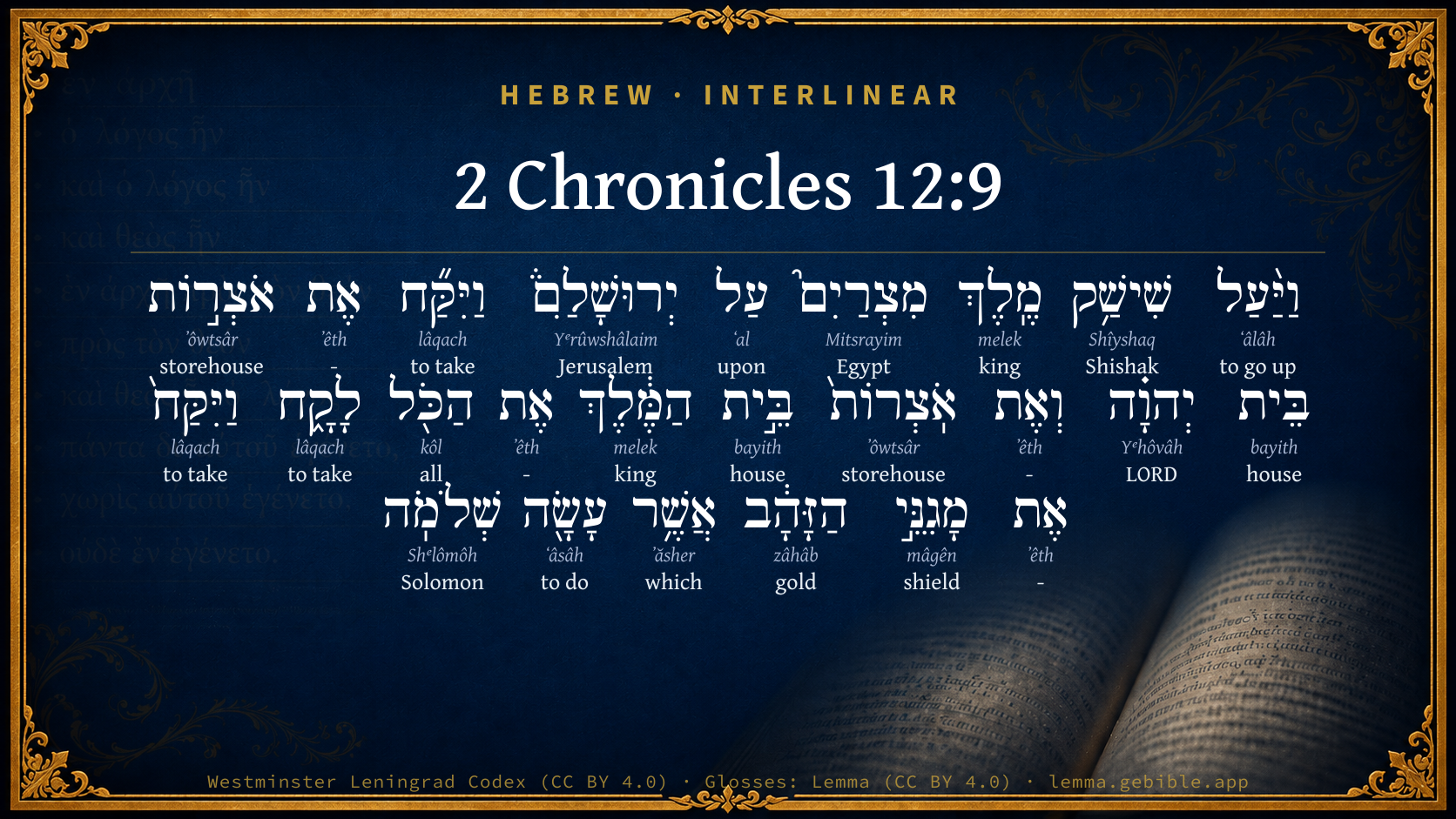
  1. וַיַּ֨עַל ʻâlâh H5927 “and · to go up” Conjunction + Verb, Qal, Sequential Imperfect, 3rd Person, Masculine, Singular
  2. מֶֽלֶךְ melek H4428 “king of” Noun, Common, Masculine, Singular, Construct
  3. מִצְרַיִם֮ Mitsrayim H4714 “Egypt” Noun, Proper
  4. עַל ʻal H5921 “upon” Preposition
  5. יְרוּשָׁלִַם֒ Yᵉrûwshâlaim H3389 “Jerusalem” Noun, Proper
  6. וַיִּקַּ֞ח lâqach H3947 “and · to take” Conjunction + Verb, Qal, Sequential Imperfect, 3rd Person, Masculine, Singular
  7. אֶת ʼêth H853 “-” Particle, Direct Object
  8. אֹצְר֣וֹת ʼôwtsâr H214 “storehouses of” Noun, Common, Masculine, Plural, Construct
  9. בֵּית bayith H1004 “house of” Noun, Common, Masculine, Singular, Construct
  10. יְהוָ֗ה Yᵉhôvâh H3068 “LORD” Noun, Proper
  11. וְאֶת ʼêth H853 “and · -” Conjunction + Particle, Direct Object
  12. אֹֽצְרוֹת֙ ʼôwtsâr H214 “storehouses of” Noun, Common, Masculine, Plural, Construct
  13. בֵּ֣ית bayith H1004 “house of” Noun, Common, Masculine, Singular, Construct
  14. הַמֶּ֔לֶךְ melek H4428 “the · king” Particle, Definite Article + Noun, Common, Masculine, Singular, Absolute
  15. אֶת ʼêth H853 “-” Particle, Direct Object
  16. הַכֹּ֖ל kôl H3605 “the · all” Particle, Definite Article + Noun, Common, Masculine, Singular, Absolute
  17. לָקָ֑ח lâqach H3947 “to take” Verb, Qal, Perfect, 3rd Person, Masculine, Singular
  18. וַיִּקַּח֙ lâqach H3947 “and · to take” Conjunction + Verb, Qal, Sequential Imperfect, 3rd Person, Masculine, Singular
  19. אֶת ʼêth H853 “-” Particle, Direct Object
  20. מָגִנֵּ֣י mâgên H4043 “shields of” Noun, Common, Both, Plural, Construct
  21. הַזָּהָ֔ב zâhâb H2091 “the · gold” Particle, Definite Article + Noun, Common, Masculine, Singular, Absolute
  22. אֲשֶׁ֥ר ʼăsher H834 “which” Particle, Relative
  23. עָשָׂ֖ה ʻâsâh H6213 “to do” Verb, Qal, Perfect, 3rd Person, Masculine, Singular
  24. שְׁלֹמֹֽה Shᵉlômôh H8010 “Solomon” Noun, Proper

About this verse

These counts appear in no published source. They are computed here, from the morphology-tagged text and Lemma’s own curated glosses. What Lemma adds →

25
words
17
distinct lemmas
Historical
section

Notable vocabulary

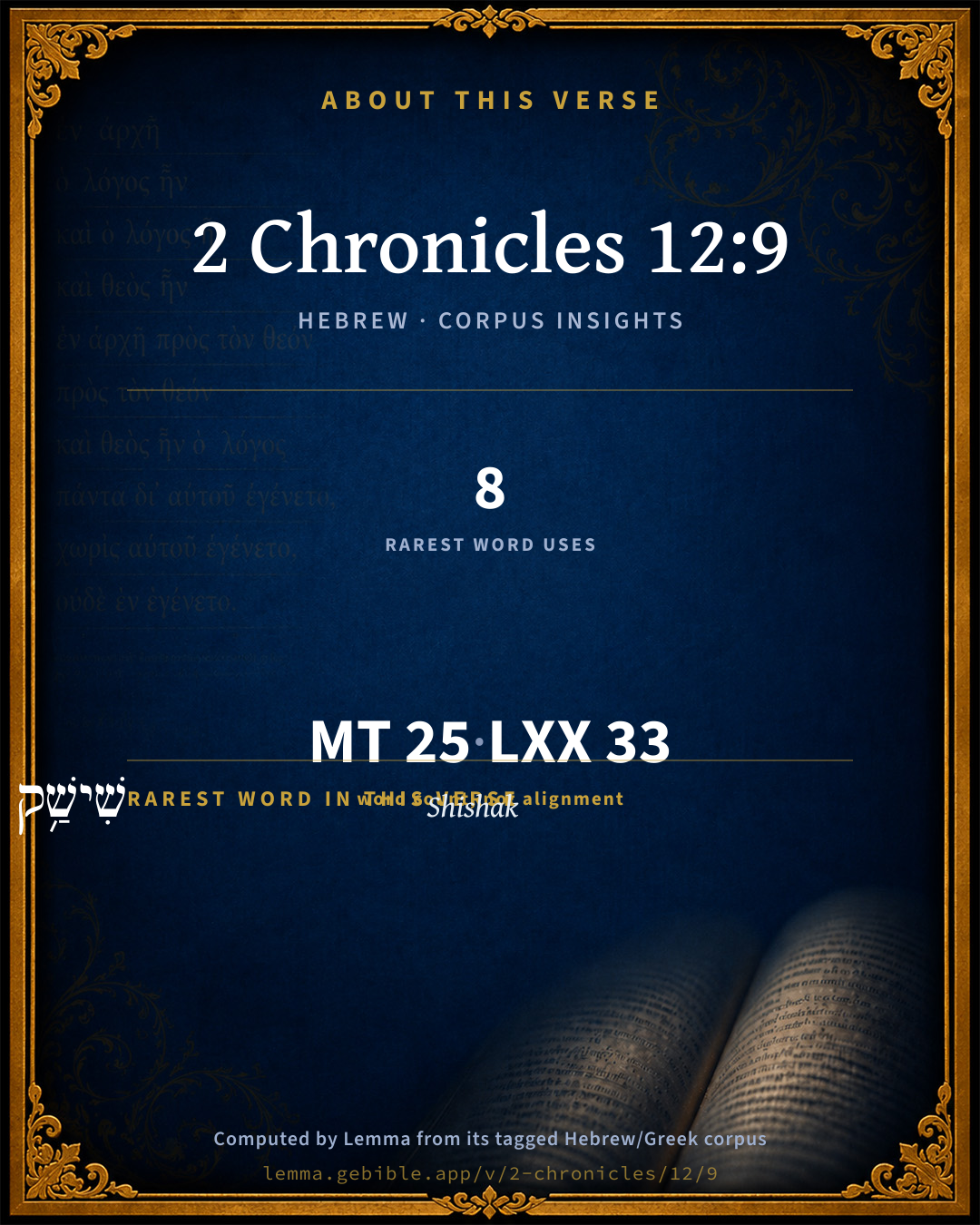
The rarest word here is שִׁישַׁ֥ק Shishak H7895 — appearing just 8 times in the whole Hebrew Bible.

Shared distinctive vocabulary

שִׁישַׁ֥ק Shishak H7895 occurs in 6 verses of the Hebrew Bible. Also found in:

Grammatical profile

  • 5 verbs
  • 14 nouns
  • 1 preposition
  • 5 particles

Verb forms

  • וַיַּ֨עַל Qal · Sequential Imperfect
  • וַיִּקַּ֞ח Qal · Sequential Imperfect
  • לָקָ֑ח Qal · Perfect
  • וַיִּקַּח֙ Qal · Sequential Imperfect
  • עָשָׂ֖ה Qal · Perfect

Repetition

Words recur within this verse — often emphatic in Hebrew:

  • וַיִּקַּ֞ח to take H3947 ×3
  • מֶֽלֶךְ king H4428 ×2
  • אֹצְר֣וֹת storehouse H214 ×2
  • בֵּית house H1004 ×2

Hebrew & Septuagint length

In English translation the verse runs 42 words from the Hebrew and 43 from the Septuagint (LXX English) — closely comparable.

A rough comparison of the two English renderings, which tokenize alike — not a word-level alignment.

Word counts can differ between the Hebrew and the Greek without any difference in meaning — e.g. the Hebrew direct-object marker אֵת has no separate Greek word, and Greek often adds the article ὁ.

In the original languages it is 25 Hebrew tokens and 33 Greek tokens — but the two are counted differently (Hebrew bundles its prefixes and suffixes into one token; the Greek is in lemma form), so that isn’t a like-for-like length.

Cross-references

7

Topical passages linked to 2 Chronicles 12:9 in the Treasury of Scripture Knowledge — connected by theme and wording, ordered by reader-vote popularity; previews shown in the World English Bible.

  • 1 Kings 10:16–17 King Solomon made two hundred bucklers of beaten gold; six hundred [shekels] of gold went to one buckler.
  • 2 Chronicles 9:15–16 King Solomon made two hundred bucklers of beaten gold; six hundred [shekels] of beaten gold went to one buckler.
  • 1 Kings 14:25–28 It happened in the fifth year of king Rehoboam, that Shishak king of Egypt came up against Jerusalem;
  • 2 Kings 16:8 Ahaz took the silver and gold that was found in the house of Yahweh, and in the treasures of the king's house, and sent it for a present to the king of Assyria.
  • 1 Kings 15:18 Then Asa took all the silver and the gold that were left in the treasures of the house of Yahweh, and the treasures of the king's house, and delivered them into the hand of his servants; and king Asa sent them to Ben Hadad, the son of Tabrimmon, the son of Hezion, king of Syria, who lived at Damascus, saying,
  • 2 Kings 18:15–16 Hezekiah gave [him] all the silver that was found in the house of Yahweh, and in the treasures of the king's house.
  • Lamentations 1:10 The adversary has spread out his hand on all her pleasant things: For she has seen that the nations are entered into her sanctuary, Concerning whom you did command that they should not enter into your assembly.

Cross-references courtesy of OpenBible.info (CC BY 4.0).

Hebrew and Greek witnesses Masoretic Hebrew ↔ Greek Septuagint

The same verse in the two great witnesses to the Old Testament, shown verse-for-verse.

These are two independent witnesses, not word-aligned to each other, and the Septuagint is shown in lemma (dictionary) form.

Hebrew 2 Chronicles 12:9 Masoretic · Westminster Leningrad Codex

וַיַּ֨עַל שִׁישַׁ֥ק מֶֽלֶךְ מִצְרַיִם֮ עַל יְרוּשָׁלִַם֒ וַיִּקַּ֞ח אֶת אֹצְר֣וֹת בֵּית יְהוָ֗ה וְאֶת אֹֽצְרוֹת֙ בֵּ֣ית הַמֶּ֔לֶךְ אֶת הַכֹּ֖ל לָקָ֑ח וַיִּקַּח֙ אֶת מָגִנֵּ֣י הַזָּהָ֔ב אֲשֶׁ֥ר עָשָׂ֖ה שְׁלֹמֹֽה

So Shishak king of Egypt came up against Jerusalem, and took away the treasures of the house of Yahweh, and the treasures of the king's house: he took all away: he took away also the shields of gold which Solomon had made.

World English Bible · Public Domain

Greek LXX 2 Chronicles 12:9 Septuagint · lemma form

καί ἀναβαίνω σουσακιμ βασιλεύς αἴγυπτος καί λαμβάνω ὁ θησαυρός ὁ ἐν οἶκος κύριος καί ὁ θησαυρός ὁ ἐν οἶκος ὁ βασιλεύς ὁ πᾶς λαμβάνω καί λαμβάνω ὁ θυρεός ὁ χρυσοῦς ὅς ποιέω σαλωμών

So Susakim king of Egypt went up against Jerusalem, and took the treasures that were in the house of the Lord, and the treasures that were in the king's house: he took all; and he took the golden shields which Solomon had made.

LXX2012 (modern English Septuagint) · Public Domain

On this verse, The Pulpit Commentary discusses the Septuagint’s reading. Read the note in Commentary ↓

Hebrew: Westminster Leningrad Codex (CC BY 4.0). Greek: Septuagint (public domain); English from LXX2012 (modern English Septuagint) (Public Domain). How the Septuagint differs from the Hebrew →

Commentary

Notes on 2 Chronicles 12:9 from classic Christian and Jewish commentators (each source and its license shown beneath its notes). The classic Christian expositions comment on the surrounding passage and are grouped to its opening verse, so a note may address several verses; the Jewish commentaries on the Tanakh (Rashi and others) are per-verse, so they appear only where the commentator wrote on this verse.

Lemma curates 59 commentaries, every one of them public domain or Creative Commons licensed, each selected and text-cleaned for this edition rather than reprinted as found. About our sources →

Trapp's Complete Commentary

John Trapp

2Ch 12:9 So Shishak king of Egypt came up against Jerusalem, and took away the treasures of the house of the LORD, and the treasures of the king’s house; he took all: he carried away also the shields of gold which Solomon had made.

Ver. 9. So Shishak king of Egypt came up against Jerusalem.] Josephus saith he marched into it, and plundered it. But it is more likely that he compounded with Rehoboam for a great sum, as Sennacherib did with Hezekiah, {2Ki 18:14-15} and upon this account had the treasures and golden shields.

John Trapp, A Commentary or Exposition upon All the Books of the Old and New Testament (1647–1656) — public domain. Text from a community e-Sword module.

The Biblical Illustrator

Joseph S. Exell

2Ch_12:9-10

Instead of which king Rehoboam made shields of brass.

The downward grade

See how deterioration follows all character that goes down in its religious aspects. This deterioration marks the whole progress of human development. Is it not so with regard to all personal service? How ardent we once were! How devoted to the house of God, how punctual in attendance, how zealous in worship! How we longed for the hour of praise to double itself, that we might have long intercourse with the Father and the Son and the Holy Ghost! Now how soon we become uneasy, how we long to be released, how patience becomes sensitive, and yields in angry surrender because too much tried! You never bring gold for brass when you leave God. The prodigal never brings any treasure back with him. When men go away intellectually from the Bible they bring back brass for gold. When they leave the Bible morally they bring back brass for gold. When they leave sympathetically they bring back artifice for inspiration, mechanics for vital communion. (J.Parker, D.D.)

The Biblical Illustrator, edited by Joseph S. Exell (c. 1880s–1900s) — public domain. Text from a community e-Sword module.

Joseph Benson's Commentary

2Ch 12:9-10. Shishak took away the treasures of the house of the Lord, and of the king’s house — He plundered both the temple and the exchequer, the treasuries of both which Solomon had left full. David and Solomon, who walked in the ways of God, filled the treasuries, one by war, and the other by merchandise; but Rehoboam, who forsook these ways, emptied them. Respecting the taking away of the golden shields, and substituting brazen ones in their place, see notes on 1Ki 14:25-28.

Joseph Benson's Commentary on the Old and New Testaments (1811–1818) — public domain. Text from a community e-Sword module.

Keil & Delitzsch

C. F. Keil & F. Delitzsch

With Ch2 12:9 the account of the war is taken up again and continued by the repetition of the words, "Then marched Shishak ... against Jerusalem" (Ch2 12:4). Shishak plundered the treasures of the temple and the palace; he had consequently captured Jerusalem. The golden shields also which had been placed in the house of the forest of Lebanon, i.e., the palace built by Solomon in Jerusalem, which Solomon had caused to be made (cf. Ch2 9:16), Shishak took away, and in their place Rehoboam caused brazen shields to be prepared; see on Kg1 14:26-28. - In Ch2 12:12 the author of the Chronicle concludes the account of this event with the didactic remark, "Because he (Rehoboam) humbled himself, the anger of Jahve was turned away from him." להשׁחית ולא, and it was not to extermination utterly (לכלה, properly to destruction, i.e., completely; cf. Eze 13:13). And also in Judah were good things. This is the other motive which caused the Lord to turn away His wrath. Good things are proofs of piety and fear of God, cf. Ch2 19:3.

Keil & Delitzsch — Biblical Commentary on the Old Testament (1861–1891) — public domain (CC PDM 1.0). Text via the HelloAO Bible API. (Old Testament only.)

Tyndale Open Study Notes

Tyndale Open Resources

12:9-11 The looting of the royal treasuries and of the Temple were the punishment Rehoboam received for his disobedience. The gold shields were ritually carried by the guard accompanying the king when he moved from the palace to the Temple. The royal processionals lost much of their splendor with the bronze shields (cp. 9:15-16), which were safely stored in the huge armory Solomon had built (8:6).

Tyndale Open Study Notes — © Tyndale Open Resources, licensed CC BY-SA 4.0. Text via the HelloAO Bible API.

Jamieson, Fausset & Brown

Robert Jamieson, A. R. Fausset & David Brown

So Shishak . . . came up against Jerusalem--After the parenthetical clause (Ch2 12:5-8) describing the feelings and state of the beleaguered court, the historian resumes his narrative of the attack upon Jerusalem, and the consequent pillage both of the temple and the palace.

he took all--that is, everything valuable he found. The cost of the targets and shields has been estimated at about £239,000 [NAPIER, Ancient Workers in Metal].

the shields of gold--made by Solomon, were kept in the house of the forest of Lebanon (Ch2 9:16). They seem to have been borne, like maces, by the guards of the palace, when they attended the king to the temple or on other public processions. Those splendid insignia having been plundered by the Egyptian conqueror, others were made of inferior metal and kept in the guard room of the palace, to be ready for use; as, notwithstanding the tarnished glory of the court, the old state etiquette was kept up on public and solemn occasions. An account of this conquest of Judah, with the name of "king of Judah" in the cartouche of the principal captive, according to the interpreters, is carved and written in hieroglyphics on the walls of the great palace of Karnak, where it may be seen at the present day. This sculpture is about twenty-seven hundred years old, and is of peculiar interest as a striking testimony from Egypt to the truth of Scripture history.

Jamieson, Fausset & Brown — Commentary Critical and Explanatory on the Whole Bible (1871) — public domain (CC PDM 1.0). Text via the HelloAO Bible API.

Adam Clarke's Commentary

Verse 9. Took away the treasures] Such a booty as never had before, nor has since, come into the hand of man.

The shields of gold] These shields were the mark of the king's body-guard: it was in imitation of this Eastern magnificence that Alexander constituted his Argyraspides, adorned with the spoils taken from Darius. See Quintus Curtius, lib. viii., c. 5, et alibi.

Adam Clarke's Commentary on the Bible (1810–1826) — public domain. Text from a community e-Sword/MySword module.

Ellicott's Commentary for English Readers

(9) So Shishak king of Egypt came up against Jerusalem.—The narrative is resumed after the parenthesis relating to Shemaiah by repeating the statement of 2Ch_12:2.

And took away the treasures of the house of the Lord.—See 1Ki_14:26, with which the rest of this verse is identical.

A Bible Commentary for English Readers, edited by Charles John Ellicott (1878–1897) — public domain. Text from a community e-Sword module.

The Cambridge Bible for Schools and Colleges

gen. ed. J. J. S. Perowne

9. he took all: he carried away also] R.V. he took all away: he took also. Shishak was bought off with a heavy present from attacking Jerusalem; cp. the case of Sennacherib (2Ki_18:13-16).

shields] Rather, targets, i.e. small shields; cp. note on 2Ch_9:15.

The Cambridge Bible for Schools and Colleges (gen. ed. J. J. S. Perowne; Cambridge University Press, 1878–1918) — public domain. Text from a community e-Sword module.

John Gill's Exposition

So Shishak king of Egypt came up against Jerusalem,.... The Vulgate Latin version is,"departed from Jerusalem,''as he did, having taken it, and spoiled it of its riches, and settled a yearly tax on the inhabitants of the land; of this, and the two following verses; see Gill on Kg1 14:26. Kg1 14:27. Kg1 14:28.

.

2 Chronicles 12:12

ch2 12:12

ch2 12:12

ch2 12:12And when he humbled himself,.... That is, Rehoboam; or broke his heart, as the Targum, was of a contrite spirit seemingly, for it was merely external:

the wrath of the Lord turned from him; which appeared by the departure of Shishak's army:

that he would not destroy him altogether; or make an utter destruction of him and his people:

and also in Judah things went well; prospered and succeeded after this affair of Shishak was over: or "in Judah there were good things" (p); there were some good men, priests, Levites, and many of the common people, that did good things, kept up and abode by the pure worship and service of God; and which was another reason why the Lord would not destroy them altogether now, see Gen 18:31.

(p) "opera bona", V. L. "res bonae", Tigurine version, Vatablus, Rambachius.

John Gill's Exposition of the Whole Bible (1746–1763) — public domain (CC PDM 1.0). Text via the HelloAO Bible API.

Matthew Poole's English Annotations

Upon which condition, and Rehoboam’s submission to him, he delivered up to him the fenced cities of Judah, which he had taken, 2Ch 12:4. But of this and the two next verses, See Poole "1Ki 14:26", &c.

Matthew Poole's English Annotations on the Holy Bible (1683–1685) — public domain. Text from a community e-Sword/MySword module.

The Pulpit Commentary

Words do not tell in this verse the "humbled service" of Rehoboam and the princes; but the position speaks, speaks volumes of itself. Where did Rehoboam hide himself, where would he not have been glad to hide himself, while the treasures of the house of the Lord, and those of his own house, were coolly taken by the foreign soldiery, none forbidding them, nor resisting, nor even making afraid?

The first sacking of Jerusalem.

I ITS HISTORIC CERTAINTY. That Shishak gradually drew his lines closer round the capital, and in the end stormed its citadel, has received confirmation from the monuments.

1. In the temple of Karnak, at Thebes, on the walls of which Soti I and Rameses II had by means of pictorial representations and hieroglyphic inscriptions preserved a record of their victories, Sheshonq, on returning from Palestine, caused a bas-relief to be executed in commemoration of his expedition.

2. On the south wall, behind the picture of the victories of Rameses II, to the east of the hall of the Bubastids, appears a colossal image of the Egyptian sovereign, arrayed in warlike costume and dealing heavy blows with a club or iron mace upon his captives, who are Jews or, at least, Asiatics, whom he grasps.by the hair of their heads.

3. In another representation he is depicted as leading captive a hundred andthirty-three cities or tribes, each one of which is personated by the figure of a chief whose name is written on an embattled shield, and whose physiognomy has been supposed (Lenormant) to declare them Jews, though this is probably imagination.

4. In the lists of names occur those of

(1) cities of Judah proper, as e.g. Adoraim (Adurma), Aijalon (Ajulon), Shoco (Shauke), Gibeon (Qebeana), etc;

(2) Levitical cities of Israel, as e.g. Taanach (Taankau), Rehob (Rehabau), Mahanaim (Mahanema), etc.; and

(3) Canaanitish cities, as e.g. Bethshan (Beithshanlan), Megiddo (Makethu).

1. Among the names is one styled Judah-Malek; not "the King of Judah" (Stanley), but "the kingly Judah" (Ebers), or "Judah a kingdom" (Rawlinson), which is supposed to point to Jerusalem.

2. The conquered nations are designated as the of a distant land,"and the Fenekh or the Phoenicians. The former expression, answers exactly to the Hebrew word for "people," and may have been intended to denote the Jews (Brugsch, "Egypt under the Pharaohs," 2:215-219; Rawliuson, "Egypt and Babylon," 334-339; Ebers, in Riehm, art. "Sisak").

II ITS ACTUAL EXTENT. Whether Shishak ravaged the city is doubtful. The plundering reported suggests that he did (Bertheau, Keil), but, "like Hezekiah on the occasion of Sennacherib"s invasion, (2Ki_18:13-16) Rehoboam may have surrendered his treasures (1Ki_14:26) "to save his city from the horrors of capture" (Rawlinson). In any case, Shishak carried off valuable spoil.

1. The treasures of the temple, or house of the Lord, the sacred utensils employed in worship, which were then material, and the loss of which greatly hindered the observance of religion a calamity which cannot now befall the Church of God in gospel times, since in Christian worship the outward ritual is nothing, but the inward spirit everything.

2. The treasures of the palace, or king"s house in the city of David, i.e. the regalia or crown jewels, which are always more or less an object of desire to victorious generals and armies a smaller calamity than the former, as the destruction of a nation"s wealth is a lesser evil than the extinction or suppression of its religion.

3. The golden shields in the house of the forest of Lebanon, (2Ch_9:16) which Solomon had made, the LXX (1Ki_14:26) adding that he likewise carried off the golden armour David had taken as spoil from the King of Zobah (1Ch_18:7) the least calamity of the three, the shields being luxuries of which king or nation might be deprived without hurt, and the armour spoil of which either might be deprived without wrong.

III ITS SPEEDY REPARATION.

1. The nations loss concealed. Rehoboam covered up as far as he could the damage wrought, especially in his palace, by constructing shields of brass to take the place of those of gold which had been abstracted (see next homily).

2. The kings vanity soothed. He also endeavoured to heal his own wounded vanity, by causing these brazen shields to be borne before him in state procession every time he entered the temple. Just as they had done before with the golden shields, the guards fetched out their spurious substitutes with solemn pomp on every ceremonial day, and when the show was concluded replaced them in the guard-chamber, the spectators probably not being aware of the imposition.

LESSONS.

1. The instability of earthly things. A greater king than Shishak will one day plunder kings and common men alike of their material possessions.

2. The facility with which men impose upon themselves, the efforts theymake, and the stratagems they resort to, to prop up their fallen greatness or restore their faded glory. Solomon"s weak and vain son not the only man who has made brass shields do duty for golden ones.

3. The historic credibility of Scripture. The Shishak invasion is not the only instance in which the monuments have surprisingly corroborated Bible history. W.

The Pulpit Commentary (1880–1919), ed. H.D.M. Spence-Jones & Joseph S. Exell — public domain. Text from a community e-Sword module.

unfoldingWord translationNotes

Door43 World Missions Community

Shishak, king of Egypt came up against Jerusalem

"Shishak, king of Egypt" here is a metonym for Shishak along with the Egyptian army. See how you translated this in 2 Chronicles 12:2. AT: "Shishak, king of Egypt, and his army with him, came up against Jerusalem" (See: Metonymy)

came up against

This is an idiom that means marched against or attacked. See how you translated this in 2 Chronicles 12:2. AT: "came to attack" (See: Idiom)

the house of Yahweh

Here the word "house" represents the temple. AT: "the temple of Yahweh" (See: Metonymy)

the shields of gold that Solomon had made

It might be best to translate so that the reader understands that other people helped Solomon make these shields. AT: "the shields of gold that Solomon had his craftsmen make" (See: Metonymy)

King Rehoboam made shields of bronze

It might be best to translate so that the reader understands that other people helped Rehoboam make these shields. AT: "King Rehoboam had his craftsmen make shields of bronze" (See: Metonymy)

in their place

"in place of the shields of gold"

entrusted them into the hands of the commanders

Here the word "hands" represents care or responsibility. AT: "made them the responsibility of the commanders" (See: Metonymy)

who guarded the doors to the king's house

Here the word "doors" represents the entrance. AT: "who guarded the entrance to the king's house" (See: Metonymy)

translationWords

house of God

shield

gold

Solomon

bronze

commander

unfoldingWord translationNotes — © Distant Shores Media and the Door43 World Missions Community, licensed CC BY-SA 4.0. Source: git.door43.org/Door43/en_tn.

Lesson kit

Teaching starters — assembled from the data on this page, not authored interpretation. Every prompt links to the verse data it draws on. Edit before teaching.

2 Chronicles, in the Historical, opens this verse with 25 words (17 distinct Hebrew lemmas). Its most distinctive word is Shîyshaq (“Shishak”). A historical commentator’s framing appears above. Read the whole chapter for the surrounding context.

Discussion questions

  1. How does “Shishak” (Shîyshaq) shape what this verse is saying?
  2. 1 Kings 11:40 shares the word «Shishak» with this verse. How do the two illuminate each other?
  3. “to take” occurs 3× in this one verse. What is the effect of the repetition?
  4. These translations render this verse differently; the difference is in the English rendering, not the original. What questions does that raise?
  5. The verb «וַיַּ֨עַל» is Qal Sequential Imperfect. How does its form color the action?
  6. Reading how Trapp's Complete Commentary and The Biblical Illustrator read this verse, where do the two commentators agree and where do they part?

Things to notice

Reading settings

Reading text

Shown beneath each verse's original-language words.

Old Testament
Old Testament edition

Read the OT as the Masoretic Hebrew (MT) or the Greek Septuagint (LXX).

English shown for the Greek Septuagint (in the Hebrew ↔ Greek comparison).

Comparing translations? Open the Compare panel on any verse page to stack up to four side by side.