
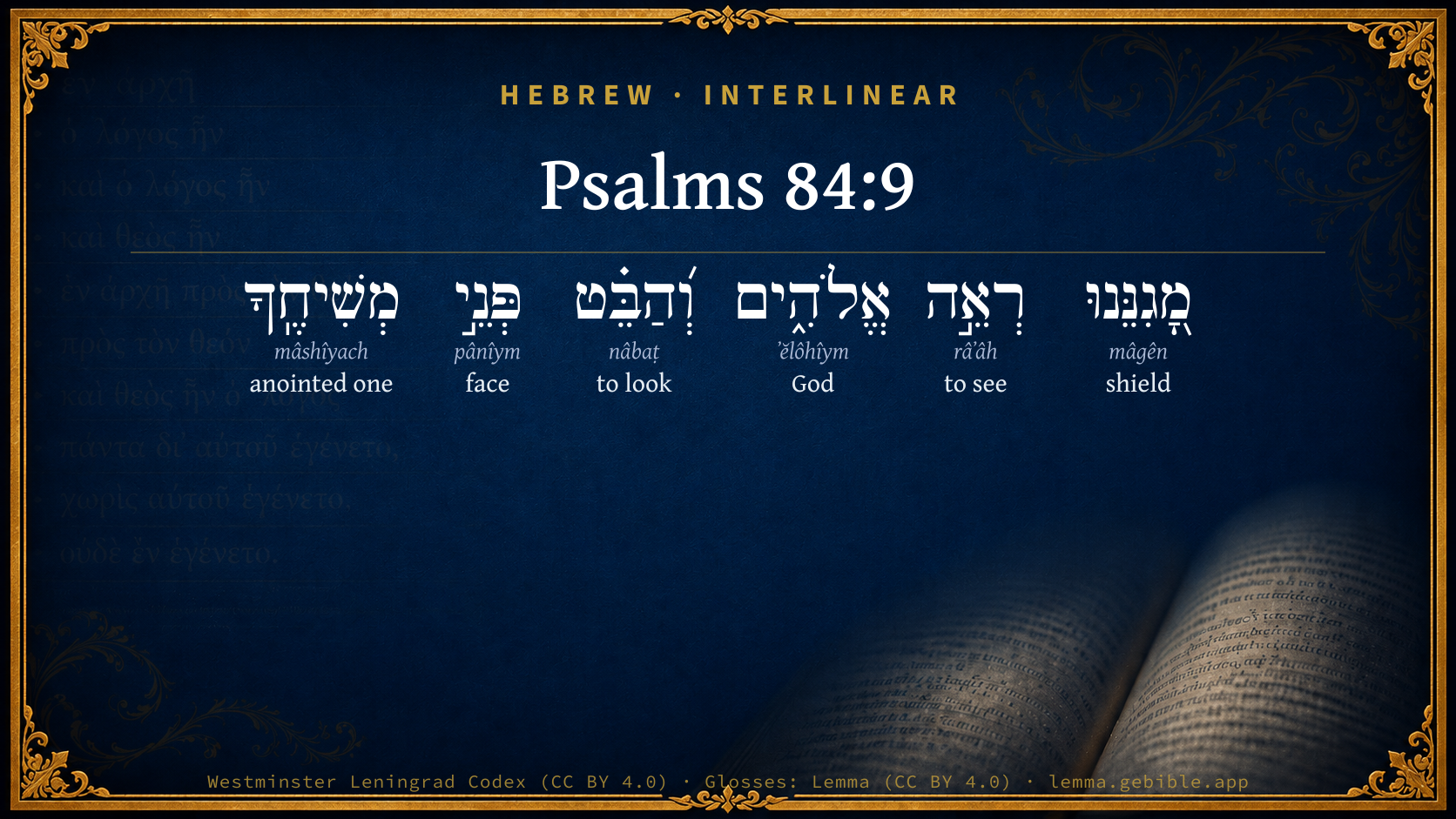
Psalms 84:9

Hebrew (Westminster Leningrad Codex) Psalms 84:9 appears in the Hebrew Old Testament. The text above is from the Westminster Leningrad Codex. Each word links to its Strong’s number, a concise gloss, and parsing drawn from the Open Scriptures Hebrew Bible morphology. Click any word for its full Brown-Driver-Briggs (BDB) entry.
Download image
Cite this verse

Psalms 84:9 (World English Bible). Public Domain. Lemma interlinear Bible study tool, https://lemma.gebible.app/v/psalms/84/9.

Show BibTeX & RIS
BibTeX
RIS
English Translation
Behold, God our shield, Look at the face of your anointed.
World English Bible · Public Domain
Download a study sheet

One document with this verse’s original text, its word-by-word gloss line, the meaning frame, cross-references with their text, attributed commentary, and full source and license credits — printable, and it pastes into notes with its structure intact.

This verse Autodidact and up

Study sheet (.html) Plain text (.txt)

A passage Seminary Student

Up to 50 verses in one chapter. A passage sheet keeps up to 6 commentary sources and 12 cross-references per verse, in the order this page ranks them, and says so on the sheet whenever that leaves anything out. Ask for a single verse and you get the Autodidact verse sheet above.

Everything on this page stays free to read, with no account — the sheet is a download of what is already on screen, not access to it.

Want to remove ads? Support Godless Engineer
Compare translations 3

The same verse in 3 English versions, stacked beneath the original-language interlinear above. Click any original word for its lexicon entry.

Each is an independent rendering of the whole verse — the interlinear is not word-aligned to these translations.

Highlighted words mark where these versions differ — a whole-verse word diff, not a word-by-word alignment.

  • World English Bible Public Domain
    Behold, God our shield, Look at the face of your anointed.
  • King James Version Public Domain
    Behold, O God our shield, and look upon the face of thine anointed.
  • unfoldingWord Literal Text CC BY-SA 4.0
    See our shield, God, and regard the face of your anointed.

unfoldingWord Literal Text — © unfoldingWord, licensed CC BY-SA 4.0. Word-aligned USFM3 via Door43 (git.door43.org/unfoldingWord/en_ult).

Versions to compare (up to 4)

3 of 4 selected

Show all 18 translations

Every available English version of this verse, each an independent rendering of the whole verse.

  • World English Bible Public Domain
    Behold, God our shield, Look at the face of your anointed.
  • Berean Standard Bible Public Domain
    Take notice of our shield, O God, and look with favor on the face of Your anointed.
  • Majority Standard Bible Public Domain
    Take notice of our shield, O God, and look with favor on the face of Your anointed.
  • King James Version Public Domain
    Behold, O God our shield, and look upon the face of thine anointed.
  • American Standard Version (1901) Public Domain
    Behold, O God our shield, And look upon the face of thine anointed.
  • Revised Version (1885) Public Domain
    Behold, O God our shield, and look upon the face of thine anointed.
  • Geneva Bible (1599) Public Domain
    Beholde, O God, our shielde, and looke vpon the face of thine Anointed.
  • Douay-Rheims (1899) Public Domain
    O Lord God of hosts, hear my prayer: give ear, O God of Jacob.
  • Young's Literal Translation Public Domain
    Our shield, see, O God, And behold the face of Thine anointed,
  • Literal Standard Version CC BY-SA 4.0
    Our shield, see, O God, || And behold the face of Your anointed,
  • Unlocked Literal Bible CC BY-SA 4.0
    God, watch over our shield; show concern for your anointed.
  • unfoldingWord Literal Text CC BY-SA 4.0
    See our shield, God, and regard the face of your anointed.
  • Darby Bible Public Domain
    Behold, O God our shield, and look upon the face of thine anointed.
  • World Messianic Bible Public Domain
    Behold, God our shield, look at the face of your anointed.
  • Webster's Bible Public Domain
    \\84:8\\O LORD God of hosts, hear my prayer: give ear, O God of Jacob. Selah.
  • Free Bible Version CC BY-SA 4.0
    Please God, look at our defender, look at the face of your anointed one.
  • Bible in Basic English Public Domain
    O God, let your eyes be on him who is our safe cover, and let your heart be turned to your king.
  • JPS Tanakh (1917) Public Domain
    (84-10) Behold, O God our shield, and look upon the face of Thine anointed.

Literal Standard Version (2020), Covenant Press — licensed CC BY-SA 4.0. Text via the HelloAO Bible API (eBible.org). Unlocked Literal Bible (unfoldingWord) — licensed CC BY-SA 4.0. Text via the HelloAO Bible API (eBible.org). unfoldingWord Literal Text — © unfoldingWord, licensed CC BY-SA 4.0. Word-aligned USFM3 via Door43 (git.door43.org/unfoldingWord/en_ult). Free Bible Version, Dr. Jonathan Gallagher — licensed CC BY-SA 4.0. Text via the HelloAO Bible API (eBible.org).

Word by word

More ways to search: Search by grammar → Find every occurrence → Compare this word →

Practice this passage: Drill this verse → Learn its vocabulary →

About this verse

These counts appear in no published source. They are computed here, from the morphology-tagged text and Lemma’s own curated glosses. What Lemma adds →

6
words
6
distinct lemmas
Wisdom
section

Shared distinctive vocabulary

מְשִׁיחֶֽךָ anointed one H4899 occurs in 38 verses of the Hebrew Bible. Also found in:

Grammatical profile

  • 2 verbs
  • 4 nouns

Verb forms

  • רְאֵ֣ה Qal · Imperative
  • וְ֝הַבֵּ֗ט Hiphil · Imperative

Hebrew & Septuagint length

In English translation the verse runs 11 words from the Hebrew and 13 from the Septuagint (LXX English) — closely comparable.

A rough comparison of the two English renderings, which tokenize alike — not a word-level alignment.

Word counts can differ between the Hebrew and the Greek without any difference in meaning — e.g. the Hebrew direct-object marker אֵת has no separate Greek word, and Greek often adds the article ὁ.

Cross-references

15

Topical passages linked to Psalms 84:9 in the Treasury of Scripture Knowledge — connected by theme and wording, ordered by reader-vote popularity; previews shown in the World English Bible.

  • Psalms 2:2 The kings of the earth take a stand, And the rulers take counsel together, Against Yahweh, and against his anointed, saying,
  • Genesis 15:1 After these things the word of Yahweh came to Abram in a vision, saying, "Don't be afraid, Abram. I am your shield, your exceedingly great reward."
  • Psalms 84:11 For Yahweh God is a sun and a shield. Yahweh will give grace and glory. He withholds no good thing from those who walk blamelessly.
  • Psalms 89:20 I have found David, my servant. I have anointed him with my holy oil,
  • Psalms 98:1 Sing to Yahweh a new song, For he has done marvelous things! His right hand, and his holy arm, have worked salvation for him.
  • Psalms 132:17 There I will make the horn of David to bud. I have ordained a lamp for my anointed.
  • Deuteronomy 33:29 Happy are you, Israel: Who is like you, a people saved by Yahweh, The shield of your help, The sword of your excellency! Your enemies shall submit themselves to you; You shall tread on their high places.
  • 1 Samuel 2:10 Those who strive with Yahweh shall be broken to pieces; Against them will he thunder in the sky: Yahweh will judge the ends of the earth; He will give strength to his king, Exalt the horn of his anointed.
  • 1 Samuel 16:6 It happened, when they had come, that he looked at Eliab, and said, Surely Yahweh's anointed is before him.
  • 2 Samuel 23:1 Now these are the last words of David. David the son of Jesse says, The man who was raised on high says, The anointed of the God of Jacob, The sweet psalmist of Israel:
  • 2 Chronicles 6:42 Yahweh God, don't turn away the face of your anointed: remember [your] loving kindnesses to David your servant.
  • Psalms 2:6 "Yet I have set my king on my holy hill of Zion."
  • Psalms 3:3 But you, Yahweh, are a shield around me, My glory, and the one who lifts up my head.
  • Psalms 59:11 Don't kill them, or my people may forget. Scatter them by your power, and bring them down, Lord our shield.
  • Acts 4:27 For truly, in this city against your holy servant, Jesus, whom you anointed, both Herod and Pontius Pilate, with the Gentiles and the people of Israel, were gathered together

Cross-references courtesy of OpenBible.info (CC BY 4.0).

Hebrew and Greek witnesses Masoretic Hebrew ↔ Greek Septuagint

The same verse in the two great witnesses to the Old Testament, shown verse-for-verse.

You’re reading Greek Psalm 83 (Hebrew Psalm 84). The Septuagint counts the superscription, so verse numbers can differ from the Hebrew — chapter-level alignment, not verse-by-verse. Numbering follows Rahlfs.

These are two independent witnesses, not word-aligned to each other, and the Septuagint is shown in lemma (dictionary) form.

Hebrew Psalms 84:9 Masoretic · Westminster Leningrad Codex

מָ֭גִנֵּנוּ רְאֵ֣ה אֱלֹהִ֑ים וְ֝הַבֵּ֗ט פְּנֵ֣י מְשִׁיחֶֽךָ

Behold, God our shield, Look at the face of your anointed.

World English Bible · Public Domain

Greek LXX Greek Psalm 83:9 Septuagint · lemma form

κύριος ὁ θεός ὁ δύναμις εἰςἀκούω ὁ προσευχή ἐγώ ἐνωτίζομαι ὁ θεός ἰακώβ διάψαλμα

Behold, O God our defender, and look upon the face of your anointed.

LXX2012 (modern English Septuagint) · Public Domain

On this verse, John Gill's Exposition discusses the Septuagint’s reading. Read the note in Commentary ↓

Hebrew: Westminster Leningrad Codex (CC BY 4.0). Greek: Septuagint (public domain); English from LXX2012 (modern English Septuagint) (Public Domain). How the Septuagint differs from the Hebrew →

Commentary

Notes on Psalms 84:9 from classic Christian and Jewish commentators (each source and its license shown beneath its notes). The classic Christian expositions comment on the surrounding passage and are grouped to its opening verse, so a note may address several verses; the Jewish commentaries on the Tanakh (Rashi and others) are per-verse, so they appear only where the commentator wrote on this verse.

Lemma curates 59 commentaries, every one of them public domain or Creative Commons licensed, each selected and text-cleaned for this edition rather than reprinted as found. About our sources →

Trapp's Complete Commentary

John Trapp

Psa 84:9 Behold, O God our shield, and look upon the face of thine anointed.

Ver. 9. Behold] Not only hear, Psa 34:15, with the note.

Look upon the face of thine anointed] Christi, cuius festina adventum, saith Kimchi; do me good for Christ’s sake.

John Trapp, A Commentary or Exposition upon All the Books of the Old and New Testament (1647–1656) — public domain. Text from a community e-Sword module.

J. A. Alexander on Psalms

Joseph Addison Alexander

10. (Psa 84:9) (Oh) our shield, see, (O) God, and behold the face of thine Anointed. Some make the first noun the object of the verb that follows, see our shield; but in Psa 84:11 God himself is so described, as well as in Psa 3:3, Gen 15:1. Its position, as a vocative, is certainly unusual, but seems to be emphatic. Behold the face, i. e. behold it favour ably, look upon it graciously. Thine Anointed (One), i.e. David, by whom, or in whose name, the psalm was written.

Joseph Addison Alexander, The Psalms Translated and Explained (1850) — public domain. Text from a community e-Sword module.

Tyndale Open Study Notes

Tyndale Open Resources

84:9 Both kings and priests were anointed to dedicate them for service (see 132:17; Exod 28:41; 1 Sam 9:16; 16:1-13; cp. Isa 61:1; Acts 10:38).

Tyndale Open Study Notes — © Tyndale Open Resources, licensed CC BY-SA 4.0. Text via the HelloAO Bible API.

Geneva Bible (1599)

Geneva Bible translators

That is, for Christ’s sake, whose figure I represent.

Geneva Bible (1599) marginal notes — public domain. Text via Bolls.life.

Adam Clarke's Commentary

Verse 9. Behold, O God, our shield] We have no Protector but thee. Thou seest the deadly blows that are aimed at us; cover our souls; protect our lives!

Look upon the face of thine anointed.] Consider the supplications sent up by him whom thou hast appointed to be Mediator between thee and man-thy Christ. But some apply this to David, to Zerubbabel, to the people of Israel; and each has his reasons.

Adam Clarke's Commentary on the Bible (1810–1826) — public domain. Text from a community e-Sword/MySword module.

Ellicott's Commentary for English Readers

(9) Shield . . . . anointed.—These are here in direct parallelism. So in Psa_89:18. (See Note, and comp. Psa_47:9, Note.)

A Bible Commentary for English Readers, edited by Charles John Ellicott (1878–1897) — public domain. Text from a community e-Sword module.

The Cambridge Bible for Schools and Colleges

gen. ed. J. J. S. Perowne

9. The Psalmist’s prayer for favourable audience in Psa_84:8 is succeeded, after a musical interlude (selah), by a prayer offered by all the pilgrims together. Contrast ‘our shield’ with ‘my prayer’ (Psa_84:8), and the singular which recurs in Psa_84:10.

The first line admits of two renderings. (1) As in the A.V., ‘our shield’ may be taken as a vocative in apposition to God, Who is styled a shield in Psa_84:11, and frequently elsewhere, e.g. Psa_3:3; Psa_28:7; Psa_59:11; Gen_15:1. (2) As in R.V. marg., Behold our shield, O God, ‘our shield’ may be taken as the object of the verb, in parallelism with and referring to ‘thine anointed’ in the next line. This rendering is commended by the parallelism, and not excluded by the order of the words in the original: the king is styled ‘our shield’ in Psa_89:18 (R.V.), and there is nothing unnatural in the application in the same context of the same epithet to the king and to God, Whose representative the king was acknowledged to be.

look upon the face of thine anointed] Graciously accept him. But who is meant by thine anointed? Is it the king, the high-priest, or the people? Those who maintain that the Psalm is post-exilic suppose that the high-priest or the people is thus designated. But though the high-priest is called the anointed priest (Lev_4:3; Lev_4:5; Lev_4:16; Lev_6:22), he is never called the anointed of Jehovah: and it is very doubtful whether this title is ever applied to the people. Psa_89:38 and Hab_3:13 are quoted, but do not establish the usage. The most natural explanation is that the king is meant. Nor is the prayer out of place. The welfare of the nation was bound up with the welfare of the king. And if the king was one who like Hezekiah or Josiah had effected a great reformation, the Psalmist might well feel that the religious privileges which he prized depended upon the continuance of the king’s life. It certainly cannot be inferred from the words that the Psalmist was himself a king, but rather the reverse.

9–12. The pilgrims’ prayer, and the ground of their confidence.

The Cambridge Bible for Schools and Colleges (gen. ed. J. J. S. Perowne; Cambridge University Press, 1878–1918) — public domain. Text from a community e-Sword module.

John Gill's Exposition

For a day in thy courts is better than a thousand,.... "One day"; so the Septuagint and Vulgate Latin, and all the Oriental versions; and so the Targum, Jarchi, and Kimchi, interpret it; one day in the house of God, in the world to come, so Arama: though rather reference is had to the seventh day sabbath, then in being; and which with the psalmist was a delight, holy and honourable; and though now abolished, as to the time of it, with the rest of the ceremonial law, there is yet a day of public worship, called the Lord's day, and the day of the Son of man; and one of these days spent in the courts of the Lord, in an attendance on the word and ordinances, in worshipping in the fear of God, in spirit and in truth; in divine service, assisted by the Spirit of God, doing everything in faith, from love, and with a view to the glory of God; a day thus spent in religious exercises "is better than a thousand"; that is, than a thousand days; not than a thousand days spent in like manner, but than a thousand other days, common day, of the week; or than a thousand in other places, especially in places of sin, and in the company of wicked men; one day in God's house employed in spiritual exercises, and enjoying communion with him, is better than a thousand days in any of the houses of Satan, of sinful pleasure, or in the houses of sinful men; better as to peace of mind, solid pleasure, real profit, and true honour:

I had rather be a doorkeeper in the house of my God; in the meanest post and place there; alluding to the Levites, who were some of them porters, and kept the doors of the Lord's house, Ch1 26:1 or to the beggars that lay at the gates of the temple for alms; see Act 3:1 or to be fixed to the door post of it, alluding to the servant that was desirous of continuing in his master's house, and serving him for ever; who was brought to the door post, and had his ears bored through with an awl, Exo 21:5. Such a willing servant was the psalmist; and this sense the Targum seems to incline to, which renders it,

"I have chose to cleave to the house of the sanctuary of God;''

or to be a waiter there, to watch daily at Wisdom's gates, and to wait at the posts of her doors; such lie in the way of conversion, and of finding Christ; in the way of spiritual healing, as the man at the pool; and of spiritual instruction, and of spiritual strength, and an increase of it: or to be, or sit, upon the threshold; or to be "thresholding" (i) of it; that is, to frequent the house of God, to be often going over the threshold of it; this the psalmist took delight to do, even to be the threshold (k) itself, for men to tread upon as they go into the house of God:

than to dwell in the tents of wickedness; meaning not houses built by wicked men, or with money ill got; but where wicked men dwelt, and who were so bad as to be called wickedness itself; perhaps the psalmist might have in his mind the tents of Kedar, where he had sometimes been; see Psa 120:5, now to live in the meanest place in the house of God, to wait at the door as a porter, to lie there as a beggar, to sit upon the threshold, and much more to go often over it, or be that itself, was abundantly preferable than to dwell "an age" (l) in the house of princes and great men, being wicked; than to live in the most pompous manner, at ease and in plenty, enjoying all the good things of life that heart can wish for; one hour's communion with God in his house is better than all this, and that for the reason following.

(i) "esse in limine", Pagninus, Montanus; "ad limen esse", Musculus; "desidere ad limen", Tigurine version, Vatablus, so Ainsworth; "frequentare limen", Junius & Tremellius; "commorari limen", Piscator; "ad limen stare", Gejerus, Michaelis. (k) Gusset. Ebr. Comment. p. 565. (l) "quam aetatem agere", Piscator; "vel aetatem omnem agere", Gejerus, Michaelis.

John Gill's Exposition of the Whole Bible (1746–1763) — public domain (CC PDM 1.0). Text via the HelloAO Bible API.

Albert Barnes' Notes on the Bible

Behold, O God our shield - Our defense, as a shield is a defense in the day of battle. Compare Psa 5:12, note; Psa 18:2, note; Psa 33:20, note. It is an appeal to God as a protector. The psalmist was an exile - a wanderer - and he looked to God as his defense.

And look upon the face of thine anointed - Look favorably upon; look with benignity and kindness. The word anointed here is the word “Messiah” - משׁיח mâshı̂yach (Greek, Χριστός Christos, “Christ”; see the notes at Mat 1:1). Compare the notes at Psa 2:2. It here refers, however, evidently to the author of the psalm; and the word used is evidence that the author was David, as the anointed of the Lord, or someone set apart to the kingly office. It is true that this word was applicable to other kings, and also to priests and prophets, but the circumstances in the case concur best on the supposition that David is referred to. The allusion here is not to Christ; and the language does not suggest or justify the use which is often made of it when prayer is offered, that “God would look upon us in the face of his anointed” - whatever may, or may not be, the propriety of that prayer on other, grounds.

Albert Barnes' Notes on the Bible (1834–1885) — public domain. Text from a community e-Sword/MySword module.

Matthew Poole's English Annotations

Look upon the face; do not turn away thine eyes from him, as men do from those whom they hate or despise, but cast a favourable eye towards him. By face he means either his person, the word face being oft redundant, as it is Gen 43:3, or his state and condition.

Of thine anointed: either,

1. Of Christ, whose proper name is the Messiah, or the Anointed. So the meaning may be, Lord, I deserve not one good look from thee, because by my great wickedness I have procured thy just displeasure, and this banishment; but look upon thy Christ, whose coming and meritorious passion, though future to us, is present to thee, and for his sake look upon me. Or,

2. Of me, who, though a vile sinner, am thine anointed king, 2Sa 12:7; 23:1.

Matthew Poole's English Annotations on the Holy Bible (1683–1685) — public domain. Text from a community e-Sword/MySword module.

The Treasury of David

Charles H. Spurgeon

Ver. 9. Behold, O God our shield, and look upon the face of thine anointed. Here we have the nation's prayer for David; and the believer's prayer for the Son of David. Let but the Lord look upon our Lord Jesus, and we shall be shielded from all harm; let him behold the face of his Anointed, and we shall be able to behold his face with joy. We also are anointed by the Lord's grace, and our desire is that he will look upon us with an eye of love in Christ Jesus. Our best prayers when we are in the best place are for our glorious King, and for the enjoyment of his Father's smile.

Ver. 9. While many, alas, are satisfied with mere formalities in religion, or with the dry discussion of doctrines, high or low, as they may be called, see thou and be occupied with Christ himself. It is the knowledge of his person that gives strength and joy to the soul. At all times, under all circumstances, we can say, Look upon the face of thine Anointed. We cannot always say, Look on us; but we may always say, Look on Him. In deepest sorrow through conscious failure, or in trials and difficulties through faithfulness to his name, we can ever plead with God what Christ is. God is ever well pleased with himever occupied with him as risen from the dead and exalted to his own right hand in heaven; and he would have us also to be occupied with him as the heart's exclusive object. True faith can only rest on God's estimate of Christ, not on inward thoughts and feelings. That which may be called the faith of the formalist, rests on the ability of his own mind to judge of these matters. He trusts in himself. This is the essential difference between faith in appearance and faith in reality. Things New and Old.

Ver. 9. Look upon the face of thine anointed. For I shall never come to look upon thy face, if thou vouchsafe not first to look upon mine: if thou afford me not as well the benefit of thine eyes, to look upon me, as the favour of thine ears, to hear me, I shall be left only to a bare expectation, but never come to the happiness of fruition; but when thou vouchsafest to look upon my face, that look of thine hath an influence of all true blessedness, and makes me find what a happiness it is to have the God of Jacob for my shield. Sir Richard Baker.

Ver. 9. Observe,

I. The Faith. Our shield is thine anointedThine

Anointed is our Shield. This is not David, because

he says our Shield, but David's greater Son. A

gleam of Gospel light through the thick clouds.

II. The Prayer. Behold, O God, etc. Look, etc.

Look upon him as our Representative, and look upon us

in him.

III. The Plea.

(1) He has engaged to be our defence from thine

anger;

(2) he has been anointed to this office by thee. G. R.

Ver. 9.

I. What God is to us.

II. What we would have him look at.

III. Where we would be: hidden behind the shieldseen

in the person of Christ.

Psalms 84:10*

Charles H. Spurgeon's The Treasury of David (1869–1885) — public domain. Psalms only. Text from a community e-Sword/MySword module.

Whedon's Commentary on the Bible

Daniel D. Whedon

9. Our shield—Our protector; so the word is figuratively used Psa_47:9; Hos_4:18, where shields is rendered rulers, because they are the natural protectors of the people. The title points to the imperilled state of the nation.

Look upon the face of thine anointed—To “look upon the face,” in oriental phrase, is to give assurance of favour. To “look upon the face” of a suppliant is to grant his request. If he has offended and asks mercy, instead of saying, “I forgive you,” the answer is, “I have seen thy face.” David said of Absalom, “Let him turn to his own house, and let him not see my face,” (2Sa_14:24;) a mark of high displeasure. Gen_43:3; 2Sa_3:13. But who is the “anointed” here mentioned? Those who think David wrote the psalm apply the title to him. But Zerubbabel must be understood rather, who, with Joshua the high priest, (one the head of the spiritual, and the other of the secular, interests of the nation,) are called the “anointed ones,” or those consecrated with oil. Zec_4:14. These leaders of the nation built the great altar, (Ezr_3:2,) and also the temple, (Ezr_5:2,) and the public prosperity rested with them. See Hag_1:1, and Zechariah 3, 4, The prayer assumes that if God “look upon the face” of the representatives of the nation in this crisis, the nation will rise from its ruins. Spiritually Christ is our representative, God’s “anointed,” in whose face he can look complacently and grant us peace.

Daniel D. Whedon (gen. ed.), Commentary on the Old and New Testaments (1874–1909) — public domain. Text from a community e-Sword module.

The Pulpit Commentary

Behold, O God our Shield; i.e. "our Protection and Defense". (comp. Psa_33:20 Psa_59:11 Psa_89:18) And look upon the face of thine anointed. Regard our Mug with favour; let the light of thy countenance shine upon him.

The shield figure.

In this psalm we find three names for God, "God of hosts," "God of Jacob," "God our Shield." To Abraham God had said, "Fear not, I am thy Shield, and thy exceeding great Reward." And in the fifth psalm we read, "Thou, Lord, wilt bless the righteous; with favour wilt thou compass him as with a shield." Moses exclaims, (Deu_33:29) "Happy art thou, O Israel! who is like unto thee, O people saved by the Lord, the Shield of thy help?" And one of the later psalms (Ps 115) has this for a refrain, "O Israel, trust thou in the Lord; he is their Help and their Shield." The prayer of the text is urged by two metaphors my Shield;" "I thine anointed.

I GOD MAY BE THOUGHT OF AS OUR SHIELD. Shields were peculiar to the hand-to-hand warfare of ancient times. They were of two kinds one very large, protecting the whole body; another smaller, used by light-armed troops very skilfully. They were sometimes made of light wood, covered with bull"s hide of two or three thicknesses, plated with metal; sometimes they were studded with nails or metal pins. They were smeared with oil, both to prevent them from injury by weather, and to render them so smooth that missiles might the more readily glance off. Show that so varied and so complicated is religious life we are glad of the help of all kinds of metaphor. As Christ is set under many names, so God is set under many relations. Christian life, conceived as a warfare, has its defensive and offensive sides. Under the shadow of God, as a Shield, men find defence. Compare figure of the "strong Tower," into which "the righteous runs and is safe." There are times in our Christian warfare when we can only act on the defensive. Then God is our Shield. Under the shadow of God, as a Shield, attacks were made. Describe the ancient mode of attacking a fortress, under shields placed together so as to make a protecting roof, which secured the soldiers from hostile missiles. There is "offensive war" sometimes in Christian life. Prevailing evils must be vigorously attacked. We may be sure of God"s shield in all active service.

The psalmist here is writing as a civilian, and a Levite, and thinks lovingly of God as his Defence from the perils of the pilgrim way.

II WE MAY THINK OF OURSELVES AS GOD"S ANOINTED. It is as though the psalmist had said, "Recognize the face that is uplifted to thee." Though the term "anointed" will suit David, it will equally suit the priest and the Levite, as set apart, anointed for the special service of God"s temple. If God has brought us into close and loving relations of service to him, he has given us a plea to use in prayer. We may say, "Look upon the face of thine anointed. R.T.

The Pulpit Commentary (1880–1919), ed. H.D.M. Spence-Jones & Joseph S. Exell — public domain. Text from a community e-Sword module.

John Wesley's Explanatory Notes

Look - Cast a favourable eye towards him. Anointed - Of me, who though a vile sinner, am thine anointed king.

John Wesley, Explanatory Notes Upon the Whole Bible (1754–1765) — public domain. Text via the GEBible commentary corpus.

Rashi

Rabbi Shlomo Yitzchaki (Rashi)

hearken to my prayer to build Your house.

Rashi on the Tanakh — English translations: “The Judaica Press complete Tanach with Rashi, translated by A. J. Rosenberg” (CC BY 4.0); “Pentateuch with Rashi's commentary by M. Rosenbaum and A.M. Silbermann, 1929-1934” (public domain); “The Metsudah Tanach series, Lakewood, N.J” (CC BY 4.0); and “The Book of Joshua, Metsudah Publications, 1997” (CC BY 4.0). Text via Sefaria.

Lesson kit

Teaching starters — assembled from the data on this page, not authored interpretation. Every prompt links to the verse data it draws on. Edit before teaching.

Psalms, in the Wisdom, opens this verse with 6 words (6 distinct Hebrew lemmas). Its most distinctive word is mâshîyach (“anointed one”). A historical commentator’s framing appears above. Read the whole chapter for the surrounding context.

Discussion questions

  1. What does “anointed one” (mâshîyach) contribute to the verse as a whole?
  2. How does Leviticus 4:3, which shares the word «anointed one», read alongside this verse?
  3. These translations render this verse differently; the difference is in the English rendering, not the original. What questions does that raise?
  4. «רְאֵ֣ה» is a Qal Imperative verb. How does that grammatical form shape the action described?
  5. Compare how Trapp's Complete Commentary and J. A. Alexander on Psalms read this verse. Where do they agree or differ?

Things to notice

Reading settings

Reading text

Shown beneath each verse's original-language words.

Old Testament
Old Testament edition

Read the OT as the Masoretic Hebrew (MT) or the Greek Septuagint (LXX).

English shown for the Greek Septuagint (in the Hebrew ↔ Greek comparison).

Comparing translations? Open the Compare panel on any verse page to stack up to four side by side.