
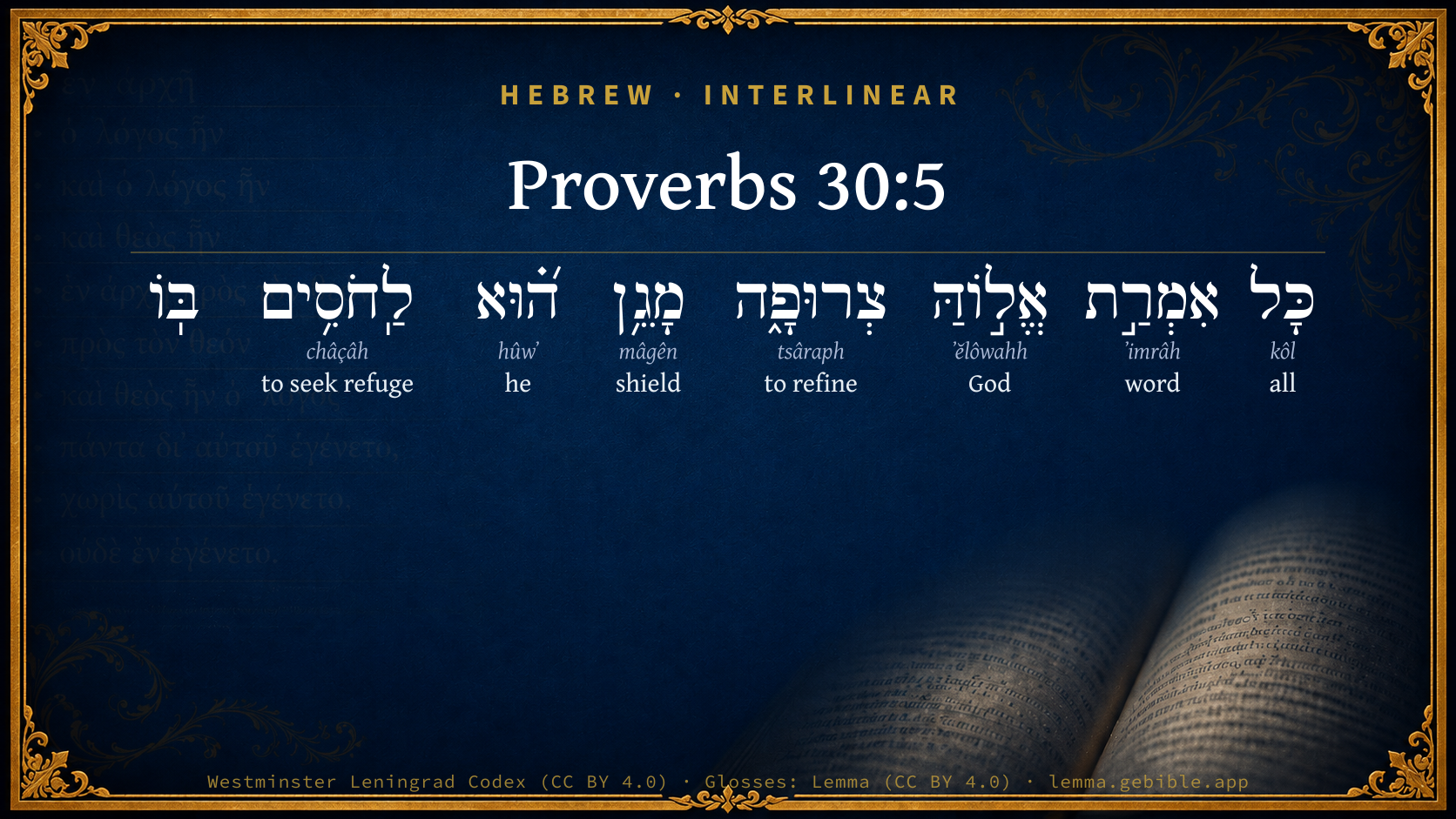
Proverbs 30:5

Hebrew (Westminster Leningrad Codex) Proverbs 30:5 appears in the Hebrew Old Testament. The text above is from the Westminster Leningrad Codex. Each word links to its Strong’s number, a concise gloss, and parsing drawn from the Open Scriptures Hebrew Bible morphology. Click any word for its full Brown-Driver-Briggs (BDB) entry.
Download image
Cite this verse

Proverbs 30:5 (World English Bible). Public Domain. Lemma interlinear Bible study tool, https://lemma.gebible.app/v/proverbs/30/5.

Show BibTeX & RIS
BibTeX
RIS
English Translation
"Every word of God is flawless. He is a shield to those who take refuge in him.
World English Bible · Public Domain
Download a study sheet

One document with this verse’s original text, its word-by-word gloss line, the meaning frame, cross-references with their text, attributed commentary, and full source and license credits — printable, and it pastes into notes with its structure intact.

This verse Autodidact and up

Study sheet (.html) Plain text (.txt)

A passage Seminary Student

Up to 50 verses in one chapter. A passage sheet keeps up to 6 commentary sources and 12 cross-references per verse, in the order this page ranks them, and says so on the sheet whenever that leaves anything out. Ask for a single verse and you get the Autodidact verse sheet above.

Everything on this page stays free to read, with no account — the sheet is a download of what is already on screen, not access to it.

Want to remove ads? Support Godless Engineer
Compare translations 3

The same verse in 3 English versions, stacked beneath the original-language interlinear above. Click any original word for its lexicon entry.

Each is an independent rendering of the whole verse — the interlinear is not word-aligned to these translations.

Highlighted words mark where these versions differ — a whole-verse word diff, not a word-by-word alignment.

  • World English Bible Public Domain
    "Every word of God is flawless. He is a shield to those who take refuge in him.
  • King James Version Public Domain
    Every word of God is pure: he is a shield unto them that put their trust in him.
  • unfoldingWord Literal Text CC BY-SA 4.0
    Every saying of God is refined; he a shield for those who take refuge in him.

unfoldingWord Literal Text — © unfoldingWord, licensed CC BY-SA 4.0. Word-aligned USFM3 via Door43 (git.door43.org/unfoldingWord/en_ult).

Versions to compare (up to 4)

3 of 4 selected

Show all 18 translations

Every available English version of this verse, each an independent rendering of the whole verse.

  • World English Bible Public Domain
    "Every word of God is flawless. He is a shield to those who take refuge in him.
  • Berean Standard Bible Public Domain
    Every word of God is flawless; He is a shield to those who take refuge in Him.
  • Majority Standard Bible Public Domain
    Every word of God is flawless; He is a shield to those who take refuge in Him.
  • King James Version Public Domain
    Every word of God is pure: he is a shield unto them that put their trust in him.
  • American Standard Version (1901) Public Domain
    Every word of God is tried: He is a shield unto them that take refuge in him.
  • Revised Version (1885) Public Domain
    Every word of God is tried: he is a shield unto them that trust in him.
  • Geneva Bible (1599) Public Domain
    Euery worde of God is pure: he is a shield to those, that trust in him.
  • Douay-Rheims (1899) Public Domain
    Every word of God is fire tried: he is a buckler to them that hope in him.
  • Young's Literal Translation Public Domain
    Every saying of God `is' tried, A shield He `is' to those trusting in Him.
  • Literal Standard Version CC BY-SA 4.0
    Every saying of God [is] tried, || He [is] a shield to those trusting in Him.
  • Unlocked Literal Bible CC BY-SA 4.0
    Every word of God is tested; he is a shield to those who take refuge in him.
  • unfoldingWord Literal Text CC BY-SA 4.0
    Every saying of God is refined; he a shield for those who take refuge in him.
  • Darby Bible Public Domain
    Every word of +God is pure: he is a shield unto them that put their trust in him.
  • World Messianic Bible Public Domain
    “Every word of God is flawless. He is a shield to those who take refuge in him.
  • Webster's Bible Public Domain
    Every word of God is pure: he is a shield to them that put their trust in him.
  • Free Bible Version CC BY-SA 4.0
    Every word God says has been proved true. He defends everyone who comes to him for protection.
  • Bible in Basic English Public Domain
    Every word of God is tested: he is a breastplate to those who put their faith in him.
  • JPS Tanakh (1917) Public Domain
    Every word of God is tried; He is a shield unto them that take refuge in Him.

Literal Standard Version (2020), Covenant Press — licensed CC BY-SA 4.0. Text via the HelloAO Bible API (eBible.org). Unlocked Literal Bible (unfoldingWord) — licensed CC BY-SA 4.0. Text via the HelloAO Bible API (eBible.org). unfoldingWord Literal Text — © unfoldingWord, licensed CC BY-SA 4.0. Word-aligned USFM3 via Door43 (git.door43.org/unfoldingWord/en_ult). Free Bible Version, Dr. Jonathan Gallagher — licensed CC BY-SA 4.0. Text via the HelloAO Bible API (eBible.org).

Word by word

More ways to search: Search by grammar → Find every occurrence → Compare this word →

Practice this passage: Drill this verse → Learn its vocabulary →

About this verse

These counts appear in no published source. They are computed here, from the morphology-tagged text and Lemma’s own curated glosses. What Lemma adds →

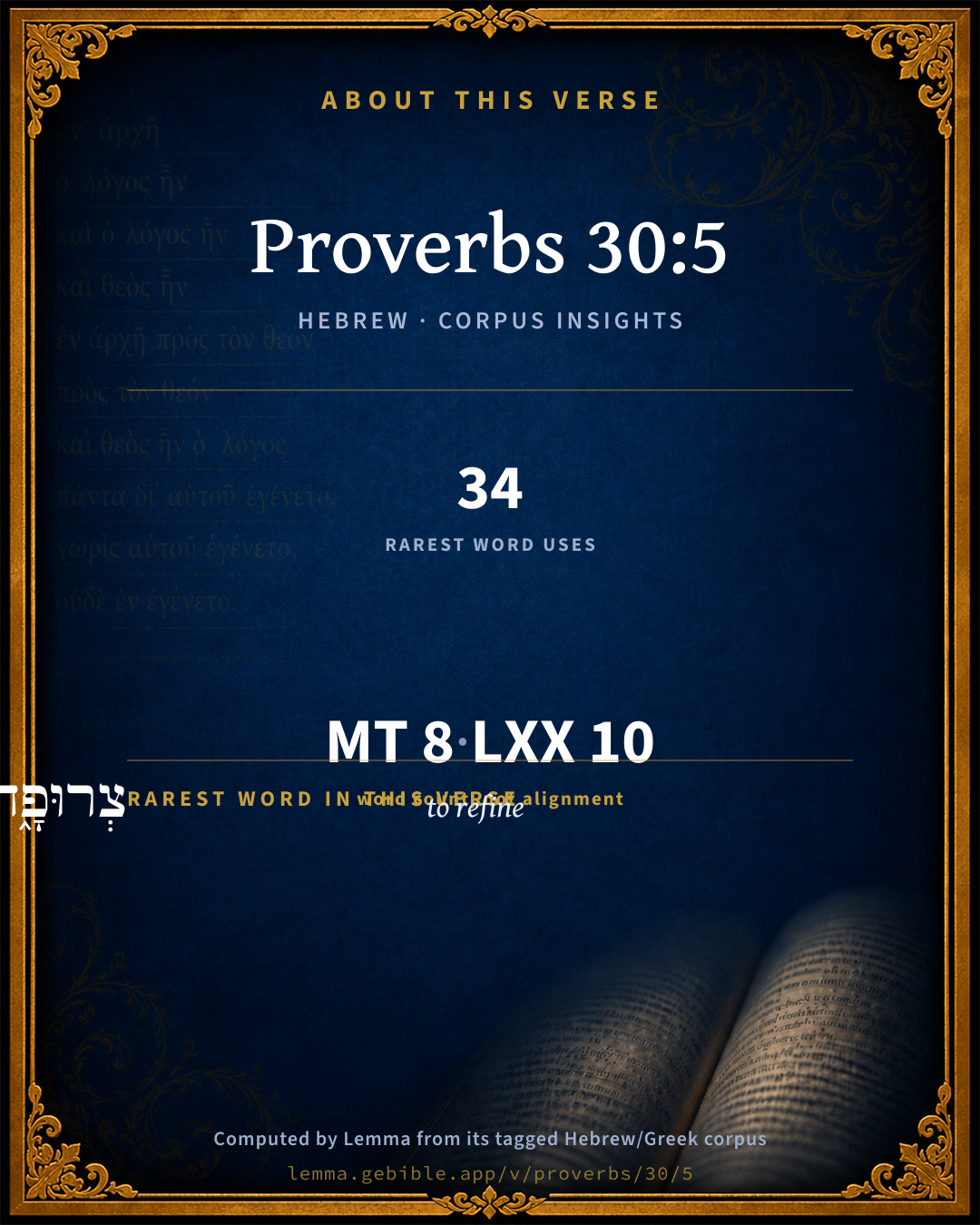
8
words
7
distinct lemmas
Wisdom
section

Shared distinctive vocabulary

צְרוּפָ֑ה to refine H6884 occurs in 29 verses of the Hebrew Bible. Also found in:

Grammatical profile

  • 2 verbs
  • 4 nouns
  • 1 pronoun
  • 1 preposition

Verb forms

  • צְרוּפָ֑ה Qal · Participle Passive
  • לַֽחֹסִ֥ים Qal · Participle Active

Hebrew & Septuagint length

In English translation the verse runs 17 words from the Hebrew and 18 from the Septuagint (LXX English) — closely comparable.

A rough comparison of the two English renderings, which tokenize alike — not a word-level alignment.

Word counts can differ between the Hebrew and the Greek without any difference in meaning — e.g. the Hebrew direct-object marker אֵת has no separate Greek word, and Greek often adds the article ὁ.

In the original languages it is 8 Hebrew tokens and 10 Greek tokens — but the two are counted differently (Hebrew bundles its prefixes and suffixes into one token; the Greek is in lemma form), so that isn’t a like-for-like length.

Cross-references

12

Topical passages linked to Proverbs 30:5 in the Treasury of Scripture Knowledge — connected by theme and wording, ordered by reader-vote popularity; previews shown in the World English Bible.

  • Psalms 18:30 As for God, his way is perfect. The word of Yahweh is tried. He is a shield to all those who take refuge in him.
  • Psalms 12:6 The words of Yahweh are flawless words, As silver refined in a clay furnace, purified seven times.
  • James 3:17 But the wisdom that is from above is first pure, then peaceful, gentle, reasonable, full of mercy and good fruits, without partiality, and without hypocrisy.
  • Psalms 3:3 But you, Yahweh, are a shield around me, My glory, and the one who lifts up my head.
  • Psalms 84:11 For Yahweh God is a sun and a shield. Yahweh will give grace and glory. He withholds no good thing from those who walk blamelessly.
  • Psalms 91:2 I will say of Yahweh, "He is my refuge and my fortress; My God, in whom I trust."
  • Psalms 119:140 Your promises have been thoroughly tested, And your servant loves them.
  • Genesis 15:1 After these things the word of Yahweh came to Abram in a vision, saying, "Don't be afraid, Abram. I am your shield, your exceedingly great reward."
  • Romans 7:12 Therefore the law indeed is holy, and the commandment holy, and righteous, and good.
  • Psalms 19:8 Yahweh's precepts are right, rejoicing the heart. Yahweh's commandment is pure, enlightening the eyes.
  • Psalms 144:2 My loving kindness, my fortress, My high tower, my deliverer, My shield, and he in whom I take refuge; Who subdues my people under me.
  • Psalms 115:9–11 Israel, trust in Yahweh! He is their help and their shield.

Cross-references courtesy of OpenBible.info (CC BY 4.0).

Hebrew and Greek witnesses Masoretic Hebrew ↔ Greek Septuagint

The same verse in the two great witnesses to the Old Testament, shown verse-for-verse.

These are two independent witnesses, not word-aligned to each other, and the Septuagint is shown in lemma (dictionary) form.

Hebrew Proverbs 30:5 Masoretic · Westminster Leningrad Codex

כָּל אִמְרַ֣ת אֱל֣וֹהַּ צְרוּפָ֑ה מָגֵ֥ן ה֝֗וּא לַֽחֹסִ֥ים בּֽוֹ

"Every word of God is flawless. He is a shield to those who take refuge in him.

World English Bible · Public Domain

Greek LXX Proverbs 30:5 Septuagint · lemma form

πᾶς λόγος θεός πυρόω ὑπερἀσπίζω δέ αὐτός ὁ εὐλαβέομαι αὐτός

For all the words of God are tried in the fire, and he defends those that reverence him.

LXX2012 (modern English Septuagint) · Public Domain

On this verse, The Pulpit Commentary discusses the Septuagint’s reading. Read the note in Commentary ↓

Hebrew: Westminster Leningrad Codex (CC BY 4.0). Greek: Septuagint (public domain); English from LXX2012 (modern English Septuagint) (Public Domain). How the Septuagint differs from the Hebrew →

Commentary

Notes on Proverbs 30:5 from classic Christian and Jewish commentators (each source and its license shown beneath its notes). The classic Christian expositions comment on the surrounding passage and are grouped to its opening verse, so a note may address several verses; the Jewish commentaries on the Tanakh (Rashi and others) are per-verse, so they appear only where the commentator wrote on this verse.

Lemma curates 59 commentaries, every one of them public domain or Creative Commons licensed, each selected and text-cleaned for this edition rather than reprinted as found. About our sources →

Trapp's Complete Commentary

John Trapp

Pro 30:5 Every word of God [is] pure: he [is] a shield unto them that put their trust in him.

Ver. 5. Every word of God is pure: he is a shield.] Albeit all the sacred sentences contained in this blessed book are pure, precious, and profitable; yet as one star in heaven outshineth another, so doth one proverb another, and this is among the rest, velut inter stellas luna minores, an eminent sentence often recorded in Scripture, and far better worthy than ever Pindar’s seventh ode was to be written in letters of gold. {a} Every word of God is pure, purer than "gold tried in the fire," {Rev 3:18} purer than "silver tried in a furnace, and seven times purified." {Psa 12:6} Julian, therefore, that odious apostate, is not to be hearkened to, who said there was as good stuff in Phocylides as in Solomon, in Pindar’s odes as in David’s psalms. Nor is that brawling dog Porphyry to be regarded, who blasphemously accuseth Daniel the prophet, and Matthew the evangelist, as writers of lies, Os durum! harsh speech. The Jesuits, some of them, say little less of St Paul’s epistles, which they could wish by some means censured and reformed, as dangerous to be read, and savouring of heresy in some places. {b} Traditions they commonly account the touchstone of doctrine and foundation of faith; the Scriptures to be rather a Commonitorium , as Bellarmine calls it, a kind of storehouse for advice, than cor et animam Dei, the heart and soul of God, as Gregory {c} calls them, - a fortress against errors, as Augustine. {d} The apostle calleth concupiscence sin - at non licet nobis ita loqui; but we may not call it so, saith Possevine, the Jesuit {e} The author to the Hebrews saith, "Marriage is honourable among all men"; but the Rhemists, on 1Co 7:9, say that the marriage of priests is the worst sort of incontinence. Christ saith the sin against the Holy Ghost hath no remission. Bellarmine {f} saith that it may be forgiven. The Council of Constance comes in with a non obstante against Christ’s institution, withholding the cup from the people at the sacrament. And a Parisian doctor {g} tells us, that although the apostle would have sermons and service celebrated in a known tongue, yet the Church, for very good cause, hath otherwise ordered it. Bishop Bonner’s chaplain called the Bible, in scorn, ‘his little pretty God’s book,’ and judged it worthy to be burnt, tanquam doctrina peregrina, as strange doctrine. Gilford and Raynolds said it contained some things profane and apocryphal. Others have styled it the ‘mother of heresy,’ and therefore not fit to be read by the common people, lest they suck poison out of it. Prodigious blasphemy! Of the purity and perennity of the holy Scriptures, see more in my True Treasure, pp. 85, 139.

He is a shield to them that put their trust in him.] See Gen 15:1 {See Trapp on "Gen 15:1"} Pro 29:25.

{a} Oda septima Pind. tantae fuit admirationis apud Rhodios ut fuerit scripta in templo aureis literis, &c. - Joh. Manl., Loc. Com., 414.

{b} Spec. Europae.

{c} Greg., in iii. Reg.

{d} Firmamentum contra errores. - Aug. in Johan., i. Tract. 2.

{e} Possevin, Appar. sac. Verbo Pat. Antiq.

{f} Lib. ii. De Poenit., cap. 16.

{g} Montan. in 1 Cor. xiv.

John Trapp, A Commentary or Exposition upon All the Books of the Old and New Testament (1647–1656) — public domain. Text from a community e-Sword module.

Joseph Benson's Commentary

Pro 30:5. Every word of God is pure — You must not expect the full knowledge of divine mysteries from me, nor from any man, but from the word of God, which is a certain rule, both for your faith and practice, because every part of it is holy, and true, and good, and there is not the least mixture of falsehood or folly in it, as there is in all the words and writings of men. He is a shield unto them that trust in him — Which supposes their knowledge of him by his word, Psa 9:10, and implies their reliance on his promises, joined with obedience to his commands.

Joseph Benson's Commentary on the Old and New Testaments (1811–1818) — public domain. Text from a community e-Sword module.

Keil & Delitzsch

C. F. Keil & F. Delitzsch

5 Every word of Eloah is pure;

A shield is He for those who hide themselves in Him.

6 Add thou not to His words,

Lest He convict thee and thou becomest a liar.

Although the tetrastich is an independent proverb, yet it is connected to the foregoing Neûm [utterance, Pro 30:1]. The more limited a man is in his knowledge of God - viz. in that which presents itself to him lumine naturae, - so much the more thankful must he be that God has revealed Himself in history, and so much the more firmly has he to hold fast by the pure word of the divine revelation. In the dependent relation of Pro 30:5 to Psa 18:31 (Sa2 22:31), and of Pro 30:6 to Deu 4:2, there is no doubt the self-testimony of God given to Israel, and recorded in the book of the Tôra, is here meant. כּל־אמרת is to be judged after πᾶσα γραφή, Ti2 3:16, not: every declaration of God, wherever promulgated, but: every declaration within the revelation lying before us. The primary passage Psa 18:31 has not כל here, but, instead of it, לכל החסים, and instead of אמרת אלוהּ it has יהוה 'אם; his change of the name of Jahve is also not favourable to the opinion that Pro 30:5. is a part of the Neûm, viz., that it is the answer thereto. The proverb in this contains traces of the Book of Job, with which in many respects that Neûm harmonizes; in the Book of Job, אלוהּ (with שׁדּי) is the prevailing name of God; whereas in the Book of Proverbs it occurs only in the passage before us. Mhlau, p. 41, notes it as an Arabism. צרף (Arab. ṣaraf, to turn, to change) is the usual word for the changing process of smelting; צרוּף signifies solid, pure, i.e., purified by separating: God's word is, without exception, like pure, massive gold. Regarding חסה, to hide oneself, vid., under Psa 2:12;: God is a shield for those who make Him, as revealed in His word, their refuge. The part. חסה occurs, according to the Masora, three times written defectively, - Pro 14:32; Sa2 22:31; Neh 1:7; in the passage before us it is to be written לחוסים; the proverbs of Agur and Lemuel have frequently the plena scriptio of the part. act. Kal, as well as of the fut. Kal, common to the Book of Job (vid., Mhlau, p. 65).

In 6a, after Aben Ezra's Moznajim 2b (11b of Heidenheim's edition), and Zachoth 53a (cf. Lipmann's ed.), and other witnesses (vid., Norzi), t sp (the ף with dagesh) is to be written, - the Cod. Jaman. and others defect. without ו, - not tôsf; for, since תּוסף (Exo 10:28) is yet further abbreviated in this way, it necessarily loses

(Note: That both Shevas in tôsp are quiesc., vid., Kimchi, Michlol 155 a b, who is finally decided as to this. That the word should be read tôspe'al is the opinion of Chagg in הנוח 'ס (regarding the quiesc. letters), p. 6 of the Ed. by Dukes-Ewald.)

the aspiration of the tenuis, as in ילדתּ (= ילדת). The words of God are the announcements of His holy will, measured by His wisdom; they are then to be accepted as they are, and to be recognised and obeyed. He who adds anything to them, either by an overstraining of them or by repressing them, will not escape the righteous judgment of God: God will convict him of falsifying His word (הוכיח, Psa 50:21; only here with ב of the obj.), and expose him as a liar - viz. by the dispensations which unmask the falsifier as such, and make manifest the falsehood of his doctrines as dangerous to souls and destructive to society. An example of this is found in the kingdom of Israel, in the destruction of which the curse of the human institution of its state religion, set up by Jeroboam, had no little share. Also the Jewish traditional law, although in itself necessary for the carrying over of the law into the praxis of private and public life, falls under the Deuteron. prohibition - which the poet here repeats - so far as it claimed for itself the same divine authority as that of the written law, and so far as it hindered obedience to the law - by the straining-at-a-gnat policy - and was hostile to piety. Or, to adduce an example of an addition more dogmatic than legal, what a fearful impulse was given to fleshly security by that overstraining of the promises in Gen 17, which were connected with circumcision by the tradition, "the circumcised come not into hell," or by the overstraining of the prerogative attributed by Paul, Rom 9:4., to his people according to the Scriptures, in the principle, "All Israelites have a part in the future world!" Regarding the accentuation of the perf. consec. after פּן, vid., at Psa 28:1. The penultima accent is always in pausa (cf. Pro 30:9 and Pro 30:10).

Keil & Delitzsch — Biblical Commentary on the Old Testament (1861–1891) — public domain (CC PDM 1.0). Text via the HelloAO Bible API. (Old Testament only.)

Jamieson, Fausset & Brown

Robert Jamieson, A. R. Fausset & David Brown

(Compare Psa 12:6; Psa 119:140).

Jamieson, Fausset & Brown — Commentary Critical and Explanatory on the Whole Bible (1871) — public domain (CC PDM 1.0). Text via the HelloAO Bible API.

Adam Clarke's Commentary

Verse 5. Every word of God is pure] כל אמרת אלוה צרופה col imrath eloah tseruphah, "Every oracle of God is purified." A metaphor taken from the purifying of metals. Every thing that God has pronounced, every inspiration which the prophets have received, is pure, without mixture of error, without dross. Whatever trials it may be exposed to, it is always like gold: it bears the fire, and comes out with the same lustre, the same purity, and the same weight.

He is a shield unto them] And this oracle among the rest. "He is the defence of all them that put their trust in him." לכל lechol, to all, is added here by nineteen of Kennicott's and De Rossi's MSS.; for instead of לחסים lachosim, to the trusters, they read לכל החוסים lechol hachosim, "to EVERY ONE of them that trust." Where the preposition and adjective are not only added, but the noun is written more full, and more emphatic: but a translation cannot well express it without paraphrase.

Adam Clarke's Commentary on the Bible (1810–1826) — public domain. Text from a community e-Sword/MySword module.

Ellicott's Commentary for English Readers

(5) Every word of God is pure.—Comp. Psalms 19, where first (Pro_30:1-6) the glories of God as revealed in nature are described, and then (Pro_30:7 sqq.) the excellence of the revelation of Himself in His word is extolled. Every word of God is “pure,” i.e., tested and proved in the furnace of experience; e.g., His promise to be a “shield” (Gen_15:1) to those that trust in Him. (Comp. Psa_18:30.)

A Bible Commentary for English Readers, edited by Charles John Ellicott (1878–1897) — public domain. Text from a community e-Sword module.

The Cambridge Bible for Schools and Colleges

gen. ed. J. J. S. Perowne

5. pure] Heb. purified. The image “hinted at” here is “expanded” (Bp Perowne) on Psa_12:6 [Hebrews 7]: “The words of the Lord are pure words, as silver tried (same Hebrew word as here) in a furnace of (or, on the) earth, purified seven times.”

The Cambridge Bible for Schools and Colleges (gen. ed. J. J. S. Perowne; Cambridge University Press, 1878–1918) — public domain. Text from a community e-Sword module.

John Gill's Exposition

Every word of God is pure,.... The whole word of God. "All Scripture", given by inspiration of God, to which Agur directs, as giving the best account of God, of his name, nature, and perfections; of his Son, person, offices, and grace; being pure, very pure, "purified" (z) like silver, purified in a furnace of earth. The whole of Scripture is pure, free from all falsehood and error; coming from the God of truth, who cannot lie, and therefore called "the Scriptures of truth": every promise is pure as well as precious, made without dissimulation, faithfully performed, and all yea and amen in Christ; every doctrine is pure, free from the mixtures and inventions of men; the sincere milk of the word; consistent and all of a piece, not yea and nay; and tending to promote purity of heart and life; wholesome words, and doctrines according to godliness; see Psa 12:6;

he is a shield unto them that put their trust in him; not the word, but God, whose the word is; and which represents him as a proper object of trust, both with respect to things temporal and spiritual, at all times; and as a shield to protect such, by his power and grace, from all their enemies, sin, Satan, and the world, and also from all errors and false doctrines; see Psa 3:3.

(z) "purgatus", Pagninus, Montanus, Tigurine version, Gejerus; "purgatissimus", Junius & Tremellius; Heb. "conflatus", Piscator, Mercerus, Cocceius, Schultens.

John Gill's Exposition of the Whole Bible (1746–1763) — public domain (CC PDM 1.0). Text via the HelloAO Bible API.

Albert Barnes' Notes on the Bible

Out of this consciousness of the impotence of all man’s efforts after the knowledge of God rises the sense of the preciousness of every living word that God has Himself revealed, whether through “the Law and the prophets” or through “wise men and scribes.”

Albert Barnes' Notes on the Bible (1834–1885) — public domain. Text from a community e-Sword/MySword module.

Haydock's Catholic Bible Commentary

Is fire-tried; that is, most pure, like gold purified by fire. (Challoner) (Psalm xvii. 31., and Jeremias xxiii. 29.) --- It cannot deceive.

George Leo Haydock (1774–1849), Haydock's Catholic Family Bible and Commentary, 1859 edition — public domain. Excludes Psalms (Douay-Rheims chapter numbering differs from Protestant) and Deuterocanonical books (Catholic canon only).

Matthew Poole's English Annotations

Every word of God is pure; and therefore you, Ithiel and Ucal, must not expect the full knowledge of Divine mysteries from me, nor from any man, but from the word of God, which is a certain rule, both of your belief and practice, because every part and parcel of it is holy, and true, and good, and there is not the least mixture of falsehood and folly in it, as there is in all the words and writings of men.

That put their trust in him; which supposeth their knowledge of him by his word, Psa 9:10; and contains their reliance upon his promises, joined with obedience to his commands.

Matthew Poole's English Annotations on the Holy Bible (1683–1685) — public domain. Text from a community e-Sword/MySword module.

Whedon's Commentary on the Bible

Daniel D. Whedon

5. Every word of God is pure — אלוה, (eloah,) God. In the unquestioned Solomonic portions of this book, the word JEHOVAH, (Authorized Version, LORD,) is used almost invariably; אלהים, elohim, the plural form, only a few times; eloah, a form of the singular, never. Agur uses all three as the name of the divine Being.

Is pure — Like refined gold; so in Psa_119:140, “Thy word is very pure;” and in Psa_12:6, “the words of the Lord are pure words: as silver tried in a furnace of earth, seven times.” From the consciousness of man’s ignorance (Pro_30:4) comes a sense of the preciousness of the revealed word.

Daniel D. Whedon (gen. ed.), Commentary on the Old and New Testaments (1874–1909) — public domain. Text from a community e-Sword module.

The Pulpit Commentary

Vers. 5, 6. The following tetrastich is connected with what has preceded in this way: As the light of nature and metaphysical speculation are of no avail in obtaining the perfect knowledge of God which the seeker craves, he must be all the more thankful for the revealed Word of God, which teaches him as much as he is capable of learning.

Every word of God is pure. "Word" is here imrah, which does not occur elsewhere in our book, which is the case also with Eloah, the term used for "God." Every declaration of God in the inspired record, the Torah, is pure, as if refined in the fire. (Psa_18:30) Vulgate, Omnis sermo Dei est ignitus; Septuagint, "All the words of God are tried in the fire (pepurwmenoi )." God"s words are true, sincere, with no mixture of error, certain of accomplishment. (comp. Psa_12:6 Psa_119:140) He is a shield. He is perfect protection to all those who, relying on the word of revelation, fly to him for refuge. (see on Pro_2:7) The knowledge of God is obtained in two ways by his revelation in his Word, and by the experience of those who trust in him.

Vers. 5, 6. The purity of God"s words.

I THE REFUGE FROM VAIN SPECULATION IS PRACTICAL REVELATION. The search for God in thought and nature has ended in weariness. But Agur does not subside into agnosticism, much less does he renounce all higher thinking as "vanity of vanities," and plunge into Sadducean worldliness and Epicurean materialism. On the contrary, though he gives up his ambitious quest with a sigh of disappointment, he learns to take a humbler path, on which he finds that God has shed light. The mysteries of pure theology are wrapped in clouds, but the path of man"s duty and the way of practical religion are illumined by the light of God"s revealed truth. This truth consists in more than those "regulative ideas," which are all that Mansel would have us expect to know, for it corresponds to the actual; it is fact and law of God"s real spiritual world. The Word of God is with us in the Bible and in Christ. In this Word the weary seeker after light may not find a star-spangled heaven, but he will see "a lamp to his feet". (Psa_119:105)

II THE REVELATION OF GOD IS PURE.

1. It is free from error. This is not a matter of the language of the Bible, which is but the case that enshrines the holy revelation. The frame is not the picture. When we crack the nut we find that the kernel is sound and flawless. The spiritual contents of revelation are infallible.

2. It is free from moral corruption. Prurient minds have affected to be shocked at immoral stories in the Bible. But what is most wonderful about the Scripture writers in respect to such matters is that, though they are bold enough to touch the most repulsive subjects, they never soil their fingers, nor do they ever soil the minds of their readers. Only impure minds draw impure suggestions from the Bible, and such minds may find them anywhere. The Bible reveals man to himself, and declares God"s estimate of sin. It cannot cover over the foulest evil with a cloak of social propriety. The horrible things must be exposed in the interest of purity, that they may be denounced, and the doers of them put to shame.

III THE PURITY OF GOD"S WORD SHOULD INSPIRE TRUST AND REVERENCE.

1. It should inspire trust. For "he is a Shield to them that put their trust inhim." We cannot understand all mysteries; the deep counsels of God must ever lie beneath our most searching inquiry; but we have light in God"s words for our help and guidance. The purity of this light is a security against danger. It will not allure us into error, and it will not permit us to live in sin unrebuked and unwarned. Therefore the light is guiding, healing, saving. With such a revelation we can afford to endure the insoluble character of great mysteries of theology. When vexed, perplexed, and wearied out, we can turn to the God who has thus made himself known to us, and quietly rest in his sheltering care.

2. It should also inspire reverere. "And not thou unto his words." The truth of God is too sacred for man to be permitted to tamper with it. This is a great warning that men have rarely heeded. We may think and utter our thoughts. But the fatal mistake is when we put forth our speculations as though they were a part of God"s revelation. This is a common sin of authoritative theology. Men"s opinions harmless enough in themselves, perhaps have been added to the Scripture truths, and set before the world as unquestionable and Divine. The interpretation of Scripture has been made as sacred as the text. Church dogma has claimed Divine authority. This is adding to God"s words, and the danger of it is

(1) Divine disapproval he reprove thee;" and

(2) human disloyalty to truth thou be found a liar."

The Pulpit Commentary (1880–1919), ed. H.D.M. Spence-Jones & Joseph S. Exell — public domain. Text from a community e-Sword module.

John Wesley's Explanatory Notes

Pure - You must not expect the full knowledge of Divine mysteries from me, nor from any man, but from the word of God.

John Wesley, Explanatory Notes Upon the Whole Bible (1754–1765) — public domain. Text via the GEBible commentary corpus.

Bridges on Proverbs

Charles Bridges

Nothing is learned solidly by abstract speculation. Go to the book. Here all is light and purity. Though "secret things belong to the LORD our God; yet the things that are revealed" are our holy directory. Everything is intended to influence the heart and conduct. (Deu 29:29 .) How unlike the sacred books of the heathen, or the sensual religion of Mahomet! Here is no license, or encouragement to sin, no connivance at it. All lurking sins, cherished in the dark cavern of pollution, are brought to light, and reproved. Every word of God is pure. Of what other book in the world can this be said? Where else is the gold found without alloy? The word is tried. (Heb.) It has stood the trial, and no dross has been found in it. ’Having God for its Author, it has truth without any mixture of error for its matter.’†1 "The words of the LORD are pure words, as silver tried in a furnace of earth, purified seven times."†2

But if every word of God is pure, take care that no word is slighted. How few range over the whole Revelation of God! To take a whole view of the universe, we should embrace not only the fruitful gardens, but its barren deserts, coming equally from the hand of God, and none of them made for nought. To take a similarly comprehensive view of the sacred field, we must study the apparently barren, as well as the more manifestly fruitful, portions. Meat will be gathered from the detailed code of laws, from the historical annals of the kings, and from the "wars and fightings" — the prolific results of "the lusts of men." (Jas 4:1 .) The whole Scripture is Scripture, and "all Scripture is profitable." (2Ti 3:16 .)

Favoritism however is a besetting snare in the sacred study. A part is too often taken instead of the whole, or as if it were the whole. One is absorbed in the doctrinal, a second in the practical, a third in the prophetical, a fourth in the experimental, Scriptures; each seeming to forget, that every word of God is pure. Some clear defect in the integrity of profession proves unsoundness. The doctrinist becomes loose in practice; the practical professor self-righteous in principle. The prophetic disciple, absorbed in his imaginative atmosphere, neglects present obligations. The experimental religionist mistakes a religion of feeling, excitement, or fancy, for the sobriety and substantial fruitfulness of the gospel. All remind us of our Lord’s rebuke — "Ye do err not knowing the Scriptures." (Mat 22:29 .)

The great exercise therefore is — to bring out the whole mass of solid truth in all its bearings and glory. So wisely has God linked together the several parts of his system, that we can receive no portion soundly, except in connection with the whole. The accuracy of any view is more than suspicious, that serves to put a forced construction upon Scripture, to dislocate its connection, or to throw important truths into the shade. Apparently contradictory statements are in fact only balancing truths; each correcting its opposite, and, like the antagonal muscles, contributing to the strength and completeness of the frame. Every heresy probably stands upon some insulated text or some exaggerated truth, pressed beyond "the proportion of faith." But none can stand upon the combined view and testimony of Scripture. Nor let it be sufficient, that our system includes no positive error, if some great truths be lacking. Let it be carefully grounded upon the acknowledgment — Every word of God is pure. Some of us may err in presumptuous familiarity with Scripture; others in unworthy reserve. But if the heart be right, self-knowledge will develop the error, and self-discipline will correct it.

Christian simplicity will teach us to receive every Divine Truth upon this formal ground — that it is the word of God. Though it is not all of equal importance, it will be regarded with equal reverence. We acknowledge implicitly God as the Author of every particle of Scripture, and that every word of God is pure. To reject therefore one ’jot or tittle is a sufficient demonstration,’ — as Dr. Owen admirably observes — ’that no one jot or tittle of it is received as it ought. Upon whatsoever this tittle and inscription is — ’The Word of Jehovah’ — there must we stoop, and bow down our souls before it, and captivate our understandings unto the obedience of faith.’†3

This holy reverence is combined with trust in God. Blessed trust, which brings a shield of special favor over his trembling child!†4 Sometimes indeed is Satan permitted to envelope him in darkness, and to picture, as it were, frightful transparencies upon his prison wall. What would he do in this time of terror, did he not find a shield and a covert in the bosom of his God? Yes — if the word of God be pure, it must be a sure ground of trust. We may take its dictum with undoubting confidence, that he is a shield, as to Abraham of old (Gen 15:1 ), so to Abraham’s children, that put their trust in him.†5 In all circumstances from within and from without — when I quake under the terrors of the law, in the hour of death, in the day of judgment — "Thou art my shield." (Psa 119:114 .) Nothing honors God, like this turning to him in every time of need. If there be rest, peaceful confidence, safe keeping, here it is. And where is if found beside? Despondency meets the poor deluded sinner, who looks for some other stay. And even the child of God traces his frequent want of protection to his feeble and uncertain use of his Divine shield.

But the word of God is not only pure, and cannot deceive. It is also sufficient; and therefore, like tried gold, it needs no addition for its perfection. Hence to add to his words, stamped as they are with his Divine authority, will expose us to his tremendous reproof, and cover us with shame.†6 The Jewish Church virtually added their oral law and written traditions. (Mar 7:7-13 .) The Church of Rome is not less guilty, and as a church has been found a liar; adding to the inspired canon a mass of unwritten tradition, and apocryphal writings, with all their gross errors, and in despite of the clearest proof of their human origin.†7 The attempt in our own day to bring tradition to a near, if not to an equal, level with the sacred testimony, is a fearful approach to this sinful presumption. A new rule of faith is thus introduced — an addition to the Divine rule, of co-ordinate authority.†8

The needlessness of this addition is obvious. For if "the holy Scriptures are able to make us wise unto salvation" (2Ti 3:15 ), what want we more? And if this were spoken of the Old Testament Scriptures, the sufficiency of a part confirms the larger sufficiency of the whole, while it excludes all reference to any other sufficiency; just as the sufficiency of the early light for all practical purposes, while it precludes the necessity of the light of a candle, establishes the fuller advantage of the light of perfect day. If "Scripture be profitable for doctrine, for reproof, for correction, and for instruction in righteousness;" if "the man of God be perfected, and throughly furnished by it" (2Ti 3:16-17 ), what clearer demonstration can be given of its absolute completeness? To reflect therefore upon the integrity of this Divine rule of faith, and to shake confidence in its sole authority, is to bring in a false principle, the source of every evil and corruption of the faith.

Never indeed was it so important to clear from all question the momentous controversy — what is, what is not, the Word of God. The Lord has most carefully guarded his pure word from all human admixture. May he preserve his ministers from "teaching for doctrine the commandments of men," saying, "The LORD hath said it, when he hath not spoken"!†9 What a reverential awe, what godly jealousy, should they exercise, to add not to the pure word by the glosses of false interpretation; not to expound their own minds, instead of the mind of God!

Footnotes:

†1 Locke.

†2 Psa 12:6. Compare Psa 119:140 . Pro 8:8-9 .

†3 Owen on the Perseverance of the Saints, chapter 10. See Life of Mary Jane Graham, chapter 5.

†4 Psa 2:11-12. Isa 66:2 .

†5 Psa 5:12. Compare the same connection, Psa 18:30 .

†6 See Deu 4:2 ; Deu 12:32 . Rev 22:18-19 .

†7 Mr. Horne has conferred an obligation upon the Church, by publishing separately his valuable Digest of the Apocryphal Question, from the last edition of his Introduction.

†8 ’Scripture is not the only ground of the faith’ (Newman’s Lectures on Roman, p. 369) ’Catholic tradition is a divine informant in religious matters.’ (Ib. 329) ’the unwritten word’ (Ib. 255) ’We agree with the Romanist in appealing to antiquity as our great teacher’ Ib. 327. Obviously therefore, while the inspiration of Scripture may be admitted, Tradition claims our equal reverence to its authority.

†9 Eze 13:7-9, with Mat 15:9 .

Charles Bridges, An Exposition of the Book of Proverbs (1846) — public domain. Text from a community e-Sword module.

Scofield Reference Notes

C. I. Scofield

trust

(See Scofield "Psa 2:12").

The Scofield Reference Bible (1917 edition), notes by C. I. Scofield — public domain. Text from a community e-Sword module.

unfoldingWord translationNotes

Door43 World Missions Community

is tested

Words are spoken of as if they were metals that need someone to clean the bad parts out of them. AT: "is like a precious metal from which someone has removed all the useless material" (See: Metaphor and Assumed Knowledge and Implicit Information)

he is a shield to those who take refuge in him

The word "shield" is a metaphor for something that protects a person. AT: "he protects those who come and ask him to protect them" (See: Metaphor)

add to his words

say more than he has said

you will be proved to be

This can be translated in active form. AT: "he will prove that you are" (See: Active or Passive)

translationWords

word of God

test

shield

refuge

rebuke

unfoldingWord translationNotes — © Distant Shores Media and the Door43 World Missions Community, licensed CC BY-SA 4.0. Source: git.door43.org/Door43/en_tn.

Rashi

Rabbi Shlomo Yitzchaki (Rashi)

Every word of God is refined Heb. צרופה, refined, and He did not write anything unnecessary. [Therefore,] I should have been careful.

Rashi on the Tanakh — English translations: “The Judaica Press complete Tanach with Rashi, translated by A. J. Rosenberg” (CC BY 4.0); “Pentateuch with Rashi's commentary by M. Rosenbaum and A.M. Silbermann, 1929-1934” (public domain); “The Metsudah Tanach series, Lakewood, N.J” (CC BY 4.0); and “The Book of Joshua, Metsudah Publications, 1997” (CC BY 4.0). Text via Sefaria.

Ibn Ezra

Rabbi Abraham ibn Ezra

Every word of God is forged — meaning, the words of the LORD are pure words, and they are the commandments forged like pure gold, and among them are wisdom of the fear of the Name, and it is not worth it to engage in anything else. Thus do not add to its words (Prov. 30:6), you, Itiel, i.e. do not add to it nor remove from it (Deut. 13:1).

A shield — the initial mem in magen is not part of the root, as in menagen (musician), mishberei el (divine waves).

God, do not, two — all three verses are connected, in the manner of prayer.

Ibn Ezra on the Tanakh — English translations: “Sefaria Community Translation” (CC0 1.0 (public-domain dedication)); “Yalkut, Sifsei Chachomim Chumash, Metsudah Publications, 2009” (CC BY 4.0); and “Commentary of Ibn Ezra on Isaiah - trans. by M. Friedlander, 1873” (public domain). Text via Sefaria.

Lesson kit

Teaching starters — assembled from the data on this page, not authored interpretation. Every prompt links to the verse data it draws on. Edit before teaching.

Proverbs, in the Wisdom, opens this verse with 8 words (7 distinct Hebrew lemmas). Its most distinctive word is tsâraph (“to refine”). A historical commentator’s framing appears above. Read the whole chapter for the surrounding context.

Discussion questions

  1. The word tsâraph carries the sense “to refine.” How does it shape the verse?
  2. How does Judges 7:4, which shares the word «to refine», read alongside this verse?
  3. The translations on this page render this verse differently — a whole-verse word diff, not a word-by-word alignment. What might account for the different wordings?
  4. «צְרוּפָ֑ה» is a Qal Participle Passive verb. How does that grammatical form shape the action described?
  5. Compare how Trapp's Complete Commentary and Joseph Benson's Commentary read this verse. Where do they agree or differ?

Things to notice

Reading settings

Reading text

Shown beneath each verse's original-language words.

Old Testament
Old Testament edition

Read the OT as the Masoretic Hebrew (MT) or the Greek Septuagint (LXX).

English shown for the Greek Septuagint (in the Hebrew ↔ Greek comparison).

Comparing translations? Open the Compare panel on any verse page to stack up to four side by side.