
Proverbs 6:11

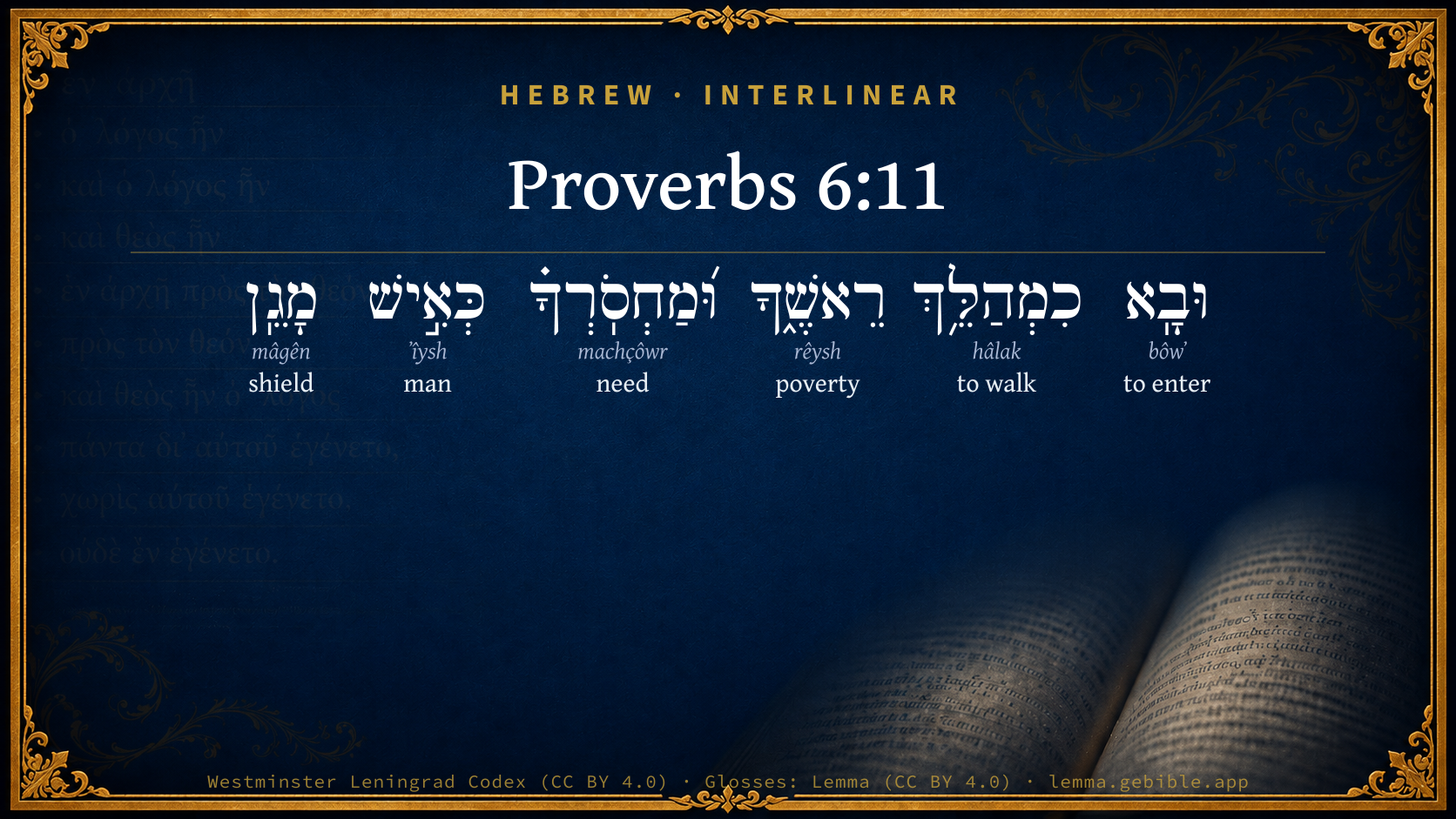
Hebrew (Westminster Leningrad Codex) Proverbs 6:11 appears in the Hebrew Old Testament. The text above is from the Westminster Leningrad Codex. Each word links to its Strong’s number, a concise gloss, and parsing drawn from the Open Scriptures Hebrew Bible morphology. Click any word for its full Brown-Driver-Briggs (BDB) entry.
Download image
Cite this verse

Proverbs 6:11 (World English Bible). Public Domain. Lemma interlinear Bible study tool, https://lemma.gebible.app/v/proverbs/6/11.

Show BibTeX & RIS
BibTeX
RIS
English Translation
So your poverty will come as a robber, And your scarcity as an armed man.
World English Bible · Public Domain
Highlights Full analysis ↓
Download a study sheet

One document with this verse’s original text, its word-by-word gloss line, the meaning frame, cross-references with their text, attributed commentary, and full source and license credits — printable, and it pastes into notes with its structure intact.

This verse Autodidact and up

Study sheet (.html) Plain text (.txt)

A passage Seminary Student

Up to 50 verses in one chapter. A passage sheet keeps up to 6 commentary sources and 12 cross-references per verse, in the order this page ranks them, and says so on the sheet whenever that leaves anything out. Ask for a single verse and you get the Autodidact verse sheet above.

Everything on this page stays free to read, with no account — the sheet is a download of what is already on screen, not access to it.

Want to remove ads? Support Godless Engineer
Compare translations 3

The same verse in 3 English versions, stacked beneath the original-language interlinear above. Click any original word for its lexicon entry.

Each is an independent rendering of the whole verse — the interlinear is not word-aligned to these translations.

Highlighted words mark where these versions differ — a whole-verse word diff, not a word-by-word alignment.

  • World English Bible Public Domain
    So your poverty will come as a robber, And your scarcity as an armed man.
  • King James Version Public Domain
    So shall thy poverty come as one that travelleth, and thy want as an armed man.
  • unfoldingWord Literal Text CC BY-SA 4.0
    and your poverty will come like one who walks and your need like a man of shield.

unfoldingWord Literal Text — © unfoldingWord, licensed CC BY-SA 4.0. Word-aligned USFM3 via Door43 (git.door43.org/unfoldingWord/en_ult).

Versions to compare (up to 4)

3 of 4 selected

Show all 18 translations

Every available English version of this verse, each an independent rendering of the whole verse.

  • World English Bible Public Domain
    So your poverty will come as a robber, And your scarcity as an armed man.
  • Berean Standard Bible Public Domain
    and poverty will come upon you like a robber, and need like a bandit.
  • Majority Standard Bible Public Domain
    and poverty will come upon you like a robber, and need like a bandit.
  • King James Version Public Domain
    So shall thy poverty come as one that travelleth, and thy want as an armed man.
  • American Standard Version (1901) Public Domain
    So shall thy poverty come as a robber, And thy want as an armed man.
  • Revised Version (1885) Public Domain
    So shall thy poverty come as a robber, and thy want as an armed man.
  • Geneva Bible (1599) Public Domain
    Therefore thy pouertie commeth as one that trauaileth by the way, and thy necessitie like an armed man.
  • Douay-Rheims (1899) Public Domain
    And want shall come upon thee, as a traveller, and poverty as a man armed. But if thou be diligent, thy harvest shall come as a fountain, and want shall flee far from thee.
  • Young's Literal Translation Public Domain
    And thy poverty hath come as a traveller, And thy want as an armed man.
  • Literal Standard Version CC BY-SA 4.0
    And your poverty has come as a traveler, || And your want as an armed man.
  • Unlocked Literal Bible CC BY-SA 4.0
    and your poverty will come like a robber and your needs like an armed soldier.
  • unfoldingWord Literal Text CC BY-SA 4.0
    and your poverty will come like one who walks and your need like a man of shield.
  • Darby Bible Public Domain
    So shall thy poverty come as a roving plunderer, and thy penury as an armed man.
  • World Messianic Bible Public Domain
    so your poverty will come as a robber, and your scarcity as an armed man.
  • Webster's Bible Public Domain
    So shall thy poverty come as one that traveleth, and thy want as an armed man.
  • Free Bible Version CC BY-SA 4.0
    and poverty will attack you like a robber, destitution like an armed warrior.
  • Bible in Basic English Public Domain
    Then loss will come on you like an outlaw, and your need like an armed man
  • JPS Tanakh (1917) Public Domain
    So shall thy poverty come as a runner, and thy want as an armed man.

Literal Standard Version (2020), Covenant Press — licensed CC BY-SA 4.0. Text via the HelloAO Bible API (eBible.org). Unlocked Literal Bible (unfoldingWord) — licensed CC BY-SA 4.0. Text via the HelloAO Bible API (eBible.org). unfoldingWord Literal Text — © unfoldingWord, licensed CC BY-SA 4.0. Word-aligned USFM3 via Door43 (git.door43.org/unfoldingWord/en_ult). Free Bible Version, Dr. Jonathan Gallagher — licensed CC BY-SA 4.0. Text via the HelloAO Bible API (eBible.org).

Word by word

More ways to search: Search by grammar → Find every occurrence → Compare this word →

Practice this passage: Drill this verse → Learn its vocabulary →

About this verse

These counts appear in no published source. They are computed here, from the morphology-tagged text and Lemma’s own curated glosses. What Lemma adds →

6
words
6
distinct lemmas
Wisdom
section

Notable vocabulary

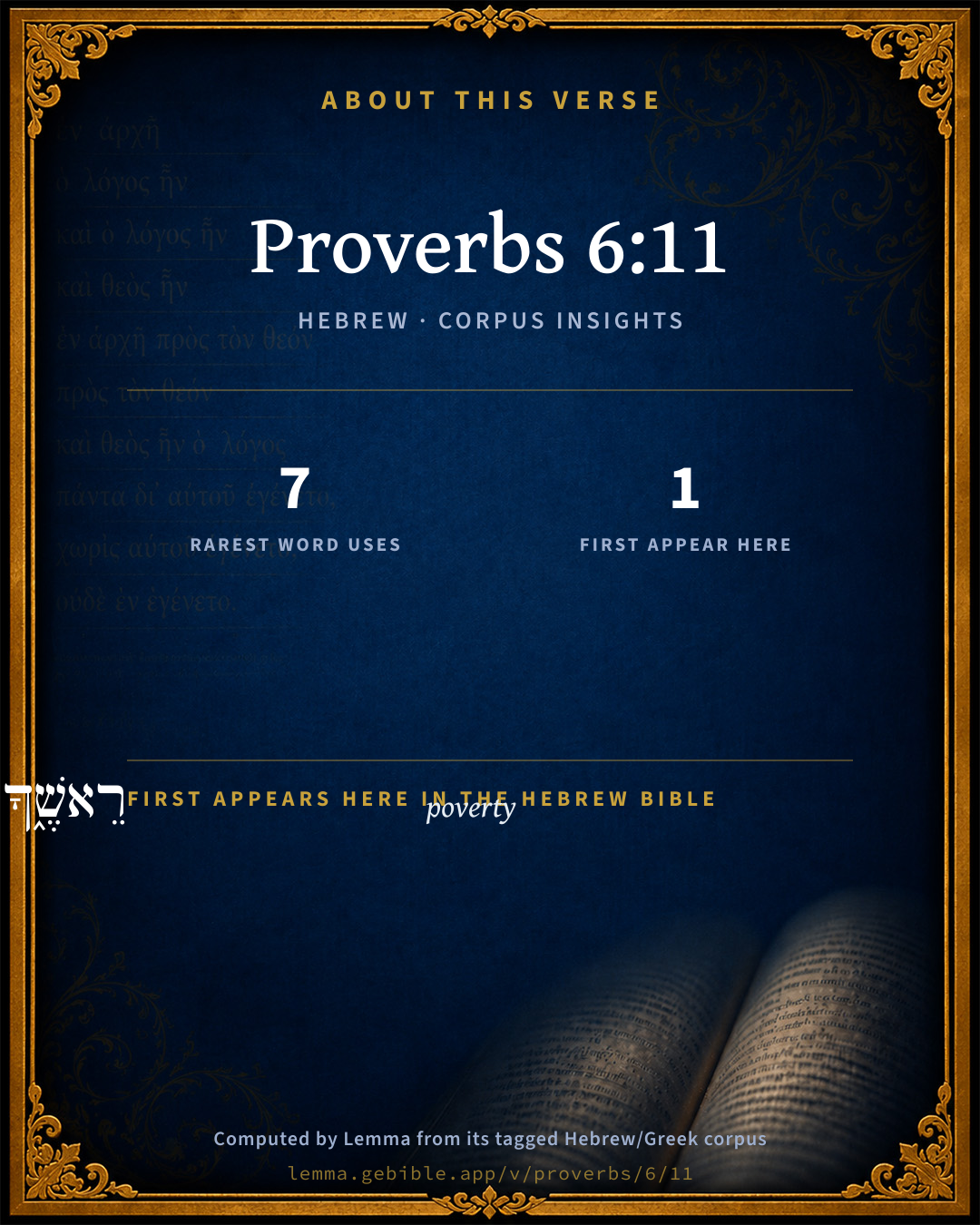
The rarest word here is רֵאשֶׁ֑ךָ poverty H7389 — appearing just 7 times in the whole Hebrew Bible.

First appearance in Scripture

This word makes its first canonical appearance in the Hebrew Bible here:

  • רֵאשֶׁ֑ךָ poverty H7389

Shared distinctive vocabulary

רֵאשֶׁ֑ךָ poverty H7389 occurs in 7 verses of the Hebrew Bible. Also found in:

Grammatical profile

  • 2 verbs
  • 4 nouns

Verb forms

  • וּבָֽא Qal · Sequential Perfect
  • כִמְהַלֵּ֥ךְ Piel · Participle Passive

Hebrew & Septuagint length

In English translation the verse runs 15 words from the Hebrew and 36 from the Septuagint (LXX English) — the Septuagint runs noticeably longer here. See the side-by-side →

A rough comparison of the two English renderings, which tokenize alike — not a word-level alignment.

Word counts can differ between the Hebrew and the Greek without any difference in meaning — e.g. the Hebrew direct-object marker אֵת has no separate Greek word, and Greek often adds the article ὁ.

Cross-references

4

Topical passages linked to Proverbs 6:11 in the Treasury of Scripture Knowledge — connected by theme and wording, ordered by reader-vote popularity; previews shown in the World English Bible.

  • Proverbs 13:4 The soul of the sluggard desires, and has nothing, But the desire of the diligent shall be fully satisfied.
  • Proverbs 10:4 He becomes poor who works with a lazy hand, But the hand of the diligent brings wealth.
  • Proverbs 20:4 The sluggard will not plow by reason of the winter; Therefore he shall beg in harvest, and have nothing.
  • Proverbs 24:34 So shall your poverty come as a robber, And your want as an armed man.

Cross-references courtesy of OpenBible.info (CC BY 4.0).

Hebrew and Greek witnesses Masoretic Hebrew ↔ Greek Septuagint

The same verse in the two great witnesses to the Old Testament, shown verse-for-verse.

Here the Septuagint runs noticeably longer than the Hebrew — LXX2012 (modern English Septuagint) 36 words vs World English Bible 15. A rough length comparison of the two English translations, not a word-level alignment — read both below.

These are two independent witnesses, not word-aligned to each other, and the Septuagint is shown in lemma (dictionary) form.

Hebrew Proverbs 6:11 Masoretic · Westminster Leningrad Codex

וּבָֽא כִמְהַלֵּ֥ךְ רֵאשֶׁ֑ךָ וּ֝מַחְסֹֽרְךָ֗ כְּאִ֣ישׁ מָגֵֽן

So your poverty will come as a robber, And your scarcity as an armed man.

World English Bible · Public Domain

Greek LXX Proverbs 6:11 Septuagint · lemma form

εἰμί ἐν παραγίγνομαι σύ ὥσπερ κακός ὁδοιπόρος ὁ πενία καί ὁ ἔνδεια ὥσπερ ἀγαθός δρομεύς ἐάν δέ ἄοκνος εἰμί ἥκω ὥσπερ πηγή ὁ ἀμητός σύ ὁ δέ ἔνδεια ὥσπερ κακός δρομεύς ἀποαὐτομολέω

Then poverty comes upon you as an evil traveller, and lack as a swift courier: but if you be diligent, your harvest shall arrive as a fountain, and poverty shall flee away as a bad courier.

LXX2012 (modern English Septuagint) · Public Domain

On this verse, Adam Clarke's Commentary discusses the Septuagint’s reading. Read the note in Commentary ↓

Hebrew: Westminster Leningrad Codex (CC BY 4.0). Greek: Septuagint (public domain); English from LXX2012 (modern English Septuagint) (Public Domain). How the Septuagint differs from the Hebrew →

Commentary

Notes on Proverbs 6:11 from classic Christian and Jewish commentators (each source and its license shown beneath its notes). The classic Christian expositions comment on the surrounding passage and are grouped to its opening verse, so a note may address several verses; the Jewish commentaries on the Tanakh (Rashi and others) are per-verse, so they appear only where the commentator wrote on this verse.

Lemma curates 59 commentaries, every one of them public domain or Creative Commons licensed, each selected and text-cleaned for this edition rather than reprinted as found. About our sources →

Trapp's Complete Commentary

John Trapp

Pro 6:11 So shall thy poverty come as one that travelleth, and thy want as an armed man.

Ver. 11. As a traveller, and thy want as an armed man.] That is, Speedily and irresistibly. Men must sweat out a living, and earn their bread before they eat it. {2Th 3:12} Think not to have wealth without working; as cities and towns are said to have fallen into Timotheus’s toil as he was sleeping - with so much ease he took them in. Spontaneae lassitudines morbos praecedunt, {a} roamings and reachings forerun diseases; so doth sluggishness usher in penury; when, as manus motitans, "the nimble hand maketh rich"; {Pro 10:4} and "in all labour there is abundance." {Pro 14:23} But, Nae, illi falsi sunt qui diversissimas res expectant ignaviae voluptatem et praemia virtutis. {b} They are utterly out that think to have the pleasure of idleness, and the plenty of painfulness.

{a} Hippocrat.

{b} Salust.

John Trapp, A Commentary or Exposition upon All the Books of the Old and New Testament (1647–1656) — public domain. Text from a community e-Sword module.

Geneva Bible (1599)

Geneva Bible translators

It shall come in such sort, as thou are not able to resist it.

That is, suddenly, and when thou lookest not for it.

Geneva Bible (1599) marginal notes — public domain. Text via Bolls.life.

Jamieson, Fausset & Brown

Robert Jamieson, A. R. Fausset & David Brown

and the fruits of their self-indulgence and indolence presented.

as . . . travelleth--literally, "one who walks backwards and forwards," that is, a highwayman.

armed man--that is, one prepared to destroy.

Jamieson, Fausset & Brown — Commentary Critical and Explanatory on the Whole Bible (1871) — public domain (CC PDM 1.0). Text via the HelloAO Bible API.

Adam Clarke's Commentary

Verse 11. So shall thy poverty come as one that travelleth] That is, with slow, but surely approaching steps.

Thy want as an armed man.] That is, with irresistible fury; and thou art not prepared to oppose it. The Vulgate, Septuagint, and Arabic add the following clause to this verse: -

"But if thou wilt be diligent, thy harvest shall be as a fountain; and poverty shall flee far away from thee."

It is also thus in the Old MS. Bible: If forsothe unslow thou shul ben; shul comen as a welle thi rip; and nede fer shal fleen fro thee.

Adam Clarke's Commentary on the Bible (1810–1826) — public domain. Text from a community e-Sword/MySword module.

Ellicott's Commentary for English Readers

(11) As one that travelleth.—The form of the Hebrew is intensive, “one who moves swiftly,” as in Psa_104:3, it is applied to God’s “moving upon the wings of the wind.” While the sluggard sleeps, poverty is coming on apace.

AS an armed man.—Against whom the sleeper will be defenceless. Pro_6:10-11 are repeated in Pro_24:33-34.

A Bible Commentary for English Readers, edited by Charles John Ellicott (1878–1897) — public domain. Text from a community e-Sword module.

The Cambridge Bible for Schools and Colleges

gen. ed. J. J. S. Perowne

11. one that travelleth … an armed man] The figure is two-fold. The doom of the sluggard travels swiftly and is inevitable. While he slumbers inertly, Poverty is coming on apace, drawing nearer to him every moment; and when it comes, it falls upon him like an armed man (Heb. “man with a shield”) from whom there is no escape.

The Cambridge Bible for Schools and Colleges (gen. ed. J. J. S. Perowne; Cambridge University Press, 1878–1918) — public domain. Text from a community e-Sword module.

John Gill's Exposition

A naughty person, a wicked man,.... Or, "a man of Belial, a man of iniquity" (w). The former signifies an unprofitable man, a man good for nothing, that is of no use to God or man; or one that is lawless, that has thrown off the yoke of the law, and will not be subject to it; Belial is the name of the devil; and here it may design such as are his children, and will do his lusts: the latter phrase signifies one that is wholly given up to work wickedness. The characters well agree with the the lawless one, the man of sin and son of perdition, antichrist, Th2 2:3. Who

walketh with a froward mouth; speaking perverse things, things contrary to the light of nature and reason, to law and Gospel; uttering lies, and deceit, and blasphemies against God and man; to which he has used himself, and in which he continues, as the word "walketh" signifies: so antichrist has a mouth opened in blasphemies against God and his saints, Rev 13:5.

(w) "homo Belijahal, vir iniquitatis", Montanus, Vatablus, Baynus, Michaelis.

John Gill's Exposition of the Whole Bible (1746–1763) — public domain (CC PDM 1.0). Text via the HelloAO Bible API.

Albert Barnes' Notes on the Bible

The similitude is drawn from the two sources of Eastern terror: the “traveler,” i. e., “the thief in the night,” coming suddenly to plunder; the “armed man,” literally “the man of the shield,” the armed robber. The habit of indolence is more fatally destructive than these marauders.

Albert Barnes' Notes on the Bible (1834–1885) — public domain. Text from a community e-Sword/MySword module.

Haydock's Catholic Bible Commentary

A traveller. Septuagint add, "wicked," and Hebrew gives the idea of a robber. (Menochius) --- But, &c. This is not in Hebrew, Complutensian, or St. Jerome. (Calmet)

George Leo Haydock (1774–1849), Haydock's Catholic Family Bible and Commentary, 1859 edition — public domain. Excludes Psalms (Douay-Rheims chapter numbering differs from Protestant) and Deuterocanonical books (Catholic canon only).

Matthew Poole's English Annotations

As one that travaileth, swiftly and unexpectedly. As an armed man, irresistibly or unavoidably.

Matthew Poole's English Annotations on the Holy Bible (1683–1685) — public domain. Text from a community e-Sword/MySword module.

The Pulpit Commentary

So shall thy poverty come as one that travelleth, and thy want as an armed man. The inevitable consequences of slothpoverty and want, two terms conveying the idea of utter destitution are described under a twofold aspect: first, as certain; second, as irresistible. Poverty will advance upon the sluggard with the unerring precision and swiftness with which a traveller tends towards the end of his journey, or, as Michaelis puts it, "quasi viator qui impigre pergit ac proprius venit donec propositum itineris scopum contingat" (Michaelis, "Notre Uberiores"). Muffet, in loc., keeping to the figure, however, explains differently, "Poverty shall overtake thee, as a swift traveller does one who walks slowly." The Authorized Version, "as one that travelleth," correctly represents the original kim"hallek. There is no ground whatever, from the use of the verb, for rendering the piel participle m"hallek as "a robber." The verb halak invariably means "to go, or walk," and the piel or intensive form of the verb means "to walk vigorously, or quickly." The participle can only mean this in the two other passages where it occurs Psa_104:3 and Ecc_4:14. The substantive helek in 2Sa_12:4 also signifies "a traveller." So the Vulgate here, quasi viator. The other view, it is stated, is required by the parallel expression in the second hemistich, "as an armed man," and receives some support from the LXX reading, wsper kakorov , "as an evil traveller," which may mean either a traveller bringing evil news, or one who wanders about with an evil intention and purpose, in the sense of the Latin grassator, "a highwayman." In this case the meaning would be that poverty shall come upon the sluggard as he is indulging in his sloth, and leave him destitute as if stripped by a robber. But the destitution of the sluggard wilt not only be certain and swift, it will be also irresistible. His want shall come upon him as an armed man (k"ish magen); literally, as a man of a shield; Vulgate, quasi vir armatus; i.e. like one fully equipped, and who attacks his foe with such onset and force that against him resistance is useless. As the unarmed, unprepared man succumbs to such an opponent, so shall the sluggard fall before want. The expressions," thy poverty" and thy want," represent the destitution of the sluggard as flowing directly from his own habit of self-indulgence. It is his in a special manner) and he, not others, is alone responsible for it. Compare, beside the parallel passage Pro_24:33, the similar teaching in Pro_10:4 Pro_13:4 Pro_20:4. The Vulgate, LXX, and Arabic Versions at the close of this verse add, "But if thou art diligent, the harvest shall come as a fountain, and want shall flee far from thee;" the LXX making a further addition, "as a bad runner (wsper kakov )." It is observable, in comparing this section with the preceding, that the teacher pursues the subject of the sluggard to its close, while he leaves the end of the surety undetermined. The explanation may be in the difference in character of the two. The surety may escape the consequences of his act, but there is no such relief for the sluggard. His slothfulness becomes a habit, which increases the more it is indulged in, and leads to consequences which are as irremediable as they are inevitable.

The Pulpit Commentary (1880–1919), ed. H.D.M. Spence-Jones & Joseph S. Exell — public domain. Text from a community e-Sword module.

John Wesley's Explanatory Notes

Travelleth - Swiftly and unexpectedly. Armed man - Irresistibly.

John Wesley, Explanatory Notes Upon the Whole Bible (1754–1765) — public domain. Text via the GEBible commentary corpus.

Rashi

Rabbi Shlomo Yitzchaki (Rashi)

And your poverty shall come like a fast walker If you do this [keep sleeping], your loss and the thing from which you are impoverished shall come to you immediately, like a man walking fast, and your want will come and fill up

like an armed man. who comes quickly to protect his master. These verses are mainly an allegory concerning those who are [too] lazy to engage in the Torah.

Rashi on the Tanakh — English translations: “The Judaica Press complete Tanach with Rashi, translated by A. J. Rosenberg” (CC BY 4.0); “Pentateuch with Rashi's commentary by M. Rosenbaum and A.M. Silbermann, 1929-1934” (public domain); “The Metsudah Tanach series, Lakewood, N.J” (CC BY 4.0); and “The Book of Joshua, Metsudah Publications, 1997” (CC BY 4.0). Text via Sefaria.

Lesson kit

Teaching starters — assembled from the data on this page, not authored interpretation. Every prompt links to the verse data it draws on. Edit before teaching.

Proverbs, in the Wisdom, opens this verse with 6 words (6 distinct Hebrew lemmas). Its most distinctive word is rêysh (“poverty”). The Greek Septuagint runs longer here. A historical commentator’s framing appears above. Read the whole chapter for the surrounding context.

Discussion questions

  1. What does “poverty” (rêysh) contribute to the verse as a whole?
  2. This is the first place “poverty” appears in Scripture (first appears here). What does its debut here establish?
  3. How does Proverbs 10:15, which shares the word «poverty», read alongside this verse?
  4. The Septuagint runs longer here than the Hebrew. What might account for the difference?
  5. These translations render this verse differently. What is at stake in choosing one wording over another?
  6. «וּבָֽא» is a Qal Sequential Perfect verb. How does that grammatical form shape the action described?
  7. Compare how Trapp's Complete Commentary and Geneva Bible (1599) read this verse. Where do they agree or differ?

Things to notice

Reading settings

Reading text

Shown beneath each verse's original-language words.

Old Testament
Old Testament edition

Read the OT as the Masoretic Hebrew (MT) or the Greek Septuagint (LXX).

English shown for the Greek Septuagint (in the Hebrew ↔ Greek comparison).

Comparing translations? Open the Compare panel on any verse page to stack up to four side by side.