Psalms 144:2

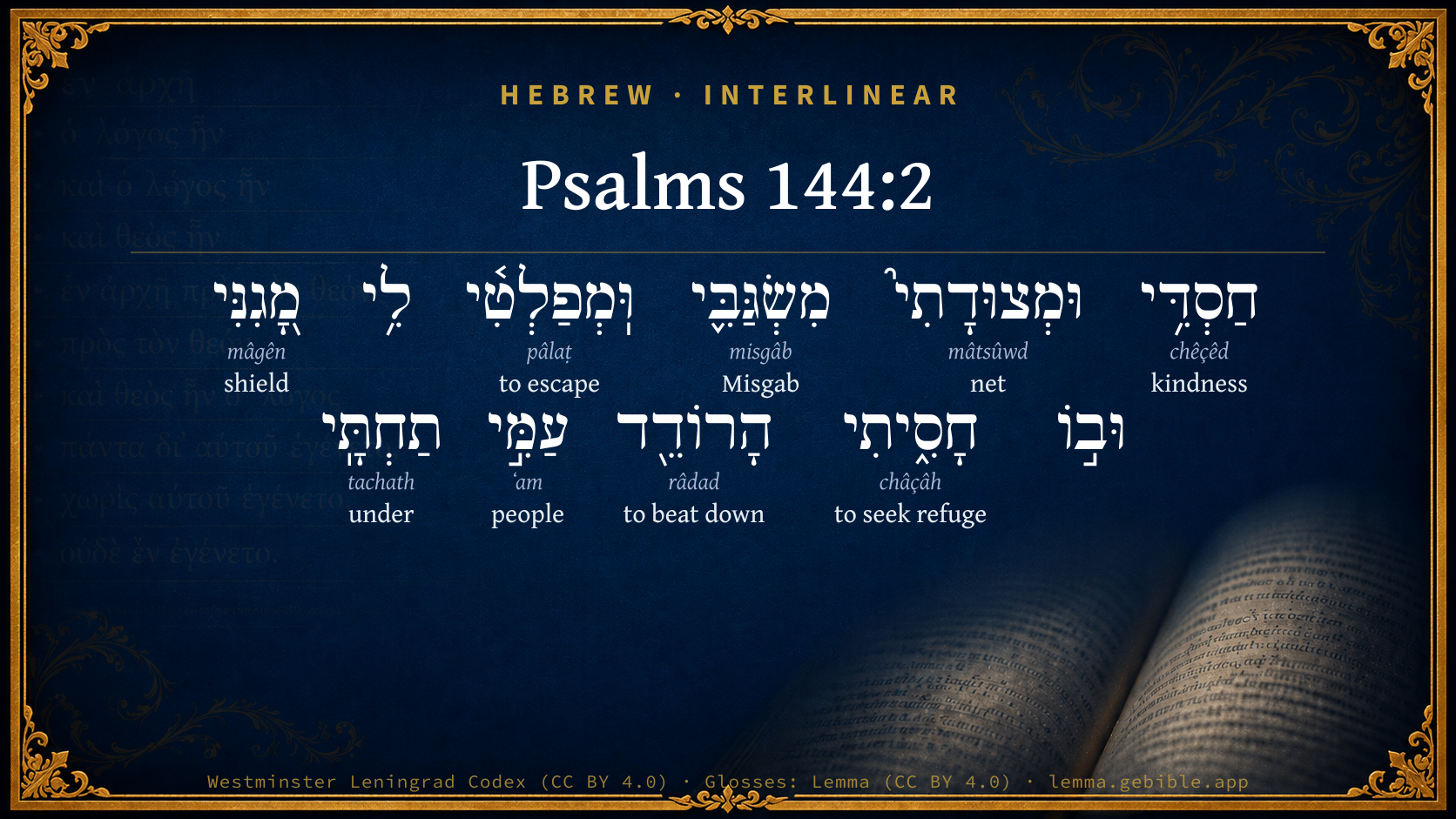
Hebrew (Westminster Leningrad Codex) Psalms 144:2 appears in the Hebrew Old Testament. The text above is from the Westminster Leningrad Codex. Each word links to its Strong’s number, a concise gloss, and parsing drawn from the Open Scriptures Hebrew Bible morphology. Click any word for its full Brown-Driver-Briggs (BDB) entry.
Download image
Cite this verse

Psalms 144:2 (World English Bible). Public Domain. Lemma interlinear Bible study tool, https://lemma.gebible.app/v/psalms/144/2.

Show BibTeX & RIS
BibTeX
RIS
English Translation
My loving kindness, my fortress, My high tower, my deliverer, My shield, and he in whom I take refuge; Who subdues my people under me.
World English Bible · Public Domain
Download a study sheet

One document with this verse’s original text, its word-by-word gloss line, the meaning frame, cross-references with their text, attributed commentary, and full source and license credits — printable, and it pastes into notes with its structure intact.

This verse Autodidact and up

Study sheet (.html) Plain text (.txt)

A passage Seminary Student

Up to 50 verses in one chapter. A passage sheet keeps up to 6 commentary sources and 12 cross-references per verse, in the order this page ranks them, and says so on the sheet whenever that leaves anything out. Ask for a single verse and you get the Autodidact verse sheet above.

Everything on this page stays free to read, with no account — the sheet is a download of what is already on screen, not access to it.

Want to remove ads? Support Godless Engineer
Compare translations 3

The same verse in 3 English versions, stacked beneath the original-language interlinear above. Click any original word for its lexicon entry.

Each is an independent rendering of the whole verse — the interlinear is not word-aligned to these translations.

Highlighted words mark where these versions differ — a whole-verse word diff, not a word-by-word alignment.

  • World English Bible Public Domain
    My loving kindness, my fortress, My high tower, my deliverer, My shield, and he in whom I take refuge; Who subdues my people under me.
  • King James Version Public Domain
    My goodness, and my fortress; my high tower, and my deliverer; my shield, and he in whom I trust; who subdueth my people under me.
  • unfoldingWord Literal Text CC BY-SA 4.0
    my covenant faithfulness and my fortress, my stronghold and the one rescuing me, my shield, and in whom I take refuge, the one subduing my people under me.

unfoldingWord Literal Text — © unfoldingWord, licensed CC BY-SA 4.0. Word-aligned USFM3 via Door43 (git.door43.org/unfoldingWord/en_ult).

Versions to compare (up to 4)

3 of 4 selected

Show all 18 translations

Every available English version of this verse, each an independent rendering of the whole verse.

  • World English Bible Public Domain
    My loving kindness, my fortress, My high tower, my deliverer, My shield, and he in whom I take refuge; Who subdues my people under me.
  • Berean Standard Bible Public Domain
    He is my steadfast love and my fortress, my stronghold and my deliverer. He is my shield, in whom I take refuge, who subdues peoples under me.
  • Majority Standard Bible Public Domain
    He is my steadfast love and my fortress, my stronghold and my deliverer. He is my shield, in whom I take refuge, who subdues peoples under me.
  • King James Version Public Domain
    My goodness, and my fortress; my high tower, and my deliverer; my shield, and he in whom I trust; who subdueth my people under me.
  • American Standard Version (1901) Public Domain
    My lovingkindness, and my fortress, My high tower, and my deliverer; My shield, and he in whom I take refuge; Who subdueth my people under me.
  • Revised Version (1885) Public Domain
    My lovingkindness, and my fortress, my high tower, and my deliverer; my shield, and he in whom I trust; who subdueth my people under me.
  • Geneva Bible (1599) Public Domain
    He is my goodnes and my fortresse, my towre and my deliuerer, my shield, and in him I trust, which subdueth my people vnder me.
  • Douay-Rheims (1899) Public Domain
    And enter not into judgment with thy servant: for in thy sight no man living shall be justified.
  • Young's Literal Translation Public Domain
    My kind one, and my bulwark, My tower, and my deliverer, My shield, and in whom I have trusted, Who is subduing my people under me!
  • Literal Standard Version CC BY-SA 4.0
    My kind one, and my bulwark, || My tower, and my deliverer, || My shield, and in whom I have trusted, || Who is subduing my people under me!
  • Unlocked Literal Bible CC BY-SA 4.0
    You are my covenant faithfulness and my fortress, my high tower and the one who rescues me, my shield and the one in whom I take refuge, the one who subdues nations under me.
  • unfoldingWord Literal Text CC BY-SA 4.0
    my covenant faithfulness and my fortress, my stronghold and the one rescuing me, my shield, and in whom I take refuge, the one subduing my people under me.
  • Darby Bible Public Domain
    My mercy and my fortress, my high tower and my deliverer, my shield and he in whom I trust, who subdueth my people under me!
  • World Messianic Bible Public Domain
    my loving kindness, my fortress, my high tower, my deliverer, my shield, and he in whom I take refuge, who subdues my people under me.
  • Webster's Bible Public Domain
    My goodness, and my fortress; my high tower, and my deliverer; my shield, and he in whom I trust; who subdueth my people under me.
  • Free Bible Version CC BY-SA 4.0
    He is the one who faithfully loves me, protects me, and defends me. He is the one who rescues me, shields me from danger, and keeps me safe. He defeats nations and places them under my rule.
  • Bible in Basic English Public Domain
    He is my strength, and my Rock; my high tower, and my saviour; my keeper and my hope: he gives me authority over my people.
  • JPS Tanakh (1917) Public Domain
    My lovingkindness, and my fortress, my high tower, and my deliverer; my shield, and He in whom I take refuge; who subdueth my people under me.

Literal Standard Version (2020), Covenant Press — licensed CC BY-SA 4.0. Text via the HelloAO Bible API (eBible.org). Unlocked Literal Bible (unfoldingWord) — licensed CC BY-SA 4.0. Text via the HelloAO Bible API (eBible.org). unfoldingWord Literal Text — © unfoldingWord, licensed CC BY-SA 4.0. Word-aligned USFM3 via Door43 (git.door43.org/unfoldingWord/en_ult). Free Bible Version, Dr. Jonathan Gallagher — licensed CC BY-SA 4.0. Text via the HelloAO Bible API (eBible.org).

Word by word

More ways to search: Search by grammar → Find every occurrence → Compare this word →

Practice this passage: Drill this verse → Learn its vocabulary →

הָרוֹדֵ֖ד
râdad
H7286
“the · beating down”
Particle, Definite Article + Verb, Qal, Participle Active, Masculine, Singular, Absolute
Part of Speech
Particle + Verb
Stem
Qal
Form
Participle Active
Gender
Masculine
Number
Singular
State
Absolute
Full BDB Definition

Origin: a primitive root

TWOT: 2120

to beat down, beat out, subdue - (Qal) to beat down (figuratively) - (Hiphil) to beat out
  1. חַסְדִּ֥י chêçêd H2617 “kindness · my” Noun, Common, Masculine, Singular, Construct + Suffix, Personal, 1st Person, Common, Singular
  2. וּמְצוּדָתִי֮ mâtsûwd H4686 “and · net · my” Conjunction + Noun, Common, Both, Singular, Construct + Suffix, Personal, 1st Person, Common, Singular
  3. מִשְׂגַּבִּ֪י misgâb H4869 “Misgab · my” Noun, Common, Masculine, Singular, Construct + Suffix, Personal, 1st Person, Common, Singular
  4. וּֽמְפַלְטִ֫י pâlaṭ H6403 “and · escaping · me” Conjunction + Verb, Piel, Participle Active, Masculine, Singular, Construct + Suffix, Personal, 1st Person, Common, Singular
  5. מָ֭גִנִּי mâgên H4043 “shield · my” Noun, Common, Both, Singular, Construct + Suffix, Personal, 1st Person, Common, Singular
  6. חָסִ֑יתִי châçâh H2620 “to seek refuge” Verb, Qal, Perfect, 1st Person, Common, Singular
  7. עַמִּ֣י ʻam H5971 “people · my” Noun, Common, Masculine, Singular, Construct + Suffix, Personal, 1st Person, Common, Singular
  8. תַחְתָּֽי tachath H8478 “under · me” Preposition + Suffix, Personal, 1st Person, Common, Singular

About this verse

These counts appear in no published source. They are computed here, from the morphology-tagged text and Lemma’s own curated glosses. What Lemma adds →

11
words
9
distinct lemmas
Wisdom
section

Notable vocabulary

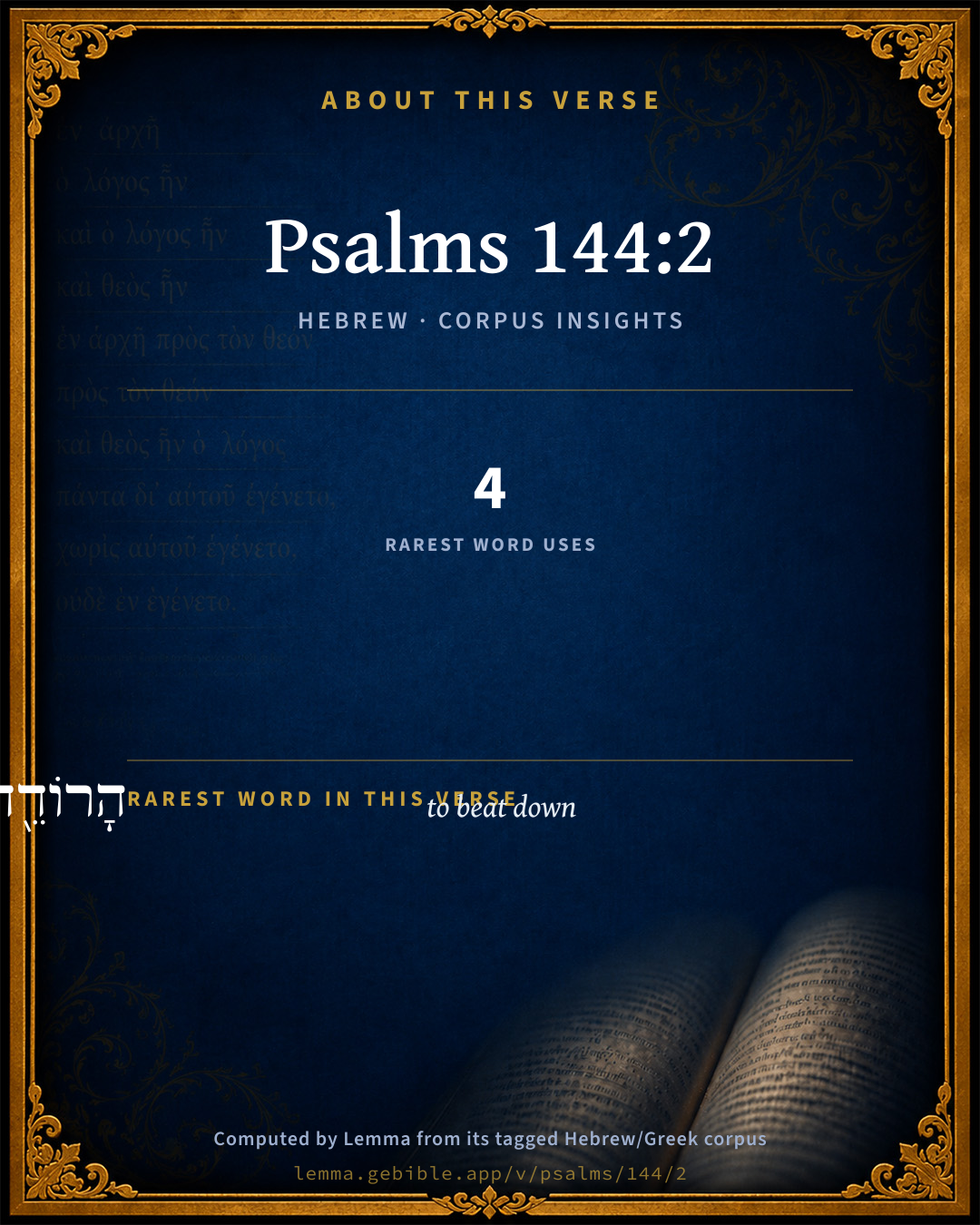
The rarest word here is הָרוֹדֵ֖ד to beat down H7286 — appearing just 4 times in the whole Hebrew Bible.

Shared distinctive vocabulary

הָרוֹדֵ֖ד to beat down H7286 occurs in 4 verses of the Hebrew Bible. Also found in:

Grammatical profile

  • 3 verbs
  • 5 nouns
  • 3 prepositions

Verb forms

  • וּֽמְפַלְטִ֫י Piel · Participle Active
  • חָסִ֑יתִי Qal · Perfect
  • הָרוֹדֵ֖ד Qal · Participle Active

Hebrew & Septuagint length

In English translation the verse runs 25 words from the Hebrew and 23 from the Septuagint (LXX English) — closely comparable.

A rough comparison of the two English renderings, which tokenize alike — not a word-level alignment.

Word counts can differ between the Hebrew and the Greek without any difference in meaning — e.g. the Hebrew direct-object marker אֵת has no separate Greek word, and Greek often adds the article ὁ.

Cross-references

9

Topical passages linked to Psalms 144:2 in the Treasury of Scripture Knowledge — connected by theme and wording, ordered by reader-vote popularity; previews shown in the World English Bible.

  • 2 Samuel 22:2–3 and he said, Yahweh is my rock, and my fortress, and my deliverer, even mine;
  • Psalms 18:2 Yahweh is my rock, my fortress, and my deliverer; My God, my rock, in whom I take refuge; My shield, and the horn of my salvation, my high tower.
  • Psalms 91:2 I will say of Yahweh, "He is my refuge and my fortress; My God, in whom I trust."
  • Psalms 59:9 Oh, my Strength, I watch for you, For God is my high tower.
  • Psalms 18:47 Even the God who executes vengeance for me, And subdues peoples under me.
  • Psalms 84:9 Behold, God our shield, Look at the face of your anointed.
  • Jeremiah 16:19 Yahweh, my strength, and my stronghold, and my refuge in the day of affliction, to you shall the nations come from the ends of the earth, and shall say, Our fathers have inherited nothing but lies, [even] vanity and things in which there is no profit.
  • 2 Samuel 22:40–48 For you have girded me with strength to the battle; You have subdued under me those who rose up against me.
  • Psalms 110:3 Your people offer themselves willingly in the day of your power, in holy array. Out of the womb of the morning, you have the dew of your youth.

Cross-references courtesy of OpenBible.info (CC BY 4.0).

Hebrew and Greek witnesses Masoretic Hebrew ↔ Greek Septuagint

The same verse in the two great witnesses to the Old Testament, shown verse-for-verse.

You’re reading Greek Psalm 143 (Hebrew Psalm 144). The Septuagint counts the superscription, so verse numbers can differ from the Hebrew — chapter-level alignment, not verse-by-verse. Numbering follows Rahlfs.

These are two independent witnesses, not word-aligned to each other, and the Septuagint is shown in lemma (dictionary) form.

Hebrew Psalms 144:2 Masoretic · Westminster Leningrad Codex

חַסְדִּ֥י וּמְצוּדָתִי֮ מִשְׂגַּבִּ֪י וּֽמְפַלְטִ֫י לִ֥י מָ֭גִנִּי וּב֣וֹ חָסִ֑יתִי הָרוֹדֵ֖ד עַמִּ֣י תַחְתָּֽי

My loving kindness, my fortress, My high tower, my deliverer, My shield, and he in whom I take refuge; Who subdues my people under me.

World English Bible · Public Domain

Greek LXX Greek Psalm 143:2 Septuagint · lemma form

ἔλεος ἐγώ καί καταφυγή ἐγώ ἀντιλήμπτωρ ἐγώ καί ῥύστης ἐγώ ὑπερασπιστής ἐγώ καί ἐπί αὐτός ἐλπίζω ὁ ὑποτάσσω ὁ λαός ἐγώ ὑπό ἐγώ

My mercy, and my refuge; my helper, and my deliverer; my protector, in whom I have trusted; who subdues my people under me.

LXX2012 (modern English Septuagint) · Public Domain

On this verse, The Cambridge Bible for Schools and Colleges discusses the Septuagint’s reading. Read the note in Commentary ↓

Hebrew: Westminster Leningrad Codex (CC BY 4.0). Greek: Septuagint (public domain); English from LXX2012 (modern English Septuagint) (Public Domain). How the Septuagint differs from the Hebrew →

Commentary

Notes on Psalms 144:2 from classic Christian and Jewish commentators (each source and its license shown beneath its notes). The classic Christian expositions comment on the surrounding passage and are grouped to its opening verse, so a note may address several verses; the Jewish commentaries on the Tanakh (Rashi and others) are per-verse, so they appear only where the commentator wrote on this verse.

Lemma curates 59 commentaries, every one of them public domain or Creative Commons licensed, each selected and text-cleaned for this edition rather than reprinted as found. About our sources →

Trapp's Complete Commentary

John Trapp

Psa 144:2 My goodness, and my fortress; my high tower, and my deliverer; my shield, and [he] in whom I trust; who subdueth my people under me.

Ver. 2. My goodness and my fortress] See Psa 18:1, with the notes, His epithetis et elogiis eblanditur Deum, saith an interpreter (Genebr.).

Who subdueth my people under me] This is the work of God, and not of kingcraft, to make men good subjects who are naturally discontented at the present government, be it never so good, and apt to rebel, αει το παρον βαρυ (Thucyd.).

John Trapp, A Commentary or Exposition upon All the Books of the Old and New Testament (1647–1656) — public domain. Text from a community e-Sword module.

J. A. Alexander on Psalms

Joseph Addison Alexander

2. (Psa 144:2) My mercy and my fortress, my high place, and a deliverer for me, my shield and (he) in whom I trust, the (one) subduing my people. No less than five of these descriptive epithets are taken from a single verse of Psalms 18, viz. ver. 3 (2). Peculiar to the place before us is my mercy, i.e. my God of mercy. The benefit of these relations to Jehovah David claims not merely for himself but for his royal race, which was closed and yet perpetuated in the Messiah. He in whom I trust, literally and in him I trust. My people, in its widest sense, including Israel and the Gentiles who were to be added to the kingdom of David under the reign of the Messiah. Compare Psa 18:43; Psa 18:47 with the parallel passages in 2 Samuel.

Joseph Addison Alexander, The Psalms Translated and Explained (1850) — public domain. Text from a community e-Sword module.

Geneva Bible (1599)

Geneva Bible translators

He confesseth that neither by his own authority, power or policy his kingdom was quiet, but by the secret grace of God.

Hebrew, my deliverer unto me: for the Prophet cannot satisfy himself with any words.

Geneva Bible (1599) marginal notes — public domain. Text via Bolls.life.

Adam Clarke's Commentary

Verse 2. Who subdueth my people] Who has once more reduced the nation to a state of loyal obedience. This may refer to the peace after the rebellion of Absalom.

Adam Clarke's Commentary on the Bible (1810–1826) — public domain. Text from a community e-Sword/MySword module.

John Calvin's Commentaries

2. My goodness, etc. This way of using the word in a passive sense, as in the Hebrew, sounds harsh in Latin; just as elsewhere (Psalm 18:50) he calls himself “God’s king,” not in the sense of his having dominion over God, but being made and appointed king by him. Having experienced God’s kindness in so many ways, he calls him “his goodness,” meaning that whatever good he possessed flowed from him. The accumulation of terms, one upon another, which follows, may appear unnecessary, yet it tends greatly to strengthen faith. We know how unstable men’s minds are, and especially how soon faith wavers, when they are assailed by some trial of more than usual severity. It is not enough, if God would sustain us under such weakness, to promise us his help in individual or single expressions; and, even however many aids he supplies us with, we are subject to very great vacillations, and a forgetfulness of his mercy creeps in upon us which almost overwhelms our minds. We are to remember that it is not merely in token of his gratitude that David heaps together so many terms in declaring the goodness of God, but to fortify God’s people against all attacks of the world, and of the evil one. He had a reason for reckoning it among the chiefest of God’s mercies, that he controlled the people under his government. For עמי, ami, my people, some read, עמים, amim, peoples; Those who conjecture that עמים, amim, is the correct reading, refer to the parallel passage in Psalm 18:47, where the word is in the plural. They also observe in support of their opinion, that this reading is actually found in a great number of MSS. examined by Kennieott and De Rossi; and they account for עמי, ami, having got into the text by supposing that it was written in the first instance as a contraction for עמים, amim. Rosenmuller supposes, but with less probability, that the original word was עם, and that the letter י, yod, is paragogic, that is, has been annexed to improve the sound; עם, am, being taken collectively. The Masorets have noticed that עם, which the translators of our English Bible took to be עם, with its possessive affix here, in 2 Samuel 22:44, and Lamentations 3:14, and consequently rendered by my people, is to be taken as the plural number of that noun.

John Calvin's Commentaries (1540-1563) — public domain. Text from the Calvin Translation Society English edition (1840s-50s) via the Christian Classics Ethereal Library (ccel.org). Calvin's coverage is partial (roughly two-thirds of the Bible); uncommented books and verses are honest gaps, never fabricated. The 19th-century editor's footnotes and remarks are omitted so the notes are faithfully Calvin's own voice.

Ellicott's Commentary for English Readers

(2) My goodness —Or, my lovingkindness, or my grace, a shortened form of “God of my grace” (Psa_59:10; Psa_59:17). The expression is exactly analogous to the term” grace,” applied to kings as the source of grace or mercy. For the other epithets, see Psa_18:2.

Who subdueth.—Psa_18:47; but the verb is different (cognate with 2Sa_22:48), and here the singular, “my people,” instead of “my peoples.” Some MSS. indeed have the plural here, and the Syriac and Chaldee followed them, or changed to suit Psalms 18. If we had the historical incidents out of which the psalm sprung we might account for the change.

A Bible Commentary for English Readers, edited by Charles John Ellicott (1878–1897) — public domain. Text from a community e-Sword module.

The Cambridge Bible for Schools and Colleges

gen. ed. J. J. S. Perowne

2. Cp. Psa_18:2; Psa_18:47, and notes there.

My goodness] Rather, my lovingkindness, a bold expression for the God of my lovingkindness (Psa_59:10; Psa_59:17), to denote Jehovah as the sum and source of lovingkindness. A partial parallel may be found in Jon_2:8, but in view of the fact that the verse is almost wholly derived from Psalms 18, it seems not improbable that we should read as in Psa_18:1, my strength (חזקי for חסרי), or as in Psa_18:2, my cliff (סלעי), which agrees better with the next epithet my fortress or stronghold.

my deliverer] Lit. my deliverer for me, as in 2Sa_22:2. In Psalms 18 for me is omitted.

my shield, and he in whom I have taken refuge] A somewhat awkward variation from the text in Psalms 18, “my rock in whom I take refuge, my shield.”

who subdueth my people under me] The phrase resembles the text of 2Sa_22:48 (who bringeth down) more closely than that of Psa_18:47 (and led subject, a different word from that used here). Instead of my people both texts read peoples, which is supported by some MSS and several Versions (Aq. Syr. Jer. Targ.) here. If Israel is the speaker, this reading must be adopted here, and the reference must be to the subjugation of neighbouring nations: but if the leader of the community is speaking, the more difficult reading ‘my people,’ which is supported by the LXX, may be right. The reference will then be to his success in overcoming internal dissensions (cp. “the strivings of my people,” 2Sa_22:44) and the establishment of his authority.

The Cambridge Bible for Schools and Colleges (gen. ed. J. J. S. Perowne; Cambridge University Press, 1878–1918) — public domain. Text from a community e-Sword module.

John Gill's Exposition

My goodness,.... Not only good, but goodness itself; the donor of all the blessings of goodness to him; the author of all goodness in him; the provider of all goodness for him, laid up to be used hereafter. The Septuagint and Vulgate Latin versions render it my mercy, properly enough; that is, the God of "my mercy", as in Psa 59:10; who is all mercy, full of mercy, rich and plenteous in it; which is abundant, and from everlasting to everlasting. Or, "my grace" (d); the God of all grace, the giver of every grace, and who is able to make all grace to abound; and from whom every blessing of grace, and every particular grace, as faith, hope, and love, and all the supplies of grace, as well as every good and perfect gift, come: Christ is prevented with all the blessings of goodness; in him all fulness of grace dwells, and with him God keeps his mercy for evermore;

and my fortress; garrison or strong hold: what fortresses or fortifications are to cities, whether natural or artificial, that is God to his people; all his perfections are on their side; and particularly they are kept by his power, as in a garrison, through faith unto salvation, Pe1 1:5;

my high tower: the name of the Lord, which is himself, is a strong tower, where his righteous ones that flee to him are safe; and is an "high" one, where they are out of the reach of all their enemies, Pro 18:10;

and my deliverer; that delivered him from his temporal enemies; and from his spiritual ones, from sin, Satan, and the world; from all afflictions and temptations, from wrath and ruin, death and hell;

my shield; that protected him from all evil and danger; whose favour encompassed him as a shield; whose salvation was a shield to him; and more particularly the person, blood, righteousness, and sacrifice of his Son, called the shield of faith, Eph 6:16;

and he in whom I trust; not in men, no, not in princes; but in the Lord only; in his Word, as the Targum; for things temporal and spiritual; for the blessings of grace here, and glory hereafter; of these several titles, see more on Psa 18:2;

who subdueth my people under me; the people of Israel, all the tribes; whose hearts the Lord inclined to make him king over them all, Sa2 5:1. Or, "the people" (f); so the Targum, Syriac, and Arabic versions; the Heathen people, the Philistines, Ammonites, Edomites, Moabites, and Syrians; see Sa2 8:1. The former reading seems best, and is followed by the Septuagint, Vulgate Latin, and other versions: and this may be typical of the subduing of Christ's people under him; who are made willing, in the day of his power, to receive and own him as their King; profess subjection to his Gospel, and submit to his ordinances.

(d) "gratia mea", Cocceius, Gejerus. (f) "pro" "populos", Piscator.

John Gill's Exposition of the Whole Bible (1746–1763) — public domain (CC PDM 1.0). Text via the HelloAO Bible API.

Albert Barnes' Notes on the Bible

My goodness - Margin, “my mercy.” That is, He shows me mercy or favor. All the favors that I receive come from him.

And my fortress; my high tower, and my deliverer - See the notes at Psa 18:2, where the same words occur.

My shield - The same word which in Psa 18:2 is rendered “buckler.” See the notes at that passage.

And he in whom I trust - The same idea as in Psa 18:2. The tense of the verb only is varied.

Who subdueth my people under me - See the notes at Psa 18:47. The language is slightly different, but the idea is the same. It is to be remarked that David “here” refers to his people - “who subdueth my people,” meaning that those over whom God had placed him had been made submissive by the divine power.

Albert Barnes' Notes on the Bible (1834–1885) — public domain. Text from a community e-Sword/MySword module.

Matthew Poole's English Annotations

My goodness; or, my mercy; or, the God of my mercy, as God is called, Psa 59:10,17; the name of God being easily understood from the foregoing verse. Or, he who is exceeding good or merciful to me, as good as goodness itself; the abstract being put for the concrete, as it is frequently in speeches of God, who is called wisdom, truth, goodness, &c.; and, sometimes of men, as Psa 12:1; Pro 10:29, where faithfulness and uprightness are put for faithful and upright men.

Who subdueth my people under me; who has disposed my people’s hearts to receive and obey me as their king.

Matthew Poole's English Annotations on the Holy Bible (1683–1685) — public domain. Text from a community e-Sword/MySword module.

The Treasury of David

Charles H. Spurgeon

Ver. 2. Now our royal poet multiplies metaphors to extol his God.

My goodness, and my fortress. The word for goodness signifies mercy. Whoever we may be, and wherever we may be, we need mercy such as can only be found in the infinite God. It is all of mercy that he is any of the other good things to us, so that this is a highly comprehensive title. O how truly has the Lord been mercy to many of us in a thousand ways! He is goodness itself, and he has been unbounded goodness to us. We have no goodness of our own, but the Lord has become goodness to us. So is he himself also our fortress and safe abode: in him we dwell as behind impregnable ramparts and immovable bastions. We cannot be driven out, or starved out; for our fortress is prepared for a siege; it is stored with abundance of food, and a well of living water is within it. Kings usually think much of their fenced cities, but King David relies upon his God, who is more to him than fortresses could have been.

My high tower, and my deliverer. As from a lofty watchtower the believer, trusting in the Lord, looks down upon his enemies. They cannot reach him in his elevated position; he is out of bow shot; he is beyond their scaling ladders; he dwells on high. Nor is this all; for Jehovah is our Deliverer as well as our Defender. These different figures set forth the varied benefits which come to us from our Lord. He is every good thing which we can need for this world or the next. He not only places us out of harm's way full often, but when we must be exposed, he comes to our rescue, he raises the siege, routs the foe, and sets us in joyous liberty.

My shield, and he in whom I trust. When the warrior rushes on his adversary, he bears his target upon his arm, and thrusts death aside; thus doth the believer oppose the Lord to the blows of the enemy, and finds himself secure from harm. For this and a thousand other reasons our trust rests in our God for everything; he never fails us, and we feel boundless confidence in him.

Who subdueth my people under me. He keeps my natural subjects subject, and my conquered subjects peaceful under my sway. Men who rule others should thank God if they succeed in the task. Such strange creatures are human beings, that if a number of them are kept in peaceful association under the leadership of any one of the Lord's servants, he is bound to bless God every day for the wonderful fact. The victories of peace are as much worthy of joyful gratitude as the victories of war. Leaders in the Christian church cannot maintain their position except as the Lord preserves to them the mighty influence which ensures obedience and evokes enthusiastic loyalty. For every particle of influence for good which we may possess let us magnify the name of the Lord.

Thus has David blessed Jehovah for blessing him. How many times he has appropriated the Lord by that little word My! Each time he grasps the Lord, he adores and blesses him; for the one word Blessed runs through all the passage like a golden thread. He began by acknowledging that his strength for fighting foreign enemies was of the Lord, and he concluded by ascribing his domestic peace to the same source. All round as a king he saw himself to be surrounded by the King of kings, to whom he bowed in lowly homage, doing suit and service on bent knee, with grateful heart admitting that he owed everything to the Rock of his salvation.

Ver. 2. My goodness, etc. This way of using the word in a passive sense, as in the Hebrew, sounds harshly; just as elsewhere (Ps 18:50) he calls himself "God's king", not in the sense of his having dominion over God, but being made and appointed king by him. Having experienced God's kindness in so many ways, he calls him "his goodness", meaning that whatever good he possessed flowed from him. The accumulation of terms, one upon another, which follows, may appear unnecessary, yet it tends greatly to strengthen faith. We know how unstable men's minds are, and especially how soon faith wavers, when they are assailed by some trial of more than usual severity. John Calvin.

Ver. 2. My fortress. David calls God by names connected with the chief deliverances of his life. The psalms abound in local references and descriptive expressions, e.g. Ps 18:2 (and in this place). The word translated "fortress" is metzuriah or masada. From 1Sa 23:29, I have no doubt that he is speaking of Masada, an isolated peak 1,500 feet high, on which was a stronghold. James Wareing Bardsley, in "Glimpses through the Veil", 1883.

Ver. 2. My high tower. Such towers were erected on mountains, on rocks, or on the walls of a city, and were regarded as safe places mainly because they were inaccessible. So the old castles in Europe, as that at Heidelberg, and generally those along the Rhine, were built on lofty places, and in such positions as not to be easily accessible. Albert Barnes.

Ver. 2. My shield. The Hebrew word signifies, not the huge shield which was carried by an armourbearer, but the handy target with which heroes entered into hand to hand conflicts. A warrior took it with him when he used his bow or his sword. It was often made of metal, but still was portable, and useful, and was made to serve as an ornament, being brightened or anointed with oil. David had made abundant use of the Lord, his God, from day to day, in battles many and murderous. C.H.S.

Ver. 2. Who subdueth my people under me. David, accordingly, having ascribed the victories he had gained over foreign enemies to God, thanks him at the same time for the settled state of the kingdom. Raised indeed as he was from an obscure station, and exposed to hatred from calumnious charges, it was scarcely to have been believed that he would ever obtain a peaceable reign. The people had suddenly, and beyond expectation, submitted to him; and so surprising a change was eminently God's work. John Calvin.

Ver. 2. Double flowers.

1. Good preserved from evil: "goodness" and "fortress."

2. Safety enlarged into liberty: "tower", "deliverer."

3. Security attended with rest: "shield, in whom I trust."

4. Sufficiency to maintain superiority: "subdueth my people under me." View God as working all.

Ver. 2. A Group of Titles. Notice,

1. Which comes first. "Goodness." Heb. "Mercy."

a) It is right and natural that a saved sinner should make the most of "mercy", and place it in the foreground.

b) Mercy is the ground and reason of the other titles named. For whatever God is to us, it is a special manifestation of his mercy.

c) It is a good thing to see a believer ripe in experience making mercy the leading note in his song of praise.

2. Which comes last: "He in whom I trust." It suggests,

a) That what God is makes him worthy of trust.

b) That meditation upon what he is strengthens our trust.

3. What peculiar force the word "my" gives to each. It makes it,

a) A record of experience.

b) An ascription of praise.

c) A blessed boasting.

d) An incentive, enough to set others longing. J.F.

Psalms 144:3*

Charles H. Spurgeon's The Treasury of David (1869–1885) — public domain. Psalms only. Text from a community e-Sword/MySword module.

Whedon's Commentary on the Bible

Daniel D. Whedon

2. My goodness—Meaning, “the source from which goodness, or mercy, comes to me.”

Who subdueth—Refers to the restoration of David’s authority after the suppression of Absalom’s rebellion.

Daniel D. Whedon (gen. ed.), Commentary on the Old and New Testaments (1874–1909) — public domain. Text from a community e-Sword module.

The Pulpit Commentary

My goodness, and my fortress; my high tower, and my deliverer; my shield, and he in whom I trust. The general resemblance to Psa_18:2 is striking, but there are peculiar and original touches which indicate the author, not the copyist. For instance, the expression, "my goodness," occurs nowhere else. Who subdueth my people under me. Another reading gives, "Who subdueth peoples under me." Either reading suits the circumstances of David, who had to subdue a great portion of his own people under him, (2Sa_2:8-31 2Sa_3:6-21) and also conquered many foreign nations. (2Sa_8:1-14)

The Pulpit Commentary (1880–1919), ed. H.D.M. Spence-Jones & Joseph S. Exell — public domain. Text from a community e-Sword module.

John Wesley's Explanatory Notes

Subdued - Who hath disposed my peoples hearts to receive and obey me as their king.

John Wesley, Explanatory Notes Upon the Whole Bible (1754–1765) — public domain. Text via the GEBible commentary corpus.

Rashi

Rabbi Shlomo Yitzchaki (Rashi)

Who flattens peoples beneath me Who flattens and spreads out my people to rest in its place, as (Job 12:23): He spreads out (שוטח) the nations.” He makes them great. רוֹדֵד is the Aramaic translation of רוֹקַע, as the Targum renders (Exod. 39:3): וַיְרַקְעוּ, and they spread out; וְרַדִּידוּ. Others interpret הרודד, Who weakens peoples under me. But in an accurate revised version, [the reading is]: עמי, upon which the Masorah states: In three cases, the meaning is עמים, peoples, but the reading is עמי, and on תחתי, it says: the reading is תחתיו, under Him.

Rashi on the Tanakh — English translations: “The Judaica Press complete Tanach with Rashi, translated by A. J. Rosenberg” (CC BY 4.0); “Pentateuch with Rashi's commentary by M. Rosenbaum and A.M. Silbermann, 1929-1934” (public domain); “The Metsudah Tanach series, Lakewood, N.J” (CC BY 4.0); and “The Book of Joshua, Metsudah Publications, 1997” (CC BY 4.0). Text via Sefaria.

Lesson kit

Teaching starters — assembled from the data on this page, not authored interpretation. Every prompt links to the verse data it draws on. Edit before teaching.

Psalms, in the Wisdom, opens this verse with 11 words (9 distinct Hebrew lemmas). Its most distinctive word is râdad (“to beat down”). A historical commentator’s framing appears above. Read the whole chapter for the surrounding context.

Discussion questions

  1. The word râdad carries the sense “to beat down.” How does it shape the verse?
  2. How does Judges 19:11, which shares the word «to beat down», read alongside this verse?
  3. These translations render this verse differently. What is at stake in choosing one wording over another?
  4. «וּֽמְפַלְטִ֫י» is a Piel Participle Active verb. How does that grammatical form shape the action described?
  5. Compare how Trapp's Complete Commentary and J. A. Alexander on Psalms read this verse. Where do they agree or differ?

Things to notice

Reading settings

Reading text

Shown beneath each verse's original-language words.

Old Testament
Old Testament edition

Read the OT as the Masoretic Hebrew (MT) or the Greek Septuagint (LXX).

English shown for the Greek Septuagint (in the Hebrew ↔ Greek comparison).

Comparing translations? Open the Compare panel on any verse page to stack up to four side by side.