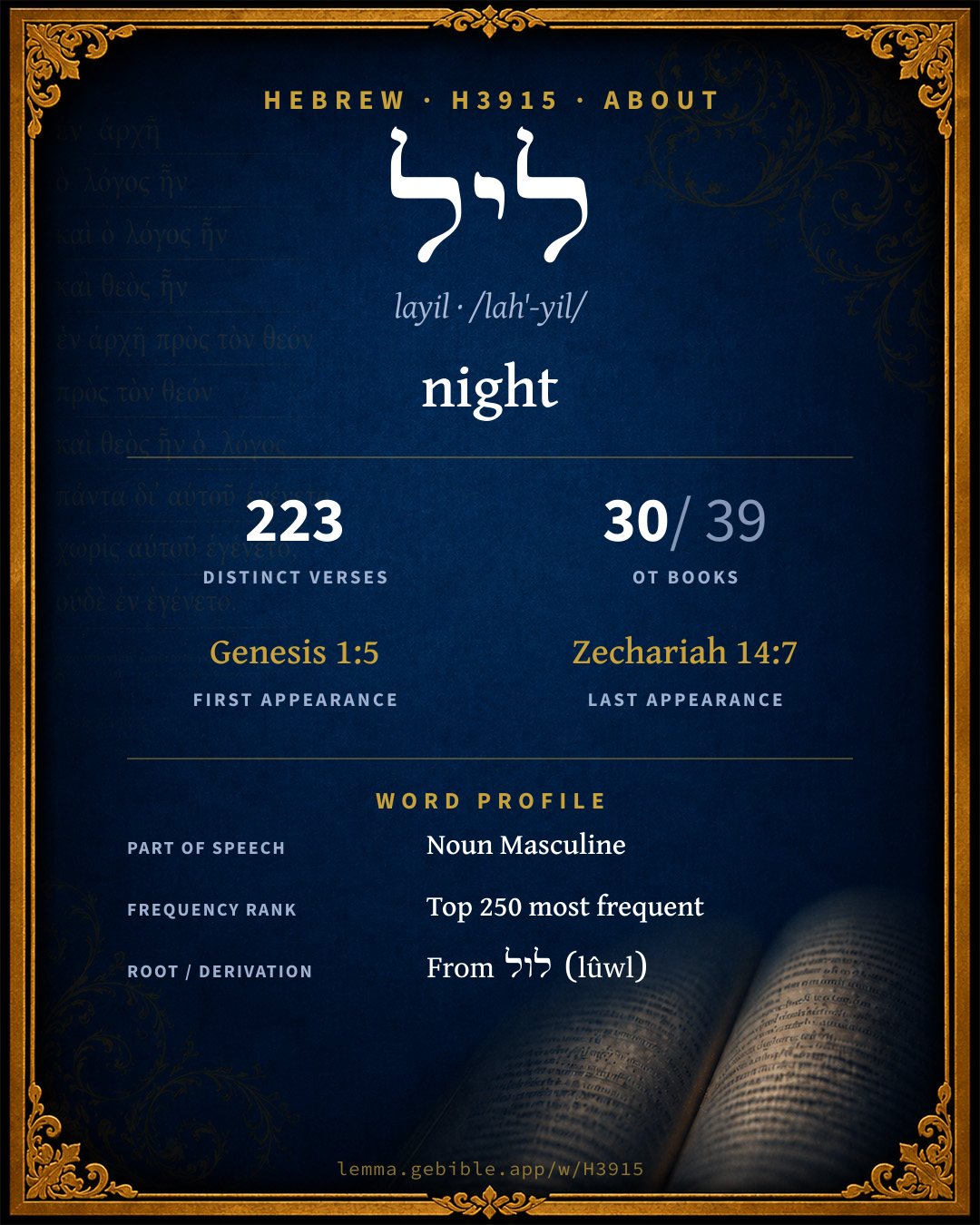
לַ֫יְלָה
night
‘night’ is one of 3 main senses fuller range ↓
Full lexicon entry — Brown-Driver-Briggs (BDB)
From Brown-Driver-Briggs (BDB)
Where this word appears
Grammar key — what these labels mean
Part of speech
- Noun
- A naming word — a person, place, thing, or idea.
Noun type
- Common
- A common noun — a general class of person, place, or thing (“king,” “city,” “water”), not a specific name.
State
- Absolute
- The independent form of a noun, not bound to a following word.
- Construct
- A noun bound to a following noun in a possessive / “of” relationship (the construct chain).
Gender
- Masculine
- Grammatically masculine.
Number
- Singular
- One.
- Plural
- More than one (in Hebrew, generally three or more).
Every verse where H3915 appears in the Book of 2 Kings — 5 distinct verses. Click any verse to open its interlinear word-by-word view. Verse text shown in the World English Bible for context — . Each verse’s Hebrew form is shown with its reference; the English is not keyword-highlighted, since the data carries no word-level English alignment. Use “Compare translations” on any verse to read it across multiple English versions. This concordance covers the Hebrew Bible; Septuagint (Greek Old Testament) occurrences are not indexed here.
2 Kings
- 2 Kings 6:14 לַ֔יְלָה n c ms Therefore sent he there horses, and chariots, and a great host: and they came by night, and surrounded the city.
- 2 Kings 7:12 לַ֗יְלָה n c ms The king arose in the night, and said to his servants, I will now show you what the Syrians have done to us. They know that we are hungry; therefore are they gone out of the camp to hide themselves in the field, saying, When they come out of the city, we shall take them alive, and get into the city.
- 2 Kings 8:21 לַ֗יְלָה n c ms Then Joram passed over to Zair, and all his chariots with him: and he rose up by night, and struck the Edomites who surrounded him, and the captains of the chariots; and the people fled to their tents.
- 2 Kings 19:35 בַּ/לַּ֣יְלָה prep det + n c ms It happened that night, that the angel of Yahweh went forth, and struck in the camp of the Assyrians one hundred eighty-five thousand: and when men arose early in the morning, behold, these were all dead bodies.
- 2 Kings 25:4 הַ/לַּ֨יְלָה֙ ptcl def.art + n c ms Then a breach was made in the city, and all the men of war [fled] by night by the way of the gate between the two walls, which was by the king's garden (now the Chaldeans were against the city round about); and [the king] went by the way of the Arabah.
About this entry
At a glance — auto-summarized from this page’s data, not written by a person. Every figure links to its source below. This summary describes the numbers; it doesn’t interpret them.
The Hebrew noun ליל centers on the idea of “night.” First canonically at Genesis 1:5, it enters the text early. It turns up in 223 verses across 30 books, a common footprint. Its meaning spans more than one sense — see its full sense range. It clusters with לול, ללאה and לילית under a shared root. For the data behind this summary, explore the sense tree and the renderings breakdown below.
Gloss history
Strong's 1890 vs modern scholarship
About this word
Strong's H3915 catalogs a Hebrew word from the Hebrew Old Testament.
These counts are not copied from any lexicon or concordance. They are computed here, from the morphology-tagged Hebrew Old Testament. What Lemma adds →
- 223
- distinct verses
- The word appears in 223 distinct verses.
- 30 / 39
- OT books
- The word appears in 30 of 39 Old Testament books.
- #200
- by frequency
- Top 250 most frequent Hebrew words (rank 200 of 8,640 Hebrew words by occurrence).
View all 223 occurrences in the concordance →
By section of the Old Testament
By traditional corpus
Conventional, traditional groupings — biblical authorship is debated, so this is a traditional corpus grouping, not an authorship claim. Each share is this word’s portion of its verses in that division of the Hebrew canon. Each figure is a share of the word’s 223 distinct verses.
- Prophets (Nevi'im) 86 verses · 39%
- Writings (Ketuvim) 77 verses · 35%
- Torah (Pentateuch) 60 verses · 27%
How translations render this word
Counts come from each version’s own published word-to-Strong’s tagging or interlinear alignment — an approximate guide to how each version renders this word, not a word-level alignment the data otherwise carries. Because each total is that version’s own tagged count, the per-version totals vary from one another and need not match the appearance or distinct-verse counts above. These counts may also differ from a printed concordance because Lemma counts each distinctly tagged rendering and does not collapse phrase taggings into a single head-word total. This is a fixed set of word-tagged versions (KJV, ASV, BSB, ULT) and does not change with the reading translation you choose elsewhere. Each version’s license is shown beside its name below (and on Sources).
- King James Version: Night 155×, Nights 14×, All night 7×
- American Standard Version: Night 138×, Nights 14×, All the night 9×
- Berean Standard Bible: Night 173×, Nights 14×, Tonight 9×
- unfoldingWord Literal Text: Night 181×, Nights 16×, Tonight 14×
King James Version Public Domain
Renders H3915 across 224 tagged occurrences — most commonly:
Plus 23 renderings that appear only once — usually multi-word phrases or single function words the recovered tagging swept in, not distinct renderings. Not rendered by a distinct English word in 9 further occurrences.
American Standard Version Public Domain
Renders H3915 across 222 tagged occurrences — most commonly:
Plus other, less common renderings. Plus 34 renderings that appear only once — usually multi-word phrases or single function words the recovered tagging swept in, not distinct renderings.
Berean Standard Bible Public Domain
Renders H3915 across 221 tagged occurrences — most commonly:
Plus 15 renderings that appear only once — usually multi-word phrases or single function words the recovered tagging swept in, not distinct renderings. Not rendered by a distinct English word in 12 further occurrences.
unfoldingWord Literal Text CC BY-SA 4.0
Renders H3915 across 255 tagged occurrences — most commonly:
Plus 9 renderings that appear only once — usually multi-word phrases or single function words the recovered tagging swept in, not distinct renderings.
Senses in the full BDB
What do BDB’s symbols mean?
BDB uses these scholarly abbreviations:
| Symbol | Meaning |
|---|---|
| 𝔊 | the Septuagint (the ancient Greek translation, LXX) |
| 𝔙 | the Vulgate (the Latin translation) |
| 𝔖 | the Syriac version (the Peshitta) |
| 𝔗 | the Targum (the Aramaic translation) |
| ψ | the Psalms |
| √ | root (the underlying root or stem) |
| ‖ | parallel passage (a synonymous or contrasted parallel) |
| † | the dagger: every passage where the word occurs is cited |
The 2 senses and sub-senses the full Brown-Driver-Briggs lexicon distinguishes for this word, in lexicon order (not ranked by frequency), with BDB’s own verbatim wording and sub-sense lettering. Shown in Hebrew script with BDB’s own scholarly abbreviations. The condensed entry is in the Lexicon Entry tab. See also the Forms in the corpus table below.
- 1. lit. night, opp. day, Gn 8:22 (J), Dt 1:33 + very often (v. יוֹם); alternation of day and night divinely ordained Gn 1:5 (P), Je 33:20(×2), 25 +; מִיּוֹם עַד־ל׳ Is 38:12, 13 i.e. within one whole day; as close of day, עַד־ל׳ 2 Ch 35:14; as time of sacred חָג (לֵיל) Is 30:29; of suffering and weeping לֵילוֹת עָמָל Jb 7:3, cf. ψ 6:7; 77:3 etc.; of pious desires, prayer, praise, meditation, etc. (sometimes ‖ by day) Is 26:9 Jb 35:10 ψ 1:2; 22:3; 42:9; 77:7; 88:2; 92:3; 119:5(×2), cf. 16:7; 17:3; of night-service in Temple 134:1; of sudden assault, or destruction, Is 15:1 Je 6:5 Ob 5 Jb 27:20; 34:20, 25; 36:20; divided into watches ψ 90:4; לֵיל שִׁמֻּרִים Ex 12:42 v. sub שׁמר; c. num., denoting duration of time, †forty days and forty nights Gn 7:4, 12 Ex 24:18; 34:28 Dt 9:9, 11, 18, 25; 10:10 1 K 19:8; three days and three nights (שְׁלשָׁה לֵילוֹת) 1 S 30:12 Jon 2:1; seven days and seven nights (שִׁבְעַת לֵילוֹת) Jb 2:13†; חֲלוֹם הַלּ׳ †Gn 20:3; 31:24 (both E), 1 K 3:5; מַרְאֹת הַלּ׳ Gn 46:2 (E); חֶזְיוֹן ל׳ Jb 20:8; 33:15, חֶזְיֹנוֹת ל׳ 4:13, חֲלוֹם חֲזוֹן ל׳ Is 29:7 (cf. Mi 3:6 infr.)†; בִּן־ל׳ Jon 4:10(×2) v. בֵּן 8. p. 121 b. Chiefly in adverb. phr.:—בַּחֲצִי הַלּ׳ at midnight Ex 12:29 + (v. חֲצִי, חָצוֹת p. 345 b), cf. בְּתוֹךְ הַלּ׳ †1 K 3:20, בְּאִישׁוֹן ל׳ Pr 7:9†; בַּלּ׳ הַזֶּה Ex 12:8, 12 on this night (P; the night of which one is speaking); בַּלּ׳ הַהוּא on that night Gn 19:35 (J) + often, (P only Nu 14:1); בַּל׳ הוּא Gn 19:33; 30:16; so הַלּ׳ alone †1 S 14:34, but del. 𝔊 We Kit, cf. Dr; Klo Bu read ליהוה; הַלּ׳ to-night †Gn 19:5, 34; 30:15 (all J), Nu 22:8, 19 (E), Jos 2:2; 4:3 (both JE), 2 S 17:1, 16; 19:8 Ru 1:12; 3:2, 13, opp. מָחָר to-morrow 1 S 19:11; הַלּ׳ = this night just past, last night 1 S 15:16 Zc 1:8; כָּל־הַלּ׳ all night Ho 7:6 (opp. בֹּקֶר), Ex 14:20, 21 (J), Nu 11:32 Jos 10:9 (both JE), Ju 16:2(×2); 19:25 1 S 15:11; 31:12 2 S 2:29, 32; 4:7; opp. כל־היום ההוא (of continuous action) 1 S 19:24; 28:20 Is 62:6, opp. יומם ψ 78:14; בְּכָל־ל׳ ψ 6:7 every night (prob.); cf. כָּל־הַלֵּילוֹת Is 21:8 all the nights (opp. יוֹמָם)†; especially לַיְלָה by night Nu 22:20 (E) Jos 8:3 (JE), Dt 16:1 Nu 9:16 (P) + 51 times; of these Gn 14:15 and Ex 13:21, 22 (J) + 25 times opp. יוֹמָם, covering all the time; otherwise Ju 6:27 (opp. יוֹמָם); לַיְלָה וָיוֹם night and day 1 K 8:29 Is 27:3 Est 4:16; less often לֵילוֹת ψ 16:7; הַלּ׳ by night †2 K 25:4 (ל׳ in ‖ Je 52:7), Zc 1:8 Ne 4:16 (opp. הַיּוֹם)†; בַּלּ׳ id., Je 6:5 + 18 times (chfly late; often opp. בַּיּוֹם, יוֹמָם, etc.); בַּלֵּילוֹת †ψ 92:3 (opp. בַּבֹּקֶר), 134:1 Ct 3:1, 8; בְּלַיְלָה Ne 9:19 (opp. בְּיוֹמָם); בְּלֵיל Is 15:1(×2); כַּל׳ as at night Jb 5:14 (opp. צָהֳרָ֑יִם)†. e.g. Genesis 8:22
- 2. fig. שִׁיתִי כַּלַיִל צִלֵּךְ Is 16:3 sim. of shadow of Zion as protection; more often in gloomy sense, of avenging calamity without divine guidance or comfort לַיְלָה מֵחָזוֹן Mi 3:6; personal distress Jb 35:10; judgment perhaps also Jb 36:20 (Ew De Di Da; night of death Bu; ‘unintelligible’ Siegf); מַה־מִּלַּיְלָה מַה־מִּלֵּיל Is 21:11 i. e. what hour of the night of calamity is it? cf. v 12 (opp. בֹּקֶר). e.g. Isaiah 16:3
Senses from the full Brown-Driver-Briggs lexicon (Brown, Driver, Briggs; Oxford 1906 — public domain), digitized via Sefaria, supplemented by the OpenScriptures HebrewLexicon (CC BY 4.0). Full attribution on Sources.
Word origin
n.m. Gn 40:5 night (NH id.; MI15 (ב)ללה; Aramaic לֵילָא, ܠܻܠܝܳܐ, ܠܶܠܝܳܐ; Arabic لَيْلٌ, لَيْلَةٌ; Ethiopic ሌሊት all = night; Assyrian lîlâtu, evening DlHWB; meaning of √ dubious; form probably לילי, and ending ָה radical, and not ה loc., NöM 127 DlProl. 128 Ges§ 90, 2. c. R. Köi. p. 57, R. 1);—abs. לַ֫יְלָה Gn 19:33 + 214 times + 2 times Qr (v. infr.); לָ֑יְלָה Gn 1:5 + 3 times; לַ֫יִל Is 16:3 + Pr 31:18 La 2:19 Kt (Qr לַיְלָה); לֵיל Is 15:1(×2); 21:11; cstr. לֵיל Ex 12:42 Is 30:29; pl. abs. לֵילוֹת 1 S 30:12 + 4 times; cstr. id., Is 21:8 + 5 times;—
— Brown-Driver-Briggs (Oxford 1906, public domain), digitized via Sefaria, supplemented by the OpenScriptures HebrewLexicon (CC BY 4.0). See Sources.
Derived from לול (lûwl) (H3883) — staircase.
Jastrow Dictionary
A second Hebrew/Aramaic lexicon for comparison, covering Aramaic and post-biblical (Talmudic, Targumic, Midrashic) usage that the biblical-Hebrew BDB does not. Matched by lemma rather than by Strong’s number, so a lemma may carry more than one Jastrow headword (shown separately below), and the entries cover usage well beyond the Bible.
ליל
- , Tosef. B. Bath. I, 4, read: לוּל.
לֵיל
- , Targ. Y. II, Deut. XXXII, 10 = יְלֵיל, v. יְלָלָא
לַיִל
- (b. h.)
- 1. night, evening; darkness; metaph. suffering, misery. Cant. R. to II, 17 לֵילָן של מלכיות the misery (of exile) under the governments; לילן של מצוים the sufferings in Egypt; v. פִּיחָה. Y. Taan. I, 64ᵃ top, v. בֹּקֶר. Ber. 3ᵃ ג׳ משמרות הוי הל׳ the night is divided into three watches. Zeb. V, 3 ליום וָלַ׳ וכ׳ the same day and the night following to midnight. Snh. 96ᵃ שנעשה עמו מעשה ל׳ Ms. M. (v. Rabb. D. S. a. l.) night-work was done for him (the stars helping, v. Jud. V, 20); a. v. fr.—Pl. לֵילוֹת, constr. לֵילֵי (also used as a sing.: night-time, v. next w.). Ber. I, 5 בַּלֵּ׳ at night (in the night prayer). Taan. 23ᵃ בל׳ רביעיות ובל׳ שבתות (not רביעית) in the nights of Wednesdays and Sabbaths. Sifra B’ḥuck. ch. I מל׳ שבת לל׳ שבת every Sabbath night; Lev. R. s. 35 בל׳ שבתות. Pes. 71ᵃ ל׳ יו"ט האחרון the night of the last (eighth) day of the festival; Succ. 48ᵃ; a. fr. e.g. Judges 5:20
- 2. pr. n. Laylah (ref. to Job III, 3), name of the angel of night and of conception. (ref. to Job III, 3), name of the angel of night and of conception. Snh. 96ᵃ. Nidd. 16ᵇ e.g. Job 3:3
A Dictionary of the Targumim, the Talmud Babli and Yerushalmi, and the Midrashic Literature (Marcus Jastrow; London, Luzac, 1903) — Public Domain. Digitized via Sefaria. Digitized via Sefaria. Full attribution on Sources.
Forms in the corpus
The 82 distinct written forms H3915 takes in the Hebrew Bible, most frequent first — each parse links to that state’s occurrences in the concordance. Hebrew forms include their vowel points and cantillation, so a single lemma takes many written forms.
The 60 most common forms are shown; 22 rarer forms follow in the full concordance.
Same root — word family
Other BDB entries built from the same root as H3915, grouped by Strong’s listed origin. These share a root / origin per the lexicon — not necessarily a shared meaning. Each links to that word’s own entry.
Derives from
Shares the same root
Proper names from this root
People and places named from this root — a name, not an additional meaning of the word.
Compare all same-root words → 1 of the same-root words is a proper name (a person or place). They share a root, not necessarily a meaning.
Septuagint verse parallels
This word appears in 204 verses that also exist in the Greek Old Testament (Septuagint), out of the 223 Hebrew verses it occurs in. You can read those verses in Greek by switching the Old Testament edition to the Septuagint.
Read these verses in the Septuagint
- Genesis 1:5
- Exodus 10:13
- Leviticus 6:9
- Numbers 9:16
- Deuteronomy 1:33
- Joshua 1:8
- Judges 6:25
- Ruth 1:12
- 1 Samuel 14:34
- 2 Samuel 2:29
- 1 Kings 3:5
- 2 Kings 6:14
This is a verse-level parallel only — the same verses exist in both the Hebrew and Greek Old Testaments. No word-level Hebrew↔Greek correspondence is claimed: the data carries no such alignment, so no Greek word is shown as this Hebrew word’s translation. Coverage is not total — the Septuagint omits the deuterocanon and renumbers the Psalms, so some Hebrew verses have no direct Greek parallel.