
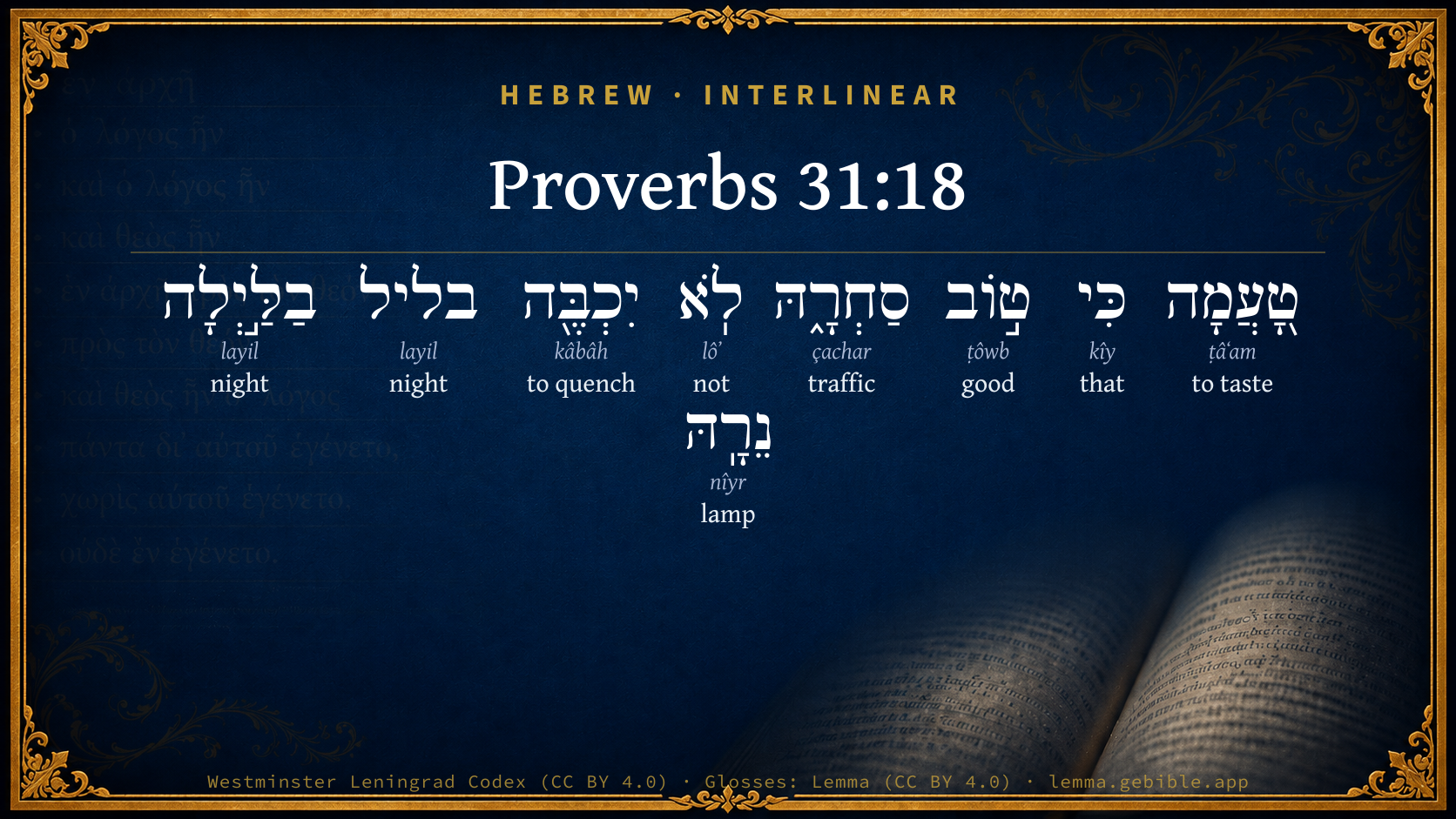
Proverbs 31:18

Hebrew (Westminster Leningrad Codex) Proverbs 31:18 appears in the Hebrew Old Testament. The text above is from the Westminster Leningrad Codex. Each word links to its Strong’s number, a concise gloss, and parsing drawn from the Open Scriptures Hebrew Bible morphology. Click any word for its full Brown-Driver-Briggs (BDB) entry.
Download image
Cite this verse

Proverbs 31:18 (World English Bible). Public Domain. Lemma interlinear Bible study tool, https://lemma.gebible.app/v/proverbs/31/18.

Show BibTeX & RIS
BibTeX
RIS
English Translation
She perceives that her merchandise is profitable. Her lamp doesn't go out by night.
World English Bible · Public Domain
Download a study sheet

One document with this verse’s original text, its word-by-word gloss line, the meaning frame, cross-references with their text, attributed commentary, and full source and license credits — printable, and it pastes into notes with its structure intact.

This verse Autodidact and up

Study sheet (.html) Plain text (.txt)

A passage Seminary Student

Up to 50 verses in one chapter. A passage sheet keeps up to 6 commentary sources and 12 cross-references per verse, in the order this page ranks them, and says so on the sheet whenever that leaves anything out. Ask for a single verse and you get the Autodidact verse sheet above.

Everything on this page stays free to read, with no account — the sheet is a download of what is already on screen, not access to it.

Want to remove ads? Support Godless Engineer
Compare translations 3

The same verse in 3 English versions, stacked beneath the original-language interlinear above. Click any original word for its lexicon entry.

Each is an independent rendering of the whole verse — the interlinear is not word-aligned to these translations.

Highlighted words mark where these versions differ — a whole-verse word diff, not a word-by-word alignment.

  • World English Bible Public Domain
    She perceives that her merchandise is profitable. Her lamp doesn't go out by night.
  • King James Version Public Domain
    She perceiveth that her merchandise is good: her candle goeth not out by night.
  • unfoldingWord Literal Text CC BY-SA 4.0
    She perceives that her profit good; her lamp does not go out in the night.

unfoldingWord Literal Text — © unfoldingWord, licensed CC BY-SA 4.0. Word-aligned USFM3 via Door43 (git.door43.org/unfoldingWord/en_ult).

Versions to compare (up to 4)

3 of 4 selected

Show all 18 translations

Every available English version of this verse, each an independent rendering of the whole verse.

  • World English Bible Public Domain
    She perceives that her merchandise is profitable. Her lamp doesn't go out by night.
  • Berean Standard Bible Public Domain
    She sees that her gain is good, and her lamp is not extinguished at night.
  • Majority Standard Bible Public Domain
    She sees that her gain is good, and her lamp is not extinguished at night.
  • King James Version Public Domain
    She perceiveth that her merchandise is good: her candle goeth not out by night.
  • American Standard Version (1901) Public Domain
    She perceiveth that her merchandise is profitable: Her lamp goeth not out by night.
  • Revised Version (1885) Public Domain
    She perceiveth that her merchandise is profitable: her lamp goeth not out by night.
  • Geneva Bible (1599) Public Domain
    She feeleth that her marchandise is good: her candle is not put out by night.
  • Douay-Rheims (1899) Public Domain
    She hath tasted and seen that her traffic is good: her lamp shall not be put out in the night.
  • Young's Literal Translation Public Domain
    She hath perceived when her merchandise `is' good, Her lamp is not extinguished in the night.
  • Literal Standard Version CC BY-SA 4.0
    She has perceived when her merchandise [is] good, || Her lamp is not extinguished in the night.
  • Unlocked Literal Bible CC BY-SA 4.0
    She perceives what will make a good profit for her; all night long her lamp is not extinguished.
  • unfoldingWord Literal Text CC BY-SA 4.0
    She perceives that her profit good; her lamp does not go out in the night.
  • Darby Bible Public Domain
    She perceiveth that her earning is good; her lamp goeth not out by night.
  • World Messianic Bible Public Domain
    She perceives that her merchandise is profitable. Her lamp doesn’t go out by night.
  • Webster's Bible Public Domain
    She perceiveth that her merchandise is good: her candle goeth not out by night.
  • Free Bible Version CC BY-SA 4.0
    She knows that the things she makes are valuable. She keeps busy—her lamp burns late into the night.
  • Bible in Basic English Public Domain
    She sees that her marketing is of profit to her: her light does not go out by night.
  • JPS Tanakh (1917) Public Domain
    She perceiveth that her merchandise is good; her lamp goeth not out by night.

Literal Standard Version (2020), Covenant Press — licensed CC BY-SA 4.0. Text via the HelloAO Bible API (eBible.org). Unlocked Literal Bible (unfoldingWord) — licensed CC BY-SA 4.0. Text via the HelloAO Bible API (eBible.org). unfoldingWord Literal Text — © unfoldingWord, licensed CC BY-SA 4.0. Word-aligned USFM3 via Door43 (git.door43.org/unfoldingWord/en_ult). Free Bible Version, Dr. Jonathan Gallagher — licensed CC BY-SA 4.0. Text via the HelloAO Bible API (eBible.org).

Word by word

More ways to search: Search by grammar → Find every occurrence → Compare this word →

Practice this passage: Drill this verse → Learn its vocabulary →

About this verse

These counts appear in no published source. They are computed here, from the morphology-tagged text and Lemma’s own curated glosses. What Lemma adds →

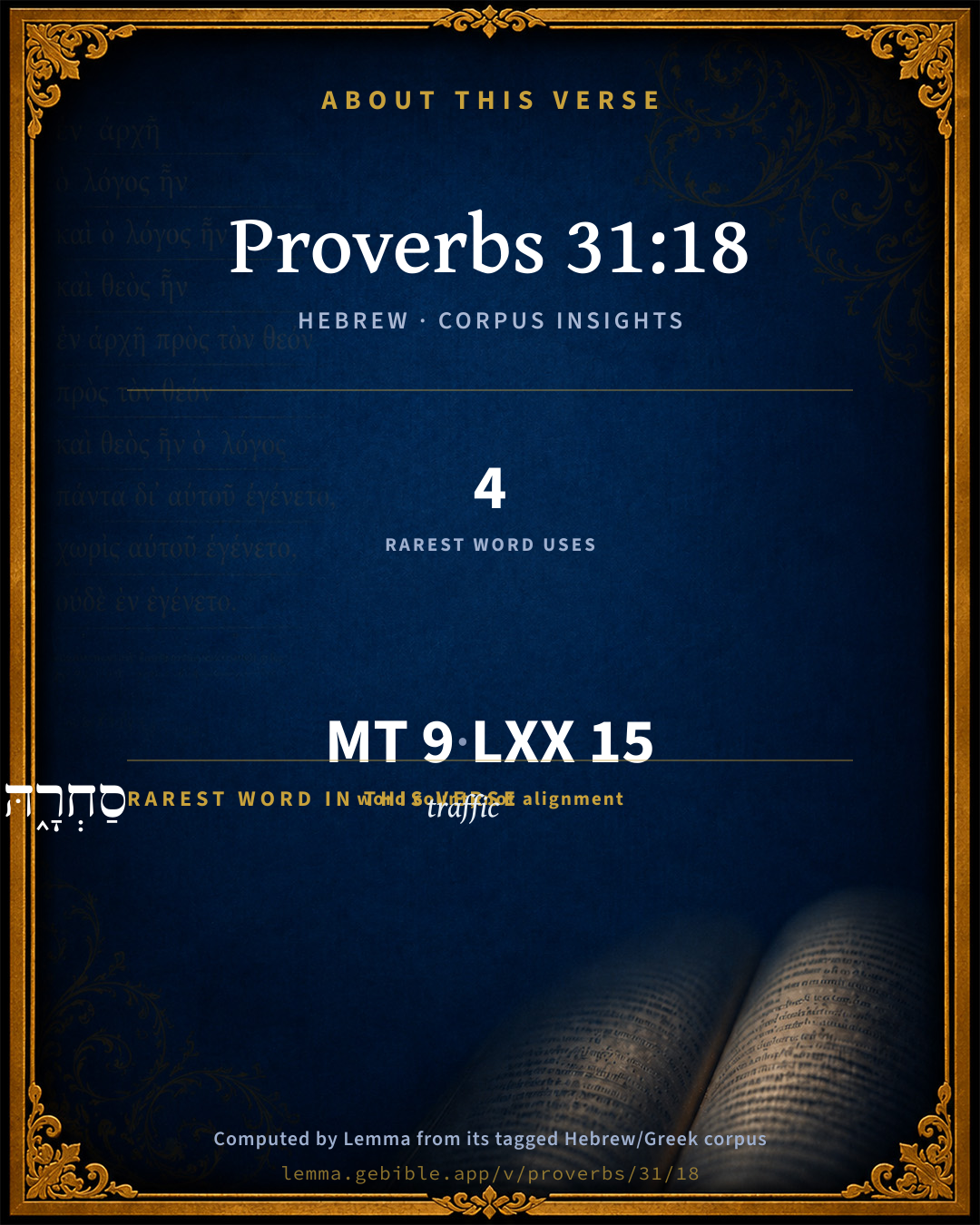
9
words
8
distinct lemmas
Wisdom
section

Notable vocabulary

The rarest word here is סַחְרָ֑הּ traffic H5504 — appearing just 4 times in the whole Hebrew Bible.

Shared distinctive vocabulary

סַחְרָ֑הּ traffic H5504 occurs in 3 verses of the Hebrew Bible. Also found in:

Grammatical profile

  • 2 verbs
  • 4 nouns
  • 1 adjective
  • 1 conjunction
  • 1 particle

Verb forms

  • טָ֭עֲמָה Qal · Perfect
  • יִכְבֶּ֖ה Qal · Imperfect

Repetition

A word recurs within this verse — often emphatic in Hebrew:

  • בליל night H3915 ×2

Hebrew & Septuagint length

In English translation the verse runs 14 words from the Hebrew and 17 from the Septuagint (LXX English) — closely comparable.

A rough comparison of the two English renderings, which tokenize alike — not a word-level alignment.

Word counts can differ between the Hebrew and the Greek without any difference in meaning — e.g. the Hebrew direct-object marker אֵת has no separate Greek word, and Greek often adds the article ὁ.

In the original languages it is 9 Hebrew tokens and 15 Greek tokens — but the two are counted differently (Hebrew bundles its prefixes and suffixes into one token; the Greek is in lemma form), so that isn’t a like-for-like length.

Cross-references

5

Topical passages linked to Proverbs 31:18 in the Treasury of Scripture Knowledge — connected by theme and wording, ordered by reader-vote popularity; previews shown in the World English Bible.

  • 1 Thessalonians 2:9 For you remember, brothers, our labor and travail; for working night and day, that we might not burden any of you, we preached to you the Gospel of God.
  • Matthew 25:3–10 Those who were foolish, when they took their lamps, took no oil with them,
  • Genesis 31:40 Thus I was; in the day the drought consumed me, and the frost by night; and my sleep fled from my eyes.
  • Psalms 127:2 It is vain for you to rise up early, To stay up late, Eating the bread of toil; For he gives sleep to his loved ones.
  • 2 Thessalonians 3:7–9 For you know how you ought to imitate us. For we didn't behave ourselves rebelliously among you,

Cross-references courtesy of OpenBible.info (CC BY 4.0).

Hebrew and Greek witnesses Masoretic Hebrew ↔ Greek Septuagint

The same verse in the two great witnesses to the Old Testament, shown verse-for-verse.

These are two independent witnesses, not word-aligned to each other, and the Septuagint is shown in lemma (dictionary) form.

Hebrew Proverbs 31:18 Masoretic · Westminster Leningrad Codex

טָ֭עֲמָה כִּי ט֣וֹב סַחְרָ֑הּ לֹֽא יִכְבֶּ֖ה בליל בַלַּ֣יְלָה נֵרָֽהּ

She perceives that her merchandise is profitable. Her lamp doesn't go out by night.

World English Bible · Public Domain

Greek LXX Proverbs 31:18 Septuagint · lemma form

γεύω ὅτι καλός εἰμί ὁ ἐργάζομαι καί οὐ ἀποσβέννυμι ὅλος ὁ νύξ ὁ λύχνος αὐτός

And she finds by experience that working is good; and her candle goes not out all night.

LXX2012 (modern English Septuagint) · Public Domain

On this verse, The Cambridge Bible for Schools and Colleges discusses the Septuagint’s reading. Read the note in Commentary ↓

Hebrew: Westminster Leningrad Codex (CC BY 4.0). Greek: Septuagint (public domain); English from LXX2012 (modern English Septuagint) (Public Domain). How the Septuagint differs from the Hebrew →

Commentary

Notes on Proverbs 31:18 from classic Christian and Jewish commentators (each source and its license shown beneath its notes). The classic Christian expositions comment on the surrounding passage and are grouped to its opening verse, so a note may address several verses; the Jewish commentaries on the Tanakh (Rashi and others) are per-verse, so they appear only where the commentator wrote on this verse.

Lemma curates 59 commentaries, every one of them public domain or Creative Commons licensed, each selected and text-cleaned for this edition rather than reprinted as found. About our sources →

Trapp's Complete Commentary

John Trapp

Pro 31:18 She perceiveth that her merchandise [is] good: her candle goeth not out by night.

Ver. 18. She perceiveth that her merchandise is good.] She feels the sweet of it, and is heartened to redouble her diligence, as a draught horse feeling his load coming, draws the harder. The good soul doth the same. For, having once tasted how sweet the Lord is, it can never have enough of him, but is carried after him with strength of desire, as the doves to their dove cotes, as the eagles to the carcases. {Psa 84:1-3} No reason would satisfy Moses, but when God had done much for him he must still have more. {Exo 33:12-19; Exo 34:9}

John Trapp, A Commentary or Exposition upon All the Books of the Old and New Testament (1647–1656) — public domain. Text from a community e-Sword module.

Adam Clarke's Commentary

Verse 18. She perceiveth that her merchandise is good]

8. She takes care to manufacture the best articles of the kind, and to lay on a reasonable price that she may secure a ready sale. Her goods are in high repute, and she knows she can sell as much as she can make. And she finds that while she pleases her customers, she increases her own profits.

9. She is watchful and careful. Her candle - her lamp, burns all night, which is of great advantage in case of sudden alarms; and in the times and places where there were so many banditti, this was a very necessary family regulation. Perhaps some works were carried on during the night, those employed sleeping in the daytime. Thus labour never stood still; whilst some slept, others worked. This was no unusual thing in ancient times; and it prevails now; but alas! little children are often thus employed to help to support their indigent parents, and to fill the coffers of their unfeeling taskmasters.

Adam Clarke's Commentary on the Bible (1810–1826) — public domain. Text from a community e-Sword/MySword module.

The Cambridge Bible for Schools and Colleges

gen. ed. J. J. S. Perowne

18. perceiveth] Lit. tasteth, A.V. margin (ἐγεύσατο, LXX.; gustavit, Vulg.), finds by experience.

good] i.e. profitable, R.V. Comp. “better than the merchandise of silver,” Pro_3:14.

her candle] Rather, lamp. To be understood literally, see Pro_31:15, not figuratively as in Pro_13:9; Pro_20:20.

The Cambridge Bible for Schools and Colleges (gen. ed. J. J. S. Perowne; Cambridge University Press, 1878–1918) — public domain. Text from a community e-Sword module.

John Gill's Exposition

She perceiveth that her merchandise is good,.... That it turns to good account; that her trading to heaven is of great advantage; that she grows rich hereby; that her merchandise with Wisdom, or Christ, is better than the merchandise of silver, and the gain thereby than fine gold; and though her voyages are attended with trouble and danger, yet are profitable, and therefore she is not discouraged, but determined to pursue them; she is like the merchant man, seeking goodly pearls, who finds a pearl of great price, worth all his trouble; See Gill on Pro 31:14 and see Pro 3:14;

her candle goeth not out by night; or "lamp" (s); her lamp of profession, which is always kept burning, Luk 12:35; or the glorious light of the Gospel, which always continues in the darkest times the church ever has been in; or her spiritual prosperity, which, though it may be damped, will never be extinct; when the candle of the wicked is often put out, Job 21:17; It may denote her diligence in working; who, as she rises early in the morning, Pro 31:15, so sits up late at night, and is never weary of well doing, night and day. Ambrose interprets it of the lamp of hope, which burns in the night, and by and for which men work, Rom 8:24.

(s) "lucerna ejus", V. L. Tigurine version, Michaelis, Schultens.

John Gill's Exposition of the Whole Bible (1746–1763) — public domain (CC PDM 1.0). Text via the HelloAO Bible API.

Haydock's Catholic Bible Commentary

Night, during a great part of which she will work.

George Leo Haydock (1774–1849), Haydock's Catholic Family Bible and Commentary, 1859 edition — public domain. Excludes Psalms (Douay-Rheims chapter numbering differs from Protestant) and Deuterocanonical books (Catholic canon only).

Matthew Poole's English Annotations

She perceiveth that her merchandise is good; she finds great comfort and good success in her labours.

Her candle goeth not out by night; which is not to be taken strictly, but only signifies her unwearied care and industry, which is oft expressed by labouring day and night, or continually.

Matthew Poole's English Annotations on the Holy Bible (1683–1685) — public domain. Text from a community e-Sword/MySword module.

Whedon's Commentary on the Bible

Daniel D. Whedon

18. She perceiveth — Literally, tastes, proves.

Her merchandise is good — Valuable, profitable, and highly appreciated, and this makes her all the more industrious; so that sometimes, at least, she works at it all night in order to supply the great demand for her goods.

Her candle — Lamp.

Goeth not out by night — Some suppose that this may be intended to mark a wise precaution against robbers or banditti, which, from time immemorial, have infested those Eastern countries. It is more probable, however, that it is intended as another mark of her extraordinary energy in accomplishing some important contract or task in the given time. When necessary she drives her work by night as well as by day.

Daniel D. Whedon (gen. ed.), Commentary on the Old and New Testaments (1874–1909) — public domain. Text from a community e-Sword module.

The Pulpit Commentary

TETH. She perceiveth that her merchandise is good; Vulgate, Gustavit et vidit quia bona est negotiatio ejus, where the paraphrase, "she tastes and sees," expresses the meaning of the verb taam here used. Her prudence and economy leave her a large surplus profit, which she contemplates with satisfaction. There is no suspicion of arrogance or conceit, The pleasure that is derived from duty done and successfully conducted business is legitimate and healthy, a providential reward of good works. Septuagint, "She tastes that it is good to work.

This comfort and success spur her on to further and more continued exertion. Her candle (lamp) goeth not out by night. She is not idle even when night falls, and outdoor occupations are cut short; she finds work for the hours of darkness, such as is mentioned in the next verse. One recalls Virgil"s picture of the thrifty housewife ("AEneid," 8:407)"Inde ubi prima quies medio jam noctis abactae Curriculo expulerat somnum, cum femina primum, Cui tolerare colo vitam tenuique Minerva Impositum, cinerem et sopitos suscitat ignis, Noctem addens operi, famulesque ad lumina longo Exercet penso.

Some take the lamp hers in an allegorical sense, as signifying life, happiness, and prosperity, as Pro_13:9 and Pro_20:20; others, as denoting a bright example of diligence and piety. (Mat_5:16) But the simple meaning seems to be the one intended. Wordsworth notes that the passage in Revelation 18, which speaks of the "merchandise" of the false Church, also affirms that "the light of a candle" shall shine in her no more, the two metaphors in our passage applied to the true Church being there applied to Babylon.

The Pulpit Commentary (1880–1919), ed. H.D.M. Spence-Jones & Joseph S. Exell — public domain. Text from a community e-Sword module.

John Wesley's Explanatory Notes

Perceiveth - She finds great comfort in her labours. Her candle - Which is not to be taken strictly, but only signifies her unwearied care and industry.

John Wesley, Explanatory Notes Upon the Whole Bible (1754–1765) — public domain. Text via the GEBible commentary corpus.

Keil & Delitzsch

C. F. Keil & F. Delitzsch

18 ט She perceiveth that her gain is good;

And her light goeth not out at night.

The perf. and fut. are related to each other as antecedent and consequent, so that 18a can also be rendered as an hypothetical antecedent. She comes to find (taste) how profitable her industry is by the experience resulting from the sale of its product: the corn, the grapes, and the wine are found to be good, and thus her gain (cf. Pro 3:14) is better, this opened new source of nourishment productive.

This spurs on her active industry to redoubled effort, and at times, when she is not fully occupied by the oversight of her fields and vineyard, she has another employment over which her light goes not out till far in the night. בּלּילה is, as at Lam 2:19, a needless Kerı̂ for the poetic בּלּיל (Isa 16:3). What other business it is to which she gives attention till in the night, is mentioned in the next verse.

Keil & Delitzsch — Biblical Commentary on the Old Testament (1861–1891) — public domain (CC PDM 1.0). Text via the HelloAO Bible API. (Old Testament only.)

unfoldingWord translationNotes

Door43 World Missions Community

perceives

sees by looking carefully

all night long her lamp is not extinguished

This is probably an exaggeration: she works late into the night, but not from dusk to dawn. AT: "She burns a lamp through the night as she works" (See: Hyperbole and Generalization and Assumed Knowledge and Implicit Information)

spindle

a thin rod or stick with pointed ends that is used in making thread

translationWords

profit

lamp

unfoldingWord translationNotes — © Distant Shores Media and the Door43 World Missions Community, licensed CC BY-SA 4.0. Source: git.door43.org/Door43/en_tn.

Lesson kit

Teaching starters — assembled from the data on this page, not authored interpretation. Every prompt links to the verse data it draws on. Edit before teaching.

Proverbs, in the Wisdom, opens this verse with 9 words (8 distinct Hebrew lemmas). Its most distinctive word is çachar (“traffic”). A historical commentator’s framing appears above. Read the whole chapter for the surrounding context.

Discussion questions

  1. How does “traffic” (çachar) shape what this verse is saying?
  2. Proverbs 3:14 shares the word «traffic» with this verse. How do the two illuminate each other?
  3. “night” occurs 2× in this one verse. What is the effect of the repetition?
  4. These translations render this verse differently; the difference is in the English rendering, not the original. What questions does that raise?
  5. The verb «טָ֭עֲמָה» is Qal Perfect. How does its form color the action?
  6. Reading how Trapp's Complete Commentary and Adam Clarke's Commentary read this verse, where do the two commentators agree and where do they part?

Things to notice

Reading settings

Reading text

Shown beneath each verse's original-language words.

Old Testament
Old Testament edition

Read the OT as the Masoretic Hebrew (MT) or the Greek Septuagint (LXX).

English shown for the Greek Septuagint (in the Hebrew ↔ Greek comparison).

Comparing translations? Open the Compare panel on any verse page to stack up to four side by side.