
Job 7:3

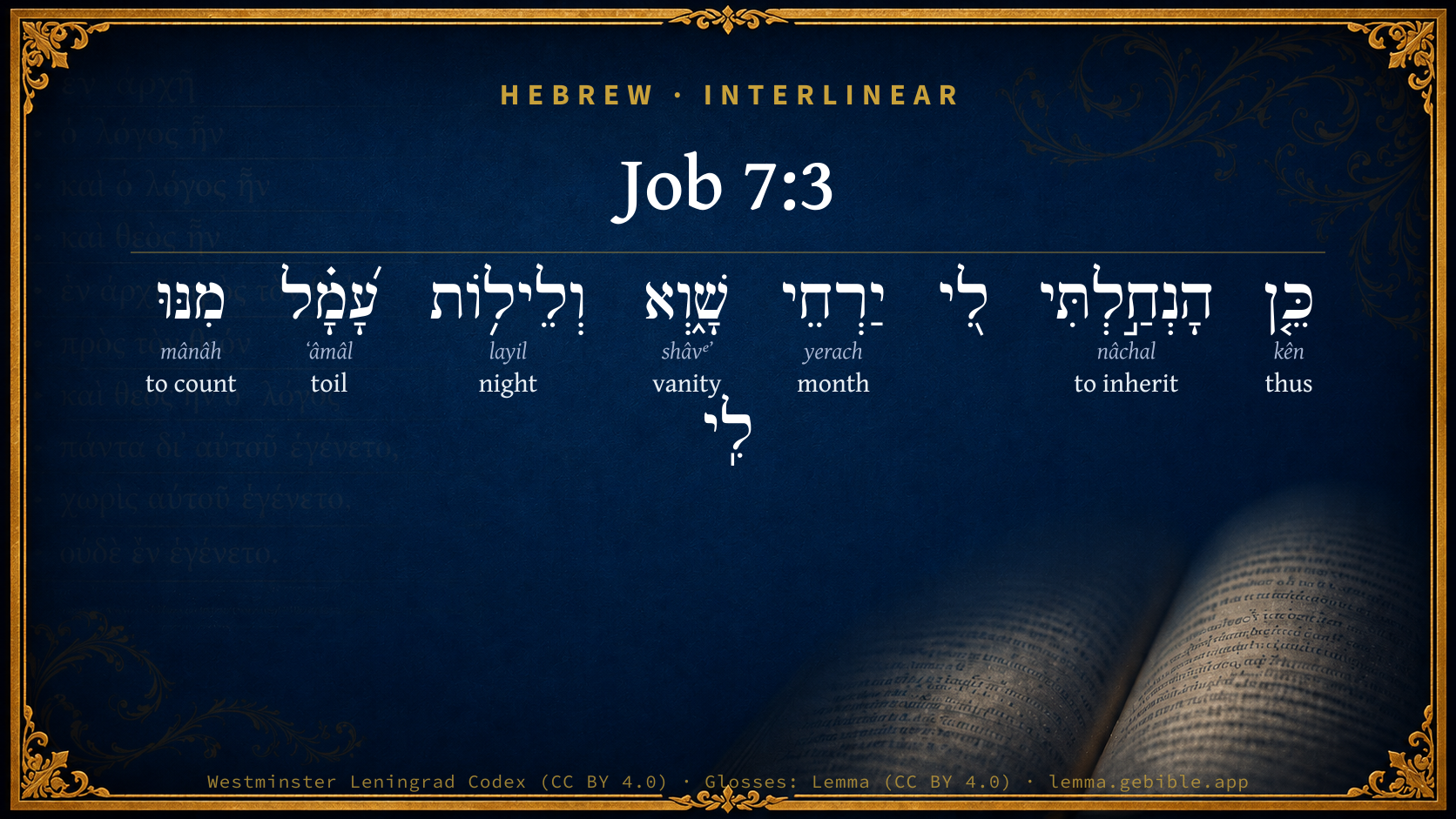
Hebrew (Westminster Leningrad Codex) Job 7:3 appears in the Hebrew Old Testament. The text above is from the Westminster Leningrad Codex. Each word links to its Strong’s number, a concise gloss, and parsing drawn from the Open Scriptures Hebrew Bible morphology. Click any word for its full Brown-Driver-Briggs (BDB) entry.
Download image
Cite this verse

Job 7:3 (World English Bible). Public Domain. Lemma interlinear Bible study tool, https://lemma.gebible.app/v/job/7/3.

Show BibTeX & RIS
BibTeX
RIS
English Translation
So am I made to possess months of misery, Wearisome nights are appointed to me.
World English Bible · Public Domain
Download a study sheet

One document with this verse’s original text, its word-by-word gloss line, the meaning frame, cross-references with their text, attributed commentary, and full source and license credits — printable, and it pastes into notes with its structure intact.

This verse Autodidact and up

Study sheet (.html) Plain text (.txt)

A passage Seminary Student

Up to 50 verses in one chapter. A passage sheet keeps up to 6 commentary sources and 12 cross-references per verse, in the order this page ranks them, and says so on the sheet whenever that leaves anything out. Ask for a single verse and you get the Autodidact verse sheet above.

Everything on this page stays free to read, with no account — the sheet is a download of what is already on screen, not access to it.

Want to remove ads? Support Godless Engineer
Compare translations 3

The same verse in 3 English versions, stacked beneath the original-language interlinear above. Click any original word for its lexicon entry.

Each is an independent rendering of the whole verse — the interlinear is not word-aligned to these translations.

Highlighted words mark where these versions differ — a whole-verse word diff, not a word-by-word alignment.

  • World English Bible Public Domain
    So am I made to possess months of misery, Wearisome nights are appointed to me.
  • King James Version Public Domain
    So am I made to possess months of vanity, and wearisome nights are appointed to me.
  • unfoldingWord Literal Text CC BY-SA 4.0
    so I have been caused to inherit months of futility, and they have appointed nights of trouble to me.

unfoldingWord Literal Text — © unfoldingWord, licensed CC BY-SA 4.0. Word-aligned USFM3 via Door43 (git.door43.org/unfoldingWord/en_ult).

Versions to compare (up to 4)

3 of 4 selected

Show all 18 translations

Every available English version of this verse, each an independent rendering of the whole verse.

  • World English Bible Public Domain
    So am I made to possess months of misery, Wearisome nights are appointed to me.
  • Berean Standard Bible Public Domain
    So I am allotted months of futility, and nights of misery are appointed me.
  • Majority Standard Bible Public Domain
    So I am allotted months of futility, and nights of misery are appointed to me.
  • King James Version Public Domain
    So am I made to possess months of vanity, and wearisome nights are appointed to me.
  • American Standard Version (1901) Public Domain
    So am I made to possess months of misery, And wearisome nights are appointed to me.
  • Revised Version (1885) Public Domain
    So am I made to possess months of vanity, and wearisome nights are appointed to me.
  • Geneva Bible (1599) Public Domain
    So haue I had as an inheritance the moneths of vanitie, and painefull nights haue bene appointed vnto me.
  • Douay-Rheims (1899) Public Domain
    So I also have had empty months, and have numbered to myself wearisome nights.
  • Young's Literal Translation Public Domain
    So I have been caused to inherit months of vanity, And nights of misery they numbered to me.
  • Literal Standard Version CC BY-SA 4.0
    So I have been caused to inherit months of vanity, || And they numbered nights of misery to me.
  • Unlocked Literal Bible CC BY-SA 4.0
    so I have been made to endure months of misery; I have been given trouble-filled nights.
  • unfoldingWord Literal Text CC BY-SA 4.0
    so I have been caused to inherit months of futility, and they have appointed nights of trouble to me.
  • Darby Bible Public Domain
    So am I made to possess months of vanity, and wearisome nights are appointed to me.
  • World Messianic Bible Public Domain
    so I am made to possess months of misery, wearisome nights are appointed to me.
  • Webster's Bible Public Domain
    So am I made to possess months of vanity, and wearisome nights are appointed to me.
  • Free Bible Version CC BY-SA 4.0
    I've been given months of emptiness and nights of misery.
  • Bible in Basic English Public Domain
    So I have for my heritage months of pain to no purpose, and nights of weariness are given to me.
  • JPS Tanakh (1917) Public Domain
    So am I made to possess — months of vanity, and wearisome nights are appointed to me.

Literal Standard Version (2020), Covenant Press — licensed CC BY-SA 4.0. Text via the HelloAO Bible API (eBible.org). Unlocked Literal Bible (unfoldingWord) — licensed CC BY-SA 4.0. Text via the HelloAO Bible API (eBible.org). unfoldingWord Literal Text — © unfoldingWord, licensed CC BY-SA 4.0. Word-aligned USFM3 via Door43 (git.door43.org/unfoldingWord/en_ult). Free Bible Version, Dr. Jonathan Gallagher — licensed CC BY-SA 4.0. Text via the HelloAO Bible API (eBible.org).

Word by word

More ways to search: Search by grammar → Find every occurrence → Compare this word →

Practice this passage: Drill this verse → Learn its vocabulary →

About this verse

These counts appear in no published source. They are computed here, from the morphology-tagged text and Lemma’s own curated glosses. What Lemma adds →

9
words
7
distinct lemmas
Wisdom
section

Notable vocabulary

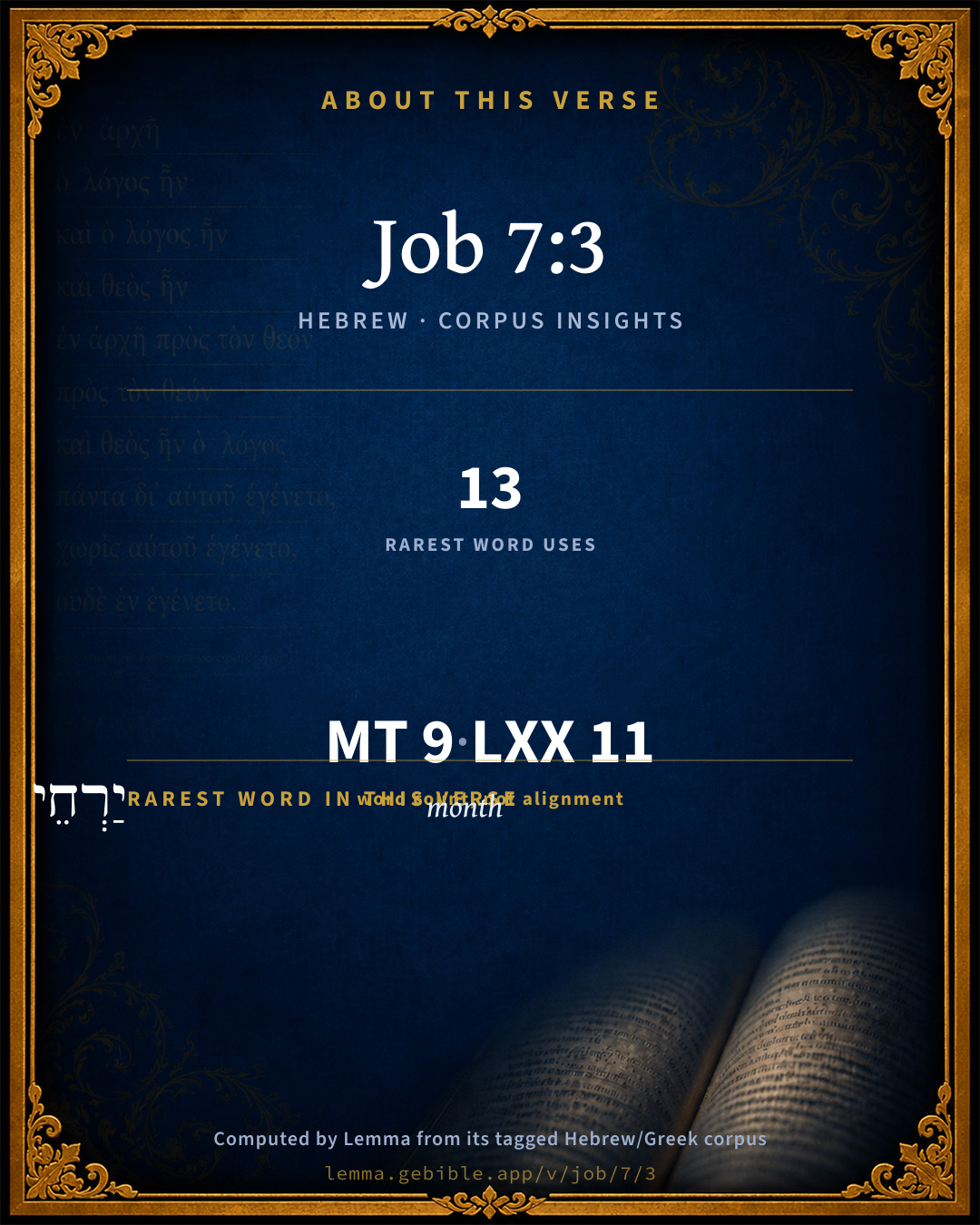
The rarest word here is יַרְחֵי month H3391 — appearing just 13 times in the whole Hebrew Bible.

Shared distinctive vocabulary

יַרְחֵי month H3391 occurs in 13 verses of the Hebrew Bible. Also found in:

Grammatical profile

  • 2 verbs
  • 4 nouns
  • 2 prepositions
  • 1 particle

Verb forms

  • הָנְחַ֣לְתִּי Hophal · Perfect
  • מִנּוּ Piel · Perfect

Hebrew & Septuagint length

In English translation the verse runs 15 words from the Hebrew and 16 from the Septuagint (LXX English) — closely comparable.

A rough comparison of the two English renderings, which tokenize alike — not a word-level alignment.

Word counts can differ between the Hebrew and the Greek without any difference in meaning — e.g. the Hebrew direct-object marker אֵת has no separate Greek word, and Greek often adds the article ὁ.

In the original languages it is 9 Hebrew tokens and 11 Greek tokens — but the two are counted differently (Hebrew bundles its prefixes and suffixes into one token; the Greek is in lemma form), so that isn’t a like-for-like length.

Cross-references

5

Topical passages linked to Job 7:3 in the Treasury of Scripture Knowledge — connected by theme and wording, ordered by reader-vote popularity; previews shown in the World English Bible.

  • Psalms 6:6 I am weary with my groaning; Every night I flood my bed; I drench my couch with my tears.
  • Ecclesiastes 1:14 I have seen all the works that are done under the sun; and, behold, all is vanity and a chasing after wind.
  • Job 16:7 But now, God, you have surely worn me out. You have made desolate all my company.
  • Job 29:2 "Oh that I were as in the months of old, As in the days when God watched over me;
  • Psalms 39:5 Behold, you have made my days handbreadths. My lifetime is as nothing before you. Surely every man stands as a breath." Selah.

Cross-references courtesy of OpenBible.info (CC BY 4.0).

Hebrew and Greek witnesses Masoretic Hebrew ↔ Greek Septuagint

The same verse in the two great witnesses to the Old Testament, shown verse-for-verse.

These are two independent witnesses, not word-aligned to each other, and the Septuagint is shown in lemma (dictionary) form.

Hebrew Job 7:3 Masoretic · Westminster Leningrad Codex

כֵּ֤ן הָנְחַ֣לְתִּי לִ֭י יַרְחֵי שָׁ֑וְא וְלֵיל֥וֹת עָ֝מָ֗ל מִנּוּ לִֽי

So am I made to possess months of misery, Wearisome nights are appointed to me.

World English Bible · Public Domain

Greek LXX Job 7:3 Septuagint · lemma form

οὕτως καΐἐγώ ὑπομένω μήν κενός νύξ δέ ὀδύνη δίδωμι ἐγώ εἰμί

So have I also endured months of vanity, and nights of pain have been appointed me.

LXX2012 (modern English Septuagint) · Public Domain

On this verse, Albert Barnes' Notes on the Bible discusses the Septuagint’s reading. Read the note in Commentary ↓

Hebrew: Westminster Leningrad Codex (CC BY 4.0). Greek: Septuagint (public domain); English from LXX2012 (modern English Septuagint) (Public Domain). How the Septuagint differs from the Hebrew →

Commentary

Notes on Job 7:3 from classic Christian and Jewish commentators (each source and its license shown beneath its notes). The classic Christian expositions comment on the surrounding passage and are grouped to its opening verse, so a note may address several verses; the Jewish commentaries on the Tanakh (Rashi and others) are per-verse, so they appear only where the commentator wrote on this verse.

Lemma curates 59 commentaries, every one of them public domain or Creative Commons licensed, each selected and text-cleaned for this edition rather than reprinted as found. About our sources →

Trapp's Complete Commentary

John Trapp

Job 7:3 So am I made to possess months of vanity, and wearisome nights are appointed to me.

Ver. 3. So am I made to possess months of vanity] So, but a great deal worse than so is it with me. The labouring servant hath his shade; the painful hireling hath his hire at the set time; but I am made to possess, or have assigned to me for mine inheritance, not days, but whole months of vanity, that is, of molestation and misery, void of the least comfort or hope of amendment. The soldier, servant, hireling, suffer hardship in hope of better; but with me it is every day worse than other; and were it not for the hope of heaven, the life I lead here would be a little hell to me. From the months of vanity here mentioned (lying months some render them, because he hoped for ease, but found none) it may be gathered that Job’s calamities lasted a long time, twelve months, say the Hebrews, seven years, saith Suidas. If we hold out faith and patience but half so long in any sort, we think ourselves worthy to be crowned and chronicled. For mouths of vanity some read empty moons; as if Job’s moon were always in the wane, or ever in the eclipse.

And wearisome nights are appointed to me] sc. By God; and that so exactly as if he had numbered them to a night. See Dan 10:1. Pondere, mensura, numero Deus omnia fecit, It is he that cutteth us out our conditions, that prepareth for us troublesome days and tiresome nights, and purposely that he may take us off from the inordinate love of life: like as by strait binding (which mortifieth and deadeneth the flesh) men are made more able to bear the cutting off of a member; so shall we take our cutting off from this world the more gently, by how much the more painful, pinching days and nights we have endured.

John Trapp, A Commentary or Exposition upon All the Books of the Old and New Testament (1647–1656) — public domain. Text from a community e-Sword module.

The Biblical Illustrator

Joseph S. Exell

Job_7:3-5

I am made to possess months of vanity.

The wasted weeks of sickness

Months of vanity indicate a protracted time of uselessness, when no good cause is furthered by us, and we ourselves seem rather to be failing in piety than growing in grace; a time of suffering without Divine consolation; months which look not even like months of discipline, because no good end seems to be served by the affliction. The modes of spiritual distress are almost as varied as the modes of spiritual progress.

I. The experience of months of vanity. We must carefully distinguish between these and months of sin, or of punishment for sin.

1. Jobs months of vanity were the result of disastrous circumstances.

2. Sickness was another factor of Jobs distress.

3. Job suffered from the injudicious sympathy of his friends. There was no lack of tenderness in these men. They were, however, wholly mistaken in the man; they wholly misread the meaning of his affliction and the purpose of God.

4. Job was in the hand of Satan. Are there not times when every woe is aggravated, and all the sufferers courage sapped by the consciousness that no help is being vouchsafed? There are powers of evil which make themselves felt, thoughts that come charged with doubt, despair, and death. These are the things that try a man, seeming to make his life valueless and his piety a dream.

II. The Divine meaning in these months of vanity. All this takes place in the providence of God. The consciousness of the sufferer is no true exponent, as his past experience is no measure of the Divine purpose.

1. These months of vanity revealed the energy of Jobs endurance. There are Christians whose mere endurance is a greater triumph of grace than the labours and successes of others.

2. See the manifest victory of Jobs faith. His utterances become more and more the utterances of faith. The manifest victory of faith becomes an enlargement of faith.

3. An enlarged thought of God was another of the fruits of Jobs months of vanity. (See the last chapter.)

4. The profound compassion and awe awakened in others by the sight of the good mans sufferings. We always need to have a new flow of sympathy, to be disturbed in our self-complacency; the tragedy of life unfolds itself to us; we are awestricken to mark Gods dealings with human souls. We learn in what a mans life consists; we watch with patience for the assured victory of the human spirit. Life becomes nobler and grander; homely piety takes on a new dignity as the infinite possibilities of the patient soul appear. (A. Mackennal, D. D.)

The design and improvement of useless days and wearisome nights

I. Useless days and wearisome nights may be the portion of the best of men. To those who, like Job, are righteous and upright in the sight of God, and have been, like him, healthy, vigorous, and useful, months of vanity are months void of health, activity, and usefulness. But this to an aged Christian is not so grievous as that there are months of vanity in which he is capable of doing little for the glory of God and the good of his fellow creatures. An ancient writer calls old age a middle state between health and sickness.

II. Months of vanity and wearisome nights are to be considered as the appointment of God and to be improved accordingly. God intends hereby--

1. To restrain an earthly spirit, and bring His people to serious consideration and piety. In order to restrain the inordinate love of the world, God is pleased to visit men with pain and sickness. He gives them time to think and consider.

2. To exercise and strengthen their graces, especially their humility, patience, meekness, and contentment. It is very difficult habitually to practise these virtues, especially if we have long enjoyed health and ease. But when God toucheth our bone and our flesh, He calls us to and disposeth us for the exercise of them.

3. To promote the good and advantage of others. It is the observation of a lively writer that God makes one-half of the human species a moral lesson to the other half. Thus He set forth Job as an example of enduring affliction and of patience.

4. To confirm their hopes and excite their desires of a blessed immortality. They tend to confirm their hopes of it. Reflections--

(1) They whose days are useful, and their nights comfortable, have great reason to be continually thankful.

(2) Learn to expect and prepare for the days of affliction.

(3) Let me exhort and comfort those who are afflicted as Job was. (Job Orton.)

On sickness

When any disease severely attacks us, we are ready to imagine that our trouble is almost peculiar to ourselves; attended with circumstances which have never been before experienced. So we think, but we are deceived. The same complaint has been formerly made; others have exceeded us in sufferings, as much as they have excelled us in patience and piety. There are disorders which make our beds uneasy. Some circumstances render the night particularly tedious to those who are sick.

1. Its darkness. Light is sweet.

2. Its solitariness. In the day the company and conversation of friends help to beguile the time. At night we are left alone.

3. Its confinement. In the day change of place and posture afford temporary relief. At night we are shut up, as it were, in a prison.

4. Its wakefulness. If we could get sleep we should welcome it as a very desirable blessing. It would render us, for a time, insensible to pain. Sometimes we cannot sleep. Suggest some useful reflections--

(1) Be thankful for former mercies.

(2) Be humbled for former sins. Observe the latter part of the text. Our disorders may be not only painful to ourselves, but offensive to those who are near us. Then be not proud of your bodies. Never boast of their strength or their complexion; for both may be destroyed by a short fit of sickness. Learn the much greater loathsomeness of sin. And rejoice in the prospect of having better bodies hereafter. (S. Lavington.)

The Biblical Illustrator, edited by Joseph S. Exell (c. 1880s–1900s) — public domain. Text from a community e-Sword module.

Joseph Benson's Commentary

Job 7:3. So am I made to possess, &c. — This word, so, respects not so much the desire of a hired servant, as the cause of it, his hard toil and service. He means, God hath allotted me these painful sufferings, as he hath allotted to a hired servant hard labour. Months of vanity — Months empty and unsatisfying, or false and deceitful, not affording me the ease and rest which they promised me, and I expected. He terms them months, rather than days, to signify the tediousness of his affliction. And wearisome nights — He mentions nights, because that is the saddest time for sick and miserable persons; the darkness and solitude of the night being of themselves uncomfortable, and giving them more opportunity for solemn and sorrowful reflections.

Joseph Benson's Commentary on the Old and New Testaments (1811–1818) — public domain. Text from a community e-Sword module.

Tyndale Open Study Notes

Tyndale Open Resources

7:3 Job’s trial might already have gone on for months. • The Hebrew term (‘amal) that runs throughout Job is translated as “misery/miserable” (3:20; 11:16; 16:2; 20:22) or as “trouble” (3:10; 4:8; 5:6, 7; 15:35).

Tyndale Open Study Notes — © Tyndale Open Resources, licensed CC BY-SA 4.0. Text via the HelloAO Bible API.

Geneva Bible (1599)

Geneva Bible translators

My sorrow hath continued from month to month, and I have looked for hope in vain.

Geneva Bible (1599) marginal notes — public domain. Text via Bolls.life.

Jamieson, Fausset & Brown

Robert Jamieson, A. R. Fausset & David Brown

--Months of comfortless misfortune.

I am made to possess--literally, "to be heir to." Irony. "To be heir to," is usually a matter of joy; but here it is the entail of an involuntary and dismal inheritance.

Months--for days, to express its long duration.

Appointed--literally, "they have numbered to me"; marking well the unavoidable doom assigned to him.

Jamieson, Fausset & Brown — Commentary Critical and Explanatory on the Whole Bible (1871) — public domain (CC PDM 1.0). Text via the HelloAO Bible API.

Adam Clarke's Commentary

Verse 3. So am I made to possess] But night is no relief to me, it is only a continuance of my anxiety and labour. I am like the hireling, I have my appointed labour for the day. I am like the soldier harassed by the enemy: I am obliged to be continually on the watch, always on the look out, with scarcely any rest.

Adam Clarke's Commentary on the Bible (1810–1826) — public domain. Text from a community e-Sword/MySword module.

The Cambridge Bible for Schools and Colleges

gen. ed. J. J. S. Perowne

3. made to possess] lit. made to inherit. They are laid on him by the will of another. Job narrows his view here from the lot of men in general to his own. He is one of an afflicted race, but the universal misery does not alleviate his own, it rather increases it.

That loss is common would not make

My own less bitter, rather more;

Too common! Never morning wore

To evening, but some heart did break.

A sorrowing Arab poet gives expression to a different feeling:

Did not a common sorrow console me I would not live an hour among men,

But whenever I will, they in like condition with myself respond to me.

Hamasa, p. 389, 396.

The point of comparison between Job’s life and the day of the hireling lies in their common toil and their common longing for the end of it. Job describes his day as “months of vanity” and “nights of trouble,” indicating that his disease had already endured a long time. He refers to “nights” perhaps because his pains were severest then (cf. Job_7:4; Job_7:14, ch. Job_30:17); although in the East the method also of counting by nights instead of days was common.

The Cambridge Bible for Schools and Colleges (gen. ed. J. J. S. Perowne; Cambridge University Press, 1878–1918) — public domain. Text from a community e-Sword module.

John Gill's Exposition

So am I made to possess months of vanity,.... This is not a reddition or application of the above similes of the servant and hireling, Job 7:1; for that is to be understood, and to be supplied at the end of Job 7:2; that as those looked for the shadow and payment of hire, so Job looked for and earnestly desired death, or to be removed out of the world; besides, the things here instanced in do not answer; for Job, instead of having the refreshing shadow, had months of vanity, and instead of rest from his labours had nothing but wearisome nights, and continual tossings to and fro; whereas the sleep of a labouring man is sweet to him; and having laboured hard all day, the night is a time of rest to him; but so it was not with Job; wherefore this "so" refers to the common state and condition of mankind, in which Job was, with an addition of extraordinary afflictions upon him: the time of his afflictions, though but short, seemed long, and therefore is expressed by months; and some months might have passed from the time his calamities began to the present; since it must be some time before his friends heard of them, and more still before they could meet together and agree upon their coming, and were actually come to him; as also some time was spent in silence, and now in conversation with him; the Jews (p) make them to be twelve months: and these months were "months of vanity", or "empty" (q) ones; such as winter months, empty of all joy, and peace, and comfort; times in which he had no pleasure, no ease of body or of mind; destitute of the good things of life, and of the presence of God and communion with him; and full of trouble, sorrow, and distress: and these were "given him for an inheritance" (r); were his lot and portion, which he received as an inheritance from his parents, in consequence of original sin, the source of all the troubles and miseries of human life, in common with other men; and which were allotted him by his heavenly Father, according to his sovereign will and pleasure, as all the afflictions of the Lord's people are the inheritance bequeathed them by their Father, and the legacy of their Redeemer:

and wearisome nights are appointed to me; one after another, in succession; in which he could have no sleep nor rest, through pain of body and distress of mind; and so became the more weary, through long lying down and tossings to and fro, through groans and tears, and much watching; and these were prepared for him in the purposes of God, and appointed to him in his counsels and decrees; see Job 23:14; or they "prepared" or "appointed" (s); that is, "Elohim", the three Divine Persons.

(p) Vid. Misn. Ediot, c. 2. sect. 10. & R. Simeon Bar Tzemach, in loc. (q) "menses vacuos", V. L. so Tigurine version, Michaelis. (r) "accepi hereditate", Pagninus, Montanus, Bolducius; so Cocceius, Schmidt, Schultens. (s) "constituerunt mihi", Pagninus, Bolducius; "mihi paraverunt", Mercerus; so Schmidt, Cocceius, Schultens.

John Gill's Exposition of the Whole Bible (1746–1763) — public domain (CC PDM 1.0). Text via the HelloAO Bible API.

Albert Barnes' Notes on the Bible

So am I made to possess - Hebrew I am made to inherit. The meaning is, that such sad and melancholy seasons now were his only portion.

Months of vanity - That is, months which were destitute of comfort; in other words, months of affliction. How long his trials had continued before this, we have no means of ascertaining. There is no reason, however, to suppose that his bodily sufferings came upon him all at once, or that they had not continued for a considerable period. It is quite probable that his expressions of impatience were the result not only of the intensity, but the continuance of his sorrows.

And wearisome nights are appointed to me - Even his rest was disturbed. The time when care is usually forgotten and toil ceases, was to him a period of sleepless anxiety and distress - עמל ‛âmâl. The Septuagint renders it, nights of pangs (νύκτες ὀδυνῶν nuktes odunōn), expressing accurately the sense of the Hebrew. The Hebrew word עמל ‛âmâl is commonly applied to intense sorrow, to trouble and pain of the severest kind, such as the pains of parturition; see the notes at Isa 53:11.

Albert Barnes' Notes on the Bible (1834–1885) — public domain. Text from a community e-Sword/MySword module.

Haydock's Catholic Bible Commentary

And have. Hebrew, "they have appointed for me." (Calmet) --- God treats me with more severity, as even the night is not a time of rest for me, and my months of service are without any present recompense. (Haydock)

George Leo Haydock (1774–1849), Haydock's Catholic Family Bible and Commentary, 1859 edition — public domain. Excludes Psalms (Douay-Rheims chapter numbering differs from Protestant) and Deuterocanonical books (Catholic canon only).

Matthew Poole's English Annotations

This so respects not so much the desire and expectation of a hired servant, which is expressed Job 7:2, as the ground and reason of it, which is plainly implied there, to wit, his hard toil and service, which makes him thirst after rest.

I am made to possess; God, by his sovereign power and providence, hath given me this as my lot and inheritance. Months; so he calls them rather than days, to note either the irksomeness and tediousness of his affliction, whereby every day seemed a month to him; or their length and continuance, which, as some infer from hence, had now been upon him some months.

Of vanity; empty and unsatisfying, or false and deceitful, not giving me that ease and rest which they promised me, and I expected.

Wearisome nights: he mentions nights, because that is the saddest time for sick and miserable persons; the darkness and solitude of the night being of themselves uncomfortable, and giving them more opportunity for solemn and sorrowful thoughts and reflections upon their own miseries.

Matthew Poole's English Annotations on the Holy Bible (1683–1685) — public domain. Text from a community e-Sword/MySword module.

Whedon's Commentary on the Bible

Daniel D. Whedon

3. Months of vanity — The misery, שׁוא, (not “vanity.”) that he is made to inherit month after month, is the pivot of the comparison. As a slave suffers and desires rest, so does Job. The suffering of the former is for a day, followed by its inseparable sweet night of repose; but Job’s misery is for months, with the ever-recurring nights, not of repose, but of distress. Job frequently refers to the night as the season when his sufferings culminated. This leads to the poetical culmination in “nights” rather than in “months.” The Arabs count their time by nights rather than by days. Job’s sufferings had evidently been long protracted before the friends came upon the scene.

Are appointed — They appoint, or number out. The agent, as in many other similar cases, Job leaves unmentioned. Compare Job_4:18-19 : “they crush:” Job_18:18. “They shall drive him from light to darkness.” Also Job_19:26; Job_34:20. Dr. Tayler Lewis argues, in loc., that the real or supposed agent is some fearful or repulsive being, whom Job on this account dreads to mention. The grammarians, on the other hand, lay down that such forms of the verb may be used indefinitely. See Nordheimer, ii, p. 46.

Daniel D. Whedon (gen. ed.), Commentary on the Old and New Testaments (1874–1909) — public domain. Text from a community e-Sword module.

The Pulpit Commentary

So am I made to possess months of vanity. "Months of vanity" are "months of which he can make no use which are no good to him." It has been concluded from this theft some considerable time had elapsed since Job was stricken by his disease. But he is perhaps looking to the future as much as to the past, anticipating a long, lingering illness. Elephantiasis is a disease which often lasts for years. And wearisome nights are appointed to me. To one stretched on a bed of sickness, the night is always more wearisome than the day. It has no changes, nothing to mark its flight. It seems almost interminable. In elephantiasis, however, it is a special feature of the disease that the sufferings of the patient are greatest at night. "In elephantiasis ansesthetica says Dr. Erasmus Wilson, "a sense of dullness and heat pervades the surface, and there are sensations of tingling and prickling, and of burning heat. While the integument is insensible, there are deep-seated burning pains, sometimes of a bone or joint, sometimes of the vertebral column. These pains are greatest at night; they prevent sleep, and give rise to restlessness and frightful dreams" (Quain"s "Dictionary of Medicine," vol. 1. p. 817).

The Pulpit Commentary (1880–1919), ed. H.D.M. Spence-Jones & Joseph S. Exell — public domain. Text from a community e-Sword module.

John Wesley's Explanatory Notes

So - This so respects not so much the desire of an hired servant, as the ground of it, his hard toil and service. Possess - God, hath given me this as my lot and inheritance. Months - So he calls them rather than days, to note the tediousness of his affliction. Vanity - Empty and unsatisfying. Nights - He mentions nights, because that is the saddest time for sick and miserable persons; the darkness and solitude of the night being of themselves uncomfortable, and giving them more opportunity for solemn and sorrowful reflections.

John Wesley, Explanatory Notes Upon the Whole Bible (1754–1765) — public domain. Text via the GEBible commentary corpus.

Rashi

Rabbi Shlomo Yitzchaki (Rashi)

So was I made to possess from Heaven months of futility and torments, that limited time that is given to man upon earth.

and they appointed wearisome nights for me from Heaven

Rashi on the Tanakh — English translations: “The Judaica Press complete Tanach with Rashi, translated by A. J. Rosenberg” (CC BY 4.0); “Pentateuch with Rashi's commentary by M. Rosenbaum and A.M. Silbermann, 1929-1934” (public domain); “The Metsudah Tanach series, Lakewood, N.J” (CC BY 4.0); and “The Book of Joshua, Metsudah Publications, 1997” (CC BY 4.0). Text via Sefaria.

Lesson kit

Teaching starters — assembled from the data on this page, not authored interpretation. Every prompt links to the verse data it draws on. Edit before teaching.

Job, in the Wisdom, opens this verse with 9 words (7 distinct Hebrew lemmas). Its most distinctive word is yerach (“month”). A historical commentator’s framing appears above. Read the whole chapter for the surrounding context.

Discussion questions

  1. What does “month” (yerach) contribute to the verse as a whole?
  2. How does Exodus 2:2, which shares the word «month», read alongside this verse?
  3. The translations on this page render this verse differently — a whole-verse word diff, not a word-by-word alignment. What might account for the different wordings?
  4. «הָנְחַ֣לְתִּי» is a Hophal Perfect verb. How does that grammatical form shape the action described?
  5. Compare how Trapp's Complete Commentary and The Biblical Illustrator read this verse. Where do they agree or differ?

Things to notice

Reading settings

Reading text

Shown beneath each verse's original-language words.

Old Testament
Old Testament edition

Read the OT as the Masoretic Hebrew (MT) or the Greek Septuagint (LXX).

English shown for the Greek Septuagint (in the Hebrew ↔ Greek comparison).

Comparing translations? Open the Compare panel on any verse page to stack up to four side by side.