Job 3:6

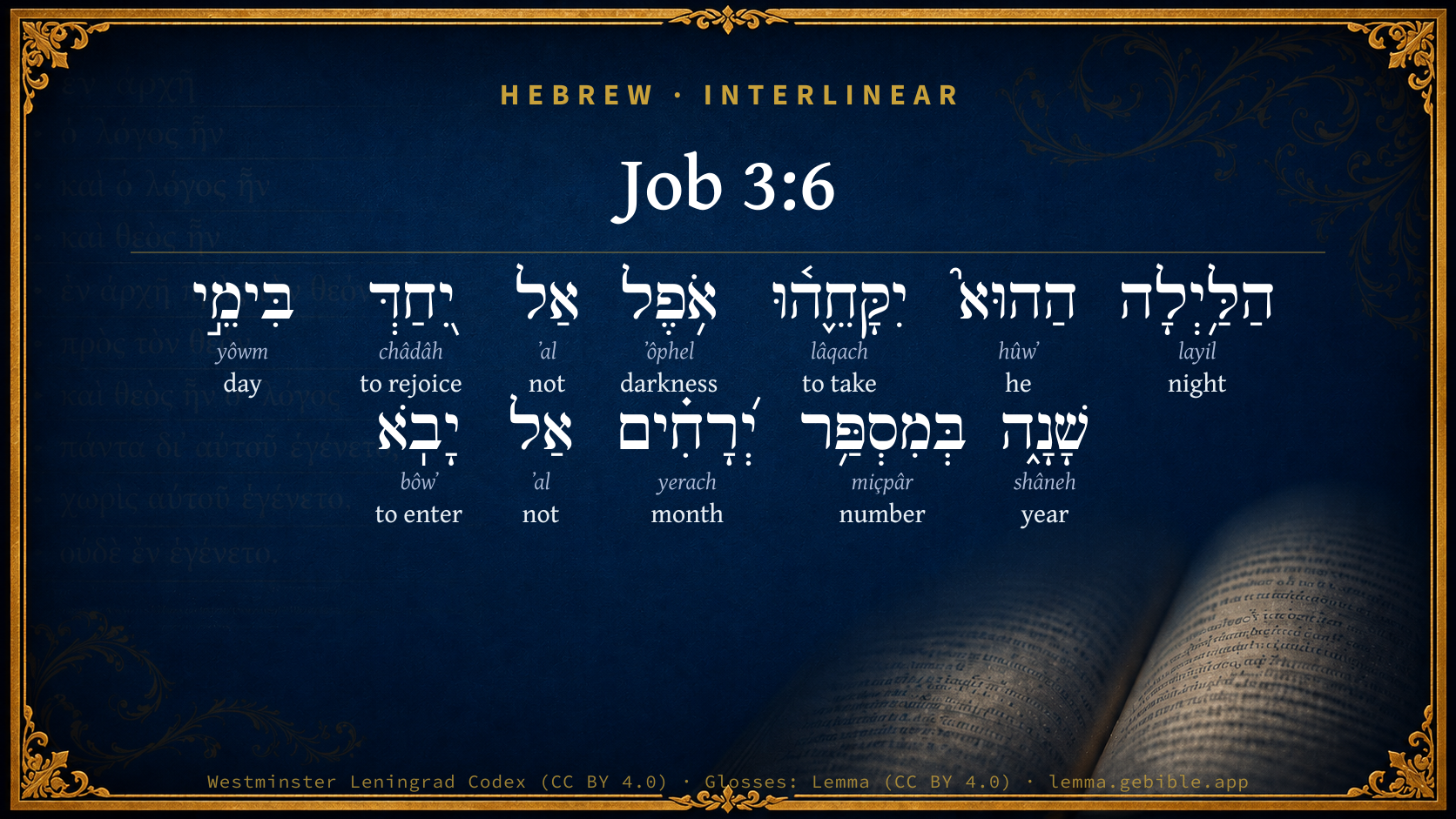
Hebrew (Westminster Leningrad Codex) Job 3:6 appears in the Hebrew Old Testament. The text above is from the Westminster Leningrad Codex. Each word links to its Strong’s number, a concise gloss, and parsing drawn from the Open Scriptures Hebrew Bible morphology. Click any word for its full Brown-Driver-Briggs (BDB) entry.
Download image
Cite this verse

Job 3:6 (World English Bible). Public Domain. Lemma interlinear Bible study tool, https://lemma.gebible.app/v/job/3/6.

Show BibTeX & RIS
BibTeX
RIS
English Translation
As for that night, let thick darkness seize on it. Let it not rejoice among the days of the year. Let it not come into the number of the months.
World English Bible · Public Domain
Highlights
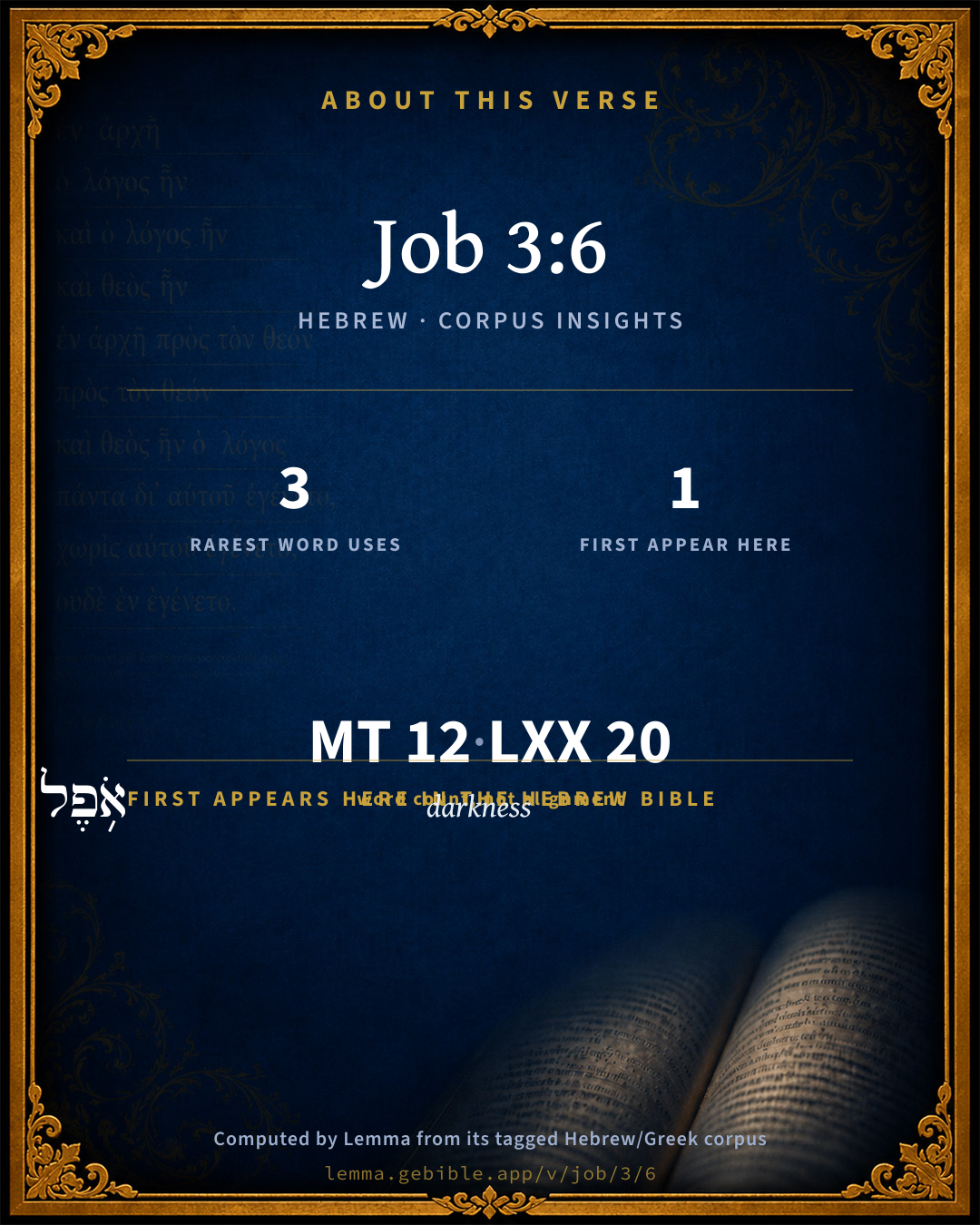
  • 1 first appearance in the Hebrew Bible
Full analysis ↓
Download a study sheet

One document with this verse’s original text, its word-by-word gloss line, the meaning frame, cross-references with their text, attributed commentary, and full source and license credits — printable, and it pastes into notes with its structure intact.

This verse Autodidact and up

Study sheet (.html) Plain text (.txt)

A passage Seminary Student

Up to 50 verses in one chapter. A passage sheet keeps up to 6 commentary sources and 12 cross-references per verse, in the order this page ranks them, and says so on the sheet whenever that leaves anything out. Ask for a single verse and you get the Autodidact verse sheet above.

Everything on this page stays free to read, with no account — the sheet is a download of what is already on screen, not access to it.

Want to remove ads? Support Godless Engineer
Compare translations 3

The same verse in 3 English versions, stacked beneath the original-language interlinear above. Click any original word for its lexicon entry.

Each is an independent rendering of the whole verse — the interlinear is not word-aligned to these translations.

Highlighted words mark where these versions differ — a whole-verse word diff, not a word-by-word alignment.

  • World English Bible Public Domain
    As for that night, let thick darkness seize on it. Let it not rejoice among the days of the year. Let it not come into the number of the months.
  • King James Version Public Domain
    As for that night, let darkness seize upon it; let it not be joined unto the days of the year, let it not come into the number of the months.
  • unfoldingWord Literal Text CC BY-SA 4.0
    That night—may gloom take it! May it not rejoice among the days of the year; into the number of the months may it not come.

unfoldingWord Literal Text — © unfoldingWord, licensed CC BY-SA 4.0. Word-aligned USFM3 via Door43 (git.door43.org/unfoldingWord/en_ult).

Versions to compare (up to 4)

3 of 4 selected

Show all 18 translations

Every available English version of this verse, each an independent rendering of the whole verse.

  • World English Bible Public Domain
    As for that night, let thick darkness seize on it. Let it not rejoice among the days of the year. Let it not come into the number of the months.
  • Berean Standard Bible Public Domain
    If only darkness had taken that night away! May it not appear among the days of the year; may it never be entered in any of the months.
  • Majority Standard Bible Public Domain
    If only darkness had taken that night away! May it not appear among the days of the year; may it never be entered in any of the months.
  • King James Version Public Domain
    As for that night, let darkness seize upon it; let it not be joined unto the days of the year, let it not come into the number of the months.
  • American Standard Version (1901) Public Domain
    As for that night, let thick darkness seize upon it: Let it not rejoice among the days of the year; Let it not come into the number of the months.
  • Revised Version (1885) Public Domain
    As for that night, let thick darkness seize upon it: let it not rejoice among the days of the year; let it not come into the number of the months.
  • Geneva Bible (1599) Public Domain
    Let darkenesse possesse that night, let it not be ioyned vnto the dayes of the yeere, nor let it come into the count of the moneths.
  • Douay-Rheims (1899) Public Domain
    Let a darksome whirlwind seize upon that night, let it not be counted in the days of the year, nor numbered in the months.
  • Young's Literal Translation Public Domain
    That night -- let thick darkness take it, Let it not be united to days of the year, Into the number of months let it not come.
  • Literal Standard Version CC BY-SA 4.0
    That night—let thick darkness take it, || Let it not be united to days of the year, || Let it not come into the number of months.
  • Unlocked Literal Bible CC BY-SA 4.0
    As for that night, may thick darkness seize it. May it not rejoice among the days of the year; may it not come into the number of the months.
  • unfoldingWord Literal Text CC BY-SA 4.0
    That night—may gloom take it! May it not rejoice among the days of the year; into the number of the months may it not come.
  • Darby Bible Public Domain
    That night -- let gloom seize upon it; let it not rejoice among the days of the year; let it not come into the number of the months.
  • World Messianic Bible Public Domain
    As for that night, let thick darkness seize on it. Let it not rejoice among the days of the year. Let it not come into the number of the months.
  • Webster's Bible Public Domain
    As for that night, let darkness seize upon it; let it not be joined to the days of the year, let it not come into the number of the months.
  • Free Bible Version CC BY-SA 4.0
    Blot out that night as if it never existed. Don't count it on the calendar. Don't let it have a day in any month.
  • Bible in Basic English Public Domain
    That night--let the thick dark take it; let it not have joy among the days of the year; let it not come into the number of the months.
  • JPS Tanakh (1917) Public Domain
    As for that night, let thick darkness seize upon it; let it not rejoice among the days of the year; let it not come into the number of the months.

Literal Standard Version (2020), Covenant Press — licensed CC BY-SA 4.0. Text via the HelloAO Bible API (eBible.org). Unlocked Literal Bible (unfoldingWord) — licensed CC BY-SA 4.0. Text via the HelloAO Bible API (eBible.org). unfoldingWord Literal Text — © unfoldingWord, licensed CC BY-SA 4.0. Word-aligned USFM3 via Door43 (git.door43.org/unfoldingWord/en_ult). Free Bible Version, Dr. Jonathan Gallagher — licensed CC BY-SA 4.0. Text via the HelloAO Bible API (eBible.org).

Word by word

More ways to search: Search by grammar → Find every occurrence → Compare this word →

Practice this passage: Drill this verse → Learn its vocabulary →

יִ֭חַדְּ
châdâh
H2302
“to rejoice”
Verb, Qal, Jussive, 3rd Person, Masculine, Singular
Part of Speech
Verb
Stem
Qal
Form
Jussive
Person
3rd Person
Gender
Masculine
Number
Singular
Full BDB Definition

Origin: a primitive root

TWOT: 607

to rejoice - (Qal) to rejoice - (Piel) to make glad, gladden
  1. הַלַּ֥יְלָה layil H3915 “the · night” Particle, Definite Article + Noun, Common, Masculine, Singular, Absolute
  2. הַהוּא֮ hûwʼ H1931 “the · he” Particle, Definite Article + Pronoun, Personal, 3rd Person, Masculine, Singular
  3. יִקָּחֵ֪ה֫וּ lâqach H3947 “to take · him” Verb, Qal, Imperfect, 3rd Person, Masculine, Singular + Suffix, Personal, 3rd Person, Masculine, Singular
  4. אֹ֥פֶל ʼôphel H652 “darkness” Noun, Common, Masculine, Singular, Absolute
  5. אַל ʼal H408 “not” Particle, Negative
  6. בִּימֵ֣י yôwm H3117 “in/at · days of” Preposition + Noun, Common, Masculine, Plural, Construct
  7. שָׁנָ֑ה shâneh H8141 “year” Noun, Common, Feminine, Singular, Absolute
  8. בְּמִסְפַּ֥ר miçpâr H4557 “in/at · number of” Preposition + Noun, Common, Masculine, Singular, Construct
  9. יְ֝רָחִ֗ים yerach H3391 “months” Noun, Common, Masculine, Plural, Absolute
  10. אַל ʼal H408 “not” Particle, Negative
  11. יָבֹֽא bôwʼ H935 “to enter” Verb, Qal, Jussive, 3rd Person, Masculine, Singular

About this verse

These counts appear in no published source. They are computed here, from the morphology-tagged text and Lemma’s own curated glosses. What Lemma adds →

12
words
11
distinct lemmas
Wisdom
section

Notable vocabulary

The rarest word here is יִ֭חַדְּ to rejoice H2302 — appearing just 3 times in the whole Hebrew Bible.

First appearance in Scripture

This word makes its first canonical appearance in the Hebrew Bible here:

  • אֹ֥פֶל darkness H652

Shared distinctive vocabulary

יִ֭חַדְּ to rejoice H2302 occurs in 3 verses of the Hebrew Bible. Also found in:

Grammatical profile

  • 3 verbs
  • 6 nouns
  • 1 pronoun
  • 2 particles

Verb forms

  • יִקָּחֵ֪ה֫וּ Qal · Imperfect
  • יִ֭חַדְּ Qal · Jussive
  • יָבֹֽא Qal · Jussive

Repetition

A word recurs within this verse — often emphatic in Hebrew:

  • אַל not H408 ×2

Hebrew & Septuagint length

In English translation the verse runs 30 words from the Hebrew and 33 from the Septuagint (LXX English) — closely comparable.

A rough comparison of the two English renderings, which tokenize alike — not a word-level alignment.

Word counts can differ between the Hebrew and the Greek without any difference in meaning — e.g. the Hebrew direct-object marker אֵת has no separate Greek word, and Greek often adds the article ὁ.

In the original languages it is 12 Hebrew tokens and 20 Greek tokens — but the two are counted differently (Hebrew bundles its prefixes and suffixes into one token; the Greek is in lemma form), so that isn’t a like-for-like length.

Hebrew and Greek witnesses Masoretic Hebrew ↔ Greek Septuagint

The same verse in the two great witnesses to the Old Testament, shown verse-for-verse.

These are two independent witnesses, not word-aligned to each other, and the Septuagint is shown in lemma (dictionary) form.

Hebrew Job 3:6 Masoretic · Westminster Leningrad Codex

הַלַּ֥יְלָה הַהוּא֮ יִקָּחֵ֪ה֫וּ אֹ֥פֶל אַל יִ֭חַדְּ בִּימֵ֣י שָׁנָ֑ה בְּמִסְפַּ֥ר יְ֝רָחִ֗ים אַל יָבֹֽא

As for that night, let thick darkness seize on it. Let it not rejoice among the days of the year. Let it not come into the number of the months.

World English Bible · Public Domain

Greek LXX Job 3:6 Septuagint · lemma form

καταἀράομαι ὁ ἡμέρα καί ὁ νύξ ἐκεῖνος ἀποφέρω αὐτός σκότος μή εἰμί εἰς ἡμέρα ἐνιαυτός μηδέ ἀριθμέω εἰς ἡμέρα μήν

let that day and night be cursed, let darkness carry them away; let it not come into the days of the year, neither let it be numbered with the days of the months.

LXX2012 (modern English Septuagint) · Public Domain

On this verse, The Pulpit Commentary discusses the Septuagint’s reading. Read the note in Commentary ↓

Hebrew: Westminster Leningrad Codex (CC BY 4.0). Greek: Septuagint (public domain); English from LXX2012 (modern English Septuagint) (Public Domain). How the Septuagint differs from the Hebrew →

Commentary

Notes on Job 3:6 from classic Christian and Jewish commentators (each source and its license shown beneath its notes). The classic Christian expositions comment on the surrounding passage and are grouped to its opening verse, so a note may address several verses; the Jewish commentaries on the Tanakh (Rashi and others) are per-verse, so they appear only where the commentator wrote on this verse.

Lemma curates 59 commentaries, every one of them public domain or Creative Commons licensed, each selected and text-cleaned for this edition rather than reprinted as found. About our sources →

Trapp's Complete Commentary

John Trapp

Job 3:6 As [for] that night, let darkness seize upon it; let it not be joined unto the days of the year, let it not come into the number of the months.

Ver. 6. As for that night, let darkness seize upon it] Having spent his spleen upon the day, he now vents himself upon the night, according to that division, Job 3:8. As for that night of mine unhappy conception, or birth, let tenebrosus turbo (as the Vulgate here hath it), a dark tempest, or a tempestuous darkness, grasp it, or invade it; let it be as dark as pitch, by a darkness superadded to its natural darkness, Caligo perpetua et inusitata (Mercer).

Let it not be joined unto the days of the year] Let nature quite disclaim it, and disjoint it from the day following; let it not be reckoned as any part of time, that measure of all our motions. Some render it, Ne gaudeat inter dies, Let it not rejoice itself among the days of the year, as one of them. The night hath glory by union with the day; this he wisheth taken from it. Disunion and division is a curse; and the number of two hath been accounted accursed, because it was the first that departed from unity.

And let it not come into the number of months] Deleatur e calendario, let it be razed out of the calendar, and not have any place in the computation of time. The Hebrews call the moon and a month by the same name; because the moon is renewed every month, So μην, month, and μηνη, moon.

John Trapp, A Commentary or Exposition upon All the Books of the Old and New Testament (1647–1656) — public domain. Text from a community e-Sword module.

Joseph Benson's Commentary

Job 3:6. As for that night, let darkness seize upon it — Constant and extraordinary darkness, without the least glimmering of light from the moon or stars; darkness to the highest degree possible. Thus, as Job had thrown out his resentment against the day in which he was both, so now the severity of his censure falls on his birth-right; and his style, we find, increases and grows stronger. Our translation, indeed, makes no difference in the expression of darkness; namely, “Let that day be darkness; as for that night, let darkness seize upon it.” But the Hebrew is very different: for חשׁךְ, choshec, is applied to the day, and אפל, ophel, to the night, which latter word signifies a much greater degree of darkness than the former. See Joe 2:2; in the Hebrew, where the latter word, אפלה, ophelah, means thick and terrible darkness. Let it not be joined unto the days of the year — Reckoned as one, or a part of one of them. Or rather, Let it not rejoice among the days, &c., for יחד, jechad, from חדה, chadah, lætari, to rejoice, may properly be so rendered. Joy here, and terror Job 3:5, are poetically and figuratively ascribed to the day or night, with respect to men who may either rejoice or be affrighted therein. Let it not rejoice, that is, let it be a sad, and, as it were, a funeral day. Let it not come into the number of the months — May every month be looked upon as perfect and complete without taking that night or day into the number.

Joseph Benson's Commentary on the Old and New Testaments (1811–1818) — public domain. Text from a community e-Sword module.

Whedon's Commentary on the Bible

Daniel D. Whedon

b. Job curses the night of his conception, Job_3:6-10.

6. Darkness — אפל, darkness exceedingly dense. A poetical word, expressive of intenser gloom than חשׁךְ. Compare Exo_10:21. Let it not be joined — The marginal reading is more correct: “Let it not rejoice among the days of the year.” The night is here personified, and conceived of as rejoicing in her course as well as the day. Compare the similar personification of the sun, Psa_19:5. “The night is not considered so much to rejoice on account of its own beauty… as to form one of the joyous and triumphant choral troop of nights that come in, in harmonious and glittering procession.” This view of Davidson is not sufficiently comprehensive, as appears from the following verse. The night that saw the beginning of his existence (his conception) should take upon itself the character of a mourner; it should be clad in darkness; it should still its notes of rejoicing, and forever maintain silence among its joyous kindred. The reader may compare the beautiful passage of Euripides: “Thee I invoke, thou self-created Being, who gavest birth to nature, and whom light and darkness, and the whole train of globes and planets, encircle with eternal music.”

Daniel D. Whedon (gen. ed.), Commentary on the Old and New Testaments (1874–1909) — public domain. Text from a community e-Sword module.

Jamieson, Fausset & Brown

Robert Jamieson, A. R. Fausset & David Brown

seize upon it--as its prey, that is, utterly dissolve it.

joined unto the days of the year--rather, by poetic personification, "Let it not rejoice in the circle of days and nights and months, which form the circle of years."

Jamieson, Fausset & Brown — Commentary Critical and Explanatory on the Whole Bible (1871) — public domain (CC PDM 1.0). Text via the HelloAO Bible API.

Adam Clarke's Commentary

Verse 6. As for that night, let darkness seize upon it] I think the Targum has hit the sense of this whole verse: "Let darkness seize upon that night; let it not be reckoned among the annual festivals; in the number of the months of the calendar let it not be computed."

Some understand the word אפל ophel as signifying a dark storm; hence the Vulgate, tenebrosus turbo, "a dark whirlwind." And hence Coverdale, Let the darck storme overcome that night, let it not be reckoned amonge the dayes off the yeare, nor counted in the monethes. Every thing is here personified; day, night, darkness, shadow of death, cloud, c. and the same idea of the total extinction of that portion of time, or its being rendered ominous and portentous, is pursued through all these verses, from the third to the ninth, inclusive. The imagery is diversified, the expressions varied, but the idea is the same.

Adam Clarke's Commentary on the Bible (1810–1826) — public domain. Text from a community e-Sword/MySword module.

Ellicott's Commentary for English Readers

(6) Let it not be joined.—Rather, let it not rejoice among, as one of the glorious procession of nights.

A Bible Commentary for English Readers, edited by Charles John Ellicott (1878–1897) — public domain. Text from a community e-Sword module.

The Cambridge Bible for Schools and Colleges

gen. ed. J. J. S. Perowne

6. let it not be joined unto] Rather, let it not rejoice among. Let it not enter the joyful troop of days, glad in its existence and its beauty. Another way of spelling the word gives the meaning, let it not be joined unto.

The Cambridge Bible for Schools and Colleges (gen. ed. J. J. S. Perowne; Cambridge University Press, 1878–1918) — public domain. Text from a community e-Sword module.

John Gill's Exposition

As for that night,.... The night of conception; Job imprecated evils on the day he was born, now on the night he was conceived in, the returns of it:

let darkness seize upon it; let it not only he deprived of the light of the moon and stars, but let an horrible darkness seize upon it, that it may be an uncommon and a terrible one:

let it not be joined unto the days of the year; the solar year, and make one of them; or, "let it not be one among them" (c), let it come into no account, and when it is sought for, let it not appear, but be found wanting; "or let it not joy" or "rejoice among the days of the year" (d), as Jarchi, Aben Ezra, and others interpret it, or be a joyful one, or anything joyful done or enjoyed in it:

let it not come into the number of the months; meaning not the intercalated months, as Sephorno, nor the feasts of the new moon, as others, but let it not serve to make up a month, which consists of so many days and nights, according to the course of the moon; the sense both of this and the former clause is, let it be struck out of the calendar.

(c) "non sit una inter dies", Pagninus; "ne adunatur in diebus", Montanus. (d) "Ne fuisset gavisa", Junius & Tremellius; "ne gaudeat", Vatablus, Beza, Mercerus, Piscator, Drusius, Broughton, Cocceius, Schmidt, Schultens, Michaelis.

John Gill's Exposition of the Whole Bible (1746–1763) — public domain (CC PDM 1.0). Text via the HelloAO Bible API.

Albert Barnes' Notes on the Bible

As for “that night.” Job, having cursed the day, proceeds to utter a malediction on the “night” also; see Job 3:3. This malediction extends to Job 3:9.

Let darkness seize upon it - Hebrew, Let it take it. Let deep and horrid darkness seize it as its own. Let no star arise upon it; let it be unbroken and uninterrupted gloom. The word “darkness,” however, does not quite express the force of the original. The word used here אפל 'ôphel is poetic, and denotes darkness more intense than is denoted by the word which is usually rendered “darkness” השׁך chôshek. It is a darkness accompanied with clouds and with a tempest. Herder understands it as meaning, that darkness should seize upon that night and bear it away, so that it should not be joined to the months of the year. So the Chaldee. But the true sense is, that Job wished so deep darkness to possess it, that no star would rise upon it; no light whatever be seen. A night like this Seneca beautifully describes in Agamemnon, verses 465ff:

Nox prima coeltum sparserat stellis,

Cum subito luna conditur, stellae cadunt;

In astra pontus tollitur, et coelum petit.

Nec una nox est, densa tenebras obruit

Caligo, et Omni luce subducta, fretum

Coelumque miscet ...

Premunt tenebrae lumina, et dirae stygis

Inferna nox est.

Let it not be joined unto the days of the year - Margin, “rejoice among.” So Good and Noyes render it. The word used here יחד yı̂chad, according to the present pointing, is the apocopated future of חדה chādâh, “to rejoice, to be glad.” If the pointing were different יחד yâchad it would be the future of יחד yachad, to be one; to be united, or joined to. The Masoretic points are of no authority, and the interpretation which supposes that the word means here to exult or rejoice, is more poetical and beautiful. It is then a representation of the days of the year as rejoicing together, and a wish is expressed that “that” night might never be allowed to partake of the general joy while the months rolled around. In this interpretation Rosenmuller and Gesenius concur. Dodwell supposes that there is an allusion to a custom among the ancients, by which inauspicious days were stricken from the calendar, and their place supplied by intercalary days. But there is no evidence of the existence of snell a custom in the time of Job.

Let it not come etc - Let it never be reckoned among the days which go to make up the number of the months. Let there be always a blank there; let its place always be lacking.

Albert Barnes' Notes on the Bible (1834–1885) — public domain. Text from a community e-Sword/MySword module.

Matthew Poole's English Annotations

Let darkness seize upon it, i. e. constant and extraordinary darkness, without the least glimmering of light from the moon or stars.

Joined unto the days of the year, i.e. reckoned as one, or a part of one, of them. The night is distinguished from the artificial day, but it is a part of the natural day, which consists of twenty-four hours. Or rather, let it not rejoice among the days, &c. Joy here, and terror, Job 3:5, are poetically and figuratively ascribed to the day or night with respect to men, who either rejoice or are affrighted in it. Let it be a sad, and as it were a funeral, day.

Let it not come into the number of the months, i.e. to be one of those nights which go to the making up of the months.

Matthew Poole's English Annotations on the Holy Bible (1683–1685) — public domain. Text from a community e-Sword/MySword module.

The Pulpit Commentary

As for that night. The night, that is, of Job"s conception (see above, ver. 3). Let darkness seize upon it. The Revised Version has thick darkness"but this is unnecessary. Let it not be joined unto the days of the year. According to the Massorites" pointing, we should translate, "Let it not rejoice among the days of the year;" and so the Revised Version. But many of the best critics prefer the pointing which is followed by the LXX and by King James"s translators. The succeeding clause strongly supports this interpretation. Let it not come into the number of the months (comp. ver. 3, and the comment on it). Job wishes the day of his birth and the night of his conception to be utterly blotted out from the calendar; but, aware that this is impossible, he subsides into a milder class of imprecations.

The Pulpit Commentary (1880–1919), ed. H.D.M. Spence-Jones & Joseph S. Exell — public domain. Text from a community e-Sword module.

John Wesley's Explanatory Notes

Darkness - Constant and extraordinary darkness, without the least glimmering of light from the moon or stars. Be joined - Reckoned as one, or a part of one of them.

John Wesley, Explanatory Notes Upon the Whole Bible (1754–1765) — public domain. Text via the GEBible commentary corpus.

Keil & Delitzsch

C. F. Keil & F. Delitzsch

6 That night! let darkness seize upon it;

Let it not rejoice among the days of the year;

Let it not come into the number of the month.

7 Lo! let that night become barren;

Let no sound of gladness come to it.

8 Let those who curse the day curse it,

Who are skilled in stirring up leviathan.

9 Let the stars of its early twilight be darkened;

Let it long for light and there be none;

And let it not refresh itself with eyelids of the dawn.

Darkness is so to seize it, and so completely swallow it up, that it shall not be possible for it to pass into the light of day. It is not to become a day, to be reckoned as belonging to the days of the year and rejoice in the light thereof. יחדּ, for יחדּ, fut. Kal from חדה (Exo 18:9), with Dagesh lene retained, and a helping Pathach (vid., Ges. 75, rem. 3, d); the reverse of the passage Gen 49:6, where יחד, from יחד, uniat se, is found. It is to become barren, גּלמוּד, so that no human being shall ever be conceived and born, and greeted joyfully in it.

(Note: Fries understands רננה, song of the spheres (concentum coeli, Job 38:37, Vulg.); but this Hellenic conception is without support in holy Scripture.)

"Those who curse days" are magicians who know how to change days into dies infausti by their incantations. According to vulgar superstition, from which the imagery of Job 3:8 is borrowed, there was a special art of exciting the dragon, which is the enemy of sun and moon, against them both, so that, by its devouring them, total darkness prevails. The dragon is called in Hindu râhu; the Chinese, and also the natives of Algeria, even at the present day make a wild tumult with drums and copper vessels when an eclipse of the sun or moon occurs, until the dragon will release his prey.

(Note: On the dragon rhu, that swallows up sun and moon, vid., Pott, in the Hallische Lit. Zeitschr. 1849, No. 199; on the custom of the Chinese, Kuffer, Das chinesische Volk, S. 123. A similar custom among the natives of Algeria I have read of in a newspaper (1856). Moreover, the clouds which conceal the sky the Indians represent as a serpent. It is ahi, the cloud-serpent, which Indra chases away when he divides the clouds with his lightning. Vid., Westergaard in Weber's Indischer Zeitschr. 1855, S. 417.)

Job wishes that this monster may swallow up the sun of his birth-day. If the night in which he was conceived or born is to become day, then let the stars of its twilight (i.e., the stars which, as messengers of the morning, twinkle through the twilight of dawn) become dark. It is to remain for ever dark, never behold with delight the eyelids of the dawn. בּ ראה, to regale one's self with the sight of anything, refresh one's self. When the first rays of morning shoot up in the eastern sky, then the dawn raises its eyelids; they are in Sophocles's Antigone, 103, χρυσέης ἡμέρας βλέφαρον, the eyelid of the golden day, and therefore of the sun, the great eye.

Keil & Delitzsch — Biblical Commentary on the Old Testament (1861–1891) — public domain (CC PDM 1.0). Text via the HelloAO Bible API. (Old Testament only.)

unfoldingWord translationNotes

Door43 World Missions Community

may thick darkness seize it

This darkness is again spoken of as if it were a person who could grasp and hold the night. AT: "may thick darkness make it disappear" (See: Personification)

thick darkness

"deep darkness" or "complete darkness"

May it not rejoice

The word "it" refers to the night of Job's birth or conception. The night of Job's conception is spoken of as if it were a person who should not rejoice. AT: "May that night vanish from the calendar" (See: Personification)

may it not come into the number

That night is spoken of as if it were a person who could walk. AT: "may no one count it in the number" (See: Personification)

may that night be barren

The night of Job's birth is spoken of as if it were a woman. AT: "may no child be born on that night" (See: Personification)

may no joyful voice come into it

Here that the night of Job's birth is spoken of as if it were a time when it was still possible for someone to be happy. AT: "may no one hear the happy cry at the birth of a son" (See: Metaphor)

joyful voice come

Here the voice stands for a person who is happy. AT: "may no one be happy in it ever again" (See: Synecdoche)

translationWords

darkness

joy

barren

joy

unfoldingWord translationNotes — © Distant Shores Media and the Door43 World Missions Community, licensed CC BY-SA 4.0. Source: git.door43.org/Door43/en_tn.

Rashi

Rabbi Shlomo Yitzchaki (Rashi)

it shall not rejoice among the days Heb. אל יחד, it shall not rejoice, as in (Exod. 18:9), “And Jethro rejoiced (וַיִחַד).” (Another explanation is: It shall not join. This does not appear in certain editions.)

Rashi on the Tanakh — English translations: “The Judaica Press complete Tanach with Rashi, translated by A. J. Rosenberg” (CC BY 4.0); “Pentateuch with Rashi's commentary by M. Rosenbaum and A.M. Silbermann, 1929-1934” (public domain); “The Metsudah Tanach series, Lakewood, N.J” (CC BY 4.0); and “The Book of Joshua, Metsudah Publications, 1997” (CC BY 4.0). Text via Sefaria.

Lesson kit

Teaching starters — assembled from the data on this page, not authored interpretation. Every prompt links to the verse data it draws on. Edit before teaching.

Job, in the Wisdom, opens this verse with 12 words (11 distinct Hebrew lemmas). Its most distinctive word is châdâh (“to rejoice”). A historical commentator’s framing appears above. Read the whole chapter for the surrounding context.

Discussion questions

  1. How does “to rejoice” (châdâh) shape what this verse is saying?
  2. The word “darkness” first appears here in Scripture. What is being introduced at this debut?
  3. Exodus 18:9 shares the word «to rejoice» with this verse. How do the two illuminate each other?
  4. “not” occurs 2× in this one verse. What is the effect of the repetition?
  5. The translations on this page render this verse differently — a whole-verse word diff, not a word-by-word alignment. What might account for the different wordings?
  6. The verb «יִקָּחֵ֪ה֫וּ» is Qal Imperfect. How does its form color the action?
  7. Reading how Trapp's Complete Commentary and Joseph Benson's Commentary read this verse, where do the two commentators agree and where do they part?

Things to notice

Reading settings

Reading text

Shown beneath each verse's original-language words.

Old Testament
Old Testament edition

Read the OT as the Masoretic Hebrew (MT) or the Greek Septuagint (LXX).

English shown for the Greek Septuagint (in the Hebrew ↔ Greek comparison).

Comparing translations? Open the Compare panel on any verse page to stack up to four side by side.