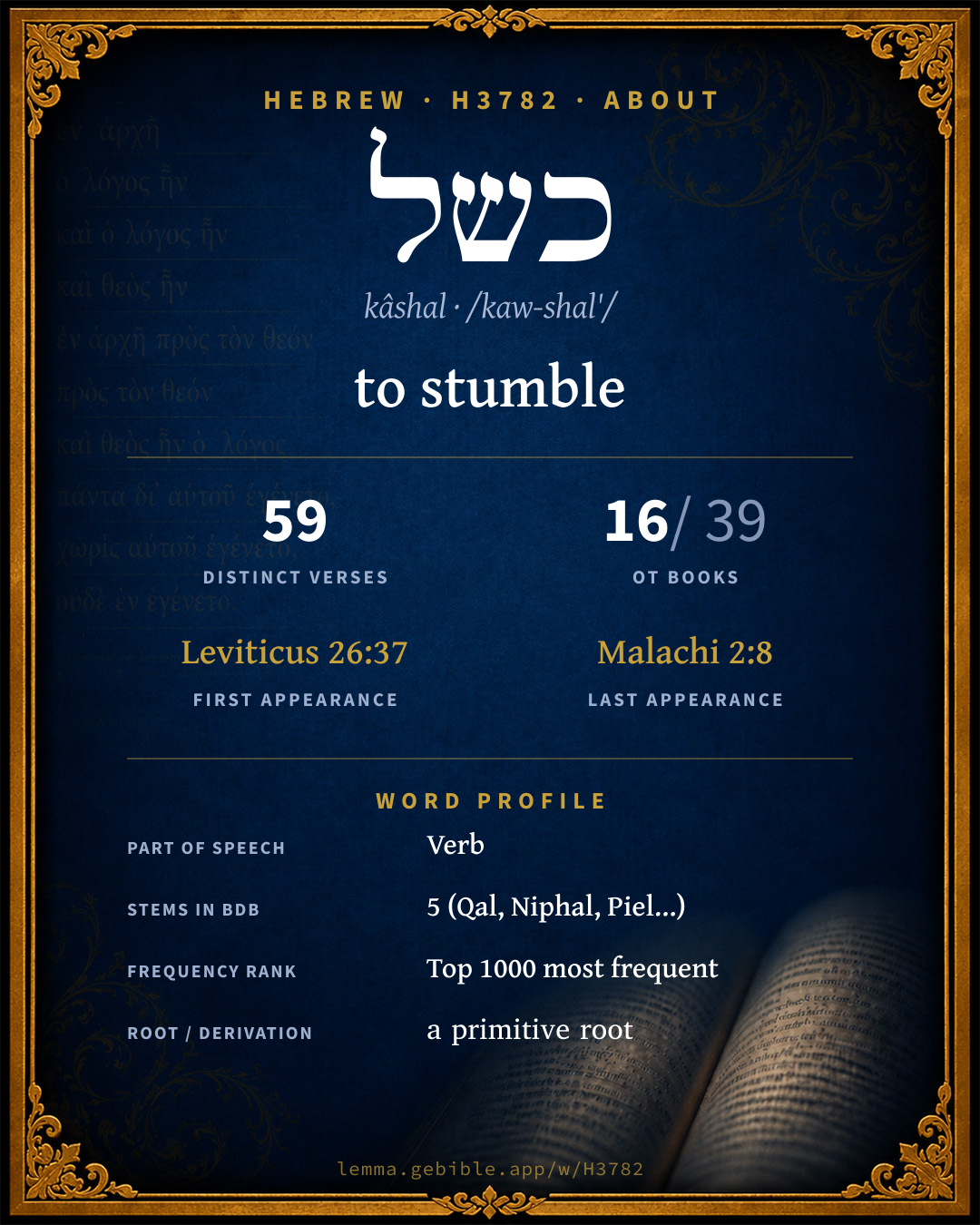
כָּשַׁל
to stumble
also: stagger, totter fuller range ↓
Full lexicon entry — Brown-Driver-Briggs (BDB)
From Brown-Driver-Briggs (BDB)
Where this word appears
See every Qal verb in the Hebrew Bible →
Grammar key — what these labels mean
Part of speech
- Verb
- An action or state-of-being word.
Stem
- Niphal
- Usually the simple passive or reflexive of the Qal (“he was written”). Here: ‘consec.’
- Qal
- The basic, simple active stem — the plain form of the verb (“he wrote”). Here: ‘stumble at’
- Hiphil
- The causative active stem (“he caused / brought about”). Here: ‘cause to stumble’
- Hophal
- The passive counterpart of the Hiphil (“he was caused to…”). Here: ‘only Pt.’
- Piel
- An intensive or resultative active stem. Here: ‘only apparent’
Form
- Imperfect
- An incomplete, ongoing, or future action (“he will / would write”).
- Perfect
- A completed action or state — Hebrew marks aspect (completeness) more than strict tense (“he wrote”).
- Participle Active
- A verbal adjective expressing ongoing or characteristic action (“writing / one who writes”).
- Sequential Perfect
- A perfect with prefixed waw continuing a preceding imperfect or command (waw-consecutive perfect).
- Infinitive Construct
- A bound verbal noun, frequently with prepositions (“to write / in writing”).
- Sequential Imperfect
- An imperfect with prefixed waw — the standard past-narrative form (waw-consecutive imperfect).
- Participle Passive
- A verbal adjective expressing action received (“written”).
- Infinitive Absolute
- An unbound verbal noun, often intensifying or standing in for a finite verb.
State
- Absolute
- The independent form of a noun, not bound to a following word.
Person
- 3rd Person
- The one spoken about (“he / she / it / they”).
- 2nd Person
- The one addressed (“you”).
- 1st Person
- The speaker (“I / we”).
Gender
- Masculine
- Grammatically masculine.
- Common
- Either gender — not distinguished for this form.
- Feminine
- Grammatically feminine.
Number
- Plural
- More than one (in Hebrew, generally three or more).
- Singular
- One.
1 verse where H3782 appears in the Hiphil stem in the Book of Jeremiah. Filtered view — show all forms. Click any verse to open its interlinear word-by-word view. Verse text shown in the World English Bible for context — . Each verse’s Hebrew form is shown with its reference; the English is not keyword-highlighted, since the data carries no word-level English alignment. Use “Compare translations” on any verse to read it across multiple English versions. This concordance covers the Hebrew Bible; Septuagint (Greek Old Testament) occurrences are not indexed here.
Jeremiah
About this entry
At a glance — auto-summarized from this page’s data, not written by a person. Every figure links to its source below. This summary describes the numbers; it doesn’t interpret them.
כשל (kâshal) is a Hebrew verb most often rendered “to stumble.” Translators differ — “fall” in the King James Version, then “stumble” (Berean Standard Bible), as the renderings breakdown shows. With 59 verses in 16 books, it is a moderately common word in the Hebrew Bible. It first appears in Leviticus 26:37. Read the stem: it spans 5 stems, including Qal and Niphal. The sections below give every sense, occurrence, and version rendering.
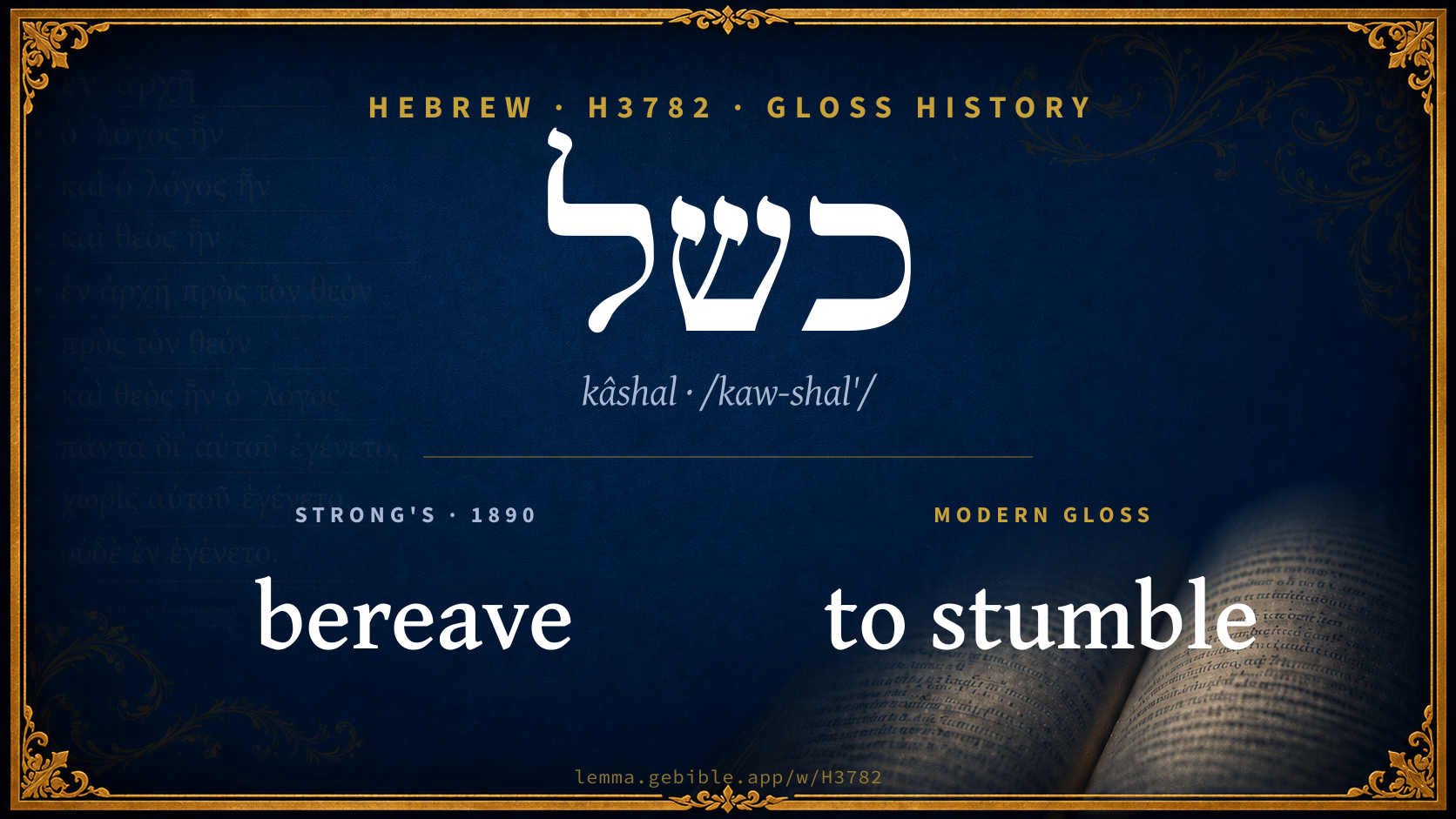
Gloss history
Strong's 1890 vs modern scholarship
About this word
Strong's H3782 catalogs a Hebrew word from the Hebrew Old Testament.
These counts are not copied from any lexicon or concordance. They are computed here, from the morphology-tagged Hebrew Old Testament. What Lemma adds →
- 59
- distinct verses
- The word appears in 59 distinct verses.
- 16 / 39
- OT books
- The word appears in 16 of 39 Old Testament books.
- #597
- by frequency
- Top 1000 most frequent Hebrew words (rank 597 of 8,640 Hebrew words by occurrence).
View all 59 occurrences in the concordance →
By section of the Old Testament
By traditional corpus
Conventional, traditional groupings — biblical authorship is debated, so this is a traditional corpus grouping, not an authorship claim. Each share is this word’s portion of its verses in that division of the Hebrew canon. Each figure is a share of the word’s 59 distinct verses.
- Prophets (Nevi'im) 33 verses · 56%
- Writings (Ketuvim) 25 verses · 42%
- Torah (Pentateuch) 1 verse · 2%
How translations render this word
Counts come from each version’s own published word-to-Strong’s tagging or interlinear alignment — an approximate guide to how each version renders this word, not a word-level alignment the data otherwise carries. Because each total is that version’s own tagged count, the per-version totals vary from one another and need not match the appearance or distinct-verse counts above. These counts may also differ from a printed concordance because Lemma counts each distinctly tagged rendering and does not collapse phrase taggings into a single head-word total. This is a fixed set of word-tagged versions (KJV, ASV, BSB, ULT) and does not change with the reading translation you choose elsewhere. Each version’s license is shown beside its name below (and on Sources).
- King James Version: Fall 7×, Shall fall 7×, They shall fall 4×
- American Standard Version: Shall stumble 5×, They stumble 4×, Stumble 3×
- Berean Standard Bible: Stumble 10×, Will stumble 5×, They stumble 4×
- unfoldingWord Literal Text: Stumble 7×, Will stumble 7×, They will stumble 6×
King James Version Public Domain
Renders H3782 across 62 tagged occurrences — most commonly:
Plus 34 renderings that appear only once — usually multi-word phrases or single function words the recovered tagging swept in, not distinct renderings. Not rendered by a distinct English word in 3 further occurrences.
American Standard Version Public Domain
Renders H3782 across 62 tagged occurrences — most commonly:
Plus 44 renderings that appear only once — usually multi-word phrases or single function words the recovered tagging swept in, not distinct renderings.
Berean Standard Bible Public Domain
Renders H3782 across 63 tagged occurrences — most commonly:
Plus 29 renderings that appear only once — usually multi-word phrases or single function words the recovered tagging swept in, not distinct renderings.
unfoldingWord Literal Text CC BY-SA 4.0
Renders H3782 across 64 tagged occurrences — most commonly:
Plus 30 renderings that appear only once — usually multi-word phrases or single function words the recovered tagging swept in, not distinct renderings.
16 senses and sub-senses in the full BDB
Hebrew verbs can shift meaning by stem (binyan): Qal is the basic action, Niphal is often passive or reflexive, Piel often intensifies or makes it factitive, and Hiphil is typically causative. The senses below are grouped under the stem BDB assigns to each. This entry also uses Hophal (the passive of Hiphil).
What do BDB’s symbols mean?
BDB uses these scholarly abbreviations:
| Symbol | Meaning |
|---|---|
| 𝔊 | the Septuagint (the ancient Greek translation, LXX) |
| 𝔙 | the Vulgate (the Latin translation) |
| 𝔖 | the Syriac version (the Peshitta) |
| 𝔗 | the Targum (the Aramaic translation) |
| ψ | the Psalms |
| √ | root (the underlying root or stem) |
| ‖ | parallel passage (a synonymous or contrasted parallel) |
| † | the dagger: every passage where the word occurs is cited |
The 16 senses and sub-senses the full Brown-Driver-Briggs lexicon distinguishes for this word, in lexicon order (not ranked by frequency), with BDB’s own verbatim wording and sub-sense lettering. Shown in Hebrew script with BDB’s own scholarly abbreviations. The condensed entry is in the Lexicon Entry tab. See also the Forms in the corpus table below.
Qal
- Pf. כ׳ Ne 4:4 +, (Ho 5:5b read יִכָּשֵׁל, cf. We), כָּֽשְׁלָה Is 3:8; 59:14; כָּֽשְׁלוּ Je 46:6 +, כָּשַׁלְנוּ Is 59:10, etc.; Impf. 3 mpl. יכשׁ֑ולו Pr 4:16 Kt (but read Hiph., q.v., so Qr); יכשׁלו Na 3:3 Kt (but read Pf. וְכָֽשְׁלוּ, so Qr); Inf. abs. כָּשׁוֹל Is 40:30 (c. Niph. Impf.); Pt. act. כּוֹשֵׁל Is 5:27 + 2 times, כֹּשֵׁל 2 Ch 28:15 ψ 105:37; fpl. כֹּשְׁלוֹת Is 35:3;— e.g. Nehemiah 4:4
- 1. stumble at, over, something, c. ב (lit. by means of), Na 3:3, גִּבּוֹר בְּגִבּוֹר כ׳ Je 46:12 (+ נָפַל), cf. Lv 26:37; וּנְעָרִים בָּעֵץ כ׳ La 5:13 i.e. stagger (of toil in captivity); abs. Is 5:27 (‖ עָיֵף), כָּֽשְׁלוּ וְנָפָ֑לוּ Je 46:6, cf. הִרְבָּה כּוֹשֵׁ֑ל גַּס־נָפַל אישׁ וגו׳ v 16 (strange; Gie, foll. in part 𝔊 𝔖, עֶרְבְּךָ כָּשַׁל וְנָפַל thy mixed people—cf. 25:20, etc.—hath stumbled and hath fallen); often fig. of overthrow, through divine judgment, c. בְּ at, (v. supr.) Je 6:21, so Is 8:15 (+ נָפַל etc.) according to Ges Hi Buhl Che Di; בָּם = among them,—Isr. and Judah,—as ב in v 16, so Ew De Du E.V; Ho 4:5(×2); 5:5; 14:2 (בַּעֲוֹנֶֽךָ, בְּ prob. instr.); abs. of Babylon, under fig. of זָדוֹן, כ׳ ונפל Je 50:32; כ׳ ונפל ψ 27:2 Is 3:8; 31:3 (both ‖ נפל); of אֱמֶת Is 59:14; Is 28:13 (+ אָחוֹר); of distress Is 59:10, ψ 107:12. e.g. Nahum 3:3
- 2. totter, of knees, lit. בִּרְכַּי כ׳ מִצּוֹם ψ 109:24 my knees totter from fasting; fig. Is 35:3 (‖ יָדַיִם רָפוֹת); כּוֹשֵׁל tottering one, lit. Jb 4:4 2 Ch 28:15 ψ 105:37; hence fig., fail, of strength (כֹּחַ), Ne 4:4 ψ 31:11;—Inf. abs. כָּשׁוֹל, v. sub Niph. e.g. Psalms 109:24
Niphal
- Pf. consec. וְנִכְשַׁל Dn 11:19, וְנִכְשְׁלוּ v 33, וְנִכְשָׁ֑לוּ v 14; Impf. יִכָּשֵׁל Ez 33:12 + Ho 5:5b (𝔊 as v a, so We; MT כָּשַׁל), 2 ms. תִּכָּשֵׁל Pr 4:12, יִכָּשְׁלוּ Ho 5:5a + 9 times; יִכָּשֵׁ֑לוּ Is 40:30 + 3 times; Inf. cstr. sf. בִּכָּֽשְׁלוֹ Pr 24:17 (yet v. Ges§ 51, R. 1), בְּהִכָּֽשְׁלָם Dn 11:34; Pt. נִכְשָׁל Zc 12:8; pl. נִכְשָׁלִים 1 S 2:4;— e.g. Daniel 11:19
- 1. stumble (= Qal) Na 2:6; Is 63:13; Je 31:9; usually fig.: e.g. Nahum 2:6
- a. of misfortune Pr 24:17 (‖ נפל), neg. 4:12. e.g. Proverbs 24:17
- b. of divine judgment (c. בְּ at) Pr 4:19; 24:16, neg. Ez 33:12; see also Ho 14:10 (בְ loc.), Je 20:11 Dn 11:14, 35, יִכָּֽשְׁלוּ וְיֹאבְדוּ מִפָּנֶיךָ ψ 9:4; be thrown to the ground, of nations, armies, etc., Ho 5:5 (c. בַּעֲוֹנָם, cf. 14:2 Qal), Je 6:15 (‖ נפל), cf. 8:12 (‖ id.), Dn 11:19 (+ נפל), v 33 (בְ instr.), v 34, 41. e.g. Proverbs 4:19
- 2. be tottering, feeble, כָּשׁוֹל יִכָּשֵׁ֑לוּ Is 40:30 (opp. יַחֲלִיפוּ כֹחַ v 31); so pt. 1 S 2:4 Zc 12:8. e.g. Isaiah 40:30
Piel
- only apparent, תְּכַשְּׁלִי Ez 36:14, read תְּשַׁכְּלִי with Qr Vrss E.V. Sm Co Da (v. alo Hiph. ad fin.). e.g. Ezekiel 36:14
Hiphil
- Pf. הִכְשִׁיל La 1:14, הִכְשַׁלְתֶּם Mal 2:8; Impf. 3 ms. sf. יַכְשִׁילְךָ 2 Ch 25:8; 2 fs. תַּכְשִׁלִי Ez 36:15 (but del. 𝔊 Co; read תשׁכלי, as v 14 other Vrss Sm Da); 3 mpl. יַכְשִׁילוּ Pr 4:16 Qr (Kt v. sub Qal), וַיַּכְשִׁילֻהוּ ψ 64:9, וַיַּכְשִׁלוּם Je 18:15 (so 𝔗; Gie, after 𝔊 𝔖, וַיִּכְשְׁלוּ, [וַיִּכָּֽשְׁלוּ]); Inf. cstr. הַכְשִׁיל 2 Ch 25:8, sf. הַכְשִׁילוֹ 2 Ch 28:23;— e.g. Lamentations 1:14
- 1. cause to stumble, fig.:
- a. = bring injury or ruin to, abs. Pr 4:16; of punishment ψ 64:9 (indef. subj.; si vera l.; text prob. corrupt, v. Che Bae). e.g. Proverbs 4:16
- b. = overthrow, of nation, army, etc., 2 Ch 25:8 (sq. לִפְנֵי אוֹיֵב), cf. v 8 (opp. עזר); cause overthrow 2 Ch 28:23.—On Ez 36:15 v. supr. e.g. 2 Chronicles 25:8
- c. morally, Je 18:15 (בְּ loc.), Mal 2:8 (בְּ instr.) e.g. Jeremiah 18:15
- 2. make feeble, weak, הִכְשִׁיל כֹּחִי La 1:14 (of God’s dealing with Jerus.) e.g. Lamentations 1:14
Hophal
- only Pt. והיו מֻכְשָׁלִים לְפָנֶיךָ Je 18:23 either and let them be ones who have stumbled before thee, i.e. regard them as such (Hi Gf VB), or and let them be ones overthrown before thee (Gie; so Qr according to Gf). So also in Ez 21:20 according to Co, cf. Sm Da (MT מִכְשֹׁלִים, v. מִכְשׁוֹל). e.g. Jeremiah 18:23
Senses from the full Brown-Driver-Briggs lexicon (Brown, Driver, Briggs; Oxford 1906 — public domain), digitized via Sefaria, supplemented by the OpenScriptures HebrewLexicon (CC BY 4.0). Full attribution on Sources.
Word origin
vb. stumble, stagger, totter (NH id.; Syriac [ܟܫܰܠ] give offence (occasion for stumbling), σκανδαλίζω, (chiefly Ethpe. Aph.), v. PS Brock Schwally; Arabic كَسِلَ is be heavy, sluggish);—
— Brown-Driver-Briggs (Oxford 1906, public domain), digitized via Sefaria, supplemented by the OpenScriptures HebrewLexicon (CC BY 4.0). See Sources.
Origin: a primitive root
Jastrow Dictionary
A second Hebrew/Aramaic lexicon for comparison, covering Aramaic and post-biblical (Talmudic, Targumic, Midrashic) usage that the biblical-Hebrew BDB does not. Matched by lemma rather than by Strong’s number, so a lemma may carry more than one Jastrow headword (shown separately below), and the entries cover usage well beyond the Bible.
כָּשַׁל
- to strike against, stumble. Lev. R. s. 19 (ref. to Is. XXXV, 3) שהן נראות כאילו כּוֹשְׁלוֹת knees which have the appearance of stumbling (threaten to stumble). Ib. שכְּשַׁלְתֶּם וכ׳ for you have really stumbled (sinned) through your evil deeds. Num. R. s. 16 כְּשַׁלְתֶּם you have stumbled (were discouraged; Tanḥ. Shlaḥ 2 נתרשלתם); a. e.—כּוֹשֵׁל (law) weak, under legal disadvantages (in adapt. of Is. l. c. a. Job IV, 4). Keth. IX, 2 ינתנו לַכּ׳ שבהן let it be given him who is under the greatest disadvantage of all (the claimants being the deceased man’s widow, his creditor and his heirs); expl. ib. 84ᵃ לכ׳ שבראיה to him who is under disadvantage for evidence (whose document is of the latest date); [oth. opin.] לכתובת אשה to the widow, v. חִינָּא; Y. ib. IX, 33ᵃ top לכ׳ שבראיותיו וכ׳ to him who is the weakest as to evidence, e.g. he who loaned without witnesses as against him who has witnesses. Ib. לכ׳ בגופו to him who is in feeble health (and poor). e.g. Isaiah 35:3
- 1. to be struck, meet with an accident. Mekh. B’shall. s. 2 לא נ׳ אחד וכ׳ not one of them (the Egyptians) met with an accident (was detained) on the road. Y. Sabb. VI, 8ᶜ bot. נ׳ באצבעו got a sore finger; ib. XVI, 15ᶜ top; Lam. R. to IV, 20; a. e.
- 2. to stumble, fall; to be led to sin. Pesik. Shub., p. 165ᵃ והיו … נִכְשָׁלִין בו and people stumbled over it (the rock); Yalk. Hos. 533. Ib. אדם נ׳ בעכירה if man becomes a victim of sin. Gitt. 43ᵃ אין אדם … אא"כ נ׳ בהן one never gets at the true sense of the words of the Law, except after mistakes; Ḥag. 14ᵃ; Sabb. 120ᵃ.—Ber. 28ᵇ ולא אֶכָּשֵׁל בדבר הלכה and that I may not err against a hălakhah; ולא יִכָּשְׁלוּ וכ׳ nor may my colleagues &c. Midr. Till. to Ps. XXII בשביל … איני נִכְשֶׁלֶת because I am a queen, I shall not come to grief; a. fr.
- to cause to stumble, to be an obstruction; to weaken; to cause sin. Y. Shebi. III, end, 34ᵈ a breach in the fence מַכְשֶׁלֶת את הרבים annoying the public (an obstruction to traffic). R. Hash. I, 6 נמצאת מַכְשִׁילָן לע"ל thou wilt make them sin in future cases (by their refraining from going to court); Yoma 77ᵇ שלא תהא מַכְשִׁילָן וכ׳ that thou mayest not cause them to sin (by staying away from college); Kidd. 33ᵃ; Ḥull. 54ᵇ מְכַשְּׁלָן (Pi.).—Ab. Zar. 11ᵇ פיהם הִכְשִׁילָן לרשעים Ms. M. (ed. ה׳ פיהם) their own (ominous) words brought these wicked men to fall; Num. R. s. 18. B. Kam. 16ᵇ; B. Bath. 9ᵇ (ref. to מכשלים, Jer. XVIII, 23) הַכְשִׁילֵם וכ׳ make them stumble by sending them unworthy subjects of charity. Midr. Till. to Ps. XC לעצמי הייתי מַכְשִׁיל I should have injured myself. e.g. Jeremiah 18:23
- 1. same, v. supra.—2)
- to weaken, break the force of. Y. Ber. IX, 13ᶜ bot. מְכַשְּׁלוֹ בגבעות (Gen. R. s. 24 מרשלו), v. חָשַׁל.
כְּשַׁל
- , Af. אַכְשַׁל to bring to fall. Gitt. 57ᵃ אַכְשְׁלֵיה פומיה לבר וכ׳ his own mouth (his presumptuous prayer) caused Bar-Daroma’s downfall.
שַׁל
- v. שַׁלְוָה) carelessness, negligence. Sot. 35ᵃ (expl. II Sam. VII, 7) על עיסקי שַׁלּוֹ for his careless handling (of the Ark); Num. R. s. 420; Yalk. Sam. 142; Num. R. s. 2112 על השל מפני ששגגת וכ׳ ‘for the carelessness’, because an involuntary act of a scholar counts as a wilful act. e.g. 2 Samuel 7:7
שַׁל ²
- , v. שַׁלְצִיּוֹן
שֶׁל
- , v. שֶׁ־) belonging to, of. Ab. II, 2 בנו של ר׳ וכ׳ the son of &c. Ib. 12 יהי ממון … כשֶׁלְּךָ let thy neighbor’s property be as dear to thee as thine own. Ib. V, 10 האומר שֶׁלִּי שלי ושֶׁלְּךָ שֶׁלָּךְ he who says, what is mine is mine, and what is thine is thine. B. Mets. I, 1 זה אומר כולה שלי וכ׳ one says, it belongs entirely to me &c. Ib. 30ᵃ שהיתה מלאכה שֶׁלּוֹ … משל חבירו when his own work is more valuable than that required for his neighbor, i.e. when by helping his neighbor he would lose more than he could save for his neighbor. Gen. R. s. 49 אמרו לו מה נאמר … שאכלנו מִשֶּׁלּוֹ they (the strangers entertained by Araham) said to him, what shall we say? Said he, say, blessed be the God of the world of whose belongings we have partaken; a. v. fr.—Kidd. 57ᵇ שחוט שלי בשלי וכ׳ (not לי) slaughter what is owing to me (the sacrifice) on what belongs to me (on Temple grounds), and what is for thee, on thy own ground.
A Dictionary of the Targumim, the Talmud Babli and Yerushalmi, and the Midrashic Literature (Marcus Jastrow; London, Luzac, 1903) — Public Domain. Digitized via Sefaria. Digitized via Sefaria. Full attribution on Sources.
Forms in the corpus
The 57 distinct written forms H3782 takes in the Hebrew Bible, most frequent first — each parse links to that stem’s occurrences in the concordance. Hebrew forms include their vowel points and cantillation, so a single lemma takes many written forms.
Same root — word family
Other BDB entries built from the same root as H3782, grouped by Strong’s listed origin. These share a root / origin per the lexicon — not necessarily a shared meaning. Each links to that word’s own entry.
Derived from this word
- כשיל kashshîyl H3781 axe
- כשלון kishshâlôwn H3783 stumbling
- מכשול mikshôwl H4383 stumbling block
- מכשלה makshêlâh H4384 ruin
Compare all same-root words → Showing 4 of 5 — not the complete family. They share a root, not necessarily a meaning.
Septuagint verse parallels
This word appears in 53 verses that also exist in the Greek Old Testament (Septuagint), out of the 59 Hebrew verses it occurs in. You can read those verses in Greek by switching the Old Testament edition to the Septuagint.
Read these verses in the Septuagint
- Leviticus 26:37
- 1 Samuel 2:4
- 2 Chronicles 25:8
- Job 4:4
- Psalms 9:3
- Proverbs 4:12
- Isaiah 3:8
- Jeremiah 6:15
- Lamentations 1:14
- Ezekiel 33:12
- Daniel 11:14
- Hosea 4:5
This is a verse-level parallel only — the same verses exist in both the Hebrew and Greek Old Testaments. No word-level Hebrew↔Greek correspondence is claimed: the data carries no such alignment, so no Greek word is shown as this Hebrew word’s translation. Coverage is not total — the Septuagint omits the deuterocanon and renumbers the Psalms, so some Hebrew verses have no direct Greek parallel.