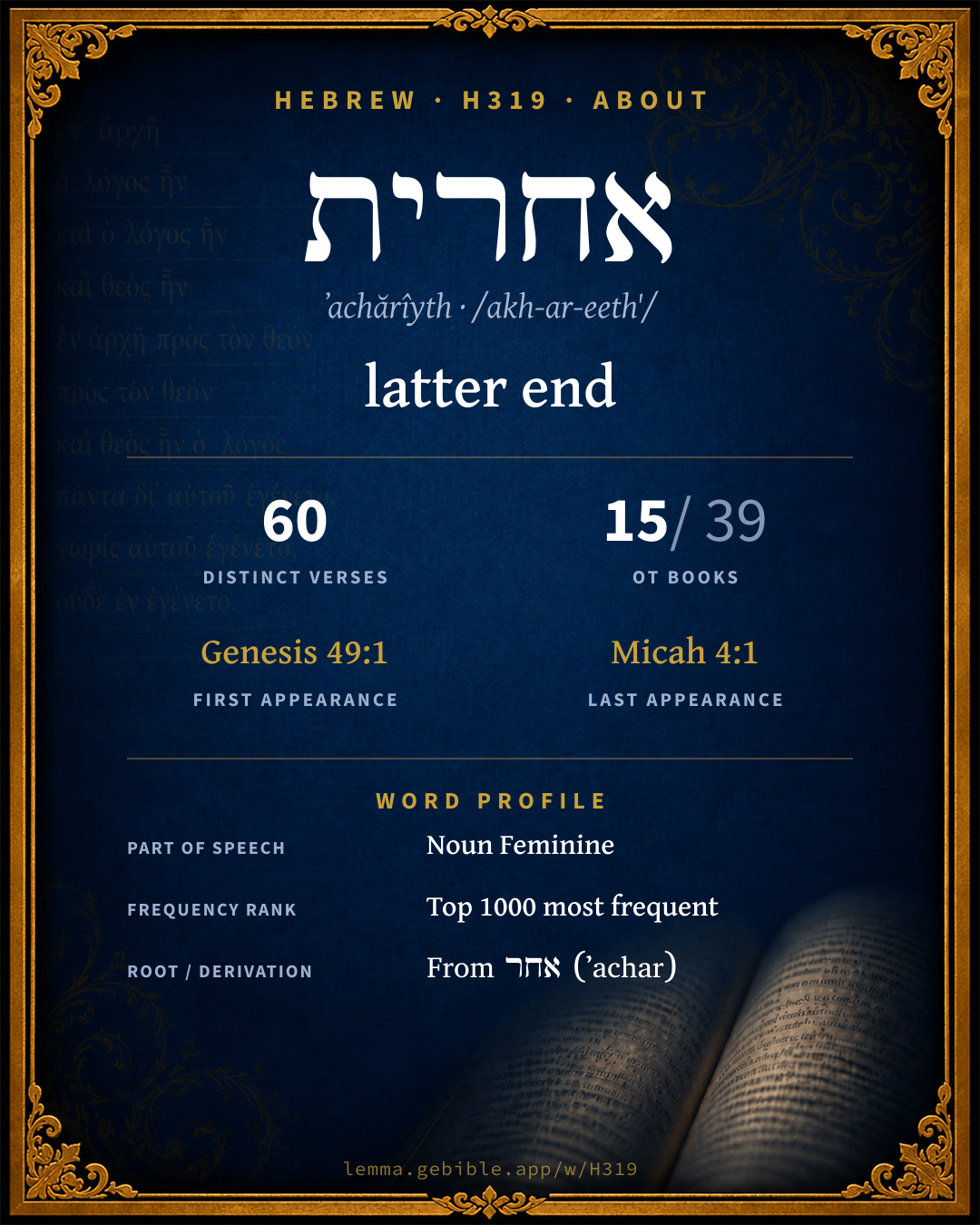
אַחֲרִית
latter end
‘latter end’ is one of 5 main senses fuller range ↓
Full lexicon entry — Brown-Driver-Briggs (BDB)
From Brown-Driver-Briggs (BDB)
Where this word appears
See every Construct-state word in the Hebrew Bible →
Grammar key — what these labels mean
Part of speech
- Noun
- A naming word — a person, place, thing, or idea.
Noun type
- Common
- A common noun — a general class of person, place, or thing (“king,” “city,” “water”), not a specific name.
State
- Construct
- A noun bound to a following noun in a possessive / “of” relationship (the construct chain).
- Absolute
- The independent form of a noun, not bound to a following word.
Gender
- Feminine
- Grammatically feminine.
Number
- Singular
- One.
Grammatical forms
- Noun, Common, Feminine, Singular, Construct 54 times (89%)
- Noun, Common, Feminine, Singular, Absolute 7 times (11%)
Parsed forms decoded from the imported morphology (morphhb / Westminster Leningrad Codex — WLC text public domain, morphhb tagging CC BY 4.0), counted across 61 parsed occurrences — not distinct verses.
Every verse where H319 appears — 60 distinct verses across 15 books. Click any verse to open its interlinear word-by-word view. Verse text shown in the World English Bible for context — . Each verse’s Hebrew form is shown with its reference; the English is not keyword-highlighted, since the data carries no word-level English alignment. Use “Compare translations” on any verse to read it across multiple English versions. This concordance covers the Hebrew Bible; Septuagint (Greek Old Testament) occurrences are not indexed here.
Genesis 1 verse
Numbers 3 verses
- Numbers 23:10 אַחֲרִיתִ֖/י n c fs cs + sfx pers 1cs Who can count the dust of Jacob, Or number the fourth part of Israel? Let me die the death of the righteous, Let my last end be like his!
- Numbers 24:14 בְּ/אַחֲרִ֥ית prep + n c fs cs Now, behold, I go to my people: come, [and] I will advertise you what this people shall do to your people in the latter days.
- Numbers 24:20 וְ/אַחֲרִית֖/וֹ conj + n c fs cs + sfx pers 3ms He looked at Amalek, and took up his parable, and said, Amalek was the first of the nations; But his latter end shall come to destruction.
Deuteronomy 6 verses
- Deuteronomy 4:30 בְּ/אַחֲרִית֙ prep + n c fs cs When you are in oppression, and all these things are come on you, in the latter days you shall return to Yahweh your God, and listen to his voice:
- Deuteronomy 8:16 בְּ/אַחֲרִיתֶֽ/ךָ prep + n c fs cs + sfx pers 2ms who fed you in the wilderness with manna, which your fathers didn't know; that he might humble you, and that he might prove you, to do you good at your latter end:
- Deuteronomy 11:12 אַחֲרִ֥ית n c fs cs a land which Yahweh your God cares for: the eyes of Yahweh your God are always on it, from the beginning of the year even to the end of the year.
- Deuteronomy 31:29 בְּ/אַחֲרִ֣ית prep + n c fs cs For I know that after my death you will utterly corrupt yourselves, and turn aside from the way which I have commanded you; and evil will happen to you in the latter days; because you will do that which is evil in the sight of Yahweh, to provoke him to anger through the work of your hands.
- Deuteronomy 32:20 אַחֲרִיתָ֑/ם n c fs cs + sfx pers 3mp He said, I will hide my face from them, I will see what their end shall be: For they are a very perverse generation, Children in whom is no faithfulness.
- Deuteronomy 32:29 לְ/אַחֲרִיתָֽ/ם prep + n c fs cs + sfx pers 3mp Oh that they were wise, that they understood this, That they would consider their latter end!
Job 2 verses
- Job 8:7 וְ֝/אַחֲרִיתְ/ךָ֗ conj + n c fs cs + sfx pers 2ms Though your beginning was small, Yet your latter end would greatly increase.
- Job 42:12 אַחֲרִ֥ית n c fs cs So Yahweh blessed the latter end of Job more than his beginning. He had fourteen thousand sheep, six thousand camels, one thousand yoke of oxen, and a thousand female donkeys.
Psalms 5 verses
- Psalms 37:37 אַחֲרִ֖ית n c fs Mark the perfect man, and see the upright, For there is a future for the man of peace.
- Psalms 37:38 אַחֲרִ֖ית n c fs cs As for transgressors, they shall be destroyed together. The future of the wicked shall be cut off.
- Psalms 73:17 לְ/אַחֲרִיתָֽ/ם prep + n c fs cs + sfx pers 3mp Until I entered God's sanctuary, And considered their latter end.
- Psalms 109:13 אַחֲרִית֥/וֹ n c fs cs + sfx pers 3ms Let his posterity be cut off. In the generation following let their name be blotted out.
- Psalms 139:9 בְּ/אַחֲרִ֥ית prep + n c fs cs If I take the wings of the dawn, And settle in the uttermost parts of the sea;
Proverbs 13 verses
- Proverbs 5:4 וְֽ֭/אַחֲרִיתָ/הּ conj + n c fs cs + sfx pers 3fs But in the end she is as bitter as wormwood, And as sharp as a two-edged sword.
- Proverbs 5:11 בְ/אַחֲרִיתֶ֑/ךָ prep + n c fs cs + sfx pers 2ms You will groan at your latter end, When your flesh and your body are consumed,
- Proverbs 14:12 וְ֝/אַחֲרִיתָ֗/הּ conj + n c fs cs + sfx pers 3fs There is a way which seems right to a man, But in the end it leads to death.
- Proverbs 14:13 וְ/אַחֲרִיתָ֖/הּ conj + n c fs cs + sfx pers 3fs Even in laughter the heart may be sorrowful, And mirth may end in heaviness.
- Proverbs 16:25 וְ֝/אַחֲרִיתָ֗/הּ conj + n c fs cs + sfx pers 3fs There is a way which seems right to a man, But in the end it leads to death.
- Proverbs 19:20 בְּ/אַחֲרִיתֶֽ/ךָ prep + n c fs cs + sfx pers 2ms Listen to counsel and receive instruction, That you may be wise in your latter end.
- Proverbs 20:21 וְ֝/אַחֲרִיתָ֗/הּ conj + n c fs cs + sfx pers 3fs An inheritance quickly gained at the beginning, Won't be blessed in the end.
- Proverbs 23:18 אַחֲרִ֑ית n c fs Indeed surely there is a future hope, And your hope will not be cut off.
- Proverbs 23:32 אַ֭חֲרִית/וֹ n c fs cs + sfx pers 3ms In the end, it bites like a snake, And poisons like a viper.
- Proverbs 24:14 אַחֲרִ֑ית n c fs So you shall know wisdom to be to your soul; If you have found it, then there will be a reward, Your hope will not be cut off.
- Proverbs 24:20 אַחֲרִ֣ית n c fs For there will be no reward to the evil man; And the lamp of the wicked shall be snuffed out.
- Proverbs 25:8 בְּ/אַחֲרִיתָ֑/הּ prep + n c fs cs + sfx pers 3fs Don't be hasty in bringing charges to court. What will you do in the end when your neighbor shames you?
- Proverbs 29:21 וְ֝/אַחֲרִית֗/וֹ conj + n c fs cs + sfx pers 3ms He who pampers his servant from youth Will have him become a son in the end.
Ecclesiastes 2 verses
Isaiah 4 verses
- Isaiah 2:2 בְּ/אַחֲרִ֣ית prep + n c fs cs It shall happen in the latter days, that the mountain of Yahweh's house shall be established on the top of the mountains, And shall be raised above the hills; And all nations shall flow to it.
- Isaiah 41:22 אַחֲרִיתָ֔/ן n c fs cs + sfx pers 3fp Let them bring forth, and declare to us what shall happen: declare you the former things, what they are, that we may consider them, and know the latter end of them; or show us things to come.
- Isaiah 46:10 אַחֲרִ֔ית n c fs declaring the end from the beginning, and from ancient times things that are not [yet] done; saying, My counsel shall stand, and I will do all my pleasure;
- Isaiah 47:7 אַחֲרִיתָֽ/הּ n c fs cs + sfx pers 3fs You said, I shall be mistress forever; so that you did not lay these things to your heart, neither did remember the latter end of it.
Jeremiah 10 verses
- Jeremiah 5:31 לְ/אַחֲרִיתָֽ/הּ prep + n c fs cs + sfx pers 3fs the prophets prophesy falsely, and the priests bear rule by their means; and my people love to have it so: and what will you do in the end of it?
- Jeremiah 12:4 אַחֲרִיתֵֽ/נוּ n c fs cs + sfx pers 1cp How long shall the land mourn, and the herbs of the whole country wither? for the wickedness of those who dwell therein, the animals are consumed, and the birds; because they said, He shall not see our latter end.
- Jeremiah 17:11 וּ/בְ/אַחֲרִית֖/וֹ conj + prep + n c fs cs + sfx pers 3ms As the partridge that sits on [eggs] which she has not laid, so is he who gets riches, and not by right; in the midst of his days they shall leave him, and at his end he shall be a fool.
- Jeremiah 23:20 בְּ/אַֽחֲרִית֙ prep + n c fs cs The anger of Yahweh shall not return, until he has executed, and until he have performed the intents of his heart: in the latter days you shall understand it perfectly.
- Jeremiah 29:11 אַחֲרִ֥ית n c fs For I know the thoughts that I think toward you, says Yahweh, thoughts of peace, and not of evil, to give you hope in your latter end.
- Jeremiah 30:24 בְּ/אַחֲרִ֥ית prep + n c fs cs The fierce anger of Yahweh shall not return, until he has executed, and until he have performed the intents of his heart: in the latter days you shall understand it.
- Jeremiah 31:17 לְ/אַחֲרִיתֵ֖/ךְ prep + n c fs cs + sfx pers 2fs There is hope for your latter end, says Yahweh; and [your] children shall come again to their own border.
- Jeremiah 48:47 בְּ/אַחֲרִ֥ית prep + n c fs cs Yet will I bring back the captivity of Moab in the latter days, says Yahweh. Thus far is the judgment of Moab.
- Jeremiah 49:39 בְּ/אַחֲרִ֣ית prep + n c fs cs But it shall happen in the latter days, that I will bring back the captivity of Elam, says Yahweh.
- Jeremiah 50:12 אַחֲרִ֣ית n c fs cs your mother shall be utterly disappointed; she who bore you shall be confounded: behold, she shall be the least of the nations, a wilderness, a dry land, and a desert.
Lamentations 1 verse
Ezekiel 3 verses
- Ezekiel 23:25 וְ/אַחֲרִיתֵ֖/ךְ וְ/אַחֲרִיתֵ֖/ךְ conj + n c fs cs + sfx pers 2fs conj + n c fs cs + sfx pers 2fs I will set my jealousy against you, and they shall deal with you in fury; they shall take away your nose and your ears; and your residue shall fall by the sword: they shall take your sons and your daughters; and your residue shall be devoured by the fire.
- Ezekiel 38:8 בְּ/אַחֲרִ֨ית prep + n c fs cs After many days you shall be visited: in the latter years you shall come into the land that is brought back from the sword, that is gathered out of many peoples, on the mountains of Israel, which have been a continual waste; but it is brought forth out of the peoples, and they shall dwell securely, all of them.
- Ezekiel 38:16 בְּ/אַחֲרִ֨ית prep + n c fs cs and you shall come up against my people Israel, as a cloud to cover the land: it shall happen in the latter days, that I will bring you against my land, that the nations may know me, when I shall be sanctified in you, Gog, before their eyes.
Daniel 5 verses
- Daniel 8:19 בְּ/אַחֲרִ֣ית prep + n c fs cs He said, Behold, I will make you know what shall be in the latter time of the indignation; for it belongs to the appointed time of the end.
- Daniel 8:23 וּֽ/בְ/אַחֲרִית֙ conj + prep + n c fs cs In the latter time of their kingdom, when the transgressors are come to the full, a king of fierce face, and understanding dark sentences, shall stand up.
- Daniel 10:14 בְּ/אַחֲרִ֣ית prep + n c fs cs Now I have come to make you understand what shall happen to your people in the latter days; for the vision is yet for [many] days:
- Daniel 11:4 לְ/אַחֲרִית֗/וֹ prep + n c fs cs + sfx pers 3ms When he shall stand up, his kingdom shall be broken, and shall be divided toward the four winds of the sky, but not to his posterity, nor according to his dominion with which he ruled; for his kingdom shall be plucked up, even for others besides these.
- Daniel 12:8 אַחֲרִ֖ית n c fs I heard, but I didn't understand: then said I, my lord, what shall be the issue of these things?
Hosea 1 verse
Amos 3 verses
- Amos 4:2 וְ/אַחֲרִיתְ/כֶ֖ן conj + n c fs cs + sfx pers 2fp The Lord Yahweh has sworn by his holiness that behold, "The days shall come on you that they will take you away with hooks, And the last of you with fish hooks.
- Amos 8:10 וְ/אַחֲרִיתָ֖/הּ conj + n c fs cs + sfx pers 3fs I will turn your feasts into mourning, And all your songs into lamentation; And I will make you wear sackcloth on all your bodies, And baldness on every head. I will make it like the mourning for an only son, And the end of it like a bitter day.
- Amos 9:1 וְ/אַחֲרִיתָ֖/ם conj + n c fs cs + sfx pers 3mp I saw the Lord standing beside the altar, and he said, "Strike the tops of the pillars, that the thresholds may shake; and break them in pieces on the head of all of them; and I will kill the last of them with the sword: there shall not one of them flee away, and there shall not one of them escape.
Micah 1 verse
About this entry
At a glance — auto-summarized from this page’s data, not written by a person. Every figure links to its source below. This summary describes the numbers; it doesn’t interpret them.
אחרית — transliterated ʼachărîyth — is a Hebrew noun carrying the sense “latter end.” It is not a single-sense word — see its full sense range. The Hebrew Bible uses it across 60 verses — moderately common. It first appears in Genesis 49:1. Related forms include אחר, אחר and אחרח. Each statement above links to its evidence; the full detail follows below.
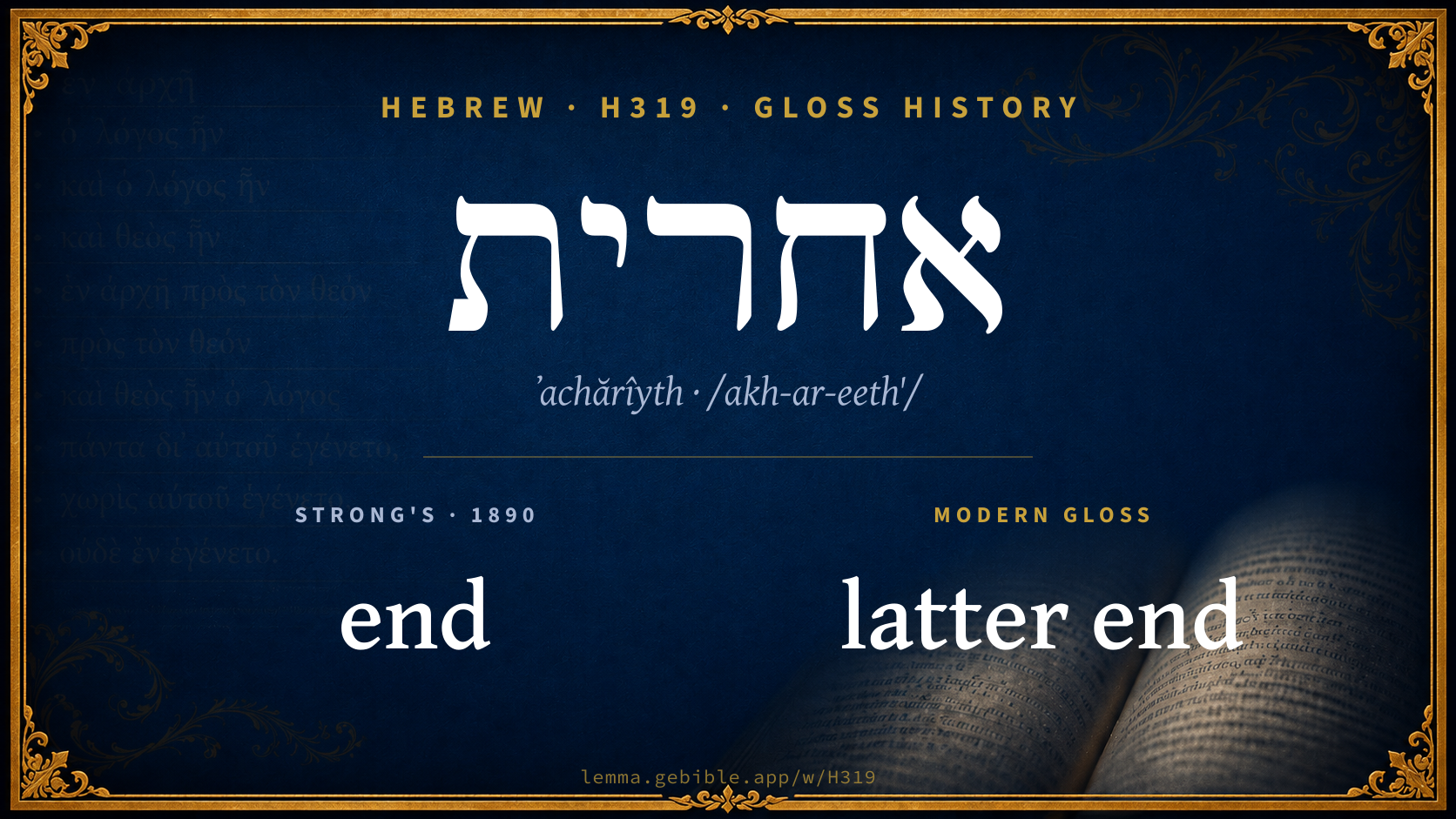
Gloss history
Strong's 1890 vs modern scholarship
About this word
Strong's H319 catalogs a Hebrew word from the Hebrew Old Testament.
These counts are not copied from any lexicon or concordance. They are computed here, from the morphology-tagged Hebrew Old Testament. What Lemma adds →
- 60
- distinct verses
- The word appears in 60 distinct verses.
- 15 / 39
- OT books
- The word appears in 15 of 39 Old Testament books.
- #629
- by frequency
- Top 1000 most frequent Hebrew words (rank 629 of 8,640 Hebrew words by occurrence).
View all 60 occurrences in the concordance →
Most concentrated in
- Proverbs 13 verses 22%
- Jeremiah 10 verses 17%
- Deuteronomy 6 verses 10%
By section of the Old Testament
By traditional corpus
Conventional, traditional groupings — biblical authorship is debated, so this is a traditional corpus grouping, not an authorship claim. Each share is this word’s portion of its verses in that division of the Hebrew canon. Each figure is a share of the word’s 60 distinct verses.
- Writings (Ketuvim) 28 verses · 47%
- Prophets (Nevi'im) 22 verses · 37%
- Torah (Pentateuch) 10 verses · 17%
How translations render this word
Counts come from each version’s own published word-to-Strong’s tagging or interlinear alignment — an approximate guide to how each version renders this word, not a word-level alignment the data otherwise carries. Because each total is that version’s own tagged count, the per-version totals vary from one another and need not match the appearance or distinct-verse counts above. These counts may also differ from a printed concordance because Lemma counts each distinctly tagged rendering and does not collapse phrase taggings into a single head-word total. This is a fixed set of word-tagged versions (KJV, ASV, BSB, ULT) and does not change with the reading translation you choose elsewhere. Each version’s license is shown beside its name below (and on Sources).
- King James Version: End 17×, Latter 8×, Latter end 7×
- American Standard Version: End 11×, Latter 10×, Latter end 7×
- Berean Standard Bible: End 18×, Future 6×, Latter 5×
- unfoldingWord Literal Text: End 21×, End of 5×, Future 4×
King James Version Public Domain
Renders H319 across 61 tagged occurrences — most commonly:
Plus 21 renderings that appear only once — usually multi-word phrases or single function words the recovered tagging swept in, not distinct renderings.
American Standard Version Public Domain
Renders H319 across 61 tagged occurrences — most commonly:
Plus 23 renderings that appear only once — usually multi-word phrases or single function words the recovered tagging swept in, not distinct renderings.
Berean Standard Bible Public Domain
Renders H319 across 61 tagged occurrences — most commonly:
Plus 19 renderings that appear only once — usually multi-word phrases or single function words the recovered tagging swept in, not distinct renderings.
unfoldingWord Literal Text CC BY-SA 4.0
Renders H319 across 61 tagged occurrences — most commonly:
Plus 15 renderings that appear only once — usually multi-word phrases or single function words the recovered tagging swept in, not distinct renderings.
Senses in the full BDB
What do BDB’s symbols mean?
BDB uses these scholarly abbreviations:
| Symbol | Meaning |
|---|---|
| 𝔊 | the Septuagint (the ancient Greek translation, LXX) |
| 𝔙 | the Vulgate (the Latin translation) |
| 𝔖 | the Syriac version (the Peshitta) |
| 𝔗 | the Targum (the Aramaic translation) |
| ψ | the Psalms |
| √ | root (the underlying root or stem) |
| ‖ | parallel passage (a synonymous or contrasted parallel) |
| † | the dagger: every passage where the word occurs is cited |
The 4 senses and sub-senses the full Brown-Driver-Briggs lexicon distinguishes for this word, in lexicon order (not ranked by frequency), with BDB’s own verbatim wording and sub-sense lettering. Shown in Hebrew script with BDB’s own scholarly abbreviations. The condensed entry is in the Lexicon Entry tab. See also the Forms in the corpus table below.
- a. of place, only ψ 139:9 (late) א׳ יָם. e.g. Psalms 139:9
- b. of time, latter part or actual close (according to context), opp. רֵאשִׁית;—of year Dt 11:12; of a man’s life Nu 23:10 Pr 5:11 Jb 8:7; 42:12; of a people’s existence Nu 24:20; = final lot Dt 32:20, 29 Je 12:4; 31:17 ψ 73:17; a future, i.e. a happy close of life, suggesting sometimes the idea of a posterity, promised to the righteous Pr 23:18 (‖ תִּקְוָה hope) 24:14 Je 29:11 (לָתֵת לָכֶם א׳ וְתִקְוָה), withheld from the wicked Pr 24:20 (‖ נֵר יִדְעָֽךְ׃: v. infr.); the end or ultimate issue of a course of action Je 5:31 Pr 14:12; 23:32 (of wine, i.e. of indulgence in it) 25:8 Is 46:10 (absol., but implicitly of a phase of history) 47:7 (of the conduct described v 6 b–7 a) Dn 12:8; Ec 7:8; of a prediction = the event Is 41:22. בְּאַחֲרִית הַיָּמִים in the end of the days, a prophetic phrase denoting the final period of the history so far as the speaker’s perspective reaches; the sense thus varies with the context, but it often = the ideal or Messianic future; †Gn 49:1 (of the period of Israel’s possession of Canaan) Nu 24:14; Dt 4:30 (of the period of Israel’s return to God after adversity) 31:29 (of the period of Israel’s rebellion) Ho 3:5; Is 2:2 (= Mi 4:1) Je 23:20 (v. Graf) = 30:24; 48:47; 49:39; Ez 38:16 (of the period of Gog’s attack upon restored Israel) Dn 2:28 (Aramaic) 10:14 (of the age of Antiochus Epiphanes): cf. בַּא׳ הַשָּׁנִים Ez 38:8. e.g. Deuteronomy 11:12
- c. א׳ הַגּוֹיִם Je 50:12 the last, hindermost of the nations (of Babylon), opp. ראשׁית הגוים Am 6:1 (Israel) cf. Nu 24:20 (Amalek) chief of the nations. e.g. Jeremiah 50:12
- d. concr. posterity (extension of usage noted above in Pr 24:20) ψ 37:37, 38 (possibly not more than ‘a future’ in v 37) 109:13 (‖ בְּדוֹר אַחֵר יִמַּח שְׁמָם) Am 4:2; 9:1 Ez 23:25(×2) (acc. to others, in these four passages, remnant, residue) Dn 11:4. e.g. Proverbs 24:20
Senses from the full Brown-Driver-Briggs lexicon (Brown, Driver, Briggs; Oxford 1906 — public domain), digitized via Sefaria, supplemented by the OpenScriptures HebrewLexicon (CC BY 4.0). Full attribution on Sources.
Word origin
n.f. after-part, end;—
— Brown-Driver-Briggs (Oxford 1906, public domain), digitized via Sefaria, supplemented by the OpenScriptures HebrewLexicon (CC BY 4.0). See Sources.
Derived from אחר (ʼachar) (H310) — after.
Jastrow Dictionary
A second Hebrew/Aramaic lexicon for comparison, covering Aramaic and post-biblical (Talmudic, Targumic, Midrashic) usage that the biblical-Hebrew BDB does not. Matched by lemma rather than by Strong’s number, so a lemma may carry more than one Jastrow headword (shown separately below), and the entries cover usage well beyond the Bible.
אַחֲרִית
- (b. h.) future, end. Y. Meg. III, 74ᵃ bot.
A Dictionary of the Targumim, the Talmud Babli and Yerushalmi, and the Midrashic Literature (Marcus Jastrow; London, Luzac, 1903) — Public Domain. Digitized via Sefaria. Digitized via Sefaria. Full attribution on Sources.
Forms in the corpus
The 37 distinct written forms H319 takes in the Hebrew Bible, most frequent first — each parse links to that state’s occurrences in the concordance. Hebrew forms include their vowel points and cantillation, so a single lemma takes many written forms.
Same root — word family
Other BDB entries built from the same root as H319, grouped by Strong’s listed origin. These share a root / origin per the lexicon — not necessarily a shared meaning. Each links to that word’s own entry.
Derives from
Shares the same root
Proper names from this root
People and places named from this root — a name, not an additional meaning of the word.
Compare all same-root words → Showing 4 of 5 — not the complete family. 2 of the same-root words are proper names (people or places). They share a root, not necessarily a meaning.
Septuagint verse parallels
This word appears in 54 verses that also exist in the Greek Old Testament (Septuagint), out of the 60 Hebrew verses it occurs in. You can read those verses in Greek by switching the Old Testament edition to the Septuagint.
Read these verses in the Septuagint
- Genesis 49:1
- Numbers 23:10
- Deuteronomy 4:30
- Job 8:7
- Psalms 73:17
- Proverbs 5:4
- Ecclesiastes 7:8
- Isaiah 2:2
- Jeremiah 5:31
- Lamentations 1:9
- Ezekiel 23:25
- Daniel 8:19
This is a verse-level parallel only — the same verses exist in both the Hebrew and Greek Old Testaments. No word-level Hebrew↔Greek correspondence is claimed: the data carries no such alignment, so no Greek word is shown as this Hebrew word’s translation. Coverage is not total — the Septuagint omits the deuterocanon and renumbers the Psalms, so some Hebrew verses have no direct Greek parallel.