
Jeremiah 49:39

Hebrew (Westminster Leningrad Codex) Jeremiah 49:39 appears in the Hebrew Old Testament. The text above is from the Westminster Leningrad Codex. Each word links to its Strong’s number, a concise gloss, and parsing drawn from the Open Scriptures Hebrew Bible morphology. Click any word for its full Brown-Driver-Briggs (BDB) entry.
Download image
Cite this verse

Jeremiah 49:39 (World English Bible). Public Domain. Lemma interlinear Bible study tool, https://lemma.gebible.app/v/jeremiah/49/39.

Show BibTeX & RIS
BibTeX
RIS
English Translation
But it shall happen in the latter days, that I will bring back the captivity of Elam, says Yahweh.
World English Bible · Public Domain
Download a study sheet

One document with this verse’s original text, its word-by-word gloss line, the meaning frame, cross-references with their text, attributed commentary, and full source and license credits — printable, and it pastes into notes with its structure intact.

This verse Autodidact and up

Study sheet (.html) Plain text (.txt)

A passage Seminary Student

Up to 50 verses in one chapter. A passage sheet keeps up to 6 commentary sources and 12 cross-references per verse, in the order this page ranks them, and says so on the sheet whenever that leaves anything out. Ask for a single verse and you get the Autodidact verse sheet above.

Everything on this page stays free to read, with no account — the sheet is a download of what is already on screen, not access to it.

Want to remove ads? Support Godless Engineer
Compare translations 3

The same verse in 3 English versions, stacked beneath the original-language interlinear above. Click any original word for its lexicon entry.

Each is an independent rendering of the whole verse — the interlinear is not word-aligned to these translations.

Highlighted words mark where these versions differ — a whole-verse word diff, not a word-by-word alignment.

  • World English Bible Public Domain
    But it shall happen in the latter days, that I will bring back the captivity of Elam, says Yahweh.
  • King James Version Public Domain
    But it shall come to pass in the latter days, that I will bring again the captivity of Elam, saith the LORD.
  • unfoldingWord Literal Text CC BY-SA 4.0
    and it will happen in later days that I will bring back the fortunes of Elam—this is Yahweh’s declaration.”

unfoldingWord Literal Text — © unfoldingWord, licensed CC BY-SA 4.0. Word-aligned USFM3 via Door43 (git.door43.org/unfoldingWord/en_ult).

Versions to compare (up to 4)

3 of 4 selected

Show all 17 translations

Every available English version of this verse, each an independent rendering of the whole verse.

  • World English Bible Public Domain
    But it shall happen in the latter days, that I will bring back the captivity of Elam, says Yahweh.
  • Berean Standard Bible Public Domain
    “Yet in the last days, I will restore Elam from captivity,” declares the LORD.
  • Majority Standard Bible Public Domain
    “Yet in the last days, I will restore Elam from captivity,” declares the LORD.
  • King James Version Public Domain
    But it shall come to pass in the latter days, that I will bring again the captivity of Elam, saith the LORD.
  • American Standard Version (1901) Public Domain
    But it shall come to pass in the latter days, that I will bring back the captivity of Elam, saith Jehovah.
  • Revised Version (1885) Public Domain
    But it shall come to pass in the latter days, that I will bring again the captivity of Elam, saith the LORD.
  • Douay-Rheims (1899) Public Domain
    But in the latter days I will cause the captives of Elam, to return, saith the Lord.
  • Young's Literal Translation Public Domain
    And it hath come to pass, in the latter end of the days, I turn back `to' the captivity of Elam, An affirmation of Jehovah!'
  • Literal Standard Version CC BY-SA 4.0
    And it has come to pass, in the latter end of the days, I return the captivity of Elam, || A declaration of YHWH!”
  • Unlocked Literal Bible CC BY-SA 4.0
    and it will happen in later days that I will bring back the fortunes of Elam—this is Yahweh's declaration.”
  • unfoldingWord Literal Text CC BY-SA 4.0
    and it will happen in later days that I will bring back the fortunes of Elam—this is Yahweh’s declaration.”
  • Darby Bible Public Domain
    But it shall come to pass at the end of the days, I will turn the captivity of Elam, saith Jehovah.
  • World Messianic Bible Public Domain
    ‘But it will happen in the latter days that I will reverse the captivity of Elam,’ says the LORD.”
  • Webster's Bible Public Domain
    But it shall come to pass in the latter days, that I will bring again the captivity of Elam, saith the LORD.
  • Free Bible Version CC BY-SA 4.0
    However, later on I will bring the Elamites back from exile, declares the Lord.
  • Bible in Basic English Public Domain
    But it will come about that, in the last days, I will let the fate of Elam be changed, says the Lord.
  • JPS Tanakh (1917) Public Domain
    But it shall come to pass in the end of days, that I will bring back the captivity of Elam, saith the LORD.

Literal Standard Version (2020), Covenant Press — licensed CC BY-SA 4.0. Text via the HelloAO Bible API (eBible.org). Unlocked Literal Bible (unfoldingWord) — licensed CC BY-SA 4.0. Text via the HelloAO Bible API (eBible.org). unfoldingWord Literal Text — © unfoldingWord, licensed CC BY-SA 4.0. Word-aligned USFM3 via Door43 (git.door43.org/unfoldingWord/en_ult). Free Bible Version, Dr. Jonathan Gallagher — licensed CC BY-SA 4.0. Text via the HelloAO Bible API (eBible.org).

Word by word

More ways to search: Search by grammar → Find every occurrence → Compare this word →

Practice this passage: Drill this verse → Learn its vocabulary →

עֵילָ֖ם
ʻÊylâm
H5867
“Elam”
Noun, Proper
Part of Speech
Noun
Type
Proper
Full BDB Definition

Origin: probably from H5956

TWOT: None

Elam = "eternity" - a Korhite Levite in the time of David (noun proper masculine) - a chief man of the tribe of Benjamin (noun proper masculine) - ancestor of a family of exiles who returned with Zerubbabel (noun proper masculine) - a chief of the people who signed the covenant with Nehemiah (noun proper masculine) - another ancestor of another family of exiles who returned with Zerubbabel (noun proper masculine) - a priest who assisted at the dedication of the wall of Jerusalem in the time of Nehemiah (noun proper masculine) - another head of a family of returning exiles (noun proper masculine) - a province east of Babylon and northeast of the lower Tigris (noun proper locative)
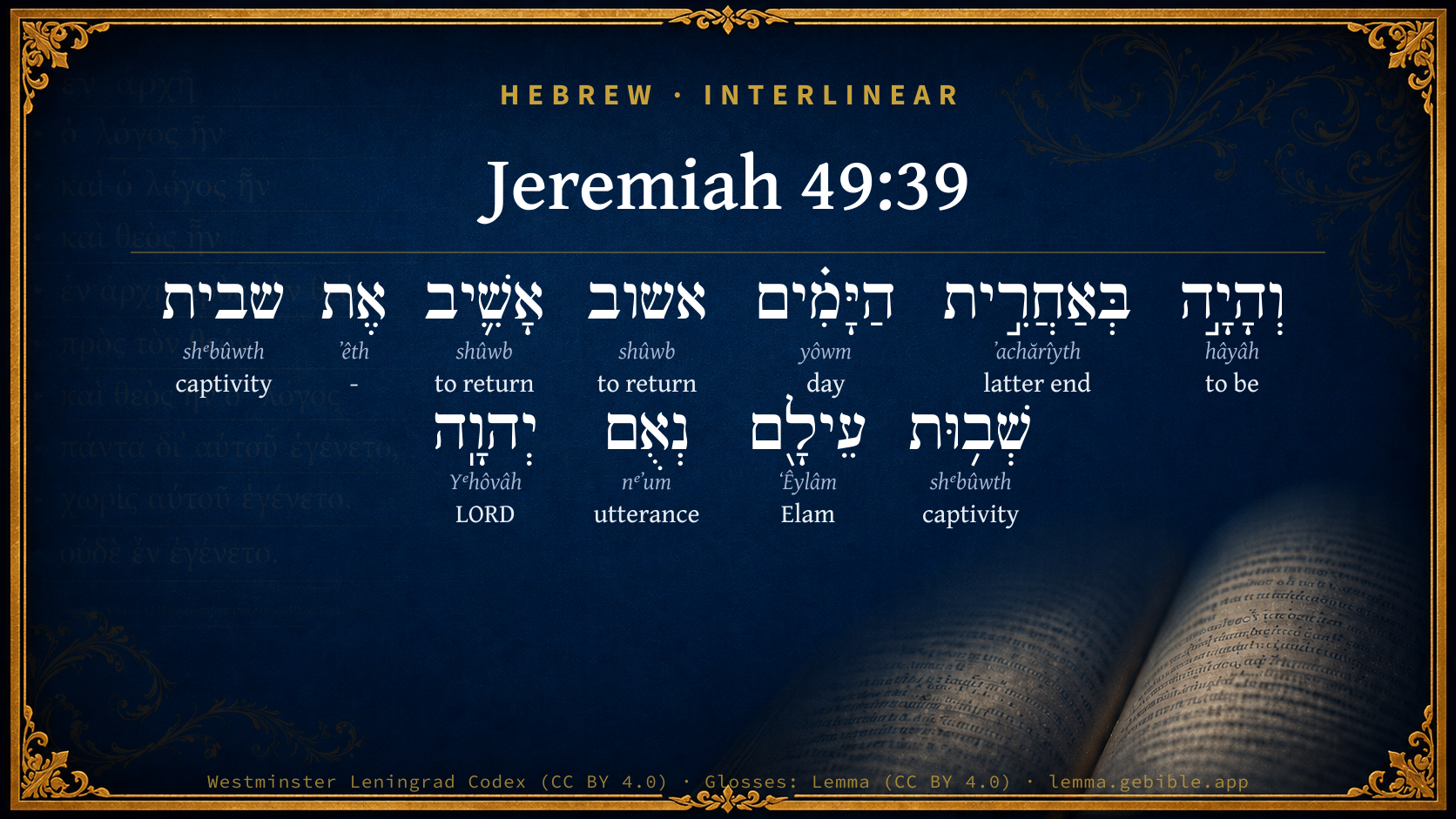
  1. וְהָיָ֣ה hâyâh H1961 “and · to be” Conjunction + Verb, Qal, Sequential Perfect, 3rd Person, Masculine, Singular
  2. בְּאַחֲרִ֣ית ʼachărîyth H319 “in/at · latter end of” Preposition + Noun, Common, Feminine, Singular, Construct
  3. הַיָּמִ֗ים yôwm H3117 “the · days” Particle, Definite Article + Noun, Common, Masculine, Plural, Absolute
  4. אשוב shûwb H7725 “to return” Verb, Qal, Imperfect, 1st Person, Common, Singular
  5. אָשִׁ֛יב shûwb H7725 “to return” Verb, Hiphil, Imperfect, 1st Person, Common, Singular
  6. אֶת ʼêth H853 “-” Particle, Direct Object
  7. שבית shᵉbûwth H7622 “captivity of” Noun, Common, Feminine, Singular, Construct
  8. שְׁב֥וּת shᵉbûwth H7622 “captivity of” Noun, Common, Feminine, Singular, Construct
  9. נְאֻם nᵉʼum H5002 “utterance of” Noun, Common, Masculine, Singular, Construct
  10. יְהוָֽה Yᵉhôvâh H3068 “LORD” Noun, Proper

About this verse

These counts appear in no published source. They are computed here, from the morphology-tagged text and Lemma’s own curated glosses. What Lemma adds →

11
words
9
distinct lemmas
Prophets
section

Shared distinctive vocabulary

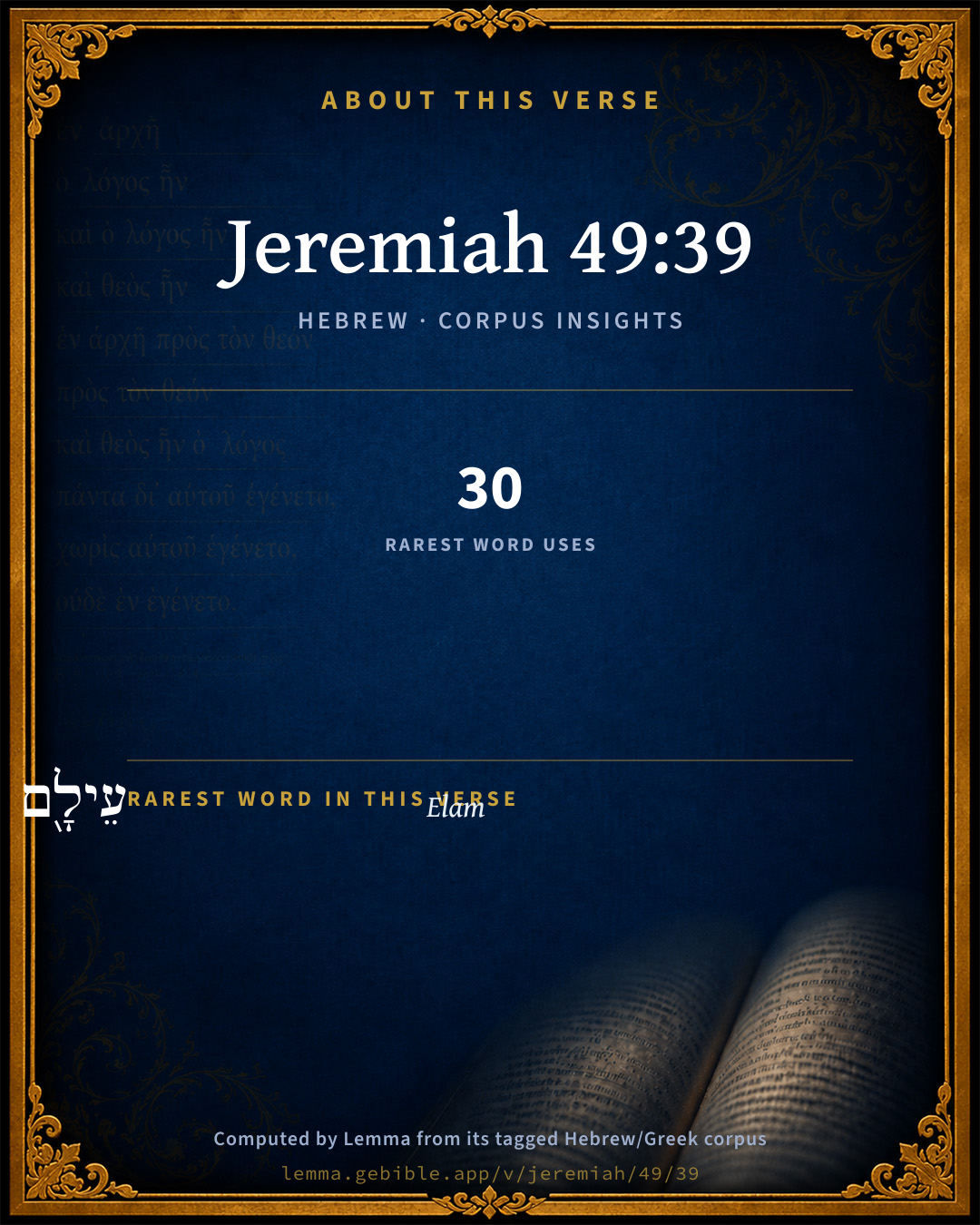
עֵילָ֖ם Elam H5867 occurs in 27 verses of the Hebrew Bible. Also found in:

Grammatical profile

  • 3 verbs
  • 7 nouns
  • 1 particle

Verb forms

  • וְהָיָ֣ה Qal · Sequential Perfect
  • אשוב Qal · Imperfect
  • אָשִׁ֛יב Hiphil · Imperfect

Repetition

Words recur within this verse — often emphatic in Hebrew:

  • אשוב to return H7725 ×2
  • שבית captivity H7622 ×2

Cross-references

13

Topical passages linked to Jeremiah 49:39 in the Treasury of Scripture Knowledge — connected by theme and wording, ordered by reader-vote popularity; previews shown in the World English Bible.

  • Jeremiah 48:47 Yet will I bring back the captivity of Moab in the latter days, says Yahweh. Thus far is the judgment of Moab.
  • Job 42:10 Yahweh turned the captivity of Job, when he prayed for his friends. Yahweh gave Job twice as much as he had before.
  • Isaiah 2:2 It shall happen in the latter days, that the mountain of Yahweh's house shall be established on the top of the mountains, And shall be raised above the hills; And all nations shall flow to it.
  • Jeremiah 49:6 But afterward I will bring back the captivity of the children of Ammon, says Yahweh.
  • Ezekiel 16:53–55 I will turn again their captivity, the captivity of Sodom and her daughters, and the captivity of Samaria and her daughters, and the captivity of your captives in the midst of them;
  • Ezekiel 29:14 and I will bring back the captivity of Egypt, and will cause them to return into the land of Pathros, into the land of their birth; and they shall be there a base kingdom.
  • Ezekiel 38:16 and you shall come up against my people Israel, as a cloud to cover the land: it shall happen in the latter days, that I will bring you against my land, that the nations may know me, when I shall be sanctified in you, Gog, before their eyes.
  • Ezekiel 39:25 Therefore thus says the Lord Yahweh: Now will I bring back the captivity of Jacob, and have mercy on the whole house of Israel; and I will be jealous for my holy name.
  • Daniel 2:28 but there is a God in heaven who reveals secrets, and he has made known to the king Nebuchadnezzar what shall be in the latter days. Your dream, and the visions of your head on your bed, are these:
  • Daniel 10:14 Now I have come to make you understand what shall happen to your people in the latter days; for the vision is yet for [many] days:
  • Hosea 3:5 Afterward the children of Israel shall return, and seek Yahweh their God, and David their king, and shall come with trembling to Yahweh and to his blessings in the last days.
  • Amos 9:14 I will bring back the captivity of my people Israel, And they will rebuild the ruined cities, and inhabit them; and they will plant vineyards, and drink wine from them. They shall also make gardens, And eat the fruit of them.
  • Micah 4:1 But in the latter days, It will happen that the mountain of Yahweh's temple will be established on the top of the mountains, And it will be exalted above the hills; And peoples will stream to it.

Cross-references courtesy of OpenBible.info (CC BY 4.0).

Hebrew and Greek witnesses Masoretic Hebrew ↔ Greek Septuagint

The same verse in the two great witnesses to the Old Testament, shown verse-for-verse.

These are two independent witnesses, not word-aligned to each other, and the Septuagint is shown in lemma (dictionary) form.

Hebrew Jeremiah 49:39 Masoretic · Westminster Leningrad Codex

וְהָיָ֣ה בְּאַחֲרִ֣ית הַיָּמִ֗ים אשוב אָשִׁ֛יב אֶת שבית שְׁב֥וּת עֵילָ֖ם נְאֻם יְהוָֽה

But it shall happen in the latter days, that I will bring back the captivity of Elam, says Yahweh.

World English Bible · Public Domain

Greek LXX Structure differs

In the Septuagint, Jeremiah is about an eighth shorter than the Hebrew and arranges its material differently — the Oracles Against the Nations (Hebrew chapters 46–51) appear in the middle of the Greek book, after 25:13. Because the chapter and verse boundaries do not line up, a verse-for-verse comparison with the Hebrew is not shown.

A verse-for-verse comparison isn’t shown here because the chapters and verses don’t line up. Switch to the LXX edition with the MT / LXX toggle above to read the Greek directly.

Hebrew: Westminster Leningrad Codex (CC BY 4.0). Greek: Septuagint (public domain); English from a public-domain English Septuagint. How the Septuagint differs from the Hebrew →

Targum (Aramaic paraphrase)

1

The Targum is the ancient Jewish Aramaic paraphrase of the Hebrew Scriptures — an interpretive translation, not the Hebrew text itself. Onkelos (literal) and Pseudo-Jonathan (expansive) render the Torah, and Jonathan the Prophets. Coverage is partial: where no permissively-licensed English translation exists for a verse, only the Aramaic is shown. This is verse-level text, not a word-by-word alignment to the Hebrew.

  1. Targum Jonathan Prophets (Joshua–Malachi)
    וִיהֵי בְּסוֹף יוֹמַיָא אֲתֵיב יַת גָלוּת עֵילָם אֲמַר יְיָ:

    (no public-domain English translation for this verse)

    Targum Jonathan — Aramaic: “Mikraot Gedolot” (public domain). English: “Sefaria Community Translation” (CC0 1.0 (public-domain dedication)); “London "Chaldee Paraphrase," 1871” (public domain). Text via Sefaria.

Commentary

Notes on Jeremiah 49:39 from classic Christian and Jewish commentators (each source and its license shown beneath its notes). The classic Christian expositions comment on the surrounding passage and are grouped to its opening verse, so a note may address several verses; the Jewish commentaries on the Tanakh (Rashi and others) are per-verse, so they appear only where the commentator wrote on this verse.

Lemma curates 59 commentaries, every one of them public domain or Creative Commons licensed, each selected and text-cleaned for this edition rather than reprinted as found. About our sources →

Trapp's Complete Commentary

John Trapp

Jer 49:39 But it shall come to pass in the latter days, [that] I will bring again the captivity of Elam, saith the LORD.

Ver. 39. I will bring again the captivity of Elam.] Principally by bringing them to Jesus Christ. And so we read {Act 2:9} of Parthians, Medes, and Elamites among those first and best believers. Eusebius {a} also telleth us that in the Council of Nice there was a bishop from Persia; and Theodoret, a very good man, in addition a great writer, served the churches of the Elamites. {b}

{a} In Vit. Constant.

{b} Claruit Theod., A.D. 390.

John Trapp, A Commentary or Exposition upon All the Books of the Old and New Testament (1647–1656) — public domain. Text from a community e-Sword module.

Joseph Benson's Commentary

Jer 49:39. In the latter days, I will bring again the captivity of Elam — This is supposed to relate to the times of the Lagi and Seleucidæ, when the Elamites recovered their liberty. Or, if we consider what is said in the foregoing verse to relate to Nebuchadnezzar, this may be understood of Cyrus’s setting them free from the Babylonish yoke; for we find from Isa 22:6, that the Elamites assisted Cyrus in the conquest of Babylon; and Shushan, the chief city of Elam, was made the metropolis of the Persian empire.

Joseph Benson's Commentary on the Old and New Testaments (1811–1818) — public domain. Text from a community e-Sword module.

Tyndale Open Study Notes

Tyndale Open Resources

49:39 The Lord’s decree of judgment was balanced by his promise to restore the fortunes of Elam. In 539 BC, a native of Elam named Cyrus conquered Babylon and founded the Persian Empire. Susa, the former capital of Elam, then became the capital of the Persian Empire (Esth 1:2). Cyrus would be God’s anointed instrument to set the Jews free (Isa 44:28–45:1).

Tyndale Open Study Notes — © Tyndale Open Resources, licensed CC BY-SA 4.0. Text via the HelloAO Bible API.

Jamieson, Fausset & Brown

Robert Jamieson, A. R. Fausset & David Brown

latter days--The full restoration belongs to gospel times. Elamites were among the first who heard and accepted it (Act 2:9).

After the predictions of judgment to be inflicted on other nations by Babylon, follows this one against Babylon itself, the longest prophecy, consisting of one hundred verses. The date of utterance was the fourth year of Zedekiah, when Seraiah, to whom it was committed, was sent to Babylon (Jer 51:59-60). The repetitions in it make it likely that it consists of prophecies uttered at different times, now collected by Jeremiah to console the Jews in exile and to vindicate God's ways by exhibiting the final doom of Babylon, the enemy of the people of God, after her long prosperity. The style, imagery, and dialogues prove its genuineness in opposition to those who deny this. It shows his faithfulness; though under obligation to the king of Babylon, he owed a higher one to God, who directed him to prophesy against Babylon.

Next: Jeremiah Chapter 50

Jamieson, Fausset & Brown — Commentary Critical and Explanatory on the Whole Bible (1871) — public domain (CC PDM 1.0). Text via the HelloAO Bible API.

Adam Clarke's Commentary

Verse 39. I will bring again the captivity of Elam] As this is to be in the latter days, probably it may mean the spiritual freedom which these people would receive under the Gospel dispensation. Under Cyrus, the Elamites, collected out of all quarters, were united with the Persians, their neighbours, and became, with them, masters of the east. See Calmet and Dahler. There are still, however, difficulties on this subject. Who the Elamites were is still a question. That which appears to be nearest the truth is, that the Elamites and Persians were two distinct people, and continued so till blended together under Cyrus. It is in this light that I have considered the subject in the preceding notes. Neighbouring people are frequently confounded in history, and sometimes the name of a people is given to those who have the same character.

Adam Clarke's Commentary on the Bible (1810–1826) — public domain. Text from a community e-Sword/MySword module.

John Calvin's Commentaries

Here God mitigates the severity of the prediction, because he would at length gather some of the Elamites and restore them, so that they might again obtain some place or honor. He says not in the end of days, but after many days, It shall be in course of time that I will restore the captivity of Elam If it be asked when this was fulfilled, doubtless there has not been a restoration of that nation recorded in history. But the Prophet no doubt gives here a hope to the Elamites, which he gave before to other nations, even that they should be united again under Christ as their head. Though then the Elamites were not afterwards known, yet they have found out that this was not said in vain; nor does the Holy Spirit without reason mention them by the mouth of Luke among others who were converted to Christ. (Acts 2:9.) For though the Elamites were almost unknown, yet he connects them with the Medes and Parthians, “Parthians and Medes and Elamites.” This then was the time of which Jeremiah had prophesied, when he said that the Elamites would again be gathered together, that they might not be perpetually captives. And though they might not have then returned into their own country, yet it was a condition far better and more desirable when they obtained a name and a place in the Church than if they had enjoyed every other blessing in the world. And we know that it is said of Christ, that God would gather under his hand all things scattered both in heaven and earth. (Colossians 1:20.) A part of this scattering was God’s vengeance on the Elamites. Gathered then have been Elamites with others; and thus God at that time stretched forth in a manner his hand to them through Christ the Mediator, and opened to them the door of hope as to eternal life.

John Calvin's Commentaries (1540-1563) — public domain. Text from the Calvin Translation Society English edition (1840s-50s) via the Christian Classics Ethereal Library (ccel.org). Calvin's coverage is partial (roughly two-thirds of the Bible); uncommented books and verses are honest gaps, never fabricated. The 19th-century editor's footnotes and remarks are omitted so the notes are faithfully Calvin's own voice.

Ellicott's Commentary for English Readers

(39) I will bring again the captivity of Elam.—Of the special history of Elam, as distinct from the other provinces of the Persian Empire, history records but little. The mention of Elamites among those who were present at Jerusalem on the day of Pentecost (Act_2:9) shows that they were a recognised province under the Parthian monarchy, and that Jews had settled among them in large numbers, and so supplies a partial fulfilment of their return from their captivity.

A Bible Commentary for English Readers, edited by Charles John Ellicott (1878–1897) — public domain. Text from a community e-Sword module.

John Gill's Exposition

But it shall come to pass in the latter days,.... Not in the times of Cyrus, when these people enjoyed their liberty, as the Jews and other nations did, freed by him from the Babylonian yoke; which cannot with propriety be called the latter days, being but seventy or eighty years at most after this prophecy; but in the times of the Messiah, often in prophecy called the latter days:

that I will bring again the captivity of Elam, saith the Lord: which was accomplished in a spiritual sense, when some of these people, the Elamites, were converted to Christ, and delivered by him from the captivity of sin and Satan, and were brought into the glorious liberty of the children of God; see Act 2:9.

Next: Jeremiah Chapter 50

John Gill's Exposition of the Whole Bible (1746–1763) — public domain (CC PDM 1.0). Text via the HelloAO Bible API.

Albert Barnes' Notes on the Bible

Elam - Elam was subject to Babylon Dan 8:2, and its capital Shushan a favorite residence of the Persian kings Est 1:2. Of its subsequent fate we know little; the Elamites continued to exist, and members of their nation were present at Pentecost among those chosen to represent the Gentile world at the first preaching of the Gospel Act 2:9.

Albert Barnes' Notes on the Bible (1834–1885) — public domain. Text from a community e-Sword/MySword module.

Haydock's Catholic Bible Commentary

Return. They joined the standards of Cyrus, and became masters of the East. (Calmet) --- This and similar texts are understood of the conversion of the Gentiles, Acts ii. 7. (Worthington)

George Leo Haydock (1774–1849), Haydock's Catholic Family Bible and Commentary, 1859 edition — public domain. Excludes Psalms (Douay-Rheims chapter numbering differs from Protestant) and Deuterocanonical books (Catholic canon only).

Matthew Poole's English Annotations

We had the like promise as to Moab, Jer 48:47, and as to Ammon, Jer 49:6; the same

latter days either signify after many days, or in the time of the Messias. In the former sense it may refer to Cyrus, who conquered Persia. In the latter sense it is referred to the spiritual liberty which some of these poor heathens were brought into by the gospel. We read, Act 2:9, that some of these Elamites were at Jerusalem at Pentecost, and were some of those converted to Christ.

Matthew Poole's English Annotations on the Holy Bible (1683–1685) — public domain. Text from a community e-Sword/MySword module.

Whedon's Commentary on the Bible

Daniel D. Whedon

39. In the latter days — The end of days; the Messianic reign. The beginning of this promise was seen at Pentecost.

Daniel D. Whedon (gen. ed.), Commentary on the Old and New Testaments (1874–1909) — public domain. Text from a community e-Sword module.

The Pulpit Commentary

But... in the latter days; i.e. presumably in the Messianic age. Into the fulfilment of this promise we need not inquire in too prosaic a spirit. It is true that "Elamites" are mentioned among the persons present on the great "day of Pentecost". (Act_2:9) But this would be a meagre fulfilment indeed. The fact is that, both in the narrative in the Acts and in this prophecy, the Elamites are chiefly mentioned as representatives of the distant and less civilized Gentile nations, and the fulfilment is granted whenever a similar people to the Elamites is brought to the knowledge of the true religion.

The Pulpit Commentary (1880–1919), ed. H.D.M. Spence-Jones & Joseph S. Exell — public domain. Text from a community e-Sword module.

John Wesley's Explanatory Notes

But - We had the like promise as to Moab, chap. xlviii, 47, and as to Ammon, ver. xlix, 6, the same latter days either signify after many days, or in the time of the Messiah. In the former sense it may refer to Cyrus, who conquered Persia. In the latter sense it refers to the spiritual liberty which some of these poor Heathens were brought into by the gospel. We read Acts ii, 9, that some of the Elamites were at Jerusalem at pentecost, and were some of those converted to Christ.

John Wesley, Explanatory Notes Upon the Whole Bible (1754–1765) — public domain. Text via the GEBible commentary corpus.

Lesson kit

Teaching starters — assembled from the data on this page, not authored interpretation. Every prompt links to the verse data it draws on. Edit before teaching.

Jeremiah, in the Prophets, opens this verse with 11 words (9 distinct Hebrew lemmas). Its most distinctive word is ʻÊylâm (“Elam”). A historical commentator’s framing appears above. Read the whole chapter for the surrounding context.

Discussion questions

  1. What does “Elam” (ʻÊylâm) contribute to the verse as a whole?
  2. Genesis 10:22 shares the word «Elam» with this verse. How do the two illuminate each other?
  3. “to return” occurs 2× in this one verse. What is the effect of the repetition?
  4. These translations render this verse differently; the difference is in the English rendering, not the original. What questions does that raise?
  5. The verb «וְהָיָ֣ה» is Qal Sequential Perfect. How does its form color the action?
  6. Reading how Trapp's Complete Commentary and Joseph Benson's Commentary read this verse, where do the two commentators agree and where do they part?

Things to notice

  • These translations choose different wording for 17 words in this verse.
  • “to return” occurs 2× in this single verse.
  • 9 distinct Hebrew lemmas span 11 words in this verse.

Reading settings

Reading text

Shown beneath each verse's original-language words.

Old Testament
Old Testament edition

Read the OT as the Masoretic Hebrew (MT) or the Greek Septuagint (LXX).

English shown for the Greek Septuagint (in the Hebrew ↔ Greek comparison).

Comparing translations? Open the Compare panel on any verse page to stack up to four side by side.