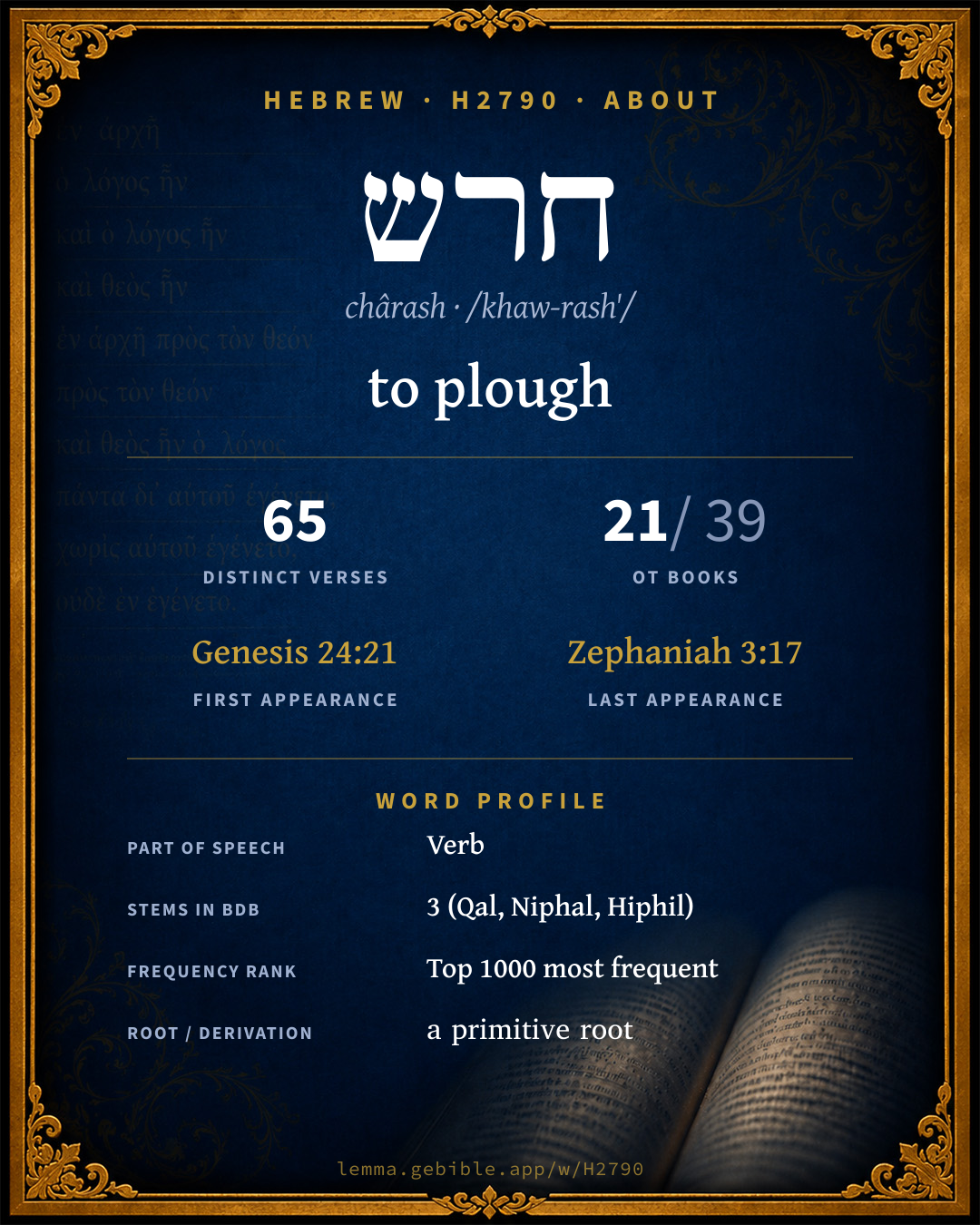
חרש
to plough
‘to plough’ is one of 2 main senses fuller range ↓
Full lexicon entry — Brown-Driver-Briggs (BDB)
From Brown-Driver-Briggs (BDB)
Where this word appears
Grammar key — what these labels mean
Part of speech
- Verb
- An action or state-of-being word.
Stem
- Qal
- The basic, simple active stem — the plain form of the verb (“he wrote”). Here: ‘cut in’
- Hiphil
- The causative active stem (“he caused / brought about”). Here: ‘be silent’
- Niphal
- Usually the simple passive or reflexive of the Qal (“he was written”).
- Hithpael
- The reflexive or reciprocal stem (the subject acts on itself).
Form
- Jussive
- A third- or second-person volitional form expressing wish or command (“let him write”).
- Imperfect
- An incomplete, ongoing, or future action (“he will / would write”).
- Participle Active
- A verbal adjective expressing ongoing or characteristic action (“writing / one who writes”).
- Sequential Perfect
- A perfect with prefixed waw continuing a preceding imperfect or command (waw-consecutive perfect).
- Sequential Imperfect
- An imperfect with prefixed waw — the standard past-narrative form (waw-consecutive imperfect).
- Infinitive Absolute
- An unbound verbal noun, often intensifying or standing in for a finite verb.
- Imperative
- A direct command (“write!”).
- Perfect
- A completed action or state — Hebrew marks aspect (completeness) more than strict tense (“he wrote”).
- Infinitive Construct
- A bound verbal noun, frequently with prepositions (“to write / in writing”).
- Participle Passive
- A verbal adjective expressing action received (“written”).
State
- Construct
- A noun bound to a following noun in a possessive / “of” relationship (the construct chain).
- Absolute
- The independent form of a noun, not bound to a following word.
Person
- 2nd Person
- The one addressed (“you”).
- 1st Person
- The speaker (“I / we”).
- 3rd Person
- The one spoken about (“he / she / it / they”).
Gender
- Masculine
- Grammatically masculine.
- Common
- Either gender — not distinguished for this form.
- Feminine
- Grammatically feminine.
Number
- Singular
- One.
- Plural
- More than one (in Hebrew, generally three or more).
Every verse where H2790 appears in the Book of Numbers — 4 distinct verses. Click any verse to open its interlinear word-by-word view. Verse text shown in the World English Bible for context — . Each verse’s Hebrew form is shown with its reference; the English is not keyword-highlighted, since the data carries no word-level English alignment. Use “Compare translations” on any verse to read it across multiple English versions. This concordance covers the Hebrew Bible; Septuagint (Greek Old Testament) occurrences are not indexed here.
Numbers
- Numbers 30:4 וְ/הֶחֱרִ֥ישׁ conj + Hiphil wpf 3ms and her father hears her vow, and her bond with which she has bound her soul, and her father holds his peace at her; then all her vows shall stand, and every bond with which she has bound her soul shall stand.
- Numbers 30:7 וְ/הֶחֱרִ֣ישׁ conj + Hiphil wpf 3ms and her husband hear it, and hold his peace at her in the day that he hears it; then her vows shall stand, and her bonds with which she has bound her soul shall stand.
- Numbers 30:11 וְ/הֶחֱרִ֣שׁ conj + Hiphil wpf 3ms and her husband heard it, and held his peace at her, and didn't disallow her; then all her vows shall stand, and every bond with which she bound her soul shall stand.
- Numbers 30:14 הַחֲרֵשׁ֩ יַחֲרִ֨ישׁ הֶחֱרִ֥שׁ Hiphil inf.abs Hiphil impf 3ms Hiphil pf 3ms But if her husband altogether hold his peace at her from day to day, then he establishes all her vows, or all her bonds, which are on her: he has established them, because he held his peace at her in the day that he heard them.
About this entry
At a glance — auto-summarized from this page’s data, not written by a person. Every figure links to its source below. This summary describes the numbers; it doesn’t interpret them.
“to plough” is the headline sense of the Hebrew verb חרש (chârash). First canonically at Genesis 24:21, it enters the text early. With 65 verses in 21 books, it is a moderately common word in the Hebrew Bible. The verb spans 3 stems, from Qal to Niphal. It clusters with חריש, חרישי and חרש under a shared root. The sections below give every sense, occurrence, and version rendering.
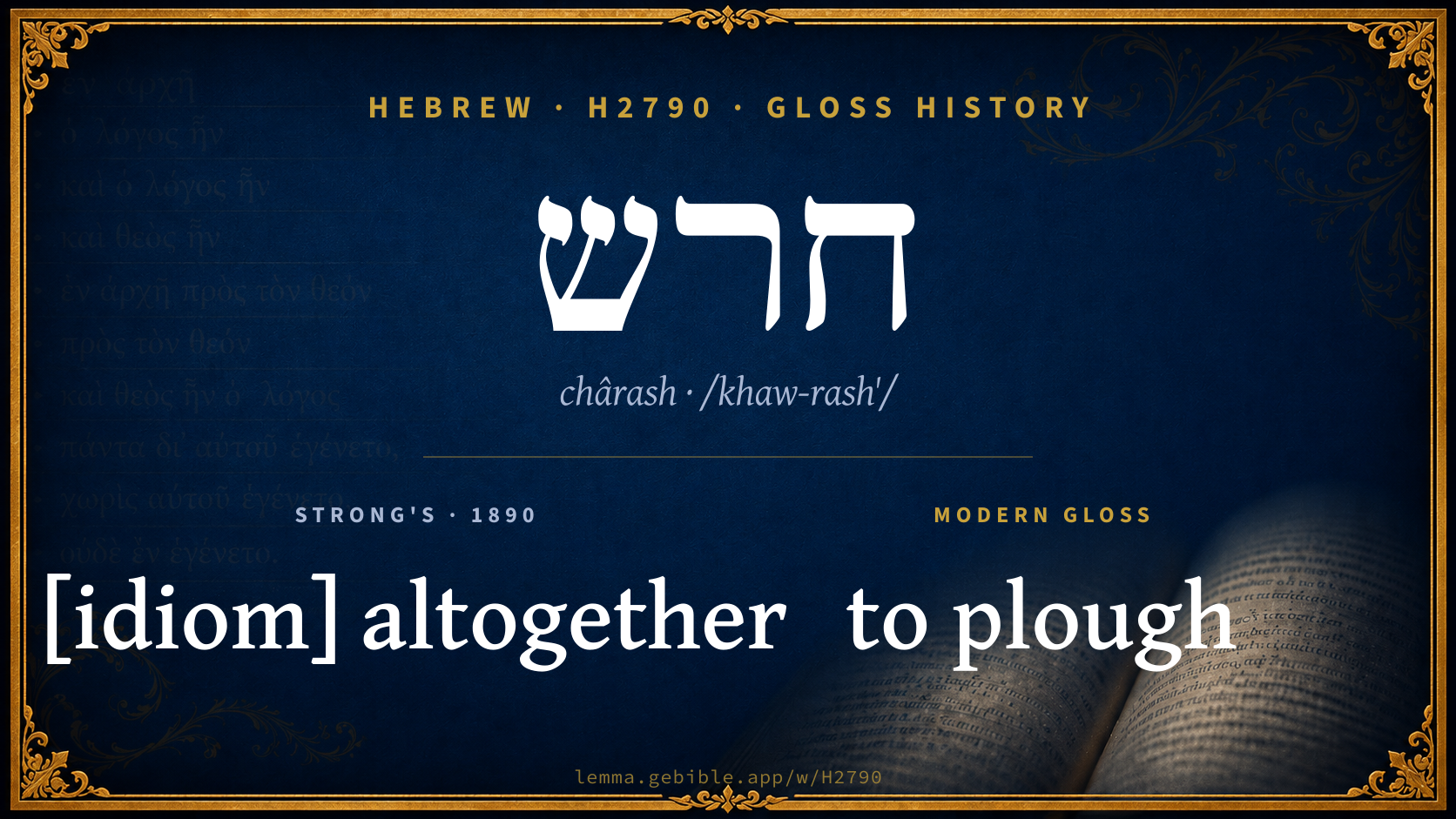
Gloss history
Strong's 1890 vs modern scholarship
About this word
Strong's H2790 catalogs a Hebrew word from the Hebrew Old Testament.
These counts are not copied from any lexicon or concordance. They are computed here, from the morphology-tagged Hebrew Old Testament. What Lemma adds →
- 65
- distinct verses
- The word appears in 65 distinct verses.
- 21 / 39
- OT books
- The word appears in 21 of 39 Old Testament books.
- #550
- by frequency
- Top 1000 most frequent Hebrew words (rank 550 of 8,640 Hebrew words by occurrence).
View all 65 occurrences in the concordance →
By section of the Old Testament
By traditional corpus
Conventional, traditional groupings — biblical authorship is debated, so this is a traditional corpus grouping, not an authorship claim. Each share is this word’s portion of its verses in that division of the Hebrew canon. Each figure is a share of the word’s 65 distinct verses.
- Writings (Ketuvim) 30 verses · 46%
- Prophets (Nevi'im) 27 verses · 42%
- Torah (Pentateuch) 8 verses · 12%
How translations render this word
Counts come from each version’s own published word-to-Strong’s tagging or interlinear alignment — an approximate guide to how each version renders this word, not a word-level alignment the data otherwise carries. Because each total is that version’s own tagged count, the per-version totals vary from one another and need not match the appearance or distinct-verse counts above. These counts may also differ from a printed concordance because Lemma counts each distinctly tagged rendering and does not collapse phrase taggings into a single head-word total. This is a fixed set of word-tagged versions (KJV, ASV, BSB, ULT) and does not change with the reading translation you choose elsewhere. Each version’s license is shown beside its name below (and on Sources).
BDB lists this Strong’s number as 2 distinct words (homographs). Each count above pools all of them and is not split by sense — see the Senses section below. A low-frequency rendering may belong to a different one of those words, not the primary meaning.
- King James Version†: Held his peace 4×, Hold not thy peace 3×, Hold thy peace 3×
- American Standard Version†: Me 5×, Devise 3×, Hold not thy peace 3×
- Berean Standard Bible†: Be silent 5×, Plow 4×, Says nothing 4×
- unfoldingWord Literal Text†: Be silent 7×, Do 3×, Is silent 3×
King James Version Public Domain
Renders H2790 across 74† tagged occurrences — most commonly:
Plus 56 renderings that appear only once — usually multi-word phrases or single function words the recovered tagging swept in, not distinct renderings.
American Standard Version Public Domain
Renders H2790 across 74† tagged occurrences — most commonly:
Plus 51 renderings that appear only once — usually multi-word phrases or single function words the recovered tagging swept in, not distinct renderings.
Berean Standard Bible Public Domain
Renders H2790 across 69† tagged occurrences — most commonly:
Plus 41 renderings that appear only once — usually multi-word phrases or single function words the recovered tagging swept in, not distinct renderings. Not rendered by a distinct English word in 3 further occurrences.
unfoldingWord Literal Text CC BY-SA 4.0
Renders H2790 across 89† tagged occurrences — most commonly:
Plus other, less common renderings. Plus 42 renderings that appear only once — usually multi-word phrases or single function words the recovered tagging swept in, not distinct renderings.
18 senses and sub-senses in the full BDB
Hebrew verbs can shift meaning by stem (binyan): Qal is the basic action, Niphal is often passive or reflexive, Piel often intensifies or makes it factitive, and Hiphil is typically causative. The senses below are grouped under the stem BDB assigns to each.
What do BDB’s symbols mean?
BDB uses these scholarly abbreviations:
| Symbol | Meaning |
|---|---|
| 𝔊 | the Septuagint (the ancient Greek translation, LXX) |
| 𝔙 | the Vulgate (the Latin translation) |
| 𝔖 | the Syriac version (the Peshitta) |
| 𝔗 | the Targum (the Aramaic translation) |
| ψ | the Psalms |
| √ | root (the underlying root or stem) |
| ‖ | parallel passage (a synonymous or contrasted parallel) |
| † | the dagger: every passage where the word occurs is cited |
The 18 senses and sub-senses the full Brown-Driver-Briggs lexicon distinguishes for this word, in lexicon order (not ranked by frequency), with BDB’s own verbatim wording and sub-sense lettering. Shown in Hebrew script with BDB’s own scholarly abbreviations. The condensed entry is in the Lexicon Entry tab. See also the Forms in the corpus table below.
חרש I
Qal
- Pf. חָֽרְשׁוּ ψ 129:3, חֲרַשְׁתֶּם Ju 14:18 Ho 10:13; Impf. יַחֲרֹשׁ Is 28:24 Pr 20:4; יַחֲרוֹשׁ Ho 10:11 + Am 6:12 (v. infr.); 2 ms. תַּחֲרֹשׁ Dt 22:10 Pr. 3:29; Inf. cstr. חֲרֹשׁ 1 S 8:12; Pt. חֹרֵשׁ Gn 4:22 + 5 times; חוֹרֵשׁ Am 9:13; pl. חֹרְשִׁים ψ 129:3, חֹרְשֵׁי Jb 4:8 + 3 times, fpl. abs. חֹרְשׁוֹת Jb 1:14; pass. חֲרוּשָׁה Je 17:1:— e.g. Psalms 129:3
- 1. cut in, engrave, of worker in metals ח׳ נְחֹשֶׁת וּבַרְזֶל Gn 4:22 (J), ח׳ נחשׁת 1 K 7:14; fig. ח׳ עַל־לוּחַ לִבָּם Je 17:1 engraved on the tablet of their heart. e.g. Genesis 4:22
- 2. plough, lit., human subj. (animal usually c. בְּ), no obj. expr. 1 K 19:19 Dt 22:10 Is 28:24, so יַחֲרוֹשׁ בבקרים Am 6:12 (but read prob. יֵחָרֵשׁ בבקר יָם, v. We al.); c. acc. cogn. ח׳ חֲרִישׁוֹ 1 S 8:12 plough his ploughing (= do his ploughing), Pr 20:4; fig. Ju 14:18 Ho 10:11; with ethical ref. ח׳ רֶשַׁע v 13 (‖ קצר), ח׳ אָוֶן Jb 4:8 (‖ זרע, קצר); עַל־גַּבִּי חָֽרְשׁוּ חֹרְשִׁים ψ 129:3 upon my back have ploughmen ploughed (fig. of oppression by wicked); חֹרֵשׁ = ploughman Is 28:24, Am 9:13 (‖ קוֹצֵר); ח׳ with oxen subj. only Jb 1:14. e.g. 1 Kings 19:19
- 3. devise (as one who works in, practises), usually bad sense, obj. רָעָה Pr 3:29, רַע 6:14; מַחְשְׁבוֹת אָוֶן v 18, חֹרְשֵׁי רַע Pr 12:20; 14:22; but also חֹרְשֵׁי טוֹב v 22. e.g. Proverbs 3:29
Niphal
- Impf. 3 fs. צִיּוֹן שָׂדֶה תֵּחָרֵשׁ Mi 3:12 Zion, as a field she shall be ploughed = Je 26:18. e.g. Micah 3:12
Hiphil
- Pt. מַחֲרִישׁ רָעָה עַל־ 1 S 23:9 fabricating mischief against (v. Dr, and cf. We). e.g. 1 Samuel 23:9
חרש II
- 1. be silent, dumb, speechless;
- 2. be deaf; chiefly poet. (NH Pi. make deaf; Aramaic ܚܪܶܫ, ܚܪܰܫ be dumb, deaf; Arabic خَرِسَ be dumb, speechless, cf. Assyrian ḫarâšu, restrain, according to DlPr 100; v. LagBN 120)—
Qal
- Impf. יֶחֱרָ֑שׁ ψ 50:3; 2 ms. תֶּחֱרַשׁ ψ 28:1; 83:2; תֶּחֱרַ֑שׁ ψ 35:22; 109:1; תֶּחֱרָ֑שׁ ψ 39:13; 3 fpl. תֶּחֱרַ֑שְׁנָה Mi 7:16;— e.g. Psalms 50:3
- 1. be silent, always of God’s keeping silence when men pray ψ 35:22; 50:3; 83:2; 109:1; sq. אֶל־ 39:13. e.g. Psalms 35:22
- 2. be deaf, subj. י׳, sq. מִמֶּנִּי ψ 28:1; subj. אָזְנַיִם Mi 7:16. e.g. Psalms 28:1
Hiphil
- Pf. חֶחֱרִשׁ Nu 30:15 Gn 34:5; וְהֶחֱרִישׁ consec. Nu 30:5, 8; וְהֶחֱרִשׁ consec. Nu 30:12; הֶחֱרַ֫שְׁתִּי Est 7:4 + 2 times etc.; Impf. יַחֲרִישׁ Nu 30:15 + 2 times (incl. Zp 3:17 v. infr.); 2 ms. תַּחֲרִישׁ Hb 1:13; juss. תַּחְרֵשׁ 1 S 7:8; 2 mpl. תַּחֲרִישׁוּן Jb 13:5; תַּחֲרִשׁוּן Ex 14:14, etc.; Imv. הַחֲרֵשׁ Ju 18:19 + 2 times; הַחֲרִ֫ישִׁי 2 S 13:20; הַחֲרִ֫ישׁוּ Jb 13:13 Is 41:1; Inf. abs. הַחֲרֵשׁ Nu 30:15 + 2 times; Pt. מַחֲרִישׁ Gn 24:21 + 2 times (incl. 1 S 10:27 v. infr.); מַחֲרִישִׁים 2 S 19:11;— e.g. Numbers 30:15
- 1. be silent (= exhibit silence)
- a. almost always of men Gn 24:21; 34:5 Ex 14:14 (all J), Ju 18:19 2 S 13:20; 19:11 2 K 18:36 = Is 36:21, Je 4:19 Jb 6:24; 13:5, 13, 19; 33:31, 33 Pr 11:12; 17:28 ψ 32:3 Ne 5:8 Est 4:14(×2); 7:4; also וַיְהִי כְּמַחֲרִישׁ 1 S 10:27 (but read rather ויהי כְּמֵחֹדֶשׁ and it came to pass after about a month, 𝔊 Dr); יחרישׁ באהבתו Zp 3:17 (𝔊 𝔖 יְחַדֵּשׁ he will renew his love, v. especially BuhlZAW v. 1885, 183); ח׳ c. לְ pers. keep silence at one, i.e. fail to make objection at proper time Nu 30:5, 8, 12, 15(×3) (all P); הח׳ אלי Is 41:1 pregn. = come silently unto me; sq. מִן pers. cease to speak with Je 38:27; be silent about, pass by in silence, sq. acc. אח׳ בַּדָּיו Jb 41:4. e.g. Genesis 24:21
- b. rarely of God, permitting evil in silence Hb 1:13 Is 42:14 ψ 50:21. e.g. Habakkuk 1:13
- 2. once causat. make silent, c. acc. Jb 11:3. e.g. Job 11:3
- 3. be deaf, shew deafness: אַל־תַּחֲרֵשׁ מִמֶּנּוּ מִזְּעֹק 1 S 7:8 be not deaf (turning) from us, so as not to cry. e.g. 1 Samuel 7:8
Hithpa. Hithp
- Impf. 3 mpl. וַיִּתְחָֽרְשׁוּ Ju 16:2 and they kept quiet. e.g. Judges 16:2
Senses from the full Brown-Driver-Briggs lexicon (Brown, Driver, Briggs; Oxford 1906 — public domain), digitized via Sefaria, supplemented by the OpenScriptures HebrewLexicon (CC BY 4.0). Full attribution on Sources.
Word origin
vb. cut in, engrave, plough, devise (NH id., plough, so Ethiopic ሐረሰ Ph. חרש, Aramaic (rare) חֲרַת engrave, ܚܪܰܬ cleave, plough, Arabic حَرَثَ plough)—
— Brown-Driver-Briggs (Oxford 1906, public domain), digitized via Sefaria, supplemented by the OpenScriptures HebrewLexicon (CC BY 4.0). See Sources.
Origin: a primitive root
Jastrow Dictionary
A second Hebrew/Aramaic lexicon for comparison, covering Aramaic and post-biblical (Talmudic, Targumic, Midrashic) usage that the biblical-Hebrew BDB does not. Matched by lemma rather than by Strong’s number, so a lemma may carry more than one Jastrow headword (shown separately below), and the entries cover usage well beyond the Bible.
חֶרֶשׂ
- , v. חֶרֶס
חָרַשׁ I
- (b. h.)
- 1. to engrave, draw, design. Koh. R. to I, 16 הלב חוֹרֵשׁ the heart designs.
- 2. to plough. Macc. III, 9 יש חוֹרֵשׁ תלם וכ׳ one may plough one bed and &c. Taan. 29ᵃ וח׳ את העיר Ms. M. and passed the plough over the city of Jerusalem. Sabb. VII, 2; a. fr.—Trnsf. to have sexual intercourse. Y. Yeb. I, 2ᵇ top. Gen. R. s. 98; a. e.
- to be ploughed over. Taan. IV, 6 נֶחְרְשָׁה העיר the plough was passed over the city of Jerusalem; a. e.
חָרַשׁ II
- Pi. חֵרֵשׁ, חֵי׳ (denom. of חֵרֵשׁ) to deafen, make deaf. B. Kam. 86ᵃ שחֵירְשׁוֹ וכ׳ when he made him deaf without wounding him. Ib. החוֹרֵשׁ את אביו (Ms. H. a. R. חֵרֵשׁ); ib. 98ᵃ חֵרְשׁוֹ לאביו if one injured his father’s hearing; v. חֲרִישָׁה II. Kidd. 24ᵇ.—Sabb. 109ᵃ top. יד מְחָרֶשֶׁת the unwashed hand put to the ear causes deafness.
- 1. same. B. Kam. 86ᵃ להַחֲרִישׁ, v. חֲרִישָׁה II.
- 2. (b. h.) to be silent. Y. Pes. IX, end. 37ᵃ (ref. to Prov. XVII, 28) ואין צ"ל חכם מַחֲרִישׁ and it is needless to say the same of a wise man keeping silence. [Usu. שָׁתַק.] e.g. Proverbs 17:28
- to become deaf (and dumb). Yeb. XIV, 1; Tosef. Ter. I, 1 פיקח ונ׳ if he had been well-hearing and became etc.; v. חֵרֵשׁ.
חֲרַשׁ
- (v. preced. wds.)
- 1. to be entangled. Targ. Job VIII, 17.
- 2. to be choked, obstructed, deaf. Gen. R. s. 81 (prov.) מהולתך חַרְשָׁה וכ׳ if thy sieve is choked, knock at it (when you are forgetful of your duties, the Lord will remind you through affliction); v. טְרַשׁ II.
- 3. to practice witchcraft. Gen. R. s. 86 באתר דחרשין חֲרִישִׁין where there are sorcerers witchcraft is practiced.
- to entangle, inure. Targ. Ez. XIII, 20 (h. text צדד).
- to be entangled, confounded. Y. Ḥag. II, 77ᶜ top (expl. תאלמנה, Ps. XXXI, 19) יִתְחַרְשָׁן וכ׳ may their lips be confounded, crushed, silenced, cmp. אִלֵּם a. חֵרֵשׁ; Gen. R. s. 1 (corr. acc.) e.g. Psalms 31:19
חָרָשׁ
- artist, artisan, carpenter, turner (faber). Deut. R. s. 2 לח׳ שהיה וכ׳ like an artist that was making an image &c.—Pl. חָרָשִׁים. Gen. R. s. 65, end; s. 70, v. חֲמוֹר; Pesik. Shek., p. 15ᵃ.—Trsnf. scholar. Gitt. 88ᵃ (ref. to II Kings XXIV, 16) חָ׳ שבשעה … כחֵרְשִׁין the scholars were named ḥarash, for when they opened argument, all were like dumb; Snh. 38ᵃ; Yalk. Dan. 1066; a. e.—Pl. as above. Ḥag. 14ᵃ (ref. to Is. III, 3). e.g. 2 Kings 24:16
חָרָשׁ ²
- sorcerer, v. חָרָשָׁא.
חֶרֶשׁ
- v. חֵרֵשׁ) silence. Tanḥ. Sh’mini 9 (play on חָרָשׁ, II Kings XXIV, 16) אלו … תפלת ח׳ בלחש וכ׳ ḥarash means those who hold silent prayers in murmuring, and yet conquer &c. e.g. 2 Kings 24:16
חֶרֶשׂ ²
- Ḥeres or Ḥeresh. Ab. IV, 15. Yoma 4ᵇ; a. e.
חֵרֵשׁ
- [closed up,] deaf, dumb (cmp. אִלֵּם); deaf and dumb. Ter. I, 2 ח׳ שדברו וכ׳ the ḥeresh of which the scholars speak (in a legal sense) means everywhere deaf and dumb. Ib. ח׳ המדבר וכ׳ a ḥeresh that can talk but not hear. Meg. II, 4 חוץ מח׳ except a deaf person. Sifré Num. 153 (ref. to Num. XXX, 5; 12) להוציא את הח׳ this excludes the case of the father (the husband) being deaf; Ned. 73ᵃ; a. fr.—Pl. חֵרְשִׁים, חֵרְשִׁין. Ḥag. 14ᵃ; Gitt. 88ᵃ, v. חָרָשׁ. Ruth R. s. 2 beg. (ref. to חרש, Josh. II, 1) עשו עצמכם ח׳ pretend to be deaf.—Fem. חֵרֶשֶׁת. Gitt. V, 5. Yeb. XIV, 1; a. e.—Pl. חֵרְשׁוֹת. Ib. 3. e.g. Numbers 30:5
A Dictionary of the Targumim, the Talmud Babli and Yerushalmi, and the Midrashic Literature (Marcus Jastrow; London, Luzac, 1903) — Public Domain. Digitized via Sefaria. Digitized via Sefaria. Full attribution on Sources.
Forms in the corpus
The 66 distinct written forms H2790 takes in the Hebrew Bible, most frequent first — each parse links to that stem’s occurrences in the concordance. Hebrew forms include their vowel points and cantillation, so a single lemma takes many written forms.
The 60 most common forms are shown; 6 rarer forms follow in the full concordance.
Same root — word family
Other BDB entries built from the same root as H2790, grouped by Strong’s listed origin. These share a root / origin per the lexicon — not necessarily a shared meaning. Each links to that word’s own entry.
Derived from this word
- חריש chârîysh H2758 ploughing
- חרישי chărîyshîy H2759 harsh
- חרש cheresh H2791 silently
- חרש chôresh H2793 forest
- חרש chôrêsh H2794 metalworker
- חרש chêrêsh H2795 deaf
- חרש chârâsh H2796 craftsman
- חרשת chărôsheth H2799 carving
- מחרשה machărêshâh H4281 plowshare
- מחרשת machăresheth H4282 plowshare
Compare all same-root words → Showing 4 of 11 — not the complete family. They share a root, not necessarily a meaning.
Septuagint verse parallels
This word appears in 62 verses that also exist in the Greek Old Testament (Septuagint), out of the 65 Hebrew verses it occurs in. You can read those verses in Greek by switching the Old Testament edition to the Septuagint.
Read these verses in the Septuagint
- Genesis 24:21
- Exodus 14:14
- Numbers 30:4
- Deuteronomy 22:10
- Judges 14:18
- 1 Samuel 7:8
- 2 Samuel 13:20
- 1 Kings 19:19
- 2 Kings 18:36
- Esther 4:14
- Job 1:14
- Psalms 28:1
This is a verse-level parallel only — the same verses exist in both the Hebrew and Greek Old Testaments. No word-level Hebrew↔Greek correspondence is claimed: the data carries no such alignment, so no Greek word is shown as this Hebrew word’s translation. Coverage is not total — the Septuagint omits the deuterocanon and renumbers the Psalms, so some Hebrew verses have no direct Greek parallel.