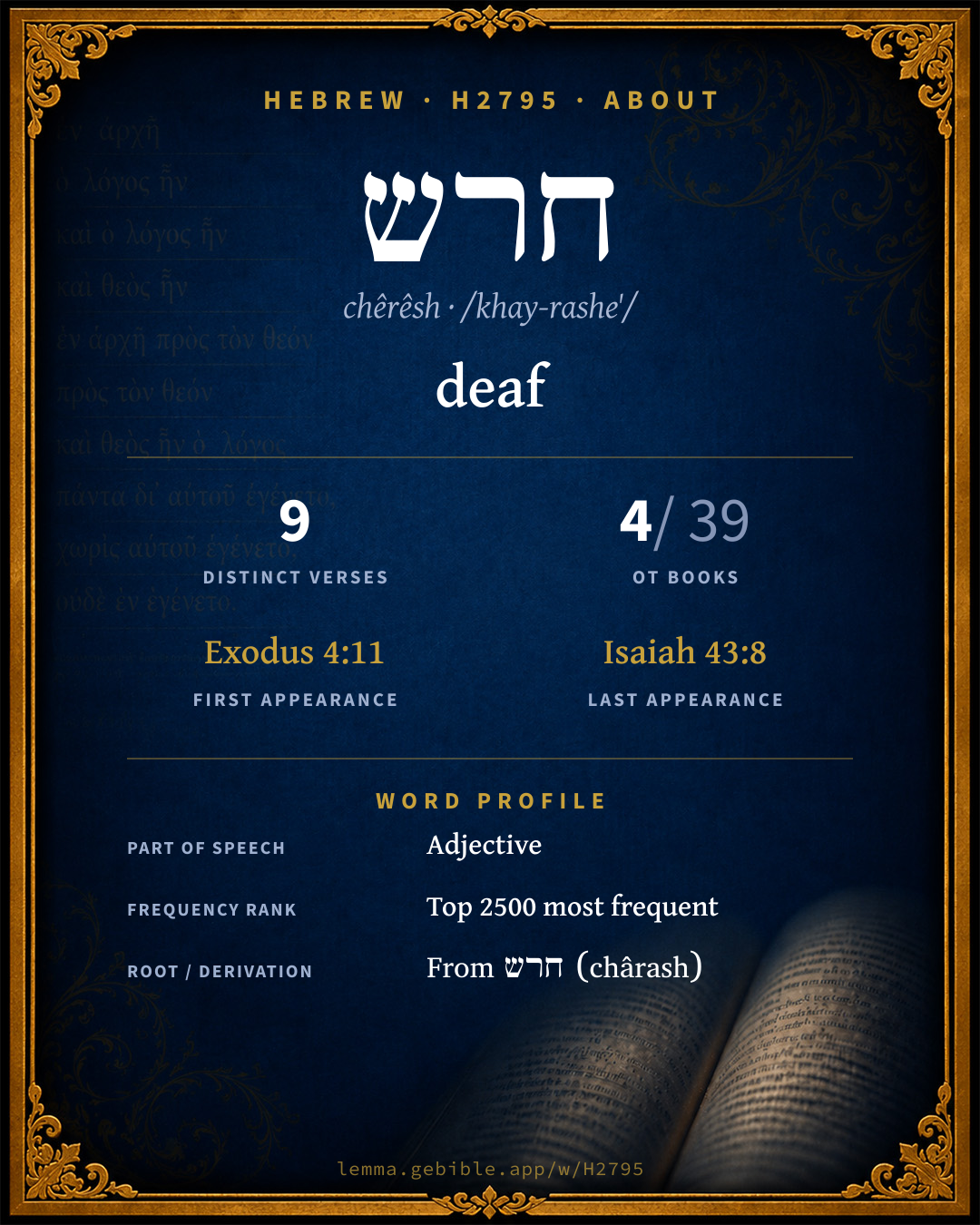
חֵרֵשׁ
deaf
Full lexicon entry — Brown-Driver-Briggs (BDB)
From Brown-Driver-Briggs (BDB)
Where this word appears
Grammar key — what these labels mean
Part of speech
- Adjective
- A word that describes or qualifies a noun.
State
- Absolute
- The independent form of a noun, not bound to a following word.
Gender
- Masculine
- Grammatically masculine.
Number
- Singular
- One.
- Plural
- More than one (in Hebrew, generally three or more).
Grammatical forms
- Adjective, Adjective, Masculine, Singular, Absolute 5 times (56%)
- Adjective, Adjective, Masculine, Plural, Absolute 4 times (44%)
Parsed forms decoded from the imported morphology (morphhb / Westminster Leningrad Codex — WLC text public domain, morphhb tagging CC BY 4.0), counted across 9 parsed occurrences — not distinct verses.
Every verse where H2795 appears — 9 distinct verses across 4 books. Click any verse to open its interlinear word-by-word view. Verse text shown in the World English Bible for context — . Each verse’s Hebrew form is shown with its reference; the English is not keyword-highlighted, since the data carries no word-level English alignment. Use “Compare translations” on any verse to read it across multiple English versions. This concordance covers the Hebrew Bible; Septuagint (Greek Old Testament) occurrences are not indexed here.
Exodus 1 verse
Leviticus 1 verse
Psalms 2 verses
Isaiah 5 verses
- Isaiah 29:18 הַ/חֵרְשִׁ֖ים ptcl def.art + Adjective Adjective mp In that day shall the deaf hear the words of the book, and the eyes of the blind shall see out of obscurity and out of darkness.
- Isaiah 35:5 חֵרְשִׁ֖ים adj Adjective mp Then the eyes of the blind shall be opened, and the ears of the deaf shall be unstopped.
- Isaiah 42:18 הַ/חֵרְשִׁ֖ים ptcl def.art + Adjective Adjective mp Hear, you deaf; and look, you blind, that you may see.
- Isaiah 42:19 וְ/חֵרֵ֖שׁ conj + Adjective Adjective ms Who is blind, but my servant? or deaf, as my messenger whom I send? Who is blind as he who is at peace, and blind as Yahweh's servant?
- Isaiah 43:8 וְ/חֵרְשִׁ֖ים conj + Adjective Adjective mp Bring forth the blind people who have eyes, and the deaf who have ears.
About this entry
At a glance — auto-summarized from this page’s data, not written by a person. Every figure links to its source below. This summary describes the numbers; it doesn’t interpret them.
The Hebrew adjective חרש centers on the idea of “deaf.” The word gravitates to Isaiah (56%), then Psalms and Exodus. It appears 9 verses across 4 books of the Hebrew Bible, among its uncommon vocabulary. Debuting at Exodus 4:11, it then recurs through the corpus. It shares a root with חרש, חריש and חרישי. Dig into 9-verse concordance and the renderings breakdown below.
Gloss history
Strong's 1890 vs modern scholarship
About this word
Strong's H2795 catalogs a Hebrew word from the Hebrew Old Testament.
These counts are not copied from any lexicon or concordance. They are computed here, from the morphology-tagged Hebrew Old Testament. What Lemma adds →
- 9
- distinct verses
- The word appears in 9 distinct verses.
- 4 / 39
- OT books
- The word appears in 4 of 39 Old Testament books.
- #2,481
- by frequency
- Top 2500 most frequent Hebrew words (rank 2,481 of 8,640 Hebrew words by occurrence).
View all 9 occurrences in the concordance →
By section of the Old Testament
By traditional corpus
Conventional, traditional groupings — biblical authorship is debated, so this is a traditional corpus grouping, not an authorship claim. Each share is this word’s portion of its verses in that division of the Hebrew canon. Each figure is a share of the word’s 9 distinct verses.
- Prophets (Nevi'im) 5 verses · 56%
- Torah (Pentateuch) 2 verses · 22%
- Writings (Ketuvim) 2 verses · 22%
How translations render this word
Counts come from each version’s own published word-to-Strong’s tagging or interlinear alignment — an approximate guide to how each version renders this word, not a word-level alignment the data otherwise carries. Because each total is that version’s own tagged count, the per-version totals vary from one another and need not match the appearance or distinct-verse counts above. These counts may also differ from a printed concordance because Lemma counts each distinctly tagged rendering and does not collapse phrase taggings into a single head-word total. This is a fixed set of word-tagged versions (KJV, ASV, BSB, ULT) and does not change with the reading translation you choose elsewhere. Each version’s license is shown beside its name below (and on Sources).
- King James Version: Deaf 3×, Or deaf 2×
- American Standard Version: Deaf 3×, Or deaf 2×
- Berean Standard Bible: Deaf 4×
- unfoldingWord Literal Text: Deaf 6×
King James Version Public Domain
Renders H2795 across 9 tagged occurrences — most commonly:
Plus 4 renderings that appear only once — usually multi-word phrases or single function words the recovered tagging swept in, not distinct renderings.
American Standard Version Public Domain
Renders H2795 across 9 tagged occurrences — most commonly:
Plus 4 renderings that appear only once — usually multi-word phrases or single function words the recovered tagging swept in, not distinct renderings.
Berean Standard Bible Public Domain
Renders H2795 across 9 tagged occurrences — most commonly:
Plus 5 renderings that appear only once — usually multi-word phrases or single function words the recovered tagging swept in, not distinct renderings.
unfoldingWord Literal Text CC BY-SA 4.0
Renders H2795 across 10 tagged occurrences — most commonly:
Plus 4 renderings that appear only once — usually multi-word phrases or single function words the recovered tagging swept in, not distinct renderings.
Senses in BDB
The 1 sense BDB distinguishes for this word, in lexicon order (not ranked by frequency or importance). The full entry — with sub-senses — is in the Lexicon Entry tab.
- deaf
Word origin
adj. deaf—חֵרֵשׁ (= חִרֵּשׁ) Ex 4:11 + 4 times; pl. חֵרְשִׁים Is 29:18 + 3 times;—deaf, Ex 4:11 (J; ‖ אִלֵּם), ψ 38:14 (‖ id.); also Lv 19:14 (H), Is 29:18; 35:5; 42:18, 19 + v 19 b (for last עִוֵּר, cf. 43:8; GrJQ 1891, Oct. p. 2 v. CheComm., JQ Jan. 1892, 332), 43:8; פֶּ֫תֶן ח׳ ψ 58:5 a deaf adder.
— Brown-Driver-Briggs (Oxford 1906, public domain), digitized via Sefaria, supplemented by the OpenScriptures HebrewLexicon (CC BY 4.0). See Sources.
Derived from חרש (chârash) (H2790) — to plough.
Jastrow Dictionary
A second Hebrew/Aramaic lexicon for comparison, covering Aramaic and post-biblical (Talmudic, Targumic, Midrashic) usage that the biblical-Hebrew BDB does not. Matched by lemma rather than by Strong’s number, so a lemma may carry more than one Jastrow headword (shown separately below), and the entries cover usage well beyond the Bible.
חֶרֶשׂ
- , v. חֶרֶס
חָרַשׁ I
- (b. h.)
- 1. to engrave, draw, design. Koh. R. to I, 16 הלב חוֹרֵשׁ the heart designs.
- 2. to plough. Macc. III, 9 יש חוֹרֵשׁ תלם וכ׳ one may plough one bed and &c. Taan. 29ᵃ וח׳ את העיר Ms. M. and passed the plough over the city of Jerusalem. Sabb. VII, 2; a. fr.—Trnsf. to have sexual intercourse. Y. Yeb. I, 2ᵇ top. Gen. R. s. 98; a. e.
- to be ploughed over. Taan. IV, 6 נֶחְרְשָׁה העיר the plough was passed over the city of Jerusalem; a. e.
חָרַשׁ II
- Pi. חֵרֵשׁ, חֵי׳ (denom. of חֵרֵשׁ) to deafen, make deaf. B. Kam. 86ᵃ שחֵירְשׁוֹ וכ׳ when he made him deaf without wounding him. Ib. החוֹרֵשׁ את אביו (Ms. H. a. R. חֵרֵשׁ); ib. 98ᵃ חֵרְשׁוֹ לאביו if one injured his father’s hearing; v. חֲרִישָׁה II. Kidd. 24ᵇ.—Sabb. 109ᵃ top. יד מְחָרֶשֶׁת the unwashed hand put to the ear causes deafness.
- 1. same. B. Kam. 86ᵃ להַחֲרִישׁ, v. חֲרִישָׁה II.
- 2. (b. h.) to be silent. Y. Pes. IX, end. 37ᵃ (ref. to Prov. XVII, 28) ואין צ"ל חכם מַחֲרִישׁ and it is needless to say the same of a wise man keeping silence. [Usu. שָׁתַק.] e.g. Proverbs 17:28
- to become deaf (and dumb). Yeb. XIV, 1; Tosef. Ter. I, 1 פיקח ונ׳ if he had been well-hearing and became etc.; v. חֵרֵשׁ.
חֲרַשׁ
- (v. preced. wds.)
- 1. to be entangled. Targ. Job VIII, 17.
- 2. to be choked, obstructed, deaf. Gen. R. s. 81 (prov.) מהולתך חַרְשָׁה וכ׳ if thy sieve is choked, knock at it (when you are forgetful of your duties, the Lord will remind you through affliction); v. טְרַשׁ II.
- 3. to practice witchcraft. Gen. R. s. 86 באתר דחרשין חֲרִישִׁין where there are sorcerers witchcraft is practiced.
- to entangle, inure. Targ. Ez. XIII, 20 (h. text צדד).
- to be entangled, confounded. Y. Ḥag. II, 77ᶜ top (expl. תאלמנה, Ps. XXXI, 19) יִתְחַרְשָׁן וכ׳ may their lips be confounded, crushed, silenced, cmp. אִלֵּם a. חֵרֵשׁ; Gen. R. s. 1 (corr. acc.) e.g. Psalms 31:19
חָרָשׁ
- artist, artisan, carpenter, turner (faber). Deut. R. s. 2 לח׳ שהיה וכ׳ like an artist that was making an image &c.—Pl. חָרָשִׁים. Gen. R. s. 65, end; s. 70, v. חֲמוֹר; Pesik. Shek., p. 15ᵃ.—Trsnf. scholar. Gitt. 88ᵃ (ref. to II Kings XXIV, 16) חָ׳ שבשעה … כחֵרְשִׁין the scholars were named ḥarash, for when they opened argument, all were like dumb; Snh. 38ᵃ; Yalk. Dan. 1066; a. e.—Pl. as above. Ḥag. 14ᵃ (ref. to Is. III, 3). e.g. 2 Kings 24:16
חָרָשׁ ²
- sorcerer, v. חָרָשָׁא.
חֶרֶשׁ
- v. חֵרֵשׁ) silence. Tanḥ. Sh’mini 9 (play on חָרָשׁ, II Kings XXIV, 16) אלו … תפלת ח׳ בלחש וכ׳ ḥarash means those who hold silent prayers in murmuring, and yet conquer &c. e.g. 2 Kings 24:16
חֶרֶשׂ ²
- Ḥeres or Ḥeresh. Ab. IV, 15. Yoma 4ᵇ; a. e.
חֵרֵשׁ
- [closed up,] deaf, dumb (cmp. אִלֵּם); deaf and dumb. Ter. I, 2 ח׳ שדברו וכ׳ the ḥeresh of which the scholars speak (in a legal sense) means everywhere deaf and dumb. Ib. ח׳ המדבר וכ׳ a ḥeresh that can talk but not hear. Meg. II, 4 חוץ מח׳ except a deaf person. Sifré Num. 153 (ref. to Num. XXX, 5; 12) להוציא את הח׳ this excludes the case of the father (the husband) being deaf; Ned. 73ᵃ; a. fr.—Pl. חֵרְשִׁים, חֵרְשִׁין. Ḥag. 14ᵃ; Gitt. 88ᵃ, v. חָרָשׁ. Ruth R. s. 2 beg. (ref. to חרש, Josh. II, 1) עשו עצמכם ח׳ pretend to be deaf.—Fem. חֵרֶשֶׁת. Gitt. V, 5. Yeb. XIV, 1; a. e.—Pl. חֵרְשׁוֹת. Ib. 3. e.g. Numbers 30:5
A Dictionary of the Targumim, the Talmud Babli and Yerushalmi, and the Midrashic Literature (Marcus Jastrow; London, Luzac, 1903) — Public Domain. Digitized via Sefaria. Digitized via Sefaria. Full attribution on Sources.
Forms in the corpus
The 7 distinct written forms H2795 takes in the Hebrew Bible, most frequent first — each parse links to that state’s occurrences in the concordance. Hebrew forms include their vowel points and cantillation, so a single lemma takes many written forms.
| Form | Parsing | Example | Uses |
|---|---|---|---|
| הַ/חֵרְשִׁ֖ים | Adjective, Adjective, Masculine, Plural, Absolute | Isaiah 29:18 | 2 |
| חֵרֵ֔שׁ | Adjective, Adjective, Masculine, Singular, Absolute | Exodus 4:11 | 2 |
| וְ/חֵרְשִׁ֖ים | Adjective, Adjective, Masculine, Plural, Absolute | Isaiah 43:8 | 1 |
| וְ/חֵרֵ֖שׁ | Adjective, Adjective, Masculine, Singular, Absolute | Isaiah 42:19 | 1 |
| חֵ֝רֵ֗שׁ | Adjective, Adjective, Masculine, Singular, Absolute | Psalms 58:4 | 1 |
| חֵרְשִׁ֖ים | Adjective, Adjective, Masculine, Plural, Absolute | Isaiah 35:5 | 1 |
| כְ֭/חֵרֵשׁ | Adjective, Adjective, Masculine, Singular, Absolute | Psalms 38:13 | 1 |
Same root — word family
Other BDB entries built from the same root as H2795, grouped by Strong’s listed origin. These share a root / origin per the lexicon — not necessarily a shared meaning. Each links to that word’s own entry.
Derives from
Shares the same root
- חריש chârîysh H2758 ploughing
- חרישי chărîyshîy H2759 harsh
- חרש cheresh H2791 silently
- חרש chôresh H2793 forest
- חרש chôrêsh H2794 metalworker
- חרש chârâsh H2796 craftsman
- חרשת chărôsheth H2799 carving
- מחרשה machărêshâh H4281 plowshare
- מחרשת machăresheth H4282 plowshare
Compare all same-root words → Showing 4 of 11 — not the complete family. They share a root, not necessarily a meaning.
Septuagint verse parallels
This word appears in 9 verses that also exist in the Greek Old Testament (Septuagint), out of the 9 Hebrew verses it occurs in. You can read those verses in Greek by switching the Old Testament edition to the Septuagint.
Read these verses in the Septuagint
This is a verse-level parallel only — the same verses exist in both the Hebrew and Greek Old Testaments. No word-level Hebrew↔Greek correspondence is claimed: the data carries no such alignment, so no Greek word is shown as this Hebrew word’s translation. Coverage is not total — the Septuagint omits the deuterocanon and renumbers the Psalms, so some Hebrew verses have no direct Greek parallel.