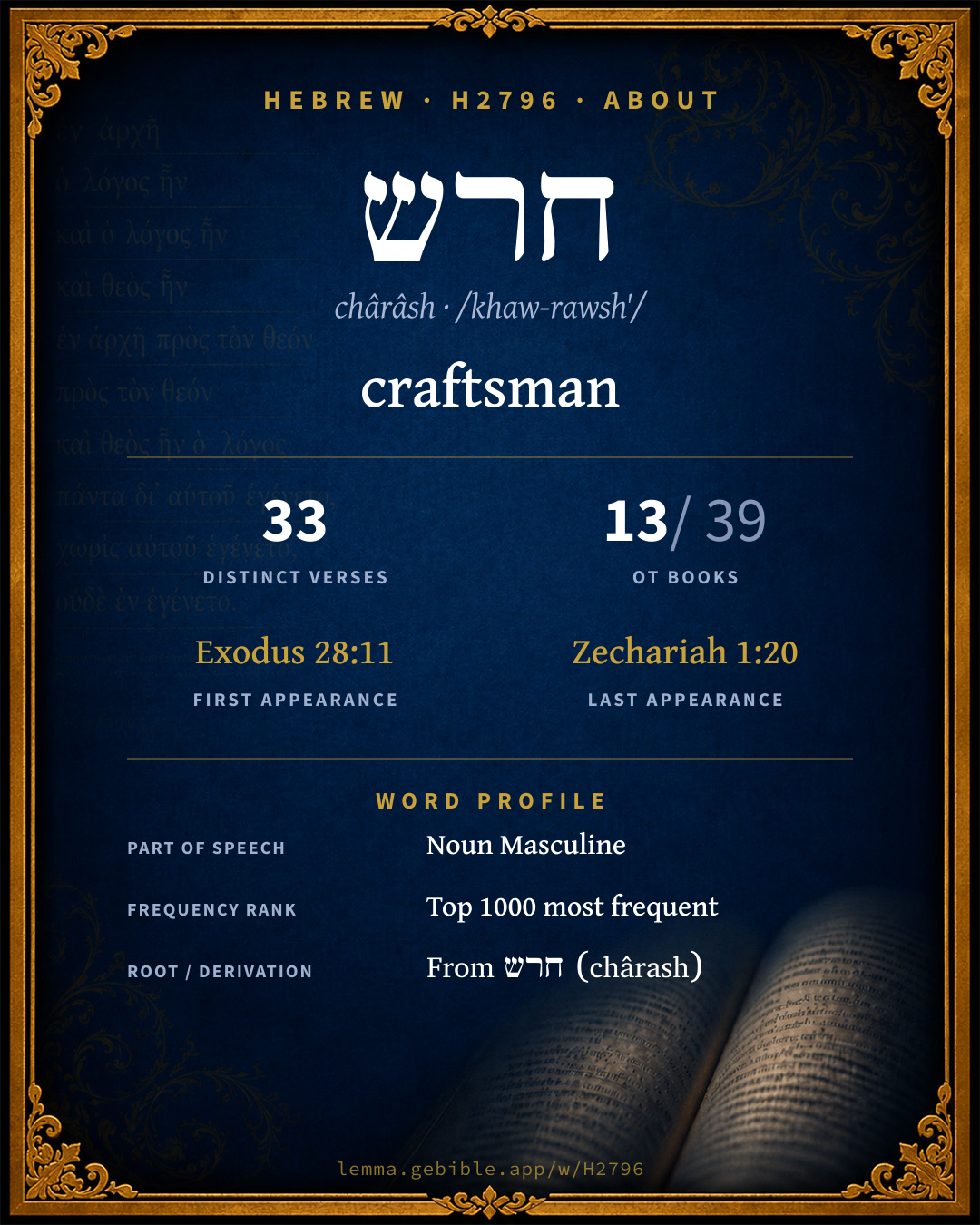
חָרָשׁ
craftsman
also: artisan, engraver, graver, artificer fuller range ↓
Full lexicon entry — Brown-Driver-Briggs (BDB)
From Brown-Driver-Briggs (BDB)
Where this word appears
See every Absolute-state word in the Hebrew Bible →
Grammar key — what these labels mean
Part of speech
- Noun
- A naming word — a person, place, thing, or idea.
Noun type
- Common
- A common noun — a general class of person, place, or thing (“king,” “city,” “water”), not a specific name.
State
- Absolute
- The independent form of a noun, not bound to a following word.
- Construct
- A noun bound to a following noun in a possessive / “of” relationship (the construct chain).
Gender
- Masculine
- Grammatically masculine.
Number
- Singular
- One.
- Plural
- More than one (in Hebrew, generally three or more).
Grammatical forms
- Noun, Common, Masculine, Singular, Absolute 15 times (42%)
- Noun, Common, Masculine, Plural, Construct 9 times (25%)
- Noun, Common, Masculine, Plural, Absolute 9 times (25%)
- Noun, Common, Masculine, Singular, Construct 3 times (8%)
Parsed forms decoded from the imported morphology (morphhb / Westminster Leningrad Codex — WLC text public domain, morphhb tagging CC BY 4.0), counted across 36 parsed occurrences — not distinct verses.
Every verse where H2796 appears — 33 distinct verses across 13 books. Click any verse to open its interlinear word-by-word view. Verse text shown in the World English Bible for context — . Each verse’s Hebrew form is shown with its reference; the English is not keyword-highlighted, since the data carries no word-level English alignment. Use “Compare translations” on any verse to read it across multiple English versions. This concordance covers the Hebrew Bible; Septuagint (Greek Old Testament) occurrences are not indexed here.
Exodus 3 verses
- Exodus 28:11 חָרַשׁ֮ n c ms cs With the work of an engraver in stone, like the engravings of a signet, shall you engrave the two stones, according to the names of the children of Israel: you shall make them to be enclosed in settings of gold.
- Exodus 35:35 חָרָ֣שׁ n c ms He has filled them with wisdom of heart, to work all manner of workmanship, of the engraver, of the skillful workman, and of the embroiderer, in blue, in purple, in scarlet, and in fine linen, and of the weaver, even of those who do any workmanship, and of those who make skillful works.
- Exodus 38:23 חָרָ֣שׁ n c ms With him was Oholiab, the son of Ahisamach, of the tribe of Dan, an engraver, and a skillful workman, and an embroiderer in blue, in purple, in scarlet, and in fine linen.
Deuteronomy 1 verse
1 Samuel 1 verse
2 Samuel 1 verse
2 Kings 4 verses
- 2 Kings 12:11 לְ/חָרָשֵׁ֤י prep + n c mp cs They gave the money that was weighed out into the hands of those who did the work, who had the oversight of the house of Yahweh: and they paid it out to the carpenters and the builders, who worked on the house of Yahweh,
- 2 Kings 22:6 לֶ/חָ֣רָשִׁ֔ים prep det + n c mp to the carpenters, and to the builders, and to the masons, and for buying timber and hewn stone to repair the house.
- 2 Kings 24:14 הֶ/חָרָ֖שׁ ptcl def.art + n c ms He carried away all Jerusalem, and all the princes, and all the mighty men of valor, even ten thousand captives, and all the craftsmen and the smiths; none remained, save the poorest sort of the people of the land.
- 2 Kings 24:16 וְ/הֶ/חָרָ֤שׁ conj + ptcl def.art + n c ms All the men of might, even seven thousand, and the craftsmen and the smiths one thousand, all of them strong and apt for war, even them the king of Babylon brought captive to Babylon.
1 Chronicles 4 verses
- 1 Chronicles 4:14 חֲרָשִׁ֖ים n c mp Meonothai became the father of Ophrah: and Seraiah became the father of Joab the father of Ge Harashim; for they were craftsmen.
- 1 Chronicles 14:1 וְ/חָרָשֵׁ֣י וְ/חָרָשֵׁ֖י conj + n c mp cs conj + n c mp cs Hiram king of Tyre sent messengers to David, and cedar trees, and masons, and carpenters, to build him a house.
- 1 Chronicles 22:15 וְ/חָרָשֵׁ֥י conj + n c mp cs There are also workmen with you in abundance, cutters and workers of stone and timber, and all kinds of men who are skillful in every kind of work:
- 1 Chronicles 29:5 חָרָשִׁ֑ים n c mp of gold for the [things of] gold, and of silver for the [things of] silver, and for all manner of work [to be made] by the hands of artificers. Who then offers willingly to consecrate himself this day to Yahweh?
2 Chronicles 2 verses
- 2 Chronicles 24:12 וְ/חָרָשִׁ֔ים לְ/חָרָשֵׁ֤י conj + n c mp prep + n c mp cs The king and Jehoiada gave it to such as did the work of the service of the house of Yahweh; and they hired masons and carpenters to restore the house of Yahweh, and also such as worked iron and brass to repair the house of Yahweh.
- 2 Chronicles 34:11 לֶ/חָֽרָשִׁים֙ prep det + n c mp even to the carpenters and to the builders gave they it, to buy hewn stone, and timber for couplings, and to make beams for the houses which the kings of Judah had destroyed.
Ezra 1 verse
Isaiah 8 verses
- Isaiah 40:19 חָרָ֔שׁ n c ms The image, a workman has cast [it], and the goldsmith overlays it with gold, and casts [for it] silver chains.
- Isaiah 40:20 חָרָ֤שׁ n c ms He who is too impoverished for [such] an offering chooses a tree that will not rot; he seeks to him a skillful workman to set up an engraved image, that shall not be moved.
- Isaiah 41:7 חָרָשׁ֙ n c ms So the carpenter encourages the goldsmith, [and] he who smoothes with the hammer him who strikes the anvil, saying of the soldering, It is good; and he fastens it with nails, that is should not be moved.
- Isaiah 44:11 וְ/חָרָשִׁ֥ים conj + n c mp Behold, all his fellows shall be disappointed; and the workmen, they are of men: let them all be gathered together, let them stand up; they shall fear, they shall be put to shame together.
- Isaiah 44:12 חָרַ֤שׁ n c ms cs The smith [makes] an axe, and works in the coals, and fashions it with hammers, and works it with his strong arm: yes, he is hungry, and his strength fails; he drinks no water, and is faint.
- Isaiah 44:13 חָרַ֣שׁ n c ms cs The carpenter stretches out a line; he marks it out with a pencil; he shapes it with planes, and he marks it out with the compasses, and shapes it after the figure of a man, according to the beauty of a man, to dwell in a house.
- Isaiah 45:16 חָרָשֵׁ֖י n c mp cs They shall be disappointed, yes, confounded, all of them; they shall go into confusion together who are makers of idols.
- Isaiah 54:16 חָרָ֔שׁ n c ms Behold, I have created the smith who blows the fire of coals, and brings forth a weapon for his work; and I have created the waster to destroy.
Jeremiah 4 verses
- Jeremiah 10:3 חָרָ֖שׁ n c ms For the customs of the peoples are vanity; for one cuts a tree out of the forest, the work of the hands of the workman with the axe.
- Jeremiah 10:9 חָרָ֖שׁ n c ms There is silver beaten into plates, which is brought from Tarshish, and gold from Uphaz, the work of the artificer and of the hands of the goldsmith; blue and purple for their clothing; they are all the work of skillful men.
- Jeremiah 24:1 הֶ/חָרָ֤שׁ ptcl def.art + n c ms Yahweh shown me, and, behold, two baskets of figs set before the temple of Yahweh, after that Nebuchadrezzar king of Babylon had carried away captive Jeconiah the son of Jehoiakim, king of Judah, and the princes of Judah, with the craftsmen and smiths, from Jerusalem, and had brought them to Babylon.
- Jeremiah 29:2 וְ/הֶ/חָרָ֥שׁ conj + ptcl def.art + n c ms (after that Jeconiah the king, and the queen-mother, and the eunuchs, [and] the princes of Judah and Jerusalem, and the craftsmen, and the smiths, were departed from Jerusalem),
Ezekiel 1 verse
Hosea 2 verses
- Hosea 8:6 חָרָ֣שׁ n c ms For this is even from Israel! The workman made it, and it is no God; Indeed, the calf of Samaria shall be broken in pieces.
- Hosea 13:2 חָרָשִׁ֖ים n c mp Now they sin more and more, And have made themselves molten images of their silver, Even idols according to their own understanding, All of them the work of the craftsmen. They say of them, "They offer human sacrifice and kiss the calves."
Zechariah 1 verse
About this entry
At a glance — auto-summarized from this page’s data, not written by a person. Every figure links to its source below. This summary describes the numbers; it doesn’t interpret them.
The Hebrew noun חרש centers on the idea of “craftsman.” Where the King James Version says “carpenters,” newer translations reach for “craftsmen” (Berean Standard Bible) and “craftsman” (unfoldingWord Literal Text); the renderings breakdown has the detail. The Hebrew Bible uses it across 33 verses — moderately common. First canonically at Exodus 28:11, it enters the text early. Beyond “craftsman” it also covers “artisan”, “engraver”, and “graver” — see its full sense range. Dig into 33-verse concordance and the renderings breakdown below.
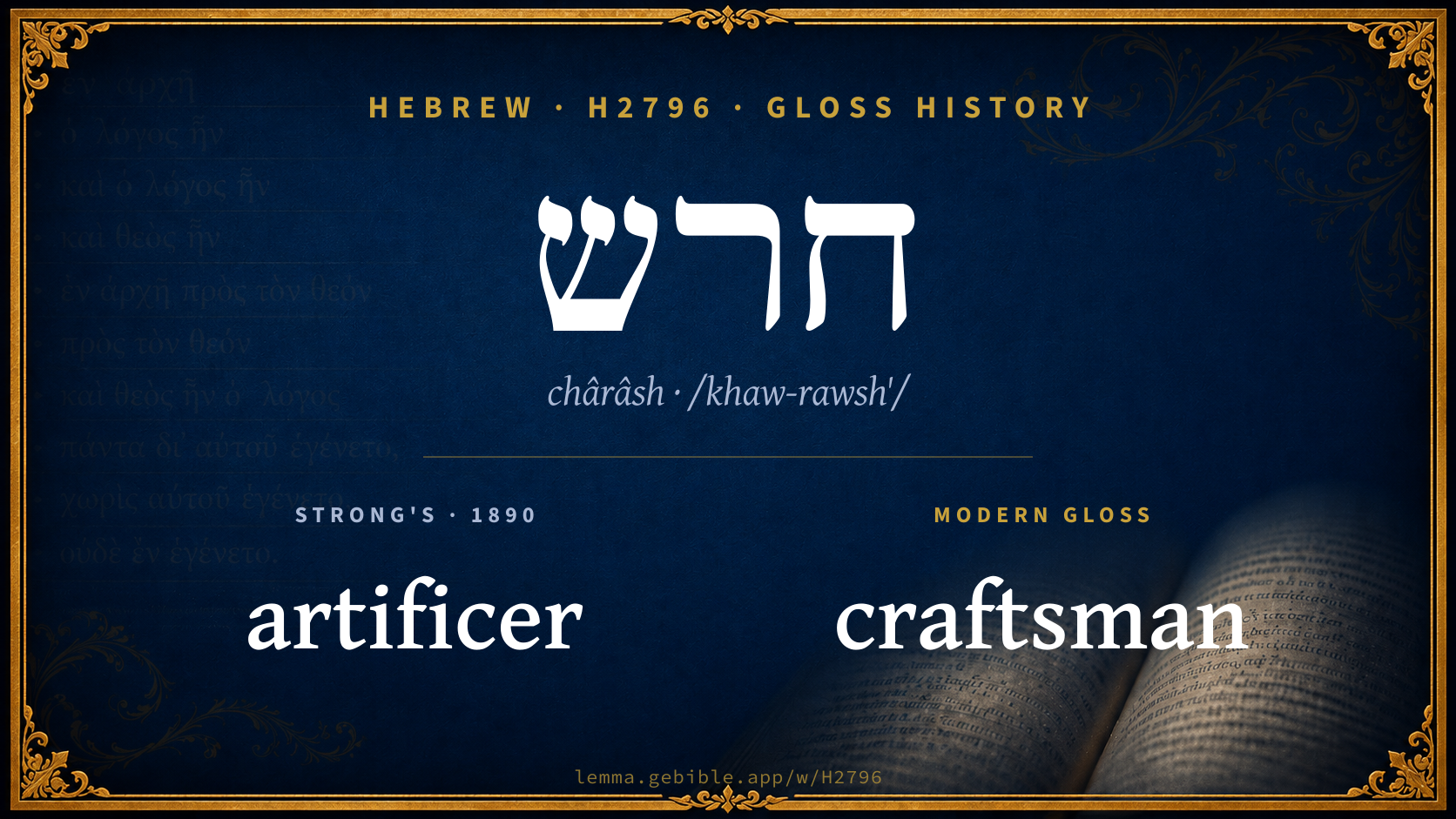
Gloss history
Strong's 1890 vs modern scholarship
About this word
Strong's H2796 catalogs a Hebrew word from the Hebrew Old Testament.
These counts are not copied from any lexicon or concordance. They are computed here, from the morphology-tagged Hebrew Old Testament. What Lemma adds →
- 33
- distinct verses
- The word appears in 33 distinct verses.
- 13 / 39
- OT books
- The word appears in 13 of 39 Old Testament books.
- #990
- by frequency
- Top 1000 most frequent Hebrew words (rank 990 of 8,640 Hebrew words by occurrence).
View all 33 occurrences in the concordance →
Most concentrated in
- Isaiah 8 verses 24%
- 2 Kings 4 verses 12%
- 1 Chronicles 4 verses 12%
By section of the Old Testament
By traditional corpus
Conventional, traditional groupings — biblical authorship is debated, so this is a traditional corpus grouping, not an authorship claim. Each share is this word’s portion of its verses in that division of the Hebrew canon. Each figure is a share of the word’s 33 distinct verses.
- Prophets (Nevi'im) 22 verses · 67%
- Writings (Ketuvim) 7 verses · 21%
- Torah (Pentateuch) 4 verses · 12%
How translations render this word
Counts come from each version’s own published word-to-Strong’s tagging or interlinear alignment — an approximate guide to how each version renders this word, not a word-level alignment the data otherwise carries. Because each total is that version’s own tagged count, the per-version totals vary from one another and need not match the appearance or distinct-verse counts above. These counts may also differ from a printed concordance because Lemma counts each distinctly tagged rendering and does not collapse phrase taggings into a single head-word total. This is a fixed set of word-tagged versions (KJV, ASV, BSB, ULT) and does not change with the reading translation you choose elsewhere. Each version’s license is shown beside its name below (and on Sources).
BDB lists this Strong’s number as 4 distinct words (homographs). Each count above pools all of them and is not split by sense — see the Senses section below. A low-frequency rendering may belong to a different one of those words, not the primary meaning.
- King James Version†: Carpenters 9×, Workman 4×, Engraver 3×
- American Standard Version†: Carpenters 7×, Craftsmen 4×, Engraver 3×
- Berean Standard Bible†: Craftsmen 9×, Craftsman 8×, Carpenters 7×
- unfoldingWord Literal Text†: Craftsman 11×, Craftsmen 10×, Craftsmen of 7×
King James Version Public Domain
Renders H2796 across 32† tagged occurrences — most commonly:
Plus 10 renderings that appear only once — usually multi-word phrases or single function words the recovered tagging swept in, not distinct renderings. Not rendered by a distinct English word in 1 further occurrence.
American Standard Version Public Domain
Renders H2796 across 32† tagged occurrences — most commonly:
Plus 13 renderings that appear only once — usually multi-word phrases or single function words the recovered tagging swept in, not distinct renderings.
Berean Standard Bible Public Domain
Renders H2796 across 36† tagged occurrences — most commonly:
Plus 8 renderings that appear only once — usually multi-word phrases or single function words the recovered tagging swept in, not distinct renderings.
unfoldingWord Literal Text CC BY-SA 4.0
Renders H2796 across 36† tagged occurrences — most commonly:
Plus 5 renderings that appear only once — usually multi-word phrases or single function words the recovered tagging swept in, not distinct renderings.
Senses in the full BDB
What do BDB’s symbols mean?
BDB uses these scholarly abbreviations:
| Symbol | Meaning |
|---|---|
| 𝔊 | the Septuagint (the ancient Greek translation, LXX) |
| 𝔙 | the Vulgate (the Latin translation) |
| 𝔖 | the Syriac version (the Peshitta) |
| 𝔗 | the Targum (the Aramaic translation) |
| ψ | the Psalms |
| √ | root (the underlying root or stem) |
| ‖ | parallel passage (a synonymous or contrasted parallel) |
| † | the dagger: every passage where the word occurs is cited |
The 6 senses and sub-senses the full Brown-Driver-Briggs lexicon distinguishes for this word, in lexicon order (not ranked by frequency), with BDB’s own verbatim wording and sub-sense lettering. Shown in Hebrew script with BDB’s own scholarly abbreviations. The condensed entry is in the Lexicon Entry tab. See also the Forms in the corpus table below.
חרש I
- 1. graver, artificer:
- a. worker in metal 1 S 13:19 Ho 8:6; 13:2 Dt 27:15 Je 10:9 (‖ צֹרֵף), Is 40:19 (‖ id.), 54:16 1 Ch 29:5; ח׳ בַּרְזֶל Is 44:12 2 Ch 24:12; perhaps also Is 41:7 (+ צֹרֵף); appar. = hammerer Zc 2:3 (symbol.). e.g. 1 Samuel 13:19
- b. worker in wood ח׳ עֵץ 2 S 5:11 = 1 Ch 14:1 (עֵצִים), 2 K 12:12; 22:6 = 2 Ch 34:11, Je 10:3 Is 40:20; 44:13 (v. also 1 Ch 22:15 infr.); perhaps also Ezr 3:7 2 Ch 24:12 (both ‖ חצב). e.g. 2 Samuel 5:11
- c. worker in stone ח׳ אֶבֶן קִיר 2 S 5:11 = 1 Ch 14:1 (om. אבן); also of engraving on gems ח׳ אבן Ex 28:11 (P; ‖ פִּתּוּחֵי חֹתָם); see also foll. e.g. 2 Samuel 5:11
- d. in gen. ח׳ אֶבֶן וָעֵץ 1 Ch 22:15; idol-maker ח׳ צִירִים Is 45:16, cf. 44:11 (also v 12, 13 supr.), 2 K 24:14, 16 Je 24:1; 29:2 (all ‖ מַסְגֵּר), Ex 35:35; 38:23 (both P; both ‖ חֹשֵׁב). In גֵּיא חֲרָשִׁים 1 Ch 4:14, גֵּי הַחֲ׳ Ne 11:35 valley of (the) artificers, and חֲרָשִׁים artificers 1 Ch 4:14, ח has—ֲ exceptionally, v. Ol§ 183 a Köii § 60. 5; read חָֽרָשִׁים? e.g. 1 Chronicles 22:15
- 2. fig. ח׳ מַשְׁחִית Ez 21:36 men skilled to destroy. e.g. Ezekiel 21:36
חרש II m. as adv. silently, secretly
חרש III m. a Levite 1 Ch 9
Senses from the full Brown-Driver-Briggs lexicon (Brown, Driver, Briggs; Oxford 1906 — public domain), digitized via Sefaria, supplemented by the OpenScriptures HebrewLexicon (CC BY 4.0). Full attribution on Sources.
Word origin
I. n.m. Ex 38:23 graver, artificer (Ph. חרש)—abs. ח׳ (= חַרָּשׁ) Ex 35:35 + 14 times; cstr. חָרַשׁ Ex 28:11 + 2 times; pl. חָֽרָשִׁים Ho 13:2 + 7 times; חֲרָשִׁים 1 Ch 4:14(×2) Ne 11:35 (v. infr.); cstr. חָֽרָשֵׁי 2 S 5:11 + 6 times;—
I. n. m. as adv. silently, secretly—מְרַגְּלִים ח׳ Jos 2:1 (JE) exploring secretly.
II. n.[m.] magic art or perhaps magic drug (Aramaic ܚܰܪܶܫ practice magic, חָרָשׁ, ܚܰܪܳܫܳܐ magician, ܚܶܪܫܳܐ incantation, magic art, preparation of magic potion, so Ethiopic ሐራሲ one using incantations; ሐረስ, ሐርስ, ሐራs incantation, magic; comp. perhaps Arabic خُرْسٌ, خُرْسَةٌ a medicinal broth given to women in childbed; חֶרֶשׁ perhaps magical drug, v. RSJPh. xiv. 1885, 125)—only חֲכַם חֲרָשִׁים Is 3:3 skilled in magic arts, or drugs (‖ נְבוֹן לָ֑חַשׁ), (> others gen. = handicraft).
III. n.pr.m. a Levite 1 Ch 9:15 𝔊 Ραραιηλ, A Αρες, 𝔊L Αρης.
— Brown-Driver-Briggs (Oxford 1906, public domain), digitized via Sefaria, supplemented by the OpenScriptures HebrewLexicon (CC BY 4.0). See Sources.
Derived from חרש (chârash) (H2790) — to plough.
Jastrow Dictionary
A second Hebrew/Aramaic lexicon for comparison, covering Aramaic and post-biblical (Talmudic, Targumic, Midrashic) usage that the biblical-Hebrew BDB does not. Matched by lemma rather than by Strong’s number, so a lemma may carry more than one Jastrow headword (shown separately below), and the entries cover usage well beyond the Bible.
חֶרֶשׂ
- , v. חֶרֶס
חָרַשׁ I
- (b. h.)
- 1. to engrave, draw, design. Koh. R. to I, 16 הלב חוֹרֵשׁ the heart designs.
- 2. to plough. Macc. III, 9 יש חוֹרֵשׁ תלם וכ׳ one may plough one bed and &c. Taan. 29ᵃ וח׳ את העיר Ms. M. and passed the plough over the city of Jerusalem. Sabb. VII, 2; a. fr.—Trnsf. to have sexual intercourse. Y. Yeb. I, 2ᵇ top. Gen. R. s. 98; a. e.
- to be ploughed over. Taan. IV, 6 נֶחְרְשָׁה העיר the plough was passed over the city of Jerusalem; a. e.
חָרַשׁ II
- Pi. חֵרֵשׁ, חֵי׳ (denom. of חֵרֵשׁ) to deafen, make deaf. B. Kam. 86ᵃ שחֵירְשׁוֹ וכ׳ when he made him deaf without wounding him. Ib. החוֹרֵשׁ את אביו (Ms. H. a. R. חֵרֵשׁ); ib. 98ᵃ חֵרְשׁוֹ לאביו if one injured his father’s hearing; v. חֲרִישָׁה II. Kidd. 24ᵇ.—Sabb. 109ᵃ top. יד מְחָרֶשֶׁת the unwashed hand put to the ear causes deafness.
- 1. same. B. Kam. 86ᵃ להַחֲרִישׁ, v. חֲרִישָׁה II.
- 2. (b. h.) to be silent. Y. Pes. IX, end. 37ᵃ (ref. to Prov. XVII, 28) ואין צ"ל חכם מַחֲרִישׁ and it is needless to say the same of a wise man keeping silence. [Usu. שָׁתַק.] e.g. Proverbs 17:28
- to become deaf (and dumb). Yeb. XIV, 1; Tosef. Ter. I, 1 פיקח ונ׳ if he had been well-hearing and became etc.; v. חֵרֵשׁ.
חֲרַשׁ
- (v. preced. wds.)
- 1. to be entangled. Targ. Job VIII, 17.
- 2. to be choked, obstructed, deaf. Gen. R. s. 81 (prov.) מהולתך חַרְשָׁה וכ׳ if thy sieve is choked, knock at it (when you are forgetful of your duties, the Lord will remind you through affliction); v. טְרַשׁ II.
- 3. to practice witchcraft. Gen. R. s. 86 באתר דחרשין חֲרִישִׁין where there are sorcerers witchcraft is practiced.
- to entangle, inure. Targ. Ez. XIII, 20 (h. text צדד).
- to be entangled, confounded. Y. Ḥag. II, 77ᶜ top (expl. תאלמנה, Ps. XXXI, 19) יִתְחַרְשָׁן וכ׳ may their lips be confounded, crushed, silenced, cmp. אִלֵּם a. חֵרֵשׁ; Gen. R. s. 1 (corr. acc.) e.g. Psalms 31:19
חָרָשׁ
- artist, artisan, carpenter, turner (faber). Deut. R. s. 2 לח׳ שהיה וכ׳ like an artist that was making an image &c.—Pl. חָרָשִׁים. Gen. R. s. 65, end; s. 70, v. חֲמוֹר; Pesik. Shek., p. 15ᵃ.—Trsnf. scholar. Gitt. 88ᵃ (ref. to II Kings XXIV, 16) חָ׳ שבשעה … כחֵרְשִׁין the scholars were named ḥarash, for when they opened argument, all were like dumb; Snh. 38ᵃ; Yalk. Dan. 1066; a. e.—Pl. as above. Ḥag. 14ᵃ (ref. to Is. III, 3). e.g. 2 Kings 24:16
חָרָשׁ ²
- sorcerer, v. חָרָשָׁא.
חֶרֶשׁ
- v. חֵרֵשׁ) silence. Tanḥ. Sh’mini 9 (play on חָרָשׁ, II Kings XXIV, 16) אלו … תפלת ח׳ בלחש וכ׳ ḥarash means those who hold silent prayers in murmuring, and yet conquer &c. e.g. 2 Kings 24:16
חֶרֶשׂ ²
- Ḥeres or Ḥeresh. Ab. IV, 15. Yoma 4ᵇ; a. e.
חֵרֵשׁ
- [closed up,] deaf, dumb (cmp. אִלֵּם); deaf and dumb. Ter. I, 2 ח׳ שדברו וכ׳ the ḥeresh of which the scholars speak (in a legal sense) means everywhere deaf and dumb. Ib. ח׳ המדבר וכ׳ a ḥeresh that can talk but not hear. Meg. II, 4 חוץ מח׳ except a deaf person. Sifré Num. 153 (ref. to Num. XXX, 5; 12) להוציא את הח׳ this excludes the case of the father (the husband) being deaf; Ned. 73ᵃ; a. fr.—Pl. חֵרְשִׁים, חֵרְשִׁין. Ḥag. 14ᵃ; Gitt. 88ᵃ, v. חָרָשׁ. Ruth R. s. 2 beg. (ref. to חרש, Josh. II, 1) עשו עצמכם ח׳ pretend to be deaf.—Fem. חֵרֶשֶׁת. Gitt. V, 5. Yeb. XIV, 1; a. e.—Pl. חֵרְשׁוֹת. Ib. 3. e.g. Numbers 30:5
A Dictionary of the Targumim, the Talmud Babli and Yerushalmi, and the Midrashic Literature (Marcus Jastrow; London, Luzac, 1903) — Public Domain. Digitized via Sefaria. Digitized via Sefaria. Full attribution on Sources.
Forms in the corpus
The 28 distinct written forms H2796 takes in the Hebrew Bible, most frequent first — each parse links to that state’s occurrences in the concordance. Hebrew forms include their vowel points and cantillation, so a single lemma takes many written forms.
Same root — word family
Other BDB entries built from the same root as H2796, grouped by Strong’s listed origin. These share a root / origin per the lexicon — not necessarily a shared meaning. Each links to that word’s own entry.
Derives from
Shares the same root
- חריש chârîysh H2758 ploughing
- חרישי chărîyshîy H2759 harsh
- חרש cheresh H2791 silently
- חרש chôresh H2793 forest
- חרש chôrêsh H2794 metalworker
- חרש chêrêsh H2795 deaf
- חרשת chărôsheth H2799 carving
- מחרשה machărêshâh H4281 plowshare
- מחרשת machăresheth H4282 plowshare
Proper names from this root
People and places named from this root — a name, not an additional meaning of the word.
Compare all same-root words → Showing 4 of 12 — not the complete family. 1 of the same-root words is a proper name (a person or place). They share a root, not necessarily a meaning.
Septuagint verse parallels
This word appears in 32 verses that also exist in the Greek Old Testament (Septuagint), out of the 33 Hebrew verses it occurs in. You can read those verses in Greek by switching the Old Testament edition to the Septuagint.
Read these verses in the Septuagint
- Exodus 28:11
- Deuteronomy 27:15
- 1 Samuel 13:19
- 2 Samuel 5:11
- 2 Kings 12:11
- 1 Chronicles 4:14
- 2 Chronicles 24:12
- Ezra 3:7
- Isaiah 40:19
- Jeremiah 10:3
- Ezekiel 21:31
- Hosea 8:6
This is a verse-level parallel only — the same verses exist in both the Hebrew and Greek Old Testaments. No word-level Hebrew↔Greek correspondence is claimed: the data carries no such alignment, so no Greek word is shown as this Hebrew word’s translation. Coverage is not total — the Septuagint omits the deuterocanon and renumbers the Psalms, so some Hebrew verses have no direct Greek parallel.