
Psalms 129:3

Hebrew (Westminster Leningrad Codex) Psalms 129:3 appears in the Hebrew Old Testament. The text above is from the Westminster Leningrad Codex. Each word links to its Strong’s number, a concise gloss, and parsing drawn from the Open Scriptures Hebrew Bible morphology. Click any word for its full Brown-Driver-Briggs (BDB) entry.
Download image
Cite this verse

Psalms 129:3 (World English Bible). Public Domain. Lemma interlinear Bible study tool, https://lemma.gebible.app/v/psalms/129/3.

Show BibTeX & RIS
BibTeX
RIS
English Translation
The plowers plowed on my back. They made their furrows long.
World English Bible · Public Domain
Download a study sheet

One document with this verse’s original text, its word-by-word gloss line, the meaning frame, cross-references with their text, attributed commentary, and full source and license credits — printable, and it pastes into notes with its structure intact.

This verse Autodidact and up

Study sheet (.html) Plain text (.txt)

A passage Seminary Student

Up to 50 verses in one chapter. A passage sheet keeps up to 6 commentary sources and 12 cross-references per verse, in the order this page ranks them, and says so on the sheet whenever that leaves anything out. Ask for a single verse and you get the Autodidact verse sheet above.

Everything on this page stays free to read, with no account — the sheet is a download of what is already on screen, not access to it.

Want to remove ads? Support Godless Engineer
Compare translations 3

The same verse in 3 English versions, stacked beneath the original-language interlinear above. Click any original word for its lexicon entry.

Each is an independent rendering of the whole verse — the interlinear is not word-aligned to these translations.

Highlighted words mark where these versions differ — a whole-verse word diff, not a word-by-word alignment.

  • World English Bible Public Domain
    The plowers plowed on my back. They made their furrows long.
  • King James Version Public Domain
    The plowers plowed upon my back: they made long their furrows.
  • unfoldingWord Literal Text CC BY-SA 4.0
    Upon my back the plowers plowed; they made long their furrows.

unfoldingWord Literal Text — © unfoldingWord, licensed CC BY-SA 4.0. Word-aligned USFM3 via Door43 (git.door43.org/unfoldingWord/en_ult).

Versions to compare (up to 4)

3 of 4 selected

Show all 18 translations

Every available English version of this verse, each an independent rendering of the whole verse.

  • World English Bible Public Domain
    The plowers plowed on my back. They made their furrows long.
  • Berean Standard Bible Public Domain
    The plowmen plowed over my back; they made their furrows long.
  • Majority Standard Bible Public Domain
    The plowmen plowed over my back; they made their furrows long.
  • King James Version Public Domain
    The plowers plowed upon my back: they made long their furrows.
  • American Standard Version (1901) Public Domain
    The plowers plowed upon my back; They made long their furrows.
  • Revised Version (1885) Public Domain
    The plowers plowed upon my back; they made long their furrows.
  • Geneva Bible (1599) Public Domain
    The plowers plowed vpon my backe, and made long furrowes.
  • Douay-Rheims (1899) Public Domain
    Thy wife as a fruitful vine, on the sides of thy house.
  • Young's Literal Translation Public Domain
    Over my back have ploughers ploughed, They have made long their furrows.
  • Literal Standard Version CC BY-SA 4.0
    Plowers have plowed over my back, || They have made their furrows long.
  • Unlocked Literal Bible CC BY-SA 4.0
    The plowers plowed on my back; they made their furrows long.
  • unfoldingWord Literal Text CC BY-SA 4.0
    Upon my back the plowers plowed; they made long their furrows.
  • Darby Bible Public Domain
    The ploughers ploughed upon my back; they made long their furrows.
  • World Messianic Bible Public Domain
    The plowers plowed on my back. They made their furrows long.
  • Webster's Bible Public Domain
    The plowers plowed upon my back: they made long their furrows.
  • Free Bible Version CC BY-SA 4.0
    They beat me on my back, leaving long furrows as if it had been plowed by a farmer.
  • Bible in Basic English Public Domain
    The ploughmen were ploughing on my back; long were the wounds they made.
  • JPS Tanakh (1917) Public Domain
    The plowers plowed upon my back; they made long their furrows.

Literal Standard Version (2020), Covenant Press — licensed CC BY-SA 4.0. Text via the HelloAO Bible API (eBible.org). Unlocked Literal Bible (unfoldingWord) — licensed CC BY-SA 4.0. Text via the HelloAO Bible API (eBible.org). unfoldingWord Literal Text — © unfoldingWord, licensed CC BY-SA 4.0. Word-aligned USFM3 via Door43 (git.door43.org/unfoldingWord/en_ult). Free Bible Version, Dr. Jonathan Gallagher — licensed CC BY-SA 4.0. Text via the HelloAO Bible API (eBible.org).

Word by word

More ways to search: Search by grammar → Find every occurrence → Compare this word →

Practice this passage: Drill this verse → Learn its vocabulary →

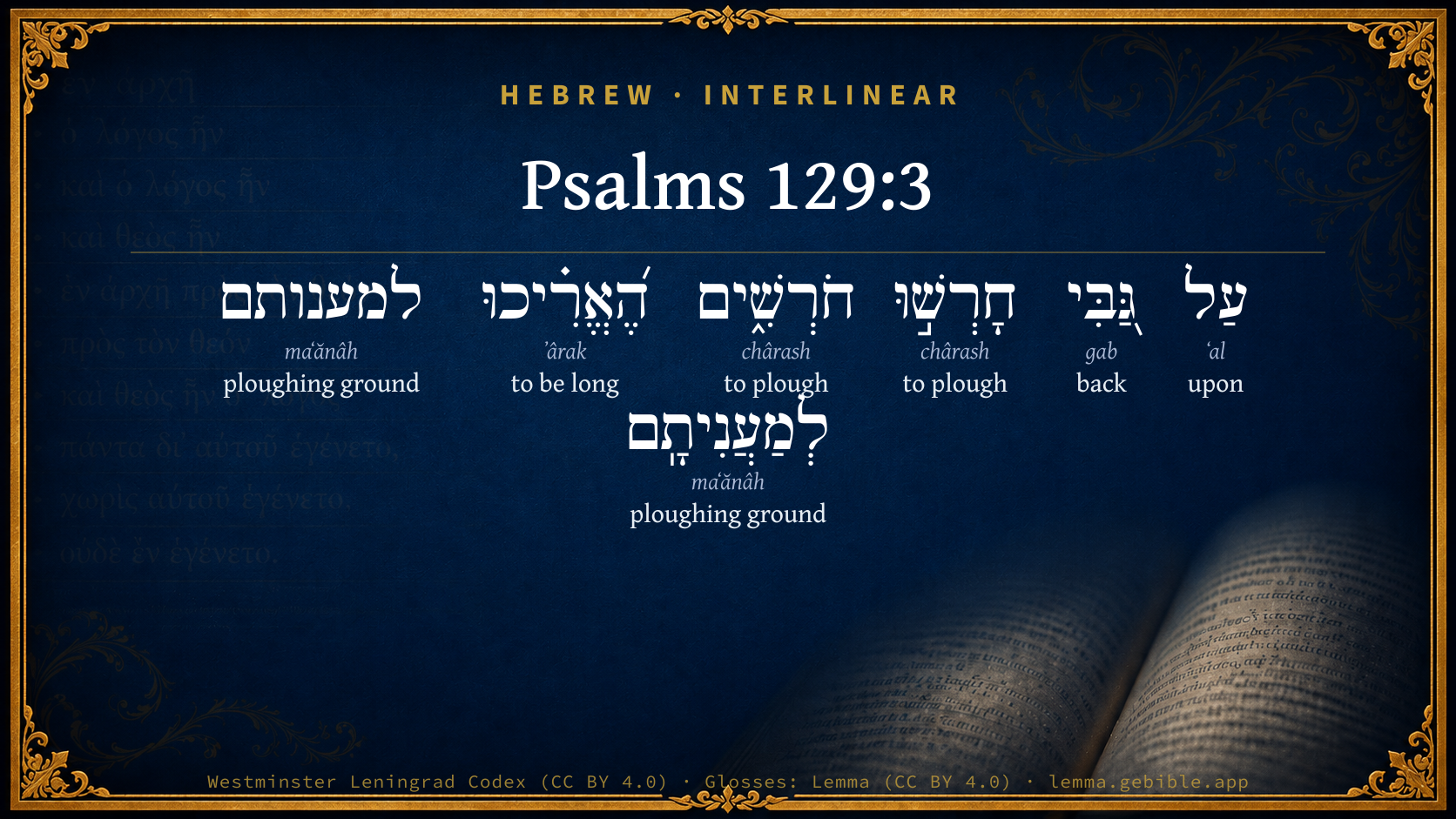
למענותם
maʻănâh
H4618
“to/for · ploughing grounds · their”
Preposition + Noun, Common, Feminine, Plural, Construct + Suffix, Personal, 3rd Person, Masculine, Plural
Part of Speech
Preposition + Noun
Type
Common
Gender
Feminine
Number
Plural
State
Construct
Full BDB Definition

Origin: from H6031 , in the sense of depression or tilling

TWOT: 1651b

ploughing ground, place for task
  1. עַל ʻal H5921 “upon” Preposition
  2. גַּ֭בִּי gab H1354 “back · my” Noun, Common, Both, Singular, Construct + Suffix, Personal, 1st Person, Common, Singular
  3. חָרְשׁ֣וּ chârash H2790 “to plough” Verb, Qal, Perfect, 3rd Person, Common, Plural
  4. חֹרְשִׁ֑ים chârash H2790 “ploughing” Verb, Qal, Participle Active, Masculine, Plural, Absolute
  5. הֶ֝אֱרִ֗יכוּ ʼârak H748 “to be long” Verb, Hiphil, Perfect, 3rd Person, Common, Plural
  6. לְמַעֲנִיתָֽם maʻănâh H4618 “to/for · ploughing ground · their” Preposition + Noun, Common, Feminine, Singular, Construct + Suffix, Personal, 3rd Person, Masculine, Plural

About this verse

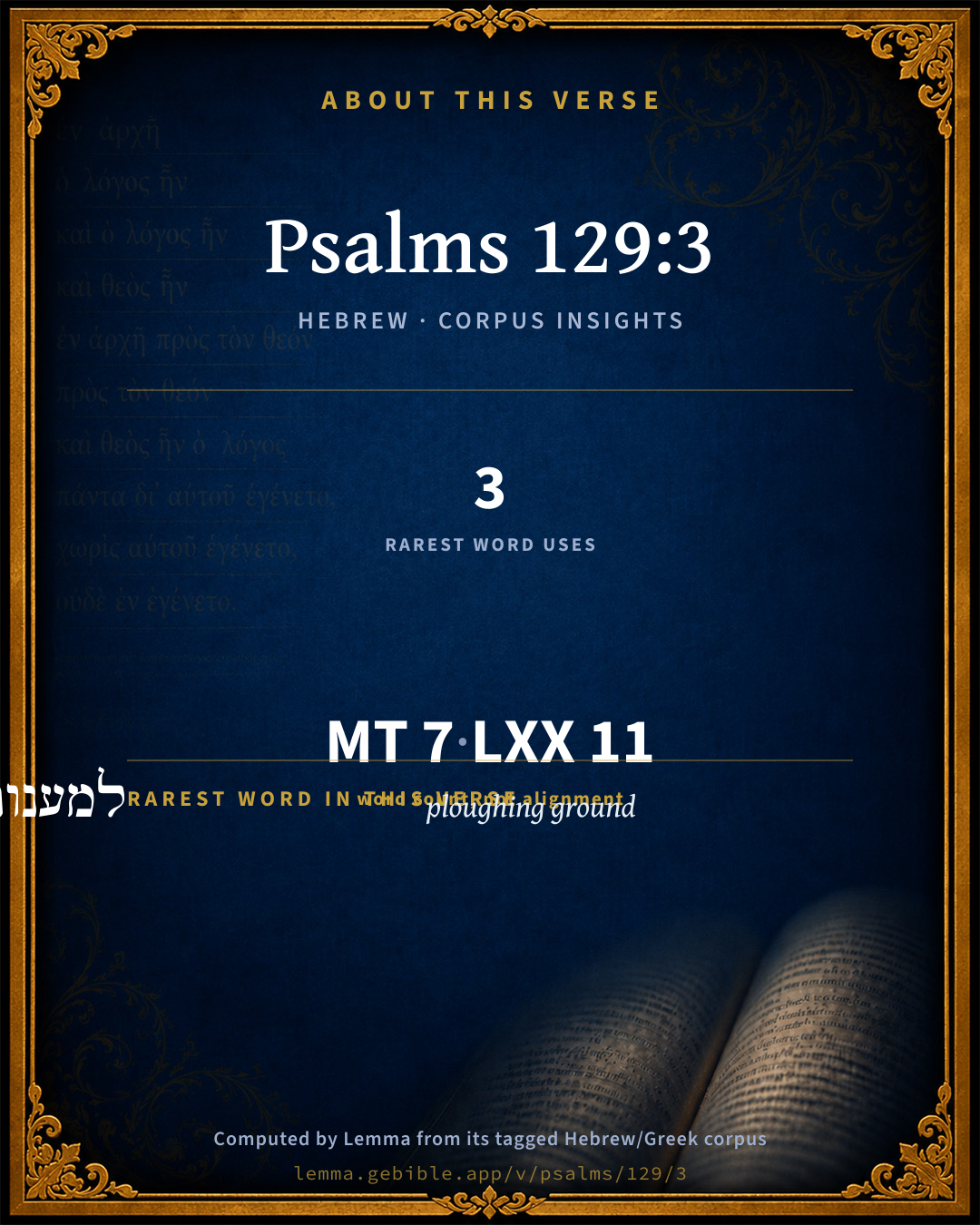
These counts appear in no published source. They are computed here, from the morphology-tagged text and Lemma’s own curated glosses. What Lemma adds →

7
words
5
distinct lemmas
Wisdom
section

Notable vocabulary

The rarest word here is למענותם ploughing ground H4618 — appearing just 3 times in the whole Hebrew Bible.

Shared distinctive vocabulary

למענותם ploughing ground H4618 occurs in 2 verses of the Hebrew Bible. Also found in:

Grammatical profile

  • 3 verbs
  • 3 nouns
  • 1 preposition

Verb forms

  • חָרְשׁ֣וּ Qal · Perfect
  • חֹרְשִׁ֑ים Qal · Participle Active
  • הֶ֝אֱרִ֗יכוּ Hiphil · Perfect

Repetition

Words recur within this verse — often emphatic in Hebrew:

  • חָרְשׁ֣וּ to plough H2790 ×2
  • למענותם ploughing ground H4618 ×2

Hebrew & Septuagint length

In English translation the verse runs 11 words from the Hebrew and 10 from the Septuagint (LXX English) — closely comparable.

A rough comparison of the two English renderings, which tokenize alike — not a word-level alignment.

Word counts can differ between the Hebrew and the Greek without any difference in meaning — e.g. the Hebrew direct-object marker אֵת has no separate Greek word, and Greek often adds the article ὁ.

In the original languages it is 7 Hebrew tokens and 11 Greek tokens — but the two are counted differently (Hebrew bundles its prefixes and suffixes into one token; the Greek is in lemma form), so that isn’t a like-for-like length.

Cross-references

2

Topical passages linked to Psalms 129:3 in the Treasury of Scripture Knowledge — connected by theme and wording, ordered by reader-vote popularity; previews shown in the World English Bible.

  • Isaiah 51:23 and I will put it into the hand of those who afflict you, who have said to your soul, Bow down, that we may go over; and you have laid your back as the ground, and as the street, to those who go over.
  • Psalms 141:7 "As when one plows and breaks up the earth, Our bones are scattered at the mouth of Sheol."

Cross-references courtesy of OpenBible.info (CC BY 4.0).

Hebrew and Greek witnesses Masoretic Hebrew ↔ Greek Septuagint

The same verse in the two great witnesses to the Old Testament, shown verse-for-verse.

You’re reading Greek Psalm 128 (Hebrew Psalm 129). The Septuagint counts the superscription, so verse numbers can differ from the Hebrew — chapter-level alignment, not verse-by-verse. Numbering follows Rahlfs.

These are two independent witnesses, not word-aligned to each other, and the Septuagint is shown in lemma (dictionary) form.

Hebrew Psalms 129:3 Masoretic · Westminster Leningrad Codex

עַל גַּ֭בִּי חָרְשׁ֣וּ חֹרְשִׁ֑ים הֶ֝אֱרִ֗יכוּ למענותם לְמַעֲנִיתָֽם

The plowers plowed on my back. They made their furrows long.

World English Bible · Public Domain

Greek LXX Greek Psalm 128:3 Septuagint · lemma form

ἐπί ὁ νῶτον ἐγώ τεκταίνω ὁ ἁμαρτωλός μακρύνω ὁ ἀνομία αὐτός

The sinners wrought upon my back: they prolonged their iniquity.

LXX2012 (modern English Septuagint) · Public Domain

On this verse, Keil & Delitzsch discusses the Septuagint’s reading. Read the note in Commentary ↓

Hebrew: Westminster Leningrad Codex (CC BY 4.0). Greek: Septuagint (public domain); English from LXX2012 (modern English Septuagint) (Public Domain). How the Septuagint differs from the Hebrew →

Commentary

Notes on Psalms 129:3 from classic Christian and Jewish commentators (each source and its license shown beneath its notes). The classic Christian expositions comment on the surrounding passage and are grouped to its opening verse, so a note may address several verses; the Jewish commentaries on the Tanakh (Rashi and others) are per-verse, so they appear only where the commentator wrote on this verse.

Lemma curates 59 commentaries, every one of them public domain or Creative Commons licensed, each selected and text-cleaned for this edition rather than reprinted as found. About our sources →

Trapp's Complete Commentary

John Trapp

Psa 129:3 The plowers plowed upon my back: they made long their furrows.

Ver. 3. The plowers plowed upon my back] Which was never without some cross upon it, yea, some plough passing over it. The Church is God’s husbandry; and he will be sure to plough his several, whatever becometh of the wild waste. She is his threshingfloor, Isa 21:10, and hath but little rest or respite. Enemies are flails to thresh off our husks, files to brighten our graces, ploughs and harrows, without which we should bear but a very thin crop. God’s people do γεωργειν τας συμφορας, sow the seed of prayer in the long furrows which those ploughers made on their backs; like as the Jews in their feasts break their glasses, as Jerusalem was broken.

They made long their furrows] Heb. furrow; as if there were totum pro vulnere corpus. Here, haply, the psalmist alludeth to those exquisite torments whereunto many of the martyrs were put, sulcati fidiculis.

John Trapp, A Commentary or Exposition upon All the Books of the Old and New Testament (1647–1656) — public domain. Text from a community e-Sword module.

Joseph Benson's Commentary

Psa 129:3-4. The ploughers ploughed upon my back — They not only threw me down and trod me under foot, but cruelly wounded, mangled, and tormented me, and had no more pity upon me than the plough-man hath upon the earth which he cuts at his pleasure. He saith, upon my back, either because they did literally scourge the captives upon their backs with such cords as are mentioned Psa 129:4, although we do not read that the Israelitish captives were thus used by any of their enemies, or by way of allusion to that usage, which made a sort of furrows on the backs of those whom they thus scourged. They made long their furrows — They often repeated their injuries, and prolonged my torments. Thus, for our sakes, he who knew no sin gave his back to the smiters, (Isa 50:6,) and permitted those ploughers to make long their furrows upon it. But, (Psa 129:4,) The righteous Lord cut asunder the cords of the wicked — Defeated their schemes and projects, frustrated their designs, and brought ruin on them by those very means whereby they endeavoured to effect the destruction of the rising church. Vengeance overtook the wretched instruments of the Messiah’s sufferings; and the persecutors of his servants, in all ages, shall perish in like manner, as the psalmist proceeds to assure us in the verses following.

Joseph Benson's Commentary on the Old and New Testaments (1811–1818) — public domain. Text from a community e-Sword module.

Keil & Delitzsch

C. F. Keil & F. Delitzsch

Elsewhere it is said that the enemies have driven over Israel (Psa 66:12), or have gone over its back (Isa 51:23); here the customary figurative language חרשׁ און in Job 4:8 (cf. Hos 10:13) is extended to another figure of hostile dealing: without compassion and without consideration they ill-treated the stretched-forth back of the people who were held in subjection, as though it were arable land, and, without restraining their ferocity and setting a limit to their spoiling of the enslaved people and country, they drew their furrow-strip (מעניתם, according to the Ker מענותם) long. But מענה does not signify (as Keil on Sa1 14:14 is of opinion, although explaining the passage more correctly than Thenius) the furrow (= תּלם, גּדוּד), but, like Arab. ma‛nât, a strip of arable land which the ploughman takes in hand at one time, at both ends of which consequently the ploughing team (צמד) always comes to a stand, turns round, and ploughs a new furrow; from ענה, to bend, turn (vid., Wetzstein's Excursus II p. 861). It is therefore: they drew their furrow-turning long (dative of the object instead of the accusative with Hiph., as e.g., in Isa 29:2, cf. with Piel in Psa 34:4; Psa 116:16, and Kal Psa 69:6, after the Aramaic style, although it is not unhebraic). Righteous is Jahve - this is an universal truth, which has been verified in the present circumstances; - He hath cut asunder the cords of the wicked (עבות as in Psa 2:3; here, however, it is suggested by the metaphor in Psa 129:3, cf. Job 39:10; lxx αὐχένας, i.e., ענוק), with which they held Israel bound. From that which has just been experienced Israel derives the hope that all Zion's haters (a newly coined name for the enemies of the religion of Israel) will be obliged to retreat with shame and confusion.

Keil & Delitzsch — Biblical Commentary on the Old Testament (1861–1891) — public domain (CC PDM 1.0). Text via the HelloAO Bible API. (Old Testament only.)

J. A. Alexander on Psalms

Joseph Addison Alexander

3. (Psa 129:3) Upon my back ploughed ploughers; they made long their furrows. The expression on my back seems to shew that the allusion is to wounds pro- duced by stripes. As if he had said, my back was furrowed by their whips or scourges. We have here then an example of the image of an image. The ploughing is a figure for scourging, and the scourging a figure for the manifold sufferings inflicted upon Israel by his cruel enemies.

Joseph Addison Alexander, The Psalms Translated and Explained (1850) — public domain. Text from a community e-Sword module.

Tyndale Open Study Notes

Tyndale Open Resources

129:3-4 the Lord is good: He rescued Israel from Egypt, from many enemy attacks, and from the Babylonian exile.

Tyndale Open Study Notes — © Tyndale Open Resources, licensed CC BY-SA 4.0. Text via the HelloAO Bible API.

Adam Clarke's Commentary

Verse 3. The plowers plowed upon my back] It is possible that this mode of expression may signify that the people, during their captivity, were cruelly used by scourging, c. or it may be a sort of proverbial mode of expression for the most cruel usage. There really appears here to be a reference to a yoke, as if they had actually been yoked to the plough, or to some kind of carriages, and been obliged to draw like beasts of burden. In this way St. Jerome understood the passage; and this has the more likelihood, as in the next verse God is represented as cutting them off from these draughts.

Adam Clarke's Commentary on the Bible (1810–1826) — public domain. Text from a community e-Sword/MySword module.

John Calvin's Commentaries

3. The ploughers have ploughed upon my back. According to Archbishop Seeker, this refers to severe scourging; and those who have witnessed this cruel infliction tell us that the allusion is most expressive, the long weals or wounds left by the scourges at each stroke being most aptly compared either to furrows, or (as the original admits) to the ridges between the furrows. With respect to the alleged incongruity of ploughing, and making long furrows on the back, the Archbishop observes, “Lacerare et secare tercum are Latin phrases, and ploughing is not much stronger, to express a severe scourging.” The language of the Psalmist may, however, without allusion to any particular species of persecuting violence, be, as Calvin understands it, simply a strong image of cruel oppression. “The persecutors of Israel,” says Walford, “are compared to ploughmen; because as they cut up, and as it were torture the surface of the earth, so did the adversaries greatly and grievously distress these afflicted people.”

In the subsequent verse a ground of consolation under the same figure is subjoined, which is, that the righteous Lord hath cut asunder the cords of the wicked The allusion is to a plough, which, as we all know, is tied with cords to the necks of the oxen. The language very aptly conveys the idea, that the wicked, — since they would never have become tired or satiated in exercising their cruelty, and also in consequence of their being well armed, — were prepared to proceed farther, but that the Lord, in a way altogether unexpected, repressed their fury, just as if a man should unyoke oxen from the plough by cutting in pieces the cords and thongs which tied them to it. Hence we perceive what is the true condition of the Church. As God would have us contentedly to take his yoke upon us, the Holy Spirit not unfitly compares us to an arable field, which cannot make any resistance to its being cut, and cleaved, and turned up by the ploughshare. Should any one be disposed to indulge in greater refinement of speculation, he might say that the field is ploughed to prepare it for receiving the seed, and that it may at length bring forth fruit. But in my opinion the subject to which the Prophet limits his attention is the afflictions of the Church. The epithet righteous, with which he honors God, must, in a suitableness to the scope of the passage, be explained as implying that, although God may seem to dissemble for a time, yet he never forgets his righteousness, so as to withhold relief from his afflicted people. Paul in like manner adduces the same reason why God will not always suffer them to be persecuted,

“Seeing it is a righteous thing with God to recompense tribulation to them that trouble you; and to you who are troubled rest with us.” (2 Thessalonians 1:6, 7,)

It is a point worthy of special notice, that the welfare of the Church is inseparably connected with the righteousness of God. The Prophet, also, wisely teaches us that the reason why the enemies of the Church did not prevail, was because God brought to nothing their enterprises, and did not suffer them to go beyond what he had determined in his own mind.

John Calvin's Commentaries (1540-1563) — public domain. Text from the Calvin Translation Society English edition (1840s-50s) via the Christian Classics Ethereal Library (ccel.org). Calvin's coverage is partial (roughly two-thirds of the Bible); uncommented books and verses are honest gaps, never fabricated. The 19th-century editor's footnotes and remarks are omitted so the notes are faithfully Calvin's own voice.

Ellicott's Commentary for English Readers

(3) Furrows.—The Hebrew word only occurs once besides, in 1Sa_14:14, where the margin renders as here, furrow—a rendering which plainly there is not intelligible. “Half a furrow of an acre of land,” as a space in which twenty men were killed, gives no clear idea to the mind. But Dr. J. G. Wettstein, in his excursus at the end of Delitzsch’s Commentary, explains the ma’an to be the strip of ground which the ploughman takes in hand at one time, and round which consequently at the end of each furrow the plough turns. Delitzsch’s “furrow-strip,” therefore, more exactly reproduces the word, though here doubtless it is used with a poetic freedom and may be translated furrow. The double image, suggesting the lash given to a slave, and at the same time the actual and terrible imprints of oppression left on the country as well as the race, is as striking as poetry ever produced. It, in fact, combines two separate prophetic figures, Isa_1:6; Isa_51:23.

A Bible Commentary for English Readers, edited by Charles John Ellicott (1878–1897) — public domain. Text from a community e-Sword module.

The Cambridge Bible for Schools and Colleges

gen. ed. J. J. S. Perowne

3. Plowers have plowed upon my dock] A bold metaphor for cruel maltreatment. Israel is imagined as thrown prostrate upon its face, while the remorseless foe drives the plough up and down over it, brutally lacerating its back. Cp. the similar figure in Isa_51:23. The use of the metaphor may have been facilitated by the common identification of the people with the land, and it may be intended to suggest the thought of the slave’s back torn and furrowed by the lash (Isa_50:6). We are reminded also of Mic_3:12, and of the story that a plough was driven over the site of the Temple by Terentius Rufus after the capture of Jerusalem by Titus, and again by Hadrian after the suppression of Bar Cocheba’s revolt.

they made long their furrows] According to Delitzsch, the word means more exactly the strip of land which is ploughed at one time, but the meaning will be the same: they did their cruel work thoroughly and spared nothing.

The Cambridge Bible for Schools and Colleges (gen. ed. J. J. S. Perowne; Cambridge University Press, 1878–1918) — public domain. Text from a community e-Sword module.

John Gill's Exposition

The ploughers ploughed upon my back,.... "Sinners", as the Septuagint, Vulgate Latin, and Arabic versions, render it; such that plough iniquity, and sow wickedness, Job 4:8; which may be understood of their carrying Israel captive, when they put yokes and bonds upon their necks, as upon oxen when they plough, as Arama interprets it; or it may design the destruction of their high places, signified by the back, such as the temple, the royal palace, and houses of their nobles, burnt with fire; yea, it was predicted that Zion should be ploughed as a field, Mic 3:12; and the Jews say that Turnus Rufus, the Roman general, as they call him, did plough up Jerusalem. The Syriac version is, "they whipped" their whips or scourges; with which many of the Israelites were scourged in the times of the Maccabees, Heb 11:36. And the Messiah himself, who gave his back to the smiters, and was buffeted and scourged by them, Isa 50:6; and many of his apostles and followers, Mat 10:17. The Targum renders it

"upon my body;''

and Aben Ezra says the phrase is expressive of contempt and humiliation, and compares with it Isa 51:23;

they made long their furrows; which signify afflictions, and the pain their enemies put them to, and the distress they gave them; as no affliction is joyous, but grievous, but like the rending and tearing up the earth with the plough; and also the length and duration of afflictions; such were the afflictions of Israel in Egypt and in Babylon, and of the church of God under Rome Pagan and Papal; but, as the longest furrows have an end, so have the most lasting afflictions. The Syriac version is, "they prolonged their humiliation", or "affliction"; Kimchi says the meaning is,

"they would give us no rest from servitude and bondage.''

John Gill's Exposition of the Whole Bible (1746–1763) — public domain (CC PDM 1.0). Text via the HelloAO Bible API.

Albert Barnes' Notes on the Bible

The plowers plowed upon my back - The comparison here is undoubtedly taken from the “plowing” of land, and the idea is that the sufferings which they had endured were such as would be well represented by a plow passing over a field, tearing up the sod; piercing deep; and producing long rows or furrows. The direct allusion would seem to be to stripes inflicted on the back, as if a plow had been made to pass over it; and the meaning is, that they had been subjected to sufferings as slaves or criminals were when the lash cut deep into the flesh. Probably the immediate thing in the mind of the psalmist was the hard bondage of the children of Israel in Egypt, when they were subjected to all the evils of servitude.

They made long their furrows - On my back. The word used here, and rendered “made long” - ארך 'ârak, means to make long, to prolong, to extend in a right line, and it may be used either in the sense of making long as to extent or space, or making long in regard to time, prolonging. The latter would seem to be the meaning here, as it is difficult to see in what sense it could be said that stripes inflicted on the back could be made long. They might, however, be continued and repeated; the sufferings might be prolonged sufferings as well as deep. It was a work of long-continued oppression and wrong.

Albert Barnes' Notes on the Bible (1834–1885) — public domain. Text from a community e-Sword/MySword module.

Matthew Poole's English Annotations

Ploughed upon my back; they have not only thrown me down, and trod me under foot, but have cruelly tormented me, wounded and mangled me, and had no more pity upon me than the ploughman hath upon the earth which he cuts up at his pleasure. He saith,

upon my back, either because they did literally scourge the captives upon their backs with such cords as are mentioned Psa 129:4, although we do not read that the Israelitish captives were thus used by any of their enemies; or by way of allusion to that usage, which made a sort of furrows in their backs, upon which they used to lay on their strokes.

They made long their furrows; they oft repeated their injuries and prolonged my torments.

Matthew Poole's English Annotations on the Holy Bible (1683–1685) — public domain. Text from a community e-Sword/MySword module.

The Treasury of David

Charles H. Spurgeon

Ver. 3. The plowers plowed up on my back. The scourgers tore the flesh as ploughmen furrow a field. The people were maltreated like a criminal given over to the lictors with their cruel whips; the back of the nation was scored and furrowed by oppression. It is a grand piece of imagery condensed into few words. A writer says the metaphor is muddled, but he is mistaken: there are several figures, like wheel within wheel, but there is no confusion. The afflicted nation was, as it were, lashed by her adversaries so cruelly that each blow left a long red mark, or perhaps a bleeding wound, upon her back and shoulders, comparable to a furrow which tears up the ground from one end of the field to the other. Many a heart has been in like case; smitten and sore wounded by them that use the scourge of the tongue; so smitten that their whole character has been cut up and scored by calumny. The true church has in every age had fellowship with her Lord under his cruel flagellations: his sufferings were s prophecy of what she would be called hereafter to endure, and the foreshadowing has been fulfilled. Zion has in this sense been ploughed as a field.

They made long their furrows: as if delighting in their cruel labour. They missed not an inch, but went from end to end of the field, meaning to make thorough work of their congenial engagement. Those who laid on the scourge did it with a thoroughness which showed how hearty was their hate. Assuredly the enemies of Christ's church never spare pains to inflict the utmost injury: they never do the work of the devil deceitfully, or hold back their hand from blood. They smite so as to plough into the man; they plough the quivering flesh as if it were clods of clay; they plough deep and long with countless furrows; until they leave no portion of the church unfurrowed or unassailed. Ah me! Well did Latimer say that there was no busier ploughman in all the world than the devil: whoever makes short furrows, he does not. Whoever balks and shirks, he is thorough in all that he does. Whoever stops work at sundown, he never does. He and his children plough like practised ploughmen; but they prefer to carry on their pernicious work upon the saints behind their backs, for they are as cowardly as they are cruel.

Ver. 3. The plowers plowed, etc. There does not seem to be any need to look for an interpretation of this in scourging, or any other bodily infliction of pain; it seems to be "a figurative mode of expressing severe oppression." Roberts informs us that when, in the East, a man is in much trouble through oppressors, he says, "How they plough me and turn me up." Ingram Cobbin, 1839.

Ver. 3. The plowers plowed, etc. The great Husbandman who owns this plough (at least by whose permission this plough goes), is God. Not only is it God who makes your common ploughs to gang, and sends the gospel into a land, but it is God also who disposes and overrules this same plough of persecution. For without his license the plough cannot be yoked; and being yoked, cannot enter to gang till he direct; and he tempers the irons, so that they cannot go one inch deeper than he thinks meet. When he thinks it time to quit work, then presently he cuts their cords, so that they cannot go once about after he thinks it time to quit work. Albeit when they yoke, they resolve to have all the land upside down, yet he will let them plough no more of it than he sees meet. Now for the ploughmen of this plough, they are Satan and the evil angels; they hold the plough, and are goad men to it; and they yoke in the oxen into the plough, and drive them up with their goads. And they have a sort of music also, which they whistle into their ears, to make them go the faster; and that is the allurements and provocations of the world. And for the oxen who draw into this plough, it may be princes when they turn persecutors of the kirk; it may be prelates; it may be politicians in the world: these are the oxen, Satan and the ill spirits inciting them, and stirring them up to go forward in their intended course. Then consider here that the plough and the ploughmen and oxen go about as God thinks meet; but what is it that they are doing in the meantime? Nothing else but preparing the ground for seed, and so the Lord employs them to prepare his people better to receive the seed of his word and of his Spirit. Alexander Henderson.

Ver. 3. God fails not to sow blessings in the furrows, which the plowers plow upon the back of the church. Jeremy Taylor, 1613-1667.

Ver. 3. The plowers plowed upon my back: they made long their furrows. When the Lord Jesus Christ was in his suffering state, and during his passion, these words here predicted of him were most expressly realized. Whilst he remained in the hands of the Roman soldiers they stript him of his raiment; they bound him with cords to a pillar; they flogged him. This was so performed by them, that they made ridges in his back and sides: they tore skin and flesh, and made him bare even to the bone, so that his body was like a ploughed field; the gashes made in it were like ridges made in a ploughed field; these were on his back. "The plowers plowed upon my back: they made long their furrows." Whilst every part of our Lord's sorrows and sufferings is most minutely set forth in the sacred hymns, Psalms, and songs, contained in what we style the Book of Psalms, yet we shall never comprehend what our most blessed Lord, in every part of his life, and in his passion and death, underwent for us: may the Lord the Spirit imprint this fresh expression used on this subject effectually upon us. Our Lord's words here are very expressive of the violence of his tormentors and their rage against him, and of the wounds and torments they had inflicted on him.

What must the feelings of our Lord have been when they made such furrows on his back, that it was all furrowed and welted with such long wounds, that it was more like a ploughed field than anything else. Blessings on him for his grace and patience, it is "with his stripes we are healed." Samuel Eyles Pierce.

Ver. 3. They made long their furrows. The apparent harshness of this figure will disappear if it be considered to refer to severe public scourgings. To those who have been so unhappy as to witness such scourgings this allusion will then appear most expressive. The long wales or wounds which the scourge leaves at each stroke may most aptly be compared either to furrows or (as the original admits) to the ridges between the furrows. The furrows made by the plough in the East are very superficial, and (although straight) are usually carried to a great length, the fields not being enclosed as in this country. John Kitto, in "The Pictorial Bible."

Ver. 3.

1. Literally fulfilled.

a) In Christ. Mt 27:26 20:19 Mr 15:15 Lu 18:33 Joh 19:1.

b) In his followers. Mt 10:17 Ac 16:23 2Co 6:5 2Co 11:23-24 Heb 11:36. And frequently in subsequent persecutions.

2. Figuratively. In secret calumnies both in Christ and his followers. G. R.

Psalms 129:4*

Charles H. Spurgeon's The Treasury of David (1869–1885) — public domain. Psalms only. Text from a community e-Sword/MySword module.

Whedon's Commentary on the Bible

Daniel D. Whedon

3. Ploughed upon my back—In Psa_66:11-12 and Isa_51:23, the figure of riding over the prostrate bodies of the people is used, which is here exchanged for ploughing furrows upon their backs, in both which the lowest degree of degradation and helpless misery is expressed.

Made long their furrows—Which, as opposed to short furrows, would seem to indicate an excess, or prolongation, of cruelty. Short furrows, not exceeding about two hundred feet, according to Wetzstein, was, and is now, the custom in Arab tillage. The word for “furrow” occurs elsewhere only in 1Sa_14:14, where the Hebrew “half a furrow, a yoke of land,” means half the landstrip “which a yoke of oxen could plough in a day.” In the psalm before us, the word is in the plural. The back is here conceived to be a field divided up into several מענית, or landstrips for ploughing, but the preterit of the verbs indicates that the psalmist is speaking of miseries from which the people had now escaped.

Daniel D. Whedon (gen. ed.), Commentary on the Old and New Testaments (1874–1909) — public domain. Text from a community e-Sword module.

The Pulpit Commentary

The plowers plowed upon my back. A strong metaphor, which does not elsewhere occur. The idea is perhaps taken from the cruel treatment of captives in those days, who, in certain cases, were "put under saws and harrows of iron", (2Sa_12:31) or, as it is elsewhere expressed, "threshed with threshing instruments of iron". (Amo_1:3) They made long their furrows; i.e. "lengthened out their tortures.

The figure of the torn land.

The expression, "They made long their furrows," can only be understood through the peculiar conditions of Eastern ploughing. The word "furrow" (maanah) signifies a strip of arable land which the ploughman takes in hand at one time, at both ends of which, consequently, the ploughing team always comes to a stand, turns round, and begins a new furrow. Since the ordinary ox of Palestine is smaller and weaker than ours, and easily becomes tired under the yoke, which presses heavily on its neck and confines its neck, they are obliged to give it time to recover its strength by frequent resting. This always takes place at the termination of a furrow, when the peasant raises the unwieldy plough out of the earth, and turns it over, clearing off the moist earth with the small shovel at the lower end of the goad, and hammering the loosened edges and rings tight again, during which time the team is able to recover itself by resting. They do not, therefore, make the furrows of great length. The figure of this verse is explained by the over-exhaustion of the oxen, if the furrows through which they had to drag the plough were made overlong. The suggestion of the "Speaker"s Commentary" is less natural. It takes the verse as a figure of scourging. (Improving on this, Dr. Wordsworth finds anticipation of the scourging of Christ.) "The lashes inflicted upon the back of the writhing slave by a cruel master are compared to the long furrows pierced in the passive earth by the share of the plougher." The figure must be explained in the light of the memories cherished by the psalmist, as representing the nation just returned from captivity. And the nation is symbolized by the land in which the nation dwelt.

I ISRAEL"S SORROWS HAD BEEN LIKE THE WORK OF A PLOUGH IN THE LAND. Attention is indeed fixed only on the tearing open and turning over of the land; but we need not miss seeing that this stern dealing was the necessary preliminary to seed sowing and fruitage. (Compare "No trial for the present seemeth to be joyous," etc.) Better be torn land than harvestless land.

II THE AGENTS OF ISRAEL"S SORROWS HAD OVERDONE THEIR WORK. They had gone beyond their commission, had increased the length of the furrow. So we often think of our sorrows when we try to estimate their moral value. But that is what we can never do wisely. They never do go beyond God-arranged limits. R.T.

The Pulpit Commentary (1880–1919), ed. H.D.M. Spence-Jones & Joseph S. Exell — public domain. Text from a community e-Sword module.

Rashi

Rabbi Shlomo Yitzchaki (Rashi)

the plowmen...they lengthened their furrow That is the hill of the plowshare, as (I Sam. 13: 14): “about half a furrow (מענה) [which] a yoke [of oxen plow in] a field.”

Rashi on the Tanakh — English translations: “The Judaica Press complete Tanach with Rashi, translated by A. J. Rosenberg” (CC BY 4.0); “Pentateuch with Rashi's commentary by M. Rosenbaum and A.M. Silbermann, 1929-1934” (public domain); “The Metsudah Tanach series, Lakewood, N.J” (CC BY 4.0); and “The Book of Joshua, Metsudah Publications, 1997” (CC BY 4.0). Text via Sefaria.

Lesson kit

Teaching starters — assembled from the data on this page, not authored interpretation. Every prompt links to the verse data it draws on. Edit before teaching.

Psalms, in the Wisdom, opens this verse with 7 words (5 distinct Hebrew lemmas). Its most distinctive word is maʻănâh (“ploughing ground”). A historical commentator’s framing appears above. Read the whole chapter for the surrounding context.

Discussion questions

  1. The word maʻănâh carries the sense “ploughing ground.” How does it shape the verse?
  2. How does 1 Samuel 14:14, which shares the word «ploughing ground», read alongside this verse?
  3. What does the repetition of “to plough” (2× in this one verse) do in this verse?
  4. These translations render this verse differently; the difference is in the English rendering, not the original. What questions does that raise?
  5. «חָרְשׁ֣וּ» is a Qal Perfect verb. How does that grammatical form shape the action described?
  6. Compare how Trapp's Complete Commentary and Joseph Benson's Commentary read this verse. Where do they agree or differ?

Things to notice

Reading settings

Reading text

Shown beneath each verse's original-language words.

Old Testament
Old Testament edition

Read the OT as the Masoretic Hebrew (MT) or the Greek Septuagint (LXX).

English shown for the Greek Septuagint (in the Hebrew ↔ Greek comparison).

Comparing translations? Open the Compare panel on any verse page to stack up to four side by side.