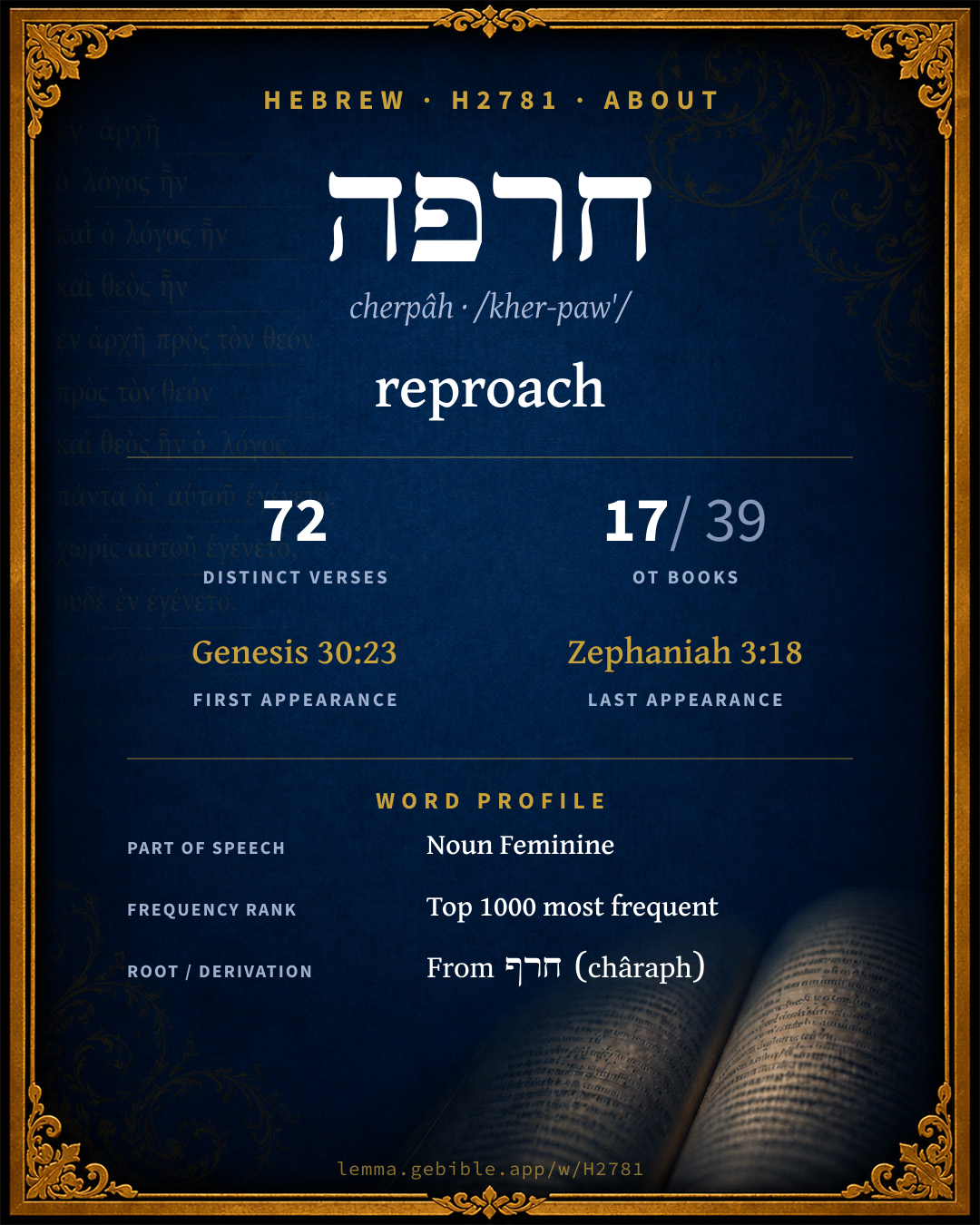
חֶרְפָּה
reproach
‘reproach’ is one of 4 main senses fuller range ↓
Full lexicon entry — Brown-Driver-Briggs (BDB)
From Brown-Driver-Briggs (BDB)
Where this word appears
See every Absolute-state word in the Hebrew Bible →
Grammar key — what these labels mean
Part of speech
- Noun
- A naming word — a person, place, thing, or idea.
Noun type
- Common
- A common noun — a general class of person, place, or thing (“king,” “city,” “water”), not a specific name.
State
- Absolute
- The independent form of a noun, not bound to a following word.
- Construct
- A noun bound to a following noun in a possessive / “of” relationship (the construct chain).
Gender
- Feminine
- Grammatically feminine.
Number
- Singular
- One.
- Plural
- More than one (in Hebrew, generally three or more).
34 distinct verses where H2781 appears in the Construct state, across 16 books. Filtered view — show all forms. Click any verse to open its interlinear word-by-word view. Verse text shown in the World English Bible for context — . Each verse’s Hebrew form is shown with its reference; the English is not keyword-highlighted, since the data carries no word-level English alignment. Use “Compare translations” on any verse to read it across multiple English versions. This concordance covers the Hebrew Bible; Septuagint (Greek Old Testament) occurrences are not indexed here.
Genesis 1 verse
Joshua 1 verse
1 Samuel 1 verse
2 Samuel 1 verse
Nehemiah 2 verses
- Nehemiah 4:4 חֶרְפָּתָ֖/ם n c fs cs + sfx pers 3mp Hear, our God; for we are despised: and turn back their reproach on their own head, and give them up for a spoil in a land of captivity;
- Nehemiah 5:9 מֵ/חֶרְפַּ֖ת prep + n c fs cs Also I said, The thing that you do is not good: ought you not to walk in the fear of our God, because of the reproach of the nations our enemies?
Job 1 verse
Psalms 9 verses
- Psalms 22:6 חֶרְפַּ֥ת n c fs cs But I am a worm, and no man; A reproach of men, and despised by the people.
- Psalms 39:8 חֶרְפַּ֥ת n c fs cs Deliver me from all my transgressions. Don't make me the reproach of the foolish.
- Psalms 69:9 וְ/חֶרְפּ֥וֹת conj + n c fp cs For the zeal of your house consumes me. The reproaches of those who reproach you have fallen on me.
- Psalms 69:19 חֶרְפָּתִ֣/י n c fs cs + sfx pers 1cs You know my reproach, my shame, and my dishonor. My adversaries are all before you.
- Psalms 74:22 חֶרְפָּתְ/ךָ֥ n c fs cs + sfx pers 2ms Arise, God! Plead your own cause. Remember how the foolish man mocks you all day.
- Psalms 78:66 חֶרְפַּ֥ת n c fs cs He struck his adversaries backward. He put them to a perpetual reproach.
- Psalms 79:12 חֶרְפָּ֘תָ֤/ם n c fs cs + sfx pers 3mp Pay back to our neighbors seven times into their bosom Their reproach with which they have reproached you, Lord.
- Psalms 89:50 חֶרְפַּ֣ת n c fs cs Remember, Lord, the reproach of your servants, How I bear in my heart the taunts of all the mighty peoples,
- Psalms 119:39 חֶ֭רְפָּתִ/י n c fs cs + sfx pers 1cs Take away my disgrace that I dread, For your ordinances are good.
Proverbs 1 verse
Isaiah 5 verses
- Isaiah 4:1 חֶרְפָּתֵֽ/נוּ n c fs cs + sfx pers 1cp Seven women shall take hold of one man in that day, saying, "We will eat our own bread, and wear our own clothing: only let us be called by your name. Take away our reproach."
- Isaiah 25:8 וְ/חֶרְפַּ֣ת conj + n c fs cs He has swallowed up death forever; and the Lord Yahweh will wipe away tears from off all faces; and the reproach of his people will he take away from off all the earth: for Yahweh has spoken it.
- Isaiah 47:3 חֶרְפָּתֵ֑/ךְ n c fs cs + sfx pers 2fs Your nakedness shall be uncovered, yes, your shame shall be seen: I will take vengeance, and will spare no man.
- Isaiah 51:7 חֶרְפַּ֣ת n c fs cs Listen to me, you who know righteousness, the people in whose heart is my law; don't you fear the reproach of men, neither be you dismayed at their insults.
- Isaiah 54:4 וְ/חֶרְפַּ֥ת conj + n c fs cs Don't be afraid; for you shall not be ashamed: neither be confounded; for you shall not be disappointed: for you shall forget the shame of your youth; and the reproach of your widowhood shall you remember no more.
Jeremiah 2 verses
- Jeremiah 23:40 חֶרְפַּ֣ת n c fs cs and I will bring an everlasting reproach on you, and a perpetual shame, which shall not be forgotten.
- Jeremiah 31:19 חֶרְפַּ֥ת n c fs cs Surely after that I was turned, I repented; and after that I was instructed, I struck on my thigh: I was ashamed, yes, even confounded, because I did bear the reproach of my youth.
Lamentations 2 verses
Ezekiel 4 verses
- Ezekiel 16:57 חֶרְפַּ֣ת n c fs cs before your wickedness was uncovered, as at the time of the reproach of the daughters of Syria, and of all who are round about her, the daughters of the Philistines, who do despite to you round about.
- Ezekiel 21:28 חֶרְפָּתָ֑/ם n c fs cs + sfx pers 3mp You, son of man, prophesy, and say, Thus says the Lord Yahweh concerning the children of Ammon, and concerning their reproach; and say you, A sword, a sword is drawn, for the slaughter it is furbished, to cause it to devour, that it may be as lightning;
- Ezekiel 36:15 וְ/חֶרְפַּ֥ת conj + n c fs cs neither will I let you hear any more the shame of the nations, neither shall you bear the reproach of the peoples any more, neither shall you cause your nation to stumble any more, says the Lord Yahweh.
- Ezekiel 36:30 חֶרְפַּ֥ת n c fs cs I will multiply the fruit of the tree, and the increase of the field, that you may receive no more the reproach of famine among the nations.
Daniel 1 verse
Hosea 1 verse
Micah 1 verse
Zephaniah 1 verse
About this entry
At a glance — auto-summarized from this page’s data, not written by a person. Every figure links to its source below. This summary describes the numbers; it doesn’t interpret them.
“reproach” is the headline sense of the Hebrew noun חרפה (cherpâh). Its meaning spans more than one sense — see its full sense range. It appears 72 verses across 17 books of the Hebrew Bible, among its moderately common vocabulary. More than a quarter of its appearances fall in Psalms. First canonically at Genesis 30:23, it enters the text early. The sections below give every sense, occurrence, and version rendering.
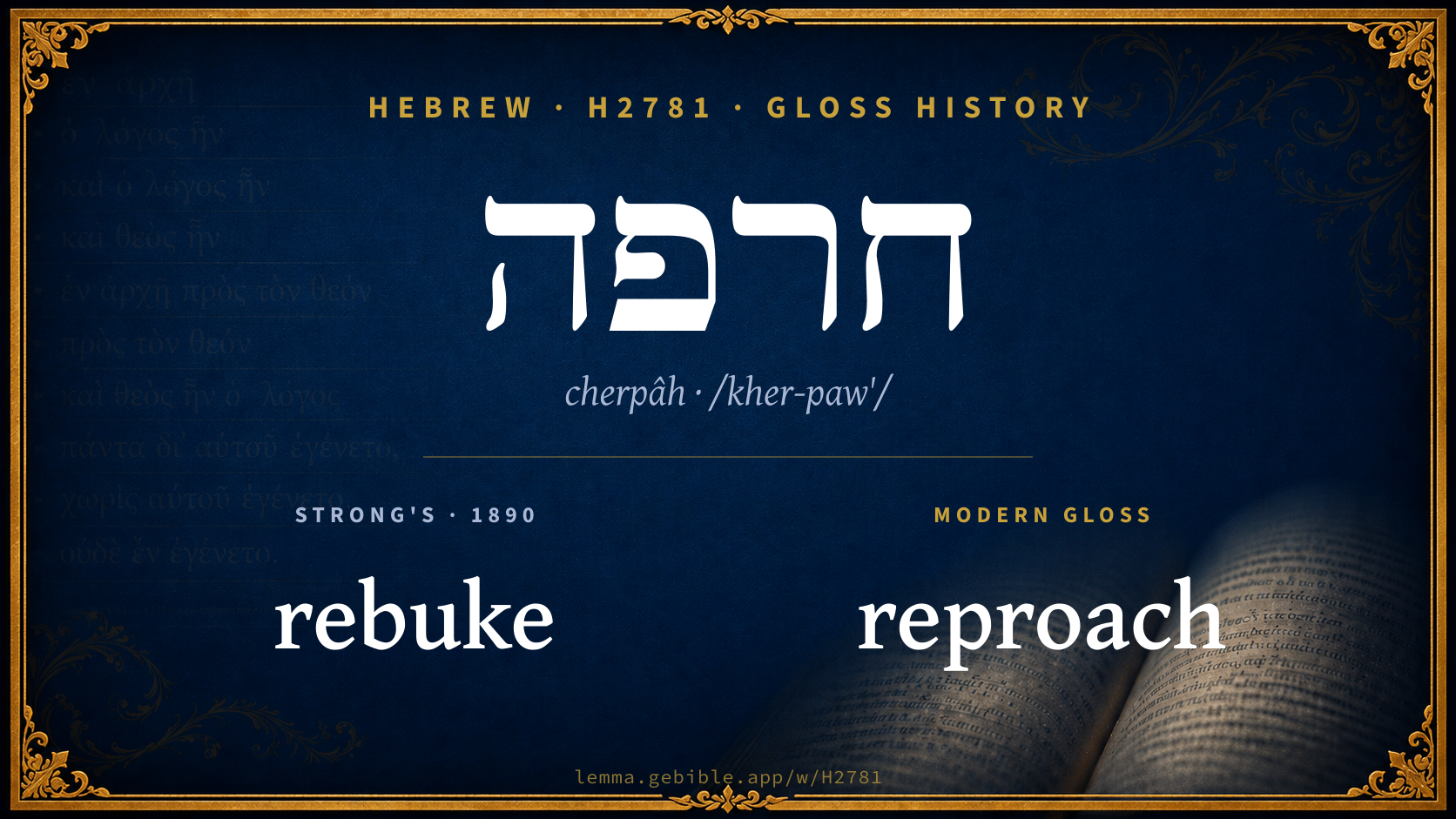
Gloss history
Strong's 1890 vs modern scholarship
About this word
Strong's H2781 catalogs a Hebrew word from the Hebrew Old Testament.
These counts are not copied from any lexicon or concordance. They are computed here, from the morphology-tagged Hebrew Old Testament. What Lemma adds →
- 72
- distinct verses
- The word appears in 72 distinct verses.
- 17 / 39
- OT books
- The word appears in 17 of 39 Old Testament books.
- #542
- by frequency
- Top 1000 most frequent Hebrew words (rank 542 of 8,640 Hebrew words by occurrence).
View all 72 occurrences in the concordance →
By section of the Old Testament
By traditional corpus
Conventional, traditional groupings — biblical authorship is debated, so this is a traditional corpus grouping, not an authorship claim. Each share is this word’s portion of its verses in that division of the Hebrew canon. Each figure is a share of the word’s 72 distinct verses.
- Prophets (Nevi'im) 36 verses · 50%
- Writings (Ketuvim) 34 verses · 47%
- Torah (Pentateuch) 2 verses · 3%
How translations render this word
Counts come from each version’s own published word-to-Strong’s tagging or interlinear alignment — an approximate guide to how each version renders this word, not a word-level alignment the data otherwise carries. Because each total is that version’s own tagged count, the per-version totals vary from one another and need not match the appearance or distinct-verse counts above. These counts may also differ from a printed concordance because Lemma counts each distinctly tagged rendering and does not collapse phrase taggings into a single head-word total. This is a fixed set of word-tagged versions (KJV, ASV, BSB, ULT) and does not change with the reading translation you choose elsewhere. Each version’s license is shown beside its name below (and on Sources).
- King James Version: Reproach 44×, Rebuke 2×
- American Standard Version: Reproach 41×, Him 2×
- Berean Standard Bible: Reproach 30×, Disgrace 15×, Scorn 6×
- unfoldingWord Literal Text: Reproach 32×, Disgrace 8×, Reproach of 7×
King James Version Public Domain
Renders H2781 across 73 tagged occurrences — most commonly:
Plus 27 renderings that appear only once — usually multi-word phrases or single function words the recovered tagging swept in, not distinct renderings.
American Standard Version Public Domain
Renders H2781 across 74 tagged occurrences — most commonly:
Plus 31 renderings that appear only once — usually multi-word phrases or single function words the recovered tagging swept in, not distinct renderings.
Berean Standard Bible Public Domain
Renders H2781 across 72 tagged occurrences — most commonly:
Plus 7 renderings that appear only once — usually multi-word phrases or single function words the recovered tagging swept in, not distinct renderings.
unfoldingWord Literal Text CC BY-SA 4.0
Renders H2781 across 73 tagged occurrences — most commonly:
Plus 13 renderings that appear only once — usually multi-word phrases or single function words the recovered tagging swept in, not distinct renderings.
8 senses and sub-senses in the full BDB
What do BDB’s symbols mean?
BDB uses these scholarly abbreviations:
| Symbol | Meaning |
|---|---|
| 𝔊 | the Septuagint (the ancient Greek translation, LXX) |
| 𝔙 | the Vulgate (the Latin translation) |
| 𝔖 | the Syriac version (the Peshitta) |
| 𝔗 | the Targum (the Aramaic translation) |
| ψ | the Psalms |
| √ | root (the underlying root or stem) |
| ‖ | parallel passage (a synonymous or contrasted parallel) |
| † | the dagger: every passage where the word occurs is cited |
The 8 senses and sub-senses the full Brown-Driver-Briggs lexicon distinguishes for this word, in lexicon order (not ranked by frequency), with BDB’s own verbatim wording and sub-sense lettering. Shown in Hebrew script with BDB’s own scholarly abbreviations. The condensed entry is in the Lexicon Entry tab. See also the Forms in the corpus table below.
- 1. taunt of enemy 1 S 17:26; so also 1 S 25:39; reproach cast upon another, scorn, contumely Ne 3:36; 5:9 ψ 69:20, 21; 71:13; 89:51; 119:22 Pr 18:3 Is 51:7 Ez 21:33; שׁמע ח׳ Je 51:51 Zp 2:8 La 3:61; נתן ח׳ על Je 23:40; נשׂא ח׳ על ψ 15:3 (slander); נשׂא ח׳ Je 31:19 Ez 36:15 Mi 6:16 (reproach); נשׂא ח׳ על bear reproach for ψ 69:8 Je 15:15 Zp 3:18; השׁיב ח׳ Ho 12:15 Ne 3:36; חרף ח׳ ψ 69:10; 79:12; 89:51; הסיר ח׳ מעל 1 S 17:26 Is 25:8; העביר ח׳ ψ 119:39; reproaches against God ψ 69:10 (חֶרְפּוֹת חוֹרְפֶיךָ), 74:22; 79:12. e.g. 1 Samuel 17:26
- 2. reproach which rests upon one, condition of shame, disgrace:
- a. sexual 2 S 13:13 Is 47:3 Ez 16:57 Pr 6:33. e.g. 2 Samuel 13:13
- b. barrenness of womb Gn 30:23 (E) Is 4:1; widowhood Is 54:4. e.g. Genesis 30:23
- c. hunger Ez 36:30; disease Jb 19:5. e.g. Ezekiel 36:30
- d. ritual, uncircumcision Gn 34:14 (P) Jos 5:9 (JE). e.g. Genesis 34:14
- e. injuries from enemies La 3:30; 5:1 Ne 1:3; 2:17 Jb 16:10 Dn 11:18(×2). e.g. Lamentations 3:30
- 3. a reproach, the object of reproach, the person or thing reproached חֶרְפַּת אָדָם a reproach of man ψ 22:7; ח׳ נבל 39:9; היה ח׳ ל׳ become an object of reproach to 31:12; 79:4; 89:42; 109:25 Ez 5:15; (היה) לח (ל׳) Is 30:5 Je 6:10; 20:8; 42:18; 44:8, 12; 49:13 ψ 69:11 Dn 9:16; 12:2; נתן ח׳ (ל׳) Ez 22:4 Jo 2:19 ψ 78:66; נתן לח׳ Je 24:9; 29:18 Ez 5:14 Jo 2:17; שׂים ח׳ ל׳ ψ 44:14; שׂים ח׳ על 1 S 11:2. e.g. Psalms 22:7
Senses from the full Brown-Driver-Briggs lexicon (Brown, Driver, Briggs; Oxford 1906 — public domain), digitized via Sefaria, supplemented by the OpenScriptures HebrewLexicon (CC BY 4.0). Full attribution on Sources.
Word origin
n.f. reproach—ח׳ Gn 34:14 + 35 times; cstr. חֶרְפַּת Jos 5:9 + 15 times; sf. חֶרְפָּֽתְךָ ψ 74:22 etc. + 17 times sfs.; pl. חֲרָפוֹת ψ 69:11 Dn 12:2; cstr. חֶרְפּוֹת ψ 69:10.—
— Brown-Driver-Briggs (Oxford 1906, public domain), digitized via Sefaria, supplemented by the OpenScriptures HebrewLexicon (CC BY 4.0). See Sources.
Derived from חרף (châraph) (H2778) — to reproach.
Jastrow Dictionary
A second Hebrew/Aramaic lexicon for comparison, covering Aramaic and post-biblical (Talmudic, Targumic, Midrashic) usage that the biblical-Hebrew BDB does not. Matched by lemma rather than by Strong’s number, so a lemma may carry more than one Jastrow headword (shown separately below), and the entries cover usage well beyond the Bible.
חֶרְפָּה
- [paleness,] shame; revilement. Gen. R. s. 80. Sabb. 88ᵇ, a. e. שומעין חֶרְפָּתָן וכ׳ hear themselves reviled and answer not.
A Dictionary of the Targumim, the Talmud Babli and Yerushalmi, and the Midrashic Literature (Marcus Jastrow; London, Luzac, 1903) — Public Domain. Digitized via Sefaria. Digitized via Sefaria. Full attribution on Sources.
Forms in the corpus
The 48 distinct written forms H2781 takes in the Hebrew Bible, most frequent first — each parse links to that state’s occurrences in the concordance. Hebrew forms include their vowel points and cantillation, so a single lemma takes many written forms.
Same root — word family
Other BDB entries built from the same root as H2781, grouped by Strong’s listed origin. These share a root / origin per the lexicon — not necessarily a shared meaning. Each links to that word’s own entry.
Derives from
Shares the same root
Proper names from this root
People and places named from this root — a name, not an additional meaning of the word.
Compare all same-root words → Showing 4 of 5 — not the complete family. 2 of the same-root words are proper names (people or places). They share a root, not necessarily a meaning.
Septuagint verse parallels
This word appears in 54 verses that also exist in the Greek Old Testament (Septuagint), out of the 72 Hebrew verses it occurs in. You can read those verses in Greek by switching the Old Testament edition to the Septuagint.
Read these verses in the Septuagint
- Genesis 30:23
- Joshua 5:9
- 1 Samuel 11:2
- 2 Samuel 13:13
- Job 16:10
- Psalms 15:3
- Proverbs 6:33
- Isaiah 4:1
- Jeremiah 6:10
- Lamentations 3:30
- Ezekiel 5:14
- Daniel 9:16
This is a verse-level parallel only — the same verses exist in both the Hebrew and Greek Old Testaments. No word-level Hebrew↔Greek correspondence is claimed: the data carries no such alignment, so no Greek word is shown as this Hebrew word’s translation. Coverage is not total — the Septuagint omits the deuterocanon and renumbers the Psalms, so some Hebrew verses have no direct Greek parallel.