
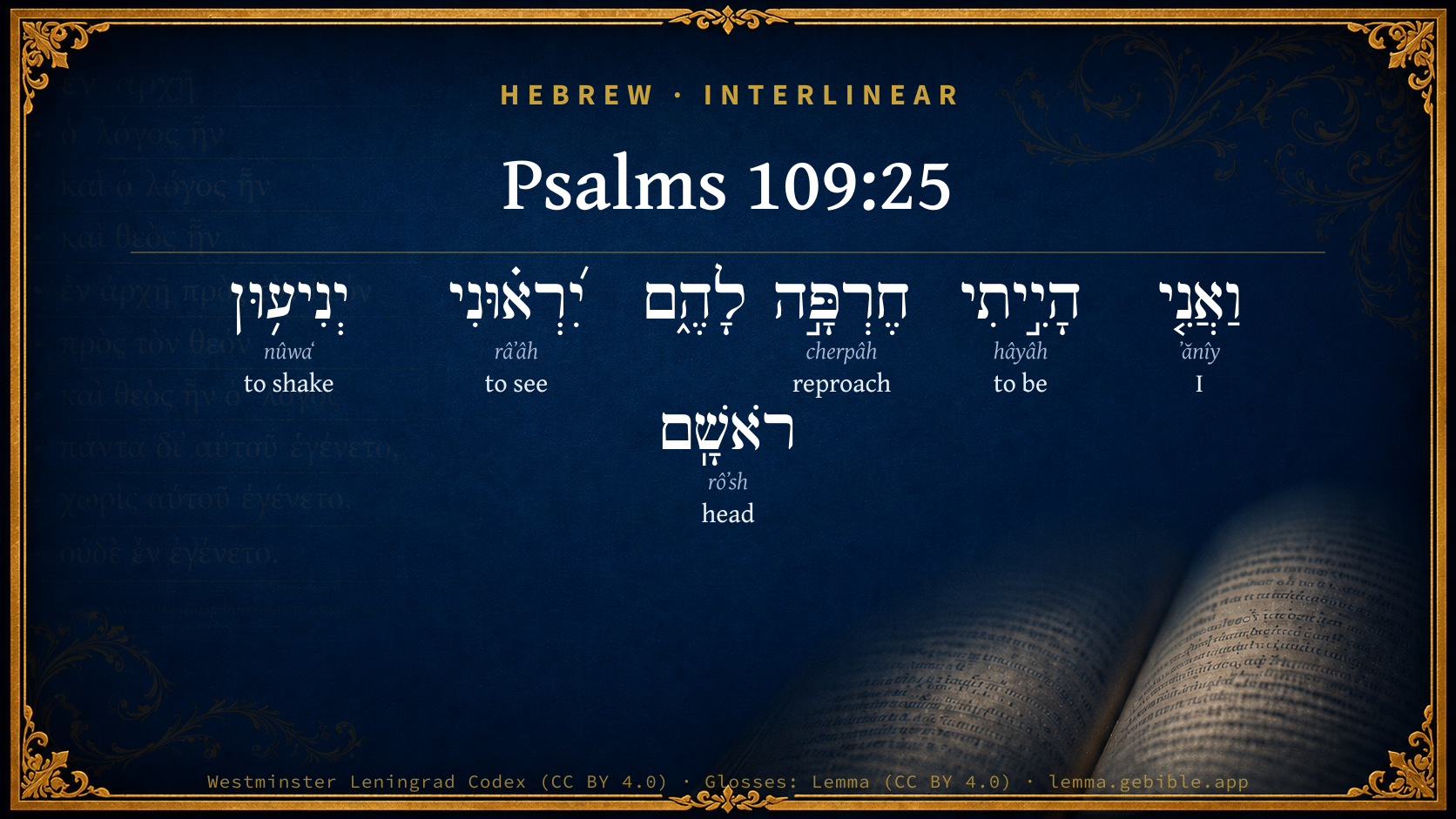
Psalms 109:25

Hebrew (Westminster Leningrad Codex) Psalms 109:25 appears in the Hebrew Old Testament. The text above is from the Westminster Leningrad Codex. Each word links to its Strong’s number, a concise gloss, and parsing drawn from the Open Scriptures Hebrew Bible morphology. Click any word for its full Brown-Driver-Briggs (BDB) entry.
Download image
Cite this verse

Psalms 109:25 (World English Bible). Public Domain. Lemma interlinear Bible study tool, https://lemma.gebible.app/v/psalms/109/25.

Show BibTeX & RIS
BibTeX
RIS
English Translation
I have also become a reproach to them. When they see me, they shake their head.
World English Bible · Public Domain
Download a study sheet

One document with this verse’s original text, its word-by-word gloss line, the meaning frame, cross-references with their text, attributed commentary, and full source and license credits — printable, and it pastes into notes with its structure intact.

This verse Autodidact and up

Study sheet (.html) Plain text (.txt)

A passage Seminary Student

Up to 50 verses in one chapter. A passage sheet keeps up to 6 commentary sources and 12 cross-references per verse, in the order this page ranks them, and says so on the sheet whenever that leaves anything out. Ask for a single verse and you get the Autodidact verse sheet above.

Everything on this page stays free to read, with no account — the sheet is a download of what is already on screen, not access to it.

Want to remove ads? Support Godless Engineer
Compare translations 3

The same verse in 3 English versions, stacked beneath the original-language interlinear above. Click any original word for its lexicon entry.

Each is an independent rendering of the whole verse — the interlinear is not word-aligned to these translations.

Highlighted words mark where these versions differ — a whole-verse word diff, not a word-by-word alignment.

  • World English Bible Public Domain
    I have also become a reproach to them. When they see me, they shake their head.
  • King James Version Public Domain
    I became also a reproach unto them: when they looked upon me they shaked their heads.
  • unfoldingWord Literal Text CC BY-SA 4.0
    And I, I am a disgrace to them; they see me; they shake their head.

unfoldingWord Literal Text — © unfoldingWord, licensed CC BY-SA 4.0. Word-aligned USFM3 via Door43 (git.door43.org/unfoldingWord/en_ult).

Versions to compare (up to 4)

3 of 4 selected

Show all 18 translations

Every available English version of this verse, each an independent rendering of the whole verse.

  • World English Bible Public Domain
    I have also become a reproach to them. When they see me, they shake their head.
  • Berean Standard Bible Public Domain
    I am an object of scorn to my accusers; when they see me, they shake their heads.
  • Majority Standard Bible Public Domain
    I am an object of scorn to my accusers; when they see me, they shake their heads.
  • King James Version Public Domain
    I became also a reproach unto them: when they looked upon me they shaked their heads.
  • American Standard Version (1901) Public Domain
    I am become also a reproach unto them: When they see me, they shake their head.
  • Revised Version (1885) Public Domain
    I am become also a reproach unto them: when they see me, they shake their head.
  • Geneva Bible (1599) Public Domain
    I became also a rebuke vnto them: they that looked vpon me, shaked their heads.
  • Douay-Rheims (1899) Public Domain
    And I am become a reproach to them: they saw me and they shaked their heads,
  • Young's Literal Translation Public Domain
    And I -- I have been a reproach to them, They see me, they shake their head.
  • Literal Standard Version CC BY-SA 4.0
    And I have been a reproach to them, || They see me, they shake their head.
  • Unlocked Literal Bible CC BY-SA 4.0
    I am disdained by my accusers; when they see me, they shake their heads.
  • unfoldingWord Literal Text CC BY-SA 4.0
    And I, I am a disgrace to them; they see me; they shake their head.
  • Darby Bible Public Domain
    And I am become a reproach unto them; [when] they look upon me they shake their heads.
  • World Messianic Bible Public Domain
    I have also become a reproach to them. When they see me, they shake their head.
  • Webster's Bible Public Domain
    I became also a reproach to them: when they looked upon me they shook their heads.
  • Free Bible Version CC BY-SA 4.0
    People ridicule me—they look at me and shake their heads!
  • Bible in Basic English Public Domain
    As for me, they make sport of me; shaking their heads when they see me.
  • JPS Tanakh (1917) Public Domain
    I am become also a taunt unto them; when they see me, they shake their head.

Literal Standard Version (2020), Covenant Press — licensed CC BY-SA 4.0. Text via the HelloAO Bible API (eBible.org). Unlocked Literal Bible (unfoldingWord) — licensed CC BY-SA 4.0. Text via the HelloAO Bible API (eBible.org). unfoldingWord Literal Text — © unfoldingWord, licensed CC BY-SA 4.0. Word-aligned USFM3 via Door43 (git.door43.org/unfoldingWord/en_ult). Free Bible Version, Dr. Jonathan Gallagher — licensed CC BY-SA 4.0. Text via the HelloAO Bible API (eBible.org).

Word by word

More ways to search: Search by grammar → Find every occurrence → Compare this word →

Practice this passage: Drill this verse → Learn its vocabulary →

יְנִיע֥וּן
nûwaʻ
H5128
“to shake”
Verb, Hiphil, Imperfect, 3rd Person, Masculine, Plural + Suffix, n
Part of Speech
Verb
Stem
Hiphil
Form
Imperfect
Person
3rd Person
Gender
Masculine
Number
Plural
Full BDB Definition

Origin: a primitive root

TWOT: 1328

to quiver, totter, shake, reel, stagger, wander, move, sift, make move, wave, waver, tremble - (Qal) - to wave, quiver, vibrate, swing, stagger, tremble, be unstable - to totter, go tottering - vagabond (participle) - (Niphal) to be tossed about or around - (Hiphil) - to toss about - to shake, cause to totter - to shake, disturb - to cause to wander
  1. וַאֲנִ֤י ʼănîy H589 “and · I” Conjunction + Pronoun, Personal, 1st Person, Common, Singular
  2. הָיִ֣יתִי hâyâh H1961 “to be” Verb, Qal, Perfect, 1st Person, Common, Singular
  3. חֶרְפָּ֣ה cherpâh H2781 “reproach” Noun, Common, Feminine, Singular, Absolute
  4. יִ֝רְא֗וּנִי râʼâh H7200 “to see · me” Verb, Qal, Imperfect, 3rd Person, Masculine, Plural + Suffix, Personal, 1st Person, Common, Singular
  5. רֹאשָֽׁם rôʼsh H7218 “head · their” Noun, Common, Masculine, Singular, Construct + Suffix, Personal, 3rd Person, Masculine, Plural

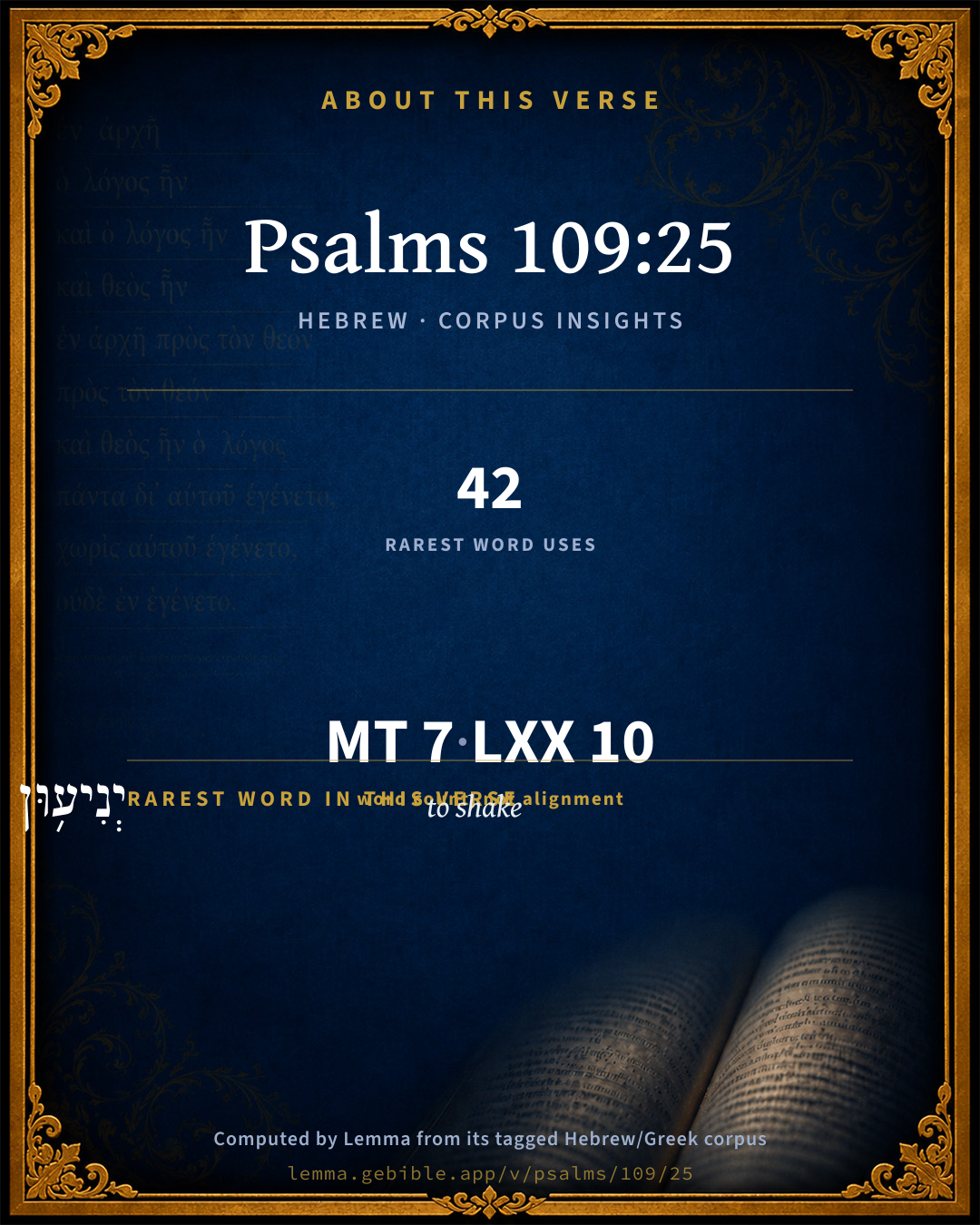
About this verse

These counts appear in no published source. They are computed here, from the morphology-tagged text and Lemma’s own curated glosses. What Lemma adds →

7
words
6
distinct lemmas
Wisdom
section

Shared distinctive vocabulary

יְנִיע֥וּן to shake H5128 occurs in 36 verses of the Hebrew Bible. Also found in:

Grammatical profile

  • 3 verbs
  • 2 nouns
  • 1 pronoun
  • 1 preposition

Verb forms

  • הָיִ֣יתִי Qal · Perfect
  • יִ֝רְא֗וּנִי Qal · Imperfect
  • יְנִיע֥וּן Hiphil · Imperfect

Hebrew & Septuagint length

In English translation the verse runs 16 words from the Hebrew and 15 from the Septuagint (LXX English) — closely comparable.

A rough comparison of the two English renderings, which tokenize alike — not a word-level alignment.

Word counts can differ between the Hebrew and the Greek without any difference in meaning — e.g. the Hebrew direct-object marker אֵת has no separate Greek word, and Greek often adds the article ὁ.

In the original languages it is 7 Hebrew tokens and 10 Greek tokens — but the two are counted differently (Hebrew bundles its prefixes and suffixes into one token; the Greek is in lemma form), so that isn’t a like-for-like length.

Cross-references

12

Topical passages linked to Psalms 109:25 in the Treasury of Scripture Knowledge — connected by theme and wording, ordered by reader-vote popularity; previews shown in the World English Bible.

  • Psalms 22:6–7 But I am a worm, and no man; A reproach of men, and despised by the people.
  • Psalms 69:19–20 You know my reproach, my shame, and my dishonor. My adversaries are all before you.
  • Romans 15:3 For even Christ didn't please himself. But, as it is written, "The reproaches of those who reproached you fell on me."
  • Psalms 69:9–12 For the zeal of your house consumes me. The reproaches of those who reproach you have fallen on me.
  • Job 16:4 I also could speak as you do. If your soul were in my soul's place, I could join words together against you, And shake my head at you.
  • Psalms 31:11–13 Because of all my adversaries I have become utterly contemptible to my neighbors, A fear to my acquaintances. Those who saw me on the street fled from me.
  • Psalms 35:15–16 But in my adversity, they rejoiced, and gathered themselves together. The attackers gathered themselves together against me, and I didn't know it. They tore at me, and didn't cease.
  • Isaiah 37:22 this is the word which Yahweh has spoken concerning him: The virgin daughter of Zion has despised you and ridiculed you; the daughter of Jerusalem has shaken her head at you.
  • Matthew 27:39–40 Those who passed by blasphemed him, wagging their heads,
  • Mark 15:29 Those who passed by blasphemed him, wagging their heads, and saying, "Ha! You who destroy the temple, and build it in three days,
  • Hebrews 12:2 looking to Jesus, the author and perfecter of faith, who for the joy that was set before him endured the cross, despising shame, and has sat down at the right hand of the throne of God.
  • Hebrews 13:13 Let us therefore go forth to him outside of the camp, bearing his reproach.

Cross-references courtesy of OpenBible.info (CC BY 4.0).

Hebrew and Greek witnesses Masoretic Hebrew ↔ Greek Septuagint

The same verse in the two great witnesses to the Old Testament, shown verse-for-verse.

You’re reading Greek Psalm 108 (Hebrew Psalm 109). The Septuagint counts the superscription, so verse numbers can differ from the Hebrew — chapter-level alignment, not verse-by-verse. Numbering follows Rahlfs.

These are two independent witnesses, not word-aligned to each other, and the Septuagint is shown in lemma (dictionary) form.

Hebrew Psalms 109:25 Masoretic · Westminster Leningrad Codex

וַאֲנִ֤י הָיִ֣יתִי חֶרְפָּ֣ה לָהֶ֑ם יִ֝רְא֗וּנִי יְנִיע֥וּן רֹאשָֽׁם

I have also become a reproach to them. When they see me, they shake their head.

World English Bible · Public Domain

Greek LXX Greek Psalm 108:25 Septuagint · lemma form

καί ἐγώ γίγνομαι ὄνειδος αὐτός ὁράω ἐγώ σαλεύω κεφαλή αὐτός

I became also a reproach to them: when they saw me they shook their heads.

LXX2012 (modern English Septuagint) · Public Domain

Hebrew: Westminster Leningrad Codex (CC BY 4.0). Greek: Septuagint (public domain); English from LXX2012 (modern English Septuagint) (Public Domain). How the Septuagint differs from the Hebrew →

Commentary

Notes on Psalms 109:25 from classic Christian and Jewish commentators (each source and its license shown beneath its notes). The classic Christian expositions comment on the surrounding passage and are grouped to its opening verse, so a note may address several verses; the Jewish commentaries on the Tanakh (Rashi and others) are per-verse, so they appear only where the commentator wrote on this verse.

Lemma curates 59 commentaries, every one of them public domain or Creative Commons licensed, each selected and text-cleaned for this edition rather than reprinted as found. About our sources →

Trapp's Complete Commentary

John Trapp

Psa 109:25 I became also a reproach unto them: [when] they looked upon me they shaked their heads.

Ver. 25. I became also a reproach] In respect to my leanness.

They shaked their heads] This is threatened as a curse, Deu 28:15-68, but may befall the best, as it did our Saviour, Psa 22:7 Mat 27:39

John Trapp, A Commentary or Exposition upon All the Books of the Old and New Testament (1647–1656) — public domain. Text from a community e-Sword module.

J. A. Alexander on Psalms

Joseph Addison Alexander

24. (Psa 109:25) My knees totter from fasting, and my flesh fails from fatness. The last phrase is obscure, but seems to mean from being fat, so that it is not fat; the privative usage of the preposition being very common. The sense thus put upon the verb is justified by the analogy of Isa 58:11, where an equivalent expression is applied to failing waters. Some interpreters, however, insist upon retaining the strict sense both of verb and noun, and understand the clause to mean, my flesh lies or deceives the eye, by no longer appearing as it once did, or by seeming to exist when it is gone, from oil, i.e. from want of oil, because no longer taken care of and anointed. But no construction could well be more forced and far-fetched. It may also be objected that the external use of oil was to anoint the head on festive occasions, not to fatten the person or preserve the flesh.

25. (Psa 109:25) And I have been a reproach to them, they see me, they shake their head. A reproach, an object of contempt, as in Psa 22:6; Psa 31:11. As to the meaning of the gesture mentioned in the last clause, see above, on Psa 22:7.

Joseph Addison Alexander, The Psalms Translated and Explained (1850) — public domain. Text from a community e-Sword module.

Adam Clarke's Commentary

Verse 25. When they looked upon me they soaked their heads.] Thus was David treated by Shimei, 2Sa 16:5-6, and our blessed Lord by the Jews, Mt 27:39.

Adam Clarke's Commentary on the Bible (1810–1826) — public domain. Text from a community e-Sword/MySword module.

The Cambridge Bible for Schools and Colleges

gen. ed. J. J. S. Perowne

25. And I—I am become a reproach unto them:

When they see me, they shake their head,

a gesture of contempt and abhorrence, as though I were the object of the wrath of God. Cp. Psa_22:7; Psa_69:10-12; Lam_2:15; Job_16:4.

The Cambridge Bible for Schools and Colleges (gen. ed. J. J. S. Perowne; Cambridge University Press, 1878–1918) — public domain. Text from a community e-Sword module.

John Gill's Exposition

Help me, O Lord my God,.... Jehovah the Father is here addressed, who is the God of Christ, as Christ is man; who formed him, supported him, and glorified him; and whom Christ loved, believed in, obeyed and prayed unto; nor did he pray to a God that could not hear, but to one that was able to save him from death: as a divine Person he needed no help, being the mighty God, the most Mighty, the Almighty: but as man he did, being encompassed about with infirmities; and as Mediator help was promised him, he expected it, and he had it, Psa 89:21.

O save me according to thy mercy; or "kindness"; as before in Psa 109:21 from sufferings, and out of them; from death and the grave, as he was; or his people by him, who are saved not by works of righteousness, but according to the mercy of God, Tit 3:5.

John Gill's Exposition of the Whole Bible (1746–1763) — public domain (CC PDM 1.0). Text via the HelloAO Bible API.

Albert Barnes' Notes on the Bible

I became also a reproach unto them - They reproached or reviled me as a bad man. Compare the notes at Psa 22:6. The plural here - “unto them” - shows that there were more than one to whom the psalm had reference, though one of them was so prominent that a considerable part of the psalm might properly be spoken of him alone.

When they looked upon me, they shaked their heads - In contempt. See Psa 22:7. Compare Mat 27:39.

Albert Barnes' Notes on the Bible (1834–1885) — public domain. Text from a community e-Sword/MySword module.

Matthew Poole's English Annotations

Instead of that pity which either religion or humanity should have taught them to a man in extreme misery, they loaded me with reproaches and scorns.

Shaked their heads; a gesture of contempt and derision; of which see Job 16:4; Psa 22:7.

Matthew Poole's English Annotations on the Holy Bible (1683–1685) — public domain. Text from a community e-Sword/MySword module.

The Treasury of David

Charles H. Spurgeon

Ver. 25. I became also a reproach unto them. They made him the theme of ridicule, the butt of their ribald jests: his emaciation by fasting made him a tempting subject for their caricatures and lampoons.

When they looked upon me they shaked their heads. Words were not a sufficient expression of their scorn, they resorted to gestures which were meant both to show their derision and to irritate his mind. Though these things break no bones, yet they do worse, for they break and bruise far tenderer parts of us. Many a man who could have answered a malicious speech, and so have relieved his mind, has felt keenly a sneer, a putting out of the tongue, or some other sign of contempt. Those, too, who are exhausted by such fasting and wasting, as the last verse describes (Ps 109:31) are generally in a state of morbid sensibility, and therefore feel more acutely the unkindness of others. What they would smile at during happier seasons becomes intolerable when they are in a highly nervous condition.

Psalms 109:26*

Charles H. Spurgeon's The Treasury of David (1869–1885) — public domain. Psalms only. Text from a community e-Sword/MySword module.

Whedon's Commentary on the Bible

Daniel D. Whedon

25. Shaked their heads—Wagged their heads as a token of scorn and insult. See Psa_22:7; Psa_44:14; Lam_2:15; 2Ki_19:21

Daniel D. Whedon (gen. ed.), Commentary on the Old and New Testaments (1874–1909) — public domain. Text from a community e-Sword module.

The Pulpit Commentary

I became (rather, am become) also a reproach unto them; i.e. to my enemies. I am an object of their reproach and scorn. When they looked upon me they shaked their heads. In derision. (comp. Psa_22:7 Psa_44:14 Mat_27:39)

The Pulpit Commentary (1880–1919), ed. H.D.M. Spence-Jones & Joseph S. Exell — public domain. Text from a community e-Sword module.

Lesson kit

Teaching starters — assembled from the data on this page, not authored interpretation. Every prompt links to the verse data it draws on. Edit before teaching.

Psalms, in the Wisdom, opens this verse with 7 words (6 distinct Hebrew lemmas). Its most distinctive word is nûwaʻ (“to shake”). A historical commentator’s framing appears above. Read the whole chapter for the surrounding context.

Discussion questions

  1. What does “to shake” (nûwaʻ) contribute to the verse as a whole?
  2. How does Genesis 4:12, which shares the word «to shake», read alongside this verse?
  3. The translations on this page render this verse differently — a whole-verse word diff, not a word-by-word alignment. What might account for the different wordings?
  4. «הָיִ֣יתִי» is a Qal Perfect verb. How does that grammatical form shape the action described?
  5. Compare how Trapp's Complete Commentary and J. A. Alexander on Psalms read this verse. Where do they agree or differ?

Things to notice

Reading settings

Reading text

Shown beneath each verse's original-language words.

Old Testament
Old Testament edition

Read the OT as the Masoretic Hebrew (MT) or the Greek Septuagint (LXX).

English shown for the Greek Septuagint (in the Hebrew ↔ Greek comparison).

Comparing translations? Open the Compare panel on any verse page to stack up to four side by side.