
Psalms 69:19

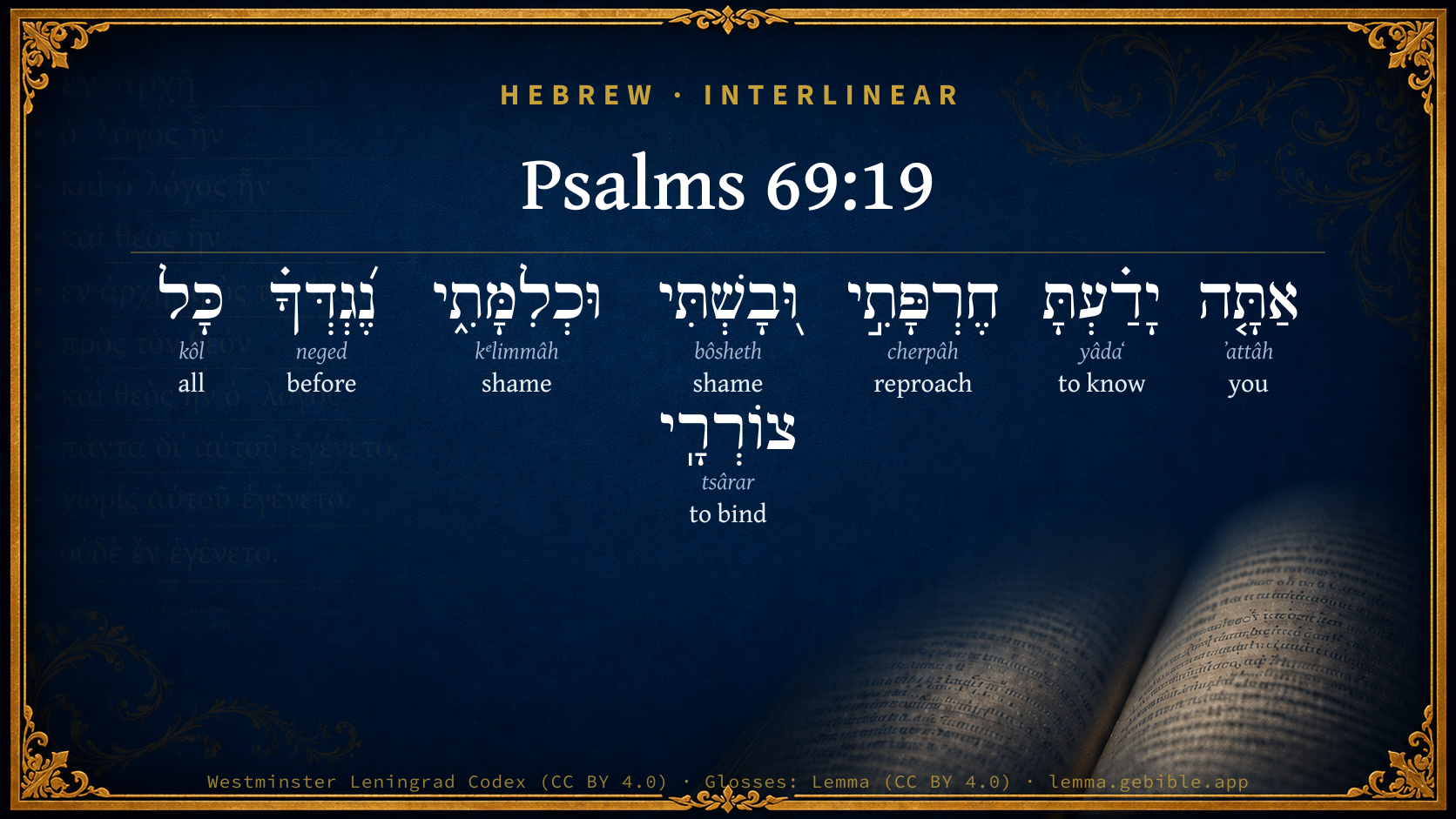
Hebrew (Westminster Leningrad Codex) Psalms 69:19 appears in the Hebrew Old Testament. The text above is from the Westminster Leningrad Codex. Each word links to its Strong’s number, a concise gloss, and parsing drawn from the Open Scriptures Hebrew Bible morphology. Click any word for its full Brown-Driver-Briggs (BDB) entry.
Download image
Cite this verse

Psalms 69:19 (World English Bible). Public Domain. Lemma interlinear Bible study tool, https://lemma.gebible.app/v/psalms/69/19.

Show BibTeX & RIS
BibTeX
RIS
English Translation
You know my reproach, my shame, and my dishonor. My adversaries are all before you.
World English Bible · Public Domain
Download a study sheet

One document with this verse’s original text, its word-by-word gloss line, the meaning frame, cross-references with their text, attributed commentary, and full source and license credits — printable, and it pastes into notes with its structure intact.

This verse Autodidact and up

Study sheet (.html) Plain text (.txt)

A passage Seminary Student

Up to 50 verses in one chapter. A passage sheet keeps up to 6 commentary sources and 12 cross-references per verse, in the order this page ranks them, and says so on the sheet whenever that leaves anything out. Ask for a single verse and you get the Autodidact verse sheet above.

Everything on this page stays free to read, with no account — the sheet is a download of what is already on screen, not access to it.

Want to remove ads? Support Godless Engineer
Compare translations 3

The same verse in 3 English versions, stacked beneath the original-language interlinear above. Click any original word for its lexicon entry.

Each is an independent rendering of the whole verse — the interlinear is not word-aligned to these translations.

Highlighted words mark where these versions differ — a whole-verse word diff, not a word-by-word alignment.

  • World English Bible Public Domain
    You know my reproach, my shame, and my dishonor. My adversaries are all before you.
  • King James Version Public Domain
    Thou hast known my reproach, and my shame, and my dishonour: mine adversaries are all before thee.
  • unfoldingWord Literal Text CC BY-SA 4.0
    You, you know my reproach and my shame and my humiliation. All of my adversaries before you.

unfoldingWord Literal Text — © unfoldingWord, licensed CC BY-SA 4.0. Word-aligned USFM3 via Door43 (git.door43.org/unfoldingWord/en_ult).

Versions to compare (up to 4)

3 of 4 selected

Show all 18 translations

Every available English version of this verse, each an independent rendering of the whole verse.

  • World English Bible Public Domain
    You know my reproach, my shame, and my dishonor. My adversaries are all before you.
  • Berean Standard Bible Public Domain
    You know my reproach, my shame and disgrace. All my adversaries are before You.
  • Majority Standard Bible Public Domain
    You know my reproach, my shame and disgrace. All my adversaries are before You.
  • King James Version Public Domain
    Thou hast known my reproach, and my shame, and my dishonour: mine adversaries are all before thee.
  • American Standard Version (1901) Public Domain
    Thou knowest my reproach, and my shame, and my dishonor: Mine adversaries are all before thee.
  • Revised Version (1885) Public Domain
    Thou knowest my reproach, and my shame, and my dishonour: mine adversaries are all before thee.
  • Geneva Bible (1599) Public Domain
    Thou hast knowen my reproofe and my shame, and my dishonour: all mine aduersaries are before thee.
  • Douay-Rheims (1899) Public Domain
    Attend to my soul, and deliver it: save me because of my enemies.
  • Young's Literal Translation Public Domain
    Thou -- Thou hast known my reproach, And my shame, and my blushing, Before Thee `are' all mine adversaries.
  • Literal Standard Version CC BY-SA 4.0
    You have known my reproach, || And my shame, and my blushing, || All my adversaries [are] before You.
  • Unlocked Literal Bible CC BY-SA 4.0
    You know my rebuke, my shame, and my dishonor; my adversaries are all before you.
  • unfoldingWord Literal Text CC BY-SA 4.0
    You, you know my reproach and my shame and my humiliation. All of my adversaries before you.
  • Darby Bible Public Domain
    *Thou* knowest my reproach, and my shame, and my dishonour: mine adversaries are all before thee.
  • World Messianic Bible Public Domain
    You know my reproach, my shame, and my dishonor. My adversaries are all before you.
  • Webster's Bible Public Domain
    \\69:18\\Draw nigh to my soul, and redeem it: deliver me because of my enemies.
  • Free Bible Version CC BY-SA 4.0
    You—you know my shame, my disgrace, my humiliation. You see everything my enemies are doing.
  • Bible in Basic English Public Domain
    You have seen my shame, how I was laughed at and made low; my haters are all before you.
  • JPS Tanakh (1917) Public Domain
    (69-20) Thou knowest my reproach, and my shame, and my confusion; mine adversaries are all before Thee.

Literal Standard Version (2020), Covenant Press — licensed CC BY-SA 4.0. Text via the HelloAO Bible API (eBible.org). Unlocked Literal Bible (unfoldingWord) — licensed CC BY-SA 4.0. Text via the HelloAO Bible API (eBible.org). unfoldingWord Literal Text — © unfoldingWord, licensed CC BY-SA 4.0. Word-aligned USFM3 via Door43 (git.door43.org/unfoldingWord/en_ult). Free Bible Version, Dr. Jonathan Gallagher — licensed CC BY-SA 4.0. Text via the HelloAO Bible API (eBible.org).

Word by word

More ways to search: Search by grammar → Find every occurrence → Compare this word →

Practice this passage: Drill this verse → Learn its vocabulary →

וּכְלִמָּתִ֑י
kᵉlimmâh
H3639
“and · shame · my”
Conjunction + Noun, Common, Feminine, Singular, Construct + Suffix, Personal, 1st Person, Common, Singular
Part of Speech
Conjunction + Noun
Type
Common
Gender
Feminine
Number
Singular
State
Construct
Full BDB Definition

Origin: from H3637

TWOT: 987a

disgrace, reproach, shame, confusion, dishonour, insult, ignominy - insult, reproach - reproach, ignominy
  1. אַתָּ֤ה ʼattâh H859 “you” Pronoun, Personal, 2nd Person, Masculine, Singular
  2. יָדַ֗עְתָּ yâdaʻ H3045 “to know” Verb, Qal, Perfect, 2nd Person, Masculine, Singular
  3. חֶרְפָּתִ֣י cherpâh H2781 “reproach · my” Noun, Common, Feminine, Singular, Construct + Suffix, Personal, 1st Person, Common, Singular
  4. וּ֭בָשְׁתִּי bôsheth H1322 “and · shame · my” Conjunction + Noun, Common, Feminine, Singular, Construct + Suffix, Personal, 1st Person, Common, Singular
  5. נֶ֝גְדְּךָ֗ neged H5048 “before · you” Preposition + Suffix, Personal, 2nd Person, Masculine, Singular
  6. כָּל kôl H3605 “all of” Noun, Common, Masculine, Singular, Construct
  7. צוֹרְרָֽי tsârar H6887 “binding · me” Verb, Qal, Participle Active, Masculine, Plural, Construct + Suffix, Personal, 1st Person, Common, Singular

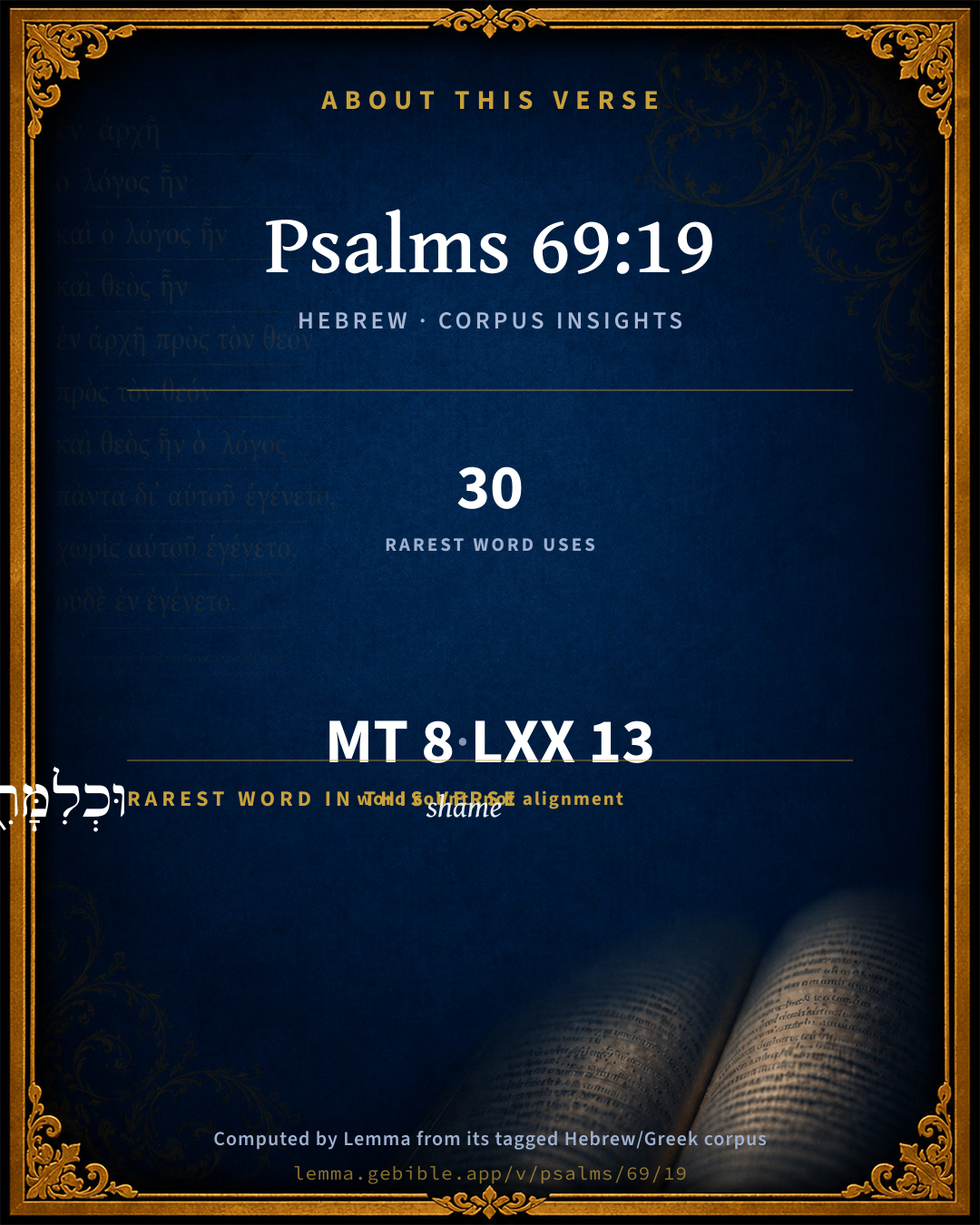
About this verse

These counts appear in no published source. They are computed here, from the morphology-tagged text and Lemma’s own curated glosses. What Lemma adds →

8
words
8
distinct lemmas
Wisdom
section

Shared distinctive vocabulary

וּכְלִמָּתִ֑י shame H3639 occurs in 29 verses of the Hebrew Bible. Also found in:

Grammatical profile

  • 2 verbs
  • 4 nouns
  • 1 pronoun
  • 1 preposition

Verb forms

  • יָדַ֗עְתָּ Qal · Perfect
  • צוֹרְרָֽי Qal · Participle Active

Hebrew & Septuagint length

In English translation the verse runs 15 words from the Hebrew and 18 from the Septuagint (LXX English) — closely comparable.

A rough comparison of the two English renderings, which tokenize alike — not a word-level alignment.

Word counts can differ between the Hebrew and the Greek without any difference in meaning — e.g. the Hebrew direct-object marker אֵת has no separate Greek word, and Greek often adds the article ὁ.

In the original languages it is 8 Hebrew tokens and 13 Greek tokens — but the two are counted differently (Hebrew bundles its prefixes and suffixes into one token; the Greek is in lemma form), so that isn’t a like-for-like length.

Cross-references

8

Topical passages linked to Psalms 69:19 in the Treasury of Scripture Knowledge — connected by theme and wording, ordered by reader-vote popularity; previews shown in the World English Bible.

  • Isaiah 53:3 He was despised, and rejected by men; a man of suffering, and acquainted with disease: and as one from whom men hide their face he was despised; and we didn't respect him.
  • Hebrews 12:2 looking to Jesus, the author and perfecter of faith, who for the joy that was set before him endured the cross, despising shame, and has sat down at the right hand of the throne of God.
  • 1 Peter 2:23 Who, when he was cursed, didn't curse back. When he suffered, didn't threaten, but committed himself to him who judges righteously;
  • Psalms 2:2–4 The kings of the earth take a stand, And the rulers take counsel together, Against Yahweh, and against his anointed, saying,
  • Psalms 38:9 Lord, all my desire is before you. My groaning is not hidden from you.
  • Psalms 69:7–9 Because for your sake, I have borne reproach. Shame has covered my face.
  • John 8:49 Jesus answered, "I don't have a demon, but I honor my Father, and you dishonor me.
  • Psalms 22:6–7 But I am a worm, and no man; A reproach of men, and despised by the people.

Cross-references courtesy of OpenBible.info (CC BY 4.0).

Hebrew and Greek witnesses Masoretic Hebrew ↔ Greek Septuagint

The same verse in the two great witnesses to the Old Testament, shown verse-for-verse.

You’re reading Greek Psalm 68 (Hebrew Psalm 69). The Septuagint counts the superscription, so verse numbers can differ from the Hebrew — chapter-level alignment, not verse-by-verse. Numbering follows Rahlfs.

These are two independent witnesses, not word-aligned to each other, and the Septuagint is shown in lemma (dictionary) form.

Hebrew Psalms 69:19 Masoretic · Westminster Leningrad Codex

אַתָּ֤ה יָדַ֗עְתָּ חֶרְפָּתִ֣י וּ֭בָשְׁתִּי וּכְלִמָּתִ֑י נֶ֝גְדְּךָ֗ כָּל צוֹרְרָֽי

You know my reproach, my shame, and my dishonor. My adversaries are all before you.

World English Bible · Public Domain

Greek LXX Greek Psalm 68:19 Septuagint · lemma form

προςἔχω ὁ ψυχή ἐγώ καί λυτρόω αὐτός ἕνεκα ὁ ἐχθρός ἐγώ ῥύομαι ἐγώ

For you know my reproach, and my shame, and my confusion; all that afflict me are before you.

LXX2012 (modern English Septuagint) · Public Domain

Hebrew: Westminster Leningrad Codex (CC BY 4.0). Greek: Septuagint (public domain); English from LXX2012 (modern English Septuagint) (Public Domain). How the Septuagint differs from the Hebrew →

Commentary

Notes on Psalms 69:19 from classic Christian and Jewish commentators (each source and its license shown beneath its notes). The classic Christian expositions comment on the surrounding passage and are grouped to its opening verse, so a note may address several verses; the Jewish commentaries on the Tanakh (Rashi and others) are per-verse, so they appear only where the commentator wrote on this verse.

Lemma curates 59 commentaries, every one of them public domain or Creative Commons licensed, each selected and text-cleaned for this edition rather than reprinted as found. About our sources →

Trapp's Complete Commentary

John Trapp

Psa 69:19 Thou hast known my reproach, and my shame, and my dishonour: mine adversaries [are] all before thee.

Ver. 19. Thou hast known my reproach] That is enough for David, that God taketh cognizance of the injuries and indignities cast upon him; for he will surely right him.

John Trapp, A Commentary or Exposition upon All the Books of the Old and New Testament (1647–1656) — public domain. Text from a community e-Sword module.

Joseph Benson's Commentary

Psa 69:19-20. Thou hast known my reproach, &c. — Thou seest how much of it I suffer, and that for thy sake. Mine adversaries are all before thee — Thou knowest them thoroughly, and all their injurious and wicked devices, and implacable malice against me. None of them, nor of their secret plots and subtle lies, whereby they seek to defame and undo me: are hidden from thy all-seeing view: nor art thou unacquainted with their impiety and contempt of thee and thy truth. Reproach hath broken my heart — Reproach is the most grievous to those whose spirits are the most generous and noble; and this was the highest degree and the worst kind of reproach, being cast upon him for God’s sake, and upon God also for his sake. I looked for some to take pity, but there was none — That is, few or none; for whether it be understood of David or of Christ, there were some who pitied both of them. Dr. Delaney, who considers the distress which David was now in as being occasioned by his fall, observes, “There were two circumstances of it which, though they are beyond all question the greatest and severest which human nature, can suffer, are not sufficiently considered. The first is, the distress he endured on account of the obloquy and reproach brought upon the true religion and the truly religious by his guilt; and the second, the reproach and endless insults brought upon himself, even by his repentance and humiliation before God and the world. Let any ingenuous man, who feels for virtue and is not seared to shame, put the question to himself: I appeal to his own heart, whether he would not infinitely rather die than endure the state now described one day; forsaken by his friends, scorned by his enemies, insulted by his inferiors, the scoff of libertines, and the song of sots? What then must we think of the fortitude and magnanimity of that man who could endure all this for a series of years? Or rather, how shall we adore that unfailing mercy and all- sufficient goodness which could support him thus, under the quickest sense of shame and infamy, and deepest compunctions of conscience; which could enable him to bear up steadily against guilt, infamy, and the evil world united; from a principle of true religion! and, in the end, even rejoice in his sad estate; as he plainly perceived it must finally tend to promote the true interest of virtue, and the glory of God; that is, must finally tend to promote that interest, which was the great governing principle and main purpose of his life.” — Life of David, b. 3. vol. 3. pp. 30-33.

Joseph Benson's Commentary on the Old and New Testaments (1811–1818) — public domain. Text from a community e-Sword module.

J. A. Alexander on Psalms

Joseph Addison Alexander

20. (Psa 69:19). Thou knowest, literally hast known, as a thing of long standing, my reproach, the contempt of which I am the object, and my shame and my disgrace; before thee, in thy sight and known to thee, (are) all my adversaries, persecutors or oppressors, not their persons merely, or their conduct in general, but their treatment of me. The conviction that God knows all involves a persuasion that he will do justice to both parties. See above, on Psa 1:6.

Joseph Addison Alexander, The Psalms Translated and Explained (1850) — public domain. Text from a community e-Sword module.

Tyndale Open Study Notes

Tyndale Open Resources

69:19-21 Alone and misunderstood, the psalmist confesses that he cannot bear his doubts. His heart has been broken by his problems.

Tyndale Open Study Notes — © Tyndale Open Resources, licensed CC BY-SA 4.0. Text via the HelloAO Bible API.

Geneva Bible (1599)

Geneva Bible translators

Thou seest that I am beset as a sheep among many wolves.

Geneva Bible (1599) marginal notes — public domain. Text via Bolls.life.

Jamieson, Fausset & Brown

Robert Jamieson, A. R. Fausset & David Brown

Calling God to witness his distress, he presents its aggravation produced by the want of sympathizing friends (compare Isa 63:5; Mar 14:50).

Jamieson, Fausset & Brown — Commentary Critical and Explanatory on the Whole Bible (1871) — public domain (CC PDM 1.0). Text via the HelloAO Bible API.

Adam Clarke's Commentary

Verse 19. Thou hast known my reproach] This is one of the most forcible appeals to mercy and compassion that was ever made. The language of these two verses is inimitable; and the sentiment cannot be mended. I can devise no comment that would not lessen their effect.

Adam Clarke's Commentary on the Bible (1810–1826) — public domain. Text from a community e-Sword/MySword module.

John Calvin's Commentaries

19 Thou knowest my reproach, and my confusion. This is a confirmation of the preceding sentence. Whence is it that the greater part of men become dispirited when they see the wicked outrageously rushing upon them, and their wickedness, like a water-flood, carrying all before it, but because they think that heaven is so obscured and overcast with clouds as to prevent God from beholding what is done upon the earth? It becomes us, therefore, in this matter, to call to our remembrance the doctrine of a Divine Providence, that contemplating it we may be assured beyond all doubt, that God will appear for our succor in due season; for he cannot, on the one hand, shut his eyes to our miseries, and it is impossible for him, on the other, to allow the license which the wicked take in doing evil to pass with impunity, without denying himself. David, therefore, takes comfort from the consideration that God is the witness of his grief, fear, sorrows, and cares; nothing being hidden from the eye of Him who is the judge and governor of the world. Nor is it a vain repetition when he speaks so frequently of his reproach and shame. As he was subjected to such dreadful assaults of temptations as might have made the stoutest heart to tremble, it was indispensably necessary for his own defense to oppose to them a strong barrier for resistance. Nothing is more bitter to men of an ingenuous and noble spirit than reproach; but when this is repeated, or rather when shame and reproach are heaped upon us, how needful is it then for us to possess more than ordinary strength, that we may not thereby be overwhelmed? for when succor is delayed, our patience is very apt to give way, and despair very easily creeps in upon us. This shame and reproach may very properly be referred both to the outward appearance and to the actual feelings of the mind. It is well known that he was everywhere held in open derision; and the mockeries which he experienced could not but strike into him both shame and sorrow. For the same reason he subjoins that his enemies are before God, or known to him; as if he had said, Lord, thou knowest how, like a poor sheep, I am surrounded by thousands of wolves.

John Calvin's Commentaries (1540-1563) — public domain. Text from the Calvin Translation Society English edition (1840s-50s) via the Christian Classics Ethereal Library (ccel.org). Calvin's coverage is partial (roughly two-thirds of the Bible); uncommented books and verses are honest gaps, never fabricated. The 19th-century editor's footnotes and remarks are omitted so the notes are faithfully Calvin's own voice.

The Cambridge Bible for Schools and Colleges

gen. ed. J. J. S. Perowne

19. Thou hast known] Rather, THOU knowest. Thou, as in Psa_69:5, is emphatic. See note there for references to Jeremiah’s use of this phrase.

all before thee] They are all in Thy sight. He pleads with God as he might with men, who are more easily moved to pity by the sight of suffering than by merely hearing of it.

19–21. Once more he lays before God the severity of his sufferings, and the inhumanity of his enemies.

The Cambridge Bible for Schools and Colleges (gen. ed. J. J. S. Perowne; Cambridge University Press, 1878–1918) — public domain. Text from a community e-Sword module.

John Gill's Exposition

Thou hast known my reproach, and my shame, and my dishonour,.... A heap of words to express the greatness of the contempt that was cast upon him, and the injury that was done to his person and character; which was all known to God: as how he was vilified by wicked words and blasphemous speeches; how he was exposed to shame and dishonour by deeds; by spitting upon him, buffeting him, veiling his face, stripping him of his garments, and scourging and crucifying him naked;

mine adversaries are all before thee; in his sight: he knew their persons, the malice and wickedness that were in their hearts; and all the evil words that were spoken, and the evil actions that were done by them. Or, "are all against thee" (f); for they that were against Christ were against his Father.

(f) "coram te, vel contra te", Cocceius.

John Gill's Exposition of the Whole Bible (1746–1763) — public domain (CC PDM 1.0). Text via the HelloAO Bible API.

Albert Barnes' Notes on the Bible

Thou hast known my reproach - The reproach that has come upon me; the shame and contempt which I am called to endure. God had seen all this; and the psalmist appeals to him as having seen it, as a reason why he should now interpose and save him.

And my shame, and my dishonor - These are different words to express the same idea. They are accumulated here to denote the “greatness” of his distress. In other words, shame and reproach bad come upon him in every possible form.

Mine adversaries are all before thee - All who persecute and oppose me are constantly in thine eye. Thou knowest who they are; thou seest all that they do. Nothing in their conduct is concealed from thee. God, therefore, could take an accurate view of his troubles, and could see all the reasons which existed for interfering in his behalf.

Albert Barnes' Notes on the Bible (1834–1885) — public domain. Text from a community e-Sword/MySword module.

Matthew Poole's English Annotations

Thou hast known my reproach, & c.; thou seest how much of it I suffer, and that for thy sake; as he said, Psa 69:7.

Are all before thee; thou knowest them thoroughly, and all their injurious and wicked devices and implacable malice against me, and all their impiety and contempt of thee; for which they deserve to be utterly and speedily destroyed.

Matthew Poole's English Annotations on the Holy Bible (1683–1685) — public domain. Text from a community e-Sword/MySword module.

The Treasury of David

Charles H. Spurgeon

Ver. 19. Thou hast known my reproach, and my shame, and my dishonour. It is no novelty or secret, it has been long continued; thou, O God, hast seen it; and for thee to see the innocent suffer is an assurance of help. Here are three words piled up to express the Redeemer's keen sense of the contempt poured upon him; and his assurance that every form of malicious despite was observed of the Lord.

Mine adversaries are all before thee. The whole lewd and loud company is now present to thine eye: Judas and his treachery; Herod and his cunning; Caiaphas and his counsel; Pilate and his vacillation; Jews, priests, people, rulers, all, thou seest and wilt judge.

Ver. 19. Thou hast known my reproach, etc. It is a great deal of comfort that God does take notice of our reproaches; this was the comfort of the psalmist. If a man suffer reproach, and disgrace, and trouble for his friends, while he is abroad from them; O, says he, did my friends know what I suffer, and suffer for them, it would comfort me: if it be comfort to be known, much more when they shall be accounted their own. Christ is acquainted with all the sufferings of every member; and, therefore, do not say, I am a poor creature; who takes notice of my sufferings? Heaven takes notice of your sufferings; Christ takes notice of them better than yourselves. Jeremiah Burroughs.

Ver. 19.

I. God knows what his people suffer; how much, how long,

from whom, for what.

II. His people should find consolation in this knowledge.

1. That trial is permitted by him.

2. That it is apportioned by him.

3. That it has its design from him.

4. That when the design is accomplished, it will be removed by him. G. R.

Psalms 69:20*

Charles H. Spurgeon's The Treasury of David (1869–1885) — public domain. Psalms only. Text from a community e-Sword/MySword module.

Whedon's Commentary on the Bible

Daniel D. Whedon

19. Thou hast known—He returns to a review of his miserable state, and of the conduct of his enemies, and comforts himself in the thought that all is “known” to God, and this appeal to the omniscience of God implies that he will, in his own time, arise to judgment. Only to the righteous is the perfect knowledge of God a consolation.

Daniel D. Whedon (gen. ed.), Commentary on the Old and New Testaments (1874–1909) — public domain. Text from a community e-Sword module.

The Pulpit Commentary

Thou hast known my reproach, and my shame, and my dishonour (comp. vers. 7-12). Whatever David has suffered at the hands of his enemies has been fully known to God, who has at any rate permitted it. Having seen and known, God will not forget. My adversaries are all before thee. Thou hast seen my adversaries also, and still hast them in thy sight. Thou beholdest their insolence and audacity.

The Pulpit Commentary (1880–1919), ed. H.D.M. Spence-Jones & Joseph S. Exell — public domain. Text from a community e-Sword module.

Rashi

Rabbi Shlomo Yitzchaki (Rashi)

Come close to my soul (Come close to me.)

redeem it Heb. גאלה, [equivalent to] גְאוֹל אוֹתָה.

Rashi on the Tanakh — English translations: “The Judaica Press complete Tanach with Rashi, translated by A. J. Rosenberg” (CC BY 4.0); “Pentateuch with Rashi's commentary by M. Rosenbaum and A.M. Silbermann, 1929-1934” (public domain); “The Metsudah Tanach series, Lakewood, N.J” (CC BY 4.0); and “The Book of Joshua, Metsudah Publications, 1997” (CC BY 4.0). Text via Sefaria.

Lesson kit

Teaching starters — assembled from the data on this page, not authored interpretation. Every prompt links to the verse data it draws on. Edit before teaching.

Psalms, in the Wisdom, opens this verse with 8 words (8 distinct Hebrew lemmas). Its most distinctive word is kᵉlimmâh (“shame”). A historical commentator’s framing appears above. Read the whole chapter for the surrounding context.

Discussion questions

  1. What does “shame” (kᵉlimmâh) contribute to the verse as a whole?
  2. How does Job 20:3, which shares the word «shame», read alongside this verse?
  3. These translations render this verse differently. What is at stake in choosing one wording over another?
  4. «יָדַ֗עְתָּ» is a Qal Perfect verb. How does that grammatical form shape the action described?
  5. Compare how Trapp's Complete Commentary and Joseph Benson's Commentary read this verse. Where do they agree or differ?

Things to notice

Reading settings

Reading text

Shown beneath each verse's original-language words.

Old Testament
Old Testament edition

Read the OT as the Masoretic Hebrew (MT) or the Greek Septuagint (LXX).

English shown for the Greek Septuagint (in the Hebrew ↔ Greek comparison).

Comparing translations? Open the Compare panel on any verse page to stack up to four side by side.