
Psalms 69:10

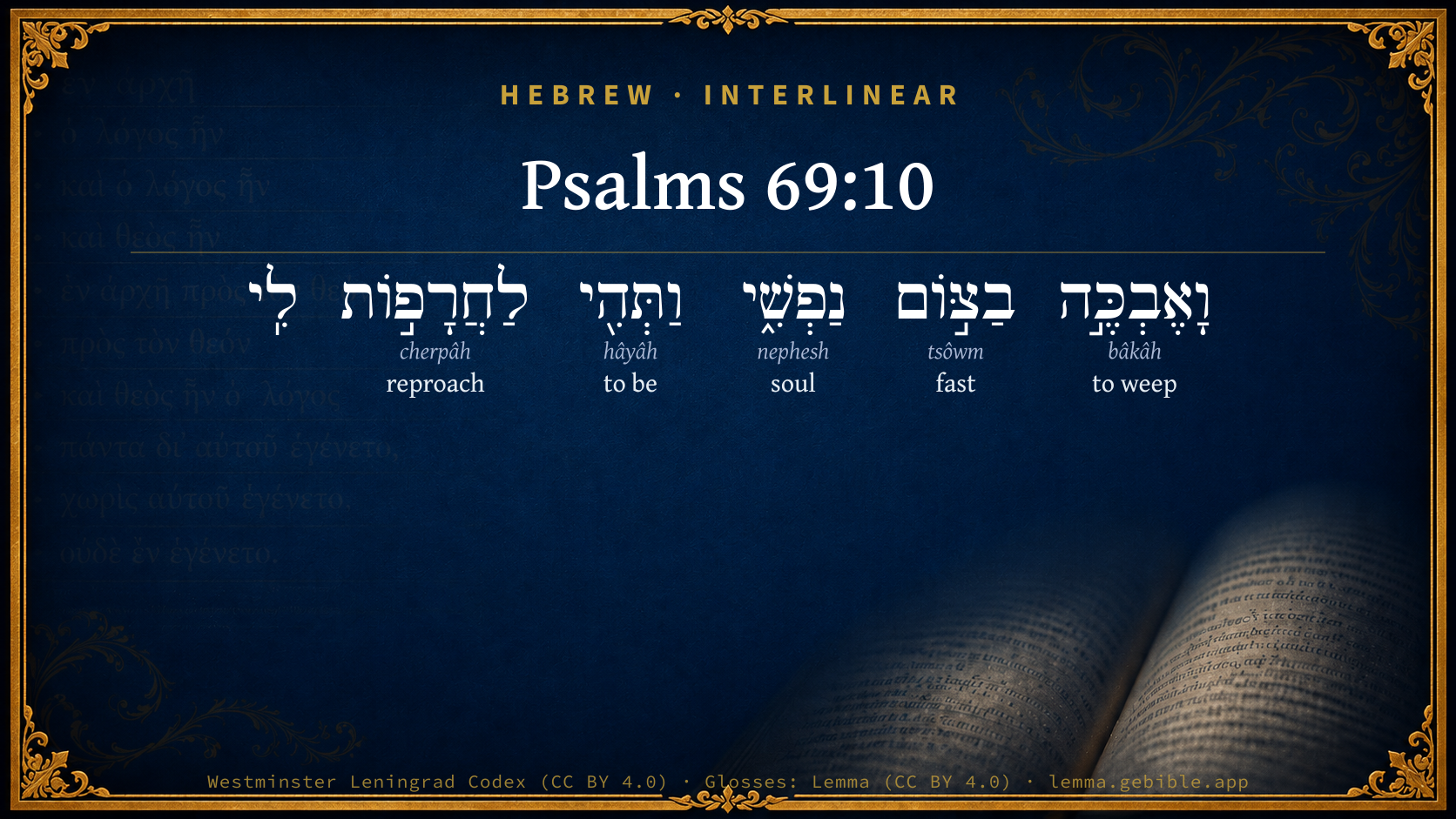
Hebrew (Westminster Leningrad Codex) Psalms 69:10 appears in the Hebrew Old Testament. The text above is from the Westminster Leningrad Codex. Each word links to its Strong’s number, a concise gloss, and parsing drawn from the Open Scriptures Hebrew Bible morphology. Click any word for its full Brown-Driver-Briggs (BDB) entry.
Download image
Cite this verse

Psalms 69:10 (World English Bible). Public Domain. Lemma interlinear Bible study tool, https://lemma.gebible.app/v/psalms/69/10.

Show BibTeX & RIS
BibTeX
RIS
English Translation
When I wept and I fasted, That was to my reproach.
World English Bible · Public Domain
Download a study sheet

One document with this verse’s original text, its word-by-word gloss line, the meaning frame, cross-references with their text, attributed commentary, and full source and license credits — printable, and it pastes into notes with its structure intact.

This verse Autodidact and up

Study sheet (.html) Plain text (.txt)

A passage Seminary Student

Up to 50 verses in one chapter. A passage sheet keeps up to 6 commentary sources and 12 cross-references per verse, in the order this page ranks them, and says so on the sheet whenever that leaves anything out. Ask for a single verse and you get the Autodidact verse sheet above.

Everything on this page stays free to read, with no account — the sheet is a download of what is already on screen, not access to it.

Want to remove ads? Support Godless Engineer
Compare translations 3

The same verse in 3 English versions, stacked beneath the original-language interlinear above. Click any original word for its lexicon entry.

Each is an independent rendering of the whole verse — the interlinear is not word-aligned to these translations.

Highlighted words mark where these versions differ — a whole-verse word diff, not a word-by-word alignment.

  • World English Bible Public Domain
    When I wept and I fasted, That was to my reproach.
  • King James Version Public Domain
    When I wept, and chastened my soul with fasting, that was to my reproach.
  • unfoldingWord Literal Text CC BY-SA 4.0
    Though I wept my soul with fasting, yet it became reproaches to me;

unfoldingWord Literal Text — © unfoldingWord, licensed CC BY-SA 4.0. Word-aligned USFM3 via Door43 (git.door43.org/unfoldingWord/en_ult).

Versions to compare (up to 4)

3 of 4 selected

Show all 18 translations

Every available English version of this verse, each an independent rendering of the whole verse.

  • World English Bible Public Domain
    When I wept and I fasted, That was to my reproach.
  • Berean Standard Bible Public Domain
    I wept and fasted, but it brought me reproach.
  • Majority Standard Bible Public Domain
    I wept and fasted, but it brought me reproach.
  • King James Version Public Domain
    When I wept, and chastened my soul with fasting, that was to my reproach.
  • American Standard Version (1901) Public Domain
    When I wept, `and chastened' my soul with fasting, That was to my reproach.
  • Revised Version (1885) Public Domain
    When I wept, and chastened my soul with fasting, that was to my reproach.
  • Geneva Bible (1599) Public Domain
    I wept and my soule fasted, but that was to my reproofe.
  • Douay-Rheims (1899) Public Domain
    For the zeal of thy house hath eaten me up: and the reproaches of them that reproached thee are fallen upon me.
  • Young's Literal Translation Public Domain
    And I weep in the fasting of my soul, And it is for a reproach to me.
  • Literal Standard Version CC BY-SA 4.0
    And I weep in the fasting of my soul, || And it is for a reproach to me.
  • Unlocked Literal Bible CC BY-SA 4.0
    When I wept and did not eat food, they insulted me.
  • unfoldingWord Literal Text CC BY-SA 4.0
    Though I wept my soul with fasting, yet it became reproaches to me;
  • Darby Bible Public Domain
    And I wept, my soul was fasting: that also was to my reproach; --
  • World Messianic Bible Public Domain
    When I wept and I fasted, that was to my reproach.
  • Webster's Bible Public Domain
    \\69:9\\For the zeal of thy house hath eaten me up; and the reproaches of them that reproached thee have fallen upon me.
  • Free Bible Version CC BY-SA 4.0
    I wept and I fasted, but they mocked me;
  • Bible in Basic English Public Domain
    My bitter weeping, and my going without food, were turned to my shame.
  • JPS Tanakh (1917) Public Domain
    (69-11) And I wept with my soul fasting, and that became unto me a reproach.

Literal Standard Version (2020), Covenant Press — licensed CC BY-SA 4.0. Text via the HelloAO Bible API (eBible.org). Unlocked Literal Bible (unfoldingWord) — licensed CC BY-SA 4.0. Text via the HelloAO Bible API (eBible.org). unfoldingWord Literal Text — © unfoldingWord, licensed CC BY-SA 4.0. Word-aligned USFM3 via Door43 (git.door43.org/unfoldingWord/en_ult). Free Bible Version, Dr. Jonathan Gallagher — licensed CC BY-SA 4.0. Text via the HelloAO Bible API (eBible.org).

Word by word

More ways to search: Search by grammar → Find every occurrence → Compare this word →

Practice this passage: Drill this verse → Learn its vocabulary →

About this verse

These counts appear in no published source. They are computed here, from the morphology-tagged text and Lemma’s own curated glosses. What Lemma adds →

6
words
5
distinct lemmas
Wisdom
section

Shared distinctive vocabulary

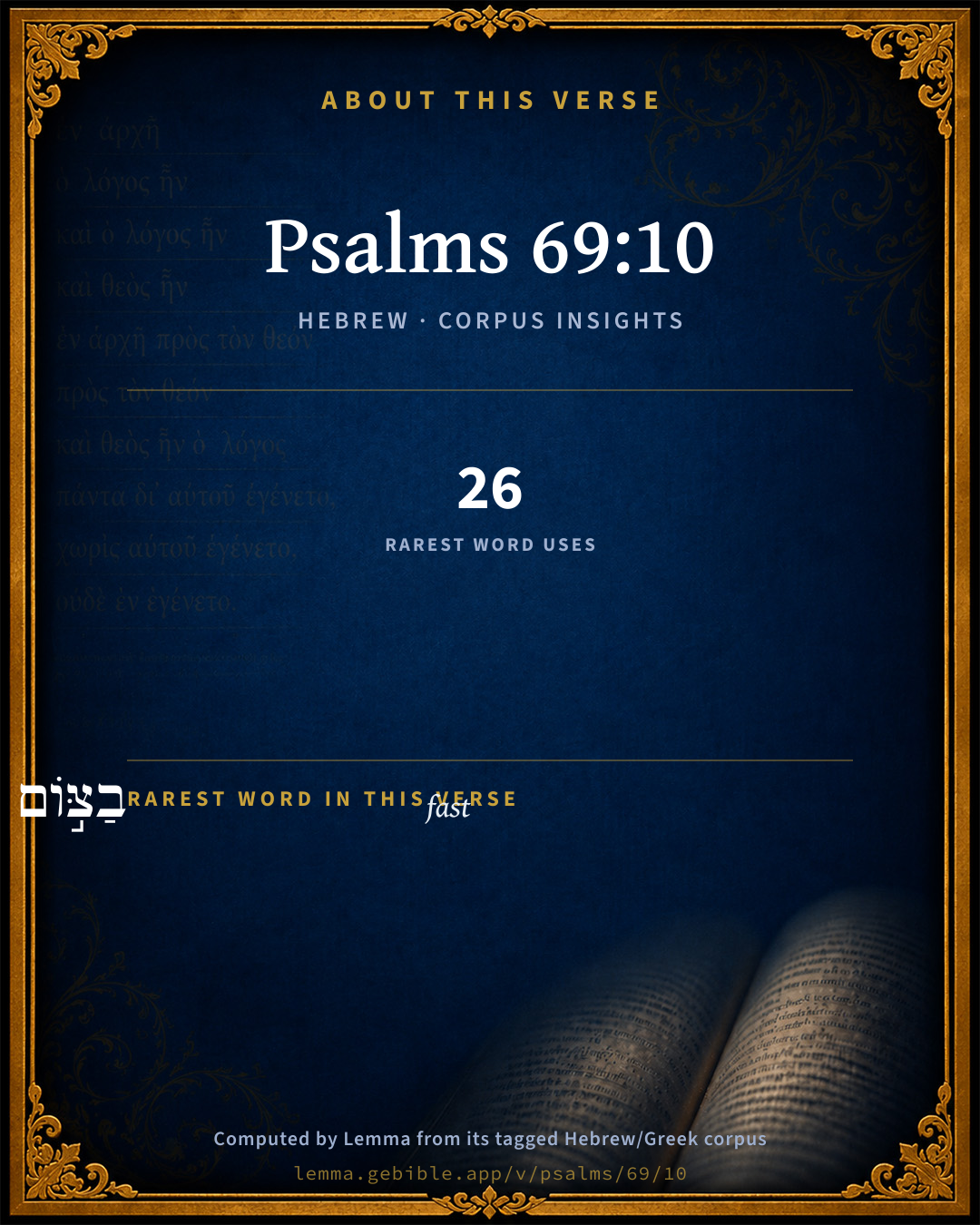
בַצּ֣וֹם fast H6685 occurs in 22 verses of the Hebrew Bible. Also found in:

Grammatical profile

  • 2 verbs
  • 3 nouns
  • 1 preposition

Verb forms

  • וָאֶבְכֶּ֣ה Qal · Sequential Imperfect
  • וַתְּהִ֖י Qal · Sequential Imperfect

Hebrew & Septuagint length

In English translation the verse runs 11 words from the Hebrew and 14 from the Septuagint (LXX English) — closely comparable.

A rough comparison of the two English renderings, which tokenize alike — not a word-level alignment.

Word counts can differ between the Hebrew and the Greek without any difference in meaning — e.g. the Hebrew direct-object marker אֵת has no separate Greek word, and Greek often adds the article ὁ.

Cross-references

4

Topical passages linked to Psalms 69:10 in the Treasury of Scripture Knowledge — connected by theme and wording, ordered by reader-vote popularity; previews shown in the World English Bible.

  • Luke 7:33–34 For John the Baptizer came neither eating bread nor drinking wine, and you say, 'He has a demon.'
  • Psalms 35:13 But as for me, when they were sick, my clothing was sackcloth. I afflicted my soul with fasting. My prayer returned into my own bosom.
  • Psalms 102:8–9 My enemies reproach me all day. Those who are mad at me use my name as a curse.
  • Psalms 109:24–25 My knees are weak through fasting. My body is thin and lacks fat.

Cross-references courtesy of OpenBible.info (CC BY 4.0).

Hebrew and Greek witnesses Masoretic Hebrew ↔ Greek Septuagint

The same verse in the two great witnesses to the Old Testament, shown verse-for-verse.

You’re reading Greek Psalm 68 (Hebrew Psalm 69). The Septuagint counts the superscription, so verse numbers can differ from the Hebrew — chapter-level alignment, not verse-by-verse. Numbering follows Rahlfs.

These are two independent witnesses, not word-aligned to each other, and the Septuagint is shown in lemma (dictionary) form.

Hebrew Psalms 69:10 Masoretic · Westminster Leningrad Codex

וָאֶבְכֶּ֣ה בַצּ֣וֹם נַפְשִׁ֑י וַתְּהִ֖י לַחֲרָפ֣וֹת לִֽי

When I wept and I fasted, That was to my reproach.

World English Bible · Public Domain

Greek LXX Greek Psalm 68:10 Septuagint · lemma form

ὅτι ὁ ζῆλος ὁ οἶκος σύ καταἐσθίω ἐγώ καί ὁ ὀνειδισμός ὁ ὀνειδίζω σύ ἐπιπίπτω ἐπί ἐγώ

And I bowed down my soul with fasting, and that was made my reproach.

LXX2012 (modern English Septuagint) · Public Domain

On this verse, Ellicott's Commentary for English Readers discusses the Septuagint’s reading. Read the note in Commentary ↓

Hebrew: Westminster Leningrad Codex (CC BY 4.0). Greek: Septuagint (public domain); English from LXX2012 (modern English Septuagint) (Public Domain). How the Septuagint differs from the Hebrew →

Commentary

Notes on Psalms 69:10 from classic Christian and Jewish commentators (each source and its license shown beneath its notes). The classic Christian expositions comment on the surrounding passage and are grouped to its opening verse, so a note may address several verses; the Jewish commentaries on the Tanakh (Rashi and others) are per-verse, so they appear only where the commentator wrote on this verse.

Lemma curates 59 commentaries, every one of them public domain or Creative Commons licensed, each selected and text-cleaned for this edition rather than reprinted as found. About our sources →

Trapp's Complete Commentary

John Trapp

Psa 69:10 When I wept, [and chastened] my soul with fasting, that was to my reproach.

Ver. 10. When I wept, and chastened my soul with fasting] That I might thereby beat down my body, and tame that rebel flesh of mine.

That was to my reproach] They said I did it in hypocrisy and design. So they dealt by the Baptist, that crucifix of mortification, Luk 7:33.

John Trapp, A Commentary or Exposition upon All the Books of the Old and New Testament (1647–1656) — public domain. Text from a community e-Sword module.

Joseph Benson's Commentary

Psa 69:10-12. When I wept — For their impiety, and the reproaches they cast upon God and godliness; and chastened my soul with fasting — That is, either my body or myself; that was my reproach — They derided me for my piety and devotion, and for my faith in God’s promises and hopes of assistance from him. I made sackcloth also my garment — In token of my humiliation and hearty sorrow, as the manner then was in days of fasting. I became a proverb to them — They used my name proverbially of any person whom they thought to be vainly and foolishly religious. They that sit in the gate — That is, as it is generally interpreted, the judges and magistrates, the gates of cities being the places of judicature. But it seems better to agree with the design of the psalmist, and to suit with the next clause, to suppose that he rather meant vain and idle persons, that spent their time in the gates and markets; or such as begged at the gates of the city, as St. Hilary interprets it. And I was the song of the drunkards — Of the scum of the people; of all lewd and debauched persons.

Joseph Benson's Commentary on the Old and New Testaments (1811–1818) — public domain. Text from a community e-Sword module.

J. A. Alexander on Psalms

Joseph Addison Alexander

11. (Psa 69:10). And I wept (away) my soul, or wept myself away, in fasting, and (even that) was for revilings to me, even that became a subject of malignant mockery against me. That weeping and fasting, as natural concomitants, were not unknown to David's experience in real life, appears from 2Sa 12:16; 2Sa 12:21-22. The first clause likewise admits of this construction: and I wept, my soul (was) in fasting, i.e. fasted. But this, though it agrees well with the Hebrew usage which represents fasting as a mortification of the soul (see above, on Psa 35:13), is neither so natural nor so striking as the first construction above given, which is found in an anonymous translation of the Psalms, published by Bagster, London, 1830.

Joseph Addison Alexander, The Psalms Translated and Explained (1850) — public domain. Text from a community e-Sword module.

Tyndale Open Study Notes

Tyndale Open Resources

69:10-12 When the psalmist denies himself normal comforts to seek God in prayer, the wicked ridicule him.

Tyndale Open Study Notes — © Tyndale Open Resources, licensed CC BY-SA 4.0. Text via the HelloAO Bible API.

Geneva Bible (1599)

Geneva Bible translators

My zeal moved me to lament and pray for my salvation.

Geneva Bible (1599) marginal notes — public domain. Text via Bolls.life.

Jamieson, Fausset & Brown

Robert Jamieson, A. R. Fausset & David Brown

wept (and chastened) my soul--literally, "wept away my soul," a strongly figurative description of deep grief.

Jamieson, Fausset & Brown — Commentary Critical and Explanatory on the Whole Bible (1871) — public domain (CC PDM 1.0). Text via the HelloAO Bible API.

John Calvin's Commentaries

10. And I wept, my soul fasted David here proves, by the signs or effects, that his efforts to promote the Divine glory proceeded from a pure and well-regulated zeal, inasmuch as he was not impelled or inflamed by the impetuosity of the flesh, but rather humbly abased himself before God, choosing him to be the witness of his sorrow. By this he shows the more evidently the incorrigible perversity of his enemies. It frequently happens, that those who set themselves boldly for the vindication of the glory of God, provoke and exasperate the wicked to a higher pitch by opposing them contentiously and without moderation. But David’s zeal was so tempered that it ought to have softened even the hardness of steel. By this circumstance he, however, intended to show that he was oppressed with such violence by the frowardness of his enemies, that he dared not even open his mouth to speak a single word in defense of the cause of God, and no other means were left him of defending it but tears and mourning. He was deprived, as we know, of the liberty of giving utterance to the sentiments of his heart, or rather his words, as being those of a condemned person, would have been repelled with cruel reproaches. It was a proof of the greater constancy when in such circumstances he continued to burn with a zeal as unabated as ever, and persevered in the voluntary sorrow which he had engaged to exercise with the view of maintaining the honor and glory of God. He accordingly declares, that he wept and that his soul fasted, and that he was clothed with sackcloth; which were the tokens of mourning among the Jews. But his enemies turned all these things into mockery and jesting; from which it is manifest that they were carried away with the fury of demons. It is of importance for us to be fortified with such an example, that in the present day we may not be discouraged when we meet with the same perversity by which the enemies of the Gospel prove themselves to be rather devils than men. We must, however, beware of pouring oil upon the fire which is already burning too fiercely, and should rather imitate David and Lot, who, although they had not liberty to rebuke the wicked, were yet deeply grieved in their hearts. And even when the wicked are constrained to hear us, mildness and humility will be a powerful means, or rather will be the best seasoning, for tempering holy zeal. Those who conceive of David as intimating that he resigned himself to suffer punishment in the room or stead of his enemies, attempt to confirm their opinion from his having clothed himself in sackcloth. But I take it more simply as meaning, that when he saw things in such a state of confusion, he voluntarily engaged in this sorrowful exercise to testify that nothing was more grievous to him than to witness the sacred name of God exposed to contumely.

John Calvin's Commentaries (1540-1563) — public domain. Text from the Calvin Translation Society English edition (1840s-50s) via the Christian Classics Ethereal Library (ccel.org). Calvin's coverage is partial (roughly two-thirds of the Bible); uncommented books and verses are honest gaps, never fabricated. The 19th-century editor's footnotes and remarks are omitted so the notes are faithfully Calvin's own voice.

Ellicott's Commentary for English Readers

(10) When I wept . . .—The expression I wept (or lamented) my soul with fasting is hardly intelligible, though perhaps we might say I wept out my soul with fasting. The LXX. and Psa_35:13 suggest an emendation to “I humbled my soul with fasting.”

To my reproach.—Quite literally and better, a reproach to me. Those who made light of the covenant altogether, who were in heart apostates both to faith and patriotism, would naturally treat with contempt those outward signs by which an erring Israelite owned his offence and sought reconciliation.

A Bible Commentary for English Readers, edited by Charles John Ellicott (1878–1897) — public domain. Text from a community e-Sword module.

The Cambridge Bible for Schools and Colleges

gen. ed. J. J. S. Perowne

10, 11. When I wept, (and chastened) my soul with fasting,

It was turned to reproaches for me:

When I made sackcloth my clothing,

I became a byword unto them.

In shame and penitence for the dishonour done by his countrymen to God, he fasted and mourned; but they only mocked and derided him for doing what they ought to have done themselves (Jer_4:8; Jer_6:26).

The construction of the first line is anomalous. Probably the word for ‘wept’ is a corruption of some word for ‘humbled’ (Psa_35:13) or ‘chastened.’ For byword cp. Psa_44:14.

The Cambridge Bible for Schools and Colleges (gen. ed. J. J. S. Perowne; Cambridge University Press, 1878–1918) — public domain. Text from a community e-Sword module.

John Gill's Exposition

When I wept,.... Because of the sins of his people imputed to him; the hardness and unbelief of the Jews that rejected him; their impiety and profaneness in polluting the temple with their merchandise: he wept at the grave of Lazarus, and over the city of Jerusalem, on account of the blindness of its inhabitants, and the ruin coming upon them; and in his prayers at different times, especially in the garden and on the cross, which were offered up with strong crying and tears; see Joh 11:35;

and chastened my soul with fasting; or "my soul being in fasting" (y). The Targum renders it, "in the fasting of my soul"; the word "chastened" is supplied from Psa 35:13; and "soul" is put for the body, or for the whole person. Christ fasted forty days and nights in the wilderness; and often, through neglect of himself, and multiplicity of business, in preaching, and in healing diseases, was without food for some time: he seems to have been fasting the day that he suffered, when he made atonement for sin; and so answered the type on the day of atonement, when every man was to afflict his soul with fasting, Lev 16:29; hence the Jews taunting at him gave him gall for his meat, and vinegar for his drink, Psa 69:21; and it follows,

that was to my reproach; if he ate and drank, he was charged with being a glutton and a winebibber; and if he wept and fasted, as John his forerunner did, they reproached him with madness, and having a devil, Mat 11:18; and, as may be reasonably supposed, after this manner;

"can this poor creature, that weeps, and mourns, and fasts, be thought to be the Son of God, a divine Person, as he makes himself to be, and his followers believe he is?''

and so the blind Jews reason to this day.

(y) "cum esset in jejunio anima mea", Musculus, Cocceius, Gejerus, De Dieu.

John Gill's Exposition of the Whole Bible (1746–1763) — public domain (CC PDM 1.0). Text via the HelloAO Bible API.

Albert Barnes' Notes on the Bible

When I wept, and chastened my soul with fasting - The words “and chastened” are not in the original. The literal translation would be, “And I wept (away) my soul with fasting;” that is, I gave myself so much to fasting accompanied with weeping, that my strength was exhausted. This refers to his acts of devotion; to his endeavors to discipline his soul so as to lead a strictly religious life.

That was to my reproach - This may either mean that they accused him of hypocrisy and insincerity; or, that they charged him with folly for being so religious, so strict, so self-sacrificing, so serious - perhaps they would say, so superstitious, so gloomy, so fanatical. The latter best accords with the connection, since it was for his “religion” mainly that they reproached him, Psa 69:7-9.

Albert Barnes' Notes on the Bible (1834–1885) — public domain. Text from a community e-Sword/MySword module.

Matthew Poole's English Annotations

Wept for their impiety and reproaches which they cast upon God and godliness.

Chastened; which word is here understood out of Psa 35:13; as it is also in 2Ch 10:11,14, out of 1Ki 12:11, where it is expressed.

My soul; either my body, or myself; the soul being oft used both ways. That was to my reproach; they derided me for my piety and devotion, and for my faith in God’s promises, and hopes of assistance from him.

Matthew Poole's English Annotations on the Holy Bible (1683–1685) — public domain. Text from a community e-Sword/MySword module.

The Treasury of David

Charles H. Spurgeon

Ver. 10. When I wept, and chastened my soul with fasting, that was to my reproach. Having resolved to hate him, everything he did was made a fresh reason for reviling. If he ate and drank as others, he was a man gluttonous and a winebibber; if he wept himself away and wore himself out with fasting, then he had a devil and was mad. Nothing is more cruel than prejudice, its eye colours all with the medium through which it looks, and its tongue rails at all indiscriminately. Our Saviour wept much in secret for our sins, and no doubt his private soul chastening on our behalf were very frequent. Lone mountains and desert places saw repeated agonies, which, if they could disclose them, would astonish us indeed. The emaciation which these exercises wrought in our Lord made him appear nearly fifty years old when he was but little over thirty; this which was to his honour was used as a matter of reproach against him.

Ver. 10. When I wept, and chastened my soul with fasting, that was to my reproach. Behold here, virtue is accounted vice; truth, blasphemy; wisdom, folly. Behold, the peace maker of the world is judged a seditious person; the fulfiller of the law, a breaker of the law; our Saviour, a sinner; our God, a devil. O poor troubled heart! wherefore dost thou weakly wail for any injury or abuse that is offered to thee? God handleth thee no otherwise in this world than he handled his only Son, who hath pledged thee in this bitter potion; not only taking essay thereof, but drinking to thee a full draught. It is not only a comfort, but a glory, to be a partner and fellow sufferer with Christ, who delighteth also to see in us some representation of himself. Dogs bark not at those whom they know, and with whom they are familiar; but against strangers they usually bark; not always for any hurt which they feel or fear, but commonly by nature or depraved custom. How then canst thou be a stranger to the world, if it dost not molest thee; if it detracts not from thee? Sir John Hayward (1560-1627), in "The Sanctuary of a Troubled Soul."

Ver. 10. There is nothing so well meant, but it may be ill interpreted. Simon Patrick.

Ver. 10-11. That Christ was derided and scoffed at is plain, from Mark 5; for, when he said, "The girl is not dead, but sleepeth, they laughed him to scorn; "and when he spoke of the necessity of giving alms, "Now, the Pharisees, who were covetous heard all these things, and they derided him." And, in his passion, he was derided by the soldiers, by Herod, by the high priests, and many others. Robert Bellarmine.

Ver. 10-12. A prophecy.

I. Of the Saviour's tears: When I wept.

II. Of his fasting.

III. Of reproach.

IV. Of his humiliation: I made sackcloth, etc.

V. Of the perversion of his words: as, "I will destroy

this temple, "etc.

VI. Of the opposition of the Pharisees, and rulers: They

that sit in the gate, etc.

VII. Of the contempt of the lowest of the people: I was

the song, etc. G. R.

Psalms 69:11*

Ver. 10-11. See Psalms on "Ps 69:12" for further information.

Ver. 10-12. A prophecy.

I. Of the Saviour's tears: When I wept.

II. Of his fasting.

III. Of reproach.

IV. Of his humiliation: I made sackcloth, etc.

V. Of the perversion of his words: as, "I will destroy

this temple, "etc.

VI. Of the opposition of the Pharisees, and rulers: They

that sit in the gate, etc.

VII. Of the contempt of the lowest of the people: I was

the song, etc. G. R.

Psalms 69:13*

Charles H. Spurgeon's The Treasury of David (1869–1885) — public domain. Psalms only. Text from a community e-Sword/MySword module.

Whedon's Commentary on the Bible

Daniel D. Whedon

10, 11. When I wept… with fasting… sackcloth—Possibly because of the public depravation of morals, and the alienation from spiritual worship; perhaps for his own sin. Psalms 38, 41, 51.

That was to my reproach— They made it the theme of jibes and merriment, as if it were unfitting my station, or insincere and for effect.

I became a proverb—That is, a by-word, a theme of satirical discourse, as Deu_28:37; 2Ch_7:20; Psa_44:14; Jer_24:9

Daniel D. Whedon (gen. ed.), Commentary on the Old and New Testaments (1874–1909) — public domain. Text from a community e-Sword module.

The Pulpit Commentary

When I wept, and chastened my soul with fasting, that was to my reproach. David"s practice of fasting appears both here and also in Psa_35:13 Psa_109:24 2Ki_12:16. As fasting was not enjoined by the Law, he might be reproached for over-righteousness, and perhaps also for ostentation, on account of it.

The Pulpit Commentary (1880–1919), ed. H.D.M. Spence-Jones & Joseph S. Exell — public domain. Text from a community e-Sword module.

John Wesley's Explanatory Notes

Wept - For their impiety. Reproach - They derided me for it.

John Wesley, Explanatory Notes Upon the Whole Bible (1754–1765) — public domain. Text via the GEBible commentary corpus.

unfoldingWord translationNotes

Door43 World Missions Community

I wept and did not eat food

The fact that the writer was fasting indicates that he was sad about the way people treated God's temple. (See: Symbolic Action and Assumed Knowledge and Implicit Information)

they insulted me

"my enemies rebuked me because of it"

I made sackcloth my clothing

Wearing rough, cheap clothing was a symbol of mourning over sin. (See: Symbolic Action)

I became the object of a proverb

The writer speak of himself as if he was the sad or foolish person in a proverb. AT: "I became the example of a sad person spoken of in their proverbs" or "they laugh at me" (See: Metaphor)

Those who sit in the city gate

Here "city gate" is associated with leadership of a town. AT: "The important people of the city" (See: Metonymy)

I am a song of drunkards

The writer speaks of himself as if he was the person about whom the drunkards sing mocking songs. AT: "the drunkards of the city sing disgusting songs about me" (See: Metaphor)

translationWords

sackcloth

proverb

gate

drunk

unfoldingWord translationNotes — © Distant Shores Media and the Door43 World Missions Community, licensed CC BY-SA 4.0. Source: git.door43.org/Door43/en_tn.

Rashi

Rabbi Shlomo Yitzchaki (Rashi)

the envy of Your house They saw the love that You showed us when Your house was still existing, and they envied me.

Rashi on the Tanakh — English translations: “The Judaica Press complete Tanach with Rashi, translated by A. J. Rosenberg” (CC BY 4.0); “Pentateuch with Rashi's commentary by M. Rosenbaum and A.M. Silbermann, 1929-1934” (public domain); “The Metsudah Tanach series, Lakewood, N.J” (CC BY 4.0); and “The Book of Joshua, Metsudah Publications, 1997” (CC BY 4.0). Text via Sefaria.

Lesson kit

Teaching starters — assembled from the data on this page, not authored interpretation. Every prompt links to the verse data it draws on. Edit before teaching.

Psalms, in the Wisdom, opens this verse with 6 words (5 distinct Hebrew lemmas). Its most distinctive word is tsôwm (“fast”). A historical commentator’s framing appears above. Read the whole chapter for the surrounding context.

Discussion questions

  1. How does “fast” (tsôwm) shape what this verse is saying?
  2. 2 Samuel 12:16 shares the word «fast» with this verse. How do the two illuminate each other?
  3. The translations on this page render this verse differently — a whole-verse word diff, not a word-by-word alignment. What might account for the different wordings?
  4. The verb «וָאֶבְכֶּ֣ה» is Qal Sequential Imperfect. How does its form color the action?
  5. Reading how Trapp's Complete Commentary and Joseph Benson's Commentary read this verse, where do the two commentators agree and where do they part?

Things to notice

Reading settings

Reading text

Shown beneath each verse's original-language words.

Old Testament
Old Testament edition

Read the OT as the Masoretic Hebrew (MT) or the Greek Septuagint (LXX).

English shown for the Greek Septuagint (in the Hebrew ↔ Greek comparison).

Comparing translations? Open the Compare panel on any verse page to stack up to four side by side.