
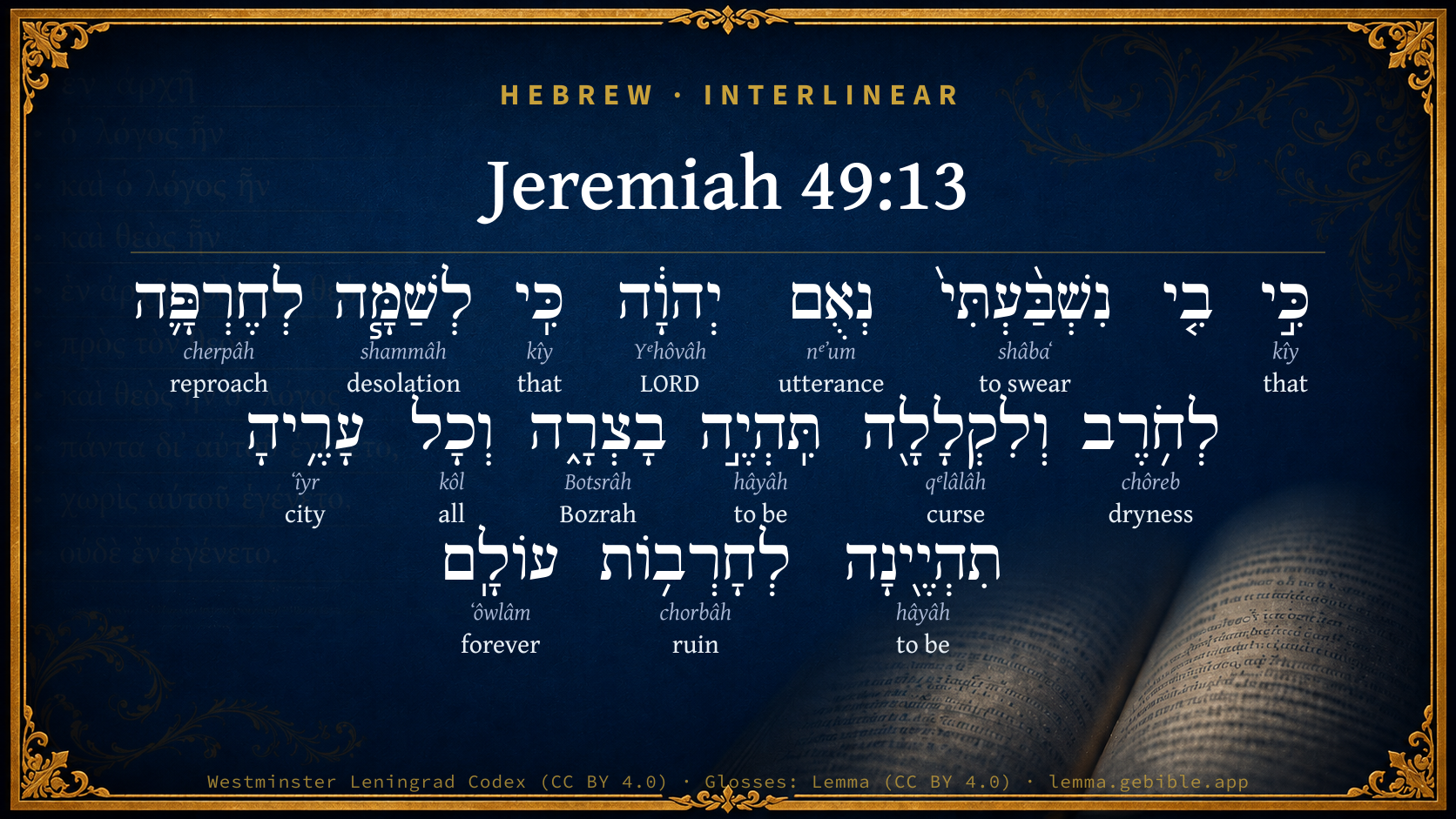
Jeremiah 49:13

Hebrew (Westminster Leningrad Codex) Jeremiah 49:13 appears in the Hebrew Old Testament. The text above is from the Westminster Leningrad Codex. Each word links to its Strong’s number, a concise gloss, and parsing drawn from the Open Scriptures Hebrew Bible morphology. Click any word for its full Brown-Driver-Briggs (BDB) entry.
Download image
Cite this verse

Jeremiah 49:13 (World English Bible). Public Domain. Lemma interlinear Bible study tool, https://lemma.gebible.app/v/jeremiah/49/13.

Show BibTeX & RIS
BibTeX
RIS
English Translation
For I have sworn by myself, says Yahweh, that Bozrah shall become an astonishment, a reproach, a waste, and a curse; and all the cities of it shall be perpetual wastes.
World English Bible · Public Domain
Download a study sheet

One document with this verse’s original text, its word-by-word gloss line, the meaning frame, cross-references with their text, attributed commentary, and full source and license credits — printable, and it pastes into notes with its structure intact.

This verse Autodidact and up

Study sheet (.html) Plain text (.txt)

A passage Seminary Student

Up to 50 verses in one chapter. A passage sheet keeps up to 6 commentary sources and 12 cross-references per verse, in the order this page ranks them, and says so on the sheet whenever that leaves anything out. Ask for a single verse and you get the Autodidact verse sheet above.

Everything on this page stays free to read, with no account — the sheet is a download of what is already on screen, not access to it.

Want to remove ads? Support Godless Engineer
Compare translations 3

The same verse in 3 English versions, stacked beneath the original-language interlinear above. Click any original word for its lexicon entry.

Each is an independent rendering of the whole verse — the interlinear is not word-aligned to these translations.

Highlighted words mark where these versions differ — a whole-verse word diff, not a word-by-word alignment.

  • World English Bible Public Domain
    For I have sworn by myself, says Yahweh, that Bozrah shall become an astonishment, a reproach, a waste, and a curse; and all the cities of it shall be perpetual wastes.
  • King James Version Public Domain
    For I have sworn by myself, saith the LORD, that Bozrah shall become a desolation, a reproach, a waste, and a curse; and all the cities thereof shall be perpetual wastes.
  • unfoldingWord Literal Text CC BY-SA 4.0
    For I have sworn by myself—this is Yahweh’s declaration—that Bozrah will become a horror, a disgrace, a devastation, and an object for cursing. All of its cities will become devastations forever.

unfoldingWord Literal Text — © unfoldingWord, licensed CC BY-SA 4.0. Word-aligned USFM3 via Door43 (git.door43.org/unfoldingWord/en_ult).

Versions to compare (up to 4)

3 of 4 selected

Show all 18 translations

Every available English version of this verse, each an independent rendering of the whole verse.

  • World English Bible Public Domain
    For I have sworn by myself, says Yahweh, that Bozrah shall become an astonishment, a reproach, a waste, and a curse; and all the cities of it shall be perpetual wastes.
  • Berean Standard Bible Public Domain
    For by Myself I have sworn, declares the LORD, that Bozrah will become a desolation, a disgrace, a ruin, and a curse, and all her cities will be in ruins forever.”
  • Majority Standard Bible Public Domain
    For by Myself I have sworn, declares the LORD, that Bozrah will become a desolation, a disgrace, a ruin, and a curse, and all her cities will be in ruins forever.”
  • King James Version Public Domain
    For I have sworn by myself, saith the LORD, that Bozrah shall become a desolation, a reproach, a waste, and a curse; and all the cities thereof shall be perpetual wastes.
  • American Standard Version (1901) Public Domain
    For I have sworn by myself, saith Jehovah, that Bozrah shall become an astonishment, a reproach, a waste, and a curse; and all the cities thereof shall be perpetual wastes.
  • Revised Version (1885) Public Domain
    For I have sworn by myself, saith the LORD, that Bozrah shall become an astonishment, a reproach, a waste, and a curse; and all the cities thereof shall be perpetual wastes.
  • Geneva Bible (1599) Public Domain
    For I haue sworne by my selfe, sayeth the Lord, that Bozrah shall be waste, and for a reproche, and a desolation, and a curse, and all the cities thereof shall be perpetuall desolations.
  • Douay-Rheims (1899) Public Domain
    For I have sworn by myself, saith the Lord, that Bosra shall become a desolation, and a reproach, and a desert, and a curse: and all her cities shall be everlasting wastes.
  • Young's Literal Translation Public Domain
    For, by Myself, I have sworn, An affirmation of Jehovah, That for a desolation, for a reproach, For a waste, and for a reviling -- is Bozrah, And all her cities are for wastes age-during.
  • Literal Standard Version CC BY-SA 4.0
    For I have sworn by Myself, || A declaration of YHWH, || That for a desolation, for a reproach, || For a dry place, and for a reviling—is Bozrah, || And all her cities are for continuous ruins.
  • Unlocked Literal Bible CC BY-SA 4.0
    For I have sworn by myself—this is Yahweh's declaration—that Bozrah will become a horror, a disgrace, a devastation, and an object for cursing. All of its cities will become devastations forever.
  • unfoldingWord Literal Text CC BY-SA 4.0
    For I have sworn by myself—this is Yahweh’s declaration—that Bozrah will become a horror, a disgrace, a devastation, and an object for cursing. All of its cities will become devastations forever.
  • Darby Bible Public Domain
    For I have sworn by myself, saith Jehovah, that Bozrah shall become an astonishment, a reproach, a waste, and a curse; and all the cities thereof shall be perpetual wastes.
  • World Messianic Bible Public Domain
    For I have sworn by myself,” says the LORD, “that Bozrah will become an astonishment, a reproach, a waste, and a curse. All its cities will be perpetual wastes.”
  • Webster's Bible Public Domain
    For I have sworn by myself, saith the LORD, that Bozrah shall become a desolation, a reproach, a waste, and a curse; and all her cities shall be perpetual wastes.
  • Free Bible Version CC BY-SA 4.0
    I made myself a solemn promise, declares the Lord, that the town of Bozrah will become a place that horrifies people, a complete humiliation, a pile of ruins, and a name that's used as a curse word. All its surrounding towns will also be left in ruins forever.
  • Bible in Basic English Public Domain
    For I have taken an oath by myself, says the Lord, that Bozrah will become a cause of wonder, a name of shame, a waste and a curse; and all its towns will be waste places for ever.
  • JPS Tanakh (1917) Public Domain
    For I have sworn by Myself, saith the LORD, that Bozrah shall become an astonishment, a reproach, a waste, and a curse; and all the cities thereof shall be perpetual wastes.

Literal Standard Version (2020), Covenant Press — licensed CC BY-SA 4.0. Text via the HelloAO Bible API (eBible.org). Unlocked Literal Bible (unfoldingWord) — licensed CC BY-SA 4.0. Text via the HelloAO Bible API (eBible.org). unfoldingWord Literal Text — © unfoldingWord, licensed CC BY-SA 4.0. Word-aligned USFM3 via Door43 (git.door43.org/unfoldingWord/en_ult). Free Bible Version, Dr. Jonathan Gallagher — licensed CC BY-SA 4.0. Text via the HelloAO Bible API (eBible.org).

Word by word

More ways to search: Search by grammar → Find every occurrence → Compare this word →

Practice this passage: Drill this verse → Learn its vocabulary →

בָצְרָ֑ה
Botsrâh
H1224
“Bozrah”
Noun, Proper
Part of Speech
Noun
Type
Proper
Full BDB Definition

Origin: the same as H1223

TWOT: None

Bozrah = "sheepfold" or " fortress" - a town in Edom - a town in Moab
  1. כִּ֣י kîy H3588 “that” Conjunction
  2. נִשְׁבַּ֨עְתִּי֙ shâbaʻ H7650 “to swear” Verb, Niphal, Perfect, 1st Person, Common, Singular
  3. נְאֻם nᵉʼum H5002 “utterance of” Noun, Common, Masculine, Singular, Construct
  4. יְהוָ֔ה Yᵉhôvâh H3068 “LORD” Noun, Proper
  5. כִּֽי kîy H3588 “that” Conjunction
  6. לְשַׁמָּ֧ה shammâh H8047 “to/for · desolation” Preposition + Noun, Common, Feminine, Singular, Absolute
  7. לְחֶרְפָּ֛ה cherpâh H2781 “to/for · reproach” Preposition + Noun, Common, Feminine, Singular, Absolute
  8. לְחֹ֥רֶב chôreb H2721 “to/for · dryness” Preposition + Noun, Common, Masculine, Singular, Absolute
  9. וְלִקְלָלָ֖ה qᵉlâlâh H7045 “and · to/for · curse” Conjunction + Preposition + Noun, Common, Feminine, Singular, Absolute
  10. תִּֽהְיֶ֣ה hâyâh H1961 “to be” Verb, Qal, Imperfect, 3rd Person, Feminine, Singular
  11. וְכָל kôl H3605 “and · all of” Conjunction + Noun, Common, Masculine, Singular, Construct
  12. עָרֶ֥יהָ ʻîyr H5892 “cities · her” Noun, Common, Feminine, Plural, Construct + Suffix, Personal, 3rd Person, Feminine, Singular
  13. תִהְיֶ֖ינָה hâyâh H1961 “to be” Verb, Qal, Imperfect, 3rd Person, Feminine, Plural
  14. לְחָרְב֥וֹת chorbâh H2723 “to/for · ruins of” Preposition + Noun, Common, Feminine, Plural, Construct
  15. עוֹלָֽם ʻôwlâm H5769 “forever” Noun, Common, Masculine, Singular, Absolute

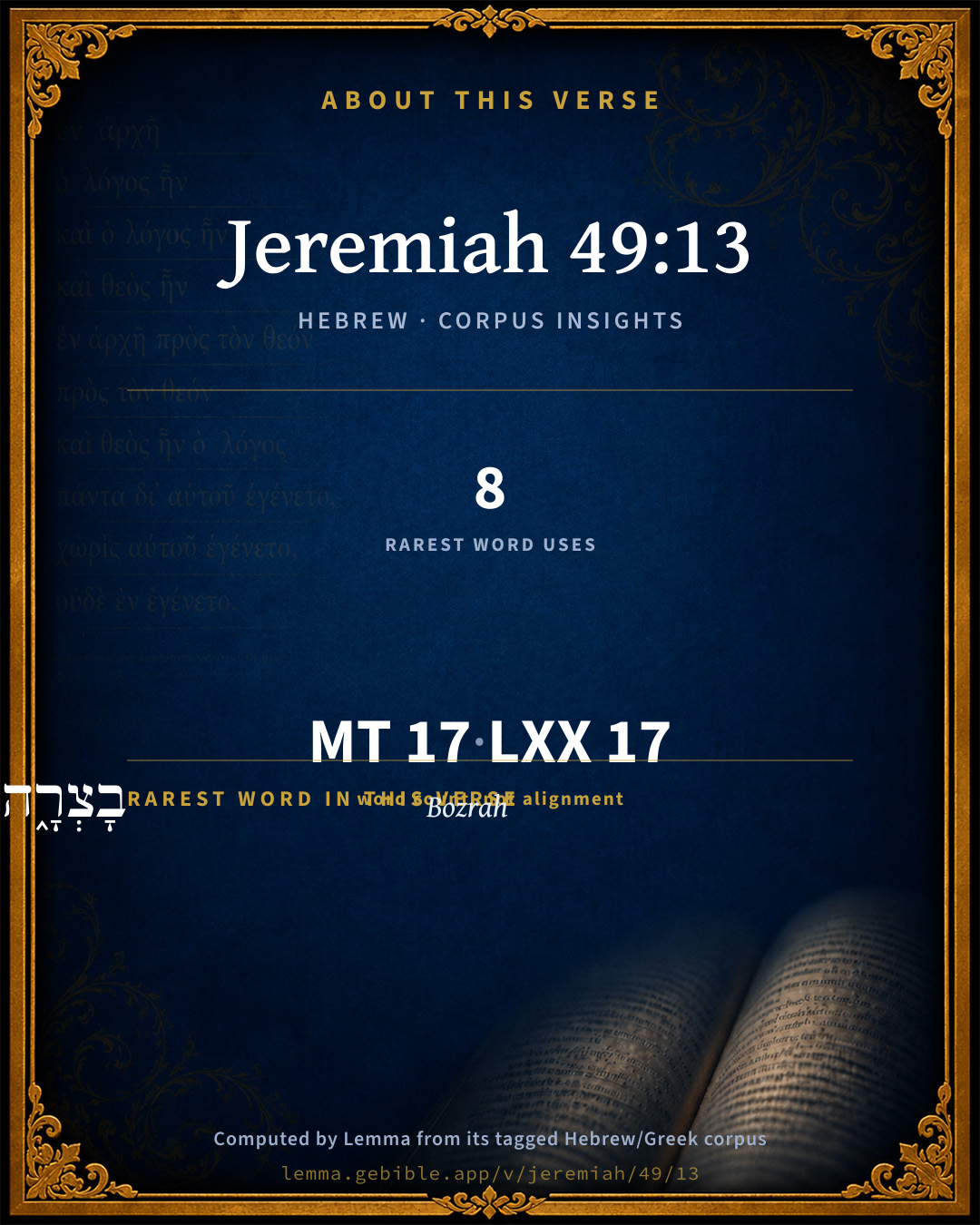
About this verse

These counts appear in no published source. They are computed here, from the morphology-tagged text and Lemma’s own curated glosses. What Lemma adds →

17
words
14
distinct lemmas
Prophets
section

Notable vocabulary

The rarest word here is בָצְרָ֑ה Bozrah H1224 — appearing just 8 times in the whole Hebrew Bible.

Shared distinctive vocabulary

בָצְרָ֑ה Bozrah H1224 occurs in 8 verses of the Hebrew Bible. Also found in:

Grammatical profile

  • 3 verbs
  • 11 nouns
  • 1 preposition
  • 2 conjunctions

Verb forms

  • נִשְׁבַּ֨עְתִּי֙ Niphal · Perfect
  • תִּֽהְיֶ֣ה Qal · Imperfect
  • תִהְיֶ֖ינָה Qal · Imperfect

Repetition

Words recur within this verse — often emphatic in Hebrew:

  • תִּֽהְיֶ֣ה to be H1961 ×2
  • כִּ֣י that H3588 ×2

Hebrew & Septuagint length

In the original languages it is 17 Hebrew tokens and 17 Greek tokens — but the two are counted differently (Hebrew bundles its prefixes and suffixes into one token; the Greek is in lemma form), so that isn’t a like-for-like length.

Cross-references

16

Topical passages linked to Jeremiah 49:13 in the Treasury of Scripture Knowledge — connected by theme and wording, ordered by reader-vote popularity; previews shown in the World English Bible.

  • Genesis 22:16 and said, "I have sworn by myself, says Yahweh, because you have done this thing, and have not withheld your son, your only son,
  • Genesis 36:33 Bela died, and Jobab, the son of Zerah of Bozrah, reigned in his place.
  • Isaiah 34:6 The sword of Yahweh is filled with blood, it is made fat with fatness, with the blood of lambs and goats, with the fat of the kidneys of rams; for Yahweh has a sacrifice in Bozrah, and a great slaughter in the land of Edom.
  • Isaiah 34:9–15 The streams of [Edom] shall be turned into pitch, and the dust of it into sulfur, and the land of it shall become burning pitch.
  • Isaiah 45:23 By myself have I sworn, the word is gone forth from my mouth [in] righteousness, and shall not return, that to me every knee shall bow, every tongue shall swear.
  • Isaiah 63:1 Who is this who comes from Edom, with dyed garments from Bozrah? this who is glorious in his clothing, marching in the greatness of his strength? I who speak in righteousness, mighty to save.
  • Jeremiah 44:26 Therefore hear the word of Yahweh, all Judah who dwell in the land of Egypt: Behold, I have sworn by my great name, says Yahweh, that my name shall no more be named in the mouth of any man of Judah in all the land of Egypt, saying, As the Lord Yahweh lives.
  • Jeremiah 49:22 Behold, he shall come up and fly as the eagle, and spread out his wings against Bozrah: and the heart of the mighty men of Edom at that day shall be as the heart of a woman in her pangs.
  • Amos 1:12 But I will send a fire on Teman, And it will devour the palaces of Bozrah."
  • Amos 6:8 "The Lord Yahweh has sworn by himself," says Yahweh, the God of hosts: "I abhor the pride of Jacob, And detest his fortresses. Therefore I will deliver up the city with all that is in it.
  • Jeremiah 49:17–18 Edom shall become an astonishment: everyone who passes by it shall be astonished, and shall hiss at all the plagues of it.
  • Ezekiel 25:13–14 therefore thus says the Lord Yahweh, I will stretch out my hand on Edom, and will cut off man and animal from it; and I will make it desolate from Teman; even to Dedan shall they fall by the sword.
  • Ezekiel 35:2–15 Son of man, set your face against Mount Seir, and prophesy against it,
  • Joel 3:19 Egypt will be a desolation, And Edom will be a desolate wilderness, For the violence done to the children of Judah, Because they have shed innocent blood in their land.
  • Obadiah 1:18 The house of Jacob will be a fire, the house of Joseph a flame, and the house of Esau for stubble. They will burn among them, and devour them. There will not be any remaining to the house of Esau." Indeed, Yahweh has spoken.
  • Malachi 1:3–4 but Esau I hated, and made his mountains a desolation, and gave his heritage to the jackals of the wilderness."

Cross-references courtesy of OpenBible.info (CC BY 4.0).

Hebrew and Greek witnesses Masoretic Hebrew ↔ Greek Septuagint

The same verse in the two great witnesses to the Old Testament, shown verse-for-verse.

These are two independent witnesses, not word-aligned to each other, and the Septuagint is shown in lemma (dictionary) form.

Hebrew Jeremiah 49:13 Masoretic · Westminster Leningrad Codex

כִּ֣י בִ֤י נִשְׁבַּ֨עְתִּי֙ נְאֻם יְהוָ֔ה כִּֽי לְשַׁמָּ֧ה לְחֶרְפָּ֛ה לְחֹ֥רֶב וְלִקְלָלָ֖ה תִּֽהְיֶ֣ה בָצְרָ֑ה וְכָל עָרֶ֥יהָ תִהְיֶ֖ינָה לְחָרְב֥וֹת עוֹלָֽם

For I have sworn by myself, says Yahweh, that Bozrah shall become an astonishment, a reproach, a waste, and a curse; and all the cities of it shall be perpetual wastes.

World English Bible · Public Domain

Greek LXX Structure differs

In the Septuagint, Jeremiah is about an eighth shorter than the Hebrew and arranges its material differently — the Oracles Against the Nations (Hebrew chapters 46–51) appear in the middle of the Greek book, after 25:13. Because the chapter and verse boundaries do not line up, a verse-for-verse comparison with the Hebrew is not shown.

A verse-for-verse comparison isn’t shown here because the chapters and verses don’t line up. Switch to the LXX edition with the MT / LXX toggle above to read the Greek directly.

Hebrew: Westminster Leningrad Codex (CC BY 4.0). Greek: Septuagint (public domain); English from a public-domain English Septuagint. How the Septuagint differs from the Hebrew →

Targum (Aramaic paraphrase)

1

The Targum is the ancient Jewish Aramaic paraphrase of the Hebrew Scriptures — an interpretive translation, not the Hebrew text itself. Onkelos (literal) and Pseudo-Jonathan (expansive) render the Torah, and Jonathan the Prophets. Coverage is partial: where no permissively-licensed English translation exists for a verse, only the Aramaic is shown. This is verse-level text, not a word-by-word alignment to the Hebrew.

  1. Targum Jonathan Prophets (Joshua–Malachi)
    אֲרֵי בְמֵימְרֵי קַיְמֵית אֲמַר יְיָ אֲרֵי לְצָדוּ לְחִיסוּדִין לְחוֹרֶב וּלְלוּטָא תְּהִי בָצְרָה וְכָל קִרְוָהָא יֶהֶוְיָן לְחוּרְבָא לַעֲלָם:

    (no public-domain English translation for this verse)

    Targum Jonathan — Aramaic: “Mikraot Gedolot” (public domain). English: “Sefaria Community Translation” (CC0 1.0 (public-domain dedication)); “London "Chaldee Paraphrase," 1871” (public domain). Text via Sefaria.

Commentary

Notes on Jeremiah 49:13 from classic Christian and Jewish commentators (each source and its license shown beneath its notes). The classic Christian expositions comment on the surrounding passage and are grouped to its opening verse, so a note may address several verses; the Jewish commentaries on the Tanakh (Rashi and others) are per-verse, so they appear only where the commentator wrote on this verse.

Lemma curates 59 commentaries, every one of them public domain or Creative Commons licensed, each selected and text-cleaned for this edition rather than reprinted as found. About our sources →

Trapp's Complete Commentary

John Trapp

Jer 49:13 For I have sworn by myself, saith the LORD, that Bozrah shall become a desolation, a reproach, a waste, and a curse; and all the cities thereof shall be perpetual wastes.

Ver. 13. I have sworn by myself, saith the Lord.] Because it seemed incredible that Bozrah should be beaten down; as also to show how exceedingly God was incensed against the Edomites, to whom therefore also no comfort is spoken, as is to Ammon and Moab in later times.

John Trapp, A Commentary or Exposition upon All the Books of the Old and New Testament (1647–1656) — public domain. Text from a community e-Sword module.

Tyndale Open Study Notes

Tyndale Open Resources

49:13 Bozrah was a fortress built on top of a high rock with steep sides, but no place in Edom would be safe.

Tyndale Open Study Notes — © Tyndale Open Resources, licensed CC BY-SA 4.0. Text via the HelloAO Bible API.

Geneva Bible (1599)

Geneva Bible translators

Which was a chief city of Edom.

Geneva Bible (1599) marginal notes — public domain. Text via Bolls.life.

Jamieson, Fausset & Brown

Robert Jamieson, A. R. Fausset & David Brown

Bozrah--(See on Jer 48:24).

Jamieson, Fausset & Brown — Commentary Critical and Explanatory on the Whole Bible (1871) — public domain (CC PDM 1.0). Text via the HelloAO Bible API.

Adam Clarke's Commentary

Verse 13. Bozrah shall become a desolation] Bozrah, a city of Idumea, is here put for the whole country.

Adam Clarke's Commentary on the Bible (1810–1826) — public domain. Text from a community e-Sword/MySword module.

John Calvin's Commentaries

Here the Prophet confirms what he had already prophesied respecting the Idumeans; but to remove every doubt, he says, that God had sworn; and he introduces God as the speaker, in order that his word might be emphatical. He then declares that God had made an oath respecting the destruction of Bozrah. What is particular is put for what is general; for he includes the whole nation under the name of this city. Nor does he simply declare that the Idumeans would be laid waste and destroyed, but he accumulates words: Bozrah, he says, shall be a waste; secondly, a reproach; thirdly, a solitude, or desert; and fourthly, a curse

What the Prophet said was no doubt a thing difficult to be believed; for God did not without reason bring forth his own name. For as he would have us to use it seriously and reverently, so he does not interpose so precious a pledge except under the greatest necessity. It is then certain, that there was a weighty reason why God testified by an oath what we read here of the destruction of the people of Edom. Now I have said that what Jeremiah announced was hardly credible; and it was so, because there was no cause for war; and besides, the country was fortified by its own inclosures; for the Idumeans thought, as it seems, that they were impregnable. This, then, was the reason why God interposed an oath. At the same time his purpose was, as I have before reminded you, to consult the benefit of the faithful; for God makes an oath that he might apply a remedy to the weakness of our faith; for as we almost always vacillate, a simple testimony, without being sanctioned by an oath, would not be sufficient for us. This is then the reason for making an oath.

God is said to swear by himself, because there is none greater; as the apostle says, by whom he can swear. (Hebrews 6:13.) Men in doubtful and hidden things flee to God, who knows the heart, who is himself the truth, and from whom nothing is hid. And an oath, as we learn from many places of Scripture, is a part of divine worship. As then this honor peculiarly belongs to him, that is, that we should swear by his name, when he himself swears, he cannot derive authority from another, which may confirm his words: he therefore swears by himself. And we have heard what he declares by Isaiah,

“I will not give my glory to another.” (Isaiah 42:8)

God then prescribes to us the form of swearing, when he swears by himself. God is said to swear sometimes by his soul, or by his life, and he is said sometimes to lift up his hand. These expressions are not strictly proper, but transferred to God from men. But the mode of speaking used by Jeremiah ought especially to be observed, for we see how an oath is to be rightly made, even when it is made by an appeal to God’s name, for he is alone the fit witness and judge in things doubtful and hidden.

There is therefore under the Papacy a base and an intolerable idolatry, for the Papists swear by dead saints. This is nothing else but to rob God of his right; for since he alone, as it has been stated, is the truth, so he alone is the fit judge when things are hidden and cannot be ascertained by human testimony. And we ought to notice the words used in swearing, that is, when men submit to God’s judgment, and implore him as a judge. Whosoever then swears by the saints, it is the same thing as to make them to occupy the place of God, so as to make them the judges of the world, and to ascribe to them all power.

“God is a witness to my soul,”

says Paul, (2 Corinthians 1:23;) and then we have such words as these,

“May God do this to me and add that.” (Ruth 1:17; 1 Samuel 14:44; 2 Samuel 3:35, etc.)

By such expressions, as I have said, is set forth the authority and character of an oath. In short, we must bear in mind, that when necessity constrains us to swear, God is ever the sole judge, and that therefore his name is profaned when we swear by another.

Now what it is to be a reproach and a curse, is evident from other places, even when any one is set as it were in a theater, that he might be an example of disgrace, or when any calamity gives an occasion for execrations and maledictions, “May God destroy thee as he destroyed the Idumeans:” this is to be a curse, as we have elsewhere seen.

He adds cities, and thereby intimates that this desolation would not be confined to one part, but be extended to all parts. He also says that they would be perpetual wastes; and thus he took away every hope of restoration. When he prophesied before against the Moabites and the Ammonites, he mingled some consolation, but as to Edom, every hope is cut off. The nation, no doubt, deserved a heavier vengeance, for it had a nearer connection with the Israelites — hence its cruelty was less to be borne. Besides, it appears that it exceeded in its barbarity all other nations; for it is not without reason said in the Psalms,

“Remember, O Lord, the children of Edom, who said in the day of Jerusalem, Let it be erased, let it be wholly erased to its foundation.” (Psalm 137:7)

We hence learn that the Idumeans raged most cruelly against their own blood: and this was the reason why God declared that their cities would become perpetual desolations; for the word עולם, oulam, which some render “age,” often means perpetuity. It follows —

John Calvin's Commentaries (1540-1563) — public domain. Text from the Calvin Translation Society English edition (1840s-50s) via the Christian Classics Ethereal Library (ccel.org). Calvin's coverage is partial (roughly two-thirds of the Bible); uncommented books and verses are honest gaps, never fabricated. The 19th-century editor's footnotes and remarks are omitted so the notes are faithfully Calvin's own voice.

Ellicott's Commentary for English Readers

(13) Bozrah.—This, as in Isa_34:6; Isa_63:1, was one of the chief cities of Edom, probably identical with the modern El-Busaireh, half-way between Petra and the Dead Sea.

A Bible Commentary for English Readers, edited by Charles John Ellicott (1878–1897) — public domain. Text from a community e-Sword module.

The Cambridge Bible for Schools and Colleges

gen. ed. J. J. S. Perowne

13. Bozrah] perhaps Busaireh, twenty miles S.E. of the Dead Sea. See on ch. Jer_48:20-24.

The Cambridge Bible for Schools and Colleges (gen. ed. J. J. S. Perowne; Cambridge University Press, 1878–1918) — public domain. Text from a community e-Sword module.

John Gill's Exposition

For I have sworn by myself, saith the Lord,.... This he did, because he could swear by no greater, and to show the certain and infallible accomplishment of the event, and the importance of it; and which was so extraordinary, that it was scarce thought credible, and therefore an oath is used to confirm it:

that Bozrah shall become a desolation, a reproach, a waste, and a curse; not Rome, as Abarbinel; nor Jerusalem, as Cocceius; nor Bozrah of Moab, Jer 48:24; but Bozrah of Idumea, Isa 63:1; the royal city of Edom, as Kimchi; this should be utterly destroyed, and be spoken of contemptibly, and used proverbially, to express a curse; the Lord curse thee as Bozrah is cursed. It may be put for the whole country of Edom, of which it was the metropolis, since it follows,

and all the cities thereof shall be perpetual wastes; either those in the neighbourhood of it, and belonging to it, it being the capital or mother city; or all the cities in the land of Edom; so general should be the desolation.

John Gill's Exposition of the Whole Bible (1746–1763) — public domain (CC PDM 1.0). Text via the HelloAO Bible API.

Haydock's Catholic Bible Commentary

Bosra, different from that of Ammon; (chap. xlviii. 24.; Cellar. iii. 14.) though this may be doubtful. Could such a city be unknown?

George Leo Haydock (1774–1849), Haydock's Catholic Family Bible and Commentary, 1859 edition — public domain. Excludes Psalms (Douay-Rheims chapter numbering differs from Protestant) and Deuterocanonical books (Catholic canon only).

Matthew Poole's English Annotations

As men, when they would confirm their promise or threatening to do any thing, add an oath to it, so doth God, who, having no greater to swear by, swears by himself, Jer 44:26. That which God would here confirm was his threatening against Edom, expressed under the notion of

Bozrah, ( a part for the whole,) Bozrah being its principal city, Isa 63:1, as well as a city of Moab (as we found in the foregoing chapter); and that which he threatens it with was not being a reproach, a waste, and a curse for a time, but for ever.

Matthew Poole's English Annotations on the Holy Bible (1683–1685) — public domain. Text from a community e-Sword/MySword module.

Whedon's Commentary on the Bible

Daniel D. Whedon

13. Bozrah — At that time the capital of the Edomites. It was situated on an eminence south of the Dead Sea, on the site of the present village of Buseirah. It is of course not to be identified with the Bozrah of Jer_48:24, which was of Moab.

Daniel D. Whedon (gen. ed.), Commentary on the Old and New Testaments (1874–1909) — public domain. Text from a community e-Sword module.

The Pulpit Commentary

Bozrah. This seems to have been at one time the capital of Edom. (see Amo_1:12 Isa_34:6 Isa_63:1) It was a hill city (comp. on ver. 16); a village called Busaira (i.e. little Bozrah) now stands among its ruins. Perpetual wastes. A phrase characteristic of Jeremiah (see also Jer_25:9) and of the second part of Isaiah. (Isa_58:12 Isa_61:4)

The Pulpit Commentary (1880–1919), ed. H.D.M. Spence-Jones & Joseph S. Exell — public domain. Text from a community e-Sword module.

John Wesley's Explanatory Notes

Bozrah - Edom is expressed under the name of Bozrah, (a part for the whole) Bozrah being its principal city.

John Wesley, Explanatory Notes Upon the Whole Bible (1754–1765) — public domain. Text via the GEBible commentary corpus.

Rashi

Rabbi Shlomo Yitzchaki (Rashi)

that Bozrah shall become desolation, reproach, waste, and a curse Bozrah was one of the cities of Moab, but because it raised up a king for Edom, as the matter is stated, “And Jobab the son of Zerah from Bozrah” (Gen. 36:33), it will suffer with them.

Rashi on the Tanakh — English translations: “The Judaica Press complete Tanach with Rashi, translated by A. J. Rosenberg” (CC BY 4.0); “Pentateuch with Rashi's commentary by M. Rosenbaum and A.M. Silbermann, 1929-1934” (public domain); “The Metsudah Tanach series, Lakewood, N.J” (CC BY 4.0); and “The Book of Joshua, Metsudah Publications, 1997” (CC BY 4.0). Text via Sefaria.

Lesson kit

Teaching starters — assembled from the data on this page, not authored interpretation. Every prompt links to the verse data it draws on. Edit before teaching.

Jeremiah, in the Prophets, opens this verse with 17 words (14 distinct Hebrew lemmas). Its most distinctive word is Botsrâh (“Bozrah”). A historical commentator’s framing appears above. Read the whole chapter for the surrounding context.

Discussion questions

  1. What does “Bozrah” (Botsrâh) contribute to the verse as a whole?
  2. Genesis 36:33 shares the word «Bozrah» with this verse. How do the two illuminate each other?
  3. “to be” occurs 2× in this one verse. What is the effect of the repetition?
  4. These translations render this verse differently. What is at stake in choosing one wording over another?
  5. The verb «נִשְׁבַּ֨עְתִּי֙» is Niphal Perfect. How does its form color the action?
  6. Reading how Trapp's Complete Commentary and Tyndale Open Study Notes read this verse, where do the two commentators agree and where do they part?

Things to notice

Reading settings

Reading text

Shown beneath each verse's original-language words.

Old Testament
Old Testament edition

Read the OT as the Masoretic Hebrew (MT) or the Greek Septuagint (LXX).

English shown for the Greek Septuagint (in the Hebrew ↔ Greek comparison).

Comparing translations? Open the Compare panel on any verse page to stack up to four side by side.