
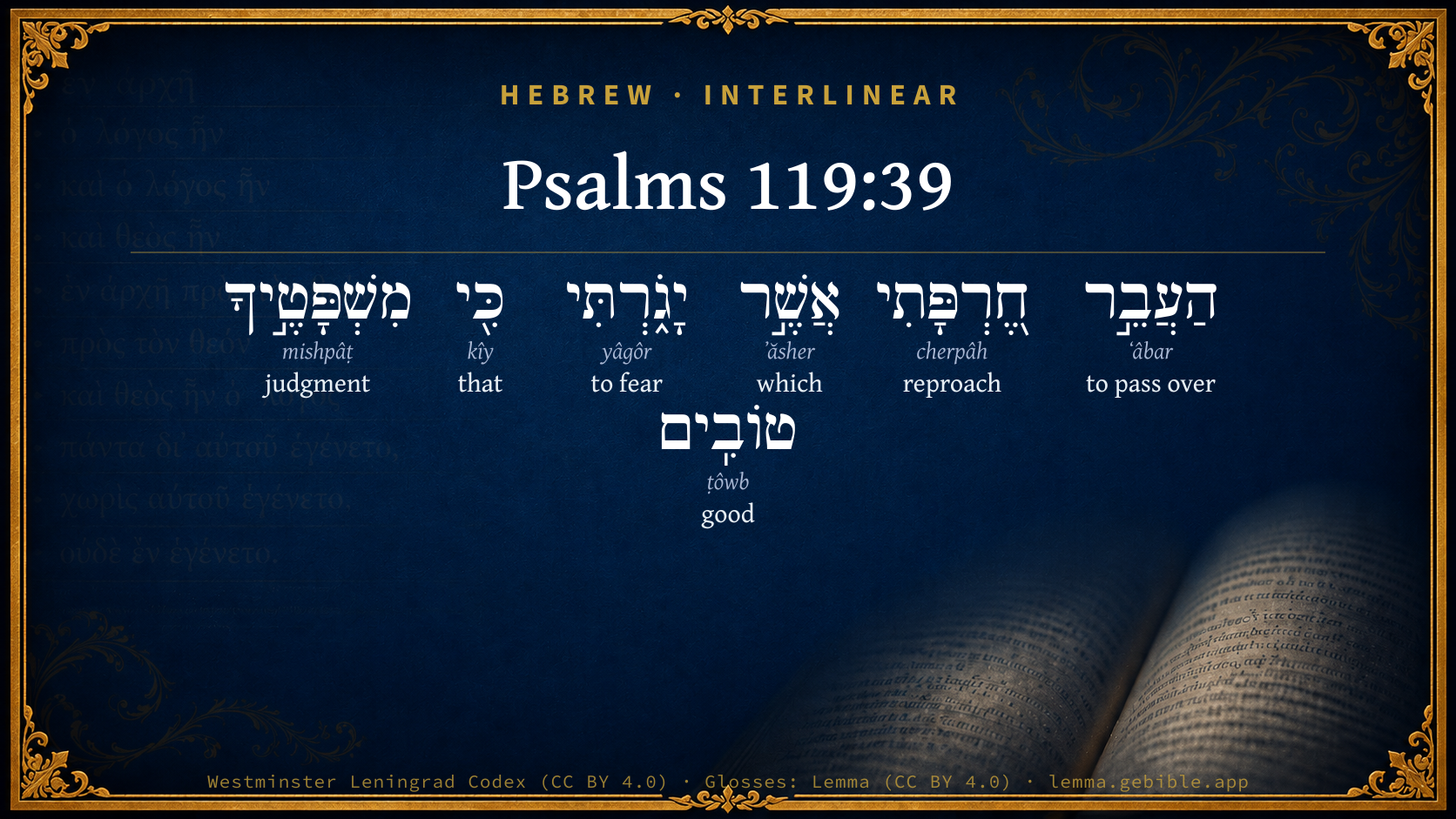
Psalms 119:39

Hebrew (Westminster Leningrad Codex) Psalms 119:39 appears in the Hebrew Old Testament. The text above is from the Westminster Leningrad Codex. Each word links to its Strong’s number, a concise gloss, and parsing drawn from the Open Scriptures Hebrew Bible morphology. Click any word for its full Brown-Driver-Briggs (BDB) entry.
Download image
Cite this verse

Psalms 119:39 (World English Bible). Public Domain. Lemma interlinear Bible study tool, https://lemma.gebible.app/v/psalms/119/39.

Show BibTeX & RIS
BibTeX
RIS
English Translation
Take away my disgrace that I dread, For your ordinances are good.
World English Bible · Public Domain
Download a study sheet

One document with this verse’s original text, its word-by-word gloss line, the meaning frame, cross-references with their text, attributed commentary, and full source and license credits — printable, and it pastes into notes with its structure intact.

This verse Autodidact and up

Study sheet (.html) Plain text (.txt)

A passage Seminary Student

Up to 50 verses in one chapter. A passage sheet keeps up to 6 commentary sources and 12 cross-references per verse, in the order this page ranks them, and says so on the sheet whenever that leaves anything out. Ask for a single verse and you get the Autodidact verse sheet above.

Everything on this page stays free to read, with no account — the sheet is a download of what is already on screen, not access to it.

Want to remove ads? Support Godless Engineer
Compare translations 3

The same verse in 3 English versions, stacked beneath the original-language interlinear above. Click any original word for its lexicon entry.

Each is an independent rendering of the whole verse — the interlinear is not word-aligned to these translations.

Highlighted words mark where these versions differ — a whole-verse word diff, not a word-by-word alignment.

  • World English Bible Public Domain
    Take away my disgrace that I dread, For your ordinances are good.
  • King James Version Public Domain
    Turn away my reproach which I fear: for thy judgments are good.
  • unfoldingWord Literal Text CC BY-SA 4.0
    Turn away my reproach, which I dread, for your judgments are good.

unfoldingWord Literal Text — © unfoldingWord, licensed CC BY-SA 4.0. Word-aligned USFM3 via Door43 (git.door43.org/unfoldingWord/en_ult).

Versions to compare (up to 4)

3 of 4 selected

Show all 17 translations

Every available English version of this verse, each an independent rendering of the whole verse.

  • World English Bible Public Domain
    Take away my disgrace that I dread, For your ordinances are good.
  • Berean Standard Bible Public Domain
    Turn away the disgrace I dread, for Your judgments are good.
  • Majority Standard Bible Public Domain
    Turn away the disgrace I dread, for Your judgments are good.
  • King James Version Public Domain
    Turn away my reproach which I fear: for thy judgments are good.
  • American Standard Version (1901) Public Domain
    Turn away my reproach whereof I am afraid; For thine ordinances are good.
  • Revised Version (1885) Public Domain
    Turn away my reproach whereof I am afraid; for thy judgments are good.
  • Geneva Bible (1599) Public Domain
    Take away my rebuke that I feare: for thy iudgements are good.
  • Young's Literal Translation Public Domain
    Remove my reproach that I have feared, For Thy judgments `are' good.
  • Literal Standard Version CC BY-SA 4.0
    Remove my reproach that I have feared, || For Your judgments [are] good.
  • Unlocked Literal Bible CC BY-SA 4.0
    Take away the insults I dread, for your righteous judgments are good.
  • unfoldingWord Literal Text CC BY-SA 4.0
    Turn away my reproach, which I dread, for your judgments are good.
  • Darby Bible Public Domain
    Turn away my reproach which I fear; for thy judgments are good.
  • World Messianic Bible Public Domain
    Take away my disgrace that I dread, for your ordinances are good.
  • Webster's Bible Public Domain
    Turn away my reproach which I fear: for thy judgments are good.
  • Free Bible Version CC BY-SA 4.0
    Take away the shame I dread, for your law is good.
  • Bible in Basic English Public Domain
    Take away the shame which is my fear; for your decisions are good.
  • JPS Tanakh (1917) Public Domain
    Turn away my reproach which I dread; for Thine ordinances are good.

Literal Standard Version (2020), Covenant Press — licensed CC BY-SA 4.0. Text via the HelloAO Bible API (eBible.org). Unlocked Literal Bible (unfoldingWord) — licensed CC BY-SA 4.0. Text via the HelloAO Bible API (eBible.org). unfoldingWord Literal Text — © unfoldingWord, licensed CC BY-SA 4.0. Word-aligned USFM3 via Door43 (git.door43.org/unfoldingWord/en_ult). Free Bible Version, Dr. Jonathan Gallagher — licensed CC BY-SA 4.0. Text via the HelloAO Bible API (eBible.org).

Word by word

More ways to search: Search by grammar → Find every occurrence → Compare this word →

Practice this passage: Drill this verse → Learn its vocabulary →

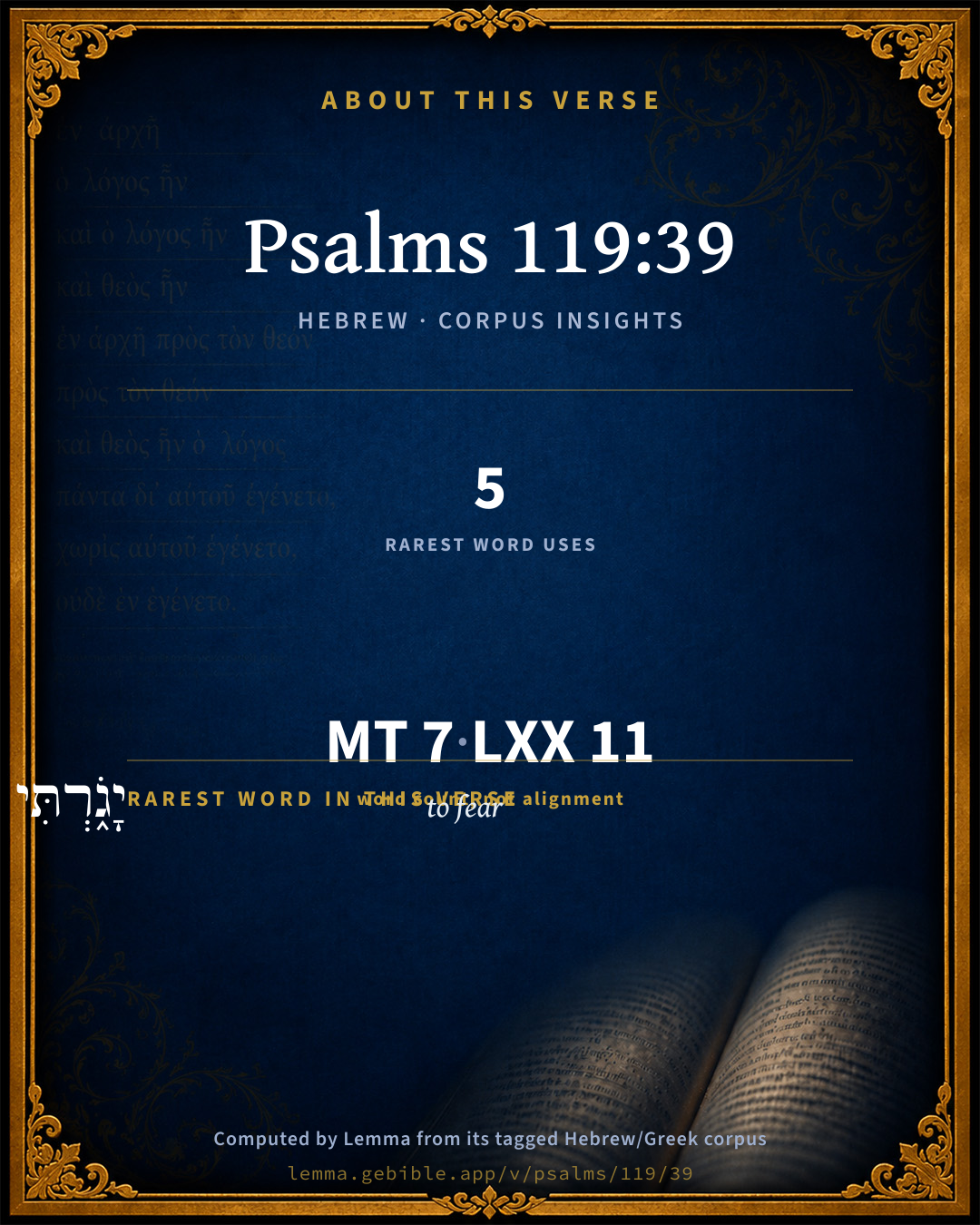
About this verse

These counts appear in no published source. They are computed here, from the morphology-tagged text and Lemma’s own curated glosses. What Lemma adds →

7
words
7
distinct lemmas
Wisdom
section

Notable vocabulary

The rarest word here is יָגֹ֑רְתִּי to fear H3025 — appearing just 5 times in the whole Hebrew Bible.

Shared distinctive vocabulary

יָגֹ֑רְתִּי to fear H3025 occurs in 5 verses of the Hebrew Bible. Also found in:

Grammatical profile

  • 2 verbs
  • 2 nouns
  • 1 adjective
  • 1 conjunction
  • 1 particle

Verb forms

  • הַעֲבֵ֣ר Hiphil · Imperative
  • יָגֹ֑רְתִּי Qal · Perfect

Hebrew & Septuagint length

In English translation the verse runs 12 words from the Hebrew and 13 from the Septuagint (LXX English) — closely comparable.

A rough comparison of the two English renderings, which tokenize alike — not a word-level alignment.

Word counts can differ between the Hebrew and the Greek without any difference in meaning — e.g. the Hebrew direct-object marker אֵת has no separate Greek word, and Greek often adds the article ὁ.

In the original languages it is 7 Hebrew tokens and 11 Greek tokens — but the two are counted differently (Hebrew bundles its prefixes and suffixes into one token; the Greek is in lemma form), so that isn’t a like-for-like length.

Cross-references

18

Topical passages linked to Psalms 119:39 in the Treasury of Scripture Knowledge — connected by theme and wording, ordered by reader-vote popularity; previews shown in the World English Bible.

  • Psalms 119:22 Take reproach and contempt away from me, For I have kept your statutes.
  • 1 Timothy 3:7 Moreover he must have good testimony from those who are outside, to avoid falling into reproach and the snare of the devil.
  • Titus 2:8 and soundness of speech that can't be condemned; that he who opposes you may be ashamed, having no evil thing to say about us.
  • Psalms 39:8 Deliver me from all my transgressions. Don't make me the reproach of the foolish.
  • Psalms 57:3 He will send from heaven, and save me, He rebukes the one who is pursuing me. Selah. God will send out his loving kindness and his truth.
  • Romans 2:2 We know that the judgment of God is according to truth against those who practice such things.
  • Revelation 19:2 for true and righteous are his judgments. For he has judged the great prostitute, who corrupted the earth with her sexual immorality, and he has avenged the blood of his servants at her hand."
  • Deuteronomy 4:8 What great nation is there, that has statutes and ordinances so righteous as all this law, which I set before you this day?
  • 2 Samuel 12:14 However, because by this deed you have given great occasion to Yahweh's enemies to blaspheme, the child also who is born to you shall surely die."
  • Psalms 19:9 The fear of Yahweh is clean, enduring forever. Yahweh's ordinances are true, and righteous altogether.
  • Psalms 119:20 My soul is consumed with longing for your ordinances at all times.
  • Psalms 119:31 I cling to your statutes, Yahweh. Don't let me be disappointed.
  • Psalms 119:43 Don't snatch the word of truth out of my mouth, For I put my hope in your ordinances.
  • Psalms 119:75 Yahweh, I know that your judgments are righteous, That in faithfulness you have afflicted me.
  • Psalms 119:123 My eyes fail looking for your salvation, For your righteous word.
  • Psalms 119:131 I opened my mouth wide and panted, For I longed for your commandments.
  • Isaiah 26:8 Yes, in the way of your judgments, Yahweh, have we waited for you; to your name, even to your memorial [name], is the desire of our soul.
  • 1 Timothy 5:14 I desire therefore that the younger widows marry, bear children, rule the household, and give no occasion to the adversary for reviling.

Cross-references courtesy of OpenBible.info (CC BY 4.0).

Hebrew and Greek witnesses Masoretic Hebrew ↔ Greek Septuagint

The same verse in the two great witnesses to the Old Testament, shown verse-for-verse.

You’re reading Greek Psalm 118 (Hebrew Psalm 119). The Septuagint counts the superscription, so verse numbers can differ from the Hebrew — chapter-level alignment, not verse-by-verse. Numbering follows Rahlfs.

These are two independent witnesses, not word-aligned to each other, and the Septuagint is shown in lemma (dictionary) form.

Hebrew Psalms 119:39 Masoretic · Westminster Leningrad Codex

הַעֲבֵ֣ר חֶ֭רְפָּתִי אֲשֶׁ֣ר יָגֹ֑רְתִּי כִּ֖י מִשְׁפָּטֶ֣יךָ טוֹבִֽים

Take away my disgrace that I dread, For your ordinances are good.

World English Bible · Public Domain

Greek LXX Greek Psalm 118:39 Septuagint · lemma form

περιαἱρέω ὁ ὀνειδισμός ἐγώ ὅς ὑποὀπτεύω ὁ γάρ κρίμα σύ χρηστός

Take away my reproach which I have feared: for your judgments are good.

LXX2012 (modern English Septuagint) · Public Domain

Hebrew: Westminster Leningrad Codex (CC BY 4.0). Greek: Septuagint (public domain); English from LXX2012 (modern English Septuagint) (Public Domain). How the Septuagint differs from the Hebrew →

Commentary

Notes on Psalms 119:39 from classic Christian and Jewish commentators (each source and its license shown beneath its notes). The classic Christian expositions comment on the surrounding passage and are grouped to its opening verse, so a note may address several verses; the Jewish commentaries on the Tanakh (Rashi and others) are per-verse, so they appear only where the commentator wrote on this verse.

Lemma curates 59 commentaries, every one of them public domain or Creative Commons licensed, each selected and text-cleaned for this edition rather than reprinted as found. About our sources →

Trapp's Complete Commentary

John Trapp

Psa 119:39 Turn away my reproach which I fear: for thy judgments [are] good.

Ver. 39. Turn away my reproach] Cover it, cure it, suffer it not to break forth, to my disgrace among men.

For thy judgments are good] But their tender mercies are mere cruelties; if, therefore, at any time I fall into opprobrious and reproachful practices; Lord, be thou my judge, and not they: for thy judgments are like thyself, good, and righteous, &c.

John Trapp, A Commentary or Exposition upon All the Books of the Old and New Testament (1647–1656) — public domain. Text from a community e-Sword module.

The Biblical Illustrator

Joseph S. Exell

Psa_119:39-40

Turn away my reproach which I fear; for Thy judgments are good.

The dreaded and the desired

I. What is here dreaded (verse 39).

1. Reproach is of two kinds.

(1) The deserved. The man who is false, mean, corrupt, deserves reproach.

(2) The undeserved.

2. Now, whether reproach is deserved or undeserved, it is a thing to be dreaded. In fact, it is more to be dreaded when deserved than when undeserved. The best men have been reproached. Even the Son of God Himself was reproached. But undeserved reproach may be well borne.

II. What is here desired? (verse 40).

1. Gods precepts are desirable things. Thy judgments are good. They are good in every sense. Good in their origin, in their essence, in their results.

2. A righteous life is a desirable thing. Quicken me in Thy righteousness. Mans well-being consists in living in the righteousness of God. (Homilist.)

Reproach rolled away

A man who had lived for many years the Christian life told me how there was a place in a street in Edinburgh which was associated with a sin. Every time in his early life he passed it, it brought back again the keen remorse and shame. It seemed to stain his life afresh whenever he saw the very place. But when he came to God and gave his heart and life to Christ, the first time he passed that place afterwards his soul, he told me, was filled by a great transport of joy that all that was done, that it was no longer part of his life, that God had forgiven and forgotten and cast it behind His back. And he entered, he told me, for a moment at least in foretaste, into the perfect joy of soul, and he forgot the shame of his youth and remembered the reproach no more. (Hugh Black.)

The Biblical Illustrator, edited by Joseph S. Exell (c. 1880s–1900s) — public domain. Text from a community e-Sword module.

Joseph Benson's Commentary

Psa 119:39-40. Turn away my reproach which I fear — For my instability in thy ways; which, in respect to my own weakness, I have great cause to fear; I have longed after thy precepts — After a more solid knowledge and constant performance of them. Quicken me — Do thou preserve and maintain both my natural and spiritual life; in thy righteousness — According to thy faithfulness, which obligeth thee to make good thy promises.

Joseph Benson's Commentary on the Old and New Testaments (1811–1818) — public domain. Text from a community e-Sword module.

J. A. Alexander on Psalms

Joseph Addison Alexander

39. (Psa 119:39) Turn away my disgrace which I dread, for thy judgments (are) good. The first word is the same with that in Psa 119:37, meaning make (or cause) to pass away. In this connection it might either mean to remove or to avert; but the latter agrees better with the next phrase, which I dread. The original is not the common Hebrew word for fear, but one used by Moses in precisely the same sense as here. See Deu 9:19; Deu 28:60, and compare Job 9:28. Thy judgments are good, i.e. prompted and controlled by infinite goodness, and should therefore fall upon the wicked, not the righteous.

Joseph Addison Alexander, The Psalms Translated and Explained (1850) — public domain. Text from a community e-Sword module.

Geneva Bible (1599)

Geneva Bible translators

Let me not fall to thy dishonor, but let mine heart still delight in thy gracious word.

Geneva Bible (1599) marginal notes — public domain. Text via Bolls.life.

Matthew Henry's Commentary

Here, 1. David prays against reproach, as before, Psa 119:22. David was conscious to himself that he had done that which might give occasion to the enemies of the Lord to blaspheme, which would blemish his own reputation and turn to the dishonour of his family; now he prays that God, who has all men's hearts and tongues in his hands, would be pleased to prevent this, to deliver him from all his transgressions, that he might not be the reproach of the foolish, which he feared (Psa 39:8); or he means that reproach which his enemies unjustly loaded him with. Let their lying lips be put to silence. 2. He pleads the goodness of God's judgments: "Lord, thou sittest in the throne, and thy judgments are right and good, just and kind, to those that are wronged, and therefore to thee I appeal from the unjust and unkind censures of men." It is a small thing to be judged of man's judgment, while he that judges us is the Lord. Or thus: "Thy word, and ways, and thy holy religion, are very good, but the reproaches cast on me will fall on them; therefore, Lord, turn them away; let not religion be wounded through my side."

Matthew Henry's Commentary on the Whole Bible (1708–1710) — public domain (CC PDM 1.0). Text via the HelloAO Bible API.

Adam Clarke's Commentary

Verse 39. Turn away my reproach, which I fear] This may be understood of the reproach which a man may meet with in consequence of living a godly life, for such a life was never fashionable in any time or country. But I have found the following note on the passage: "I have done a secret evil; my soul is sorry for it: if it become public, it will be a heavy reproach to me. O God, turn it away, and let it never meet the eye of man!" - Anon.

Adam Clarke's Commentary on the Bible (1810–1826) — public domain. Text from a community e-Sword/MySword module.

John Calvin's Commentaries

39. Take away my reproach. It is not certain to what reproach he alludes. Knowing that many calumniators were on the watch to find occasion for reviling him, should they happen to detect him in any offense, it is not without reason he dreaded lest he might fall into such disgrace, and that by his own fault. Probably he might be apprehensive of some other reproach, aware that wicked men shamefully and injuriously slander the good generally, and, by their calumnies, distort and pervert their good actions. The concluding clause, Because the judgments of God are good, is the reason why God should put to silence the mischievous tongues, which pour out the venom of their malice without shame against the innocent, who are reverently observing his law. If any be inclined to view the word reproach as directed against God himself, such an interpretation is by no means objectionable, That the prophet, whose aim it was to stand approved as to his life in God’s sight, merely desired, when he appeared before his tribunal, not to be judged as a reprobate man; just as if, with great zeal and magnanimity, he would despise all the empty talk of the men of the world, provided he stood upright in God’s sight. Above all, it becomes holy men to dread the reproach of being suffused with shame at God’s judgment-seat.

John Calvin's Commentaries (1540-1563) — public domain. Text from the Calvin Translation Society English edition (1840s-50s) via the Christian Classics Ethereal Library (ccel.org). Calvin's coverage is partial (roughly two-thirds of the Bible); uncommented books and verses are honest gaps, never fabricated. The 19th-century editor's footnotes and remarks are omitted so the notes are faithfully Calvin's own voice.

Ellicott's Commentary for English Readers

(39) My reproach which I fear.—The word for fear is an unusual one, used in Deu_9:19; Deu_28:60, for very strong dread. The reproach may be either the disgrace in God’s sight of violating His commands, or, as the context (Psa_119:42) suggests, a reproach from men for keeping God’s law.

A Bible Commentary for English Readers, edited by Charles John Ellicott (1878–1897) — public domain. Text from a community e-Sword module.

The Cambridge Bible for Schools and Colleges

gen. ed. J. J. S. Perowne

39. my reproach] Here, as in Psa_119:22-23; Psa_119:42, the scorn which he has to bear for his loyalty to God’s law.

for thy judgments are good] And therefore I ought not to suffer for observing them. For judgments see Psa_119:13; Psa_119:20; Psa_119:30.

The Cambridge Bible for Schools and Colleges (gen. ed. J. J. S. Perowne; Cambridge University Press, 1878–1918) — public domain. Text from a community e-Sword module.

John Gill's Exposition

VAU.--The Sixth Part.

VAU. Let thy mercies come also unto me, O Lord,.... Meaning not his providential mercies, but his special mercies and favours; his mercies of old, which were upon his heart and thoughts from everlasting; the sure mercies of David, or the blessings of the everlasting covenant; the spiritual blessings, wherewith the saints are blessed in Christ; the grace that was given to them in him, before the world was: these are desired by the psalmist to be remembered, shown, communicated, and applied unto him, and, as it were, that they might come into his heart and soul; which is done when the love of God is shed abroad there, when full flows of it come in, and all grace is made to abound, and every want is supplied;

even thy salvation, according to thy word; not temporal, but spiritual and eternal salvation; which God has appointed his people to, secured for them in covenant, promised them in Christ, whom he sent to work it out, and which is in him; and which in the effectual calling comes to the soul, being brought near and applied to a sensible sinner by the Spirit of God. Here a fresh view of interest in it, a fresh visit with it, and a restoration of the joys of it, are desired; and which salvation flows from the abundant mercy and free favour of God in Christ; and is, according to his word of promise, spoken by the mouth of all his holy prophets, from the beginning of the world; and may here respect the particular word of promise made to David, that God would put away his sin, and save him, and that he should not die, Sa2 12:13; or his word of promise in general, to all that seek and call upon the Lord, that they shall find grace and mercy, and be saved everlastingly.

John Gill's Exposition of the Whole Bible (1746–1763) — public domain (CC PDM 1.0). Text via the HelloAO Bible API.

Albert Barnes' Notes on the Bible

Turn away my reproach - The reproach which is likely to come upon me from being a professed worshipper of God. In all ages good men have been exposed to this reproach.

Which I fear - Which I have reason to apprehend will come upon me. This may not mean that he was personally afraid of it, but merely that he had reason to apprehend that he was exposed to it. The prayer is proper, for there is nothing which our nature makes us shrink back from more than reproach. Compare Psa 119:22; Psa 69:9, Psa 69:20; Rom 15:3; 2Co 12:10. The word repreach in the original is the same which denotes shame or dishonor.

For thy judgments are good - Thy statutes; thy laws. I know they are good. I feel that I desire to obey them. I pray, therefore, that obedience on my part to that which is good may not subject me to shame; that people may see that thy laws are good, and that it is not a matter of reproach to obey them.

Albert Barnes' Notes on the Bible (1834–1885) — public domain. Text from a community e-Sword/MySword module.

Matthew Poole's English Annotations

Turn away my reproach; either,

1. For the shameful disappointment of my hopes and confident boastings concerning the truth and certainty of thy promises; or,

2. For my manifold failings, and particularly for that shameful matter about Uriah and Bathsheba; or,

3. For my instability in or apostacy from thy ways; which in respect of mine own weakness and folly I have great cause to fear. For thy judgments are good: this may be a reason either,

1. Why he prayed and hoped that God would turn away reproach from him, because God’s word and statutes were good, and therefore it was not fit for any to suffer reproach in and for his diligent observation of them; or,

2. Why he feared reproach, because he had, and feared he might hereafter, transgress those judgments or statutes of God which were, and he very well knew to be, good, i.e. just, and holy, and excellent, and therefore it was a shameful thing to violate them.

Matthew Poole's English Annotations on the Holy Bible (1683–1685) — public domain. Text from a community e-Sword/MySword module.

The Treasury of David

Charles H. Spurgeon

Ver. 39. Turn away my reproach which I fear. He feared just reproach, trembling lest he should cause the enemy to blaspheme through any glaring inconsistency. We ought to fear this, and watch that we may avoid it. Persecution in the form of calumny may also be prayed against, for it is a sore trial, perhaps the sorest of trials to men of sensitive minds. Many would sooner bear burning at the stake than the trial of cruel mockings. David was quick tempered, and he probably had all the greater dread of slander because it raised his anger, and he could hardly tell what he might not do under great provocation. If God turns away our eyes from falsehood, we may also expect that he will turn away falsehood from injuring our good name. We shall be kept from lies if we keep from lies.

For thy judgments are good. Therefore he is anxious that none may speak evil of the ways of God through hearing an ill report about himself. We mourn when we are slandered; because the shame is cast rather upon our religion than ourselves. If men would be content to attribute evil to us, and go no further, we might bear it, for we are evil; but our sorrow is that they cast a slur upon the word and character of God, who is so good, that there is none good in comparison with him. When men rail at God's government of the world it is our duty and privilege to stand up for him, and openly to declare before him, "thy judgments are good"; and we should do the same when they assail the Bible, the gospel, the law, or the name of our Lord Jesus Christ. But we must take heed that they can bring no truthful accusation against us, or our testimony will be so much wasted breath.

This prayer against reproach is parallel to Ps 119:31, and in general to many other of the seventh verses in the octaves, which usually imply opposition from without and a sacred satisfaction within. Observe the things which are good: "thy judgments are good; ""thou art good and doest good" (Ps 119:68); "good for me to have been afflicted" (Ps 119:71); "teach me good judgment" (Ps 119:66).

Ver. 39. Turn away my reproach which I fear. "Cause to pass my reproach which I feared." This also, like the vanity spoken of in Ps 119:37, the Psalmist prays that he may not see. He would have the gaze of his whole manhood bent only on the word. The reproach which he feared is that to which he had already referred in Ps 119:21-22, and perhaps again in Ps 119:31. The proud had erred from the commandments, and had inherited rebuke; it was the reproach and shame which were theirs that the Psalmist would have to be turned aside, so that they should not be seen. For thy judgments are good. This is given as a reason why the reproach should be thus turned aside. The proud had thought lightly and contemptuously on the divine judgments, hence their reproach; the Psalmist held those judgments to be good, and thus hoped that he might not see reproach.

Ver. 39. Turn away my reproach, etc. In these words you have,

1. A request, "Turn away my reproach."

2. A reason to enforce it. "For thy judgments are good."

First, for the request. "Turn away, "roll from upon me, so it signifies. He was clothed with reproach; now roll from me "my reproach." Some think he means God's condemnatory sentence, which would turn to ills reproach, or some remarkable rebuke from God, because of his sin. Rather, I think, the reproach of his enemies; and he calls it "my reproach, "either as deserved by himself, or as having personally lighted upon him, the reproach which was like to be his lot and portion in the world, through the malice of his enemies: "the reproach which I fear, "that is, which I have cause to expect, and am sensible of the sad consequences of it.

Secondly, for the reason by which this is enforced: "for thy judgments are good." There are different opinions about the form of this argument. Some take the reason thus: Let me not suffer reproach for adhering to thy word, thy word which is so good. But David doth not speak here of suffering reproach for righteousness' sake, but such reproach as was likely to befall him because of his own infirmities and failings. Reproaches for righteousness' sake are to be "rejoiced in; "but he saith, this I "fear, "and therefore I suppose this doth not hit the reason. Neither do I accept the other sense, Why should I be looked upon as an evil doer as long as I keep thy law, and observe thy statutes? Others judge badly of me, but I appeal to thy good judgment.

By "judgments" we may understand God's dealings. Thou dost not deal with men according to their desert. Thy dispensations are kind and gracious. Better still: by "judgments" are meant the ways, statutes, and ordinances of God called judgments, because all our words, works, thoughts are to be judged according to the sentence of the word: now these, it is a pity they should suffer in my reproach and ignominy. This is that I fear more than anything else that can happen to me. I think the reason will better run thus: Lord, there is in thy law, word, covenant, many promises to encourage thy people, and therefore rules to provide for the due honour and credit of thy people. Thomas Manton.

Ver. 39. Turn away my reproach. In the Hebrew it is, "Take away my rebuke"; as if he should have said, O Lord, I may commit some such evil against thy good law, yea, some such notorious transgression, as may tend to my shame; I beseech thee, take it away. Or else he meaneth, I have already, O Lord, by divers sins, and by name through adultery and murder brought shame and rebuke upon myself among men; I entreat thee to remove this shame and rebuke.

Out of the first exposition we learn, First, that the godly are subject unto notorious sins. Secondly, that those sins will cause shame in them, though the wicked will not be ashamed. Thirdly, that God only can take away this shame. Fourthly, that we may pray for the removing of shame even amongst men, especially that which may bring with it some dishonour to God. Fifthly, that the godly are most jealous over themselves. Sixthly, the way to avoid sin is ever to be afraid lest we should sin.

Out of the second exposition note, that the remembrance of our former sins must draw out of us prayers unto God, that for them we may not be rebuked in displeasure in this life, nor confounded and abashed in the life to come. Richard Greenham.

Ver. 39. My reproach is the reproach which the world casts on the God fearing. This is dreaded as a great temptation to apostasy. James G. Murphy.

Ver. 39. For thy judgments are good. One would have expected him to say For thou art merciful Cause my reproach which I fear to pass over from me, for thou art merciful. No, he does not add this as his present reason, but "Thy judgments are good." We should catch the meaning at once, were the words these For thy judgments are awful "Turn away my reproach which I fear, "for thy judgments are awful. But as the words are "For thy judgments are good, "we find he verily takes refuge in the "judgments" viz., that the Lord would vindicate him against all the unjust judgments of men; and as to judgment with God, since he took refuge in the atonement which the Lord had appointed, the Lord would vindicate him there also. John Stephen.

Ver. 39. For thy judgments are good. The judgments of the wicked are bad judgments, but the judgments of God are good; I pray against those, I appeal, to these: I fear the one, I approve the other. Now the judgments which God pronounces in his word, be they threatenings in the law, or consolations in the Gospel, yea, and those also which he executeth in the world, whether upon the godly or godless, they must needs be good.

1. Because God is goodness itself.

2. He cannot be deceived.

3. He will not be bribed.

4. He alone is no respecter of persons, but judgeth according to every man's work. Richard Greenham.

Ver. 39. The "reproach" which the poet fears in this verse is not the reproach of confessing, but of denying God. Franz Delitzsch.

Ver. 39. For thy judgments are good. This reason shows he feared God's rebuke. Man's "reproach" comes from a corrupt judgment, he condemns where God will absolve, I pass not for it; but I know thy rebuke is always deserved, "for thy judgments are good." William Nicholson.

Ver. 39.

1. Man's judgment dreaded.

2. God's judgment approved.

Ver. 39. The reproach of inconsistency.

1. The dishonour caused by it (2Sa 12:14).

2. The danger of incurring it.

3. The prayer against it. C.A.D.

Psalms 119:40*

Charles H. Spurgeon's The Treasury of David (1869–1885) — public domain. Psalms only. Text from a community e-Sword/MySword module.

The Pulpit Commentary

Turn away my reproach, which I fear; i.e. "turn away from me the only reproach of which I am afraid the reproach of transgressing against thy Law" (comp. ver. 31). For thy judgments are good. Right in themselves, and conducive to man"s happiness.

The Pulpit Commentary (1880–1919), ed. H.D.M. Spence-Jones & Joseph S. Exell — public domain. Text from a community e-Sword module.

John Wesley's Explanatory Notes

I fear - For my instability in thy ways; which in respect to my own weakness, I have great cause to fear.

John Wesley, Explanatory Notes Upon the Whole Bible (1754–1765) — public domain. Text via the GEBible commentary corpus.

unfoldingWord translationNotes

Door43 World Missions Community

I dread

"I am very afraid of"

your righteous judgments are good

God judges rightly and his decisions are good. AT: "Your judgments are righteous and good" (See: Abstract Nouns)

See

This refers to being aware of the situation. The focus is on knowledge or understanding, rather than just observing.

I have longed for your instructions

Possible meanings are 1) "I want very much to know your instructions" or 2) "I want very much to obey what you teach us to do."

revive me in your righteousness

The word "righteousness" is an abstract noun and refers to being righteous. AT: "revive me because you are righteous" (See: Abstract Nouns)

revive me

Possible meanings are 1) "Keep me alive" or 2) "Make me strong."

translationWords

righteous

judge

unfoldingWord translationNotes — © Distant Shores Media and the Door43 World Missions Community, licensed CC BY-SA 4.0. Source: git.door43.org/Door43/en_tn.

Rashi

Rabbi Shlomo Yitzchaki (Rashi)

Remove my disgrace Forgive me for that sin [with Bath-sheba], and my enemies will no longer be able to disgrace me with it.

for Your judgments are good and I already accept upon myself “to repay the ewe-lamb fourfold.”

Rashi on the Tanakh — English translations: “The Judaica Press complete Tanach with Rashi, translated by A. J. Rosenberg” (CC BY 4.0); “Pentateuch with Rashi's commentary by M. Rosenbaum and A.M. Silbermann, 1929-1934” (public domain); “The Metsudah Tanach series, Lakewood, N.J” (CC BY 4.0); and “The Book of Joshua, Metsudah Publications, 1997” (CC BY 4.0). Text via Sefaria.

Lesson kit

Teaching starters — assembled from the data on this page, not authored interpretation. Every prompt links to the verse data it draws on. Edit before teaching.

Psalms, in the Wisdom, opens this verse with 7 words (7 distinct Hebrew lemmas). Its most distinctive word is yâgôr (“to fear”). A historical commentator’s framing appears above. Read the whole chapter for the surrounding context.

Discussion questions

  1. The word yâgôr carries the sense “to fear.” How does it shape the verse?
  2. How does Deuteronomy 9:19, which shares the word «to fear», read alongside this verse?
  3. These translations render this verse differently; the difference is in the English rendering, not the original. What questions does that raise?
  4. «הַעֲבֵ֣ר» is a Hiphil Imperative verb. How does that grammatical form shape the action described?
  5. Compare how Trapp's Complete Commentary and The Biblical Illustrator read this verse. Where do they agree or differ?

Things to notice

Reading settings

Reading text

Shown beneath each verse's original-language words.

Old Testament
Old Testament edition

Read the OT as the Masoretic Hebrew (MT) or the Greek Septuagint (LXX).

English shown for the Greek Septuagint (in the Hebrew ↔ Greek comparison).

Comparing translations? Open the Compare panel on any verse page to stack up to four side by side.