
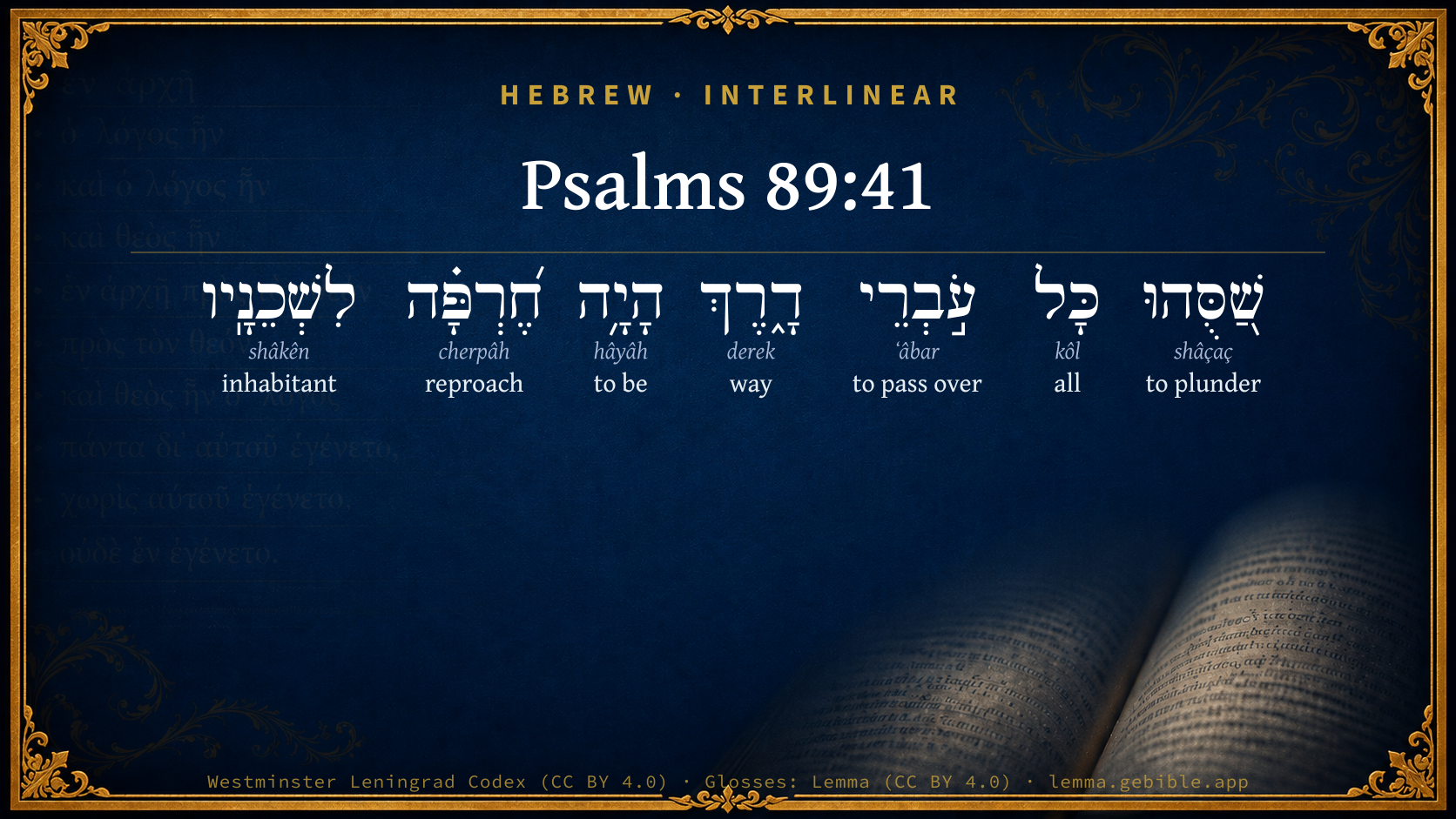
Psalms 89:41

Hebrew (Westminster Leningrad Codex) Psalms 89:41 appears in the Hebrew Old Testament. The text above is from the Westminster Leningrad Codex. Each word links to its Strong’s number, a concise gloss, and parsing drawn from the Open Scriptures Hebrew Bible morphology. Click any word for its full Brown-Driver-Briggs (BDB) entry.
Download image
Cite this verse

Psalms 89:41 (World English Bible). Public Domain. Lemma interlinear Bible study tool, https://lemma.gebible.app/v/psalms/89/41.

Show BibTeX & RIS
BibTeX
RIS
English Translation
All who pass by the way rob him. He has become a reproach to his neighbors.
World English Bible · Public Domain
Download a study sheet

One document with this verse’s original text, its word-by-word gloss line, the meaning frame, cross-references with their text, attributed commentary, and full source and license credits — printable, and it pastes into notes with its structure intact.

This verse Autodidact and up

Study sheet (.html) Plain text (.txt)

A passage Seminary Student

Up to 50 verses in one chapter. A passage sheet keeps up to 6 commentary sources and 12 cross-references per verse, in the order this page ranks them, and says so on the sheet whenever that leaves anything out. Ask for a single verse and you get the Autodidact verse sheet above.

Everything on this page stays free to read, with no account — the sheet is a download of what is already on screen, not access to it.

Want to remove ads? Support Godless Engineer
Compare translations 3

The same verse in 3 English versions, stacked beneath the original-language interlinear above. Click any original word for its lexicon entry.

Each is an independent rendering of the whole verse — the interlinear is not word-aligned to these translations.

Highlighted words mark where these versions differ — a whole-verse word diff, not a word-by-word alignment.

  • World English Bible Public Domain
    All who pass by the way rob him. He has become a reproach to his neighbors.
  • King James Version Public Domain
    All that pass by the way spoil him: he is a reproach to his neighbours.
  • unfoldingWord Literal Text CC BY-SA 4.0
    All of the passers of the way plunder him; he has become a reproach to his neighbors.

unfoldingWord Literal Text — © unfoldingWord, licensed CC BY-SA 4.0. Word-aligned USFM3 via Door43 (git.door43.org/unfoldingWord/en_ult).

Versions to compare (up to 4)

3 of 4 selected

Show all 18 translations

Every available English version of this verse, each an independent rendering of the whole verse.

  • World English Bible Public Domain
    All who pass by the way rob him. He has become a reproach to his neighbors.
  • Berean Standard Bible Public Domain
    All who pass by plunder him; he has become a reproach to his neighbors.
  • Majority Standard Bible Public Domain
    All who pass by plunder him; he has become a reproach to his neighbors.
  • King James Version Public Domain
    All that pass by the way spoil him: he is a reproach to his neighbours.
  • American Standard Version (1901) Public Domain
    All that pass by the way rob him: He is become a reproach to his neighbors.
  • Revised Version (1885) Public Domain
    All that pass by the way spoil him: he is become a reproach to his neighbours.
  • Geneva Bible (1599) Public Domain
    All that goe by the way, spoyle him: he is a rebuke vnto his neighbours.
  • Douay-Rheims (1899) Public Domain
    Thou hast broken down all his hedges: thou hast made his strength fear.
  • Young's Literal Translation Public Domain
    Spoiled him have all passing by the way, He hath been a reproach to his neighbours,
  • Literal Standard Version CC BY-SA 4.0
    Everyone passing by the way has spoiled him, || He has been a reproach to his neighbors,
  • Unlocked Literal Bible CC BY-SA 4.0
    All who pass by have robbed him. He has become an object of disgust to his neighbors.
  • unfoldingWord Literal Text CC BY-SA 4.0
    All of the passers of the way plunder him; he has become a reproach to his neighbors.
  • Darby Bible Public Domain
    All that pass by the way plunder him; he is become a reproach to his neighbours.
  • World Messianic Bible Public Domain
    All who pass by the way rob him. He has become a reproach to his neighbors.
  • Webster's Bible Public Domain
    \\89:40\\Thou hast broken down all his hedges; thou hast brought his strong holds to ruin.
  • Free Bible Version CC BY-SA 4.0
    Everyone who passes by has robbed him; he has become an object of mockery to the nations nearby.
  • Bible in Basic English Public Domain
    All those who come by take away his goods; he is laughed at by his neighbours.
  • JPS Tanakh (1917) Public Domain
    (89-42) All that pass by the way spoil him; he is become a taunt to his neighbours.

Literal Standard Version (2020), Covenant Press — licensed CC BY-SA 4.0. Text via the HelloAO Bible API (eBible.org). Unlocked Literal Bible (unfoldingWord) — licensed CC BY-SA 4.0. Text via the HelloAO Bible API (eBible.org). unfoldingWord Literal Text — © unfoldingWord, licensed CC BY-SA 4.0. Word-aligned USFM3 via Door43 (git.door43.org/unfoldingWord/en_ult). Free Bible Version, Dr. Jonathan Gallagher — licensed CC BY-SA 4.0. Text via the HelloAO Bible API (eBible.org).

Word by word

More ways to search: Search by grammar → Find every occurrence → Compare this word →

Practice this passage: Drill this verse → Learn its vocabulary →

About this verse

These counts appear in no published source. They are computed here, from the morphology-tagged text and Lemma’s own curated glosses. What Lemma adds →

7
words
7
distinct lemmas
Wisdom
section

Notable vocabulary

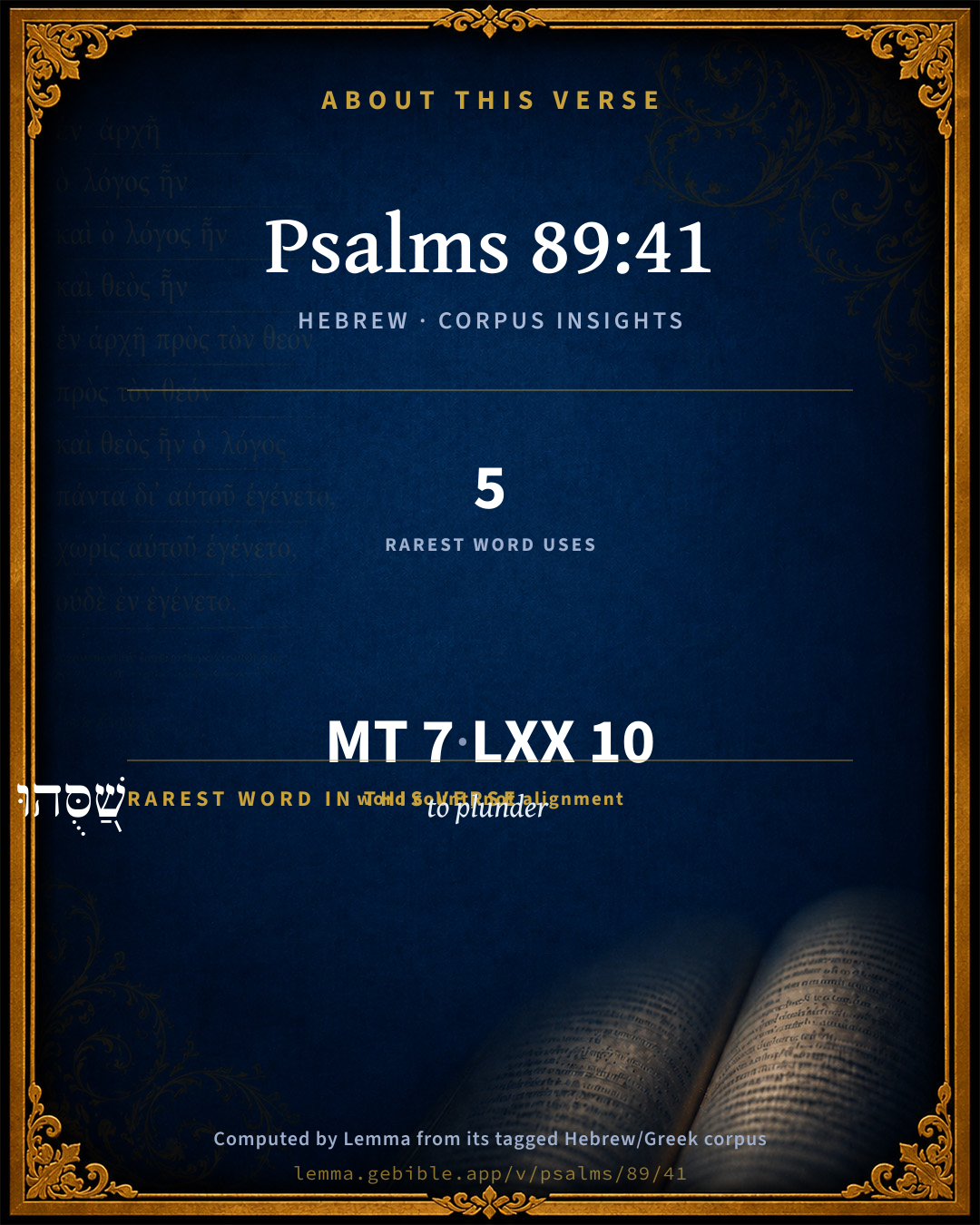
The rarest word here is שַׁ֭סֻּהוּ to plunder H8155 — appearing just 5 times in the whole Hebrew Bible.

Shared distinctive vocabulary

שַׁ֭סֻּהוּ to plunder H8155 occurs in 5 verses of the Hebrew Bible. Also found in:

Grammatical profile

  • 3 verbs
  • 3 nouns
  • 1 adjective

Verb forms

  • שַׁ֭סֻּהוּ Qal · Perfect
  • עֹ֣בְרֵי Qal · Participle Active
  • הָיָ֥ה Qal · Perfect

Hebrew & Septuagint length

In English translation the verse runs 16 words from the Hebrew and 17 from the Septuagint (LXX English) — closely comparable.

A rough comparison of the two English renderings, which tokenize alike — not a word-level alignment.

Word counts can differ between the Hebrew and the Greek without any difference in meaning — e.g. the Hebrew direct-object marker אֵת has no separate Greek word, and Greek often adds the article ὁ.

In the original languages it is 7 Hebrew tokens and 10 Greek tokens — but the two are counted differently (Hebrew bundles its prefixes and suffixes into one token; the Greek is in lemma form), so that isn’t a like-for-like length.

Cross-references

16

Topical passages linked to Psalms 89:41 in the Treasury of Scripture Knowledge — connected by theme and wording, ordered by reader-vote popularity; previews shown in the World English Bible.

  • Psalms 79:4 We have become a reproach to our neighbors, A scoffing and derision to those who are around us.
  • Deuteronomy 28:37 You shall become an astonishment, a proverb, and a byword, among all the peoples where Yahweh shall lead you away.
  • Nehemiah 5:9 Also I said, The thing that you do is not good: ought you not to walk in the fear of our God, because of the reproach of the nations our enemies?
  • Psalms 44:10–14 You make us turn back from the adversary. Those who hate us take spoil for themselves.
  • Psalms 74:10 How long, God, shall the adversary reproach? Shall the enemy blaspheme your name forever?
  • Psalms 80:13 The boar out of the wood ravages it. The wild animals of the field feed on it.
  • Isaiah 10:6 I will send him against a profane nation, and against the people of my wrath will I give him a charge, to take the spoil, and to take the prey, and to tread them down like the mire of the streets.
  • Jeremiah 24:9 I will even give them up to be tossed back and forth among all the kingdoms of the earth for evil; to be a reproach and a proverb, a taunt and a curse, in all places where I shall drive them.
  • Jeremiah 29:18 I will pursue after them with the sword, with the famine, and with the pestilence, and will deliver them to be tossed back and forth among all the kingdoms of the earth, to be an object of horror, and an astonishment, and a hissing, and a reproach, among all the nations where I have driven them;
  • Jeremiah 42:18 For thus says Yahweh of Hosts, the God of Israel: As my anger and my wrath has been poured forth on the inhabitants of Jerusalem, so shall my wrath be poured forth on you, when you shall enter into Egypt; and you shall be an object of horror, and an astonishment, and a curse, and a reproach; and you shall see this place no more.
  • Jeremiah 44:8 in that you provoke me to anger with the works of your hands, burning incense to other gods in the land of Egypt, where you are gone to sojourn; that you may be cut off, and that you may be a curse and a reproach among all the nations of the earth?
  • Jeremiah 50:17 Israel is a hunted sheep; the lions have driven him away: first, the king of Assyria devoured him; and now at last Nebuchadrezzar king of Babylon has broken his bones.
  • Lamentations 5:1 Remember, Yahweh, what has come on us: Look, and see our reproach.
  • Ezekiel 5:14–15 Moreover I will make you a desolation and a reproach among the nations that are round about you, in the sight of all that pass by.
  • Daniel 9:16 Lord, according to all your righteousness, let your anger and please let your wrath be turned away from your city Jerusalem, your holy mountain; because for our sins, and for the iniquities of our fathers, Jerusalem and your people are become a reproach to all who are round about us.
  • Jeremiah 44:12 I will take the remnant of Judah, that have set their faces to go into the land of Egypt to sojourn there, and they shall all be consumed; in the land of Egypt shall they fall; they shall be consumed by the sword and by the famine; they shall die, from the least even to the greatest, by the sword and by the famine; and they shall be an object of horror, [and] an astonishment, and a curse, and a reproach.

Cross-references courtesy of OpenBible.info (CC BY 4.0).

Hebrew and Greek witnesses Masoretic Hebrew ↔ Greek Septuagint

The same verse in the two great witnesses to the Old Testament, shown verse-for-verse.

You’re reading Greek Psalm 88 (Hebrew Psalm 89). The Septuagint counts the superscription, so verse numbers can differ from the Hebrew — chapter-level alignment, not verse-by-verse. Numbering follows Rahlfs.

These are two independent witnesses, not word-aligned to each other, and the Septuagint is shown in lemma (dictionary) form.

Hebrew Psalms 89:41 Masoretic · Westminster Leningrad Codex

שַׁ֭סֻּהוּ כָּל עֹ֣בְרֵי דָ֑רֶךְ הָיָ֥ה חֶ֝רְפָּ֗ה לִשְׁכֵנָֽיו

All who pass by the way rob him. He has become a reproach to his neighbors.

World English Bible · Public Domain

Greek LXX Greek Psalm 88:41 Septuagint · lemma form

κατααἱρέω πᾶς ὁ φραγμός αὐτός τίθημι ὁ ὀχύρωμα αὐτός δειλία

All that go by the way have spoiled him: he is become a reproach to his neighbors.

LXX2012 (modern English Septuagint) · Public Domain

Hebrew: Westminster Leningrad Codex (CC BY 4.0). Greek: Septuagint (public domain); English from LXX2012 (modern English Septuagint) (Public Domain). How the Septuagint differs from the Hebrew →

Commentary

Notes on Psalms 89:41 from classic Christian and Jewish commentators (each source and its license shown beneath its notes). The classic Christian expositions comment on the surrounding passage and are grouped to its opening verse, so a note may address several verses; the Jewish commentaries on the Tanakh (Rashi and others) are per-verse, so they appear only where the commentator wrote on this verse.

Lemma curates 59 commentaries, every one of them public domain or Creative Commons licensed, each selected and text-cleaned for this edition rather than reprinted as found. About our sources →

Trapp's Complete Commentary

John Trapp

Psa 89:41 All that pass by the way spoil him: he is a reproach to his neighbours.

Ver. 41. All that pass by the way spoil him] They rob and rifle him: such havoc was made by Shisbak, and is still by the Church’s enemies, Heb 10:34.

He is a reproach to his neighbours] Who now look upon him as a king of clouts, and ask, Where is his invincible majesty?

John Trapp, A Commentary or Exposition upon All the Books of the Old and New Testament (1647–1656) — public domain. Text from a community e-Sword module.

J. A. Alexander on Psalms

Joseph Addison Alexander

42. (Psa 89:41) All spoil him that pass by the way; he has become a contempt to his neighbours. With the first clause compare Psa 80:12); with the last, Psa 80:6. These resemblances prove nothing as to the relative antiquity of the two psalms, or the date of either. The figure is more fully carried out in Psalms 80, but this no more proves that to be the original than it proves it to be the copy. If any such conclusion were legitimate, it would. be easier to account for the amplification of the hint here thrown out by a later writer, than for the omission, in the case before us, of so many fine strokes in that admirable apologue. A contempt, an object of supercilious pity and disdainful wonder.

Joseph Addison Alexander, The Psalms Translated and Explained (1850) — public domain. Text from a community e-Sword module.

Adam Clarke's Commentary

Verse 41. All that pass by the way spoil him.] The land is in the condition of a vineyard, the hedge of which is broken down, so that they who pass by may pull the grapes, and dismantle or tear down the vines. The Chaldeans and the Assyrians began the ravage; the Samaritans on the one hand, and the Idumeans on the other, have completed it.

Adam Clarke's Commentary on the Bible (1810–1826) — public domain. Text from a community e-Sword/MySword module.

The Cambridge Bible for Schools and Colleges

gen. ed. J. J. S. Perowne

41. The first line from Psa_80:12, with the substitution of spoil for pluck: the second from Psa_79:4; cp. Psa_44:13. The ‘neighbours’ are surrounding nations, once tributary to Israel.

The Cambridge Bible for Schools and Colleges (gen. ed. J. J. S. Perowne; Cambridge University Press, 1878–1918) — public domain. Text from a community e-Sword module.

John Gill's Exposition

Thou hast set up the right hand of his adversaries,.... Suffered them to become powerful, and to prevail against him; as the wicked Jews, and Satan, and his principalities and powers, at the time of Christ's apprehension, crucifixion, and death; for then were their hour, and the power of darkness, Luk 22:53, death also had dominion over him, and held him under the power of it for awhile: the enemies of his interest, Rome Pagan, and Rome Papal, have, in their turns, had their right hands set up, and have had power, and prevailed over it; and the latter will again, at the slaying of the witnesses: all which, though it seems contrary to Psa 89:21, yet is not; for Satan, though he bruised Christ's heel, yet Christ bruised his head, destroyed his works, and him himself, and that by dying; and spoiled his principalities and powers; and death could not hold him long, nor has it now any dominion over him, and is abolished by him; and antichrist, and all the antichristian powers, will be destroyed by him ere long:

thou hast made all his enemies to rejoice; as they did when they had got him on the cross; and especially when he was laid in the grave, Psa 22:7, and as the antichristian party will when his witnesses are slain, Rev 11:10, but as the joy of the former was short lived, and was soon turned into sorrow, so will be that of the latter.

John Gill's Exposition of the Whole Bible (1746–1763) — public domain (CC PDM 1.0). Text via the HelloAO Bible API.

Albert Barnes' Notes on the Bible

All that pass by the way spoil him - The sentiment here is substantially the same as in Psa 80:12. See the notes at that place. The idea is that of fields or vineyards, where all the fences, the walls, and the hedges are thrown down so that they become like an open common.

He is a reproach to his neighbors - An object of ridicule, as if he were forsaken by God; as if east out and despised.

Albert Barnes' Notes on the Bible (1834–1885) — public domain. Text from a community e-Sword/MySword module.

Matthew Poole's English Annotations

An object of their scorn and reproach. Is this the anointed of the Lord? Is this the everlasting family and kingdom?

Matthew Poole's English Annotations on the Holy Bible (1683–1685) — public domain. Text from a community e-Sword/MySword module.

The Treasury of David

Charles H. Spurgeon

Ver. 41. All that pass by the way spoil him. Idle passers by, who have nothing else to do, must needs have a pluck at this vine, and they do it without difficulty, since the hedges are gone. Woe is the day when every petty reasoner has an argument against religion, and men in their cups are fluent with objections against the gospel of Jesus. Although Jesus on the cross is nothing to them, and they pass him by without inquiring into what he has done for them, yet they can loiter as long as you will, if there be but the hope of driving another nail into his hands and helping to crucify the Lord afresh. They will not touch him with the finger of faith, but they pluck at him with the hand of malice.

He is a reproach to his neighbours. David's successors had unneighbourly neighbours, who were a reproach to good fellowship, because they were so ready to reproach their neighbour. The Jews were much taunted by the surrounding Gentiles when at any time they fell into trouble. At this time the people of God, who follow the Lord fully, are subject to a thousand reproaches, and some of them of the most bitter kind. These reproaches are really the reproach of Christ, and, at bottom, are meant for him. Shall it always be so? Shall he, who deserves to be universally adored, be subject to general scorn? Where, then, O God, is thy faithfulness to thy covenant?

Psalms 89:42*

Charles H. Spurgeon's The Treasury of David (1869–1885) — public domain. Psalms only. Text from a community e-Sword/MySword module.

Whedon's Commentary on the Bible

Daniel D. Whedon

41. All that pass by the way spoil him—So destitute is he of either military defences or protective government, that even the casual traveller, as he goes along, makes free plunder of his substance.

Neighbours— Bordering tribes and nations.

Daniel D. Whedon (gen. ed.), Commentary on the Old and New Testaments (1874–1909) — public domain. Text from a community e-Sword module.

The Pulpit Commentary

All that pass by the way spoil him. This feature of the situation recalls 2Ki_24:2, but might, no doubt, suit also other times of distress. He is a reproach to his neighbours; or, "he is become a reproach". (comp. Neh_1:3 Neh_2:17 Psa_44:13 Psa_79:4, etc.)

The Pulpit Commentary (1880–1919), ed. H.D.M. Spence-Jones & Joseph S. Exell — public domain. Text from a community e-Sword module.

unfoldingWord translationNotes

Door43 World Missions Community

to his neighbors

Here "neighbors" means people of nearby nations.

raised the right hand of his enemies

Here "right hand" represents power. To "raise the right hand" means that Yahweh has made his enemies strong enough to defeat God's chosen king. (See: Metonymy and Symbolic Action)

turn back the edge of his sword

Here "sword" represents the king's power in battle. To turn the sword back represents making the king unable to win in battle. (See: Metonymy and Idiom)

the edge of his sword

Here "edge" represents the whole sword. AT: "his sword" (See: Synecdoche)

have not made him stand when in battle

Here "stand" represents being victorious in battle. AT: "You have not helped him to be victorious in battle" (See: Metonymy)

translationWords

neighbor

raise

right hand

joy

sword

unfoldingWord translationNotes — © Distant Shores Media and the Door43 World Missions Community, licensed CC BY-SA 4.0. Source: git.door43.org/Door43/en_tn.

Rashi

Rabbi Shlomo Yitzchaki (Rashi)

all his fences which he built in Jerusalem.

his fortifications The Temple Mount and the stronghold of Zion.

Rashi on the Tanakh — English translations: “The Judaica Press complete Tanach with Rashi, translated by A. J. Rosenberg” (CC BY 4.0); “Pentateuch with Rashi's commentary by M. Rosenbaum and A.M. Silbermann, 1929-1934” (public domain); “The Metsudah Tanach series, Lakewood, N.J” (CC BY 4.0); and “The Book of Joshua, Metsudah Publications, 1997” (CC BY 4.0). Text via Sefaria.

Lesson kit

Teaching starters — assembled from the data on this page, not authored interpretation. Every prompt links to the verse data it draws on. Edit before teaching.

Psalms, in the Wisdom, opens this verse with 7 words (7 distinct Hebrew lemmas). Its most distinctive word is shâçaç (“to plunder”). A historical commentator’s framing appears above. Read the whole chapter for the surrounding context.

Discussion questions

  1. The word shâçaç carries the sense “to plunder.” How does it shape the verse?
  2. Judges 2:14 shares the word «to plunder» with this verse. How do the two illuminate each other?
  3. These translations render this verse differently; the difference is in the English rendering, not the original. What questions does that raise?
  4. The verb «שַׁ֭סֻּהוּ» is Qal Perfect. How does its form color the action?
  5. Reading how Trapp's Complete Commentary and J. A. Alexander on Psalms read this verse, where do the two commentators agree and where do they part?

Things to notice

Reading settings

Reading text

Shown beneath each verse's original-language words.

Old Testament
Old Testament edition

Read the OT as the Masoretic Hebrew (MT) or the Greek Septuagint (LXX).

English shown for the Greek Septuagint (in the Hebrew ↔ Greek comparison).

Comparing translations? Open the Compare panel on any verse page to stack up to four side by side.