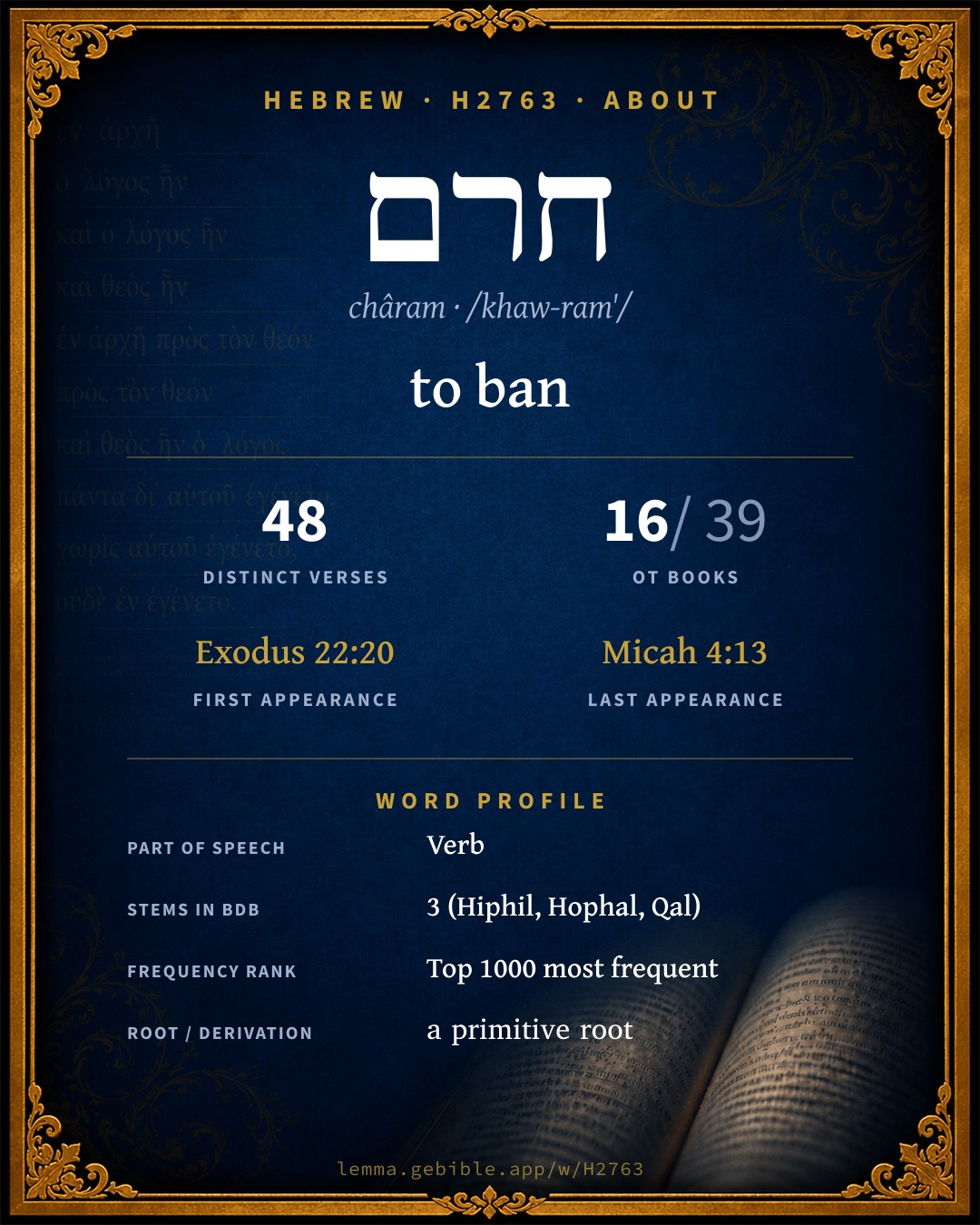
חָרַם
to ban
also: devote, destroy utterly, completely destroy, dedicate for destruction fuller range ↓
Full lexicon entry — Brown-Driver-Briggs (BDB)
From Brown-Driver-Briggs (BDB)
Where this word appears
See every Hiphil verb in the Hebrew Bible →
Grammar key — what these labels mean
Part of speech
- Verb
- An action or state-of-being word.
Stem
- Hiphil
- The causative active stem (“he caused / brought about”). Here: ‘most often of devoting to destruction cities of Canaanites and other neighbours of Isr.’
- Hophal
- The passive counterpart of the Hiphil (“he was caused to…”). Here: ‘be put under the ban’
- Qal
- The basic, simple active stem — the plain form of the verb (“he wrote”).
Form
- Perfect
- A completed action or state — Hebrew marks aspect (completeness) more than strict tense (“he wrote”).
- Infinitive Absolute
- An unbound verbal noun, often intensifying or standing in for a finite verb.
- Sequential Imperfect
- An imperfect with prefixed waw — the standard past-narrative form (waw-consecutive imperfect).
- Infinitive Construct
- A bound verbal noun, frequently with prepositions (“to write / in writing”).
- Imperfect
- An incomplete, ongoing, or future action (“he will / would write”).
- Sequential Perfect
- A perfect with prefixed waw continuing a preceding imperfect or command (waw-consecutive perfect).
- Imperative
- A direct command (“write!”).
- Participle Passive
- A verbal adjective expressing action received (“written”).
State
- Absolute
- The independent form of a noun, not bound to a following word.
Person
- 3rd Person
- The one spoken about (“he / she / it / they”).
- 1st Person
- The speaker (“I / we”).
- 2nd Person
- The one addressed (“you”).
Gender
- Masculine
- Grammatically masculine.
- Common
- Either gender — not distinguished for this form.
Number
- Singular
- One.
- Plural
- More than one (in Hebrew, generally three or more).
Grammatical forms 21 distinct
- Verb, Hiphil, Perfect, 3rd Person, Masculine, Singular 8 times (15%)
- Verb, Hiphil, Infinitive Construct 7 times (13%)
- Verb, Hiphil, Infinitive Absolute 5 times (10%)
- Verb, Hiphil, Sequential Imperfect, 3rd Person, Masculine, Plural 4 times (8%)
- Verb, Hophal, Imperfect, 3rd Person, Masculine, Singular 3 times (6%)
- Verb, Hiphil, Sequential Perfect, 1st Person, Common, Singular 3 times (6%)
- Verb, Hiphil, Sequential Imperfect, 3rd Person, Masculine, Singular 3 times (6%)
- Verb, Hiphil, Sequential Imperfect, 1st Person, Common, Plural 2 times (4%)
+13 more forms (17 occurrences)
Parsed forms decoded from the imported morphology (morphhb / Westminster Leningrad Codex — WLC text public domain, morphhb tagging CC BY 4.0), counted across 52 parsed occurrences — not distinct verses.
Every verse where H2763 appears — 48 distinct verses across 16 books. Click any verse to open its interlinear word-by-word view. Verse text shown in the World English Bible for context — . Each verse’s Hebrew form is shown with its reference; the English is not keyword-highlighted, since the data carries no word-level English alignment. Use “Compare translations” on any verse to read it across multiple English versions. This concordance covers the Hebrew Bible; Septuagint (Greek Old Testament) occurrences are not indexed here.
Exodus 1 verse
Leviticus 3 verses
- Leviticus 21:18 חָרֻ֖ם Qal ptcp.pass ms For whatever man he is that has a blemish, he shall not draw near: a blind man, or a lame, or he who has a flat nose, or any deformity,
- Leviticus 27:28 יַחֲרִם֩ Hiphil impf 3ms "'Notwithstanding, no devoted thing, that a man shall devote to Yahweh of all that he has, whether of man or animal, or of the field of his possession, shall be sold or redeemed: every devoted thing is most holy to Yahweh.
- Leviticus 27:29 יָחֳרַ֛ם Hophal impf 3ms "'No one devoted, who shall be devoted from among men, shall be ransomed; he shall surely be put to death.
Numbers 2 verses
- Numbers 21:2 וְ/הַֽחֲרַמְתִּ֖י conj + Hiphil wpf 1cs Israel vowed a vow to Yahweh, and said, If you will indeed deliver this people into my hand, then I will utterly destroy their cities.
- Numbers 21:3 וַ/יַּחֲרֵ֥ם conj + Hiphil wimpf 3ms Yahweh listened to the voice of Israel, and delivered up the Canaanites; and they utterly destroyed them and their cities: and the name of the place was called Hormah.
Deuteronomy 5 verses
- Deuteronomy 2:34 וַֽ/נַּחֲרֵם֙ conj + Hiphil wimpf 1cp We took all his cities at that time, and utterly destroyed every inhabited city, with the women and the little ones; we left none remaining:
- Deuteronomy 3:6 וַ/נַּחֲרֵ֣ם הַחֲרֵם֙ conj + Hiphil wimpf 1cp Hiphil inf.abs We utterly destroyed them, as we did to Sihon king of Heshbon, utterly destroying every inhabited city, with the women and the little ones.
- Deuteronomy 7:2 הַחֲרֵ֤ם תַּחֲרִים֙ Hiphil inf.abs Hiphil impf 2ms and when Yahweh your God shall deliver them up before you, and you shall strike them; then you shall utterly destroy them: you shall make no covenant with them, nor show mercy to them;
- Deuteronomy 13:15 הַחֲרֵ֨ם Hiphil inf.abs you shall surely strike the inhabitants of that city with the edge of the sword, destroying it utterly, and all that is therein and the cattle of it, with the edge of the sword.
- Deuteronomy 20:17 הַחֲרֵ֣ם תַּחֲרִימֵ֗/ם Hiphil inf.abs Hiphil impf 2ms + sfx pers 3mp but you shall utterly destroy them: the Hittite, and the Amorite, the Canaanite, and the Perizzite, the Hivite, and the Jebusite; as Yahweh your God has commanded you;
Joshua 14 verses
- Joshua 2:10 הֶחֱרַמְתֶּ֖ם Hiphil pf 2mp For we have heard how Yahweh dried up the water of the Red Sea before you, when you came out of Egypt; and what you did to the two kings of the Amorites, who were beyond the Jordan, to Sihon and to Og, whom you utterly destroyed.
- Joshua 6:18 תַּחֲרִ֖ימוּ Hiphil impf 2mp But as for you, only keep yourselves from the devoted thing, lest when you have devoted it, you take of the devoted thing; so would you make the camp of Israel accursed, and trouble it.
- Joshua 6:21 וַֽ/יַּחֲרִ֨ימוּ֙ conj + Hiphil wimpf 3mp They utterly destroyed all that was in the city, both man and woman, both young and old, and ox, and sheep, and donkey, with the edge of the sword.
- Joshua 8:26 הֶחֱרִ֔ים Hiphil pf 3ms For Joshua didn't draw back his hand, with which he stretched out the javelin, until he had utterly destroyed all the inhabitants of Ai.
- Joshua 10:1 וַ/יַּחֲרִימָ/הּ֒ conj + Hiphil wimpf 3ms + sfx pers 3fs Now it happened, when Adoni-zedek king of Jerusalem heard how Joshua had taken Ai, and had utterly destroyed it; as he had done to Jericho and her king, so he had done to Ai and her king; and how the inhabitants of Gibeon had made peace with Israel, and were among them;
- Joshua 10:28 הֶחֱרִ֣ם Hiphil pf 3ms Joshua took Makkedah on that day, and struck it with the edge of the sword, and the king of it: he utterly destroyed them and all the souls who were therein; he left none remaining; and he did to the king of Makkedah as he had done to the king of Jericho.
- Joshua 10:35 הֶחֱרִ֑ים Hiphil pf 3ms and they took it on that day, and struck it with the edge of the sword; and all the souls who were therein he utterly destroyed that day, according to all that he had done to Lachish.
- Joshua 10:37 וַ/יַּחֲרֵ֣ם conj + Hiphil wimpf 3ms and they took it, and struck it with the edge of the sword, and the king of it, and all the cities of it, and all the souls who were therein; he left none remaining, according to all that he had done to Eglon; but he utterly destroyed it, and all the souls who were therein.
- Joshua 10:39 וַֽ/יַּחֲרִ֨ימוּ֙ conj + Hiphil wimpf 3mp and he took it, and the king of it, and all the cities of it; and they struck them with the edge of the sword, and utterly destroyed all the souls who were therein; he left none remaining: as he had done to Hebron, so he did to Debir, and to the king of it; as he had done also to Libnah, and to the king of it.
- Joshua 10:40 הֶחֱרִ֔ים Hiphil pf 3ms So Joshua struck all the land, the hill-country, and the South, and the lowland, and the slopes, and all their kings: he left none remaining, but he utterly destroyed all that breathed, as Yahweh, the God of Israel, commanded.
- Joshua 11:11 הַֽחֲרֵ֔ם Hiphil inf.abs They struck all the souls who were therein with the edge of the sword, utterly destroying them; there was none left who breathed: and he burnt Hazor with fire.
- Joshua 11:12 הֶחֱרִ֣ים Hiphil pf 3ms All the cities of those kings, and all the kings of them, did Joshua take, and he struck them with the edge of the sword, and utterly destroyed them; as Moses the servant of Yahweh commanded.
- Joshua 11:20 הַֽחֲרִימָ֔/ם Hiphil inf.cs + sfx pers 3mp For it was of Yahweh to harden their hearts, to come against Israel in battle, that he might utterly destroy them, that they might have no favor, but that he might destroy them, as Yahweh commanded Moses.
- Joshua 11:21 הֶחֱרִימָ֥/ם Hiphil pf 3ms + sfx pers 3mp Joshua came at that time, and cut off the Anakim from the hill-country, from Hebron, from Debir, from Anab, and from all the hill-country of Judah, and from all the hill-country of Israel: Joshua utterly destroyed them with their cities.
Judges 2 verses
- Judges 1:17 וַ/יַּחֲרִ֣ימוּ conj + Hiphil wimpf 3mp Judah went with Simeon his brother, and they struck the Canaanites who inhabited Zephath, and utterly destroyed it. The name of the city was called Hormah.
- Judges 21:11 תַּחֲרִֽימוּ Hiphil impf 2mp This is the thing that you shall do: you shall utterly destroy every male, and every woman who has lain by man.
1 Samuel 6 verses
- 1 Samuel 15:3 וְ/הַֽחֲרַמְתֶּם֙ conj + Hiphil wpf 2mp Now go and strike Amalek, and utterly destroy all that they have, and don't spare them; but kill both man and woman, infant and suckling, ox and sheep, camel and donkey.
- 1 Samuel 15:8 הֶחֱרִ֥ים Hiphil pf 3ms He took Agag the king of the Amalekites alive, and utterly destroyed all the people with the edge of the sword.
- 1 Samuel 15:9 הַחֲרִימָ֑/ם הֶחֱרִֽימוּ Hiphil inf.cs + sfx pers 3mp Hiphil pf 3cp But Saul and the people spared Agag, and the best of the sheep, and of the oxen, and of the fatlings, and the lambs, and all that was good, and wouldn't utterly destroy them: but everything that was vile and refuse, that they destroyed utterly.
- 1 Samuel 15:15 הֶחֱרַֽמְנוּ Hiphil pf 1cp Saul said, They have brought them from the Amalekites: for the people spared the best of the sheep and of the oxen, to sacrifice to Yahweh your God; and the rest we have utterly destroyed.
- 1 Samuel 15:18 וְ/הַחֲרַמְתָּ֞ה conj + Hiphil wpf 2ms and Yahweh sent you on a journey, and said, 'Go, and utterly destroy the sinners the Amalekites, and fight against them until they are consumed.'
- 1 Samuel 15:20 הֶחֱרַֽמְתִּי Hiphil pf 1cs Saul said to Samuel, Yes, I have obeyed the voice of Yahweh, and have gone the way which Yahweh sent me, and have brought Agag the king of Amalek, and have utterly destroyed the Amalekites.
1 Kings 1 verse
2 Kings 1 verse
1 Chronicles 1 verse
2 Chronicles 2 verses
- 2 Chronicles 20:23 לְ/הַחֲרִ֣ים prep + Hiphil inf.cs For the children of Ammon and Moab stood up against the inhabitants of Mount Seir, utterly to kill and destroy them: and when they had made an end of the inhabitants of Seir, everyone helped to destroy another.
- 2 Chronicles 32:14 הֶחֱרִ֣ימוּ Hiphil pf 3cp Who was there among all the gods of those nations which my fathers utterly destroyed, that could deliver his people out of my hand, that your God should be able to deliver you out of my hand?
Ezra 1 verse
Isaiah 3 verses
- Isaiah 11:15 וְ/הֶחֱרִ֣ים conj + Hiphil wpf 3ms Yahweh will utterly destroy the tongue of the Egyptian sea; and with his scorching wind will he wave his hand over the River, and will strike it into seven streams, and cause men to march over in sandals.
- Isaiah 34:2 הֶחֱרִימָ֖/ם Hiphil pf 3ms + sfx pers 3mp For Yahweh has indignation against all the nations, and wrath against all their host: he has utterly destroyed them, he has delivered them to the slaughter.
- Isaiah 37:11 לְ/הַחֲרִימָ֑/ם prep + Hiphil inf.cs + sfx pers 3mp Behold, you have heard what the kings of Assyria have done to all lands, by destroying them utterly: and shall you be delivered?
Jeremiah 4 verses
- Jeremiah 25:9 וְ/הַ֣חֲרַמְתִּ֔י/ם conj + Hiphil wpf 1cs + sfx pers 3mp behold, I will send and take all the families of the north, says Yahweh, and [I will send] to Nebuchadrezzar the king of Babylon, my servant, and will bring them against this land, and against the inhabitants of it, and against all these nations round about; and I will utterly destroy them, and make them an astonishment, and a hissing, and perpetual desolations.
- Jeremiah 50:21 וְ/הַחֲרֵ֤ם conj + Hiphil impv 2ms Go up against the land of Merathaim, even against it, and against the inhabitants of Pekod: kill and utterly destroy after them, says Yahweh, and do according to all that I have commanded you.
- Jeremiah 50:26 וְ/הַחֲרִימ֑וּ/הָ conj + Hiphil impv 2mp + sfx pers 3fs Come against her from the utmost border; open her store-houses; cast her up as heaps, and destroy her utterly; let nothing of her be left.
- Jeremiah 51:3 הַחֲרִ֖ימוּ Hiphil impv 2mp Against [him who] bends let the archer bend his bow, and against [him who] lifts himself up in his coat of mail: and don't you spare her young men; destroy you utterly all her host.
Daniel 1 verse
Micah 1 verse
About this entry
At a glance — auto-summarized from this page’s data, not written by a person. Every figure links to its source below. This summary describes the numbers; it doesn’t interpret them.
“to ban” is the headline sense of the Hebrew verb חרם (châram). Where the King James Version says “utterly destroyed,” newer translations reach for “devote to destruction” (Berean Standard Bible) and “he devoted” (unfoldingWord Literal Text); the renderings breakdown has the detail. It appears 48 verses across 16 books of the Hebrew Bible, among its moderately common vocabulary. More than a quarter of its appearances fall in Joshua. The verb spans 3 stems, from Hiphil to Hophal. See the sense tree, 48-verse concordance, and the renderings breakdown below.
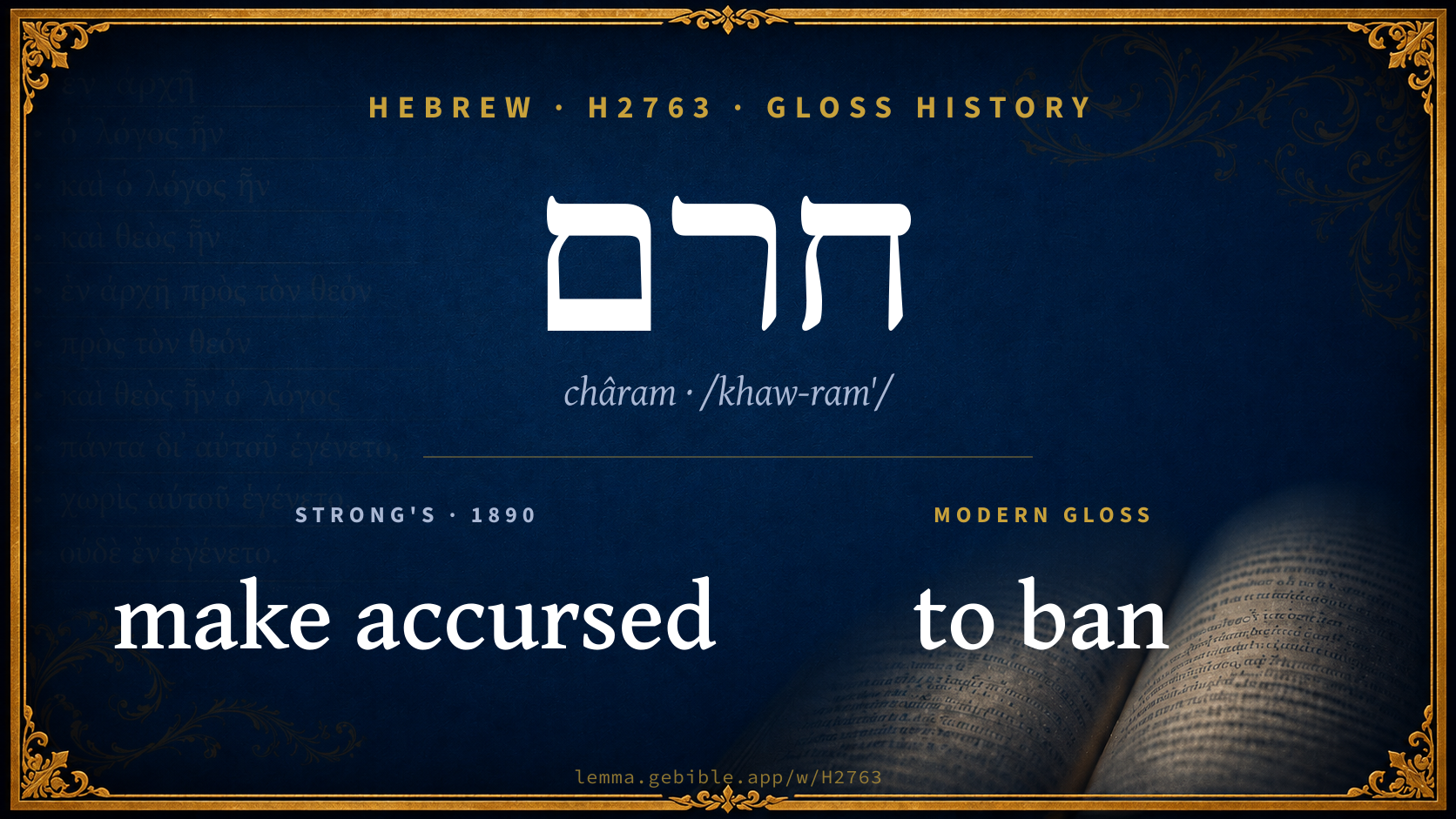
Gloss history
Strong's 1890 vs modern scholarship
About this word
Strong's H2763 catalogs a Hebrew word from the Hebrew Old Testament.
These counts are not copied from any lexicon or concordance. They are computed here, from the morphology-tagged Hebrew Old Testament. What Lemma adds →
- 48
- distinct verses
- The word appears in 48 distinct verses.
- 16 / 39
- OT books
- The word appears in 16 of 39 Old Testament books.
- #718
- by frequency
- Top 1000 most frequent Hebrew words (rank 718 of 8,640 Hebrew words by occurrence).
View all 48 occurrences in the concordance →
Most concentrated in
- Joshua 14 verses 29%
- 1 Samuel 6 verses 13%
- Deuteronomy 5 verses 10%
By section of the Old Testament
By traditional corpus
Conventional, traditional groupings — biblical authorship is debated, so this is a traditional corpus grouping, not an authorship claim. Each share is this word’s portion of its verses in that division of the Hebrew canon. Each figure is a share of the word’s 48 distinct verses.
- Prophets (Nevi'im) 32 verses · 67%
- Torah (Pentateuch) 11 verses · 23%
- Writings (Ketuvim) 5 verses · 10%
How translations render this word
Counts come from each version’s own published word-to-Strong’s tagging or interlinear alignment — an approximate guide to how each version renders this word, not a word-level alignment the data otherwise carries. Because each total is that version’s own tagged count, the per-version totals vary from one another and need not match the appearance or distinct-verse counts above. These counts may also differ from a printed concordance because Lemma counts each distinctly tagged rendering and does not collapse phrase taggings into a single head-word total. This is a fixed set of word-tagged versions (KJV, ASV, BSB, ULT) and does not change with the reading translation you choose elsewhere. Each version’s license is shown beside its name below (and on Sources).
BDB lists this Strong’s number as 2 distinct words (homographs). Each count above pools all of them and is not split by sense — see the Senses section below. A low-frequency rendering may belong to a different one of those words, not the primary meaning.
- King James Version†: Utterly destroyed 6×, Utterly destroy 4×, Destroy 2×
- American Standard Version†: Utterly destroyed 6×, Utterly destroy 4×, Destroying them utterly 2×
- Berean Standard Bible†: Devote to destruction 5×, Devoted to destruction 5×, Devote them to destruction 3×
- unfoldingWord Literal Text†: He devoted 7×, Devoting 5×, Destruction 3×
King James Version Public Domain
Renders H2763 across 52† tagged occurrences — most commonly:
Plus 32 renderings that appear only once — usually multi-word phrases or single function words the recovered tagging swept in, not distinct renderings.
American Standard Version Public Domain
Renders H2763 across 51† tagged occurrences — most commonly:
Plus 31 renderings that appear only once — usually multi-word phrases or single function words the recovered tagging swept in, not distinct renderings.
Berean Standard Bible Public Domain
Renders H2763 across 49† tagged occurrences — most commonly:
Plus 23 renderings that appear only once — usually multi-word phrases or single function words the recovered tagging swept in, not distinct renderings. Not rendered by a distinct English word in 3 further occurrences.
unfoldingWord Literal Text CC BY-SA 4.0
Renders H2763 across 54† tagged occurrences — most commonly:
Plus 19 renderings that appear only once — usually multi-word phrases or single function words the recovered tagging swept in, not distinct renderings.
11 senses and sub-senses in the full BDB
Hebrew verbs can shift meaning by stem (binyan): Qal is the basic action, Niphal is often passive or reflexive, Piel often intensifies or makes it factitive, and Hiphil is typically causative. The senses below are grouped under the stem BDB assigns to each. This entry also uses Hophal (the passive of Hiphil).
What do BDB’s symbols mean?
BDB uses these scholarly abbreviations:
| Symbol | Meaning |
|---|---|
| 𝔊 | the Septuagint (the ancient Greek translation, LXX) |
| 𝔙 | the Vulgate (the Latin translation) |
| 𝔖 | the Syriac version (the Peshitta) |
| 𝔗 | the Targum (the Aramaic translation) |
| ψ | the Psalms |
| √ | root (the underlying root or stem) |
| ‖ | parallel passage (a synonymous or contrasted parallel) |
| † | the dagger: every passage where the word occurs is cited |
The 11 senses and sub-senses the full Brown-Driver-Briggs lexicon distinguishes for this word, in lexicon order (not ranked by frequency), with BDB’s own verbatim wording and sub-sense lettering. Shown in Hebrew script with BDB’s own scholarly abbreviations. The condensed entry is in the Lexicon Entry tab. See also the Forms in the corpus table below.
חרם I Hiph. ban, devote, exterminate (MI17 החרמתה of devoting, dedicating a city to Chemosh, in cl. with כי explaining massacre of all inhabitants
Hiphil
- Pf. הֶהֱרִים Jos 8:26 + 5 times; הֶחֱרִם Jos 10:28; 2 ms. וְהַחֲרַמְתָּ֫ה 1 S 15:18; 1 s. הֶחֱרַמְתִּי 1 S 15:20; וְהַחֲרַמְתִּ֫י Nu 21:2; 2 fs. וְהַחֲרַמְתְּ(י) consec. Mi 4:13 (so 𝔊 𝔙 𝔖 𝔗 RV most; MT 1 s.), v. Ges§ 44, R. 4; pl. הֶחֱרִימוּ 1 S 15:9 2 Ch 32:14 etc.; (1 S 15:3 read והחרמתו 𝔊 We Dr); Impf. יַחֲרִם Lv 27:28; וַיַּחֲרֵם Nu 21:3 Jos 10:37; sf. וַיַּחֲרִימָהּ Jos 10:1; 1 pl. וַנַּחֲרֵם Dt 2:34; 3:6 etc.; Imv. הַחֲרֵם Dt 13:16; pl. הַחֲרִימוּ Je 51:3; sf. הַחֲרִימוּהָ Je 50:26; Inf. abs. הַחֲרֵם Dt 3:6 + 4 times; cstr. הַחֲרִים 2 Ch 20:23 Dn 11:44; sf. הַחֲרִימָם Jos 11:20 + 4 times;—ban, devote (especially religiously, sq. objects hostile to the theocracy [v. especially Ex 22:19 Hoph.]; this involved gen. their destruction; when a city was ‘devoted’ the inhab. were put to death, the spoil being destroyed or not according to the gravity of the occasion [contrast Jos 6:17, 21 1 S 15:3 with Dt 2:34f.; 3:6, 7], cf. MI17 לעשתר כמש החרמתה to Ashtar-Chemosh I devoted it, i.e. the city Nebo);— e.g. Joshua 8:26
- 1. most often of devoting to destruction cities of Canaanites and other neighbours of Isr., exterminating inhabitants, and destroying or appropriating their possessions:
- a. Isr. and her leaders subj. Nu 21:2, 3 (destruction according to vow), Jos 6:21 (cf. חֵרֶם ליהוה v 17; all J); in v 18 read תַּחְמְדוּ (for MT תַּחֲרִימוּ, v. Di VB); 8:26 𝔊, not 𝔊L, om. v.), 10:1 (JE), Dt 2:34; 3:6(×2); 7:2(×2) (commanded through Moses, cf. for underlying thought v 4, 5, 6), 20:17(×2) (commanded by י׳), Jos 2:10 10:28, 35, 37, 39, 40 (divine command), 11:11, 12, 20, 21 (divine command v 12, 20; all D), 1 S 15:3, 8, 9(×2), 15, 18, 20 (divine command v 3, 18, 20, cf. v 11, 22, 23); quite secondary is simple exterminate 1 K 9:21, 1 Ch 4:41. e.g. Numbers 21:2
- b. secondary meaning destroy, exterminate, also with other nations subj.:—2 K 19:11 = Is 37:11 = 2 Ch 32:14, 2 Ch 20:23, Je 50:21, 26 (both by divine command), 51:3 Dn 11:44. e.g. 2 Kings 19:11
- c. God as subj., fig. all nations and their armies Is 34:2; the nations of Western Asia Je 25:9; the tongue of the Egyptian sea (by drying it up) Is 11:15 (but read perhaps החריב with 𝔊 𝔖 𝔙 𝔗). e.g. Isaiah 34:2
- d. so also of devoting even Israelites: a city of Isr. for worshipping other gods Dt 13:16; residents of Jabesh-Gilead for not joining in campaign against Benj. Ju 21:11. e.g. Deuteronomy 13:16
- 2. devote to י׳: for sacred uses החרים ליהוה the spoil of the nations Mi 4:13; private possessions, whether a man, animal, or field Lv 27:28 (P). e.g. Micah 4:13
Hophal
- Impf. יָחֳרַם Lv 27:29 Ezr 10:8; יָחֳרָ֑ם Ex 22:19;— e.g. Leviticus 27:29
- 1. be put under the ban, devoted (to death), for worshipping other gods than י׳ Ex 22:19 (JE; earliest use of word in OT); for some other theocratic offence Lv 27:29 (P; v. Di). e.g. Exodus 22:19
- 2. devoted, i.e. forfeited, to the temple treasures Ezr 10:8.—On חרם v. especially Di (Kn) Lv 27:28; EwAntiq.75.78, Dr 1 S 15:33. e.g. Ezra 10:8
חרם II
Qal
- Pt. pass. אִישׁ עִוֵּר אוֹ פִּסֵּחַ אוֹ חָרֻם אוֹ שָׂרוּעַ a man blind or lame or mutilated in the face (in nose, lip, ear, etc.), or too long in a limb Lv 21:18 (H), v. Di (Kn). e.g. Leviticus 21:18
Senses from the full Brown-Driver-Briggs lexicon (Brown, Driver, Briggs; Oxford 1906 — public domain), digitized via Sefaria, supplemented by the OpenScriptures HebrewLexicon (CC BY 4.0). Full attribution on Sources.
Word origin
I. vb.Hiph. ban, devote, exterminate (MI17 החרמתה of devoting, dedicating a city to Chemosh, in cl. with כי explaining massacre of all inhabitants; the altar-hearth of י׳ there was dragged before Chemosh; حَرُمَ be prohibited, forbidden, unlawful, become sacred; ii. make, pronounce sacred, inviolable; Ethiopic ሐረመ prohibit from common use, consecrate to God, esteem unlawful; Palm. חרם = consacré VogNo. 35; Nab. id., Eutp. 28; Sab. מחרם sanctuary, temple, OsZMG 1865, 176, 252, חרמתן DHMZMG 1875, 594; Aramaic אַחֲרִים, and especially ܐܰܚܪܶܡ anathematize, excommunicate; v. also WeSkizzen iii, 165, DrSm 100 ff., RSSem. i. 140(150))—
II. vb. slit (nose, lip, ear, etc.), mutilate, especially face (Arabic خَرَمَ perforate, pierce, slit the partition between the nostrils, or the lip, or the lobe of the ear)—
— Brown-Driver-Briggs (Oxford 1906, public domain), digitized via Sefaria, supplemented by the OpenScriptures HebrewLexicon (CC BY 4.0). See Sources.
Origin: a primitive root
Jastrow Dictionary
A second Hebrew/Aramaic lexicon for comparison, covering Aramaic and post-biblical (Talmudic, Targumic, Midrashic) usage that the biblical-Hebrew BDB does not. Matched by lemma rather than by Strong’s number, so a lemma may carry more than one Jastrow headword (shown separately below), and the entries cover usage well beyond the Bible.
חָרַם
- (b. h.) [to perforate, break through (cmp. Arab. ḫaram, a. חֲרָךְ I),]
- 1. to make a net. Men. 37ᵃ top ר׳ יוסי החוֹרֵם R. J. the net-maker (or fisher); [Rashi, reading החָרוּם, (v. Rabb. D. S. a. l., note 100), v. infra].
- 2. to perforate. Part. pass. חָרוּם (b. h. חָרֻם) one whose nose is so flattened as to show its holes, flat-nosed. Bekh. VII, 3 איזהו ח׳ הכוחל וכ׳ a ḥarum is he who can paint both of his eyes with one movement. Ib. 43ᵇ ח׳ שחוטמו שקוע ḥ. is one whose nose is sunk.
- 3. to cut off, to set outside (cmp. Arab. ḥaram), v. infra, a. חֵרֶם.—[
- 4. to burn, cmp. חָרַךְ, חָרֵב; v. חוּרְמַן.]
- (denom. of חֵרֶם) [to set outside, apart,]
- 1. to dedicate for priestly or sacred use (Lev. XXVII, 28, sq.); to renounce private use. Arakh. VIII, 4 מַחֲרִים אדם וכ׳ a man may renounce a portion of his sheep &c.; ואם ה׳ את כולם אינן מוּחֲרָמִין but if he renounces all of them, they are not dedicated (his vow is invalid). Ib. מה אם לגבוה להַחֲרִים וכ׳ since man is not permitted to renounce all his property even for a sacred purpose &c. Ib. 7 מח׳ אדם את קדשיו וכ׳ one may declare ḥerem one’s own designated offerings (in which case he has to pay their value to the priest or the sanctuary); a. v. fr.—Part. pass. מוּחֳרָם, pl. מוּחֳרָמִין, מוּחֳרָמִים. Ib. 4, sq., v. supra; a. fr. e.g. Leviticus 27:28
- 2. to excommunicate, to pronounce the higher ban (which includes the withdrawal of protection of property). M. Kat. 16ᵃ מנדין … ומַחֲרִימִין וכ׳ the smaller ban is pronounced (over one disregarding a legal summons) at once …, the great ban after sixty days.
חֲרַם
- , to perforale. Part. pass. חֲרִים, חָרִים flat-nosed, v. preced. Targ. O. Lev. XXI, 18.
- 1. to declare חֵרֶם. Targ. Josh. VI, 18 תְחַרְמוּן (Var. תַחַרְ׳, read: תַחְרְ׳). Targ. I Sam. XV, 21 די חַרְמוּן (ed. Lag. a. oth. דיַחְרְמוּן).—Targ. O. Lev. XXVII, 28.—Arakh. 28ᵃ כל דאית ליה לא לַחְרֵים … ליחַרְמֵיה כוליה one must not renounce (for sacred purposes) all his property, but of one kind he may renounce all he has.
- 2. to excommunicate. M. Kat. 16ᵃ מנלן דמַחְרְמִינָן (or דמְחַרְמִי׳) whence is it proven that we (the court) have a right to excommunicate a recreant person?—Y. ib. III, 81ᵈ top אילולא דלא חַרְמִית … מְחַרֵם וכ׳ were it not that I never in my life excommunicated a person, I should have excommunicated that man; a. e.—Part. pass. מְחַרַם, pl. מְחַרְמִין. Ib. bot. ייא ההוא גברא מ׳ this man (thou) be excommunicated. Ib. ליהוון ההיא עמא מח׳ those people (you) be excommunicated.
- to he declared חֵרֶם, to be dedicated. Targ. O. Lev. XXVII, 29 דיִתְחֲ׳ ed. Berl. (oth. דיִתַּחֲ׳).
חֵרֶם
- preced.)
- 1. net. Kel. XXIII, 5; XXVIII, 9, v. זֶוֶט; a. fr.—Ned. II, 5, v. infra.
- 2. a place adapted for catching fish in nets, fishing coast, fishery. B. Kam. 81ᵇ מלא חבל ח׳ בדרומה a rope’s length (district) of fishing coast south of it (the Lake of Tiberias); Tosef. ib. VIII, 18 Var. ed. Zuck.—Erub. 47ᵇ ח׳ שבין וכ׳ a fishpond between two territories.
- 3. [cut off, excluded, cmp. חוּלִּין, הֶפְקֵר,] ḥerem, property set apart for priest’s or Temple use; doomed to destruction. Ned. II, 4 אם כח׳ של שמים if (he said, This shall be to me) like the ḥerem consecrated to the Temple, opp. ח׳ של כהנים assigned to the private use of priests. Ib. 5 נדר בח׳ … בחֶרְמוֹ של ים if he made a vow of abstinence using the word ḥerem, and he says, I meant the ḥerem of the sea (fisher’s net). Ib. I, 2 כינויין לח׳ verbal substitutes for ḥerem (effecting prohibition); a. fr.
- 4. excommunication. M. Kat. 17ᵃ.—Pl. חֲרָמִים, חֲרָמִין. Snh. 43ᵇ מעל עכן בג׳ ח׳ Akhan committed three sacrileges. Ned. II, 4 סתם ח׳ containing the expression ḥerem unqualified. Ib. חַרְמֵי הכהנים the dedications as priestly property. Arakh. VIII, 6 סתם ח׳ לבדק הבית unqualified dedications (this be ḥerem) go to the repair of the Temple; a. fr.—[Y. Kil. IX, 32ᵃ top שצבעה בחרם, read: בחֶרֶת.]—V. חֵירוּם.
חָרָם
- (preced.)
- 1. fisherman.—Pl. חָרָמִים, חָרָמִין, constr. חָרָמֵי. Y. M. Kat. II, end, 81ᵇ; Y. Pes. IV, 30ᵈ top ח׳ טבריה the net-fishers of Tiberias.
- 2. confiscator, official oppressor, v. הָרָג.—Tosef. Ab. Zar. VII (VIII), 6; Ab. Zar. 58ᵃ. Tosef. B. Mets. III, 19; Y. ib. IV, end, 9ᵈ a defective coin must not be given לתגר … ולא לח׳ וכ׳ to a travelling merchant, to a highwayman, or to an oppressor, because they will cheat &c.—Pl. as ab. Ned. III, 4; B. Kam. 113ᵃ, v. נָדַר.
A Dictionary of the Targumim, the Talmud Babli and Yerushalmi, and the Midrashic Literature (Marcus Jastrow; London, Luzac, 1903) — Public Domain. Digitized via Sefaria. Digitized via Sefaria. Full attribution on Sources.
Forms in the corpus
The 50 distinct written forms H2763 takes in the Hebrew Bible, most frequent first — each parse links to that stem’s occurrences in the concordance. Hebrew forms include their vowel points and cantillation, so a single lemma takes many written forms.
Same root — word family
Other BDB entries built from the same root as H2763, grouped by Strong’s listed origin. These share a root / origin per the lexicon — not necessarily a shared meaning. Each links to that word’s own entry.
Derived from this word
Proper names from this root
People and places named from this root — a name, not an additional meaning of the word.
- חרומף chărûwmaph H2739 Harumaph
- חרם Chŏrêm H2765 Horem
- חרם Chârim H2766 Harim
- חרמה Chormâh H2767 Hormah
- חרמון Chermôwn H2768 Hermon
Compare all same-root words → Showing 4 of 8 — not the complete family. 5 of the same-root words are proper names (people or places). They share a root, not necessarily a meaning.
Septuagint verse parallels
This word appears in 44 verses that also exist in the Greek Old Testament (Septuagint), out of the 48 Hebrew verses it occurs in. You can read those verses in Greek by switching the Old Testament edition to the Septuagint.
Read these verses in the Septuagint
- Exodus 22:20
- Leviticus 21:18
- Numbers 21:2
- Deuteronomy 2:34
- Joshua 2:10
- Judges 1:17
- 1 Samuel 15:3
- 2 Kings 19:11
- 1 Chronicles 4:41
- 2 Chronicles 20:23
- Ezra 10:8
- Isaiah 11:15
This is a verse-level parallel only — the same verses exist in both the Hebrew and Greek Old Testaments. No word-level Hebrew↔Greek correspondence is claimed: the data carries no such alignment, so no Greek word is shown as this Hebrew word’s translation. Coverage is not total — the Septuagint omits the deuterocanon and renumbers the Psalms, so some Hebrew verses have no direct Greek parallel.