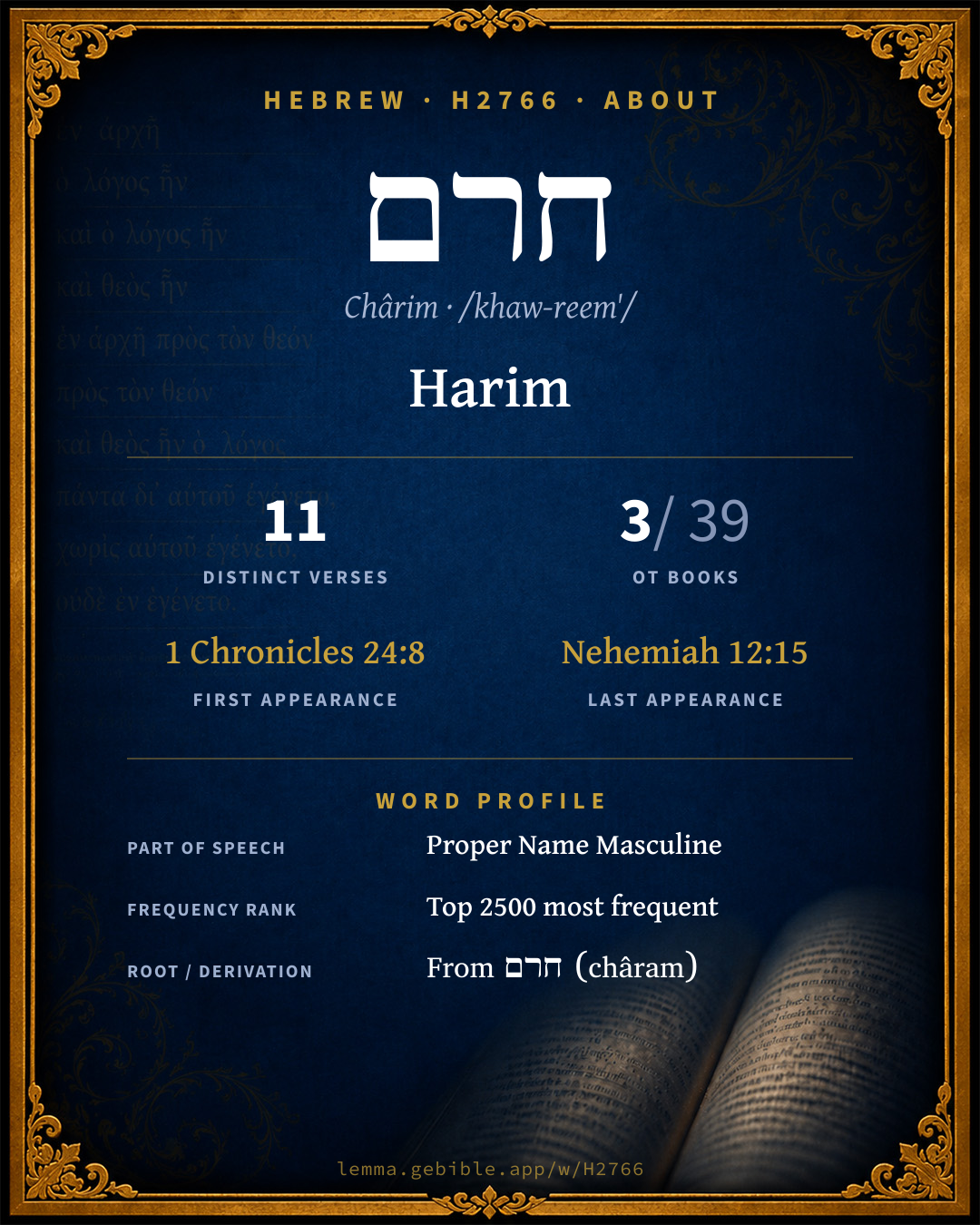
חָרִם
Harim
BDB lists 6 entries for ‘Harim’ fuller range ↓
Full lexicon entry — Brown-Driver-Briggs (BDB)
From Brown-Driver-Briggs (BDB)
Where this word appears
Grammar key — what these labels mean
Part of speech
- Noun
- A naming word — a person, place, thing, or idea.
Noun type
- Proper
- A name of a specific person, place, or people (e.g. Abraham, Zion, Israel).
Every verse where H2766 appears — 11 distinct verses across 3 books. Click any verse to open its interlinear word-by-word view. Verse text shown in the World English Bible for context — . Each verse’s Hebrew form is shown with its reference; the English is not keyword-highlighted, since the data carries no word-level English alignment. Use “Compare translations” on any verse to read it across multiple English versions. This concordance covers the Hebrew Bible; Septuagint (Greek Old Testament) occurrences are not indexed here.
1 Chronicles 1 verse
Ezra 4 verses
- Ezra 2:32 חָרִ֔ם n Proper The children of Harim, three hundred twenty.
- Ezra 2:39 חָרִ֔ם n Proper The children of Harim, one thousand seventeen.
- Ezra 10:21 חָרִ֑ם n Proper Of the sons of Harim: Maaseiah, and Elijah, and Shemaiah, and Jehiel, and Uzziah.
- Ezra 10:31 חָרִ֑ם n Proper [of] the sons of Harim: Eliezer, Isshijah, Malchijah, Shemaiah, Shimeon,
Nehemiah 6 verses
- Nehemiah 3:11 חָרִ֔ם n Proper Malchijah the son of Harim, and Hasshub the son of Pahath-moab, repaired another portion, and the tower of the furnaces.
- Nehemiah 7:35 חָרִ֔ם n Proper The children of Harim, three hundred twenty.
- Nehemiah 7:42 חָרִ֔ם n Proper The children of Harim, one thousand [and] seventeen.
- Nehemiah 10:5 חָרִ֥ם n Proper Harim, Meremoth, Obadiah,
- Nehemiah 10:27 חָרִ֖ם n Proper Malluch, Harim, Baanah.
- Nehemiah 12:15 לְ/חָרִ֣ם prep + n Proper of Harim, Adna; of Meraioth, Helkai;
About this entry
At a glance — auto-summarized from this page’s data, not written by a person. Every figure links to its source below. This summary describes the numbers; it doesn’t interpret them.
חרם — transliterated Chârim — is a Hebrew name carrying the sense “Harim.” Its uses cluster heavily in Nehemiah (55% of all occurrences). With 11 verses in 3 books, it is an uncommon word in the Hebrew Bible. It first appears in 1 Chronicles 24:8. See 11-verse concordance and the renderings breakdown below.
Gloss history
Strong's 1890 vs modern scholarship
About this word
Strong's H2766 catalogs a Hebrew word from the Hebrew Old Testament.
These counts are not copied from any lexicon or concordance. They are computed here, from the morphology-tagged Hebrew Old Testament. What Lemma adds →
- 11
- distinct verses
- The word appears in 11 distinct verses.
- 3 / 39
- OT books
- The word appears in 3 of 39 Old Testament books.
- #2,210
- by frequency
- Top 2500 most frequent Hebrew words (rank 2,210 of 8,640 Hebrew words by occurrence).
View all 11 occurrences in the concordance →
Most concentrated in
- Nehemiah 6 verses 55%
- Ezra 4 verses 36%
- 1 Chronicles 1 verse 9%
By section of the Old Testament
By traditional corpus
Conventional, traditional groupings — biblical authorship is debated, so this is a traditional corpus grouping, not an authorship claim. Each share is this word’s portion of its verses in that division of the Hebrew canon. Each figure is a share of the word’s 11 distinct verses.
- Writings (Ketuvim) 11 verses · 100%
How translations render this word
Counts come from each version’s own published word-to-Strong’s tagging or interlinear alignment — an approximate guide to how each version renders this word, not a word-level alignment the data otherwise carries. Because each total is that version’s own tagged count, the per-version totals vary from one another and need not match the appearance or distinct-verse counts above. These counts may also differ from a printed concordance because Lemma counts each distinctly tagged rendering and does not collapse phrase taggings into a single head-word total. This is a fixed set of word-tagged versions (KJV, ASV, BSB, ULT) and does not change with the reading translation you choose elsewhere. Each version’s license is shown beside its name below (and on Sources).
- King James Version: Harim 11×
- American Standard Version: Harim 11×
- Berean Standard Bible: Harim 11×
- unfoldingWord Literal Text: Harim 11×
King James Version Public Domain
Renders H2766 across 11 tagged occurrences — most commonly:
American Standard Version Public Domain
Renders H2766 across 11 tagged occurrences — most commonly:
Berean Standard Bible Public Domain
Renders H2766 across 11 tagged occurrences — most commonly:
unfoldingWord Literal Text CC BY-SA 4.0
Renders H2766 across 11 tagged occurrences — most commonly:
Senses in the full BDB
What do BDB’s symbols mean?
BDB uses these scholarly abbreviations:
| Symbol | Meaning |
|---|---|
| 𝔊 | the Septuagint (the ancient Greek translation, LXX) |
| 𝔙 | the Vulgate (the Latin translation) |
| 𝔖 | the Syriac version (the Peshitta) |
| 𝔗 | the Targum (the Aramaic translation) |
| ψ | the Psalms |
| √ | root (the underlying root or stem) |
| ‖ | parallel passage (a synonymous or contrasted parallel) |
| † | the dagger: every passage where the word occurs is cited |
The 6 senses and sub-senses the full Brown-Driver-Briggs lexicon distinguishes for this word, in lexicon order (not ranked by frequency), with BDB’s own verbatim wording and sub-sense lettering. Shown in Hebrew script with BDB’s own scholarly abbreviations. The condensed entry is in the Lexicon Entry tab. See also the Forms in the corpus table below.
- 1. priest of the third course, David’s time, according to 1 Ch 24:8. e.g. 1 Chronicles 24:8
- 2. priest of time of Nehemiah Ne 10:6. e.g. Nehemiah 10:6
- 3. heads of families of returning exiles:
- a. Ezr 2:39 = Ne 7:42, Ezr 10:21 Ne 12:15. e.g. Ezra 2:39
- b. Ezr 2:32 = Ne 7:35, Ezr 10:31 Ne 3:11. e.g. Ezra 2:32
- 4. a prince Ne 10:28. e.g. Nehemiah 10:28
Senses from the full Brown-Driver-Briggs lexicon (Brown, Driver, Briggs; Oxford 1906 — public domain), digitized via Sefaria, supplemented by the OpenScriptures HebrewLexicon (CC BY 4.0). Full attribution on Sources.
Word origin
n.pr.m. (consecrated; cf. Sab. n.pr.m. חרם, יחרמאל Hal411. 504 DHMl.c.)—
— Brown-Driver-Briggs (Oxford 1906, public domain), digitized via Sefaria, supplemented by the OpenScriptures HebrewLexicon (CC BY 4.0). See Sources.
Derived from חרם (châram) (H2763) — to ban.
Jastrow Dictionary
A second Hebrew/Aramaic lexicon for comparison, covering Aramaic and post-biblical (Talmudic, Targumic, Midrashic) usage that the biblical-Hebrew BDB does not. Matched by lemma rather than by Strong’s number, so a lemma may carry more than one Jastrow headword (shown separately below), and the entries cover usage well beyond the Bible.
חָרַם
- (b. h.) [to perforate, break through (cmp. Arab. ḫaram, a. חֲרָךְ I),]
- 1. to make a net. Men. 37ᵃ top ר׳ יוסי החוֹרֵם R. J. the net-maker (or fisher); [Rashi, reading החָרוּם, (v. Rabb. D. S. a. l., note 100), v. infra].
- 2. to perforate. Part. pass. חָרוּם (b. h. חָרֻם) one whose nose is so flattened as to show its holes, flat-nosed. Bekh. VII, 3 איזהו ח׳ הכוחל וכ׳ a ḥarum is he who can paint both of his eyes with one movement. Ib. 43ᵇ ח׳ שחוטמו שקוע ḥ. is one whose nose is sunk.
- 3. to cut off, to set outside (cmp. Arab. ḥaram), v. infra, a. חֵרֶם.—[
- 4. to burn, cmp. חָרַךְ, חָרֵב; v. חוּרְמַן.]
- (denom. of חֵרֶם) [to set outside, apart,]
- 1. to dedicate for priestly or sacred use (Lev. XXVII, 28, sq.); to renounce private use. Arakh. VIII, 4 מַחֲרִים אדם וכ׳ a man may renounce a portion of his sheep &c.; ואם ה׳ את כולם אינן מוּחֲרָמִין but if he renounces all of them, they are not dedicated (his vow is invalid). Ib. מה אם לגבוה להַחֲרִים וכ׳ since man is not permitted to renounce all his property even for a sacred purpose &c. Ib. 7 מח׳ אדם את קדשיו וכ׳ one may declare ḥerem one’s own designated offerings (in which case he has to pay their value to the priest or the sanctuary); a. v. fr.—Part. pass. מוּחֳרָם, pl. מוּחֳרָמִין, מוּחֳרָמִים. Ib. 4, sq., v. supra; a. fr. e.g. Leviticus 27:28
- 2. to excommunicate, to pronounce the higher ban (which includes the withdrawal of protection of property). M. Kat. 16ᵃ מנדין … ומַחֲרִימִין וכ׳ the smaller ban is pronounced (over one disregarding a legal summons) at once …, the great ban after sixty days.
חֲרַם
- , to perforale. Part. pass. חֲרִים, חָרִים flat-nosed, v. preced. Targ. O. Lev. XXI, 18.
- 1. to declare חֵרֶם. Targ. Josh. VI, 18 תְחַרְמוּן (Var. תַחַרְ׳, read: תַחְרְ׳). Targ. I Sam. XV, 21 די חַרְמוּן (ed. Lag. a. oth. דיַחְרְמוּן).—Targ. O. Lev. XXVII, 28.—Arakh. 28ᵃ כל דאית ליה לא לַחְרֵים … ליחַרְמֵיה כוליה one must not renounce (for sacred purposes) all his property, but of one kind he may renounce all he has.
- 2. to excommunicate. M. Kat. 16ᵃ מנלן דמַחְרְמִינָן (or דמְחַרְמִי׳) whence is it proven that we (the court) have a right to excommunicate a recreant person?—Y. ib. III, 81ᵈ top אילולא דלא חַרְמִית … מְחַרֵם וכ׳ were it not that I never in my life excommunicated a person, I should have excommunicated that man; a. e.—Part. pass. מְחַרַם, pl. מְחַרְמִין. Ib. bot. ייא ההוא גברא מ׳ this man (thou) be excommunicated. Ib. ליהוון ההיא עמא מח׳ those people (you) be excommunicated.
- to he declared חֵרֶם, to be dedicated. Targ. O. Lev. XXVII, 29 דיִתְחֲ׳ ed. Berl. (oth. דיִתַּחֲ׳).
חֵרֶם
- preced.)
- 1. net. Kel. XXIII, 5; XXVIII, 9, v. זֶוֶט; a. fr.—Ned. II, 5, v. infra.
- 2. a place adapted for catching fish in nets, fishing coast, fishery. B. Kam. 81ᵇ מלא חבל ח׳ בדרומה a rope’s length (district) of fishing coast south of it (the Lake of Tiberias); Tosef. ib. VIII, 18 Var. ed. Zuck.—Erub. 47ᵇ ח׳ שבין וכ׳ a fishpond between two territories.
- 3. [cut off, excluded, cmp. חוּלִּין, הֶפְקֵר,] ḥerem, property set apart for priest’s or Temple use; doomed to destruction. Ned. II, 4 אם כח׳ של שמים if (he said, This shall be to me) like the ḥerem consecrated to the Temple, opp. ח׳ של כהנים assigned to the private use of priests. Ib. 5 נדר בח׳ … בחֶרְמוֹ של ים if he made a vow of abstinence using the word ḥerem, and he says, I meant the ḥerem of the sea (fisher’s net). Ib. I, 2 כינויין לח׳ verbal substitutes for ḥerem (effecting prohibition); a. fr.
- 4. excommunication. M. Kat. 17ᵃ.—Pl. חֲרָמִים, חֲרָמִין. Snh. 43ᵇ מעל עכן בג׳ ח׳ Akhan committed three sacrileges. Ned. II, 4 סתם ח׳ containing the expression ḥerem unqualified. Ib. חַרְמֵי הכהנים the dedications as priestly property. Arakh. VIII, 6 סתם ח׳ לבדק הבית unqualified dedications (this be ḥerem) go to the repair of the Temple; a. fr.—[Y. Kil. IX, 32ᵃ top שצבעה בחרם, read: בחֶרֶת.]—V. חֵירוּם.
חָרָם
- (preced.)
- 1. fisherman.—Pl. חָרָמִים, חָרָמִין, constr. חָרָמֵי. Y. M. Kat. II, end, 81ᵇ; Y. Pes. IV, 30ᵈ top ח׳ טבריה the net-fishers of Tiberias.
- 2. confiscator, official oppressor, v. הָרָג.—Tosef. Ab. Zar. VII (VIII), 6; Ab. Zar. 58ᵃ. Tosef. B. Mets. III, 19; Y. ib. IV, end, 9ᵈ a defective coin must not be given לתגר … ולא לח׳ וכ׳ to a travelling merchant, to a highwayman, or to an oppressor, because they will cheat &c.—Pl. as ab. Ned. III, 4; B. Kam. 113ᵃ, v. נָדַר.
A Dictionary of the Targumim, the Talmud Babli and Yerushalmi, and the Midrashic Literature (Marcus Jastrow; London, Luzac, 1903) — Public Domain. Digitized via Sefaria. Digitized via Sefaria. Full attribution on Sources.
Forms in the corpus
The 6 distinct written forms H2766 takes in the Hebrew Bible, most frequent first — each parse links to that state’s occurrences in the concordance. Hebrew forms include their vowel points and cantillation, so a single lemma takes many written forms.
| Form | Parsing | Example | Uses |
|---|---|---|---|
| חָרִ֔ם | Noun, Proper | Ezra 2:32 | 5 |
| חָרִ֑ם | Noun, Proper | Ezra 10:21 | 2 |
| חָרִ֖ם | Noun, Proper | Nehemiah 10:27 | 1 |
| חָרִ֥ם | Noun, Proper | Nehemiah 10:5 | 1 |
| לְ/חָרִ֣ם | Noun, Proper | Nehemiah 12:15 | 1 |
| לְ/חָרִם֙ | Noun, Proper | 1 Chronicles 24:8 | 1 |
Same root — word family
Other BDB entries built from the same root as H2766, grouped by Strong’s listed origin. These share a root / origin per the lexicon — not necessarily a shared meaning. Each links to that word’s own entry.
Derives from
Shares the same root
Proper names from this root
People and places named from this root — a name, not an additional meaning of the word.
- חרומף chărûwmaph H2739 Harumaph
- חרם Chŏrêm H2765 Horem
- חרמה Chormâh H2767 Hormah
- חרמון Chermôwn H2768 Hermon
Compare all same-root words → Showing 4 of 8 — not the complete family. 4 of the same-root words are proper names (people or places). They share a root, not necessarily a meaning.
Bible dictionary
Public-domain dictionary articles matched to this entry by name (Harim). A biblical name can be shared by more than one person or place, so an article may treat several.
Easton's Bible Dictionary · M. G. Easton, 1897
Flat-nosed. (1.) The head of the second course of priests (1 Chr. 24:8). (2.) Ezra 2:32, 39; Neh. 7:35, 42. (3.) Neh. 3:11. (4.) 12:3. (5.) 10:5
Smith's Bible Dictionary · William Smith, 1863
(flat-nosed).
+ A priest who had charge of the third division in the house of God. (1 Chronicles 24:8) (B.C. 1014.) + Bene-Harim, probably descendants of the above, to the number of 1017, came from Babylon with Zerubbabel. (Ezra 2:39; Nehemiah 7:42) (B.C. 536.) + It further occurs in a list of the families of priests "who went up with Zerubbabel and Jeshua," and of those who were their descendants in the next generation. (Nehemiah 12:16) + Another family of Bene-Harim, 320 in number, came from the captivity in the same caravan. (Ezra 2:82; Nehemiah 7:35) (B.C. 536.) They also appear among those who had married foreign wives, (Ezra 10:31) as well as those who sealed the covenant- (Nehemiah 10:27) (B.C. 410.)
Hitchcock's Bible Names Dictionary · Roswell D. Hitchcock, 1869
destroyed; dedicated to God
Classic public-domain reference works; full attribution on Sources.
Septuagint verse parallels
This word appears in 5 verses that also exist in the Greek Old Testament (Septuagint), out of the 11 Hebrew verses it occurs in. You can read those verses in Greek by switching the Old Testament edition to the Septuagint.
Read these verses in the Septuagint
This is a verse-level parallel only — the same verses exist in both the Hebrew and Greek Old Testaments. No word-level Hebrew↔Greek correspondence is claimed: the data carries no such alignment, so no Greek word is shown as this Hebrew word’s translation. Coverage is not total — the Septuagint omits the deuterocanon and renumbers the Psalms, so some Hebrew verses have no direct Greek parallel.