Ezekiel 3:8

Hebrew (Westminster Leningrad Codex) Ezekiel 3:8 appears in the Hebrew Old Testament. The text above is from the Westminster Leningrad Codex. Each word links to its Strong’s number, a concise gloss, and parsing drawn from the Open Scriptures Hebrew Bible morphology. Click any word for its full Brown-Driver-Briggs (BDB) entry.
Download image
Cite this verse

Ezekiel 3:8 (World English Bible). Public Domain. Lemma interlinear Bible study tool, https://lemma.gebible.app/v/ezekiel/3/8.

Show BibTeX & RIS
BibTeX
RIS
English Translation
Behold, I have made your face hard against their faces, and your forehead hard against their foreheads.
World English Bible · Public Domain
Download a study sheet

One document with this verse’s original text, its word-by-word gloss line, the meaning frame, cross-references with their text, attributed commentary, and full source and license credits — printable, and it pastes into notes with its structure intact.

This verse Autodidact and up

Study sheet (.html) Plain text (.txt)

A passage Seminary Student

Up to 50 verses in one chapter. A passage sheet keeps up to 6 commentary sources and 12 cross-references per verse, in the order this page ranks them, and says so on the sheet whenever that leaves anything out. Ask for a single verse and you get the Autodidact verse sheet above.

Everything on this page stays free to read, with no account — the sheet is a download of what is already on screen, not access to it.

Want to remove ads? Support Godless Engineer
Compare translations 3

The same verse in 3 English versions, stacked beneath the original-language interlinear above. Click any original word for its lexicon entry.

Each is an independent rendering of the whole verse — the interlinear is not word-aligned to these translations.

Highlighted words mark where these versions differ — a whole-verse word diff, not a word-by-word alignment.

  • World English Bible Public Domain
    Behold, I have made your face hard against their faces, and your forehead hard against their foreheads.
  • King James Version Public Domain
    Behold, I have made thy face strong against their faces, and thy forehead strong against their foreheads.
  • unfoldingWord Literal Text CC BY-SA 4.0
    Behold! I have made your face as hard as their faces and your brow as hard as their brows.

unfoldingWord Literal Text — © unfoldingWord, licensed CC BY-SA 4.0. Word-aligned USFM3 via Door43 (git.door43.org/unfoldingWord/en_ult).

Versions to compare (up to 4)

3 of 4 selected

Show all 18 translations

Every available English version of this verse, each an independent rendering of the whole verse.

  • World English Bible Public Domain
    Behold, I have made your face hard against their faces, and your forehead hard against their foreheads.
  • Berean Standard Bible Public Domain
    Behold, I will make your face as hard as their faces, and your forehead as hard as their foreheads.
  • Majority Standard Bible Public Domain
    Behold, I will make your face as hard as their faces, and your forehead as hard as their foreheads.
  • King James Version Public Domain
    Behold, I have made thy face strong against their faces, and thy forehead strong against their foreheads.
  • American Standard Version (1901) Public Domain
    Behold, I have made thy face hard against their faces, and thy forehead hard against their foreheads.
  • Revised Version (1885) Public Domain
    Behold, I have made thy face hard against their faces, and thy forehead hard against their foreheads.
  • Geneva Bible (1599) Public Domain
    Beholde, I haue made thy face strong against their faces, and thy forehead harde against their foreheads.
  • Douay-Rheims (1899) Public Domain
    Behold I have made thy face stronger than their faces: and thy forehead harder than their foreheads.
  • Young's Literal Translation Public Domain
    `Lo, I have made thy face strong against their face, and thy forehead strong against their forehead.
  • Literal Standard Version CC BY-SA 4.0
    Behold, I have made your face strong against their face, and your forehead strong against their forehead.
  • Unlocked Literal Bible CC BY-SA 4.0
    Behold! I have made your face as stubborn as their faces and your brow as hard as their brows.
  • unfoldingWord Literal Text CC BY-SA 4.0
    Behold! I have made your face as hard as their faces and your brow as hard as their brows.
  • Darby Bible Public Domain
    Behold, I have made thy face hard against their faces, and thy forehead hard against their foreheads.
  • World Messianic Bible Public Domain
    Behold, I have made your face hard against their faces, and your forehead hard against their foreheads.
  • Webster's Bible Public Domain
    Behold, I have made thy face strong against their faces, and thy forehead strong against their foreheads.
  • Free Bible Version CC BY-SA 4.0
    Look! I'm going to make you as tough as them, and as strong-minded as them.
  • Bible in Basic English Public Domain
    See, I have made your face hard against their faces, and your brow hard against their brows.
  • JPS Tanakh (1917) Public Domain
    Behold, I have made thy face hard against their faces, and thy forehead hard against their foreheads.

Literal Standard Version (2020), Covenant Press — licensed CC BY-SA 4.0. Text via the HelloAO Bible API (eBible.org). Unlocked Literal Bible (unfoldingWord) — licensed CC BY-SA 4.0. Text via the HelloAO Bible API (eBible.org). unfoldingWord Literal Text — © unfoldingWord, licensed CC BY-SA 4.0. Word-aligned USFM3 via Door43 (git.door43.org/unfoldingWord/en_ult). Free Bible Version, Dr. Jonathan Gallagher — licensed CC BY-SA 4.0. Text via the HelloAO Bible API (eBible.org).

Word by word

More ways to search: Search by grammar → Find every occurrence → Compare this word →

Practice this passage: Drill this verse → Learn its vocabulary →

מִצְחֲךָ֥
mêtsach
H4696
“forehead · your”
Noun, Common, Masculine, Singular, Construct + Suffix, Personal, 2nd Person, Masculine, Singular
Part of Speech
Noun
Type
Common
Gender
Masculine
Number
Singular
State
Construct
Full BDB Definition

Origin: from an unused root meaning to be clear, i.e. conspicuous

TWOT: 1233a

brow, forehead
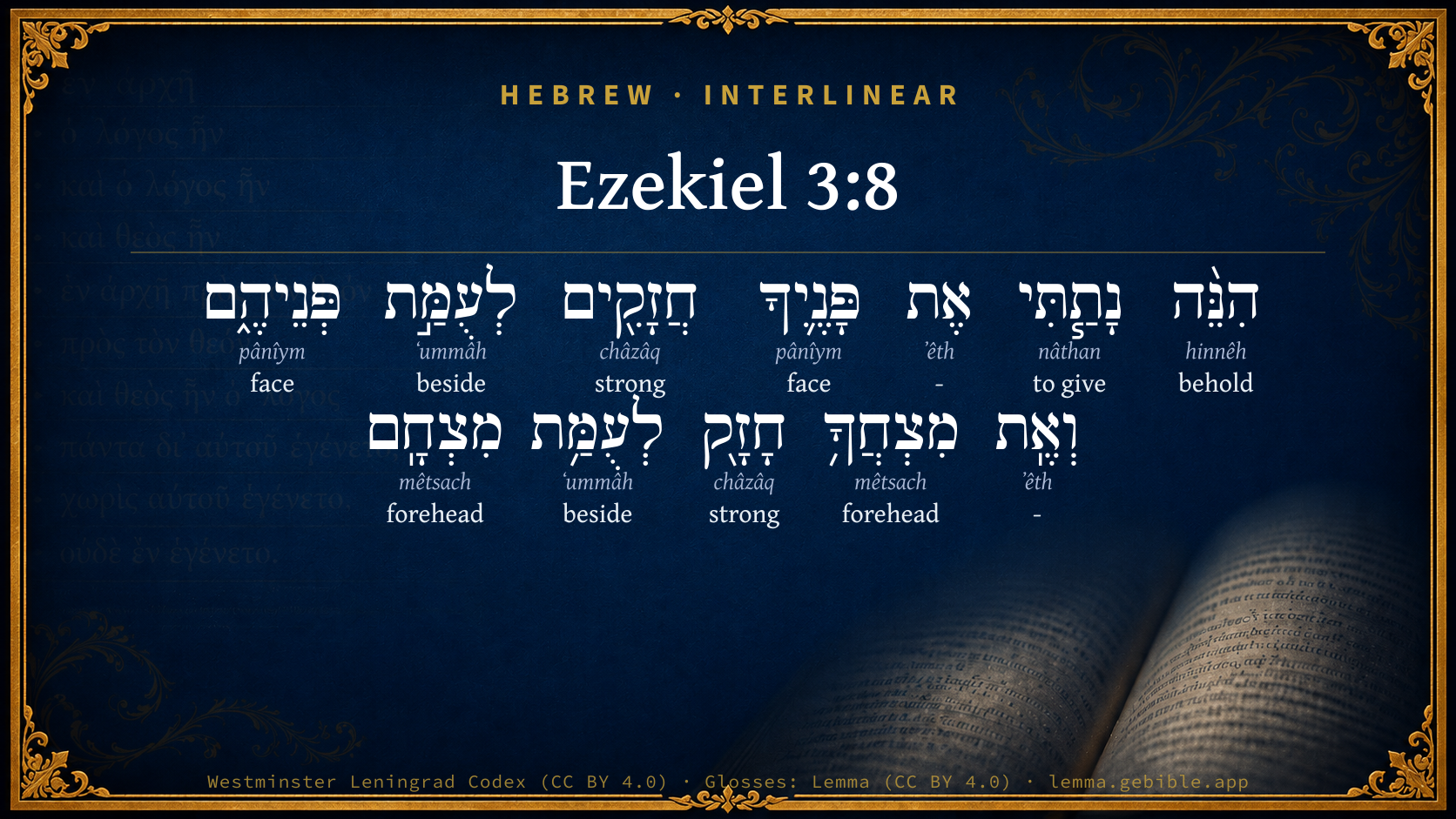
  1. הִנֵּ֨ה hinnêh H2009 “behold” Particle, Demonstrative
  2. נָתַ֧תִּי nâthan H5414 “to give” Verb, Qal, Perfect, 1st Person, Common, Singular
  3. אֶת ʼêth H853 “-” Particle, Direct Object
  4. פָּנֶ֛יךָ pânîym H6440 “face(s) · your” Noun, Common, Both, Plural, Construct + Suffix, Personal, 2nd Person, Masculine, Singular
  5. חֲזָקִ֖ים châzâq H2389 “strong” Adjective, Adjective, Masculine, Plural, Absolute
  6. לְעֻמַּ֣ת ʻummâh H5980 “to/for · beside of” Preposition + Noun, Common, Feminine, Singular, Construct
  7. פְּנֵיהֶ֑ם pânîym H6440 “face(s) · their” Noun, Common, Both, Plural, Construct + Suffix, Personal, 3rd Person, Masculine, Plural
  8. וְאֶֽת ʼêth H853 “and · -” Conjunction + Particle, Direct Object
  9. חָזָ֖ק châzâq H2389 “strong” Adjective, Adjective, Masculine, Singular, Absolute
  10. לְעֻמַּ֥ת ʻummâh H5980 “to/for · beside of” Preposition + Noun, Common, Feminine, Singular, Construct
  11. מִצְחָֽם mêtsach H4696 “forehead · their” Noun, Common, Masculine, Singular, Construct + Suffix, Personal, 3rd Person, Masculine, Plural

About this verse

These counts appear in no published source. They are computed here, from the morphology-tagged text and Lemma’s own curated glosses. What Lemma adds →

12
words
7
distinct lemmas
Prophets
section

Notable vocabulary

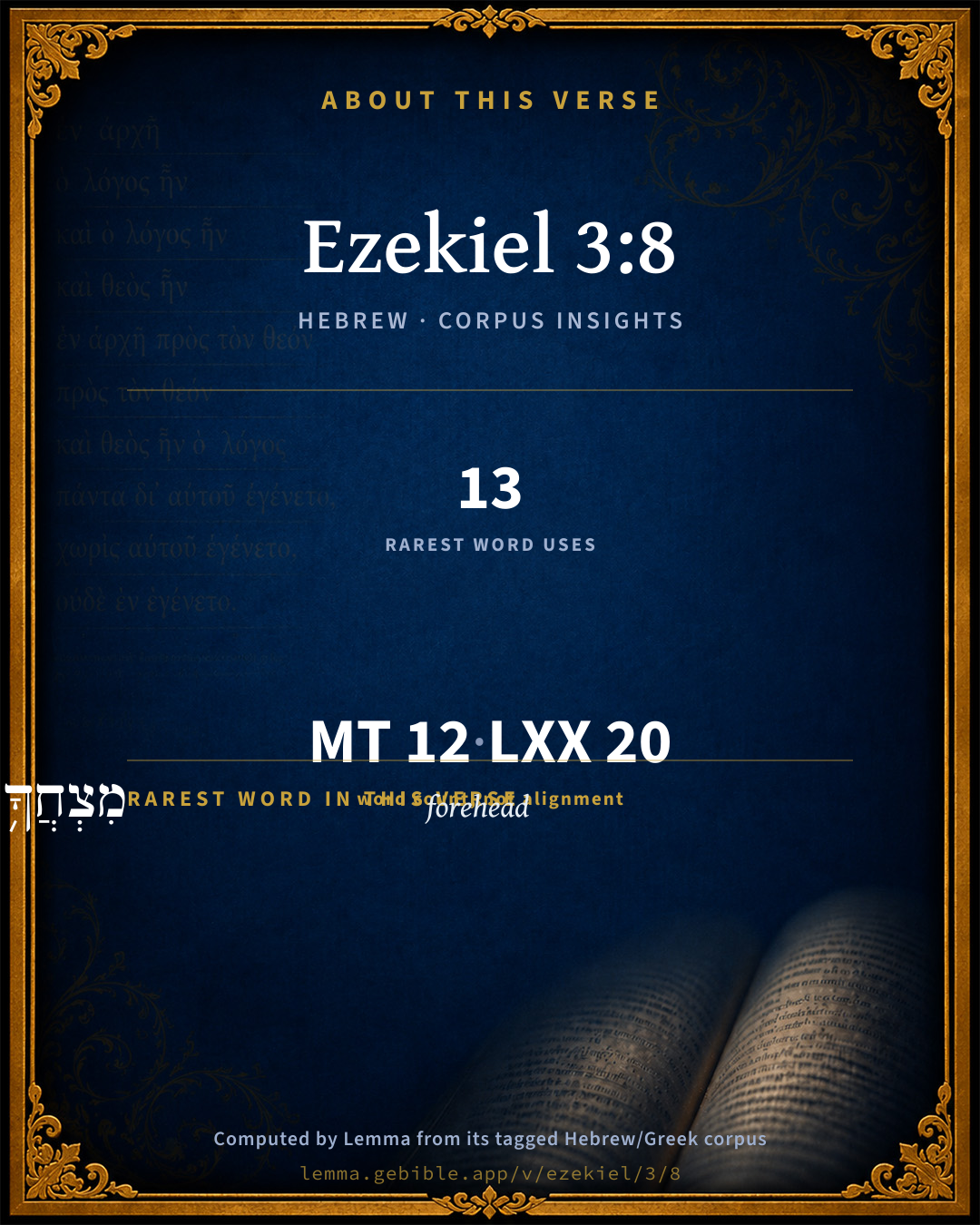
The rarest word here is מִצְחֲךָ֥ forehead H4696 — appearing just 13 times in the whole Hebrew Bible.

Shared distinctive vocabulary

מִצְחֲךָ֥ forehead H4696 occurs in 10 verses of the Hebrew Bible. Also found in:

Grammatical profile

  • 1 verb
  • 6 nouns
  • 2 adjectives
  • 3 particles

Verb forms

  • נָתַ֧תִּי Qal · Perfect

Repetition

Words recur within this verse — often emphatic in Hebrew:

  • פָּנֶ֛יךָ face H6440 ×2
  • חֲזָקִ֖ים strong H2389 ×2
  • לְעֻמַּ֣ת beside H5980 ×2
  • מִצְחֲךָ֥ forehead H4696 ×2

Hebrew & Septuagint length

In English translation the verse runs 17 words from the Hebrew and 20 from the Septuagint (LXX English) — closely comparable.

A rough comparison of the two English renderings, which tokenize alike — not a word-level alignment.

Word counts can differ between the Hebrew and the Greek without any difference in meaning — e.g. the Hebrew direct-object marker אֵת has no separate Greek word, and Greek often adds the article ὁ.

In the original languages it is 12 Hebrew tokens and 20 Greek tokens — but the two are counted differently (Hebrew bundles its prefixes and suffixes into one token; the Greek is in lemma form), so that isn’t a like-for-like length.

Cross-references

10

Topical passages linked to Ezekiel 3:8 in the Treasury of Scripture Knowledge — connected by theme and wording, ordered by reader-vote popularity; previews shown in the World English Bible.

  • Jeremiah 1:18 For, behold, I have made you this day a fortified city, and an iron pillar, and brazen walls, against the whole land, against the kings of Judah, against the princes of it, against the priests of it, and against the people of the land.
  • Acts 7:51–56 "You stiff-necked and uncircumcised in heart and ears, you always resist the Holy Spirit! As your fathers did, so you do.
  • Exodus 4:15–16 You shall speak to him, and put the words in his mouth. I will be with your mouth, and with his mouth, and will teach you what you shall do.
  • Exodus 11:4–8 Moses said, "This is what Yahweh says: 'About midnight I will go out into the midst of Egypt,
  • 1 Kings 21:20 Ahab said to Elijah, Have you found me, my enemy? He answered, I have found you, because you have sold yourself to do that which is evil in the sight of Yahweh.
  • Isaiah 50:7 For the Lord Yahweh will help me; therefore I have not been confounded: therefore have I set my face like a flint, and I know that I shall not be disappointed.
  • Micah 3:8 But as for me, I am full of power by the Spirit of Yahweh, And of judgment, and of might, To declare to Jacob his disobedience, And to Israel his sin.
  • Hebrews 11:27 By faith, he left Egypt, not fearing the wrath of the king; for he endured, as seeing him who is invisible.
  • Hebrews 11:32–37 What more shall I say? For the time would fail me if I told of Gideon, Barak, Samson, Jephthah, David, Samuel, and the prophets;
  • Jeremiah 15:20 I will make you to this people a fortified brazen wall; and they shall fight against you, but they shall not prevail against you; for I am with you to save you and to deliver you, says Yahweh.

Cross-references courtesy of OpenBible.info (CC BY 4.0).

Hebrew and Greek witnesses Masoretic Hebrew ↔ Greek Septuagint

The same verse in the two great witnesses to the Old Testament, shown verse-for-verse.

These are two independent witnesses, not word-aligned to each other, and the Septuagint is shown in lemma (dictionary) form.

Hebrew Ezekiel 3:8 Masoretic · Westminster Leningrad Codex

הִנֵּ֨ה נָתַ֧תִּי אֶת פָּנֶ֛יךָ חֲזָקִ֖ים לְעֻמַּ֣ת פְּנֵיהֶ֑ם וְאֶֽת מִצְחֲךָ֥ חָזָ֖ק לְעֻמַּ֥ת מִצְחָֽם

Behold, I have made your face hard against their faces, and your forehead hard against their foreheads.

World English Bible · Public Domain

Greek LXX Ezekiel 3:8 Septuagint · lemma form

καί ἰδού δίδωμι ὁ πρόσωπον σύ δυνατός κατέναντι ὁ πρόσωπον αὐτός καί ὁ νεῖκος σύ καταἰσχύω κατέναντι ὁ νεῖκος αὐτός

And, behold, I have made your face strong against their faces, and I will strengthen your power against their power.

LXX2012 (modern English Septuagint) · Public Domain

Hebrew: Westminster Leningrad Codex (CC BY 4.0). Greek: Septuagint (public domain); English from LXX2012 (modern English Septuagint) (Public Domain). How the Septuagint differs from the Hebrew →

Targum (Aramaic paraphrase)

1

The Targum is the ancient Jewish Aramaic paraphrase of the Hebrew Scriptures — an interpretive translation, not the Hebrew text itself. Onkelos (literal) and Pseudo-Jonathan (expansive) render the Torah, and Jonathan the Prophets. Coverage is partial: where no permissively-licensed English translation exists for a verse, only the Aramaic is shown. This is verse-level text, not a word-by-word alignment to the Hebrew.

  1. Targum Jonathan Prophets (Joshua–Malachi)
    הָא יַהֲבֵית יַת אַפָּךְ תַּקִיף כִּקְבֵּיל בֵּית אַפֵּיהוֹן וְיַת בֵּית עֵינָךְ חֲסִין כִּקְבֵיל בֵּית עֵינֵיהוֹן:

    (no public-domain English translation for this verse)

    Targum Jonathan — Aramaic: “Mikraot Gedolot” (public domain). English: “Sefaria Community Translation” (CC0 1.0 (public-domain dedication)); “London "Chaldee Paraphrase," 1871” (public domain). Text via Sefaria.

Commentary

Notes on Ezekiel 3:8 from classic Christian and Jewish commentators (each source and its license shown beneath its notes). The classic Christian expositions comment on the surrounding passage and are grouped to its opening verse, so a note may address several verses; the Jewish commentaries on the Tanakh (Rashi and others) are per-verse, so they appear only where the commentator wrote on this verse.

Lemma curates 59 commentaries, every one of them public domain or Creative Commons licensed, each selected and text-cleaned for this edition rather than reprinted as found. About our sources →

Geneva Bible (1599)

Geneva Bible translators

God promiseth his assistance to his ministers, and that he will give them boldness and constancy in their vocation, Isa. 50:7; Jer. 1:18; Mic. 3:8.

Geneva Bible (1599) marginal notes — public domain. Text via Bolls.life.

Trapp's Complete Commentary

John Trapp

Eze 3:8 Behold, I have made thy face strong against their faces, and thy forehead strong against their foreheads.

Ver. 8. Behold, I have made thy face strong against their faces.] I have steeled thy forehead and strengthened thine heart, that thou shalt budge for none of them. I have rendered thee insuperable.

John Trapp, A Commentary or Exposition upon All the Books of the Old and New Testament (1647–1656) — public domain. Text from a community e-Sword module.

Matthew Poole's English Annotations

This may be to remove the objection of the prophet, who might plead the softness of his own metal, and pretend shameless sinners will scoff a young prophet out of countenance. Behold, says God, consider.

I have made; given. They have given themselves this impudent countenance; I have given thee true courage, constancy, and manly carriage.

Thy forehead strong; the same answer in words very little varying. God will qualify and gift him for this work among this people, and edge his own tools to cut into the hardest metal. So Isa 1:7; Jer 1:18; Mic 3:8.

Matthew Poole's English Annotations on the Holy Bible (1683–1685) — public domain. Text from a community e-Sword/MySword module.

Tyndale Open Study Notes

Tyndale Open Resources

3:8-9 God would make Ezekiel as thoroughly persistent in presenting God’s message as the people were in rejecting it.

Tyndale Open Study Notes — © Tyndale Open Resources, licensed CC BY-SA 4.0. Text via the HelloAO Bible API.

Jamieson, Fausset & Brown

Robert Jamieson, A. R. Fausset & David Brown

Ezekiel means one "strengthened by God." Such he was in godly firmness, in spite of his people's opposition, according to the divine command to the priest tribe to which he belonged (Deu 33:9).

Jamieson, Fausset & Brown — Commentary Critical and Explanatory on the Whole Bible (1871) — public domain (CC PDM 1.0). Text via the HelloAO Bible API.

John Calvin's Commentaries

Ezekiel was forewarned of the obstinacy of the people, yea, even of their desperate wickedness. Now God strengthens him lest he should despair when he saw that he must contend with such abandoned and reckless men; for what else was it than contending with stones? If Ezekiel had been commanded to strike a mountain, it would have been just the same as contending with such a people. He had need then of this strengthening, viz., his forehead should be adamant against the hardness of the people If he had hoped for more fruit from his labor, perhaps that facility had been the cause of negligence: for confidence makes us more remiss when the work in hand is neither laborious nor difficult. The Prophet, therefore, would have been colder, if, certainly persuaded that the people would be docile, he had approached them more carelessly. God, therefore, excites him when he speaks of their obstinacy. As then it was useful that the Prophet should comprehend how arduous was the duty to the discharge of which he was called, so also he ought to be armed with the strength of God, for otherwise he would have been easily overcome by its difficulty. This is the reason why God adds, that he had given him a stout front and a brazen aspect against the face and front of the people Besides, in this way he was admonished that fortitude was to be hoped for from some other quarter, that he might not spend his strength in vain, but allow himself to be governed by the Spirit of God. For when we think only on the quality and quantity of our own powers, they may easily flow away, and disperse, and even become vapid, unless we discharge our duty with manliness. God, therefore, recalls his Prophet when he says, that he had given him a face, as if he would say, that the Prophet did not make war in his own strength, but was armed with celestial virtue. Although, therefore, this seems to have been spoken once for Ezekiel’s private use, yet it belongs to us all. Let us learn, then, when God calls us to the office of teaching, never to measure the effect of our work by the standard of our own capacity, nor yet to consider our own powers, but to repose on some communicated strength which God here extols in no empty praises. Whoever, therefore, shall acknowledge that God is sufficient for overcoming all obstacles, will gird himself bravely for his work; but he who delays for calculating his own strength is not only weakened but is almost overcome. Besides, we see that we are here instructed in humility and modesty, lest we should claim anything as due to our own strength. Hence it happens, that many are so full, yea so puffed out with confidence, that they bring forth nothing but wind. Hence, let us learn to seek from God alone that fortitude which we need: for we are not stronger than Ezekiel, and if he needed to be strengthened by the Spirit of God, much more do we at this time need it.

John Calvin's Commentaries (1540-1563) — public domain. Text from the Calvin Translation Society English edition (1840s-50s) via the Christian Classics Ethereal Library (ccel.org). Calvin's coverage is partial (roughly two-thirds of the Bible); uncommented books and verses are honest gaps, never fabricated. The 19th-century editor's footnotes and remarks are omitted so the notes are faithfully Calvin's own voice.

Ellicott's Commentary for English Readers

(8) Thy face strong against their faces.—The word strong is the same here as that rendered impudent (marg. stiff) in Eze_3:7. Of course it must have a different shade of meaning in its application to the rebellious people and to the prophet; but the main thought is taken from the figure of horned animals in their contests, and God promises Ezekiel to make him in the struggle stronger than those who oppose him. The same thing is expressed by another figure in Eze_3:9.

A Bible Commentary for English Readers, edited by Charles John Ellicott (1878–1897) — public domain. Text from a community e-Sword module.

John Gill's Exposition

Behold, I have made the, face strong against their faces,.... Not that the prophet should have the same sort of impudence and confidence they had; but that God would "give" (n) him such a face, as it is in the Hebrew text, such spirit and courage, that he should neither be ashamed of the words of the Lord, nor afraid to speak them to this people; so that he should be a match for them; they should not be able to outface him, or look him out of countenance; he should behave with an undaunted spirit, and with great intrepidity, amidst all opposition made to him: the Lord fits his ministers for the people he sends them to, and gives them courage and strength proportionate to the opposition they meet with; as their day is, their strength is; and all that invincible courage, boldness, and strength, with which they are endowed, it is all from the Lord, and a gift of his:

and thy forehead strong against their foreheads; which is the same thing in different words.

(n) "dedi faciem tuam", V. L. Vatablus, Cocceius, Starckius.

John Gill's Exposition of the Whole Bible (1746–1763) — public domain (CC PDM 1.0). Text via the HelloAO Bible API.

Albert Barnes' Notes on the Bible

I have made ... thy forehead strong - I have given thee a strength superior to theirs; a metaphor taken from horned animals.

Albert Barnes' Notes on the Bible (1834–1885) — public domain. Text from a community e-Sword/MySword module.

Haydock's Catholic Bible Commentary

Harder. If they will not blush, thou shalt not be ashamed to lay their disorders before their eyes, though they be such as ought not to be mentioned, as becomes saints. (Haydock) See chap. xvi., and xxii. (Calmet)

George Leo Haydock (1774–1849), Haydock's Catholic Family Bible and Commentary, 1859 edition — public domain. Excludes Psalms (Douay-Rheims chapter numbering differs from Protestant) and Deuterocanonical books (Catholic canon only).

Whedon's Commentary on the Bible

Daniel D. Whedon

8, 9. Jehovah declares that though the people to whom he will speak “are stiff-faced” and “hard of heart,” he himself will make the prophet as strong and persistent as they, with a forehead hard as adamant, or “diamond” (Kautzsch; see also Jer_17:1). He need not fear them nor their looks, “for they are a rebellious house.” Loyalty is stronger than rebellion, and righteousness may well be braver than sin. (Compare Isa_50:7.)

Daniel D. Whedon (gen. ed.), Commentary on the Old and New Testaments (1874–1909) — public domain. Text from a community e-Sword module.

The Pulpit Commentary

I have made thy face strong; literally, as in the Revised Version, hard. Ezekiel"s name was at once nomen et omen. Hard as Israel might be, he could be made harder, i.e. stronger, than they, end should prevail against them. (compare the parallels of Isa_1:7; Jer_1:18 Jer_15:20) The boldness of God"s prophets is a strictly supernatural gift. Whatever persistency there may be in evil, they will be able to meet it, perhaps to overcome it, by a greater persistency in good.

Vers. 8, 9. The fearlessness of the Lord"s messenger.

After hearing that Israel would give no heed to his prophetic messages, the Prophet Ezekiel must have needed strong encouraging. It is always depressing to engage in a hopeless undertaking. Yet there was a moral necessity for the mission to be fulfilled. And the Lord strengthened and fortified his servant for his painful duty by breathing into him a Divine courage, and by bidding him dismiss all fear. Although Ezekiel"s position was very special, every servant and herald commissioned by the Most High to witness on his behalf to his fellow men has frequent need of such encouragement as that imparted to the prophet of the Captivity.

I THE OUTWARD OCCASIONS OF FEAR. There are many circumstances which are likely to arouse the apprehensions, and so to depress the energies, of God"s messengers to Their fellow men.

1. Want of sympathy with his message on the part of those towhom he is sent.

2. An attitude of deliberate indifference and unbelief.

3. Determined resistance and resentment.

4. Threats of personal violence.

The former occasions of fear are such as every minister of religion must expect to encounter. But the Hebrew prophets sometimes met with actual ill treatment blows, bonds, and death. So it was with the apostles of our Lord, and so it has been with missionaries of the cross, who have fulfilled their ministry among the unenlightened, prejudiced, and hostile heathen. Many have "resisted unto blood, striving against sin.

II THE INWARD INCLINATION TO FEAR. There is great difference in the matter of constitutional temperament; some men are naturally timid, and prone to be overawed by opposition and intimidation, whilst others have a certain delight in antagonism, and care not what odds are against them in the conflict.

1. Sometimes the messenger of God is too prone to regard his own peaceand comfort, and is averse to any step which may bring him into collision with others.

2. The feeling on the part of God"s servant, that he is but one againstmany, inclines him to retirement and reticence.

3. And this is increased when there is no countenance or support fromcolleagues in labour and warfare. The consciousness of personal feebleness and insufficiency, combined with the feeling of isolation, may naturally account for the prevalence of fear in the presence of difficulty, opposition, and hostility. He who made man, and who is perfectly acquainted with human nature, is aware that his servants are subject to such infirmities, and that they need accordingly a special provision of Divine grace to fortify them against the spiritual danger to which they are exposed.

III THE DIVINE PRESERVATIVE FROM FEAR.

1. The consciousness of a message from God to be delivered, whether manwill hear or forbear, is fitted to take away all dread of men"s displeasure, as well as all undue desire for men"s favour.

2. The assurance that Divine authority accompanies the Lord"s servant is initself sufficient to make his face and his forehead hard as adamant in.the presence of opponents whose only authority lies in force or in the conventional greatness attaching to earthly rank or station.

3. To this is added the express promise of God"s aid. The opponents maybe mighty; but the soldier of truth and of righteousness has the assurance that he who is with him is mightier still. "Fear not," says the Almighty, "for I am with you. T.

The Pulpit Commentary (1880–1919), ed. H.D.M. Spence-Jones & Joseph S. Exell — public domain. Text from a community e-Sword module.

John Wesley's Explanatory Notes

I have - I have given thee, constancy, and manly carriage. The more impudent wicked people are in their opposition to religion, the more openly and resolutely should God's people appear in the practice and defense of it.

John Wesley, Explanatory Notes Upon the Whole Bible (1754–1765) — public domain. Text via the GEBible commentary corpus.

unfoldingWord translationNotes

Door43 World Missions Community

General Information:

The Spirit of God continues speaking to Ezekiel.

Behold!

The word "Behold" here alerts Ezekiel to pay attention to the surprising information that follows.

I have made your face as stubborn as their faces

The words "face" and "faces" are used to stand for the people the sentence is about. AT: "I have made you as stubborn as they are" (See: Synecdoche)

I have made ... your brow as hard as their brows

The "brow" is the forehead or eyebrow and is a metonym for what the person thinks. AT: "I have made ... you strong so you will not stop doing what you are doing" (See: Metonymy)

I have made your brow like a diamond, harder than flint

"I have made your brow like the hardest stone, harder than flint"

flint

a stone that is hard enough to start a fire by hitting it with metal or another stone

house

This is a metonym for the family that lives in the house, in this case the Israelites, the descendants of Jacob over many years. See how you translated this in Ezekiel 2:5. AT: "people group" (See: Metonymy)

translationWords

face

fear

rebel

unfoldingWord translationNotes — © Distant Shores Media and the Door43 World Missions Community, licensed CC BY-SA 4.0. Source: git.door43.org/Door43/en_tn.

Lesson kit

Teaching starters — assembled from the data on this page, not authored interpretation. Every prompt links to the verse data it draws on. Edit before teaching.

Ezekiel, in the Prophets, opens this verse with 12 words (7 distinct Hebrew lemmas). Its most distinctive word is mêtsach (“forehead”). A historical commentator’s framing appears above. Read the whole chapter for the surrounding context.

Discussion questions

  1. How does “forehead” (mêtsach) shape what this verse is saying?
  2. Exodus 28:38 shares the word «forehead» with this verse. How do the two illuminate each other?
  3. “face” occurs 2× in this one verse. What is the effect of the repetition?
  4. The translations on this page render this verse differently — a whole-verse word diff, not a word-by-word alignment. What might account for the different wordings?
  5. The verb «נָתַ֧תִּי» is Qal Perfect. How does its form color the action?
  6. Reading how Geneva Bible (1599) and Trapp's Complete Commentary read this verse, where do the two commentators agree and where do they part?

Things to notice

Reading settings

Reading text

Shown beneath each verse's original-language words.

Old Testament
Old Testament edition

Read the OT as the Masoretic Hebrew (MT) or the Greek Septuagint (LXX).

English shown for the Greek Septuagint (in the Hebrew ↔ Greek comparison).

Comparing translations? Open the Compare panel on any verse page to stack up to four side by side.