Ezekiel 3:9

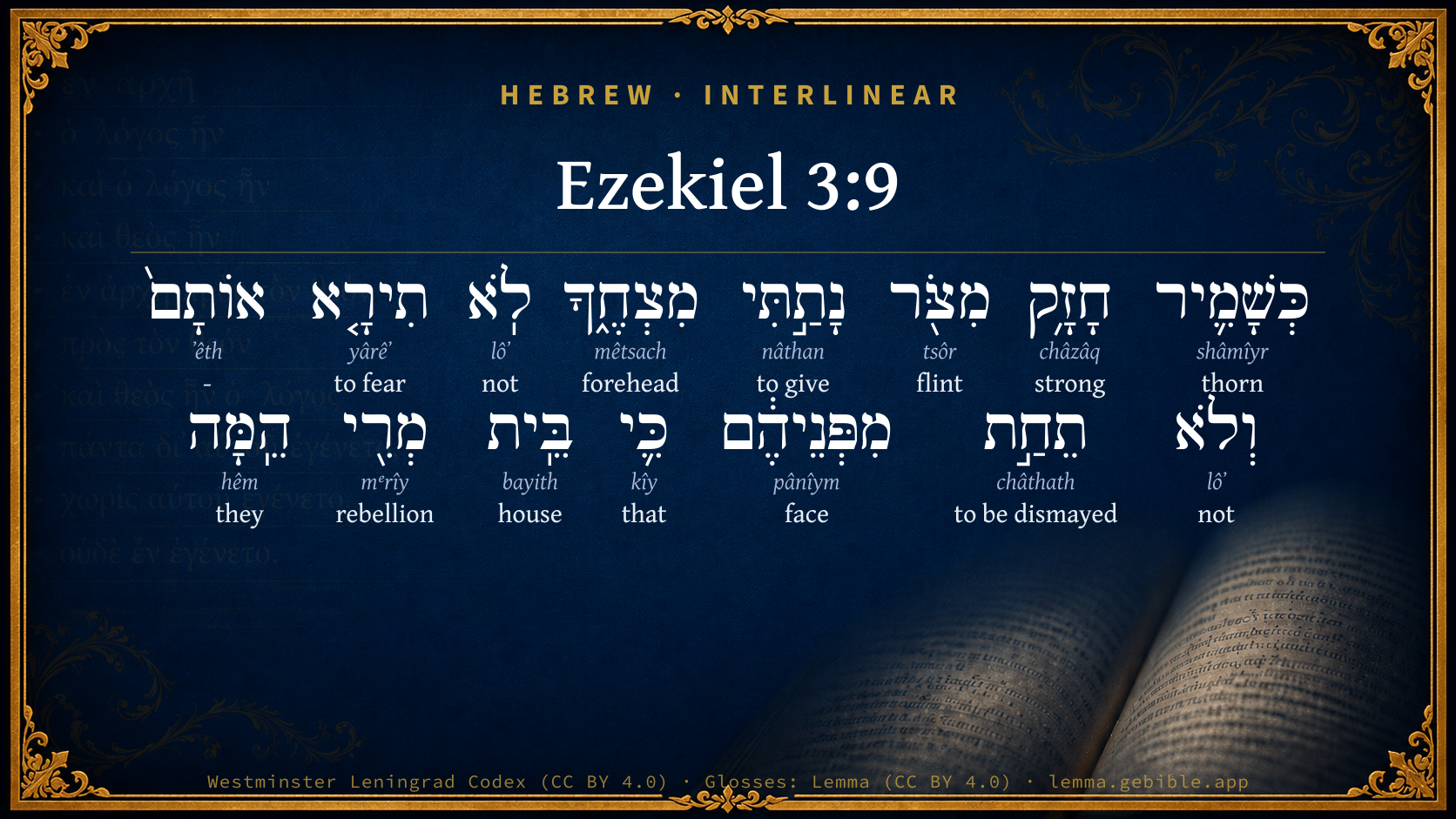
Hebrew (Westminster Leningrad Codex) Ezekiel 3:9 appears in the Hebrew Old Testament. The text above is from the Westminster Leningrad Codex. Each word links to its Strong’s number, a concise gloss, and parsing drawn from the Open Scriptures Hebrew Bible morphology. Click any word for its full Brown-Driver-Briggs (BDB) entry.
Download image
Cite this verse

Ezekiel 3:9 (World English Bible). Public Domain. Lemma interlinear Bible study tool, https://lemma.gebible.app/v/ezekiel/3/9.

Show BibTeX & RIS
BibTeX
RIS
English Translation
As an adamant harder than flint have I made your forehead: don't be afraid of them, neither be dismayed at their looks, though they are a rebellious house.
World English Bible · Public Domain
Download a study sheet

One document with this verse’s original text, its word-by-word gloss line, the meaning frame, cross-references with their text, attributed commentary, and full source and license credits — printable, and it pastes into notes with its structure intact.

This verse Autodidact and up

Study sheet (.html) Plain text (.txt)

A passage Seminary Student

Up to 50 verses in one chapter. A passage sheet keeps up to 6 commentary sources and 12 cross-references per verse, in the order this page ranks them, and says so on the sheet whenever that leaves anything out. Ask for a single verse and you get the Autodidact verse sheet above.

Everything on this page stays free to read, with no account — the sheet is a download of what is already on screen, not access to it.

Want to remove ads? Support Godless Engineer
Compare translations 3

The same verse in 3 English versions, stacked beneath the original-language interlinear above. Click any original word for its lexicon entry.

Each is an independent rendering of the whole verse — the interlinear is not word-aligned to these translations.

Highlighted words mark where these versions differ — a whole-verse word diff, not a word-by-word alignment.

  • World English Bible Public Domain
    As an adamant harder than flint have I made your forehead: don't be afraid of them, neither be dismayed at their looks, though they are a rebellious house.
  • King James Version Public Domain
    As an adamant harder than flint have I made thy forehead: fear them not, neither be dismayed at their looks, though they be a rebellious house.
  • unfoldingWord Literal Text CC BY-SA 4.0
    I have made your brow like a diamond, harder than flint! Do not fear them or be discouraged by their faces, since they are a rebellious house.”

unfoldingWord Literal Text — © unfoldingWord, licensed CC BY-SA 4.0. Word-aligned USFM3 via Door43 (git.door43.org/unfoldingWord/en_ult).

Versions to compare (up to 4)

3 of 4 selected

Show all 18 translations

Every available English version of this verse, each an independent rendering of the whole verse.

  • World English Bible Public Domain
    As an adamant harder than flint have I made your forehead: don't be afraid of them, neither be dismayed at their looks, though they are a rebellious house.
  • Berean Standard Bible Public Domain
    I will make your forehead like a diamond, harder than flint. Do not be afraid of them or dismayed at their presence, even though they are a rebellious house.”
  • Majority Standard Bible Public Domain
    I will make your forehead like a diamond, harder than flint. Do not be afraid of them or dismayed at their presence, even though they are a rebellious house.”
  • King James Version Public Domain
    As an adamant harder than flint have I made thy forehead: fear them not, neither be dismayed at their looks, though they be a rebellious house.
  • American Standard Version (1901) Public Domain
    As an adamant harder than flint have I made thy forehead: fear them not, neither be dismayed at their looks, though they are a rebellious house.
  • Revised Version (1885) Public Domain
    As an adamant harder than flint have I made thy forehead: fear them not, neither be dismayed at their looks, though they be a rebellious house.
  • Geneva Bible (1599) Public Domain
    I haue made thy forehead as the adamant, and harder then the flint: feare them not therefore, neither be afraid at their lookes: for they are a rebellious house.
  • Douay-Rheims (1899) Public Domain
    I have made thy face like an adamant and like flint: fear them not, neither be thou dismayed at their presence: for they are a provoking house.
  • Young's Literal Translation Public Domain
    As an adamant harder than a rock I have made thy forehead; thou dost not fear them, nor art thou affrighted before them, for a rebellious house `are' they.'
  • Literal Standard Version CC BY-SA 4.0
    As an adamant, harder than a rock, I have made your forehead; do not fear them, nor are you frightened before them, for they [are] a house of rebellion.”
  • Unlocked Literal Bible CC BY-SA 4.0
    I have made your brow like a diamond, harder than flint! Do not fear them or be discouraged by their faces, since they are a rebellious house.”
  • unfoldingWord Literal Text CC BY-SA 4.0
    I have made your brow like a diamond, harder than flint! Do not fear them or be discouraged by their faces, since they are a rebellious house.”
  • Darby Bible Public Domain
    As an adamant harder than flint have I made thy forehead. Fear them not, neither be dismayed at them, for they are a rebellious house.
  • World Messianic Bible Public Domain
    I have made your forehead as a diamond, harder than flint. Don’t be afraid of them, neither be dismayed at their looks, though they are a rebellious house.”
  • Webster's Bible Public Domain
    As an adamant harder than flint have I made thy forehead: fear them not, neither be dismayed at their looks, though they are a rebellious house.
  • Free Bible Version CC BY-SA 4.0
    I will make your mind like adamant, harder than flint. Don't be afraid of what they say or discouraged by the way they look at you, even though they are a rebellious people.”
  • Bible in Basic English Public Domain
    Like a diamond harder than rock I have made your brow: have no fear of them and do not be overcome by their looks, for they are an uncontrolled people.
  • JPS Tanakh (1917) Public Domain
    As an adamant harder than flint have I made thy forehead; fear them not, neither be dismayed at their looks, for they are a rebellious house.'

Literal Standard Version (2020), Covenant Press — licensed CC BY-SA 4.0. Text via the HelloAO Bible API (eBible.org). Unlocked Literal Bible (unfoldingWord) — licensed CC BY-SA 4.0. Text via the HelloAO Bible API (eBible.org). unfoldingWord Literal Text — © unfoldingWord, licensed CC BY-SA 4.0. Word-aligned USFM3 via Door43 (git.door43.org/unfoldingWord/en_ult). Free Bible Version, Dr. Jonathan Gallagher — licensed CC BY-SA 4.0. Text via the HelloAO Bible API (eBible.org).

Word by word

More ways to search: Search by grammar → Find every occurrence → Compare this word →

Practice this passage: Drill this verse → Learn its vocabulary →

מִצֹּ֖ר
tsôr
H6864
“from · flint”
Preposition + Noun, Common, Masculine, Singular, Absolute
Part of Speech
Preposition + Noun
Type
Common
Gender
Masculine
Number
Singular
State
Absolute
Full BDB Definition

Origin: from H6696

TWOT: 1975b

flint, hard pebble - used as a knife
  1. כְּשָׁמִ֛יר shâmîyr H8068 “like/as · thorn” Preposition + Noun, Common, Masculine, Singular, Absolute
  2. חָזָ֥ק châzâq H2389 “strong” Adjective, Adjective, Masculine, Singular, Absolute
  3. נָתַ֣תִּי nâthan H5414 “to give” Verb, Qal, Perfect, 1st Person, Common, Singular
  4. מִצְחֶ֑ךָ mêtsach H4696 “forehead · your” Noun, Common, Masculine, Singular, Construct + Suffix, Personal, 2nd Person, Masculine, Singular
  5. לֹֽא lôʼ H3808 “not” Particle, Negative
  6. תִירָ֤א yârêʼ H3372 “to fear” Verb, Qal, Imperfect, 2nd Person, Masculine, Singular
  7. אוֹתָם֙ ʼêth H853 “- · them” Particle, Direct Object + Suffix, Personal, 3rd Person, Masculine, Plural
  8. וְלֹא lôʼ H3808 “and · not” Conjunction + Particle, Negative
  9. תֵחַ֣ת châthath H2865 “to be dismayed” Verb, Niphal, Imperfect, 2nd Person, Masculine, Singular
  10. מִפְּנֵיהֶ֔ם pânîym H6440 “from · face(s) · their” Preposition + Noun, Common, Both, Plural, Construct + Suffix, Personal, 3rd Person, Masculine, Plural
  11. כִּ֛י kîy H3588 “that” Conjunction
  12. בֵּֽית bayith H1004 “house of” Noun, Common, Masculine, Singular, Construct
  13. מְרִ֖י mᵉrîy H4805 “rebellion” Noun, Common, Masculine, Singular, Absolute
  14. הֵֽמָּה hêm H1992 “they” Pronoun, Personal, 3rd Person, Masculine, Plural

About this verse

These counts appear in no published source. They are computed here, from the morphology-tagged text and Lemma’s own curated glosses. What Lemma adds →

15
words
14
distinct lemmas
Prophets
section

Notable vocabulary

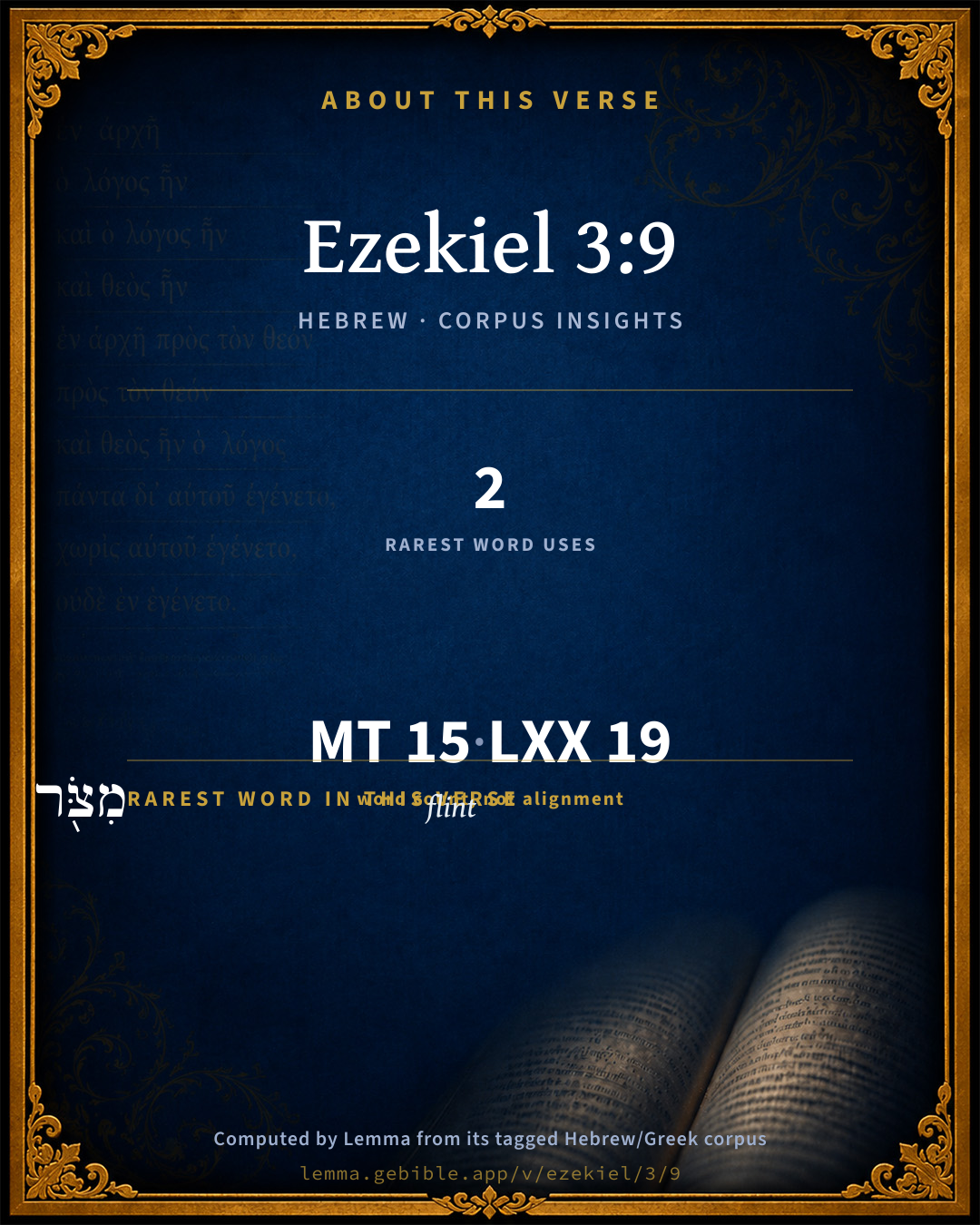
The rarest word here is מִצֹּ֖ר flint H6864 — appearing just 2 times in the whole Hebrew Bible.

Shared distinctive vocabulary

מִצֹּ֖ר flint H6864 occurs in 2 verses of the Hebrew Bible. Also found in:

Grammatical profile

  • 3 verbs
  • 6 nouns
  • 1 adjective
  • 1 pronoun
  • 1 conjunction
  • 3 particles

Verb forms

  • נָתַ֣תִּי Qal · Perfect
  • תִירָ֤א Qal · Imperfect
  • תֵחַ֣ת Niphal · Imperfect

Repetition

A word recurs within this verse — often emphatic in Hebrew:

Hebrew & Septuagint length

In English translation the verse runs 28 words from the Hebrew and 26 from the Septuagint (LXX English) — closely comparable.

A rough comparison of the two English renderings, which tokenize alike — not a word-level alignment.

Word counts can differ between the Hebrew and the Greek without any difference in meaning — e.g. the Hebrew direct-object marker אֵת has no separate Greek word, and Greek often adds the article ὁ.

In the original languages it is 15 Hebrew tokens and 19 Greek tokens — but the two are counted differently (Hebrew bundles its prefixes and suffixes into one token; the Greek is in lemma form), so that isn’t a like-for-like length.

Cross-references

11

Topical passages linked to Ezekiel 3:9 in the Treasury of Scripture Knowledge — connected by theme and wording, ordered by reader-vote popularity; previews shown in the World English Bible.

  • Ezekiel 2:6 You, son of man, don't be afraid of them, neither be afraid of their words, though briers and thorns are with you, and you do dwell among scorpions: don't be afraid of their words, nor be dismayed at their looks, though they are a rebellious house.
  • Jeremiah 1:8 Don't be afraid because of them; for I am with you to deliver you, says Yahweh.
  • Isaiah 41:10 Don't you be afraid, for I am with you; don't be dismayed, for I am your God; I will strengthen you; yes, I will help you; yes, I will uphold you with the right hand of my righteousness.
  • Isaiah 50:7 For the Lord Yahweh will help me; therefore I have not been confounded: therefore have I set my face like a flint, and I know that I shall not be disappointed.
  • Zechariah 7:12 Yes, they made their hearts as hard as flint, lest they might hear the law, and the words which Yahweh of Hosts had sent by his Spirit by the former prophets. Therefore great wrath came from Yahweh of Hosts.
  • Isaiah 41:14 Don't be afraid, you worm Jacob, and you men of Israel; I will help you, says Yahweh, and your Redeemer is the Holy One of Israel.
  • Jeremiah 17:18 Let them be disappointed who persecute me, but let not me be disappointed; let them be dismayed, but don't let me be dismayed; bring on them the day of evil, and destroy them with double destruction.
  • Micah 3:8 But as for me, I am full of power by the Spirit of Yahweh, And of judgment, and of might, To declare to Jacob his disobedience, And to Israel his sin.
  • 1 Timothy 2:3 For this is good and acceptable in the sight of God our Savior;
  • Jeremiah 1:17 You therefore gird up your loins, and arise, and speak to them all that I command you: don't be dismayed at them, lest I dismay you before them.
  • 2 Timothy 2:6 The farmers who labor must be the first to get a share of the crops.

Cross-references courtesy of OpenBible.info (CC BY 4.0).

Hebrew and Greek witnesses Masoretic Hebrew ↔ Greek Septuagint

The same verse in the two great witnesses to the Old Testament, shown verse-for-verse.

These are two independent witnesses, not word-aligned to each other, and the Septuagint is shown in lemma (dictionary) form.

Hebrew Ezekiel 3:9 Masoretic · Westminster Leningrad Codex

כְּשָׁמִ֛יר חָזָ֥ק מִצֹּ֖ר נָתַ֣תִּי מִצְחֶ֑ךָ לֹֽא תִירָ֤א אוֹתָם֙ וְלֹא תֵחַ֣ת מִפְּנֵיהֶ֔ם כִּ֛י בֵּֽית מְרִ֖י הֵֽמָּה

As an adamant harder than flint have I made your forehead: don't be afraid of them, neither be dismayed at their looks, though they are a rebellious house.

World English Bible · Public Domain

Greek LXX Ezekiel 3:9 Septuagint · lemma form

καί εἰμί διά πᾶς κραταιός πέτρα μή φοβέω ἀπό αὐτός μηδέ πτοέω ἀπό πρόσωπον αὐτός διότι οἶκος παραπικραίνω εἰμί

And it shall be continually stronger than a rock: be not afraid of them, neither be dismayed at their faces, because it is a provoking house.

LXX2012 (modern English Septuagint) · Public Domain

Hebrew: Westminster Leningrad Codex (CC BY 4.0). Greek: Septuagint (public domain); English from LXX2012 (modern English Septuagint) (Public Domain). How the Septuagint differs from the Hebrew →

Targum (Aramaic paraphrase)

1

The Targum is the ancient Jewish Aramaic paraphrase of the Hebrew Scriptures — an interpretive translation, not the Hebrew text itself. Onkelos (literal) and Pseudo-Jonathan (expansive) render the Torah, and Jonathan the Prophets. Coverage is partial: where no permissively-licensed English translation exists for a verse, only the Aramaic is shown. This is verse-level text, not a word-by-word alignment to the Hebrew.

  1. Targum Jonathan Prophets (Joshua–Malachi)
    כְּמָא דְשָׁמִירָא תַּקִיף מִטִינָרָא כֵּן יַהֲבֵית יַת בֵּית עֵינָךְ חֲסִין כִּקְבֵיל בֵּית אַפֵּיהוֹן לָא תִדְחַל מִנְהוֹן וְלָא תִתְבַּר מִן קָדָמֵיהוֹן אֲרֵי עַם סַרְבָן אִינוּן:

    (no public-domain English translation for this verse)

    Targum Jonathan — Aramaic: “Mikraot Gedolot” (public domain). English: “Sefaria Community Translation” (CC0 1.0 (public-domain dedication)); “London "Chaldee Paraphrase," 1871” (public domain). Text via Sefaria.

Commentary

Notes on Ezekiel 3:9 from classic Christian and Jewish commentators (each source and its license shown beneath its notes). The classic Christian expositions comment on the surrounding passage and are grouped to its opening verse, so a note may address several verses; the Jewish commentaries on the Tanakh (Rashi and others) are per-verse, so they appear only where the commentator wrote on this verse.

Lemma curates 59 commentaries, every one of them public domain or Creative Commons licensed, each selected and text-cleaned for this edition rather than reprinted as found. About our sources →

Trapp's Complete Commentary

John Trapp

Eze 3:9 As an adamant harder than flint have I made thy forehead: fear them not, neither be dismayed at their looks, though they [be] a rebellious house.

Ver. 9. As an adamant, harder than flint.] Heb., Strong above a rock. Instar rupis quae in mari vadoso horridi Iovis, et irati, ut ita dicam, Neptuni fervidis assultibus undique verberata, non cedit, aut minuitur; sed obtendit assuetum fluctibus latus, et firma duritis, tumentis undae impetum sustinet ac frangit. This {a} invincible courage and constance in God’s ministers the mad world calleth and counteth pride and pertinace; but these know not the power of the Spirit, nor the privy armour of proof that such have about their hearts. {b}

Fear them not, &c.] See Eze 2:6.

{a} John Wower, Polymath.

{b} Durus ut his animus solido ex adamante creatus. - Hesiod.

John Trapp, A Commentary or Exposition upon All the Books of the Old and New Testament (1647–1656) — public domain. Text from a community e-Sword module.

The Biblical Illustrator

Joseph S. Exell

Eze_3:9

As an adamant harder than flint have I made thy forehead.

The adamant

(Zec_7:12):--A great and good man who served and suffered for Christ in North Africa seventeen centuries ago won for himself a noble name by which he is still known, Origen the Adamantine. There isnt a boy nor, in her own quiet way, a girl who does not feel some glow of heart or flush of face at the magic of this name, the Unsubduable, the Invincible. But he was not the first who bore the name. It was given long before by God Himself to His captive prophet in Babylon, whose forehead, as he faced the people, whose hearts were cold and hard as stones, might well be firm as adamant, since, in his very name, Ezekiel, he carried the great power of God. Now, what is adamant? Look at a ladys finger ring, and find among the precious stones set in its golden circle one that is quite clear and lustrous, and that throws off from every facet whatever rays of light are falling upon it. We call this sparkling gem, as you know, a diamond. But that is just another form of the word adamant, which we owe to the old Greeks, who naturally called the precious stone which could not be broken, adamas or the unsubduable.

1. The diamond now flashing on your mothers finger was not always the hardest of stones. It was once a bit of soft, vegetable matter. For the diamond is not really different from the coal which makes our winter fires, and which, long, long ages ago, was a thick, steaming forest. Hence it is quite true that the sunbeams are driving our railway trains. And the exiles in Babylon, who had grown so adamantine in evil that the sword of the Spirit which is the Word of God made no more impression on their hearts than your penknife on the angles of a diamond, were once boys and girls playing in the streets of Jerusalem, singing the songs of Zion, and dreaming their day dreams of ministering to the Lord like Samuel, or fighting with Goliaths like David, or leading the dance of triumph like Miriam. This terrible process of heart petrifying, or turning to stone, comes about by the action of the wise and good, though solemn and awful, law of habit. The oftener, the easier. How woeful to reach at last the state when, as regards all that is highest and best, one is past feeling, as though the conscience had been burned with a hot iron, or the heart made as hard as an adamant stone! From which may the good Lord deliver us!

2. We may find a promise of better things even in Zechariahs awful image of disobedience. The exquisite diamonds, or carbon crystals, are combustible, and, if subjected to a sufficient degree of heat, will pass off in carbonic acid gas. Fine ladies need not be so proud of their diamonds, since they may all be dissipated by fire; and poorer folks need not so greatly covet their possession, since they are breathing out diamond essence with every exhalation! And if we were so foolishly greedy as to want our diamond breaths back again, they would poison us. However this may be, it is certain that hearts as hard as an adamant stone are every day being softened, melted, transformed, by the fire of Gods holy love, which saves the sinner by consuming his sins.

3. But the broken heart, though it may seem strange to say so, is the stoutest and bravest of hearts. The true hero has always a tender conscience. He who fears God has no other fear. If Christ is your Master, and you are learning in His school, you may well appropriate the sturdy words over the gate of Marischal College, Aberdeen: They say: what say they? let them say. God has His diamonds as well as the devil. Against the whole House of Disobedience stood up the son of Buzi, the prophet of the exile, in the strength of God. If the people were hard as flint in their own evil ways, he was firm as the adamant, which is harder than flint in the service of God. They did well to call Origen, the Adamantine, the Invincible, for when, at the age of sixteen, his father was thrown into prison for his confession of Christ, he wanted to go and suffer with him; and when it was shown him that this was not his duty, he wrote to his father not to falter in his faith for their sakes, for he would undertake the support of his mother and his six younger brothers. And nobly did he fulfil his promise, selling his books, working early and late as a teacher in Alexandria, and inspiring his pupils with such devotion that they called his college a school for martyrs. (A. N. Mackray, M. A.)

Weakness made strong

What is more unstable than water, yet, when frozen, what is more immovable? It becomes hard as a rock when God touches it. What He does in nature tie also does in grace. Peter was weak as water, but the Lord changed his nature as well as his name, and Simon, son of Jonas, became Peter, son of Jehovah. The Lord did the same for Ezekiel. Behold, I have made thy face strong against their faces, and thy forehead strong against their foreheads. As an adamant harder than flint have I made thy forehead: fear them not, neither be dismayed at their looks, though they be a rebellious house (Eze_3:9). The worlds hardening is death: Gods hardening is strength; the yielding became unyielding, and those rippled with every breath became immovable. Yes, it is wonderful what God can enable us to bear! (Footsteps of Truth.)

Hardened for endurance

Loose-braced, easy souls, that lie open to all the pleasurable influences of ordinary life, are no more fit for Gods weapons than a reed for a lance, or a bit of flexible lead for a spear point. The wood must be tough and compact, the metal hard and close-grained, out of which God makes His shafts. The brand that is to guide men through the darkness to their Fathers home must glow with a pallor of consuming flame that purges its whole substance into light. (A. Maclaren.)

The Biblical Illustrator, edited by Joseph S. Exell (c. 1880s–1900s) — public domain. Text from a community e-Sword module.

Jamieson, Fausset & Brown

Robert Jamieson, A. R. Fausset & David Brown

As . . . flint--so Messiah the antitype (Isa 50:7; compare Jer 1:8, Jer 1:17).

Jamieson, Fausset & Brown — Commentary Critical and Explanatory on the Whole Bible (1871) — public domain (CC PDM 1.0). Text via the HelloAO Bible API.

John Calvin's Commentaries

Lastly, we gather from this passage that although the whole world should rise up against the servants of God, yet his strength would be superior, as we saw it was with Jeremiah: They shall fight against thee, but they shall not prevail. (Jeremiah 1:19; Jeremiah 15:20.) Hence there is no reason why we should be afraid of the violent attack of any enemy, and although the whole world should be in a tumult, yet we need not tremble, because God’s strength in us will always be more powerful. Therefore it is added, as an adamant, harder than flint, have I placed thee; therefore do not fear them. God says I have placed the forehead of the Prophet like adamant; not that he strove with the people by either injustice or audacity, but because God opposed the confidence with which Ezekiel was endowed to the furious impudence of the people. In this sense then the forehead of the Prophet is said to be adamant Now he adds — do not fear, then, and do not be broken by their face or presence These phrases, that the Prophet be not broken, and yet fear not, seem to be opposed to each other, since he excels in unconquered fortitude. But God so tempers his favor, that the faithful always have need of excitements, even when he animates them, and supplies them with strength. God, therefore, so works within his servants, that they do nothing except as they are ruled by his Spirit; and yet they have need of his teaching, since his exhortations to them are never superfluous. Profane men think that there is no use in teaching, and that all exhortations are frivolous, if God, when he acts upon us by his Spirit, not only begins, but continues and perfects his own work. But the Scripture shows that these two things mutually agree; for while God strengthens us and renders us unconquerable by his Spirit, at the same time he breathes virtue into his exhortations, and causes them to flourish within us, and to bring forth fruit In this way God on his part confirms his Prophet, by giving him an adamantine forehead and more than stony, and by giving him an unconquered spirit, and yet he exhorts him to fear not. We see, then, how God governs his own people within them, and yet adds teaching as an instrument of his Spirit. Then he adds, because they are a rebellious house, or although they are; for the particle כי, ki, is often put adversatively, as we have said elsewhere. If we take it in its proper sense, it will suit very well, because they are a rebellious house; as if it had been said, the Prophet has no cause for fear, because he was carefully admonished beforehand, and nothing new could happen; for we are accustomed to be very much frightened by novelty; but when we have meditated on what happens, we are not disturbed, neither do we stand still nor hesitate; for although the Prophet had already learnt that the house of Israel was rebellious, yet he perseveres, because he experiences nothing new or unusual. It follows —

John Calvin's Commentaries (1540-1563) — public domain. Text from the Calvin Translation Society English edition (1840s-50s) via the Christian Classics Ethereal Library (ccel.org). Calvin's coverage is partial (roughly two-thirds of the Bible); uncommented books and verses are honest gaps, never fabricated. The 19th-century editor's footnotes and remarks are omitted so the notes are faithfully Calvin's own voice.

Ellicott's Commentary for English Readers

(9) An adamant harder than flint.—Adamant is the diamond, as it is translated (Jer_17:1). The people were as hard as flint, but as the diamond cuts flint, so Ezekiel’s words should be made by the Divine power to cut through all their resistance. Armed with this strength, he need not fear their obduracy, however great.

A Bible Commentary for English Readers, edited by Charles John Ellicott (1878–1897) — public domain. Text from a community e-Sword module.

The Cambridge Bible for Schools and Colleges

gen. ed. J. J. S. Perowne

9. harder than flint] Cf. Jer_5:3, “they have made their faces harder than a rock; they have refused to return.”

though they be a rebellious] Rather: for they are. See ch. Eze_2:6. What gave the prophet invincible courage in the face of the opposition of the people was in the main the assurance that he was sent of God, that God was with him, and that his word was given him to speak. Comp. Isa_50:7, “For the Lord Jehovah will help me, therefore shall I not be confounded; therefore have I set my face like a flint, and I know that I shall not be ashamed.”

The Cambridge Bible for Schools and Colleges (gen. ed. J. J. S. Perowne; Cambridge University Press, 1878–1918) — public domain. Text from a community e-Sword module.

John Gill's Exposition

As an adamant harder than flint have I made thy forehead,.... Or, "than a rock" (o); the "adamant" has its name in Greek, because it cannot be conquered or subdued, neither by the hammer, nor by fire; the one cannot break, nor this other consume it; land it is called "shamir" in Hebrew, from its preserving itself from both; it will cut iron in pieces, which is harder than stone, and therefore must be harder than that. Bochart takes it to be the same with "smiris", a hard stone, which jewellers use to polish their gems with; see Jer 17:1. The design of the simile is to set forth the courage and fortitude of mind the prophet was endowed with, in order to face an impudent and hardhearted people;

fear them not, neither be dismayed at their looks, though they be a rebellious house; See Gill on Eze 2:6.

(o) "rupe", Junius & Tremellius, Polanus, Piscator; "prae rupe", Cocceius; "ex rupe", Starckius; "prae petra", Montanus.

John Gill's Exposition of the Whole Bible (1746–1763) — public domain (CC PDM 1.0). Text via the HelloAO Bible API.

Albert Barnes' Notes on the Bible

Adamant - Or, diamond Jer 17:1, which was employed to cut flint. Ezekiel’s firmness being that of a diamond, he should cut a stroke home to the hardened hearts of a rebellious people. For “though” read “for.”

Albert Barnes' Notes on the Bible (1834–1885) — public domain. Text from a community e-Sword/MySword module.

Haydock's Catholic Bible Commentary

CHAPTER III.

George Leo Haydock (1774–1849), Haydock's Catholic Family Bible and Commentary, 1859 edition — public domain. Excludes Psalms (Douay-Rheims chapter numbering differs from Protestant) and Deuterocanonical books (Catholic canon only).

Matthew Poole's English Annotations

If their foreheads be hard and cutting as the flint, if they wound the soft and tender, if they sparkle with fire against those of harder metal; yet be not afraid, I have made thee as the adamant, harder than flint, able to cut and to break it. But what if there should be allusion to the Talmudic rabbinical tradition about their supposed worm

shamir, the word here used; if the tradition be as old as Ezekiel’s time, it will carry some probability with it. This

schamir they say was a worm, which by secret virtue would, when applied, cut or form hard stones, and divide the greatest; that Moses used it to prepare the precious stones for the breastplate, and Solomon, they say, used it to fit the stones without hammer for the temple. Well then, Ezekiel, fear not, thou shalt be a

schamir to the Jews in captivity, and fit some of them to be either rich ornaments in the breastplate, or beautiful stones in the temple; go about thy work, it shall not be, though it seem, successless.

Fear them not; let no prevailing fear take thee quite off from thy work; let not any lesser surprises and sudden discomposures of mind, when thou appearest before them, unfit thee for this work I set thee about.

A rebellious house; as a house that is rebellion itself.

Matthew Poole's English Annotations on the Holy Bible (1683–1685) — public domain. Text from a community e-Sword/MySword module.

The Pulpit Commentary

Adamant. The Hebrew word shemir is used in Jer_17:1. (where the Authorized Version gives "diamond" for a stone used inengraving on gems in Zec_7:12) it appears, as it does here, as a type of exceeding hardness. It is not found elsewhere in the Old Testament. It is commonly identified with the stone known as corundum, which appears in some of its forms as the sapphire and the Oriental ruby, and also as the stone the powder of which is used as emery. The special point of the comparison is, of course, that the adamant was actually used to cut either flint itself or stones as hard as flint. Neither be dismayed at their looks. The words indicate the extreme sensitiveness of the prophet"s natural temperament. He had shrunk not only from the threats and revilings of the rebellious house, but even from their scowls of hatred.

Adamant.

I WHAT IT IS FOR THE FOREHEAD TO BE OF ADAMANT.

1. It is external hardness. Zechariah writes of those who "made their hearts as an adamant stone". (Zec_7:12) Ezekiel is not to do this; he only has his forehead made as adamant. The adamantine heart is a sign of sin. It is sure to fail in all attempts at spiritual work. We must feel sympathy with those whom we would help. But it is possible to have a "tough skin with a tender heart." Unfortunately, those people who are pachydermatous are also too often tough hearted. Yet the forehead of adamant does not imply want of sensitiveness to the finer feelings. It only means a certain callousness in regard to external criticism.

2. It is hardness against hindrances to progress. The adamant is to be in the forehead, in the front. It is like Christian"s armour, with a good breastplate, but no protection for his back. We want most strength and security in advancing.

3. It is hardiness before the seat of thought. The forehead guards the brain. Much may move our hearts, but no human considerations should shake our convictions.

4. It is hardness before a vital organ. The brain must be sheltered, or the life will be forfeited. We may bear attacks on the outworks of our religious life. The crowning citadel of faith must not be touched.

II WHY THE FOREHEAD SHOULD BE OF ADAMANT.

1. It is required by the opposition of men. Ezekiel had to face fierce opponents. The servant of truth must often encounter unpopularity. If men always speak well of a Divine messenger, there is a suspicion of weakness in following the popular whims. There must be unpleasant truths for the faithful preacher to declare.

2. It is necessary for success. The prophet must guide, mould, influence men. If he is but a weather cock, his mission has failed. Often he must set himself like a rock in the middle of a raging torrent. Decision and firmness are essential in the work of a leader of men. The Christian minister who is afraid of his congregation has forfeited all right to be their teacher.

3. It is demanded by loyalty to God. The prophet is God"s messenger. The Christian minister is Christ"s servant. To his own Master he stands or falls. Obsequiousness before men means a betrayal of the duty owed to God.

III HOW THE FOREHEAD MAY BECOME OF ADAMANT. Many of the truest servants of God are naturally so sensitive and timorous that they well need some such assurance as that given to Ezekiel. Now, God had made his prophet"s forehead as adamant. It is a Divine work. But there are human ideas through which he works.

1. God is to be feared more than man. We must remember that "the fear of man bringeth a snare." While shrinking from man"s petty anger we risk the awful thunders of the wrath of God.

2. Trust is to be put in the protection of God. He wilt not desert his own agents at the post of peril. When men do their worst, Almighty aid is at hand. If death is to be encountered, there is the martyr"s crown beyond.

3. There must be a deep conviction of the truth of our message. A wavering mind will not support a countenance of adamant. We must first be sure ourselves. Then we can dare to face the world. Truth is the adamant that hardens the forehead against unbelief, misrepresentation, opposition. It has been well said, "Those men are strongest who stake most on a deep and worthy conviction.

4. An honest kindness of intention will create the firmness of adamant. Selfishness wavers; sympathy is strong. The murderer"s hand trembles; the surgeon"s hand is steady, though his patient shrieks under the knife. When we earnestly desire to benefit people, we can afford to have them misunderstand us, and perhaps even smile when they cry out against our unkindness. Mixed motives weaken the front we present to the world. A pure, unselfish devotion will be brave, strong, firm as adamant.

The Pulpit Commentary (1880–1919), ed. H.D.M. Spence-Jones & Joseph S. Exell — public domain. Text from a community e-Sword module.

Rashi

Rabbi Shlomo Yitzchaki (Rashi)

As shamir It is a kind of worm, to which they show a stone, and it [the stone] splits in front of it. [Gloss: Another explanation: Shumir is a term for a strong rock, and in Targum Yerushalmi it is used as the translation of צוּר, rock, and so too is the Targum of מִצוּר הָחֲלָמִישּׂ as מִשְּׂמִיר טִנָרָא “out of the flinty rock” (Deut. 8:15). Shamir also means the strongest iron. For just as the strongest rock is called shamir, so is the [element] iron called shamir because of its strength. [This does not appear in all editions.]

Rashi on the Tanakh — English translations: “The Judaica Press complete Tanach with Rashi, translated by A. J. Rosenberg” (CC BY 4.0); “Pentateuch with Rashi's commentary by M. Rosenbaum and A.M. Silbermann, 1929-1934” (public domain); “The Metsudah Tanach series, Lakewood, N.J” (CC BY 4.0); and “The Book of Joshua, Metsudah Publications, 1997” (CC BY 4.0). Text via Sefaria.

Lesson kit

Teaching starters — assembled from the data on this page, not authored interpretation. Every prompt links to the verse data it draws on. Edit before teaching.

Ezekiel, in the Prophets, opens this verse with 15 words (14 distinct Hebrew lemmas). Its most distinctive word is tsôr (“flint”). A historical commentator’s framing appears above. Read the whole chapter for the surrounding context.

Discussion questions

  1. The word tsôr carries the sense “flint.” How does it shape the verse?
  2. How does Exodus 4:25, which shares the word «flint», read alongside this verse?
  3. What does the repetition of “not” (2× in this one verse) do in this verse?
  4. The translations on this page render this verse differently — a whole-verse word diff, not a word-by-word alignment. What might account for the different wordings?
  5. «נָתַ֣תִּי» is a Qal Perfect verb. How does that grammatical form shape the action described?
  6. Compare how Trapp's Complete Commentary and The Biblical Illustrator read this verse. Where do they agree or differ?

Things to notice

Reading settings

Reading text

Shown beneath each verse's original-language words.

Old Testament
Old Testament edition

Read the OT as the Masoretic Hebrew (MT) or the Greek Septuagint (LXX).

English shown for the Greek Septuagint (in the Hebrew ↔ Greek comparison).

Comparing translations? Open the Compare panel on any verse page to stack up to four side by side.