
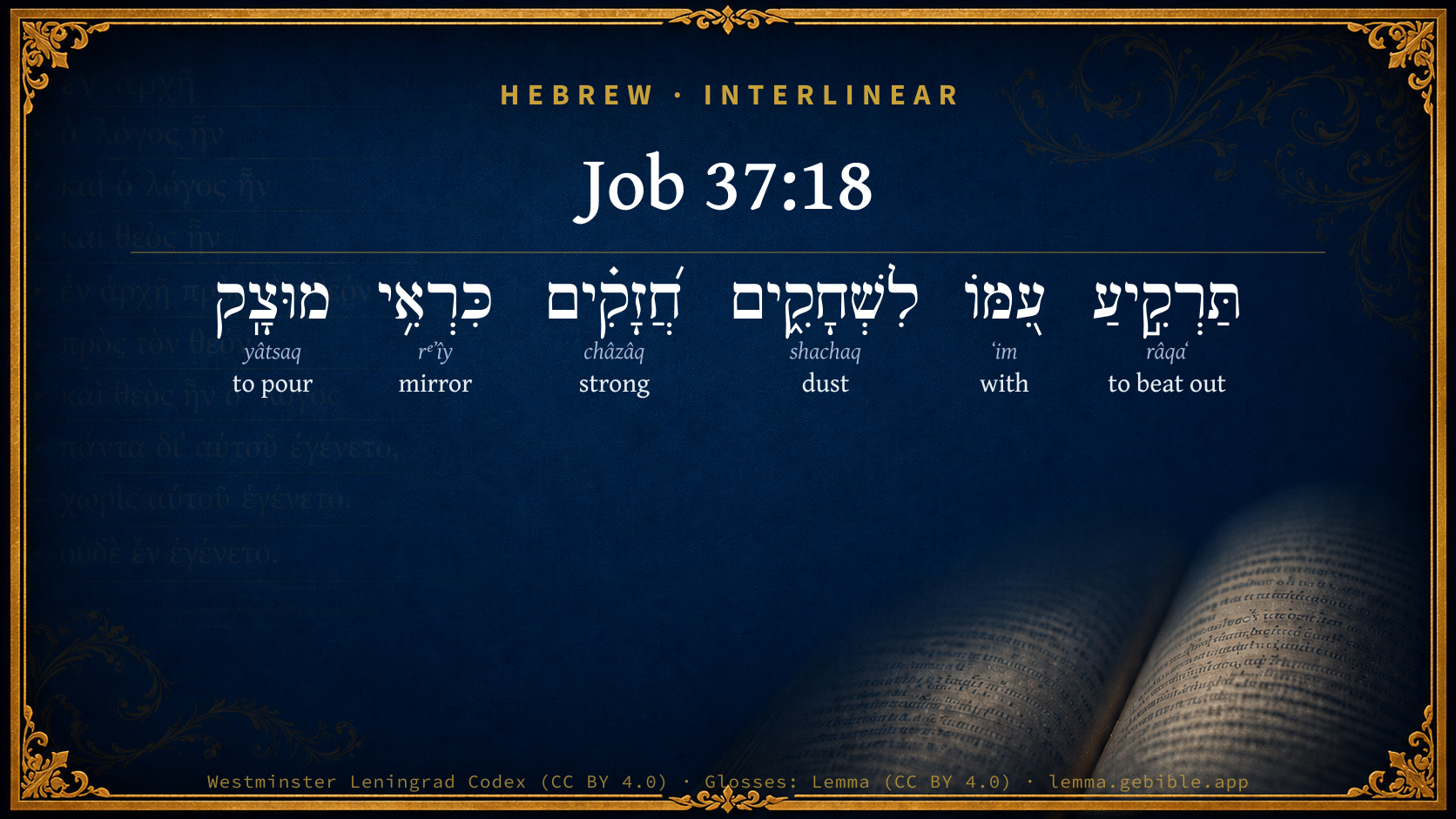
Job 37:18

Hebrew (Westminster Leningrad Codex) Job 37:18 appears in the Hebrew Old Testament. The text above is from the Westminster Leningrad Codex. Each word links to its Strong’s number, a concise gloss, and parsing drawn from the Open Scriptures Hebrew Bible morphology. Click any word for its full Brown-Driver-Briggs (BDB) entry.
Download image
Cite this verse

Job 37:18 (World English Bible). Public Domain. Lemma interlinear Bible study tool, https://lemma.gebible.app/v/job/37/18.

Show BibTeX & RIS
BibTeX
RIS
English Translation
Can you, with him, spread out the sky, Which is strong as a cast metal mirror?
World English Bible · Public Domain
Highlights
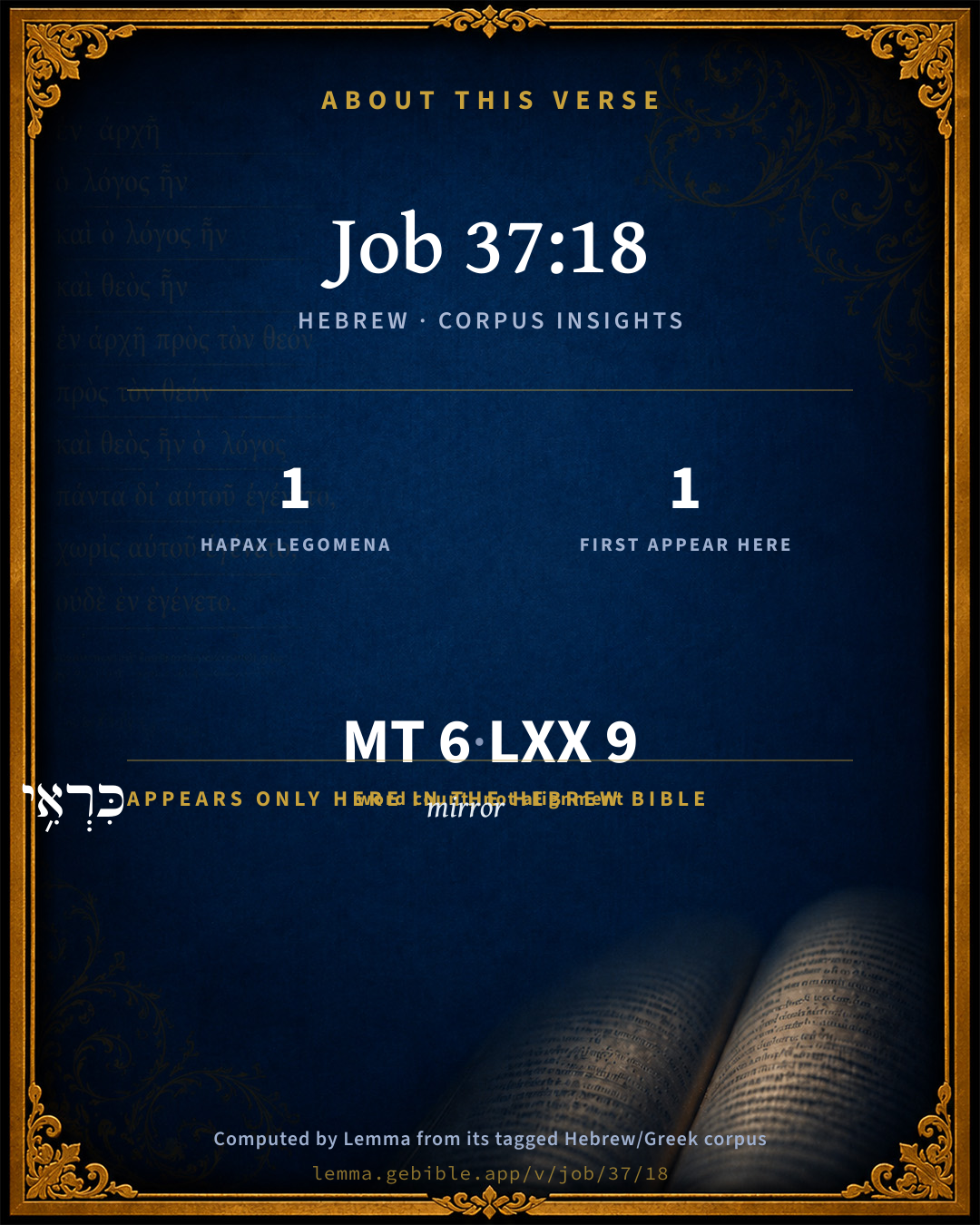
  • 1 hapax legomenon — only here in the Hebrew Bible
  • 1 first appearance in the Hebrew Bible
Full analysis ↓
Download a study sheet

One document with this verse’s original text, its word-by-word gloss line, the meaning frame, cross-references with their text, attributed commentary, and full source and license credits — printable, and it pastes into notes with its structure intact.

This verse Autodidact and up

Study sheet (.html) Plain text (.txt)

A passage Seminary Student

Up to 50 verses in one chapter. A passage sheet keeps up to 6 commentary sources and 12 cross-references per verse, in the order this page ranks them, and says so on the sheet whenever that leaves anything out. Ask for a single verse and you get the Autodidact verse sheet above.

Everything on this page stays free to read, with no account — the sheet is a download of what is already on screen, not access to it.

Want to remove ads? Support Godless Engineer
Compare translations 3

The same verse in 3 English versions, stacked beneath the original-language interlinear above. Click any original word for its lexicon entry.

Each is an independent rendering of the whole verse — the interlinear is not word-aligned to these translations.

Highlighted words mark where these versions differ — a whole-verse word diff, not a word-by-word alignment.

  • World English Bible Public Domain
    Can you, with him, spread out the sky, Which is strong as a cast metal mirror?
  • King James Version Public Domain
    Hast thou with him spread out the sky, which is strong, and as a molten looking glass?
  • unfoldingWord Literal Text CC BY-SA 4.0
    will you hammer out the sky with him, strong as a cast mirror?

unfoldingWord Literal Text — © unfoldingWord, licensed CC BY-SA 4.0. Word-aligned USFM3 via Door43 (git.door43.org/unfoldingWord/en_ult).

Versions to compare (up to 4)

3 of 4 selected

Show all 18 translations

Every available English version of this verse, each an independent rendering of the whole verse.

  • World English Bible Public Domain
    Can you, with him, spread out the sky, Which is strong as a cast metal mirror?
  • Berean Standard Bible Public Domain
    can you, like Him, spread out the skies to reflect the heat like a mirror of bronze?
  • Majority Standard Bible Public Domain
    can you, like Him, spread out the skies, as strong as a mirror of bronze?
  • King James Version Public Domain
    Hast thou with him spread out the sky, which is strong, and as a molten looking glass?
  • American Standard Version (1901) Public Domain
    Canst thou with him spread out the sky, Which is strong as a molten mirror?
  • Revised Version (1885) Public Domain
    Canst thou with him spread out the sky, which is strong as a molten mirror?
  • Geneva Bible (1599) Public Domain
    Hast thou stretched out the heaues, which are strong, and as a molten glasse?
  • Douay-Rheims (1899) Public Domain
    Thou perhaps hast made the heavens with him, which are most strong, as if they were of molten brass.
  • Young's Literal Translation Public Domain
    Thou hast made an expanse with Him For the clouds -- strong as a hard mirror!
  • Literal Standard Version CC BY-SA 4.0
    You have made an expanse with Him || For the clouds—strong as a hard mirror!
  • Unlocked Literal Bible CC BY-SA 4.0
    Can you spread out the sky as he can— the sky, which is as strong as a mirror of cast metal?
  • unfoldingWord Literal Text CC BY-SA 4.0
    will you hammer out the sky with him, strong as a cast mirror?
  • Darby Bible Public Domain
    Hast thou with him spread out the sky, firm, like a molten mirror?
  • World Messianic Bible Public Domain
    Can you, with him, spread out the sky, which is strong as a cast metal mirror?
  • Webster's Bible Public Domain
    Hast thou with him spread out the sky which is strong, and as a molten looking-glass?
  • Free Bible Version CC BY-SA 4.0
    Can you hammer out the sky so it becomes like a molten mirror, as he does?
  • Bible in Basic English Public Domain
    Will you, with him, make the skies smooth, and strong as a polished looking-glass?
  • JPS Tanakh (1917) Public Domain
    Canst thou with Him spread out the sky, which is strong as a molten mirror?

Literal Standard Version (2020), Covenant Press — licensed CC BY-SA 4.0. Text via the HelloAO Bible API (eBible.org). Unlocked Literal Bible (unfoldingWord) — licensed CC BY-SA 4.0. Text via the HelloAO Bible API (eBible.org). unfoldingWord Literal Text — © unfoldingWord, licensed CC BY-SA 4.0. Word-aligned USFM3 via Door43 (git.door43.org/unfoldingWord/en_ult). Free Bible Version, Dr. Jonathan Gallagher — licensed CC BY-SA 4.0. Text via the HelloAO Bible API (eBible.org).

Word by word

More ways to search: Search by grammar → Find every occurrence → Compare this word →

Practice this passage: Drill this verse → Learn its vocabulary →

About this verse

These counts appear in no published source. They are computed here, from the morphology-tagged text and Lemma’s own curated glosses. What Lemma adds →

6
words
6
distinct lemmas
Wisdom
section

Notable vocabulary

1 hapax legomenon — a word that appears only here in the entire Hebrew Bible:

  • כִּרְאִ֥י mirror H7209

First appearance in Scripture

This word makes its first canonical appearance in the Hebrew Bible here:

  • כִּרְאִ֥י mirror H7209

Shared distinctive vocabulary

תַּרְקִ֣יעַ to beat out H7554 occurs in 11 verses of the Hebrew Bible. Also found in:

Grammatical profile

  • 2 verbs
  • 2 nouns
  • 1 adjective
  • 1 preposition

Verb forms

  • תַּרְקִ֣יעַ Hiphil · Imperfect
  • מוּצָֽק Hophal · Participle Passive

Hebrew & Septuagint length

In English translation the verse runs 16 words from the Hebrew and 17 from the Septuagint (LXX English) — closely comparable.

A rough comparison of the two English renderings, which tokenize alike — not a word-level alignment.

Word counts can differ between the Hebrew and the Greek without any difference in meaning — e.g. the Hebrew direct-object marker אֵת has no separate Greek word, and Greek often adds the article ὁ.

In the original languages it is 6 Hebrew tokens and 9 Greek tokens — but the two are counted differently (Hebrew bundles its prefixes and suffixes into one token; the Greek is in lemma form), so that isn’t a like-for-like length.

Cross-references

10

Topical passages linked to Job 37:18 in the Treasury of Scripture Knowledge — connected by theme and wording, ordered by reader-vote popularity; previews shown in the World English Bible.

  • Isaiah 44:24 Thus says Yahweh, your Redeemer, and he who formed you from the womb: I am Yahweh, who makes all things; who stretches forth the heavens alone; who spreads abroad the earth (who is with me?);
  • Psalms 104:2 He covers himself with light as with a garment. He stretches out the heavens like a curtain.
  • Exodus 38:8 He made the basin of brass, and its base of brass, out of the mirrors of the ministering women who ministered at the door of the tent of meeting.
  • Isaiah 40:22 [It is] he who sits above the circle of the earth, and the inhabitants of it are as grasshoppers; who stretches out the heavens as a curtain, and spreads them out as a tent to dwell in;
  • Genesis 1:6–8 God said, "Let there be an expanse in the midst of the waters, and let it divide the waters from the waters."
  • Job 9:8–9 Who alone stretches out the heavens, Treads on the waves of the sea;
  • Psalms 148:4–6 Praise him, you heavens of heavens, You waters that are above the heavens.
  • Psalms 150:1 Praise Yah! Praise God in his sanctuary! Praise him in his heavens for his acts of power!
  • Proverbs 8:27 When he established the heavens, I was there; When he set a circle on the surface of the deep,
  • Isaiah 40:12 Who has measured the waters in the hollow of his hand, and meted out the sky with the span, and comprehended the dust of the earth in a measure, and weighed the mountains in scales, and the hills in a balance?

Cross-references courtesy of OpenBible.info (CC BY 4.0).

Hebrew and Greek witnesses Masoretic Hebrew ↔ Greek Septuagint

The same verse in the two great witnesses to the Old Testament, shown verse-for-verse.

These are two independent witnesses, not word-aligned to each other, and the Septuagint is shown in lemma (dictionary) form.

Hebrew Job 37:18 Masoretic · Westminster Leningrad Codex

תַּרְקִ֣יעַ עִ֭מּוֹ לִשְׁחָקִ֑ים חֲ֝זָקִ֗ים כִּרְאִ֥י מוּצָֽק

Can you, with him, spread out the sky, Which is strong as a cast metal mirror?

World English Bible · Public Domain

Greek LXX Job 37:18 Septuagint · lemma form

στερεόω μετά αὐτός εἰς παλαίωμα ἰσχυρός ὡς ὅρασις ἐπίχυσις

Will you establish with him foundations for the ancient heavens? they are strong as a molten mirror.

LXX2012 (modern English Septuagint) · Public Domain

On this verse, Albert Barnes' Notes on the Bible discusses the Septuagint’s reading. Read the note in Commentary ↓

Hebrew: Westminster Leningrad Codex (CC BY 4.0). Greek: Septuagint (public domain); English from LXX2012 (modern English Septuagint) (Public Domain). How the Septuagint differs from the Hebrew →

Commentary

Notes on Job 37:18 from classic Christian and Jewish commentators (each source and its license shown beneath its notes). The classic Christian expositions comment on the surrounding passage and are grouped to its opening verse, so a note may address several verses; the Jewish commentaries on the Tanakh (Rashi and others) are per-verse, so they appear only where the commentator wrote on this verse.

Lemma curates 59 commentaries, every one of them public domain or Creative Commons licensed, each selected and text-cleaned for this edition rather than reprinted as found. About our sources →

Trapp's Complete Commentary

John Trapp

Job 37:18 Hast thou with him spread out the sky, [which is] strong, [and] as a molten looking glass?

Ver. 18. Hast thou with him spread out the sky] He had convinced Job of his ignorance, and now he will of his impotence and imbecility; and this by an irony; q.d. Tune ille gigas es? Art thou indeed that giant, or demi-god, that helped the Almighty when he spread the heavens, when he laid the foundation of the earth? &c. Age itaque si tantus vires, quantum te ostentas, &c., Go to, then, if thou be indeed such a one as thou wouldst seem to be, while thou takest upon thee to be, viz. to contend with God, and to complain of his hard dealing with thee. "Teach us what we shall say unto him," &c., as Job 37:19, for we dare not, as thou hast done, dare him to come into the lists with us, as hoping to have the better of him.

Which is strong] Not by reason of any hard massy elemental thickness, but by reason of their airy, incorruptible, indissoluble nature, composed of very thin and even parts (Diodati). Hence the Greeks call it στερεωμα, and the Latins firmamentum. {See Trapp on "Gen 1:7"}

And as a molten looking glass?] Perspicuum et sapphirinum, dear and transparent as a mirror wherein God maketh himself visible, as it were; who of himself is too subtile for sight or sinew to seize upon (R. Levi). The Hebrew hath it, which is strong as a molten looking glass; i.e. as a polished brazen looking glass, being more solid than brass, more transparent than crystal.

John Trapp, A Commentary or Exposition upon All the Books of the Old and New Testament (1647–1656) — public domain. Text from a community e-Sword module.

The Biblical Illustrator

Joseph S. Exell

Job_37:18

Hast thou with Him spread out the sky?

The sky

For beauty, for inspiration, for health and refreshment, for a sense of freedom and enlargement, is there anything like the sky when the earth does not bury it out of sight by her vapours, nor foul and tarnish it by her smoke? Or again, for teaching and for sublimest instruction, for tenderness and for strength, for measurelessness and everlastingness, is there anything like the sky? How it attracts us and draws us all out of doors, makes it impossible for us to live within any doors! We must be under the sky. And how it rewards us! The first step when we leave the threshold, what a meeting between a mans face and the face of the sky! It is a spirit and life to us. It bathes us. It is anodyne in the evening, it kisses us in the morning. It is vital enough, intense enough to enter and flow through the centre of every blood globule, every nerve and every atom. More, it positively is soul for our soul, for it kindles thought and affection; yea, still more, it is inmost spirit for our inmost spirit, for God is in the sky and gives Himself to us through it. If you do not receive God through the sky that is your fault; it is neither Gods fault nor the fault of the sky. For I, at any rate, am conscious of receiving God every day of my life through the sky. Hence the sky feeds our reverence; quickens worship; teaches us how to worship; puts all littleness and partiality out of our worship; makes our worship large, and grand, and impartial as the sky; takes fear and distrust from us, creates in us faith and a hope that will not die. When you feel dark and doleful within the narrow prison of your own personality, do go out to Gods sky, liberate yourself, let your soul expand in its openness. There is an infinite hope for us in the sky, and God has put it there. All prophets, therefore, and these Scriptures refer us to the sky. You know how full the prophets of this Old Book are of reference to the sky and to Him who stretched it out. God alone stretcheth out the heavens, saith Job. O Lord, my God, says David, Thou art very great;. . .Who stretchest out the heavens like a curtain. The sky is a veil or a curtain between His glory and the outer glory. But what we call the outer glory--sky--is His glory come through. His vitality presses on the bike curtain. The blue curtain is pervious in every point to His Spirit. The tender infinite sky is Gods remoter robe, and His robe is full of Him--full of His virtues. He holdeth back the face of His throne, and hangeth the blue curtain before it. Let me note here that the word translated sky in our text is plural in the Hebrew, and means the ethers or the tenuous atmospheres which are intermediate between our heaven and that other glory which mortal eyes cannot see. And in justifying the words stretcheth out and spreadeth, as applicable to the ethers or the sky, let us observe, once for all, that the things most solid and those most attenuated are all one substance. Strictly, there is but one substance in the visible and invisible universe. The ether of the sky is just as metallic as gold, or silver, or steel. These metals may any day be made ether again. Nothing is so solid and nothing so strong as the everlasting sky. It is the stretched out spirit substance; the sweet transparency. It is the image and the mirror of the invisible God, and one word expresses both, the ether and His Spirit. The breath of God is what we call Holy Spirit, and the stretched out sky simply clothes His breath or spirit to us who are so dull of comprehending His Spirit--the great, clear, infinite sky--so that it is the manifestation, the image of the Spirit of God. We must allow God to hang the picture before us; He knows what we want. We are wise enough to follow this Divine method in putting pictures before the eyes of our little ones, and having awakened wonder and secured their interest we then proceed to give them the ideas of which the pictures are the signs. Now of all pictures, the infinite curtain dotted over with its innumerable golden suns is the picture. It is God holding before our eyes the shadow of Himself. The boundless, over-arching tent which is spread over all the worlds and heavens of His children is simply the image of His own boundlessness. It is one, like God--fathomless, measureless, strong, and endless. As of all scenes the sky is first and largest, likewise among things serviceable it is of the very first use. It is the infinite, the invisible servant of God. It is the first of all His ministering angels. It is always blessing us and without a sound. It is always teaching us. It teaches us more than all sounds and voices ever taught us or ever can teach. It teacheth us concerning the Spirit of God, concerning the face of God, and concerning the operation of God. And if you want to learn what His Trinity is, I implore you not to learn it from men, or books, but from Gods teaching. It is the Father representing His own adorable Trinity to His children, and how unspeakably superior to all our definitions, whether Athanasian or otherwise! Lift up your eyes, He says, and behold My infinite ether, behold it by day and behold it by night. When you have considered with admiration and reflection My infinite ether, then consider the sun which is in the bosom of the ether, the child, the only begotten of the infinite ether. Then, thirdly, think of the breath of the ether coming down into your blood and frame, and of the beam of light, both alike proceeding from the Father, and the Son, from the infinite ether and from the sun in the sky. It is impossible to imagine either a more expressive or a more impressive teaching about Father, Son, and Holy Spirit than God has made the sky. From the sky we have breath for the lungs and light for the eyes, and from the adorable Trinity the breath and illumination of His Spirit for our eternal life. Think of the infinitude of the living spirit which is behind the ether, and think of that central light which lightens all the suns, which the suns simply reflect, and think again of the living spirit and the living light giving themselves to every atom child in the universe for the eternal life of every child of the Father in His visible heavens. God has given to us the sublimest teaching in the sublimest way. Now as if to insist that we must carry over the whole sky and all that is in the sky into our Gospel--and if you do not carry it into the Gospel then it is no Gospel of God, for wherever your Gospel came from I am certain that the first teaching of God is in His infinite sky--God shows us therein a mirror of Himself spread out before us. The sky is a molten looking glass to reflect Gods face. Likewise we read, Thy tabernacle, thy tent in which thou dwellest with thy children. But who can speak of the children folded within the infinite curtain of the sky? All worlds have, of course, their own atmospheres, but beyond their distinct atmospheres there is one ethereal mantle, one sky that includes them all. One blue tent comprehends all constellations and all planets, but nothing is so firm as this fixed tent. Why do we call it firm? Because it is immovable. Winds blow and storms rage in your planetary atmosphere, but never in the ether. If ten thousand times ten thousand suns, which are now in the firmament, were to burn out and become extinct tonight, it would not in the very least touch or affect the infinite or the eternal ether which over-arches all worlds. It is imperturbable because it is Gods image, like Himself, imperturbable, and yet infinitely delicate and tender. God breathes through this skyey tent, and His tent at every point inbreathes the breath of God. His sleeping and waking children throughout the universe sleep and wake throughout their Fathers all-breathing tent of azure and of gold. He stretcheth out the heavens as a curtain, and spreadeth them out as a tent for His children to dwell in, and He breathes through into the tent, into every spirit and bosom of every child, because the ethers are many. One ether above another, one ether within another, adapted to the diverse requirements of His children, and yet all the inner and inmost ethers of angels and of men, all the material heavens of immensity, and all the invisible heavens are but one Fathers tent to dwell in. Lift up your eyes on high and behold the countless homes in your Fathers infinite tent; the children of each orb in the sky, of incomputable number. How ineffable then is the thought of all the children of all the worlds and all the heavens in one tent of an infinite God. Scope enough opens here to admit of foreign travel to all eternity. There is also family enough here to occupy and interest us to all eternity. We shall have an everlasting opportunity of entertaining strangers and of being entertained by strangers. But the thing which specially concerns us is that beautiful transformation we are undergoing from being grubs of the earth to becoming Gods butterflies of the sky--the transformation of Gods children from being planetary children to becoming His children of the heavens. In the present form of our nature we can only live in the dense atmosphere of our own earth, but God is generating an inner man within us. He who asked us just now to think of Him who formed us in the womb asks us now to think of our outer form as a womb in which He is forming the inner creature which shall be able to breathe His ether, and after that the sublimer ether, until at last in our highest refinement we shall be able to breathe the sublimest ether, namely, the ether of His own presence and glory. Suppose, for an illustration of our formation and our transfiguration, that we take those strange denizens of our sky called comets, which appear to be planets in the making, that is, they so appear to me, and I shall so think of them till I am better instructed. They have all been generated and thrown off by some sun. All earths and comets are children of suns. The comets have too much of the fiery energy of their original. The comets are too recent; they require ages and ages to cool down--as our own planet did--before they can become grass-growing, fruit-growing habitations. But mark the beautiful process. To what immeasurable distance from their parent sun these comets rush, as though they were bent on entering the outer darkness! But behold in due time, perhaps in their hundredth year, if not then, in their seven hundredth year, or in their thousandth year, they begin to rush as fast back under the attraction of their parent the sun--just as fast as they had all the centuries been receding from the sun. What a process! Receive instruction. In travelling from the sun they are cooling, cooling, and bathing themselves in distant and more distant atmospheres, and impregnating themselves with foreign virtues, and then in returning to the sun they renew their energy and are impregnated with solar electricities. And this strange law of receding from and then advancing towards the sun continues until the happy balance is struck, and they become mild and temperate worlds. In the light of this law contemplate the present strangely inconsistent earth life of man. Child though he is of God, shot out of His bosom, yet there is in him a terribly strong tendency of turning his back on God, and rushing away in the strength of his own will, as though he would rush on to darkness, chaos, desert, hell, and find a region without God--without hope. But the moment comes--the moment of his greatest distance, perhaps his greatest sin--when he bethinks himself, pulls himself up and repents, bends round, turns, moves towards his God with all the earnestness that heretofore he went from Him, comet-like. Thus it is that he, too, acquires experience, w the experience of distance, the experience of darkness, the experience of his own fiery passions; and then the experience of Gods breath, of Gods harmonising truth, of Gods pure, calm, changeless, eternal love, until ultimately he attains to great riches of nature, the riches of darkness, the riches of light, the riches of personality, the riches Of God, and becomes a divinely balanced character, a noble son of God. (John Pulsford.)

The Biblical Illustrator, edited by Joseph S. Exell (c. 1880s–1900s) — public domain. Text from a community e-Sword module.

Joseph Benson's Commentary

Job 37:18-19. Hast thou, with him, spread out the sky — Wast thou his assistant in spreading out the sky, like a canopy, over the earth? Which is strong — Which, though it be very thin and transparent, yet is also firm, and compact, and steadfast. As a molten looking-glass — Made of brass and steel, as the manner then was. Smooth and polished, without the least flaw. In this, as in a glass, we may behold the glory of God, and the wisdom of his handiwork. Teach us — If thou canst; what we shall say unto him — Of these his wonderful works, or of his divine counsels and ways. For we cannot order our speech — We know neither with what words or matter, nor in what manner, to maintain discourse with him, or plead against him. By reason of darkness — Both because of the darkness of the matter, God’s counsels and ways being a great depth, and far out of our reach; and because of the darkness, or blindness, of our minds.

Joseph Benson's Commentary on the Old and New Testaments (1811–1818) — public domain. Text from a community e-Sword module.

Geneva Bible (1599)

Geneva Bible translators

For their clearness.

Geneva Bible (1599) marginal notes — public domain. Text via Bolls.life.

Jamieson, Fausset & Brown

Robert Jamieson, A. R. Fausset & David Brown

with him--like as He does (Job 40:15).

spread out--given expanse to.

strong pieces--firm; whence the term "firmament" ("expansion," Gen 1:6, Margin; Isa 44:24).

molten looking glass--image of the bright smiling sky. Mirrors were then formed of molten polished metal, not glass.

Jamieson, Fausset & Brown — Commentary Critical and Explanatory on the Whole Bible (1871) — public domain (CC PDM 1.0). Text via the HelloAO Bible API.

Adam Clarke's Commentary

Verse 18. Hast thou with him spread out the sky] Wert thou with him when he made the expanse; fitted the weight to the winds; proportioned the aqueous to the terrene surface of the globe; the solar attraction to the quantum of vapours necessary; to be stored up in the clouds, in order to be occasionally deposited in fertilizing showers upon the earth? and then dost thou know how gravity and elasticity should be such essential properties of atmospheric air, that without them and their due proportions, we should neither have animal nor vegetable life?

Strong-as a molten looking-glass?] Like a molten mirror. The whole concave of heaven, in a clear day or brilliant night, being like a mass of polished metal, reflecting or transmitting innumerable images.

Adam Clarke's Commentary on the Bible (1810–1826) — public domain. Text from a community e-Sword/MySword module.

Ellicott's Commentary for English Readers

(18) Spread out the sky.—Some understand this of the action of the sun in dispersing the clouds; but it seems more probable that it refers to God. “Hast thou spread out with Him the magnificent dome of heaven?” The words used, however, imply the clouds rather than the cloudless sky which resembles a burnished mirror; so that it is not improbable that the sun may be the subject here and in the following verses.

A Bible Commentary for English Readers, edited by Charles John Ellicott (1878–1897) — public domain. Text from a community e-Sword module.

The Cambridge Bible for Schools and Colleges

gen. ed. J. J. S. Perowne

18. The present tense is better in this verse,

Canst thou with him spread out the skies,

Strong, as a molten mirror?

“With Him” may mean “along with Him,” or rather like Him. The comparison of the clear, dry, burnished summer skies of the East to “brass” is made in other parts of Scripture. The Eastern mirrors were plates of metal, Exo_38:8.

The Cambridge Bible for Schools and Colleges (gen. ed. J. J. S. Perowne; Cambridge University Press, 1878–1918) — public domain. Text from a community e-Sword module.

John Gill's Exposition

Hast thou with him spread out the sky?.... Wast thou concerned with him at the first spreading out of the sky? wast thou an assistant to him in it? did he not spread it as a curtain or canopy about himself, without the help of another? verily he did; see Job 9:8, Isa 44:24;

which is strong: for though it seems a fluid and thin, is very firm and strong, as appears by what it bears, and are contained in it; and therefore is called "the firmament of his power", Psa 150:1;

and as a molten looking glass; clear and transparent, like the looking glasses of the women, made of molten brass, Exo 38:8; and firm and permanent (u); and a glass this is in which the glory of God, and his divine perfections, is to be seen; and is one of the wondrous works of God, made for the display of his own glory, and the benefit of men, Psa 19:1. Or this may respect the spreading out a clear serene sky, and smoothing it after it has been covered and ruffled with storms and tempests; which is such a wonderful work of God, that man has no hand in.

(u) . Pindar. Nem. Ode 6.

John Gill's Exposition of the Whole Bible (1746–1763) — public domain (CC PDM 1.0). Text via the HelloAO Bible API.

Albert Barnes' Notes on the Bible

Hast thou with him spread out the sky? - That is, wert thou employed with God in performing that vast work, that thou canst explain how it was done? Elihu here speaks of the sky as it appears, and as it is often spoken of, as an expanse or solid body spread out over our heads, and as sustained by some cause which is unknown. Sometimes in the Scriptures it is spoken of as a curtain (Notes, Isa 40:22); sometimes as a “firmament,” or a solid body spread out (Septuagint, Gen 1:6-7); sometimes as a fixture in which the stars are placed (Notes, Isa 34:4), and sometimes as a scroll that may be rolled up, or as a garment, Psa 102:26. There is no reason to suppose that the true cause of the appearance of an expanse was understood at that time, but probably the prevailing impression was that the sky was solid and was a fixture in which the stars were held. Many of the ancients supposed that there were concentric spheres, which were transparent but solid, and that these spheres revolved around the earth carrying the heavenly bodies with them. In one of these spheres, they supposed, was the sun; in another the moon; in another the fixed stars; in another the planets; and it was the harmonious movement of these concentric and transparent orbs which it was supposed produced the “music of the spheres.”

Which is strong - Firm, compact. Elihu evidently supposed that it was solid. It was so firm that it was self-sustained.

And as a molten looking-glass - As a mirror that is made by being fused or cast. The word “glass” is not in the original, the Hebrew denoting simply “seeing,” or a “mirror” (ראי re'ı̂y). Mirrors were commonly made of plates of metal highly polished; see the notes at Isa 3:23; compare Wilkinson’s Manners and Customs of the Ancient Egyptians, vol. iii. p. 365. Ancient mirrors were so highly polished that in some which have been discovered at Thebes the luster has been partially restored, though they have been buried for many centuries. There can be no doubt that the early apprehension in regard to the sky was, that it was a solid expanse, and that it is often so spoken of in the Bible. There is, however, no direct declaration that it is so, and whenever it is so spoken of, it is to be understood as popular language, as we speak still of the rising or setting of the sun, though we know that the language is not philosophically correct. The design of the Bible is not to teach science, but religion, and the speakers in the Bible were allowed to use the language of common life - just as scientific men in fact do now.

Albert Barnes' Notes on the Bible (1834–1885) — public domain. Text from a community e-Sword/MySword module.

Haydock's Catholic Bible Commentary

Brass. Hebrew, "Hast thou with him stretched out (or beaten, as brass, tarkiang; which word Moses uses for the firmament) the heavens, which are as solid (Chaldean, and like) a molten looking-glass?" which was formerly made of metal, Exodus xxxviii. 8. The Hebrews looked upon the sky as a sheet of brass; and the poets speak of the brazen heaven. (Pindar. Nem. vi.; Homer, Iliad A.)

George Leo Haydock (1774–1849), Haydock's Catholic Family Bible and Commentary, 1859 edition — public domain. Excludes Psalms (Douay-Rheims chapter numbering differs from Protestant) and Deuterocanonical books (Catholic canon only).

Matthew Poole's English Annotations

Wast thou his co-worker or assistant in spreading out the sky like a tent or canopy over the earth? or canst thou spread out such another sky? Then indeed thou mayst with some colour pretend to be privy to his counsels, and to judge of his works.

Which is strong; which though it be very thin and transparent, yet is also firm, and compact, and stedfast, and of great force when it is pent up.

As a molten looking-glass, made of brass or steel, as the manner then was.

Matthew Poole's English Annotations on the Holy Bible (1683–1685) — public domain. Text from a community e-Sword/MySword module.

Whedon's Commentary on the Bible

Daniel D. Whedon

18. Molten looking-glass — Septuagint, Vision of Melting. The mirrors of the ancients were made of metal, whose power of reflection depended upon their being highly burnished. Such a mirror might stand as an image of brightness or effulgence, as well as of strength or stability. The dazzling effulgence of an eastern sky, too great for the eye to bear, may have been really the point of comparison in the mind of Elihu. The apostle alludes to the comparatively imperfect reflection of mirrors made of metal, (1Co_13:12;) but this divine mirror, notwithstanding all the storms which pass over it, is as bright now as in the morn of creation. In speaking of the strength of the sky, there is no evidence that Elihu regarded it as solid. On the contrary, as Petavius long ago suggested, though but thin and vaporous expanse, (rakia’h,) it separates and holds up the waters. “as if it were a most solid wall.” Comp. Gen_1:6-7. Our own word firmament, from the Latin word firmus, (strong,) corresponds to the Greek στερεωμα, a word once used in the New Testament, and then applied by the apostle to faith, (Col_2:5,) which our translators have rendered by steadfastness, that is, “firm in its place,” the old Danish word sted signifying “place.” For Scripture views of the sky, compare Exo_24:10, (transparent sapphire;) Psa_102:26, (vesture;) Psa_104:2, (a curtain;) Isa_40:22, (“as a curtain,” or, “like gauze.”)

Daniel D. Whedon (gen. ed.), Commentary on the Old and New Testaments (1874–1909) — public domain. Text from a community e-Sword module.

The Pulpit Commentary

Hast thou with him spread out the sky? Didst thou assist in the spreading out of the sky, that great and magnificent work of the Creator, transcending almost all others? (see the comment on Job_9:8) Or did not God effect this work alone, without even a counsellor, (Isa_40:13, Isa_40:14) so that thou hadst no part in it? Which is strong, and as a molten looking-glass. The sky is "strong" or "firm;" i.e. enduring or permanent, though not really hard like a mirror. Elihu, however, seems to have regarded it, like many of the ancients, as a solid mass, resembling a concave mirror of metal. The translation, "looking-glass," is wrong, both here and in Exo_38:8, since glass was not used for mirrors until the period of the early Roman empire. The earlier mirrors were of polished metal (see Smith"s "Dict. of Antiquities," vol. 3. pp. 1052, 1212).

The Pulpit Commentary (1880–1919), ed. H.D.M. Spence-Jones & Joseph S. Exell — public domain. Text from a community e-Sword module.

John Wesley's Explanatory Notes

With him - Wast thou his assistant in spreading out the sky like a canopy over the earth? Strong - Which though it be very thin and transparent, yet is also firm and compact and steadfast. Looking glass - Made of brass and steel, as the manner then was. Smooth and polished, without the least flaw. In this, as in a glass, we may behold the glory of God and the wisdom of his handy- work.

John Wesley, Explanatory Notes Upon the Whole Bible (1754–1765) — public domain. Text via the GEBible commentary corpus.

unfoldingWord translationNotes

Door43 World Missions Community

Can you spread out the sky ... a mirror of cast metal?

Elihu asks this question to emphasize that Job cannot do this. AT: "You cannot spread out the sky ... a mirror of cast metal." (See: Rhetorical Question)

as strong as a mirror of cast metal

In biblical days, mirrors were made of metal. Elihu speaks of the sky giving no rain as if it were as hard as solid metal. (See: Metaphor)

cast metal

This refers to metal that is melted, poured into a mold, and then hardens as it cools.

Teach us what we should say to him

Here the words "us" and "we" refer to Elihu, Eliphaz, Bildad, and Zophar, but not to Job. Elihu uses this phrase sarcastically. (See: Exclusive and Inclusive "We")

because of the darkness of our minds

Elihu speaks of the inability to understand as if it were having darkness in one's mind. AT: "because we do not understand" (See: Metaphor)

Should he be told that I wish to speak with him?

Elihu asks this rhetorical question to emphasize that no one can do this. AT: "I cannot have someone tell him that I wish to speak with him." (See: Rhetorical Question)

Should he be told

This can be stated in active form. AT: "Should I have someone tell him" (See: Active or Passive)

Would a person wish to be swallowed up?

Elihu asks this rhetorical question to emphasize that no one would want this to happen. AT: "No person would want to be swallowed up." (See: Rhetorical Question)

to be swallowed up

Elihu speaks of a person being destroyed as if the person were swallowed up. This can be stated in active form. AT: "for God to destroy him" (See: Metaphor and Active or Passive)

translationWords

heaven

teach

mind

unfoldingWord translationNotes — © Distant Shores Media and the Door43 World Missions Community, licensed CC BY-SA 4.0. Source: git.door43.org/Door43/en_tn.

Rashi

Rabbi Shlomo Yitzchaki (Rashi)

strong the skies.

as a molten mirror Like a mirror into which women look. [molten tristre, which is very strong.]

Rashi on the Tanakh — English translations: “The Judaica Press complete Tanach with Rashi, translated by A. J. Rosenberg” (CC BY 4.0); “Pentateuch with Rashi's commentary by M. Rosenbaum and A.M. Silbermann, 1929-1934” (public domain); “The Metsudah Tanach series, Lakewood, N.J” (CC BY 4.0); and “The Book of Joshua, Metsudah Publications, 1997” (CC BY 4.0). Text via Sefaria.

Lesson kit

Teaching starters — assembled from the data on this page, not authored interpretation. Every prompt links to the verse data it draws on. Edit before teaching.

Job, in the Wisdom, opens this verse with 6 words (6 distinct Hebrew lemmas). Its most distinctive word is rᵉʼîy (“mirror”). A historical commentator’s framing appears above. Read the whole chapter for the surrounding context.

Discussion questions

  1. How does “mirror” (rᵉʼîy) shape what this verse is saying?
  2. This verse holds 1 word here found nowhere else in the Hebrew Bible. What might the rare word draw attention to?
  3. The word “mirror” first appears here in Scripture. What is being introduced at this debut?
  4. Exodus 39:3 shares the word «to beat out» with this verse. How do the two illuminate each other?
  5. These translations render this verse differently. What is at stake in choosing one wording over another?
  6. The verb «תַּרְקִ֣יעַ» is Hiphil Imperfect. How does its form color the action?
  7. Reading how Trapp's Complete Commentary and The Biblical Illustrator read this verse, where do the two commentators agree and where do they part?

Things to notice

Reading settings

Reading text

Shown beneath each verse's original-language words.

Old Testament
Old Testament edition

Read the OT as the Masoretic Hebrew (MT) or the Greek Septuagint (LXX).

English shown for the Greek Septuagint (in the Hebrew ↔ Greek comparison).

Comparing translations? Open the Compare panel on any verse page to stack up to four side by side.