
Jeremiah 31:11

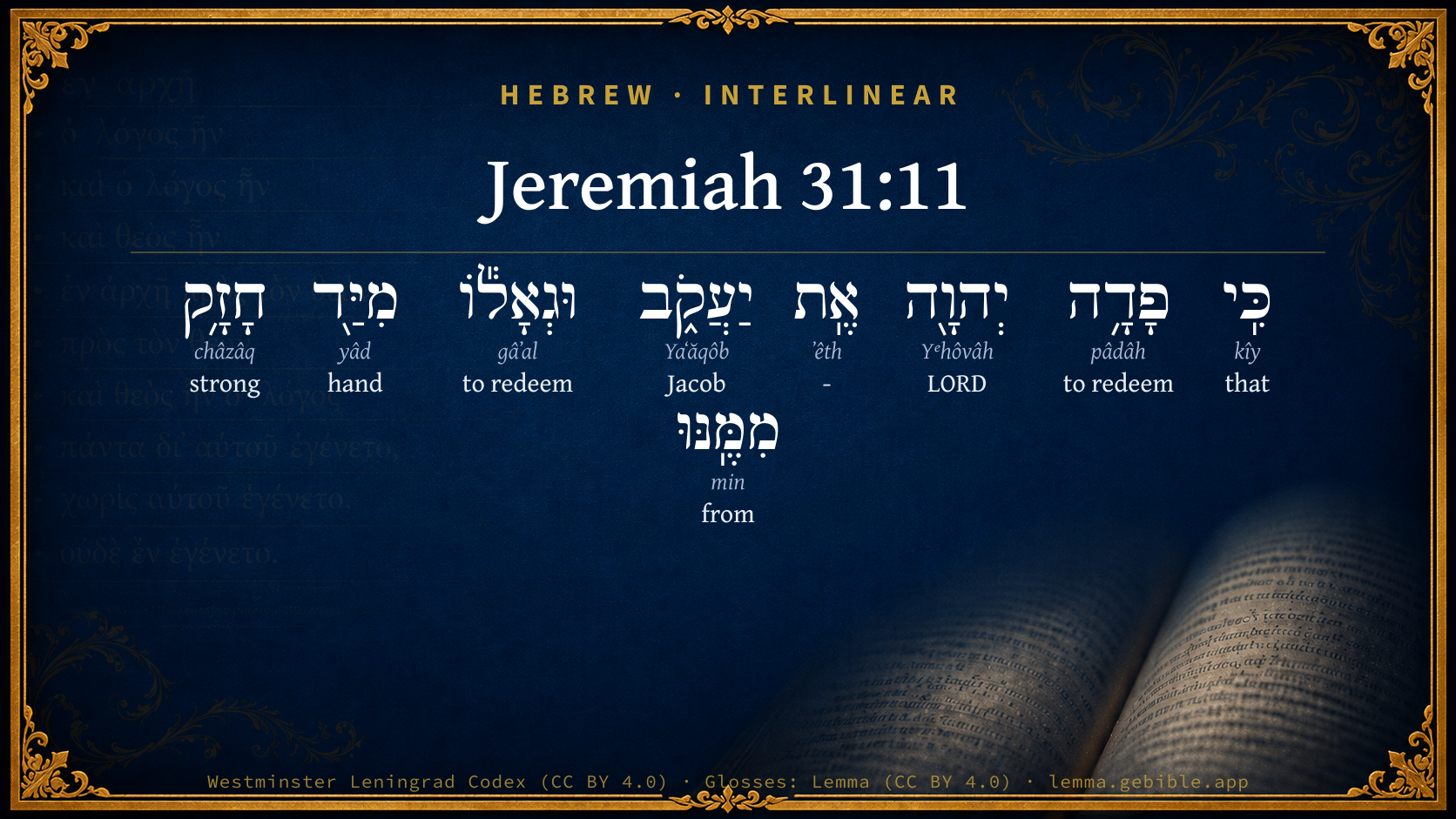
Hebrew (Westminster Leningrad Codex) Jeremiah 31:11 appears in the Hebrew Old Testament. The text above is from the Westminster Leningrad Codex. Each word links to its Strong’s number, a concise gloss, and parsing drawn from the Open Scriptures Hebrew Bible morphology. Click any word for its full Brown-Driver-Briggs (BDB) entry.
Download image
Cite this verse

Jeremiah 31:11 (World English Bible). Public Domain. Lemma interlinear Bible study tool, https://lemma.gebible.app/v/jeremiah/31/11.

Show BibTeX & RIS
BibTeX
RIS
English Translation
For Yahweh has ransomed Jacob, and redeemed him from the hand of him who was stronger than he.
World English Bible · Public Domain
Download a study sheet

One document with this verse’s original text, its word-by-word gloss line, the meaning frame, cross-references with their text, attributed commentary, and full source and license credits — printable, and it pastes into notes with its structure intact.

This verse Autodidact and up

Study sheet (.html) Plain text (.txt)

A passage Seminary Student

Up to 50 verses in one chapter. A passage sheet keeps up to 6 commentary sources and 12 cross-references per verse, in the order this page ranks them, and says so on the sheet whenever that leaves anything out. Ask for a single verse and you get the Autodidact verse sheet above.

Everything on this page stays free to read, with no account — the sheet is a download of what is already on screen, not access to it.

Want to remove ads? Support Godless Engineer
Compare translations 3

The same verse in 3 English versions, stacked beneath the original-language interlinear above. Click any original word for its lexicon entry.

Each is an independent rendering of the whole verse — the interlinear is not word-aligned to these translations.

Highlighted words mark where these versions differ — a whole-verse word diff, not a word-by-word alignment.

  • World English Bible Public Domain
    For Yahweh has ransomed Jacob, and redeemed him from the hand of him who was stronger than he.
  • King James Version Public Domain
    For the LORD hath redeemed Jacob, and ransomed him from the hand of him that was stronger than he.
  • unfoldingWord Literal Text CC BY-SA 4.0
    For Yahweh has ransomed Jacob and has redeemed him from the hand that was too strong for him.

unfoldingWord Literal Text — © unfoldingWord, licensed CC BY-SA 4.0. Word-aligned USFM3 via Door43 (git.door43.org/unfoldingWord/en_ult).

Versions to compare (up to 4)

3 of 4 selected

Show all 18 translations

Every available English version of this verse, each an independent rendering of the whole verse.

  • World English Bible Public Domain
    For Yahweh has ransomed Jacob, and redeemed him from the hand of him who was stronger than he.
  • Berean Standard Bible Public Domain
    For the LORD has ransomed Jacob and redeemed him from the hand that had overpowered him.
  • Majority Standard Bible Public Domain
    For the LORD has ransomed Jacob and redeemed him from the hand that had overpowered him.
  • King James Version Public Domain
    For the LORD hath redeemed Jacob, and ransomed him from the hand of him that was stronger than he.
  • American Standard Version (1901) Public Domain
    For Jehovah hath ransomed Jacob, and redeemed him from the hand of him that was stronger than he.
  • Revised Version (1885) Public Domain
    For the LORD hath ransomed Jacob, and redeemed him from the hand of him that was stronger than he.
  • Geneva Bible (1599) Public Domain
    For the Lord hath redeemed Iaakob, and ransomed him from the hande of him, that was stronger then he.
  • Douay-Rheims (1899) Public Domain
    For the Lord hath redeemed Jacob, and delivered him out of the hand of one that was mightier than he.
  • Young's Literal Translation Public Domain
    For Jehovah hath ransomed Jacob, And redeemed him from a hand stronger than he.
  • Literal Standard Version CC BY-SA 4.0
    For YHWH has ransomed Jacob, || And redeemed him from a hand stronger than he.
  • Unlocked Literal Bible CC BY-SA 4.0
    For Yahweh has ransomed Jacob and has redeemed him from the hand that was too strong for him.
  • unfoldingWord Literal Text CC BY-SA 4.0
    For Yahweh has ransomed Jacob and has redeemed him from the hand that was too strong for him.
  • Darby Bible Public Domain
    For Jehovah hath ransomed Jacob, and redeemed him from the hand of one stronger than he.
  • World Messianic Bible Public Domain
    For the LORD has ransomed Jacob, and redeemed him from the hand of him who was stronger than he.
  • Webster's Bible Public Domain
    For the LORD hath redeemed Jacob, and ransomed him from the hand of him that was stronger than he.
  • Free Bible Version CC BY-SA 4.0
    The Lord has redeemed the descendants of Jacob and rescued them from their enemies who had defeated them.
  • Bible in Basic English Public Domain
    For the Lord has given a price for Jacob, and made him free from the hands of him who was stronger than he.
  • JPS Tanakh (1917) Public Domain
    For the LORD hath ransomed Jacob, and He redeemeth him from the hand of him that is stronger than he.

Literal Standard Version (2020), Covenant Press — licensed CC BY-SA 4.0. Text via the HelloAO Bible API (eBible.org). Unlocked Literal Bible (unfoldingWord) — licensed CC BY-SA 4.0. Text via the HelloAO Bible API (eBible.org). unfoldingWord Literal Text — © unfoldingWord, licensed CC BY-SA 4.0. Word-aligned USFM3 via Door43 (git.door43.org/unfoldingWord/en_ult). Free Bible Version, Dr. Jonathan Gallagher — licensed CC BY-SA 4.0. Text via the HelloAO Bible API (eBible.org).

Word by word

More ways to search: Search by grammar → Find every occurrence → Compare this word →

Practice this passage: Drill this verse → Learn its vocabulary →

About this verse

These counts appear in no published source. They are computed here, from the morphology-tagged text and Lemma’s own curated glosses. What Lemma adds →

9
words
9
distinct lemmas
Prophets
section

Shared distinctive vocabulary

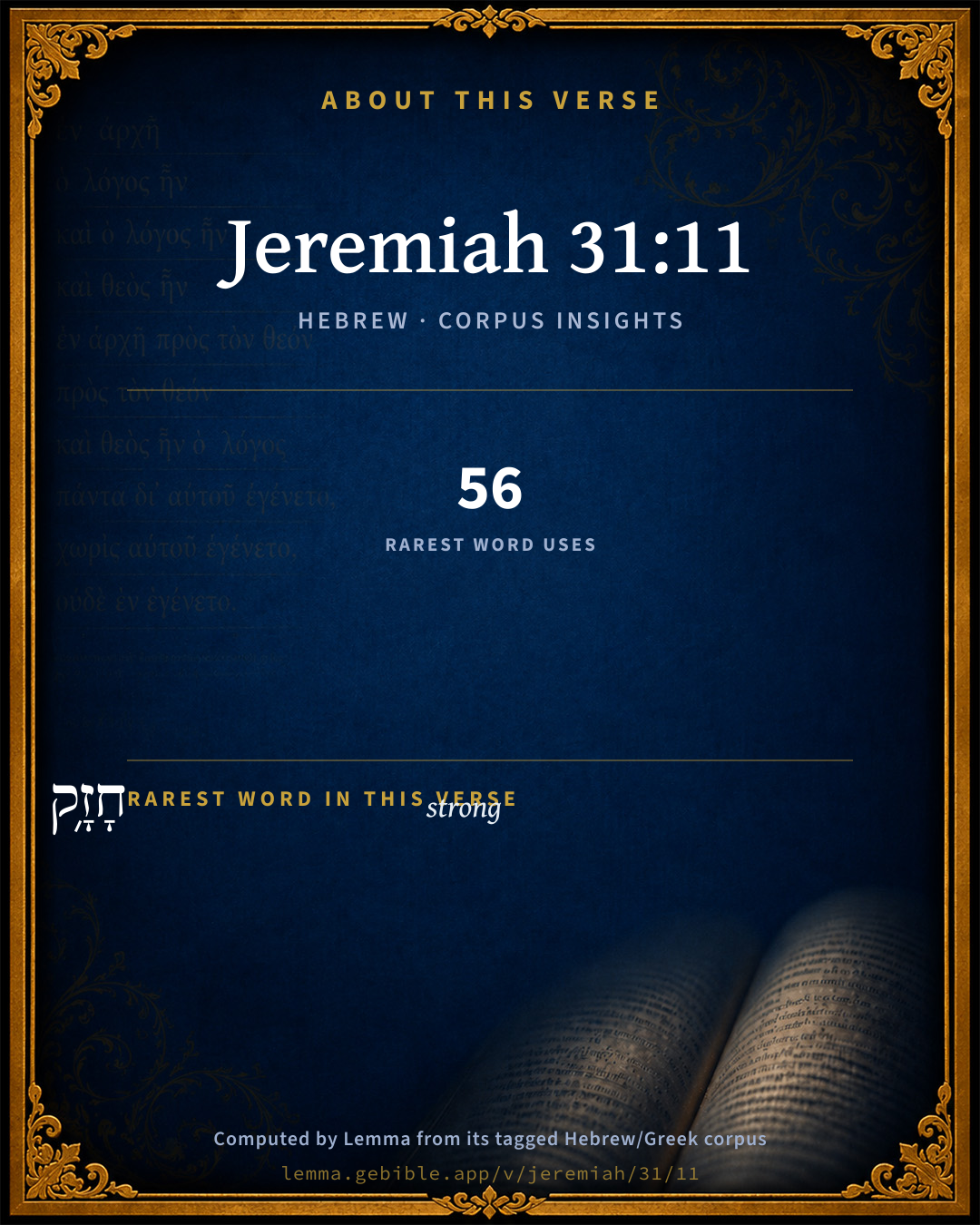
חָזָ֥ק strong H2389 occurs in 54 verses of the Hebrew Bible. Also found in:

Grammatical profile

  • 2 verbs
  • 3 nouns
  • 1 adjective
  • 1 preposition
  • 1 conjunction
  • 1 particle

Verb forms

  • פָדָ֥ה Qal · Perfect
  • וּגְאָל֕וֹ Qal · Perfect

Cross-references

13

Topical passages linked to Jeremiah 31:11 in the Treasury of Scripture Knowledge — connected by theme and wording, ordered by reader-vote popularity; previews shown in the World English Bible.

  • Isaiah 44:23 Sing, you heavens, for Yahweh has done it; shout, you lower parts of the earth; break forth into singing, you mountains, O forest, and every tree therein: for Yahweh has redeemed Jacob, and will glorify himself in Israel.
  • Isaiah 48:20 Go you forth from Babylon, flee you from the Chaldeans; with a voice of singing declare you, tell this, utter it even to the end of the earth: say you, Yahweh has redeemed his servant Jacob.
  • Titus 2:14 who gave himself for us, that he might redeem us from all iniquity, and purify for himself a people for his own possession, zealous for good works.
  • Psalms 142:6 Listen to my cry, For I am in desperate need. Deliver me from my persecutors, For they are stronger than me.
  • Isaiah 49:24 Shall the prey be taken from the mighty, or the lawful captives be delivered?
  • Jeremiah 15:21 I will deliver you out of the hand of the wicked, and I will redeem you out of the hand of the terrible.
  • Matthew 12:29 Or how can one enter into the house of the strong man, and plunder his goods, unless he first bind the strong man? Then he will plunder his house.
  • Matthew 20:28 even as the Son of Man came not to be served, but to serve, and to give his life as a ransom for many."
  • Luke 11:21–22 "When the strong man, fully armed, guards his own dwelling, his goods are safe.
  • Jeremiah 50:33 Thus says Yahweh of hosts: The children of Israel and the children of Judah are oppressed together; and all who took them captive hold them fast; they refuse to let them go.
  • Hosea 13:14 I will ransom them from the power of Sheol. I will redeem them from death! Death, where are your plagues? Sheol, where is your destruction? Compassion will be hidden from my eyes.
  • Matthew 22:29 But Jesus answered them, "You are mistaken, not knowing the Scriptures, nor the power of God.
  • Hebrews 2:14–15 Since then the children have shared in flesh and blood, he also himself in like manner partook of the same, that through death he might bring to nothing him who had the power of death, that is, the devil,

Cross-references courtesy of OpenBible.info (CC BY 4.0).

Hebrew and Greek witnesses Masoretic Hebrew ↔ Greek Septuagint

The same verse in the two great witnesses to the Old Testament, shown verse-for-verse.

These are two independent witnesses, not word-aligned to each other, and the Septuagint is shown in lemma (dictionary) form.

Hebrew Jeremiah 31:11 Masoretic · Westminster Leningrad Codex

כִּֽי פָדָ֥ה יְהוָ֖ה אֶֽת יַעֲקֹ֑ב וּגְאָל֕וֹ מִיַּ֖ד חָזָ֥ק מִמֶּֽנּוּ

For Yahweh has ransomed Jacob, and redeemed him from the hand of him who was stronger than he.

World English Bible · Public Domain

Greek LXX Structure differs

In the Septuagint, Jeremiah is about an eighth shorter than the Hebrew and arranges its material differently — the Oracles Against the Nations (Hebrew chapters 46–51) appear in the middle of the Greek book, after 25:13. Because the chapter and verse boundaries do not line up, a verse-for-verse comparison with the Hebrew is not shown.

A verse-for-verse comparison isn’t shown here because the chapters and verses don’t line up. Switch to the LXX edition with the MT / LXX toggle above to read the Greek directly.

Hebrew: Westminster Leningrad Codex (CC BY 4.0). Greek: Septuagint (public domain); English from a public-domain English Septuagint. How the Septuagint differs from the Hebrew →

Targum (Aramaic paraphrase)

1

The Targum is the ancient Jewish Aramaic paraphrase of the Hebrew Scriptures — an interpretive translation, not the Hebrew text itself. Onkelos (literal) and Pseudo-Jonathan (expansive) render the Torah, and Jonathan the Prophets. Coverage is partial: where no permissively-licensed English translation exists for a verse, only the Aramaic is shown. This is verse-level text, not a word-by-word alignment to the Hebrew.

  1. Targum Jonathan Prophets (Joshua–Malachi)
    אֲרֵי פָרֵיק יְיָ יַת דְבֵית יַעֲקֹב וְשֵׁיזְבִינוּן מִיַד דְתַקִיפִין מִנְהוֹן:

    God has redeemed those of the house of Jacob and saved them from the hands of those too strong for them.

    Targum Jonathan — Aramaic: “Mikraot Gedolot” (public domain). English: “Sefaria Community Translation” (CC0 1.0 (public-domain dedication)); “London "Chaldee Paraphrase," 1871” (public domain). Text via Sefaria.

Commentary

Notes on Jeremiah 31:11 from classic Christian and Jewish commentators (each source and its license shown beneath its notes). The classic Christian expositions comment on the surrounding passage and are grouped to its opening verse, so a note may address several verses; the Jewish commentaries on the Tanakh (Rashi and others) are per-verse, so they appear only where the commentator wrote on this verse.

Lemma curates 59 commentaries, every one of them public domain or Creative Commons licensed, each selected and text-cleaned for this edition rather than reprinted as found. About our sources →

Trapp's Complete Commentary

John Trapp

Jer 31:11 For the LORD hath redeemed Jacob, and ransomed him from the hand of [him that was] stronger than he.

Ver. 11. For the Lord hath redeemed Jacob.] Redemption is a voluminous mercy, an accumulative blessing.

From the hand of him that was stronger than he,] scil., The Chaldean, but especially from Satan. {Mat 12:29 Joh 12:31}

John Trapp, A Commentary or Exposition upon All the Books of the Old and New Testament (1647–1656) — public domain. Text from a community e-Sword module.

Tyndale Open Study Notes

Tyndale Open Resources

31:11 The Lord alone could accomplish the people’s release from exile.

Tyndale Open Study Notes — © Tyndale Open Resources, licensed CC BY-SA 4.0. Text via the HelloAO Bible API.

Geneva Bible (1599)

Geneva Bible translators

That is, from the Babylonians, and other enemies.

Geneva Bible (1599) marginal notes — public domain. Text via Bolls.life.

Jamieson, Fausset & Brown

Robert Jamieson, A. R. Fausset & David Brown

ransomed . . . from . . . hand of . . . stronger--No strength of the foe can prevent the Lord from delivering Jacob (Isa 49:24-25).

Jamieson, Fausset & Brown — Commentary Critical and Explanatory on the Whole Bible (1871) — public domain (CC PDM 1.0). Text via the HelloAO Bible API.

John Calvin's Commentaries

He goes on with the same subject. He had said before that it would not be a difficult or an arduous work for God to deliver his people; he now says, Jehovah will redeem his people, and will redeem them from the hand of one more powerful than themselves Jeremiah again obviates the doubt which might have dejected the minds of the godly; for this thought ever recurred to them, “How can God redeem us? he might indeed have cheeked the Chaldeans, but now they rule over the whole East; this monarchy is like a gulf in which the whole world is swallowed up: since then God has thus exalted the Chaldean power, we are wholly without hope.” They might then have despaired when they compared this evil with all the remedies that might occur to them. But the Prophet here confirms what he had just stated, that God would be more powerful than the Chaldeans and all other enemies; as though he had said,

“Though your enemies are strong, and ye are like sheep in the jaws of wolves, yet nothing can hinder God from redeeming you.”

To the same purpose is what God says often by his Prophets,

“Ye have been sold for nothing, and redeemed shall ye be without price,” (Isaiah 52:3)

as though he had said, “I am not bound to pay anything to the Chaldeans, for I did not sell you to them as by a contract, but I sold you on account of your sins; as to them, they have given me no price: let nothing, therefore, terrify you as though they could oppose your deliverance against my will.” How so? “Because they have no right to detain you; therefore, if ye only accept my favor, the strength of your enemies, which appears so formidable, shall not hinder your redemption.” This is the reason why he says that the Chaldeans were stronger or more powerful than the Israelites.

This truth is also of no little use to us at this day; for when we consider how great is the strength of our enemies, despair must overwhelm our minds; but this promise comes to our aid — God testifies that he will in such a way be the Deliverer of his people, that the power of men shall not prevent nor delay his work. It follows, —

John Calvin's Commentaries (1540-1563) — public domain. Text from the Calvin Translation Society English edition (1840s-50s) via the Christian Classics Ethereal Library (ccel.org). Calvin's coverage is partial (roughly two-thirds of the Bible); uncommented books and verses are honest gaps, never fabricated. The 19th-century editor's footnotes and remarks are omitted so the notes are faithfully Calvin's own voice.

Ellicott's Commentary for English Readers

(11) For the Lord hath redeemed Jacob . . .—Of the two verbs “redeem” and “ransom” here used, the first expresses the act of setting free, the other that of acting as the goel, or nearest kinsman, who was not only the liberator, but the avenger of those to whom he stood in that relation. (Comp. Num_35:19; Deu_19:6; 2Sa_14:11; Isa_59:20; Psa_19:14.) The idea of a “ransom,” however—i.e., of a price paid for freedom—does not lie in the Hebrew word.

A Bible Commentary for English Readers, edited by Charles John Ellicott (1878–1897) — public domain. Text from a community e-Sword module.

John Gill's Exposition

For the Lord hath redeemed Jacob,.... Not the patriarch Jacob singly and personally, though he no doubt was a redeemed one; nor his carnal posterity, at least not all of them, only a remnant among them, and especially not them only; but the Gentiles also, even all the elect of God, his church and people, of whatsoever nation, which frequently go by this name in the prophetic writings: and this redemption of them by Christ, which, though future, is spoken of as past, because of the certainty of it; and is the ground and foundation of their being gathered in effectual calling, and of their final perseverance; for redemption has its certain effect, and Christ will never lose the purchase of his blood; see Zac 10:8;

and ransomed him from the hand of him that was stronger than he; meaning Satan, the strong man armed; who is stronger than man, as appears by his possession of the bodies of men, inflicting diseases on them, and death itself, of which he had the power when permitted; and by his influence over the minds of men; by his temptations to sin, in which he so much succeeds; and even by the prevalence of his temptations over the saints themselves; and by the power which he had over our first parents in innocence, whom he prevailed upon to eat the forbidden fruit, which brought ruin on themselves, and on their posterity; by which means he got them into his hands, and God's elect among the rest, whom he leads captive at his will; and being enfeebled by sin, are so weak as not to be able to rescue themselves out of his hands; for he is stronger than they; but Christ is stronger than the strong man armed; he is the Redeemer that is mighty, and has taken the prey out of his hands, and has led captivity captive: and this he has done, not only by power and conquest, spoiling Satan and his principalities and powers; but by paying a "ransom" price for these captives into the hands of God; and which is no other than his precious blood, his life, himself; and so must be a sufficient ransom for them. This redemption was typified by the deliverance of the Jews out of the hands of the Chaldeans, a mighty nation, and stronger than they; and is the ground, reason, and foundation, of the restoration of that people in the latter day.

John Gill's Exposition of the Whole Bible (1746–1763) — public domain (CC PDM 1.0). Text via the HelloAO Bible API.

Matthew Poole's English Annotations

Because of the certainty of Divine prophecies and promises, things in them are often said to be already done which are not to be fulfilled of many years after. The sense is, God will as certainly do it as if he had already done it; for whether it be understood of a deliverance from Babylon, or of the salvation of the gospel by Christ, which by a metaphor is often also called redeeming and ransoming, it was to be accomplished long after this time. By

him that was stronger than he, some understand the Chaldeans, others understand the devil (interpreting the text of the spiritual redemption of God’s people by the blood of Christ, being the ransom given for them); but undoubtedly the text is literally to be understood of their deliverance from Babylon, though (as the apostle saith) all these things happened to them in a figure. In their deliverance, as well from Babylon as Egypt, they were types of the deliverance of God’s people from spiritual Babylon and Egypt by Christ, as well as in their entering into Canaan they were (as the apostle proveth, Heb 3; Heb 4) types of the saints entering into heaven, of which Canaan was a type.

Matthew Poole's English Annotations on the Holy Bible (1683–1685) — public domain. Text from a community e-Sword/MySword module.

Whedon's Commentary on the Bible

Daniel D. Whedon

11. Stronger than he — But not stronger than God.

Daniel D. Whedon (gen. ed.), Commentary on the Old and New Testaments (1874–1909) — public domain. Text from a community e-Sword module.

The Pulpit Commentary

Strong, stronger, strongest.

Israel, Babylon, God. Note

I THE STRONG. Was not Israel so? Regarding Israel as including Judah and Jerusalem, how strong, even materially, was Israel! In her numbers, wealth, fortresses especially Jerusalem, which was one of the most impregnable of all the cities of the world! in her privileges, memories, promised help of God! in her past prestige and influence! in her long traditions of freedom and greatness! and in much beside! But Israel may Be taken as a type of all humanity. Looking upon our first parents, the head of our race, surely we should have thought their position of happiness, holiness, and Divine favour, impregnable. What safeguard did they lack? what motive to withstand the tempter was wanting? And how many there are now who say of themselves, and others think it, that they shall never be moved? Their mountain seems to stand so strong. Lands where pure gospel ministry exists; children of godly homes; men who have long walked in God"s ways. But facts all too often show that, "strong" as these may be, there is

II THE STRONGER one who overcomes them. The Chaldean armies were too strong for Israel. "The hand of Babylon "was stronger than he." And the facts of human life all reveal how humanity has come under the cruel dominance of one who is stronger than man. Behold the body, a prey to feebleness, disease, pain, and death; the mind, to corrupt imagination, to delusion, and deceit; the affections clinging to things evil, debased, perverted; the will enslaved, made to do that which it would not; the soul earth bound, unable to rise up to God and heaven, as it was made to do. Yes; the evidence is abundant and everywhere that a stronger than man has overcome him to his harm. But this verse tells of deliverance from the hand of this stronger one, by one who is

III THE STRONGEST of all. It came true of Israel, and shall come true again. It is true in regard to humanity and the individual soul. It may be thought, considering the comparatively small number of the exiles who returned to Jerusalem, that this prediction was scarcely verified. But in the increase of the Jewish race in the lands of their exile, in their preservation from the hatred of their enemies (cf. Book of Esther), in the deliverance of them from the snare of idolatry, in the implantation in their hearts of a deeper love and understanding of God"s Word, in all these and in other respects Israel was delivered. And humanity is redeemed, ransomed. When Christ said, "It is finished," then was virtually accomplished that deliverance for which, in its full realization, the world yet groans. But in every triumph of Divine grace, every conversion, every breaking away from evil, every tightening of the blessed bends which bind us to Christ, every advance the gospel makes, every missionary triumph, every act of self-consecration, there is present proof of what by and by shall be perfectly proved. And the means by which all this is accomplished are suggested to us by the word "ransomed;" it sends our thoughts to him who said of himself that he came to give his life a "ransom for many." Therefore:

1. Let us each look on beyond that mighty one, the prince of this world, who is stronger than we, to him, the Saviour of us all, the Mightiest, who is stronger than he.

2. And ask ourselves the question Under whose rule and service do we ourselves live? That is the all-important question. God help us to give it the right answer. C.

The Pulpit Commentary (1880–1919), ed. H.D.M. Spence-Jones & Joseph S. Exell — public domain. Text from a community e-Sword module.

John Wesley's Explanatory Notes

Hath redeemed - God will as certainly do it, as if he had already done it. In their deliverance as well from Babylon as Egypt, they were types of the deliverance of God's people, by Christ; as well as in their entering into Canaan, they were types of the saints, entering into heaven.

John Wesley, Explanatory Notes Upon the Whole Bible (1754–1765) — public domain. Text via the GEBible commentary corpus.

Scofield Reference Notes

C. I. Scofield

redeemed (See Scofield "Isa 59:20"). See Scofield "Exo 14:30".

ransomed

Heb. "goel," Redemp. (Kinsman type). (See Scofield "Isa 59:20").

The Scofield Reference Bible (1917 edition), notes by C. I. Scofield — public domain. Text from a community e-Sword module.

Lesson kit

Teaching starters — assembled from the data on this page, not authored interpretation. Every prompt links to the verse data it draws on. Edit before teaching.

Jeremiah, in the Prophets, opens this verse with 9 words (9 distinct Hebrew lemmas). Its most distinctive word is châzâq (“strong”). A historical commentator’s framing appears above. Read the whole chapter for the surrounding context.

Discussion questions

  1. How does “strong” (châzâq) shape what this verse is saying?
  2. How does Exodus 3:19, which shares the word «strong», read alongside this verse?
  3. The translations on this page render this verse differently — a whole-verse word diff, not a word-by-word alignment. What might account for the different wordings?
  4. «פָדָ֥ה» is a Qal Perfect verb. How does that grammatical form shape the action described?
  5. Compare how Trapp's Complete Commentary and Tyndale Open Study Notes read this verse. Where do they agree or differ?

Things to notice

Reading settings

Reading text

Shown beneath each verse's original-language words.

Old Testament
Old Testament edition

Read the OT as the Masoretic Hebrew (MT) or the Greek Septuagint (LXX).

English shown for the Greek Septuagint (in the Hebrew ↔ Greek comparison).

Comparing translations? Open the Compare panel on any verse page to stack up to four side by side.