
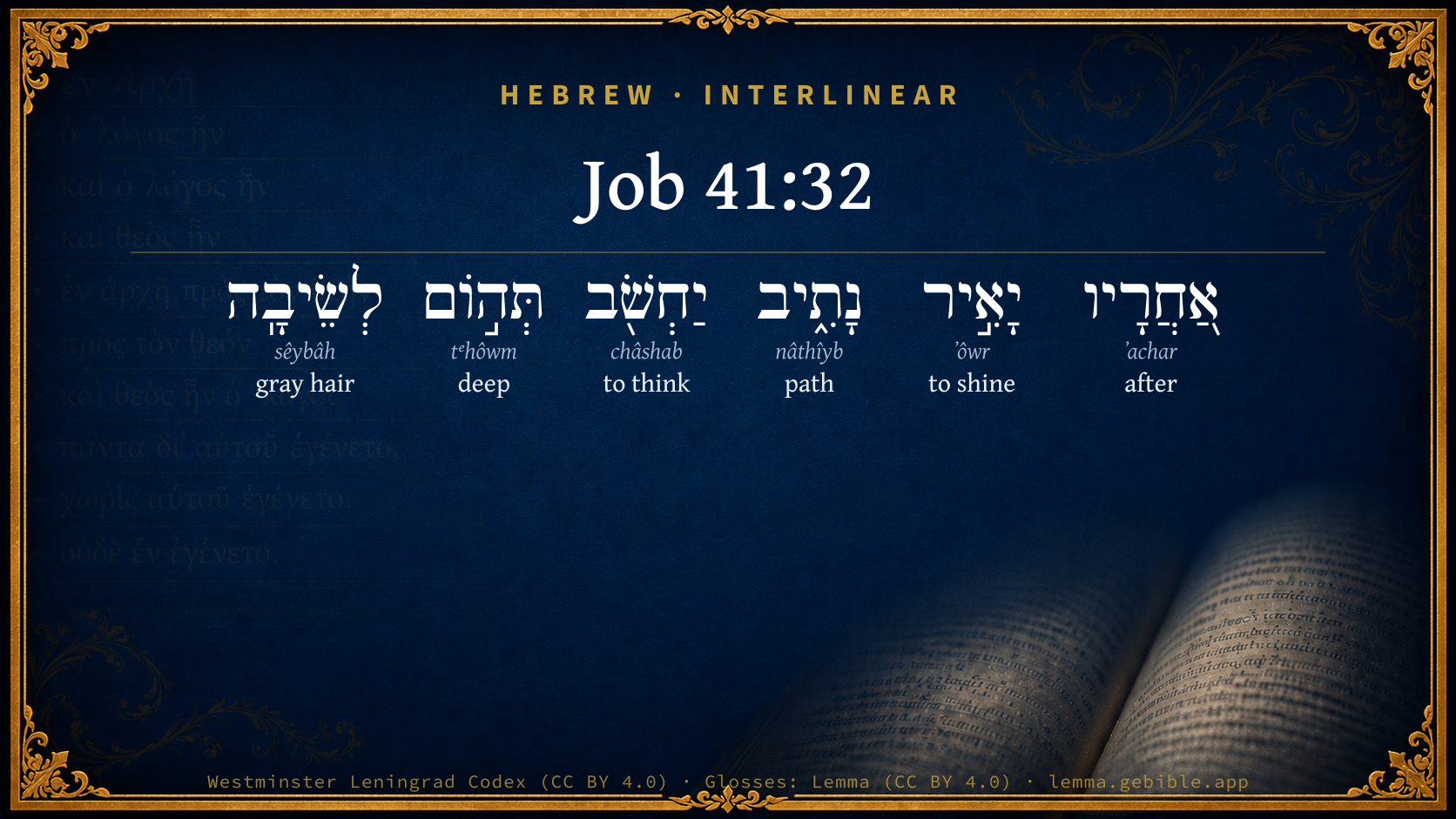
Job 41:32

Hebrew (Westminster Leningrad Codex) Job 41:32 appears in the Hebrew Old Testament. The text above is from the Westminster Leningrad Codex. Each word links to its Strong’s number, a concise gloss, and parsing drawn from the Open Scriptures Hebrew Bible morphology. Click any word for its full Brown-Driver-Briggs (BDB) entry.
Download image
Cite this verse

Job 41:32 (World English Bible). Public Domain. Lemma interlinear Bible study tool, https://lemma.gebible.app/v/job/41/32.

Show BibTeX & RIS
BibTeX
RIS
English Translation
He makes a path to shine after him. One would think the deep had white hair.
World English Bible · Public Domain
Download a study sheet

One document with this verse’s original text, its word-by-word gloss line, the meaning frame, cross-references with their text, attributed commentary, and full source and license credits — printable, and it pastes into notes with its structure intact.

This verse Autodidact and up

Study sheet (.html) Plain text (.txt)

A passage Seminary Student

Up to 50 verses in one chapter. A passage sheet keeps up to 6 commentary sources and 12 cross-references per verse, in the order this page ranks them, and says so on the sheet whenever that leaves anything out. Ask for a single verse and you get the Autodidact verse sheet above.

Everything on this page stays free to read, with no account — the sheet is a download of what is already on screen, not access to it.

Want to remove ads? Support Godless Engineer
Compare translations 3

The same verse in 3 English versions, stacked beneath the original-language interlinear above. Click any original word for its lexicon entry.

Each is an independent rendering of the whole verse — the interlinear is not word-aligned to these translations.

Highlighted words mark where these versions differ — a whole-verse word diff, not a word-by-word alignment.

  • World English Bible Public Domain
    He makes a path to shine after him. One would think the deep had white hair.
  • King James Version Public Domain
    He maketh a path to shine after him; one would think the deep to be hoary.
  • unfoldingWord Literal Text CC BY-SA 4.0
    It makes a path shine behind it; one considers the deep white-haired.

unfoldingWord Literal Text — © unfoldingWord, licensed CC BY-SA 4.0. Word-aligned USFM3 via Door43 (git.door43.org/unfoldingWord/en_ult).

Versions to compare (up to 4)

3 of 4 selected

Show all 14 translations

Every available English version of this verse, each an independent rendering of the whole verse.

  • World English Bible Public Domain
    He makes a path to shine after him. One would think the deep had white hair.
  • Berean Standard Bible Public Domain
    He leaves a glistening wake behind him; one would think the deep had white hair!
  • Majority Standard Bible Public Domain
    He leaves a glistening wake behind him; one would think the deep had white hair!
  • King James Version Public Domain
    He maketh a path to shine after him; one would think the deep to be hoary.
  • American Standard Version (1901) Public Domain
    He maketh a path to shine after him; One would think the deep to be hoary.
  • Revised Version (1885) Public Domain
    He maketh a path to shine after him; one would think the deep to be hoary.
  • Young's Literal Translation Public Domain
    After him he causeth a path to shine, One thinketh the deep to be hoary.
  • Literal Standard Version CC BY-SA 4.0
    He causes a path to shine after him, || One thinks the deep to be hoary.
  • Unlocked Literal Bible CC BY-SA 4.0
    He makes a shining wake behind him; one would think the deep had gray hair.
  • unfoldingWord Literal Text CC BY-SA 4.0
    It makes a path shine behind it; one considers the deep white-haired.
  • Darby Bible Public Domain
    He maketh the path to shine after him: one would think the deep to be hoary.
  • World Messianic Bible Public Domain
    He makes a path shine after him. One would think the deep had white hair.
  • Free Bible Version CC BY-SA 4.0
    It leaves a glistening wake behind it as if the sea had white hair.
  • JPS Tanakh (1917) Public Domain
    (41-24) He maketh a path to shine after him; one would think the deep to be hoary.

Literal Standard Version (2020), Covenant Press — licensed CC BY-SA 4.0. Text via the HelloAO Bible API (eBible.org). Unlocked Literal Bible (unfoldingWord) — licensed CC BY-SA 4.0. Text via the HelloAO Bible API (eBible.org). unfoldingWord Literal Text — © unfoldingWord, licensed CC BY-SA 4.0. Word-aligned USFM3 via Door43 (git.door43.org/unfoldingWord/en_ult). Free Bible Version, Dr. Jonathan Gallagher — licensed CC BY-SA 4.0. Text via the HelloAO Bible API (eBible.org).

Word by word

More ways to search: Search by grammar → Find every occurrence → Compare this word →

Practice this passage: Drill this verse → Learn its vocabulary →

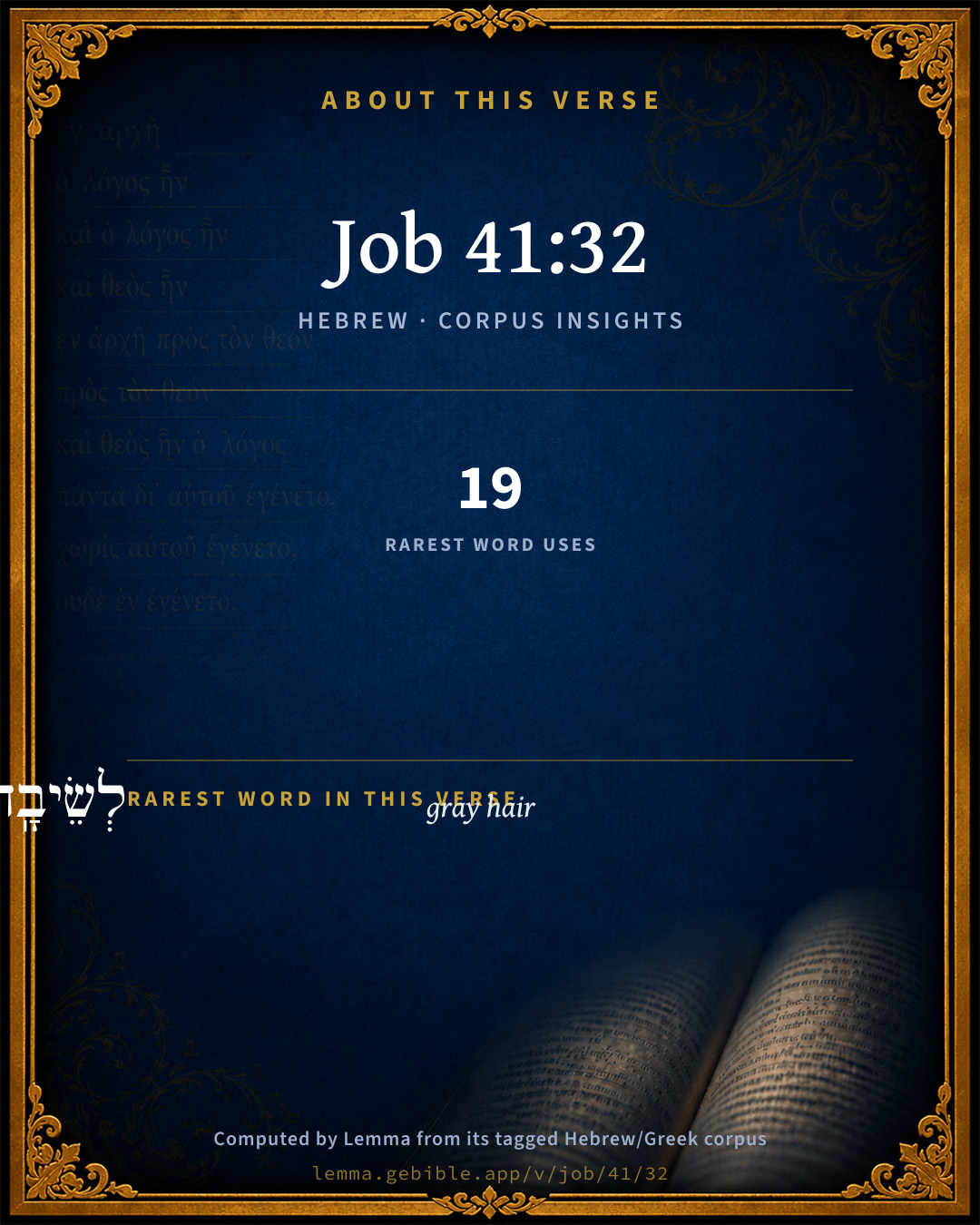
About this verse

These counts appear in no published source. They are computed here, from the morphology-tagged text and Lemma’s own curated glosses. What Lemma adds →

6
words
6
distinct lemmas
Wisdom
section

Notable vocabulary

The rarest word here is לְשֵׂיבָֽה gray hair H7872 — appearing just 19 times in the whole Hebrew Bible.

Shared distinctive vocabulary

לְשֵׂיבָֽה gray hair H7872 occurs in 19 verses of the Hebrew Bible. Also found in:

Grammatical profile

  • 2 verbs
  • 3 nouns
  • 1 preposition

Verb forms

  • יָאִ֣יר Hiphil · Imperfect
  • יַחְשֹׁ֖ב Qal · Imperfect

Cross-references

10

Topical passages linked to Job 41:32 in the Treasury of Scripture Knowledge — connected by theme and wording, ordered by reader-vote popularity; previews shown in the World English Bible.

  • Genesis 1:2 Now the earth was formless and empty. Darkness was on the surface of the deep. God's Spirit was hovering over the surface of the waters.
  • Genesis 1:15 and let them be for lights in the expanse of sky to give light on the earth," and it was so.
  • Genesis 15:15 But you will go to your fathers in peace. You will be buried in a good old age.
  • Genesis 25:8 Abraham gave up the spirit, and died in a good old age, an old man, and full of years, and was gathered to his people.
  • Genesis 42:38 He said, "My son shall not go down with you; for his brother is dead, and he only is left. If harm happens to him by the way in which you go, then you will bring down my gray hairs with sorrow to Sheol."
  • Job 28:14 The deep says, 'It isn't in me.' The sea says, 'It isn't with me.'
  • Job 38:16 "Have you entered into the springs of the sea? Or have you walked in the recesses of the deep?
  • Job 38:30 The waters become hard like stone, When the surface of the deep is frozen.
  • Proverbs 16:31 Gray hair is a crown of glory. It is attained by a life of righteousness.
  • Proverbs 20:29 The glory of young men is their strength. The splendor of old men is their gray hair.

Cross-references courtesy of OpenBible.info (CC BY 4.0).

Hebrew and Greek witnesses Masoretic Hebrew ↔ Greek Septuagint

The same verse in the two great witnesses to the Old Testament, shown verse-for-verse.

These are two independent witnesses, not word-aligned to each other, and the Septuagint is shown in lemma (dictionary) form.

Hebrew Job 41:32 Masoretic · Westminster Leningrad Codex

אַ֭חֲרָיו יָאִ֣יר נָתִ֑יב יַחְשֹׁ֖ב תְּה֣וֹם לְשֵׂיבָֽה

He makes a path to shine after him. One would think the deep had white hair.

World English Bible · Public Domain

Hebrew: Westminster Leningrad Codex (CC BY 4.0). Greek: Septuagint (public domain); English from a public-domain English Septuagint. How the Septuagint differs from the Hebrew →

Commentary

Notes on Job 41:32 from classic Christian and Jewish commentators (each source and its license shown beneath its notes). The classic Christian expositions comment on the surrounding passage and are grouped to its opening verse, so a note may address several verses; the Jewish commentaries on the Tanakh (Rashi and others) are per-verse, so they appear only where the commentator wrote on this verse.

Lemma curates 59 commentaries, every one of them public domain or Creative Commons licensed, each selected and text-cleaned for this edition rather than reprinted as found. About our sources →

Trapp's Complete Commentary

John Trapp

Job 41:32 He maketh a path to shine after him; [one] would think the deep [to be] hoary.

Ver. 32. He maketh a path to shine after him] A ship doth so, much more a whale.

One would think the deep to be hoary] By reason of the white shining foam left behind him.

John Trapp, A Commentary or Exposition upon All the Books of the Old and New Testament (1647–1656) — public domain. Text from a community e-Sword module.

The Biblical Illustrator

Joseph S. Exell

Job_41:32

He maketh a path to shine after him.

Phosphorescence

What was that illumined path? It was phosphorescence. You find it in the wake of a ship in the night, especially after rough weather. Phosphorescence is the lightning of the sea. I found a book of John Ruskin, and the first sentence my eyes fell upon was his description of phosphorescence, in which he calls it the lightning of the sea. It is the waves of the sea diamonded; it is the inflorescence of the billows; the waves of the sea crimsoned, as was the deep after the sea fight of Lepanto; the waves of the sea on fire. There are times when from horizon to horizon the entire ocean seems in conflagration with this strange splendor, as it changes every moment to tamer or more dazzling colour on all sides of you. You sit looking over the rail of the yacht or ocean steamer, watching and waiting to see what new thing the God of beauty will do with the Atlantic. This phosphorescence is the appearance of myriads of the animal kingdom rising, falling, flashing, living, dying. These luminous animalcules for nearly one hundred and fifty years have been the study of naturalists and the fascination of all who have brain enough to think. Now God, who puts in His Bible nothing trivial or useless, calls the attention of Job, the greatest scientist of his day, to this phosphorescence, and as the leviathan of the deep sweeps past, points out the fact that He maketh a path to shine after him. (T. De Witt Talmage.)

The Biblical Illustrator, edited by Joseph S. Exell (c. 1880s–1900s) — public domain. Text from a community e-Sword module.

Jamieson, Fausset & Brown

Robert Jamieson, A. R. Fausset & David Brown

path--the foam on his track.

hoary--as hair of the aged.

Jamieson, Fausset & Brown — Commentary Critical and Explanatory on the Whole Bible (1871) — public domain (CC PDM 1.0). Text via the HelloAO Bible API.

Adam Clarke's Commentary

Verse 32. He maketh a path to shine after him] In certain states of the weather a rapid motion through the water disengages many sparks of phosphoric fire. I have seen this at sea; once particularly, on a fine clear night, with a good breeze, in a fast-sailing vessel, I leaned over the stern, and watched this phenomenon for hours. The wake of the vessel was like a stream of fire; millions of particles of fire were disengaged by the ship's swift motion through the water, nearly in the same way as by the electric cushion and cylinder; and all continued to be absorbed at a short distance from the vessel. Whether this phenomenon takes place in fresh water or in the Nile, I have had no opportunity of observing.

The deep to be hoary.] By the frost and foam raised by the rapid passage of the animal through the water.

Adam Clarke's Commentary on the Bible (1810–1826) — public domain. Text from a community e-Sword/MySword module.

The Cambridge Bible for Schools and Colleges

gen. ed. J. J. S. Perowne

32. The verse refers to the shining track which his swift darting through the water leaves behind him.

The Cambridge Bible for Schools and Colleges (gen. ed. J. J. S. Perowne; Cambridge University Press, 1878–1918) — public domain. Text from a community e-Sword module.

John Gill's Exposition

Upon the earth there is not his like,.... As to form and figure; in most creatures there is some likeness between those in the sea and on the land, as sea horses, calves, &c. but there is no likeness between a whale and any creature on earth; there is between the crocodile and the lizard; nor is any like the whale for the largeness of its bulk; the Targum is,

"his dominion is not on the earth,''

but on the sea, as Aben Ezra notes; but rather the sense is, there is no power on earth that he obeys and submits to, as the Tigurine version; though the meaning seems to be, that there is none like him, for what follows:

who is made without fear; yet this agrees not neither with the crocodile, which Aelianus (w) says is fearful; nor with the whale, which will make off and depart at the shoutings of men, blowing of trumpets, and making use of any tinkling instruments, at which it is frightened, as Strabo (x), Philostratus (y), and Olaus Magnus (z), relate. It is observed (a); of their valour, that if they see a man or a long boat, they go under water and run away; and are never known to endeavour to hurt any man, but when in danger; though a voyager (b) of our own says,

"we saw whales in Whale-sound, and lying aloft on the water, not fearing our ships, or aught else.''

The Targum is,

"he is made that he might not be broken;''

or bruised, as Bochart; as reptiles usually may, among whom the crocodile may be reckoned, because of its short legs; and yet is made with such a hard scaly skin, that it cannot be crushed, bruised, and broken. Aben Ezra observes that some say, the word "hu", that is, "he", is wanting, and should be supplied, "he", that is, "God, made him without fear"; or that he might not be bruised; wherefore Cocceius interprets the following words entirely of God.

(w) De Animal. l. 10. c. 24. (x) Geograph. l. 15. p. 499. (y) Vit. Apollon. l. 3. c. 16. (z) De Ritu Gent. Septent. l. 21. c. 3, 6. (a) Voyage to Spitzbergen, p. 153. (b) Baffin in the North-West Fox, p. 150.

John Gill's Exposition of the Whole Bible (1746–1763) — public domain (CC PDM 1.0). Text via the HelloAO Bible API.

Albert Barnes' Notes on the Bible

He maketh a path to shine after him - This refers doubtless to the white foam of the waters through which he passes. If this were spoken of some monster that commonly resides in the ocean, it would not be unnatural to suppose that it refers to the phosphoric light such as is observed when the waters are agitated, or when a vessel passes rapidly through them. If it refers, however, to the crocodile, the allusion must be understood of the hoary appearance of the Nile or the lake where he is found.

One would think the deep to be hoary - Homer often speaks of the sea as πολιὴν θάλασσαν poliēn thalassan - “the hoary sea.” So Apollonius, speaking of the Argonauts, Lib. i. 545:

- μακραὶ δ ̓ αἰὲν ἐλευκαίνοντο κέλευθοι -

- makrai d' aien eleukainonto keleuthoi -

“The long paths were always white”

So Catullus, in Epith. Pelei:

Totaque remigio spumis incanuit unda.

And Ovid, Epis. Oeno:

- remis eruta canet aqua.

The rapid motion of an aquatic animal through the water will produce the effect here referred to.

Albert Barnes' Notes on the Bible (1834–1885) — public domain. Text from a community e-Sword/MySword module.

Matthew Poole's English Annotations

When he raiseth himself to the top of the waters, he doth as it were plough it up, and make large furrows, and causeth a white froth or foam upon the waters.

Matthew Poole's English Annotations on the Holy Bible (1683–1685) — public domain. Text from a community e-Sword/MySword module.

Whedon's Commentary on the Bible

Daniel D. Whedon

32. Hoary — This figure (comparing the foaming water to hair white with age) is one of great dignity, and is common in the classics. For instance, Homer (Iliad, 1:350) speaks of “the hoary sea,” and Moschus of “the hoary deep.” — Id., Job_5:5.

Daniel D. Whedon (gen. ed.), Commentary on the Old and New Testaments (1874–1909) — public domain. Text from a community e-Sword module.

The Pulpit Commentary

He maketh a path to shine after him; one would think the deep to be hoary. He leaves a white trail behind him as he passes from sand-bank to sand-bank through the shallows. It is as if the Nile had grown old and put on hoar hairs.

The Pulpit Commentary (1880–1919), ed. H.D.M. Spence-Jones & Joseph S. Exell — public domain. Text from a community e-Sword module.

John Wesley's Explanatory Notes

Shine - By the white froth or foam upon the waters. The same may be observed in the wake of a ship by night.

John Wesley, Explanatory Notes Upon the Whole Bible (1754–1765) — public domain. Text via the GEBible commentary corpus.

Lesson kit

Teaching starters — assembled from the data on this page, not authored interpretation. Every prompt links to the verse data it draws on. Edit before teaching.

Job, in the Wisdom, opens this verse with 6 words (6 distinct Hebrew lemmas). Its most distinctive word is sêybâh (“gray hair”). A historical commentator’s framing appears above. Read the whole chapter for the surrounding context.

Discussion questions

  1. What does “gray hair” (sêybâh) contribute to the verse as a whole?
  2. How does Genesis 15:15, which shares the word «gray hair», read alongside this verse?
  3. The translations on this page render this verse differently — a whole-verse word diff, not a word-by-word alignment. What might account for the different wordings?
  4. «יָאִ֣יר» is a Hiphil Imperfect verb. How does that grammatical form shape the action described?
  5. Compare how Trapp's Complete Commentary and The Biblical Illustrator read this verse. Where do they agree or differ?

Things to notice

Reading settings

Reading text

Shown beneath each verse's original-language words.

Old Testament
Old Testament edition

Read the OT as the Masoretic Hebrew (MT) or the Greek Septuagint (LXX).

English shown for the Greek Septuagint (in the Hebrew ↔ Greek comparison).

Comparing translations? Open the Compare panel on any verse page to stack up to four side by side.